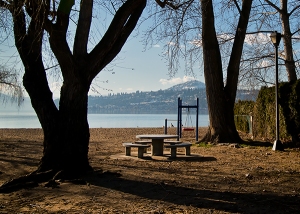
Photography on a Winter Beach    

beach-abbott

waters-edge-tree


Bootprints in the sand

beach-boat-docks

beach-bench-solitude

the-only-vacationers

February found Linda and I spending a couple weeks in the lakeside town of Kelowna. Linda had 10 days of appointments so we decided rather than commute for four hours a day (it’s two hours each way) we would take accommodation.

Kelowna in the summer is packed. Parking is always at a premium, the cost of lodging anywhere near the beach is prohibitive and the traffic is, well the traffic is what one would expect in a city filled with vacationers. However, the days and nights in February are below freezing, and that pretty much reduces the beach crowd.

Linda’s appointments vary through out the week, but Tuesday’s was early so after a big lunch when she decided to relax with a couple magazines, I took the opportunity to grab my camera and headed to the beach.

I know that beach area pretty well. I have never seen a parking space during the summer, and any photographer wanting to capture photos of the beach, the lake, or distant mountains has to be content with lots of people included in their photographs.

My thought was to build a series of images that discussed the cold, empty winter lakeside. And I decided no matter what I saw I would limit myself to only photographs of the waterfront.

That meant to ignore the extravagant architecture of the beachfront homes, expensive cars and, of course, people. However, I was tempted to get shots of a guy eating a cup of ice cream while walking with his dog, and later on, two women slurping milk shakes while walking along on the breezy minus 6 Celsius day. There’s something to be said about Canadians.

I even declined when two tattered guys came up to me and suggested they would make good photo subjects. One fellow was waving a broken golf club handle and I stepped back saying, “I am not doing people today”. We all laughed and they ambled on leaving me alone on the beach.

The winter beach is interesting. Shoeprints in the sand instead of bare feet, the hordes of sun worshippers and swimmers are absent and the lake that’s usually a waterscape of boats has only ducks and geese this time of year.

I walked for two hours along the waterfront before deciding to turn back. And when I found a deserted bench I just sat enjoying the solitude. There is something about wandering alone along a big lake that is bordered by a large active city. I guess there is some isolation, but the noise never stops. Nevertheless, it’s an excellent opportunity to creatively point a camera without any interference.
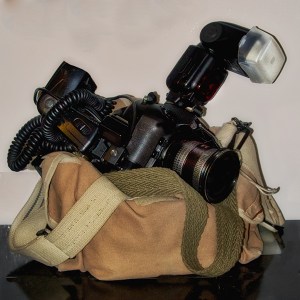
Modern TTL Flash    

ttl-flash-camera

Attaching a flash to one’s camera has been, and still is, a hot topic of discussion that was going on long before I got serious about photography in the 1970’s.

I remember being confused, well actually, really confused, and read everything I could find trying to understand how a flash attached to my camera’s hotshoe worked, and how adding light from a flash (on and off camera) could be used to enhance my photography.

Early flashes produced a constant amount of light no matter how close the subject was, and over or under exposures were common. The most frequent way of controlling flash power was to use exotic technology like a white handkerchief, a translucent soap holder, or attaching a white bounce card to the flash.

Later technological development included light measuring sensors in the flash that read the light reflected back from the subject and shut off the flash when a predetermined amount was reached.

Then TTL (through-the-lens) flash came along and small computers in the camera controlled the flash. The reflected light was read by the camera, making the lens focal length, the aperture, and the distance all part of the exposure equation.

Today’s hotshoe connected flash is nothing short of amazing, and there is absolute control over the flash.

Subtracting light intended for the subject no longer needs some translucent material placed over the flash head.

Using devices like white cups, and bounce cards with a TTL flash have become all about softening or diffusing the light instead of only reducing it.

The latest flashes easily control power output, and can be comfortably used with wireless off-camera technology. Alternatively, the flash can also be connected by a dedicated cord and still remain off-camera allowing the photographer to point the flash toward the subject at flattering angles without time consuming calculations.

A photographer can, while shooting, easily select the exposure in camera, or dial the flash power output up or down. It is now so simple to reduce or increase the ambient exposure while maintaining or brightening the subject alone for more natural looking photographs than it was with early flash photography.

When I began using a flash many years ago it changed the quality of my photography. It became just like the image change I gained by using different focal length lenses.

I no longer had to rely on ambient light and I began to notice my subjects had more “pop” than those without the flash and I was pleased at being able to fill unflattering shadows coming from overhead lighting and reduce deep shadows caused by sunlight.

The modern speedlight (hotshoe) flash gives a photographer control over the quality of light and using a flash (or several flash units off-camera) when photographing people is more than just brightening up subjects in a darkened room.


Why Is The Concept of Depth Of Field So Elusive?     

depth-of-field-2

d-of-f-1a

d-of-f-2a


The topic of Depth of Field just keeps coming up and I suppose it deserves a revisit for this year. There must be a reason why Depth of Field is so elusive to photographers.

I wonder if it is because modern cameras have computers that focus, balance the colour, and control the exposure. All are impressive functions that make new users believe all they need to get a good photo is to point and shoot.

I have discussed Depth of Field in my blog numerous times. And find myself constantly explaining how depth of field works to photographers that visit my shop. I must admit that many photographers just smile and nod like they understand what I am talking about. However, unfortunately, when I see their photographs I realize otherwise, and I expect most would have been much happier if I just told them the reason their picture wasn’t really sharp was because they needed a new lens. (Buying a new lens is so much easier than taking a class in photography.)

Understanding of the concept (and I guess technique) of depth of field will make their photographs better and save them money, as they did not really need a new lens.

This past week, I viewed an image a photographer posted online. He wrote that he was proud with his creative and unusual view. The overall exposure was fairly good, the colours were close to reality, and the centre of the picture was in focus. Nevertheless, other than that small, in-focus, central area the rest of his subject wasn’t in focus at all. The foreground was blurry and the background was blurry.

The definition of depth of field is, “that area around the main subject, in front of and behind, that is in acceptably sharp focus”. In application the wider the lens’ aperture is the less the depth of field, or that area of sharp focus, around the main subject will be. Practically, the depth of the field of focus will be 1/3rd in front and 2/3rds behind the subject.

Using a wide aperture can increase the exposure in limited lighting conditions; but, along with the benefit of additional light reaching the camera’s sensor, the resulting effect is reduced depth of field. Creating a field of focus behind the subject of 4 inches or so might look really good when making a portrait, but it is not effective in a scenic.

The smaller the lens aperture the more the area of focus around the subject will be. I prefer using a small aperture for scenic photography. I am concerned with all elements in the photograph, front to back, of being sharp and in “acceptably sharp focus”.

The Internet is packed with information on scenic photography, and there are thousands (millions?) of books on photography that are easy to read. I expect that any discussion on scenic photography will include a full discussion of Depth of Field.

Infrared Photography On A Cold Winter Day   

blue-horizon

frozen-pond

winter-grass

tracks-and-cliffs

orange-sky

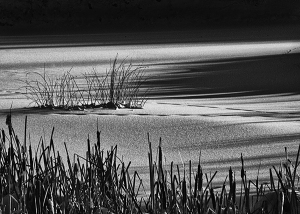
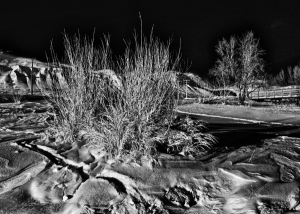
Gosh, this cold weather is uncomfortable! Mostly I have been huddling inside except to feed my chickens, and dig through the latest snowfall so I can get my car out of the driveway. However, the morning’s sky was so clear and blue that, in spite of the negative -19C, I just had to bundle up against the cold and head outside with my infrared camera.

The contrast of clear blue against the fresh white snow would make for a colourful scene, but there is something about infrared that has always intrigued me.

Maybe it’s the black sky against the brighter foreground. There is a word I remember my art instructors would sometimes use in their discussions and it is, “juxtaposition”, or elements in an image placed together with a contrasting effect.

In the summer infrared turns the trees to white, the sky a strange shade of magenta, and everything else a slight blue. But in the winter one can create an image with magenta tinted snow and clouds, with a blue cast to the sky by adjusting the colour channels in Photoshop, or convert to a striking black and white image. B&W is always my favourite. I guess that it is from the many years of exposing rolls of Kodak infrared film. And as I said, I like the black skies.

Infrared creates a completely different feeling. I have written before that using a modified camera is an exploration that moves a photographer far from the usual setting with the effect being surreal and unworldly. The bluer the sky, the greater the likelihood of that unworldly effect; and white surfaces can glow with an ethereal brightness.

I haven’t used my IR camera since last October when I decided to try out a fisheye lens.

Since then I acquired an 18-35mm, so I took that and my favourite, a 24-85mm lens out to see what I could get. I prefer a plan as opposed to just driving around, but this time I wouldn’t venture very far from my warm car. Besides the cold I was too lazy to get my shoeshoes and the snow was too deep to go off the plowed road.

I am not a prolific shooter. I guess that’s an oddity in this day of shotgun style photography when it’s not unusual for photographers to return with a hundred or so images from only a few hours of shooting. I spent a lot of time just standing and looking, and as was the case this time, freezing my fingers.

The low-angled light from the afternoon created lots of deep shadows on the drifts of snow and from fence posts, train tracks, and stark, leafless trees. All are excellent subjects for infrared.

If there was a goal for this outing it was to get a picture for next month’s calendar. My wife Linda and I alternate monthly as to who’s picture is displayed for each month’s calendar, and one of my infrared captures should work perfectly for February.

Learning From the best Photographers of the Past.

learning-from-famous-photogs

I had a discussion with a fellow that was looking for help with his photography. He was frustrated with all the books and online publications that seem to be more about the camera, lens, and exposure setting than what I’ll call “one’s mindset” when it comes to making a creative decision about photographing the subject.

My suggestion was to start looking at photographs made throughout history by those photographers applauded by their approaches. I suggested he check out Jerry Uelsman’s creative montages, Arnold Newman’s environmental portraits, Irving Penn’s fashion work, and, of course, the world famous, scenic photography of Ansel Adams.

I offered Digital Camera World’s “The 55 best photographers of all time. ”http://www.digitalcameraworld.com/2012/07/17/famous-photographers-the-55-best-photographers-of-all-time/

The editors began their article with “The best photographers of all time? Surely there can be no definitive list! We’re not afraid of courting controversy here at Digital Camera World. OK, maybe we are a little bit, which is why we thought it was time to be bold for once! Over the years we’ve interviewed a number of famous photographers and been inspired by each of them, but one thing we often hear from readers, social media followers and others is… “Who are the best photographers of all time?” It’s a good question! We put on our thinking caps and took a stab it.”

There is another top ten list by the editors of the website, Ansel Adams. http://www.picturecorrect.com/tips/top-10-most-famous-photographers-of-all-time/

They write, “If you want to take truly memorable and moving photographs, you can learn something by studying the pictures of famous photographers. Some of the most beloved artists are deceased, but some are still delighting us with their photographs. The list includes some of the more famous photographers that still impact our lives today.”

I liked what Picture Correct’s editors wrote about how famous photographers are, “impacting our lives today”. I believe a good photograph is timeless and speaks to every generation.

Both articles are great and well worth taking time to read.

I enjoy studying those that excel in this medium, and I think we, as they wrote, “Can learn something by studying the pictures of famous photographers,” and I believe that photographers can advance their personal work by examining the work of others.

Photography is a medium that almost everybody within our contemporary culture has a personal familiarity with and an opinion on.

I suspect it is probably that familiarity with photography that drives many to think that they will excel as long as they keep up with the latest technology their photography will be applauded by their peers. However, I am of the belief that even though a photographer has technical skills, examining the work of photographers with a track record from the past will, as Picture Correct puts it, “help advance personal work by examining the work of others”.

Those two lists are only the opinion of the authors and as I perused the comments readers posted, many felt their favorite photographers had been excluded and others were unhappy with some on the lists. In my opinion that just doesn’t matter who made or didn’t make the lists, I enjoyed reading about them and their personal perspectives on photography.

Photographer’s resolutions for 2017  

The snows and drab colours of 2016 with the growth and bright colours of 2017.

The snows and drab colours of 2016 with the growth and bright colours of 2017.

So many people are saying they are relieved 2016 is over. I don’t know if I am really ready for this year to be over yet, there are lot of things I have enjoyed. That said, this year, 2016, like so many before it has passed by like a rocket. And there surely are new and exciting opportunities in the year to come, so I asked some friends if they had any resolutions or personal photography goals for 2017.

I knew they would struggle a bit knowing I wanted more than the usual simple ones we read about on some forums like, use a tripod more, turn off Auto mode, shoot RAW, make a photo-a-day challenge, and so on.

These first five are from my friends. I have edited them a bit, but the following is what I liked best from their resolutions for 2017.

  1. “This year my approach to photography is going to be to romance the simple things.” I like that. So much of the time photographers get so involved with the latest technology and spread themselve’s over everything while forgetting about the small stuff. And I think adding a bit of romance (whatever that means to each of us) is always a good thing.
  1. “I’ll be learning lots, I just got lights an they’ll give me plenty of opportunity to develop my own style. I want my knowledge to show in my work.” There is nothing like education. I can’t think of a better goal for any photographer.

3. “To grow and improve, as a photographer.” Now that is a good resolution.

  1. “Try new techniques and explore new places”. I could also use words like “examine” and “research.”

5.   “Despite how busy things get, make the time to shoot.” That is a great resolution for any one that enjoys this                                                  exciting medium.

I want to finish by adding two from previous years so as to give us a “Lucky Seven” for a lucky year for 2017.

  1. “Be more ruthless with the seeing and editing process; conditioning oneself to throw out the crap is the only way to keep improving.” This resolution is “quality not quantity”.

And I’ll suggest a final resolution number for everyone:

  1. “That they should take risks photographically and move away from always trying to please, and fitting in with what everyone else is doing.”

Make this the year to push beyond the comfort zone without being concerned with other’s opinions, to be pleased  first for oneself. Make this the year to put “me” in the photograph.   Linda and I are wishing everyone a Happy and eventful New Year.

Do you have a resolution for your photography for 2017 you’d like to share?

Another Year Is Just About Over


This year's adventure is about over.

This year’s adventure is about over.


Another year has gone by and I guess its time to put the old baggage away and get out the new. Christmas is here and I’m sure the year to come is going to be filled with fun photography.

I hope that the thoughts and experiences I have written about this past year have been interesting and worth reading. My goal is to write articles that are, at the least, a bit different from the exotic location photos in magazines, and that complicated on-line how-to.

I will admit that just posting a couple of pictures with a how I-did-it recipe would be easier, but this damn medium of photography is so damn exciting that I can’t help but talk about why I like it.

As I wrote last year, there are so many people writing about photography that I do wonder if I can add anything worth viewing and reading.

I try to stick with a technique that worked during the many years I taught photography and that is to tell a story that includes photo information I want to discuss.

Something else that I learned during my years teaching was to keep the subject fresh. That meant introducing something new each class and that is how I choose my topics, something different each week.

Changing the subject each week does get hard, and (I wish I could say it wasn’t so) there are other things in life than photography and it isn’t unusual for me to say Linda, “Gosh, I have no idea what am I going to write about this week.”

Fortunately, with Linda’s help it usually works out and I come up with something to say each week.

Linda reminded me that last year I mentioned those subjects that I enjoyed writing about the most. Well, looking back here are my personal favorites.

My article in August, “Two Photographers Are More Fun” was very personal because my wife Linda is the best photo-partner I could ask for. Throughout the year I wrote several times about the Lighting workshops I lead. I enjoy watching others learn about photography and in my articles I try to explain a little about that process and adventure. I also wanted to let people know how much fun I had in September photographing a little location at Vancouver’s Denman Street and Stanley Park. Those are a few. I generally liked all the subjects I photographed and wrote about.

I’ll keep this short and wish all photographers out there a very Merry Christmas.

Photography at the Christmas Party   

tree-planters-4

tree-planters-1

tree-planter-5

tree-planters-7

tree-planters-6

I talked to a person this week that has been asked to be the staff photographer at an upcoming event. With that, I thought I would revisit an article I wrote December 2014.

The Christmas season is here and that means photographers will happily begin filling memory cards with photographic opportunities as they join family, friends, and co-workers at this month’s festive events.

The act of picture taking has become easy and so much fun as people rush over to take a picture and then quickly show other partyers the images from the LCD. Some seem more interested in that quickly snapped candid than what is actually happening at the moment. For many, it is more about the activity of picture taking than it is about making memorable photographs of the party.

Images made in this fashion rarely become more than stored files on computers and cell phones. People have good intentions, but after that initial viewing, most photos loose value because there are too many, and very few are good enough to give to others anyway.

What is my advice for photography at the next Christmas party? Yes, continue to make candid photographs of people having fun, but, perhaps, think about making pictures that tell a story, capture an exciting moment, and importantly, flatter the subjects. Most people don’t mind seeing a picture of them being silly or having fun, but they don’t like pictures that make them look stupid or unattractive.

My approach is to take a moment to look at the room in which I intend to make photographs, make a couple of test shots using longer shutter speeds (my favourite is 1/60th of a second), to include the room’s ambient light. And I always use a flash so as not to end up with brightly lit faces surrounded by a black environment.

I suggest taking group shots with two or three people. Get them to position themselves squeezed together with a tight composition, and include only a little background or foreground. Don’t shoot fast. Steady the camera. Select a shutter speed that includes the ambient light. Use a flash. Fortunately most modern DSLRs easily allow ISO sensitivity that can be set to 1600, and some can go a lot higher.

Shutter speeds of 1/60th of a second, or less, doesn’t always work for children (or adults) playing in the snow during the day because moving subjects will be blurry, but, with limited indoor lighting, moving subjects will only be properly illuminated when the flash goes off.

Lighting everything with complicated studio equipment would be great, but that would ruin the party for everyone. The occasion would become more about the photography and less about the fun and festivities. I use a hotshoe mounted flash and make adjustments as I go. I want to join in on the fun, blend in, and not act like a photojournalist.

Family and friends don’t mind having their pictures taken as long as it’s enjoyable and I want pictures that show them having a good time. So, along with those quick candids I make posed portraits with smiling faces, and if I select some pictures to give away later I want people to like and not be embarrassed by the pictures taken of them.


Twelve Gifts for a Photographer’s 12 days of Christmas     

xmas-tree

night-porch

We finished setting up our Christmas tree, and sat down to celebrate with a glass of eggnog, while listening Christmas music coming from the TV music station. As we rested Linda just asked me that question that I had been side tracking, “You haven’t told me yet what you want for Christmas. Do you want something for photography?”

I hadn’t thought about what I wanted. And regarding anything to do with photography, if I thought I could afford it, I would usually just get it for myself.

I had been enjoying the tree, and the Christmas music, but as far as a gift for me, especially, “something for photography” left me at a loss of what to say, so I replied, “I suppose I want everything and anything that will fit my camera.”

I watched the train go round the tree, and I listened to the music, but I am still thinking about what I should tell my wife.

In keeping with that subject, I decided to pose that question to some photographers I know. There are so many different genres of photography with different ideas on what would be the perfect photography gift for each. I edited them and selected twelve in keeping with the tradition of twelve days of Christmas.

I am sure readers have their own Christmas list, however, here are some items that I picked out for this year.

(1) I had more than one person say, “I would like to move up to a newer model.” And their discussion for preferring full or cropped frame is always fun. The first on this list is one of many that wanted a particular camera. I think a photographer would have to have been real good to deserve this.

(2) I wasn’t surprised with this one, “I asked Santa Claus for the new Tamron 150-600mm lens.”

(3) When I heard this from a very serious photographer I thought, “me too”, “There is a new program called Aurora I would really like to try out over the Xmas Holidays.”

(4) More than one photographer upon retiring has gone this way so I wasn’t surprised with when some said, “After all these years of packing around a big DSLR, I would really like Santa to give me a small, lightweight Mirrorless camera.”

(6) Hey, this idea is just smart, “I’ve asked for gift cards, better chance of getting some of those than the Nikon D500 I really want.”

(7) “A new graphite tripod would be great to find under the Christmas tree.”

(8) I have my fingers crossed for this person, “A new camera backpack to hold the 70-200mm lens I hope I am getting.”

(9) A budding portraitist said, “I am hoping for several things this Christmas. A flash, a wireless off-camera trigger and a light stand with a softbox.”

(10) This is a great choice, “I really would be happy if I could get a macro ring flash for Christmas.”

(11) And I thought, “well of course” with this, “I think I’ll request that Santa Claus puts a couple of good quality, 32GB memory cards in my stocking.”

(12) This last one is practical for both portraiture and garden photographers “I’d be happy with a 5-in-1 collapsible reflector.

Personally, I could suggest many of the previous, but there are two photographers in our household and there needs to be some money left for my wife. So I’ll to put more thought into this before I reply.

There is still time to get your list to Santa. Good luck and Merry Christmas.

Photographing a Late Fall Garden   

oregon-grape

thistle-2

thistle

grass

thorns

yellow

I try to wander about in our garden with my camera each and every time the season changes; spring, summer, fall and winter.

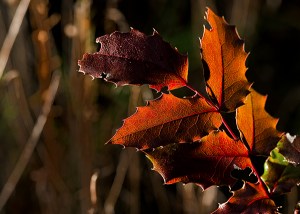
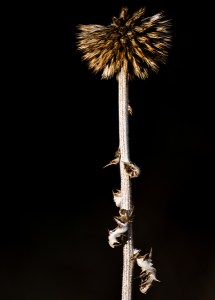
I have photographed the changing garden throughout the years and, although it always seems very familiar and comforting, I find myself discovering different ways to capture the life that begins, grows, blossoms and then retreats into sleep. There are times when I have constructed elaborate sets with reflectors to capture and control the light. I have built mini studios much like the controlled indoor setups that portrait photographers are familiar with. I’ve lain in the snow and employed umbrellas on rainy days. However, on this particular day I wanted light, and waited all day for sunlight that seemed reluctant to bring me one day of fall warmth I wanted to photograph before the snow that was predicted in a day or two.

When 3pm rolled around I worried that if I didn’t get something done in the quickly dropping light, other than look out the window, I wouldn’t get any pictures at all.

My camera was waiting with a manual 200mm macro, wireless sender and two light stands with a flash and umbrella mounted on each. However, when I finally walked outside (yep, I already said “quickly dropping light) I realised I was doomed to failure if I relied on taking the time to set up that equipment.

Years ago I was asked to give a lecture to the Abbotsford Photo Arts Club. I won’t go into that long discussion, but the title I chose was, “A problem solving approach to photography”. And I realised that this was the time to move into a problem-solving mode.

I removed the 200mm macro from my camera and replaced it with my wife’s 70-180mm macro. I prefer my old manual lens for close up photography, but that Auto focus zoom macro is really easy to use.

I also put aside the light stands and attached a single flash to an eight-foot TTL flash cord. I could have set things up wireless, but I was going for quick and easy and with the TTL cord I just let the flash hang off my shoulder until I wanted it.

I could have used a high ISO, a wide aperture, and just popped a bit of light for a proper exposure. But a high ISO would increase the ambient light and show the lifeless colours of surrounding foliage. A wide aperture would limit my depth of field, and TTL is fast and easy to light, compose and relight a subject.

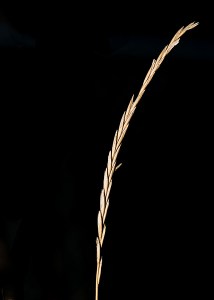
I under-exposed my exposure by several stops, and let the dedicated TTL flash (with a diffusor cup) do what it was designed for, to deliver just the right amount of light on my subject.   That gave me a dark background that I could later make completely black by adjusting the contrast in Photoshop.

I didn’t have a lot of time before more clouds moved in making an already dark afternoon even darker, but my portable set-up made things easy and even gave me a moment to pause and watch our three legged, feral cat flee as it ran out from the cover of the shrubbery. Gosh, in spite of the damage to her one back leg, she sure can move.

I had been trying for three days to get some pictures, but unpleasant weather and life in general got in the way. However, with a bit of problem solving and the will to finally get out and do something, a person can end up with a few photographs worth keeping.