Photographers – What is your studio lighting setup?

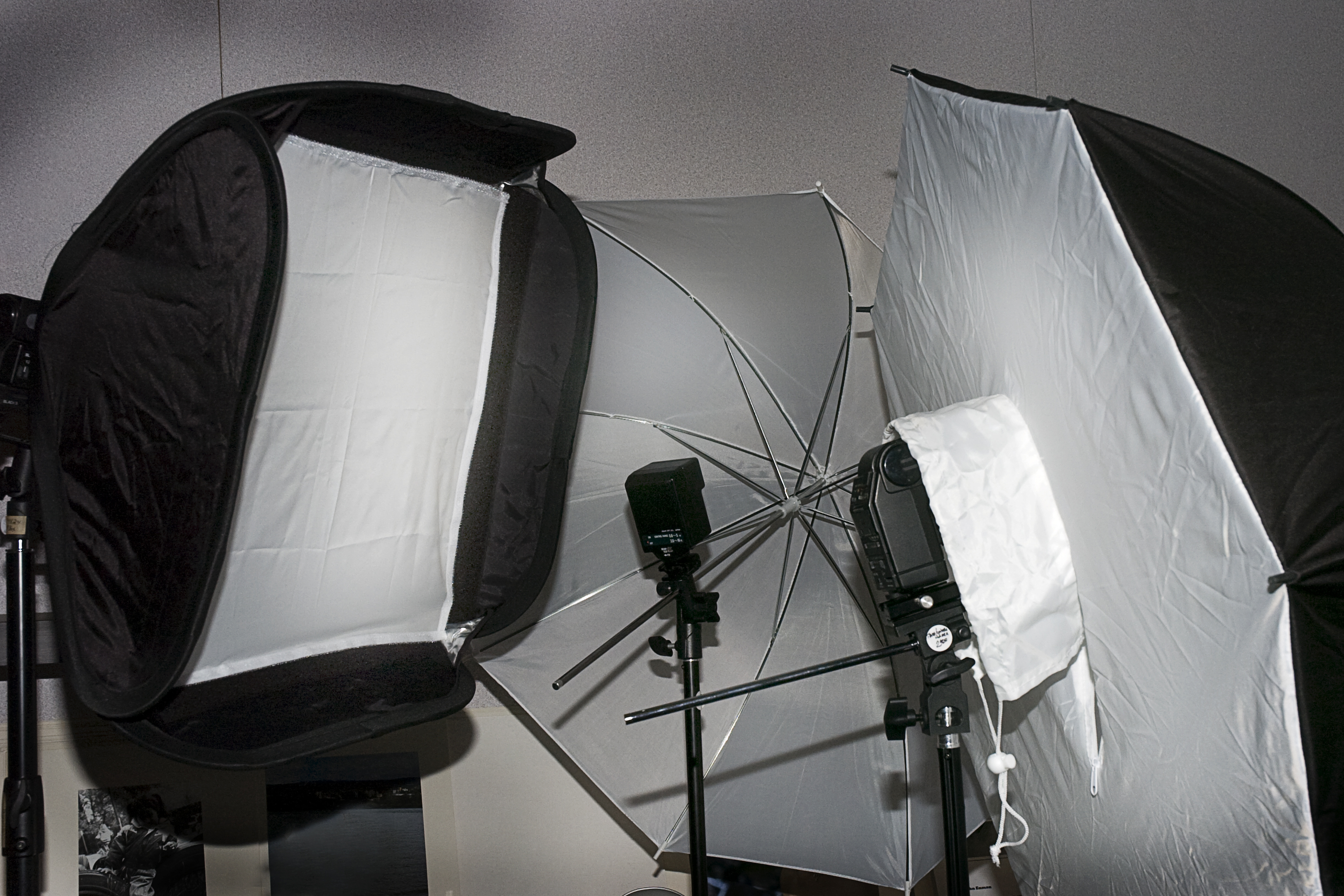
My inexpensive and very portable "Portrait kit". Works easily for indoor or out of doors lighting.

My inexpensive and very portable “Portrait kit” works easily for indoor or out of doors lighting.

Last week an online forum in which I participated asked the question, “What is your studio lighting setup?”

Most participants were posting the brand name they used, and how many lights they owned, however, my post was about what I would call “kits”, that I used for each different situation or environment.

My opinion has always been that there are different tools for different jobs, and I have four individual lighting setups that fit particular photographic undertakings.

My “event kit” consists of four TTL hot shoe flashes. My “portrait kit” consists of three older manual hotshoe flashes mounted on wireless receivers. I also have two “studio kits”. The first studio kit, for those situations where I can find power, has a 1000w power pack with four strobe heads. The second kit is a battery-operated 280w strobe that will go anywhere.

Some forum members complained that they would have to wait till they had the money before a home studio lighting situation could be set up. I believe they only paid attention to those responders that included the manufacturer’s names for their expensive studio type lighting setups.

Yes, I agree, if one wants big powerful studio strobes there will be a considerable price attached.  And each manufacturer will hope to sell their own brand of light stands and light modifiers along with the lighting units. Yes indeed, all that will be expensive.

Most home photography studios are in the basement, or in a spare room to be quickly set up for a portrait session. However, the big name brands never discuss light volume or power vs. studio size.

My opinion is, if the room is less than twelve feet high, thirty feet long and only used for small group or single person portraits, those big, powerful, fast recycling, and expensive studio lights might be overkill, and a real hassle when one wants to soften the background by shooting a wide aperture because there is just too much power.

I wrote about the four kits that I use for different situations. The small hotshoe flashes I use for events and portraits, and the bigger less portable units I use with large groups, moving subjects, or when I just want coverage out of doors. I think those photographers intent on setting up small home studios for portraits and small groups don’t need to go to the expense of the brawny, studio type lights. Photographers can easily, and without much initial cost, set up a studio with what I called my “portrait kit”.

My portrait kit only has three hotshoe flashes, each with it’s own wireless receiver and two stands. Depending on the space a client provides for me to use, I use a small shoot-through umbrella, an umbrella brolly box, once in a while I use a soft box, and sometimes include a reflector. And it’s the inexpensive and easily stored “portrait kit” that I would recommend for most first-time, home studio photographers.

Wireless senders and receivers come in all sorts of incarnations, and can be, depending on brand and manufacturer, if one shops around, purchased for prices less than $100 for two receivers and a sender.

I use the inexpensive sender/receivers that fit under my flash, seated on a light stand bracket, and holds an umbrella, a brolly, or sometimes a softbox. And I use three Vivitar 283 flashes dating from the 1970s that I bought used.

My total cost for 3 flashes, the wireless sender & receivers, 2 shoot through umbrellas, stands, and 2 flash/stand brackets, and a small tabletop tripod that I can place behind my portrait subject was under $400 Canadian.  All of this is much less expensive, and a lot easier to store and/or move around than the big. studio-type flash units.

I make lighting tests before the person who I will be photographing arrives to get the correct exposure, and when he/she does show up, I take two or three more test shots as I move the lights for the most flattering effect.

Even if there were a wad of cash burning a hole it your pocket, my advice would be to proceed slowly, and learn how best to photograph a person first. Using hotshoe speedlights off-camera will be perfect for that educational process, and when they are no longer a good fit with your creative growth, the choices as to the next step in lighting equipment will be educated decisions instead of emotional.

As always I look forward to any comments. Thanks, John

My website is at www.enmanscamera.com
Use the Right Tool to Copy Old Photos

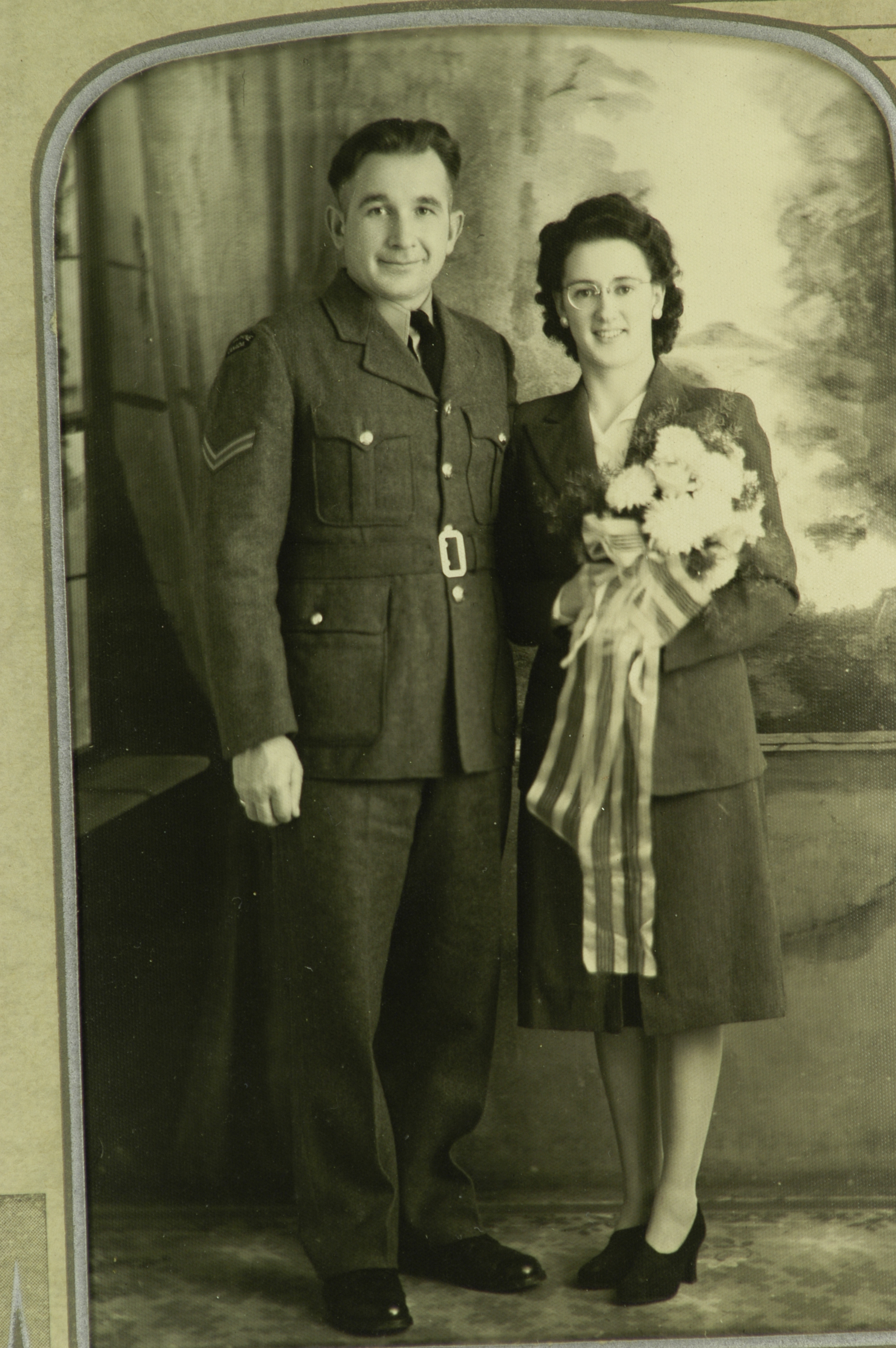
Harvey & Violet Walch 2  Wedding Day

Using the wrong tool usually leads to unacceptable results in one way or another, for example, when a butter knife is substituted for a screwdriver.  That was what came to mind when I was asked if I could make quality copies of old photographs that a family wanted to use for a book of genealogy they planned on publishing. They required image files with enough quality for good enlargements, and usable for the intended family book.

They began by trying to copy several images using home scanners that worked great for documents, but only produced pictures that lacked detail. I suspect many of those originals photos were a bit over or under exposed in the beginning.  Some family members tried copying the old photographs with their little digicams, however, that resulted in bright white reflection spots from the flash that obscured features in their family photos. They decided to shoot from the side hoping to reduce the glare, but only got unusable foreshortened pictures; by that I mean the closest frame edge was large and distorted and the far frame edge was small.

They told me that even though their photographs had a bit better detail the results were still unacceptable.  That is what I mean by using the wrong tool. A camera with an on-camera flash will produce glare on reflective surfaces, and angled shots don’t make for good documentation of flat artwork because things close to the camera lens appear larger and those farther away become smaller, and while inexpensive document scanners are great for documents they rarely produce quality reproductions of photographs.  The result was they were having trouble all around.

The right tool for them would have been a camera attached to off-camera flashes, with the flashes set off side from the painting at a 45-degree angle. When I copy photographs I use two umbrellas to diffuse the flash, but one could get reasonable results by placing some translucent material in front of, or bouncing, the light from the flashes off large white cards.  In any case, the light needs to softly and broadly, not sharply, expose the old photograph’s surface.  The wonder of digital technology is how quickly one can review the image and retake the photo if needed. I also recommend taking several shots at different apertures.  For that, the right tool is a camera that one is able set to manual exposure.

When photographing oil paintings or other uneven reflective surfaces I prefer working with slightly under exposed image files.  That way I can bring the detail up using PhotoShop without loosing the highlights.

If the next question is, “What kind of camera?” my answer will be that it depends on what is the desired outcome.  If it is for, as in this case, faded old photographic prints for reproduction in a book, the image file needs to be large and for that I prefer a DSLR (digital single lens reflex) camera, but for a small newspaper, or website image, a digicam that will accept an off-camera flash will do just fine.

If there isn’t access to an off-camera flash then wait for the opportunity to place the painting in “flat” daylight.  Today, as I write, I see out my window that it is cloudy and overcast, perfect for even, flat lighting. One could place the picture on any support that will allow tilting right, left, up, and down. Then as exposures are made and checked, the picture can be moved around until there is no reflection.

Two umbrellas allow me to balance the light. I lay the photographs flat and mount my camera on a copy stand that I have had for years, and use a small level to make sure the camera lens and the photographs are parallel. Then I make a test shot to check the exposure for reflection. My first and then finished image of one photo is posted ate the beginning of this article.

The final step for me is PhotoShop, which I use to color balance, then for cropping, contrast, and sharpening. I could purchase an expensive scanner, but I already have lots invested in a camera, and lenses that work perfectly well, and which I think may be faster to use.

I do appreciate your comments. Thanks, John

My website is at www.enmanscamera.com

Modifying light and keeping photograph’s exposure believable.

A few weeks ago I wrote about modifying light instead of using the direct light from a camera mounted flash.  This is a topic I have discussed many times in my years writing for different publications as I strive to persuade photographers to add flash to their portrait photography.

It seems my comments are having some success because since my blog of May 5thth I have had more than one photographer tell me they had started using light modifiers like “shoot through” and reflector umbrellas. That is a good thing, however, I’m now receiving questions like, “Now that I’m bouncing and softening the light, how come the background doesn’t look right?”

Like any photograph, inside or outside, a photographer needs to take into account how all elements in the image are exposed. That’s the reason I prefer using the manual mode on my camera. It makes it easy to set the exposure where I want to make that subject look like it fits into the environment.

Here is an example that might help readers.  A week ago I photographed a couple in a wide field alongside the South Thompson River. They wanted the white, silt cliffs that jutted up from the grassy flatlands to be visible behind them. The sun (when it poked through the clouds) was bright and cast unflattering shadows on their faces.

My goal was to have the correct exposure for the cliffs, the sky, and, of course, my subjects.  It was slightly breezy; therefore, my wife held onto a stand with a 33” umbrella and wireless flash I used to provide a fill light that would get rid of unsightly shadows on my subjects.

Indoors or out, I always start with the shutter speed. If I need it to be faster I bump up the ISO. Usually I try for 100 ISO, but sometimes I need a higher shutter speed and a wider aperture and that’s when I adjust my ISO.

I first decided what exposure would give me a nice sky and scenic white cliffs. In this instance I metered the exposure and then underexposed by two stops to give me a bit of a darker appearing landscape. Then as my subjects were positioning themselves I fired the wireless flash from different positions until I saw that the light on their faces appeared in the way I wanted it.

My exposure and flash modes were both set to manual. Using manual exposure gave me consistent control over the ambient light. To find the proper exposure for the flash I just moved it closer till I was satisfied with what I saw in my camera’s LCD.   I had balanced the light. There was a nice dark sky, the white cliffs were shining and had defining shadows. My subjects were separated from the slightly darker ambient light without any shadows at all on their faces.

The ambient light kept changing quickly as clouds moved in and a storm approached so I switched from manual flash to TTL flash, and because of troubling wind removed the umbrella from the stand, and instead used a small diffuser cup on the flash to modify its light.

With the camera in manual mode, the shutter, aperture, ISO, distance of the light to the subject, and power of our light source, all controls flash exposure. Things change with the incorporation of TTL flash.  Used together, the TTL camera and flash controls and calculates the flash exposure, and adjusts the power of the flash to deliver and determine the correct flash exposure regardless of the photographer’s choice of shutter, aperture, ISO, and subject distance.

How a portrait looks does have a lot to do with how the subject(s) are posed, but I think light and how it is applied is just as important. Using flash, on or off camera, to modify light gives a photographer more control than just using the sun, or relying on a high ISO. In addition photographers must also experiment and learn how to balance the background, or ambient light, with that flash.

The location really does not matter, whether inside or out, as long as there is enough ambient light to expose the subject. Pose the subject in front of a window or on the lawn. Then add enough light from another source to achieve the final goal of having the background, the foreground, and the subject exposures all together appear to be balanced and not looking artificial.

http://www.enmanscamera.com


Photographers – Don’t just add light, modify the light.

For some time I’ve been advising photographers to use a flash when they take pictures of people, whether indoors or out. Yes, I understand that those with a few extra dollars in their pocket can purchase expensive cameras that can capture images in low light using a higher ISO, but using additional light is much more flattering.

While sitting by the window in a coffee shop last week a friend casually snapped a picture of me using an ISO of 9000. I was impressed at the clarity and colour. Hmm… maybe a bit too clear and colourful for my old face.  Nevertheless, my comment was, “Nice picture, too bad you didn’t have a reflector”, which brings me to my topic this week – light modifiers.

Readers know what harsh sunlight looks like on our subject’s face in a photo, or winced at the loss of detail caused by the direct light of a camera-mounted flash.  A flattering photograph isn’t just capturing or adding light, but modifying its path to the subject. That might be as simple as bouncing the flash off the ceiling, or a wall. The pop-up flash might work at parties, but mounting a flash on the camera gives more power, control and pleasing results.

When outdoors without a flash a popular and easy to use light modifier is a reflector. Place the subject out of the direct sun and direct the sun in a controlled way back to the subject using a reflector. Reflectors come in all sizes, shapes, colours and surfaces. Silver is a cool, gold has a warm cast, and white is neutral. I prefer the compact folding reflectors that fit in my camera bag. Reflectors are great outdoors, and are perfect with a bounce flash for that multi-use basement studio.

More and more photographers are using wireless flash. A small hotshoe flash mounted on a stand can be aimed at the ceiling, a wall, or a reflector, for much nicer light than if pointed directly at the subject.  But the wall, ceiling, and reflector only give a broad indirect light. Yes, it is better than a bare flash, but not very controllable.

Enter umbrellas, softboxes, beauty dishes, and all sorts of contraptions that modify and control the light.  I like bouncing and reflecting light in some conditions, and these give photographers more control as they reshape, restyle, alter, modify, direct, and soften the light from our little flashes.

Umbrellas come in several types. Choose a shoot through or reflective, large or small. The reflective umbrellas are available with different surfaces – silver, gold, white – each has its own way of changing the light. For example, I like the soft broad light reflective umbrellas give when photographing several people or families.

Many portraitists seem to prefer softboxes. Whereas umbrellas give more control than a flat reflector, a softbox directs and controls light much better than an umbrella. Softboxes also come in many sizes and shapes depending on use – rectangle, square, octagon, etc.  When viewers see that soft shadowed “Rembrandt style” lighting in a portrait, they can safely assume the photographer used a softbox.

For photographers that want more luminosity than umbrellas and softboxes there is the beauty dish. A beauty dish provides a glowing kind of light, very directional, easy to control, and when used with diffuser it has an attractive smooth light.  There are, of course, many modifications to each of those I have mentioned. Again, it depends on how a photographer wants to apply light to a subject.

My set up isn’t always the same. For example, the flash above and behind me might be either in a softbox or a reflector umbrella, the sidelight could be a small shoot-through umbrella or bounced off a reflector, and backlight directed at the background with only a small dome diffuser covering it.  That’s one quick, effortless setup that I can easily carry in two small bags – one bag for light stands and light modifiers and one for the flash units and my camera. The point is that the light I use is more controllable and attractive than a pop up flash, the sun, or relying on a high ISO.

www.enmanscamera.com

 Select the follow button at page top. Thanks