The Portrait   

The conversation – a Portrait.

For most photographers a portrait is an artistic representation of an individual or individuals, with the goal of capturing some likeness as to who they are.

Famous American photographer, Richard Avedon carried this further when he said, “A portrait is not a likeness. The moment an emotion or fact is transformed into a photograph it is no longer a fact but an opinion. There is no such thing as inaccuracy in a photograph. All photographs are accurate. None of them is the truth. ”

Popular American painter Jamie Wyeth wrote, “Everything I paint is a portrait, whatever the subject.”

For years most of the photography I did was portraiture, whether wedding pictures for a family, or private sessions. My opinion is that portraits are pretty narcissistic and because of that, can be much harder to do properly than many other photographic pastimes.

Make a bad landscape and no one will really care, capture a bird flying poorly and it’s no big deal; however if you give someone an unflattering photograph of themself and you have might make an enemy for life.

A portrait can be a representation of anything and doesn’t necessarily need to only be of people. Years ago my wife and I had show dogs and would regularly attend and participate in events in hopes of having the judges select our dog as best from some group; and when we did win, we would walk our dogs to a photography booth set up by a skilled dog portraitist to have a portraits taken that day when they looked so good and performed so well.

As I watched a TV show earlier this week I noticed framed pictures of the owner’s cat hanging on the wall, and I have seen all types of pet portraits in friends’ homes. I suppose a picture of a favourite or special car, motorcycle, boat or even treasured holiday snapshot, might be called a portrait.

I wonder if many photographers might agree with the painter Wyeth’s contention that, “Everything I paint (or photograph) is a portrait, whatever the subject.”

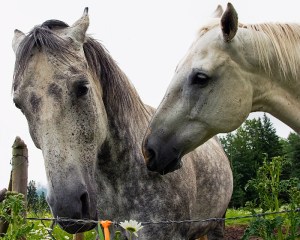
Some time ago I went for a slow drive along the winding roads high above my place in Pritchard hoping to find some cows, horses, or deer to photograph. I wanted head and shoulder compositions (or portraits), not animals in the landscape.

I leisurely drove around, passing lots of roadside deer; cows quietly chewing the cud, and finally stopped near two horses standing very close to a fence. My choice was to compose of portrait of them instead of just a pleasing documentary of two horses in a field. So I mounted a 24-85mm lens on my camera, walked through the wet grass to the fence to take their picture, and worked angle after angle for a portrait.

I suppose the words “artistic representation” and “goal of capturing some likeness” are appropriate when a photographer captures human-like qualities in animal portraits. I wanted a picture that included me, or at least inferred some conversation between the horses about me. My image is, as Avedon said, “….an opinion”.
What is a Good Photograph?

Just what defines a good photograph is, and will always be, a topic of heated discussion with serious photographers; and in my opinion, is one that is certainly worth regular examination because, simply put, a “good photograph” is what those who enjoy this medium want to make.

There are, of course, those that believe a good photograph must capture an image absolutely true to life, while others might say it’s totally about how creative the photographer is, however, if one relies on they number of “likes” they receive on social media sites a good photograph probably depends on the beauty of the subject.

When I taught photography I told my students that a good photograph includes acceptable composition, exposure, and an interesting perspective.

I also said that a good photograph makes us have a connection with, or think about the subject, and might help us understand what the photographer feels about that subject; and if successful, evokes some kind of mood, whether good or bad.

American photographer Ansel Adams said, “A great photograph is one that fully expresses what one feels, in the deepest sense, about what is being photographed.” And he elaborates, “Simply look with perceptive eyes at the world about you, and trust to your own reactions and convictions. Ask yourself: “Does this subject move me to feel, think and dream? Can I visualize a print – my own personal statement of what I feel and want to convey – from the subject before me?”

And Adams reminds us, “There are always two people in every picture: the photographer and the viewer.”

Another of my favorite scenic photographers, Elliott Porter, commented, “You learn to see by practice. It’s just like playing tennis; you get better the more you play. The more you look around at things, the more you see. The more you photograph, the more you realize what can be photographed and what can’t be photographed. You just have to keep doing it.”

Vogue magazine Editorial photographer Irving Penn, wrote, “A good photograph is one that communicates a fact, touches the heart and leaves the viewer a changed person for having seen it. It is, in a word, effective.”

What is a good photograph? That might only be in the “eye of the beholder”. If one is a camera club member there will be rules on how a photograph is judged. And when I graded my students’ work I was mostly interested in their knowledge.

Sometimes we see a photograph that moves or inspires us, makes us feel, think and dream. And when a photographer is able to convey that to viewers he or she has truly made a good photograph.

Learning From the best Photographers of the Past.

learning-from-famous-photogs

I had a discussion with a fellow that was looking for help with his photography. He was frustrated with all the books and online publications that seem to be more about the camera, lens, and exposure setting than what I’ll call “one’s mindset” when it comes to making a creative decision about photographing the subject.

My suggestion was to start looking at photographs made throughout history by those photographers applauded by their approaches. I suggested he check out Jerry Uelsman’s creative montages, Arnold Newman’s environmental portraits, Irving Penn’s fashion work, and, of course, the world famous, scenic photography of Ansel Adams.

I offered Digital Camera World’s “The 55 best photographers of all time. ”http://www.digitalcameraworld.com/2012/07/17/famous-photographers-the-55-best-photographers-of-all-time/

The editors began their article with “The best photographers of all time? Surely there can be no definitive list! We’re not afraid of courting controversy here at Digital Camera World. OK, maybe we are a little bit, which is why we thought it was time to be bold for once! Over the years we’ve interviewed a number of famous photographers and been inspired by each of them, but one thing we often hear from readers, social media followers and others is… “Who are the best photographers of all time?” It’s a good question! We put on our thinking caps and took a stab it.”

There is another top ten list by the editors of the website, Ansel Adams. http://www.picturecorrect.com/tips/top-10-most-famous-photographers-of-all-time/

They write, “If you want to take truly memorable and moving photographs, you can learn something by studying the pictures of famous photographers. Some of the most beloved artists are deceased, but some are still delighting us with their photographs. The list includes some of the more famous photographers that still impact our lives today.”

I liked what Picture Correct’s editors wrote about how famous photographers are, “impacting our lives today”. I believe a good photograph is timeless and speaks to every generation.

Both articles are great and well worth taking time to read.

I enjoy studying those that excel in this medium, and I think we, as they wrote, “Can learn something by studying the pictures of famous photographers,” and I believe that photographers can advance their personal work by examining the work of others.

Photography is a medium that almost everybody within our contemporary culture has a personal familiarity with and an opinion on.

I suspect it is probably that familiarity with photography that drives many to think that they will excel as long as they keep up with the latest technology their photography will be applauded by their peers. However, I am of the belief that even though a photographer has technical skills, examining the work of photographers with a track record from the past will, as Picture Correct puts it, “help advance personal work by examining the work of others”.

Those two lists are only the opinion of the authors and as I perused the comments readers posted, many felt their favorite photographers had been excluded and others were unhappy with some on the lists. In my opinion that just doesn’t matter who made or didn’t make the lists, I enjoyed reading about them and their personal perspectives on photography.

Another Year Is Just About Over


This year's adventure is about over.

This year’s adventure is about over.


Another year has gone by and I guess its time to put the old baggage away and get out the new. Christmas is here and I’m sure the year to come is going to be filled with fun photography.

I hope that the thoughts and experiences I have written about this past year have been interesting and worth reading. My goal is to write articles that are, at the least, a bit different from the exotic location photos in magazines, and that complicated on-line how-to.

I will admit that just posting a couple of pictures with a how I-did-it recipe would be easier, but this damn medium of photography is so damn exciting that I can’t help but talk about why I like it.

As I wrote last year, there are so many people writing about photography that I do wonder if I can add anything worth viewing and reading.

I try to stick with a technique that worked during the many years I taught photography and that is to tell a story that includes photo information I want to discuss.

Something else that I learned during my years teaching was to keep the subject fresh. That meant introducing something new each class and that is how I choose my topics, something different each week.

Changing the subject each week does get hard, and (I wish I could say it wasn’t so) there are other things in life than photography and it isn’t unusual for me to say Linda, “Gosh, I have no idea what am I going to write about this week.”

Fortunately, with Linda’s help it usually works out and I come up with something to say each week.

Linda reminded me that last year I mentioned those subjects that I enjoyed writing about the most. Well, looking back here are my personal favorites.

My article in August, “Two Photographers Are More Fun” was very personal because my wife Linda is the best photo-partner I could ask for. Throughout the year I wrote several times about the Lighting workshops I lead. I enjoy watching others learn about photography and in my articles I try to explain a little about that process and adventure. I also wanted to let people know how much fun I had in September photographing a little location at Vancouver’s Denman Street and Stanley Park. Those are a few. I generally liked all the subjects I photographed and wrote about.

I’ll keep this short and wish all photographers out there a very Merry Christmas.

Photography at the Christmas Party   

tree-planters-4

tree-planters-1

tree-planter-5

tree-planters-7

tree-planters-6

I talked to a person this week that has been asked to be the staff photographer at an upcoming event. With that, I thought I would revisit an article I wrote December 2014.

The Christmas season is here and that means photographers will happily begin filling memory cards with photographic opportunities as they join family, friends, and co-workers at this month’s festive events.

The act of picture taking has become easy and so much fun as people rush over to take a picture and then quickly show other partyers the images from the LCD. Some seem more interested in that quickly snapped candid than what is actually happening at the moment. For many, it is more about the activity of picture taking than it is about making memorable photographs of the party.

Images made in this fashion rarely become more than stored files on computers and cell phones. People have good intentions, but after that initial viewing, most photos loose value because there are too many, and very few are good enough to give to others anyway.

What is my advice for photography at the next Christmas party? Yes, continue to make candid photographs of people having fun, but, perhaps, think about making pictures that tell a story, capture an exciting moment, and importantly, flatter the subjects. Most people don’t mind seeing a picture of them being silly or having fun, but they don’t like pictures that make them look stupid or unattractive.

My approach is to take a moment to look at the room in which I intend to make photographs, make a couple of test shots using longer shutter speeds (my favourite is 1/60th of a second), to include the room’s ambient light. And I always use a flash so as not to end up with brightly lit faces surrounded by a black environment.

I suggest taking group shots with two or three people. Get them to position themselves squeezed together with a tight composition, and include only a little background or foreground. Don’t shoot fast. Steady the camera. Select a shutter speed that includes the ambient light. Use a flash. Fortunately most modern DSLRs easily allow ISO sensitivity that can be set to 1600, and some can go a lot higher.

Shutter speeds of 1/60th of a second, or less, doesn’t always work for children (or adults) playing in the snow during the day because moving subjects will be blurry, but, with limited indoor lighting, moving subjects will only be properly illuminated when the flash goes off.

Lighting everything with complicated studio equipment would be great, but that would ruin the party for everyone. The occasion would become more about the photography and less about the fun and festivities. I use a hotshoe mounted flash and make adjustments as I go. I want to join in on the fun, blend in, and not act like a photojournalist.

Family and friends don’t mind having their pictures taken as long as it’s enjoyable and I want pictures that show them having a good time. So, along with those quick candids I make posed portraits with smiling faces, and if I select some pictures to give away later I want people to like and not be embarrassed by the pictures taken of them.


Leading a Photography Lighting Workshop   

getting-ready

photographers

reflector

modeling

having-fun

checking

American photographer David Hobby, author of the lighting blog Strobist that promotes lighting techniques, wrote about learning to use flash, “You may not realize it yet, but you have just stepped through a door that may change your photography forever…Photography is literally writing with light.” And he continues, “…you’ll learn how to take control of your electronic flash. If you can imagine it, you’ll be able to create it.”

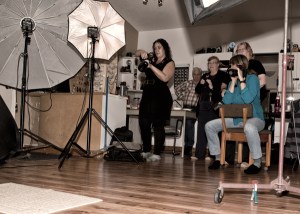
I like using flash, and in my many years as a working photographer I rarely photographed people indoors or out without using a flash; and last Sunday with Hobby’s words in mind I led yet another interactive lighting workshop.

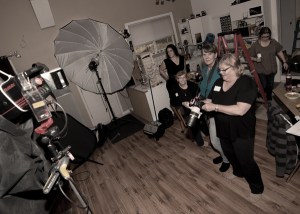
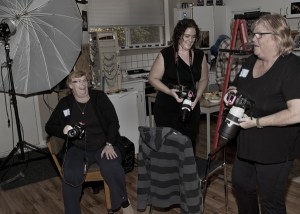
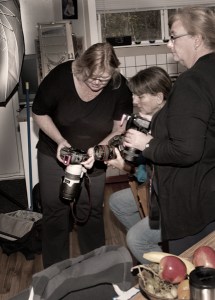
Actually I wonder if “study group” might be a better description of what happens when several photographers get together to experiment with flash. Nevertheless, these sessions are always an enjoyable whirlwind session for me as I try to present as much information as I can without reaching information-overload for the participants.

As photographers in the workshop begin to realize how much better, and more creative, their portraits are when they begin taking control of electronic flash they get excited. That excitement is contagious. So much so that I have to remind myself to slow down and explain what I am doing and why I am doing it when I add lights to a portrait setup.

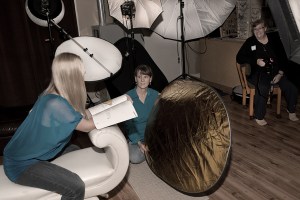
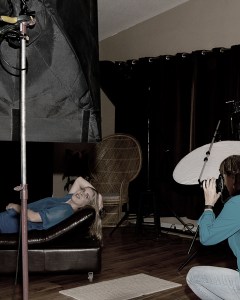
Sunday’s group of photographers were quick learners and were demanding as they pushed limits and exhausted the model, then without skipping a beat, when our ever-so-patient model needed a break, one of the photographers took her place and the group kept on going.

I remember reading a book entitled, Teaching as a Subversive Activity, about student-centered learning over teacher-centered teaching. Sometimes one has to step back from being the center of attention and let people learn by themselves.

When I realized those photographers had reached the point where they were beginning to understand where I was leading them, I just got out of their way and let them be, besides that gave me some time to wander a bit and take some pictures of what was happening.

This first of two sessions, Modeling with Lighting in the Studio is now over.

Next Sunday we’ll be braving British Columbia’s cool October weather as we take our model outdoors to pose in several different locations with different lighting conditions in each. I entitled that, Balancing Lighting Out-Of-Doors.

In the studio we used large and powerful studio lights that recycled instantly. Next Sunday we will use much less powerful, small wireless speedlights that require waiting for batteries to recycle. The quick recycling studio lights are grand, but I like the slower speedlights because they force photographers to think about and plan their next shot.

Last weekend was a lot a fun. It is great being with other photographers and watching them get excited about learning something new. Saying that, I will add a quote by French photographerJacques-Henri Lartigue that I have used several times before, “It’s marvellous, marvellous! Nothing will ever be as much fun. I’m going to photograph everything, everything!”


Camera Care On Wet Days    

linda-shooting-in-the-rain

Barriere, British Columbia Star Journal newspaper Editor, Jill Hayward, asked me to discuss the use, care of, and protection of cameras, lenses, and other photographic equipment during wet conditions. She worried about people carrying and using their cameras under the wet conditions at the North Thompson Fall Fair this past weekend. She also mentioned that she meets many local photographers that have scratched lenses.

I rarely let wet days limit my photography. Nevertheless, with the exception of those expensive pro level DSLRs and, of course, a few small waterproof cameras, most of the cameras photographers use don’t have much resistance to water.

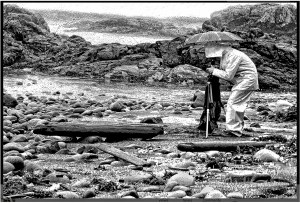
Several years ago my wife, Linda, and I took a photography vacation on Vancouver Island. The weather was forecast to be completely rainy, so we prepared with plastic bags to cover our cameras, umbrellas to deflect water off our viewfinders, hairdryers to dry out cameras and tripods every evening, and wet weather attire because we didn’t want wet clothing. The trip was a bit uncomfortable, but the coastal downpour didn’t stop us from doing photography, and we didn’t waste a day of that trip huddled indoors. We were outside, cameras in hand, every day of that excursion and returned with great pictures, and a fun experience of shooting in the rain.

We had a good experience because we were prepared. That’s the secret. I always carry an old towel in my camera bag. And when water (or soon snow) begins to gather on my camera I continually wipe it off. Those areas I worry about are around the pop-up flash, where the lens mounts, the LCD, and the info window, and anywhere else that I think water might find a way into my camera.

I keep a lens cap on my lens. But what about when one is taking pictures? I know there will be those that advise putting a UV filter on every lens.

UV filters are from a time when we had a necessity to colour balance our film and in the spring we would use (U)ltra (V)iolet filters to warm the colours. Using an old UV filter is fine, as are any of the many different clear filters manufactures are selling for lens protection, but digital sensors no longer need colour correction filters and many photographers worry that inexpensive filters placed in front of their expensive lens glass might degrade the image.

Whether you agree with that notion or not, I think that using a lens hood is much better insurance than clear protection lenses. My advice is to get a plastic lens hood for every lens. Plastic lens hoods protect our lenses by bending, bouncing, and sometimes even breaking in the process of absorbing the impact and saving the lens. Personally I feel safer with a lens hood than a tight fitting glass filter. Anyway, we should always be using lens hoods to keep glare off the lens front.

When I return home after a day of photography I remove the lens and check my equipment. I remove the memory card for downloading to my computer, recharge the battery and, especially after rain, wipe my camera and lenses.

As I already wrote, I don’t let rain limit my photography. And there are times when the rain adds something to a picture.

Country singer Roger Miller wrote, “Some people walk in the rain, others just get wet.” Those are good word for creative photographers. And for those afraid of taking pictures in the rain, another singer, Cher made me laugh when she said, “Don’t take your toys inside just because it’s raining.”


Two Photographers Are More Fun 

TwoPhotogs 1

It is always fun to do photography with someone else. This past week I have been talking to a friend who would really like his wife to get involved with photography, and I’ve told him how much enjoyment I get from this exciting medium of photography would be missing if my wife, Linda, were not also a photographer.

I have written about this in the past, but I am going to bring back a previous article for those readers that might have missed the original and would like their spouse to take up photography.

When we first got together 40 years ago Linda didn’t do photography, but that quickly changed.

I suppose she didn’t have any other option. Then and in all the years she has known me I have been I am either doing, teaching, talking or writing about photography.

My advice to any photographer that is actually interested in getting their spouse involved is as follows.

Match the equipment. I mean that with regard to cameras, both DSLRs should operate the same way. The models can be a year or so apart, but should be the same brand and the controls should operate similarly and if two of the latest models are affordable, so much the better.

Don’t be cheap with lenses or cameras for your spouse. If it isn’t good enough for you, it isn’t good enough for the most important person in your life. Just as you would select a lens for the subject and the way you like to shoot, your photo partner should select lenses for his or her preferences.

I know your mother told you to share, but my recommendation is don’t share. That just leaves someone behind. If you both like long telephoto lenses, get two.

I can remember the exact moment I thought about the concept of equality. I was in Yellowstone National Park in Wyoming waiting for Old Faithful Geyser to erupt. While I waited I noticed a man and woman with their tripods setting up closer than me. I was obvious they were both serious about getting good photos of the geyser, but I could see that his was larger and feature packed, while hers was just a tiny, toy-like, point-and-shoot camera.

In my mind, it didn’t matter who was the better photographer or had the better eye. That point-and-shoot reduced her chances, and I wondered why she would even try, or how long she would keep it up when her equipment kept her behind.

I had a friend who tried getting his wife interested in photography. He bought her a cheap, entry-level camera and while he would make 16×20 prints of his images, hers were rarely over 8×10. She lost interest.

Shop for accessories together. Each photographer has his or her own preferences and should make equipment choices for the subjects they like to shoot.

Education is always a good idea. Attend a photography class or workshop. Search for them online or check local camera shops. Take turns going to photography classes or better yet take part in the same workshop.

One of our most memorable vacations was when we both attended a weeklong wilderness photography workshop on Mt. Rainier.

In my opinion we may have gotten more out of that class than the other participants because we were able to share information and experiences during and after.

Gently critique each other’s photography. Don’t just store pictures away on the computer. Sit in front to the computer display together and decide which photographs work and which that don’t, and then delete all the failures. We make large prints and calendars of our pictures.

One photographer in the family is cool, but two photographers, in my opinion, are much better. If you want your partner to have the same excitement about photography as you do, don’t be stingy with the compliments. And on that occasion when your spouse makes a better picture of the waterfall or the running deer than you, be sure to tell them.

Oh, and I never have the worry or guilt about getting new equipment.


Why do photography?

No Loitering

Guitar

St. Andrews

Tall ships Victoria

Kamloops Lake 2

Sternwheel

Coca-Cola

Forgotten shops

Yellow & Red

Just Waiting

After a discussion with a fellow who told me he has become bored with photography I thought I’d revisit the following from an earlier post.

I once asked “Why do photography” to members of an online forum and received some unremarkable responses like, “because I can” and “because I have a camera”.  Well, I suppose it is all about the camera to lots of people. However, there were two responses that I really liked, the first from someone called Soenda who eloquently wrote,

“ Because taking pictures has helped me see better. Before, I was less aware or the way light strikes leaves. I didn’t notice the symmetry of birds on a wire. Sunsets were masses of agreeable colour; now they are gold, pink, lavender and blue”.

The second from someone named Laura who philosophically said,

“Because when I look at my life, I cannot say I have done nothing. The proof exists that I have seen at least a wee bit of the world. I take pictures because it is artistic expression, and I think when we repress our artistic nature, we do ourselves no good, no good at all. I take pictures because it is fun. I can spend the entire day taking pictures, and it could not be a day better spent…”

For me, photography changes. There are times when I just want to play and am interested in nothing more than experimenting, my goal just seeing how something works.   I enjoy photographing my friends, family and pets. Pictures that have meaning only to me, but might never go anywhere other than on my computer’s screen saver.  And of course, until I retired, photography was the way I earned my living.

There are those times when I try to visually create an image that says something to others about how I see and feel about something. I can’t really say that the medium of photography is a passion for me, but I am enthusiastic. It’s just something I think about a lot and do.

Many use photography as a way to express themselves artistically, of which I heartily agree. Expressing oneself through photography is easy, as it doesn’t require the trapping of other mediums like painting or sculpture, and merely requires a camera.

Photography, for those who first wanted to make photographs, became accessible during the 1800s. The first surviving image made by Jacques Daguerre was of some artistically arranged plaster casts resting on a window ledge in 1837, and a short 20 years later photographers were wandering the North American wilderness and newly constructed cities creating photographs with the same intensity, all though not in the same numbers, as we are today.

Why take pictures? For some it is to document history, we know about the civil war in the 1860s through the photographs of Mathew Brady and the Vietnam War in the 1970s by David Kennerly.   Timothy O’Sullivan, William Henry Jackson, Ansel Adams, Elliott Porter, Imogene Cunningham, Bret Weston and others gave us their visual opinions of an early American landscapes.

There were those like Dorothea Lang and Walker Evens that during the great depression of the 1930s told us about the human condition. While Photographers Arnold Newman, Richard Avedon and Canadian Yousuf Karsh, celebrated the beauty of the human expression”  paving the way for modern portrait photographers.

For some the question “Why do photography?” may be very philosophical and for others practical. Soenda commented, “ Because taking pictures has helped me see better.” And Laura wrote, “I take pictures because, when I look at my life, I cannot say I have done nothing.”

I wonder what readers would answer.

Communicating Our Personal Photographic Vision  


I enjoy pretty much everything when it comes to photography. I am happiest when I get to talk about it, read about it, and look at other photographer’s work, and of course, any occasion where I get to point my camera at a subject.

Famous and influential photographer Edward Weston once wrote, “Photography suits the temper of this age – of active bodies and minds. It is a perfect medium for one whose mind is teeming with ideas, imagery, for a prolific worker who would be slowed down by painting or sculpting, for one who sees quickly and acts decisively, accurately.”

Weston most likely said sometime in the 1950s, but it aptly describes many of those taking pictures with all kinds of cameras in the 21st century. Yes, it is the, “perfect medium for one whose mind is teeming with ideas…”

As I looked at several images (several were from iPhones) that were proudly posted online I thought how those words fit many modern photographers. However, there I was looking at many pictures that, although quite creative and colourful, lacked the basic compositional guidelines I was taught              (I suspect Weston learned also) and are still being taught in almost any class on photography.

Photographic composition is the selection and arrangement of the subject within the picture area. However, what I saw seemed in many cases to be hastily captured images with little regard to the importance of any centre of interest that might help viewers identify what the photographer is trying to communicate.

Maybe it is the conditioning we get by clumsily pointing our cell phones at a subject, or the thoughtless reliance on a camera’s auto focusing device to select whatever is in the middle of the viewfinder for proper focus.

There is a compositional guideline called, “the rule of thirds”. This so-called rule is a simple principal that divides an image into thirds, horizontally and vertically, and tells us to position the most important elements in our scene along these lines, or at the points where they intersect, and by doing so, adding balance and interest to one’s picture.

I subscribe to four components when I create a picture:

  1. The Centre of Interest: A strong center of interest helps the viewer identify the point of the picture, or what the photographer is trying to communicate.
  2. Angles: Begin by looking at the subject, move around – up and down, vertical or horizontal. Decide what should or should not be included.
  3. Distance: Don’t back away. Eliminate everything that does not add to the picture.  Close-ups convey intimacy, long shots build space and depth.
  4. Background: The background can make or break that photograph. Use the background to build interest in the center of interest.

There will be those photographers that in the interest of their own creative freedom will disregard anything that they believe will restrict their photographic independence and innovation or what they think might apply limits to their imagination.

I wouldn’t agree with that. I don’t think this is an argument of vision.

If our goal as photographers is to create an image that withstands the test of time and communicating a personal vision, then one must learn the        basics of composition in the same way as one would learn the basics of exposure, or how to make the camera actually work whether it’s a DSLR, or a feature of a cell phone.