Two Photographers Are More Fun Than One

Linda

Linda


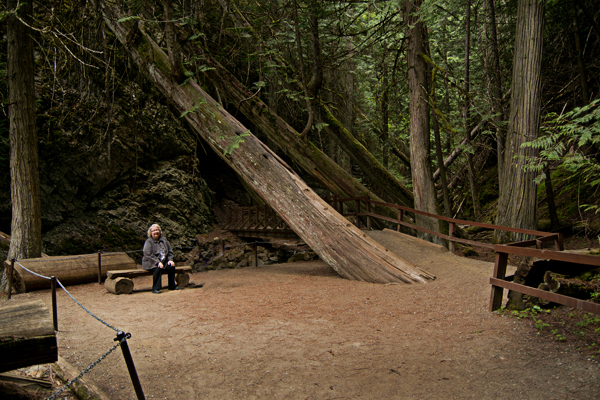
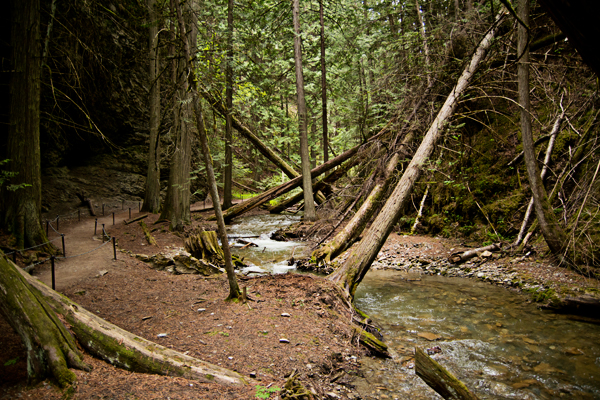
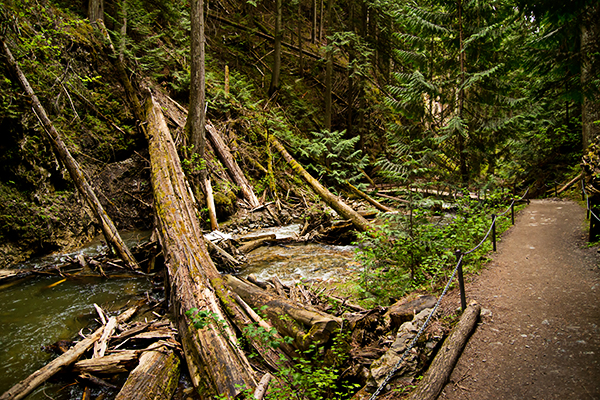
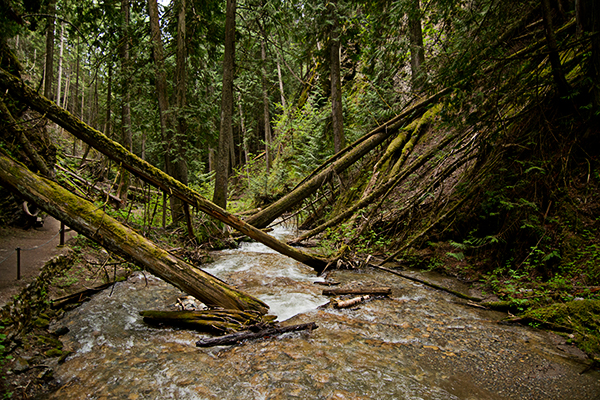
Fallen Cedars by John

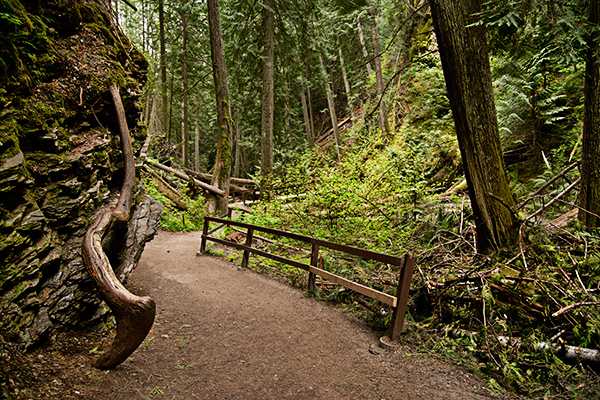
By John


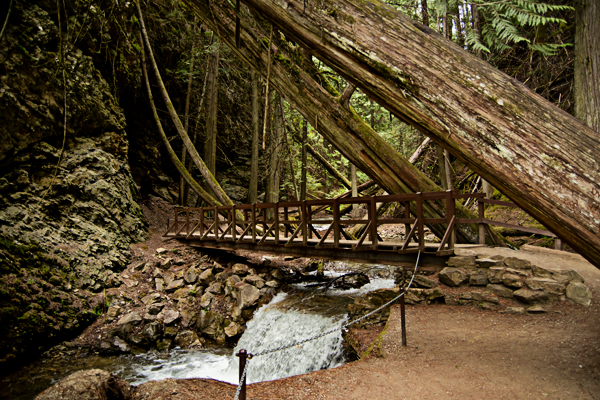
Fallen Cedars by Linda

By Linda

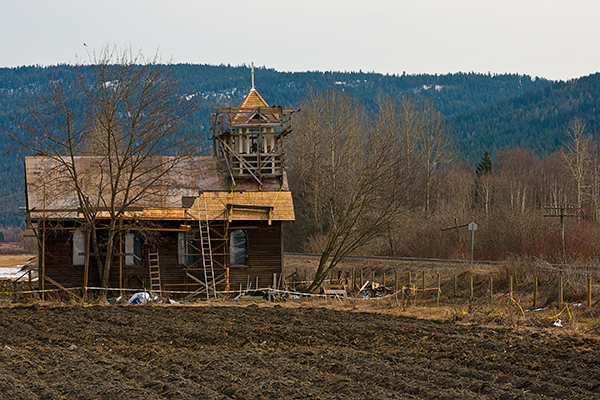
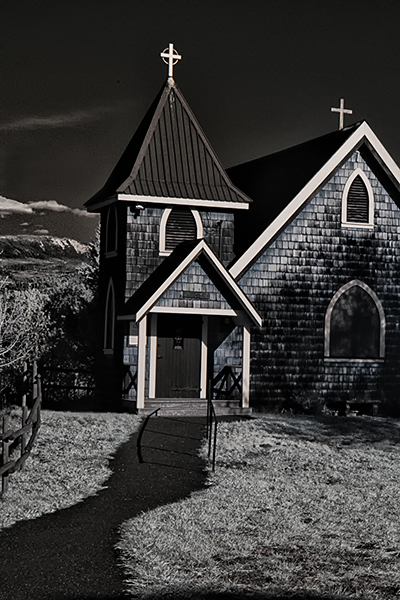
Notch hill church. Linda

By Linda

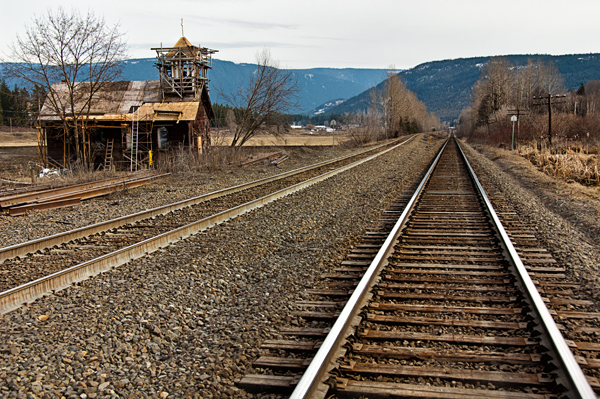
The train goes by

By John

This week I talked with a fellow that grumbled about how his wife complains about waiting for him when he wants to stop to take a pictures. I suggested that he find a way to get his wife involved in his hobby. After he left I remembered the following article I wrote back in August of 2011. For those who may have missed it, I thought I’d post it again.

I received a most encouraging email from a reader: “In talking to you I noted that you and your wife both are into photography, so I proposed giving my wife a DSLR and get her into shooting her own pictures. She was a little hesitant to the idea saying she did not have the “artist’s eye”. However, I printed out your blogs on ‘What Makes a Good Photograph’.

After reading it she commented that “each person has their own take on what makes a good picture”, and the short of it is, she is willing to take up photography with me”.

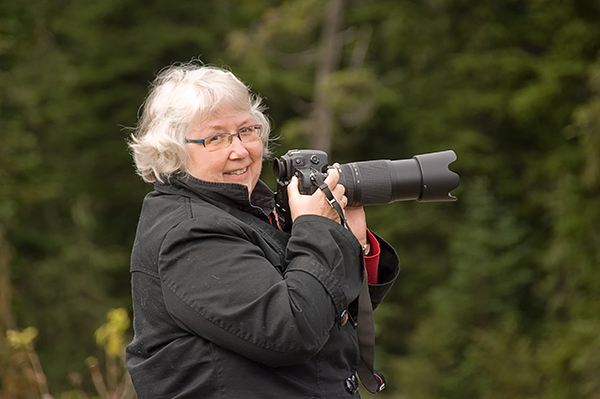
Personally, I think much of my enjoyment of photography would be missing if my wife, Linda, was not also a photographer, and it is great that we both enjoy this exciting medium and can share the experience of making photographs.

My advice to any photographers that are interested in getting their spouse involved in photography is as follows.

Match the equipment. I mean with regard to cameras, both DSLR (digital single lens reflex) cameras should operate in much the same way. The models can be a few years apart, but should be the same brand and the controls should operate similarly and if two of the latest models are affordable, so much the better.

Don’t be cheap with lenses for your spouse. If it isn’t good enough for you, it isn’t good enough for the most important person in your life. Just as you would select a lens for the subject and the way you like to shoot, your spouse should select lenses for his or her preferences. I know your mother told you to share, but my recommendation is don’t share. That just leaves someone behind. If you both like long telephoto lenses, get two.

I can remember the exact moment I thought about the concept of equality. I was in Yellowstone National Park in Wyoming waiting for Old Faithful geyser to erupt. While I waited I noticed a man and woman with their tripods setting up closer than me. I could see that he had a large, professional looking camera and she had a tiny, almost toy like camera. I knew that his photographs would be good and hers not so good. It didn’t matter if she was the better photographer or had the better eye, his pictures would be better, and I wondered why would she even try.

Shop for accessories together. Each photographer has his or her preferences and should make equipment choices for the subjects they like to shoot.

Education is always a good idea. Attend a photography class or workshop. Search for them on line or check local camera shops. Take turns going to photography classes or take part in the same workshop. One of my wife’s and my most memorable vacations was when we both attended a weeklong wilderness photography workshop on Mt. Rainier. In my opinion we may have got more out of that class than the other participants because we were able to share information and experiences.

Gently critique each other’s photography. Don’t just store pictures away on the computer. Sit in front to the computer display together and decide which photographs work and which that don’t, delete all the failures, and make a combined presentation of all the successful images to show your friends and family.

One photographer in the family is cool, but two photographers, in my opinion, are much better. If you want your partner to have the same excitement about photography as you do, don’t be stingy with the compliments. And if your spouse is fortunate enough to make a better picture of that waterfall or running deer than you, be sure to tell them.

Interesting and Unconventional Photography

Unorthadox refection

Building behnd the shadow LIght in the shadows

Looking Up Town

About the time of World War I the common attitude regarding art and photography was shattered by innovations of modern painters like Picasso and Matisse. However, the fundamentally realistic medium of photography did not acknowledge that photographers could or even should produce abstractions or distortions to the extent that painters could.

Nevertheless, there were a growing number of artist-photographers like Alfred Stiegletz and Edward Steichen that worked at bringing photography in line with modern painting by creating abstract images and processes.

They, and others, worked to popularize the “sharp focus realism” or “Modernist” movement that was at that time deemed unartistic by traditionalists that called themselves “Pictorialists”. (The Pictorializm style is where a photograph lacks sharp focus and sometimes even had brush strokes muting the surface of the final print.) The pioneers of the “Modernist” movement in North America was Alfred Stiegletz, Edward Steichen and Paul Strand

The current age of digital photography seems to have vitalized photography more than any one could have guessed as recently at the 1990s. Although there are still those clamouring loudly from the sidelines calling themselves “traditionalists” and insist they will never move beyond their beloved film.

Attend any event and there will be lots of cameras ranging from cell phones, little point-and-shoot cameras, to impressive DSLR’s documenting everything from every angle. The internet is packed with images, with all kinds of sites available for people to stack their documents of everyday life.

In a moment of late night boredom I decided to do a search for a past friend who lives in the US. I not only found his company advertisement, but also several pages of family Christmas photos he and his wife took. My thoughts were that this is a reasonable and typical document of people having fun, nothing creative, just a real nice family documentary; and not unusual, as photographic documentation is more prolific than it has ever been, however, I began to wonder about another creative part of photography, the abstract and the unusual.

There are lots of instances of PhotoShop manipulation that anyone can find without looking very hard, yet I wonder at the style of abstract photography practiced by the greats like Stiegletz, Steichen, and Strand. They were very much involved in looking at everyday subjects from different angles or perspectives. They photographed the usual in unique ways and photographed the unique in unusual ways. They searched out things that many would ignore because they were ugly or boring, and chose diverse photographic views and visually discussed them in interesting and unconventional ways.

In my work I get to see peoples’ photos all the time, landscapes, portraits of people and animals, and a few close-up flower shots. Usually they are very nice and some are downright beautiful, but it is rare for someone to show me an abstract created by using their camera to photograph something using a unique view.

Abstract art and abstract photography may not be to everyone’s liking and I know when we show our photographs to other people we want them to comment favourably about our pictures. When a photographer takes a chance and tries to visualize and photograph something differently, he or she cannot worry about whether or not they will receive praise or criticism of the visual creation of the unusual, the ugly, the boring, or the unique. To do so means they must contemplate photographing the subject in their own personal way.

If readers have the interest, my suggestion is to take some time and find out about those pioneer photographers Stiegletz, Steichen, and Strand. We can always learn from history and their photography is very interesting and just might be inspiring to those wanting to step away from the crowd.

I look forward to any comments. Thanks, John

A Photo Trip to Margaret Falls

Linda at Margaret Falls

First bridge

Along the path

Reinecker Creek

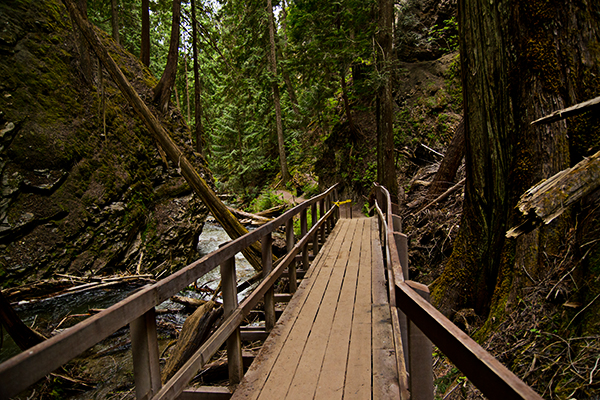
Fallen Cedars

Crooked tree


Bridge to Margaret Falls

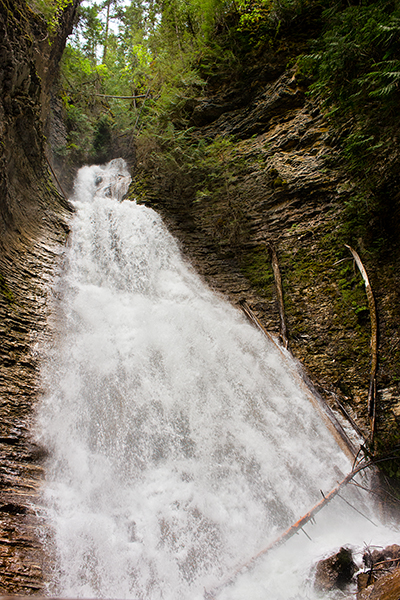
Margaret Falls, British Columbia (B)

I have spent the last few days slowly dismantling an old shed I built over 20 years ago. I will say that I enjoyed building that ramshackle structure that has served as a goat barn, a chicken coup, and lastly for storing stuff I didn’t know what to do with. The process of destruction hasn’t been going all that quickly because I have been finding any excuse to delay my work taking it apart and I suppose that’s why when my wife mentioned it would be pleasant to go to Margaret Falls I didn’t hesitate to put our cameras in the car and head out for an easy drive.

Margaret Falls is a 200 feet high cascade that drops into Reinecker Creek on the edge of Shuswap Lake’s Herald Provincial Park. Local lore says the falls gets its name from the first white woman to see them. I also have been told it was called Reinecker Falls. But I wonder what that place was called by those that went there long before the white settlers.
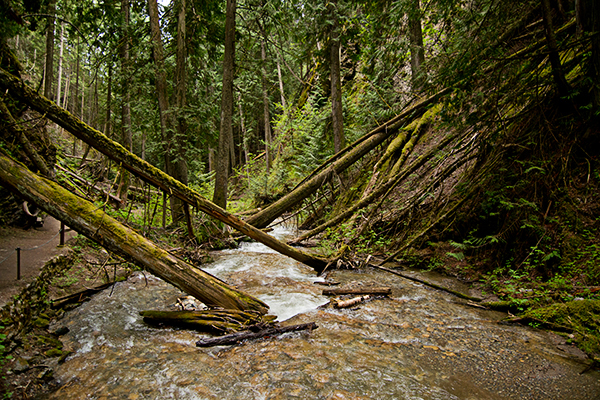
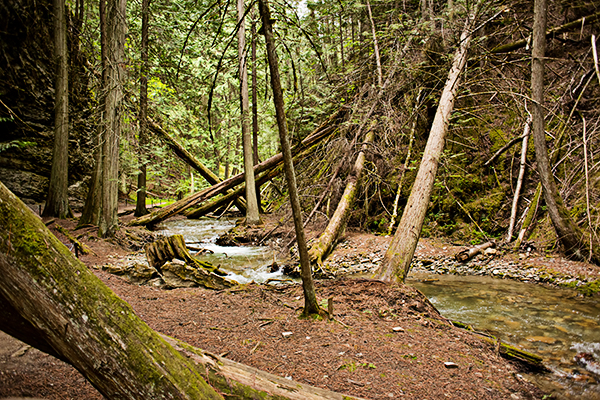
It is the place, and not the waterfall that draws tourists and photographers to make the short trek through that moss covered, old-growth cedar forest nestled in a narrow gorge.

Reinecker Creek falls down a sheer rock face and into the narrow chasm creating a wonderland for those that walk along the beautiful gulley filled with large trees and looming cliffs above.

Before one is even aware of the unique ecosystem, there is the envelopment of a waft cool, damp air that on a hot July day will be a startling difference in temperature. Knowing that we included jackets with our camera gear.

Over the years Linda and I have spent many hours wandering along paths with cameras and tripods, but this time the wind was picking up and we could see large, dark clouds looming. So we just brought our cameras in case we had to make a quick getaway. I do not remember how many times I have taken pictures along that cool walkway up to the falls, or all the different camera formats I have used. I have been there in every season of the year, rain or snow, and I have even photographed a wedding there.

For this visit Linda used a 24mm prime and I used my 24-85mm zoom. Wide angle is a must for that narrow canyon.

The overcast day really wasn’t a bother because our modern full-frame cameras can easily handle 1600 ISO and depending on our subject’s location we could choose either 125th or 250th of a second shutterspeed an still keep our aperture small enough to get reasonable depth-of-field.

One rarely has the trail to Margaret Falls to themselves. To achieve scenic photography photographers have to be patient. However, this outing was petty good. Our only interruption was a guy on his mountain bicycle that turned around and left when he realized there were people on the trail. And we met some people that told us they were celebrating their 70th reunion. They gently ambled up the path to the waterfalls, extended their arms for cell phone snaps and then left, giving us all the time we needed to compose our pictures. I did have a good time, but, as free as I was to wander around with my camera and 24-85mm lens, I missed having my tripod. We have decided to return in a week or two packing tripods and neutral density filters prepared and spend a bit more time.

I always look forward to comments. Thanks, John


The Best Camera for Outdoor and Wildlife Photography

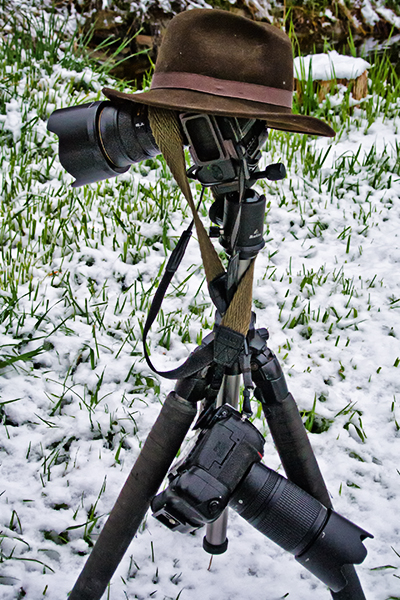
Outdoor camera

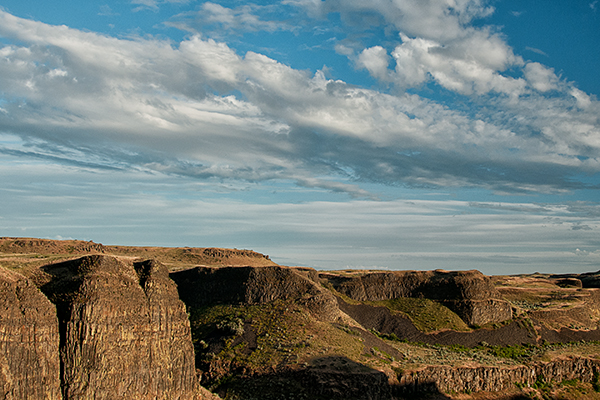
Washington Landscape

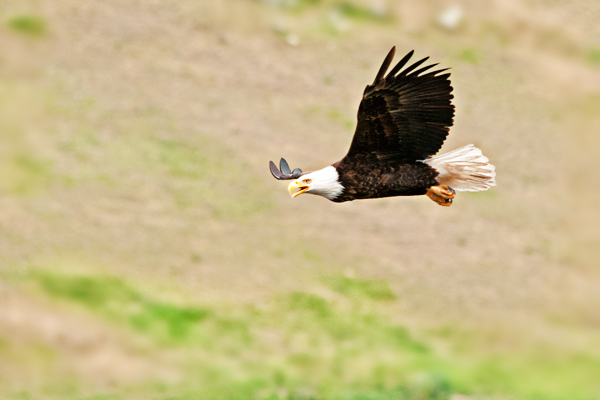
Eagle

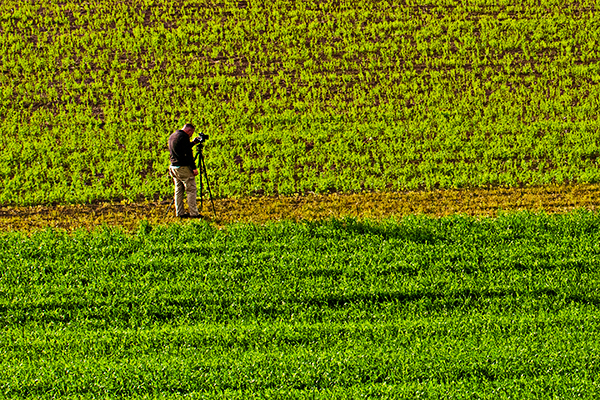
Landscape Photographer

Digital technology has been around long enough that I occasionally forget there are many people that have never used anything but small-sensored point and shoot digicams. I recently talked with an amateur photographer who was planning to discard his well-used point-and-shoot camera hoping that a DSLR would help him take better pictures. No, that’s not exactly right. He believed like so many others that a better camera would make him a better photographer. Actually, his question was, “What would be the best camera for outdoors and wildlife photography?” He is an outdoorsman and “needed the whole meal deal,” although I am not sure what he actually meant by that. Perhaps he wanted one camera that would be capable of doing everything.

What should be my advice to an aspiring wildlife photographer? I could give him my personal perspective, and I could suggest he search out wildlife and scenic photographer sites online to make his own decisions.

I will summarize what I got from a check of advice from avid wildlife photographers. Wildlife photography is harder on a camera than any other type of photography. Most of the time photographers will need to push the limits of their cameras. And, photographing wildlife will demand speed, resolution, and a well-built, quality camera, and, therefore, the best cameras for wildlife photos are usually the most expensive ones.

The photographer then should begin by looking at cameras that are durable, and capable of taking some bumping around, and be sturdy enough to take some abuse from the weather. And because the photographer would be shooting in all types of lighting conditions, especially low light, early in the morning, or at the end of the day, I would recommend looking at, and expecting to pay more for models capable of higher ISO.

Unlike a tiny digicam the photographer will need to concern him/herself with the lens, as well as with the camera. Personally, I would save my money on the camera and spend it on a quality lens. A saying I have heard over and over ever since I have been in this medium is that “it’s all about the glass,” referring to the lens. A photographer, like any craftsperson, needs the correct tools.

Then there is the discussion of full frame versus crop-sensor cameras when one is deciding on which is the best DSLR. Hmm…I think that’s a can of worms best left for later. There are enough confusing choices to keep a photographer awake at night with topics like which camera manufacturer, which model, and which lens. And I suppose there are also the possibilities with the new host of lightweight, mirror-less cameras making their way into photographer’s bags.

I plan on spending some time helping this about-to-be wildlife/scenic photographer make his own choice about his camera equipment. I would rather not be one of those that advise a particular manufacturer. That choice should be the photographer’s.

If we were able to ask Ansel Adams, one of the most famous scenic photographers, for his thoughts, he would say, “The single most important component of a camera is twelve inches behind it.”

I know that does not assist with the decision of what camera that photographer should get, but it does let him know that whatever he gets, he will absolutely need to spend time learning how to use it.

I always enjoy comments. Thank you, John

Infrared photography moves a photographer far from the usual.

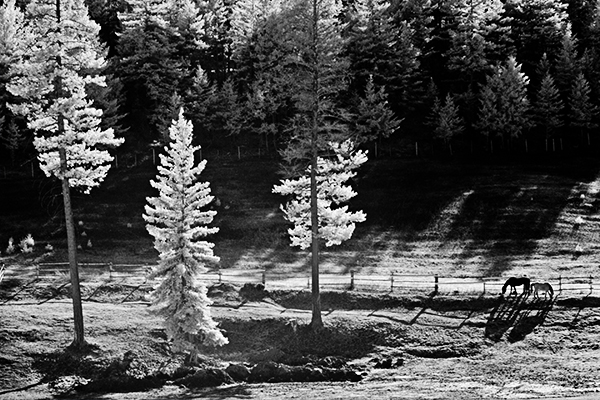
Horses in meadow

Monty Creek

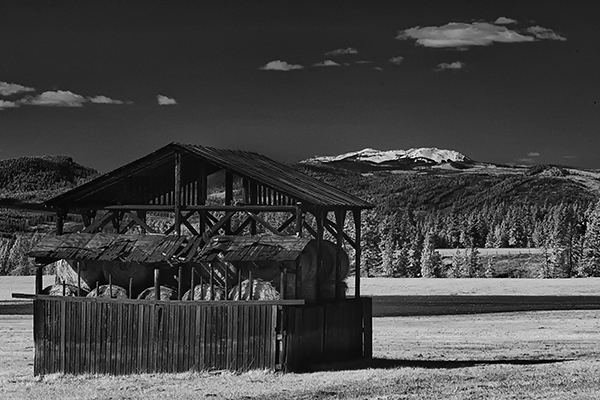
Pritchard Barn

Spring pond                                                Pond Cattail

Monty Creek Church  Watch for Livestock

Sometimes it is necessary for me to get away from doing the usual things. My time as a photographer is spent being precise. I meter for the light and shadow, striving for the best possible exposure, and not much is left to chance.

On the Easter weekend I spent a day photographing a family Christening. My job was to take a creative approach to photographing that religious occasion and telling the family’s story. At an event such as a Christening nothing waits for the photographer and there is no time to correct omissions or mistakes.

The main rule for me was to keep out of everyone’s way, not to become a focal point of attention, and never to miss any thing that happens.

The next morning as I sat at my computer working on the post-production photo editing of the Christening my wife mentioned she would like to finish off the roll of film she had been saving for a sunny day. It didn’t take much convincing to ignore the day’s “to do” list and as I looked out at the clear blue sky I realized I needed something to take off the stress I had been feeling.

There is nothing quite like infrared photography. It is always an exploration when I use the well-worn Nikon D100 that I had modified many years ago to only “see” infrared light.

Vegetation appears white or near white. Black surfaces can appear gray or almost white depending on the angle of reflected light, and if photographed from the right direction the sky becomes black. The bluer the sky, the more the chance there is for an unworldly, surreal effect. And white surfaces can glow with a brightness that illuminates the sky.

I have written about infrared before, but for those that are new to this subject here is the gist of it.

Digital camera sensors are as sensitive to infrared light as to visible light. In order to stop infrared light from contaminating images manufacturers place what they call “a hot filter” in front of the sensor to block the infrared part of the spectrum and still allow the visible light to pass through. My infrared modified D100 has had that filter removed and replaced with a custom filter that allows for infrared only.

My wife wanted to visit a marshy area not far from our home that on wet years fills up with water, and is annually visited by birds, ducks, and geese. But this year’s early dry spring has not given the marsh much water, and when I walked up to the dam two ducks quacked loudly and flew away, and that was the only wildlife sighting for the day.

The back roads always have something to photograph, so we moved on and chose our subjects depending on the light. Linda was shooting with her old medium format 1950’s Ikoflex and was looking for interesting features like fallen trees and rock formations. That particular old film camera doesn’t have an automatic mode, or an in camera meter and requires a hand held light meter. I am sure the few passers by wondered at a woman standing roadside with a boxy thing hanging from her neck while she peered at something in her outstretched hand.

I just explored, and unlike Linda’s limited, 12 exposure roll of film, I had an almost endless supply of digital choice, and besides, infrared changes the way we see things. So I pointed my camera at anything that caught my eye.

I began this discussion with the words, “I spend my time being precise.” And “Not much is left to chance.” However, not so much with infrared. I only use the meter as a not-so-precise guide, and don’t worry about much else. I do try for interesting angles of the subjects I photograph, but sometimes I am in for a surprise when I bring the images up on my monitor.

Shooting infrared is always an exploration, a discovery and moves a photographer far from the usual.

I look forward to all comments. Thanks, John


About Black and White Photographs

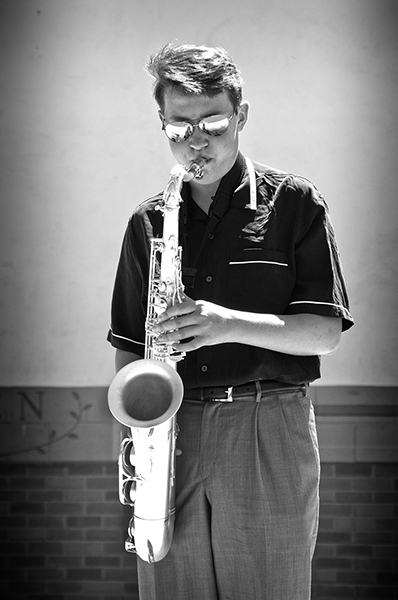
Sax player

Cups and a mirror

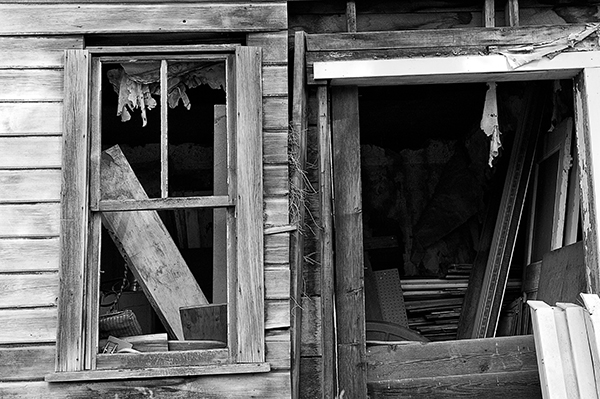
Windows


Bronc rider


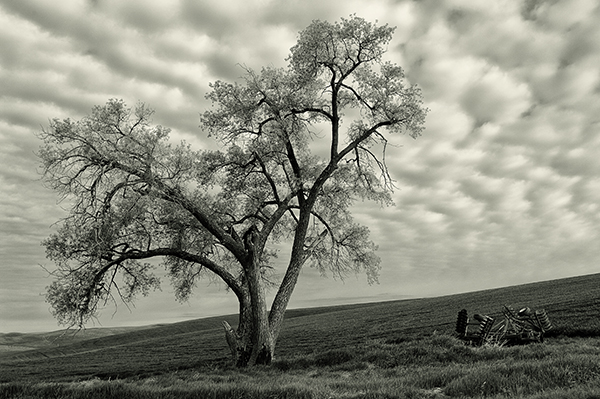
Tree

Sentinal after the fall

One of the fun things I like about photography is the endless conversations I get to have with both long time and beginning photographers, as they explore and re-explore this exciting medium. Last week I talked to photographers that wondered if reverting back to film would help them become more creative. And in the past few days more than one person has stopped by wanting to talk about converting their images to black and white.

When I started out with photography I spent most of my time shooting with B&W. I studied Ansel Adams’ books on his zone system, and Richard Zakia’s writings on tone control, and I read or looked at everything I could find to understand black and white photography and printmaking.

I began to understand exposure as of shades of grey, and got used to thinking about the subjects I photographed in tonal values instead of only bright colours. I remember a trick that one of my photography instructor’s suggested for those students that had trouble “seeing” contrast. He said we should “squint down to f/16 when we looked a subject”. I expect other students on campus wondered about the camera-toting students squinting up at the college’s clock tower after class.

I learned to previsualize, and as I selected my subject I would think about how I would process the film and make the final print. I might adjust the exposure rating and developing, as with the Zone system, and select different papers and alternate chemicals to change contrast or tonal values in the final print. Nowadays I do the same, but think about what I will need to do to enhance my image file with Photoshop.

Modern cameras capture images in colour, but that doesn’t mean we can’t previsualize the outcome; and converting a RAW colour file is really easy with programs like Photoshop, and my favourite, Silver EFex Pro. Converting that image to B&W stretches our creativity and forces us to visualize our world in different terms.

A black and white image is a matter for the eye of the beholder, the intuition, and finally the intellect. Of course colour is all that, but much of the time it seems photographers, overwhelmed by colour, just push the shutter seeing nothing deeper in a scene than the colours. A black and white photograph depends on its ability to communicate; it doesn’t need to rely on eye-catching colours for its visual presentation.

Black and white images don’t attract with a play of colours. To me they are subtle and make viewers think about the picture. The B&W image demands close attention to composition, lighting, perspective, and the context in which the image is shot

A 1950s photographer named Paul Outerbridge, once said, “In black and white you suggest. In color you state.”   And I remember another photographer saying that he believed shooting in B&W refined one’s way of seeing.

I am of the belief that those photographers that are good at black and white photography learn to exploit the differences in tonal elements in a scene and present viewers with successful B&W portrayals that make excellent use of shapes, textures, light and shadow, and the loss of those original colours becomes irrelevant.

For those that haven’t tried B&W image making, converting an image is really easy with programs like Photoshop and Silver Efex. Readers will find a new way of displaying work. Black and white will have readers visualizing the world in new and creative ways and who knows, like me I expect they will enjoy black and white photography.


I look forward to comments. Thanks, John

My website is at www.enmanscamera.com

Studio Portraiture Workshop

Class Portrait 1  Class 2

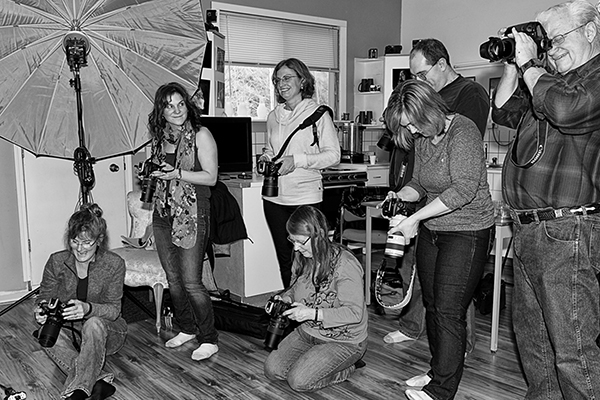
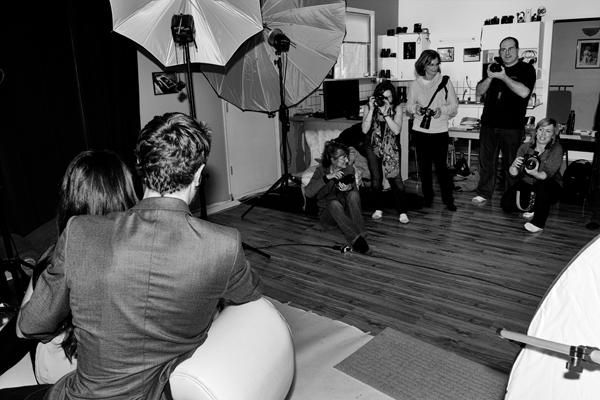
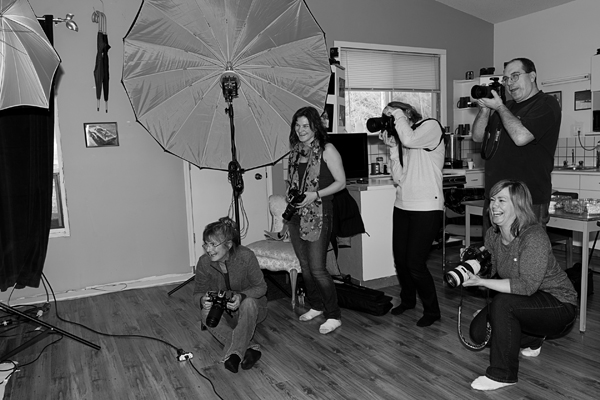
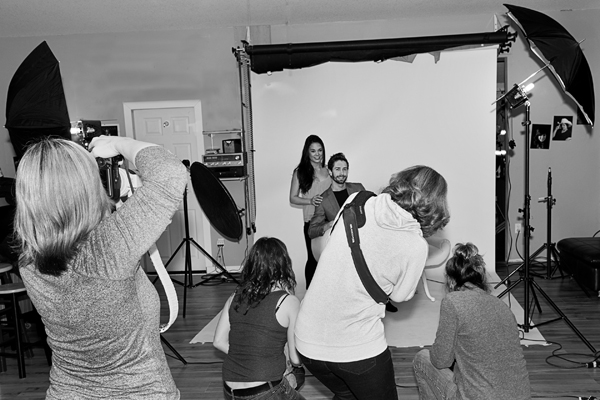
This past Sunday I lead the first day of a two-day workshop discussing posing and lighting. I hadn’t planned on undertaking any workshops this early in the year, but I had been getting requests from several excited photographers who are out there getting ready for spring and summer portrait sessions.

I finally made the decision to proceed when my friend Dave Monsees, owner of the Versatile Photography Studio near Kamloops, mentioned that photographers renting his studio told him they needed help in lighting couples. They lamented that most tutorials available were only about photographing one person.

I am sure if they browsed the internet they would have found what they were looking for, but working with live models is a lot more fun than reading articles and looking at pictures, so I hired two up-and-coming local models that fit that request perfectly.

In previous posts I have stated how I enjoy the enlivened interaction that happens when students of photography participate in active learning. So when I started getting requests that I offer  another session I crossed my fingers and hoped for an early spring, booked that large local studio, and hired two models.

During a workshop my job is to present information on the subject, and keep things going. I don’t like to be a demonstrator on stage and I rarely pick up a camera during the workshops I lead, unless it is to take a snapshot or two of photographers in action. And besides, when I finally let the workshop participants apply what we had discussed, there wasn’t room for me anyway.

The workshop dealt with modifying and placing light. We employed one, then two, and then three lights; and modified the light first with umbrellas, then changed to a softbox and reflector to create shadow, and, of course, that classic and compelling “Rembrandt lighting” effect.

This was an advanced workshop and I limited participation to seven photographers. As with all my workshops, my main goal is to help participants gain an understanding of how to use light. I want them to consider the “quality” of light instead of the “quantity” of light. I lecture to them that they should use light to “flatter” their subjects as opposed to only “illuminating” them.

I think that studying the mechanics of lighting includes two additional aspects, which are (1) experience, and (2) the willingness to step beyond lazily pointing a camera in a light filled room or out in the sunshine. Posing a model, or in our case, two models, seems to me to be more about engaging with the subject and being comfortable with telling someone how you want them to look. I once heard a photographer say that he never posed people because he thought is was rude to tell adults what to do. I can’t comment on that fellow’s work, maybe he was really lucky, but I expect there were lots of missed shots. I suppose he would disagree, or just plain ignore the words of award winning Dallas, Texas photographer, Caroline Mueller when she says, “What I look for in pictures (that) I take: eyes, hands, head tilt, body language, background, and use of space.”

I believe those photographers that are successful at portrait photography don’t hide behind their camera, but they start with a plan and are good at engaging, explaining, and demonstrating what their vision for the session is.

Now I am really looking forward to next Sunday. The few images I have seen so far are great and I am certain spending another day (this time with speedlights out-of-doors in the failing afternoon light) helping and watching each photographer’s progress is going to be a lot of fun.

class 3  class 4


Thanks in advance for your comments, John

My website is at www.enmanscamera.com

Photography as a Fine Art

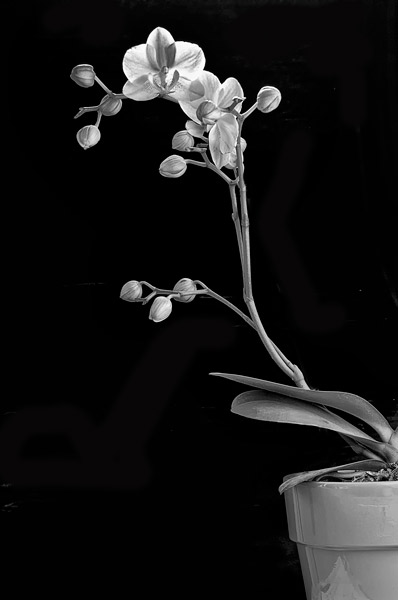
Orchid-2

I have discussed this topic before, but after a conversation I had about an upcoming photography exhibition in Kamloops with one of the judges and, of course, the heated debate now raging about that $6.5M photo of a canyon, I thought I would revisit it.

Wikipedia’s on-line encyclopedia says, “Fine art photography is photography created in accordance with the vision of the artist as photographer. Fine art photography stands in contrast to representational photography, such as photojournalism, which provides a documentary visual account of specific subjects and events, literally re-presenting objective reality rather than the subjective intent of the photographer; and commercial photography, the primary focus of which is to advertise products or services”.

Photography as art has changed since its beginnings in the mid 1800s, and, in my opinion, with the increased interest in photography because of the ease of making photographs since digital technology became the mainstay, photography as an art interests more and more people.

That art may be nothing more than a screensaver on one’s computer display. Some photographers go further and it is not unusual to see a personal photograph, or one of a friend, framed and hanging on the walls in someone’s home.

I have been interested in photography as an artistic medium for a very long time and have attended many exhibitions of artistic world-renowned photographers. And I think Wikipedia’s definition is worth noting because it separates what it declares as fine art photography from photojournalism and commercial photography, classifications that could divide those photographers in new ways for me.

By the middle of the nineteenth century photographers felt their art should be held in the same exalted status that painters claimed for theirs. Their contention was that it’s the photographer, not the camera that makes the picture. The goal was, and still may be, to convince not only the art community, but also those interested in creative arts that photography is art. Then, as now, the discussion was about whether the different aspects of photography, commercial, photojournalistic, or those created only as personal creative vision should be considered art.

The question photographers can ask is, whether the photograph’s goal is as “visual support”, to “sell a product”, as a “documentary”, or as a creative vision?

I have come to think that definitions like those of Wikipedia’s have changed. Maybe it is the way modern viewers see and use photography. That quickly-snapped portrait of a favorite pet displayed in the owner’s home probably needs an explanation to go along with it, but is cherished enough to be included with the rest of the owner’s art even though art scholars would disagree.

Remember, photographers are still contending with those critics that hold that only painting and sculpture are art and that photography is but a technology. For me the lines have become blurred, and I see photography as an artistic medium equal to others, although I am not altogether secure in categorizing any photographer’s work.

Debates like those in The Guardian newspaper, http://petapixel.com/2014/12/11/columnists-guardian-debate-whether-not-photography-art/ are fun, but in the end forget that the camera is just a tool, absolutely a high technology tool for sure, but a tool just the same, that helps any person to be creative and photographers only need to decide on their own particular style, and what, as Wikipedia states, is “created to fulfill the creative vision of the artist”. What that vision is should be entirely up to the photographer and the audience for whom the image is produced.


I always look forward to readers comments. Thanks, John

My website is at www.enmanscamera.com


A Photographer’s Walk on Snowshoes

Snoeshoeing-2

Wind-swept-field-2


forgotten-barn-2

Tracks-2-


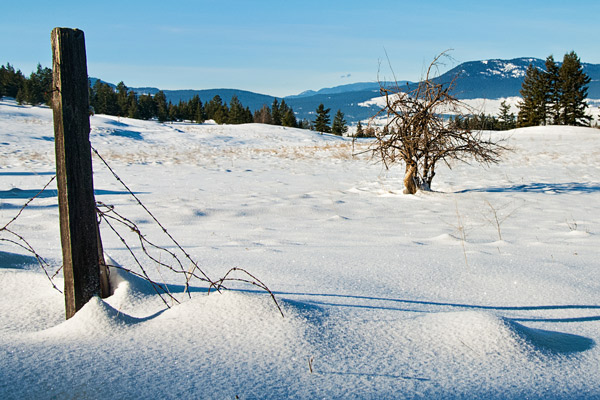
Almost a year ago to the day I wrote that I looked forward to enough snow-pack on the hills to snowshoe in, and as then, after a morning of shoveling a deep path to my chicken coops, clearing the driveway, and another path to the front porch, I was again taking my first winter hike up to the high meadow above my home.

Last year my January walk up into the meadow’s deep snow was on a sunless, stormy day. And I recall setting a high ISO so I could get a shutterspeed that would let me handhold my camera, and then returning home in a snowstorm.

This time I mounted a light-weight, 18-105mm lens on my camera, stuck an old tea towel in my pocket in case I got my camera wet from the snow, and headed out in the balmy minus 3C day under a bright, almost-cloudless, blue sky. And instead of struggling with low, flat light, my ISO was set at 400; and I added a polarizing filter to darken the skies, increase the contrast in the scene, and suppress glare from the surface of the bright white snow.
I trekked up the hill, and as I had so many times before photographed everything. When I stroll up into that long meadow I rarely see animals, however, they are surely there hiding, and I did hear a snort from something as it moved through the trees, and when I began to cross the meadow a crow cried a warning to hidden watchers, then everything quieted, and the only sound was from my snowshoes and my camera shutter as I photographed the Thompson River valley far below and the tracks I made through the meadow.

My last article was entitled, “What Makes Photographers Happy?” Photographers wrote me noting that, “there is nothing like a new lens” or “fun day with my clients”, and I can’t agree more. I must include the words of three bloggers that sent their comments to me: Northern Desert photography, Nature Photography by Martin Ryer and Jane Lurie Photography.

The first from blogger Northern Desert says that happiness is “The process of being out in nature searching for the shot, be it landscape or wildlife. I love the post processing, editing job. So fun to see what you can do with software. Love talking with and interacting with other photographers about photography.”

I also had to pause and think a moment about the words of blogger Martin Ryer who wrote about when he has“…results that exceed or even completely differ from any preconceptions I may have had. It’s when this happens that I feel myself entranced by all of the possibilities that photography offers.”

Blogger Jane Lurie’s comment is delightful, “…I’m very happy when my final result is actually what I conceived in my head when I saw the shot. Capturing that small moment in time is a beautiful thing.”

What great thoughts on photographic happiness and I agree with everyone.  As for me, I will include the following from philosopher and theologian, Paul Tillich, who wrote, ” Language…has created the word ‘loneliness’ to express the pain of being alone. And it has created the word ‘solitude ‘ to express the glory of being alone.”   To those words I will add that my quiet, solitary walk and photo excursion on snowshoes made me happy.

As always, I look forward to your comments. Thanks, John

My website is at www.enmanscamera.com

What Makes Photographers Happy?

Jada-2

I have read that there are 12 states of happiness. What they are, or how “happiness” is determined and is then defined, is beyond me, but I did find a short article that said to be happy people need to “anticipate with pleasure, savor the moment, express happiness, and reflect on happy memories”.

I know there are times and things that make me happy. Nevertheless, there are moments that no matter what my surroundings are, or the circumstances, I am just not happy. And I am sure I am not the only one that gets in a bad mood (or good mood for that matter) without knowing why.

I doubt one can find any studies on the states of happiness for photographers. So while readers think about what makes them happy I’m going to delve into that mysterious state.  Is it happiness about how things like camera equipment make them feel, or about how circumstances such as creating a good photograph make them feel? Most photographers are devastated when they receive a poor review on a picture, so there is lots of ego involved in their happiness. And I know that sitting around with other photographers talking about anything photographic is just plain blissful for me.

I don’t know any social scientists that I can call up, and I haven’t discussed happiness with any philosophers. However, I have always felt that photographers have a culture of their own. There are those who might argue that concept, but I am absolutely convinced that it is so. I constantly interact with other photographers in online forums, blogs, or talk to them personally, and those photographers are always ready and willing to tell me when they are happy or not.

Some are actually more interested in the technology of photography then the actual process of making pictures. I recall a guy that was happiest when he found a problem with a piece of photography equipment. He delighted in making test after test to find if a particular camera matched what the manufacturer or other photographers claimed. I’m disappointed when something doesn’t work as described, but this fellow would actually be down right cheery.

I had a friend that spent all his spare time wandering back roads. He’d show up at my shop with a grin as wide as all outdoors and stick his ipad or ipone on the counter for me to scroll through and happily describe how he photographed that hawk on the wire, the owl on a fence post or that eagle fishing on the river bank. What made him happy weren’t his pictures as much as his process of making pictures.

I know photographers that are continually changing equipment. Not because they find problems with what they own, or because their equipment is limiting, but because they read something, or talked to someone, about a new addition from their manufacturer of choice, and can’t live with out it. They excitedly talk about how wonderful that new piece of equipment is. I know their choices don’t so much meet a practical need as an emotional one, but they make it easy for me, and anyone else they talk to, to observe how darned happy they are with their new camera, or lens, and with, for that matter, everything they own.

This exciting medium has many levels and outlets to make one happy. There are portrait photographers, wildlife photographers, scenic and landscape photographers, sports photographers, baby photographers, those that specialize in plant photography and, of course, many more, each with differing sets of skills, and, to my mind, their own states of happiness. I don’t know if photographers have twelve states of happiness, or only the four I found in that short article, but I will say that I meet lots of people that are happy to be doing photography, and being involved with it in their own, very personal, way.

Care to comment on what makes ya happy?

My website is at www.enmanscamera.com