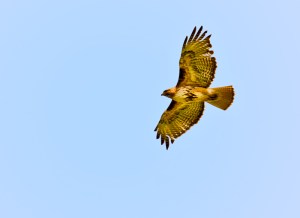
Photos of turtles will have to do.   


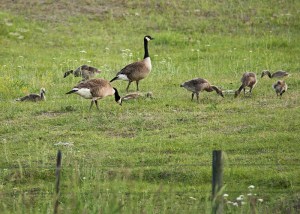
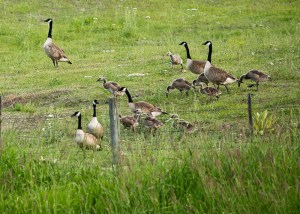
For the past month I have been visiting a little pond just up the road from my place hoping to get photos of geese and their chicks.

I have been going there with my camera equipped with long-lenses for years. Some times have been great with lots of geese near the road, like there were last year, but all to often they were too far away.

Last June the hill across from the pond was covered with geese. I am pretty sure that would be called a gaggle. (I have also heard people refer to a group of photographers as gaggle) Parents and goslings were everywhere and really didn’t mind my car after I parked and sat quietly for a few minutes.

This year I made trip after trip in the morning, at noon, then in late afternoon and finally evenings before I lost the light.

There are a lot of geese at the pond, but for some reason they are staying low to the pond and so far on the other side that even my 600mm lens isn’t doing them justice.

I wonder what caused them to stay such at such a distance this year. The road isn’t any busier than normal. They aren’t acting skittish, so I don’t think anything has been bothering them. Nevertheless, they are wild birds and I expect the first one there must have decided on a good spot and the rest nested nearby as they arrived. Good for them, disappointing for me.

I could have turned around each day and gone home for a beer, but the rural area I live in is filled with life in the spring. So instead I just moseyed along and keeping on the lookout along the roadside.

There are many old dilapidated buildings slowly dissolving into farmer’s back yards and I could have pointed my camera any of the many deer that are always munching grass in fields at anytime of the day. But, since I couldn’t photograph the geese I decided that deer and old buildings would be off my list and I should search for other wild things.

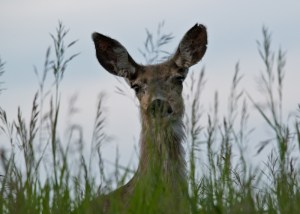
I wasn’t doing to well, and in frustration after my latest trip to the pond I chose a couple blackbirds and actually stopped to photograph a deer that peered out of the long grass as I passed. However, when my friend Jo stopped by, as I was about to leave on what I expected to be another fruitless trip, I invited her to join me on the drive.

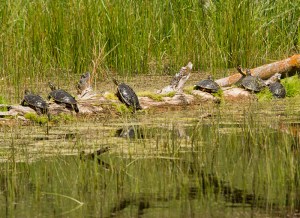
Sometimes it’s a fresh pair of eyes that is needed. Each day I passed a neighbour’s slough. I had seen turtles there before, but like the geese, they were eluding me. I drove slowly and Jo looking out the window suddenly yelled, “stop, there’s turtles”! Sure enough the wily little critters were sunning themselves all along a half sunken moss covered tree in the swamp. There were seven of them near one end and three resting midway down.

I finally did reach out with my long lens to photograph the distant geese, and I captured a couple shots of blackbirds, and there was that deer hiding in the ditch. I was bound to my goal of photographing anything wild, and have been keeping at that for days, but I wasn’t all that happy and maybe a bit bored with my subjects.

However, the septet of turtles changed that. I was pleased to have turtles for my subjects, so for this week the photograph of the turtles will have to do.

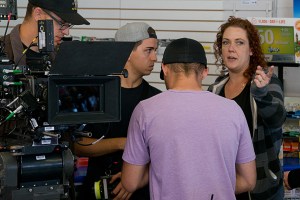
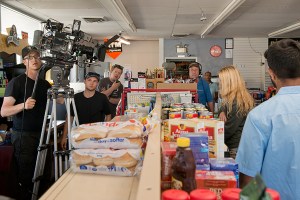
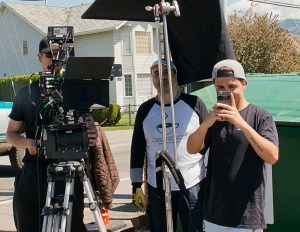
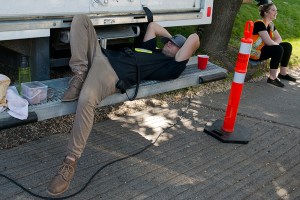
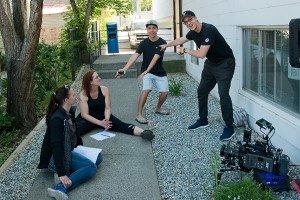
Photographing behind the scenes at a movie.   


My first full time job as a photographer was to document events for the Office of Education, Los Angeles California. Years later, after moving to Canada, I became a photographer for a University’s Public Relations Department.

During my 40 plus years earning my living as a photographer I pointed my camera at quite an array of exciting subjects, but it was those two early jobs that fashioned my approach.

This past week I was asked by writer and director, Cjay Boisclair, if I would act as a staff photographer for her movie, “The Bench”, for a couple of the shooting days.

I am retired and stay away from anything that demands that I be on time. But the thought of taking behind the scenes pictures intrigued me.

Although I have many, many times enjoyed watching movies being made, I have never actually been part of the film crew. “Film crew”, that can’t be correct. I wonder what they call themselves now? Nevertheless, I was sure the photography would be much the same as any public relations exercise.

Public Relations photography in my experience is physically active, there is never a chance to sit and one must to constantly be looking for animated subjects. I never saw or presented myself as being important as those I was photographing, and always preferred to sneak voyeuristically around. And although my photographs were used by news sources and much of the time were in publications, I never thought of myself as a photojournalist. Photojournalists tell a story, whereas my job was to document the interaction and hard work of the people in the event.

It was with that attitude that I quietly walked on to the set the morning of my first day.

I guess I forgot how small Kamloops is, one would think that in a city of over ninety thousand people there would be some anonymity, but alas, that was not to be. A complete stranger said, “John, right? They are around the corner.”

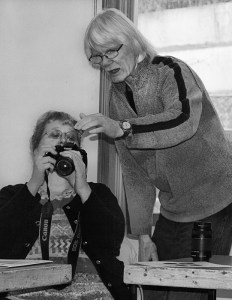
I photographed everything that happened behind the scenes for two days. I am sure that many star-struck, first time photographers might think, “what a great chance for me to photograph a movie”.   However, at this production there were three trained, creative, cameramen operating a two hundred thousand dollar camera, whose job it was to photograph the movie’s action. Taking pictures of the movie isn’t what I think my position as a still photographer needs to be doing. My job was to photograph the people that were actually making the movie and I did just that.

I shot for two tiring days. From time to time I was able to lean against walls, and once or twice even tried to sit down. But of course, as soon as I thought I could relax, I would see crewmembers doing something interesting and rushed to get that shot.

Mostly I wanted those classic images we see in the old newsreels of the Director in action. Pointing, talking to the lead, or working with the cameramen. The crew wasn’t huge and I got to talk to and photograph everyone working on “The Bench” at some point over the two days.

Photographing on a movie set was a new and certainly entertaining experience. I have always thought that movie people were a special breed, and now that I have had first hand experience being around them as they worked, I absolutely believe that.


Photographing flowers.    


Just after I got to my shop this morning I received a text on my phone that read. “ Hi, How’s your shop today? I hope you sell something. What’s your article going to be about this week?”

To tell the truth, at that moment I was walking down the street to get a coffee from Tim Horton’s and I hadn’t thought about my shop, impending sales or my article.

Just coffee. However, when I got to the coffee shop there was a line, so to keep from being rude I returned a text that said, “I dunno, me too, dunno.”

I’ll shorten this story by saying that about four or five hours later I received another text from my friend Jo that said, “I have pictures for you of flowers in your yard. Stop by on your way home tonight and get the USB drive. They’ll be edited to PSDs and ready for your article.”

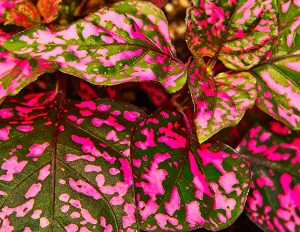
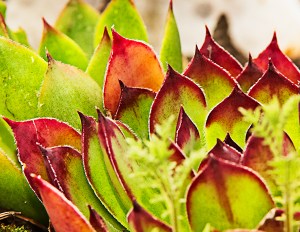
So the images I am posting this week are again from my photography pal Jo. However, this time she didn’t have to wander around in the rain.
Spring is just beginning and there are many plants in the process of poking out of the ground and blooming. I haven’t taken the time to photograph anything anywhere in the garden yet.

Maybe next week.

For me, photographing my wife’s garden is quite a time consuming process that includes a tripod, an off-camera flash or two, reflectors, and sometimes even a backdrop.

My wife used to complain that I enjoyed the photography more than her garden.

That may be so.

When I opened Jo’s images on the USB drive it was obvious that she was of the same mindset as my wife, and enjoyed the spring garden as much as she was enjoyed pointing her camera’s 70-200mm lens at everything growing there.

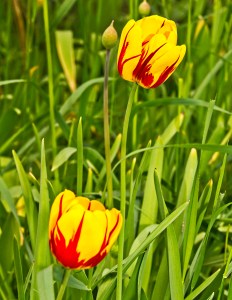
I have been noticing more and more flower pictures being shown on our local photographer’s page. I suppose Jo, like most of those that are posting flower pictures, could wander the mountain meadows around Kamloops, British Columbia. However,most of the pictures I see are of the same one or two early blooming wild plants, whereas the large fenced garden at my place has lots of different shapes and colours to choose from and if one is, like me, more interested in the image then the flower, a colourful garden is a great choice.

This is a good time to get out with one’s camera. Whether it’s to photograph plants and flowers in the rain or on a sunny day the growth and colours that spring brings is so stimulating.

The famous Canadian photographer Freeman Patterson, in his book, “Photography and the Art of Seeing” wrote, “ Seeing, in the finest and broadest sense, means using your senses, you intellect, and your emotions. It means encountering your subject matter with your whole being. It means looking beyond the labels of things and discovering the remarkable world around you.”


And thanks again to my good friend Jo McAvany.


Leading another class on photography         

The first class I ever taught on photography was sometime back in 1976. I think.

I had just moved from Los Angeles to Kamloops, British Columbia and a coordinator from the local Parks and Recreation Association asked me if I would teach a class for beginning photographers.

He had talked to some friends and found out that I had worked as a photographer for the Los Angeles office of Education and also spent time teaching grade school age children in private schools, so he thought I would be a perfect fit in their community education program.

I always liked sharing my knowledge of photography with those that, like me, were excited about this exciting medium and always enjoyed hanging out with other photographers. I had trained to teach grade school, but I wasn’t sure about adults.

Well, here I am all these years later. Gosh, 1976 seems so darned long ago. And I have shared my knowledge with so many people. I taught classes all over the province and was even employed as a college photography instructor for many, many years. So when a friend’s mother; who works for the Ashcroft community association asked me get up early on a Sunday morning and travel two hours to teach a photo class to fifteen eager photographers, lazy as I am, I couldn’t say no.

I designed the sessions I lead for busy adult beginning photographers that have lots of other stuff on their plate. I break my presentations into four separate headings that allow me to add information as I go along. I begin with Modes and give participants my opinion as to why they should only use and how to use, Shutter priority, Aperture priority and Manual modes. The terminology varies with different manufactures, but the discussion is the same. I can then easily plug in all sorts of tips and directions regarding their camera menus without loosing track of our exploration of Modes.

Naturally my next heading is Understanding Exposure, how could it not be after examining their camera’s Modes. Then as they scribble notes on the handouts I have given them I turn on my projector and begin my talk about Depth of Field.

Depth of field is, “that area in front of and behind the subject that is acceptably sharp”. Treating DOF as a main topic helps to show learners how the Aperture and Shutterspeed have a use other than just choosing a way to make sure their image isn’t under or over exposed.

Finally, and my favourite discussion of the day, I present Composition. The word composition gets thrown around a lot. I’ll read forums where members might say something like, “great capture, good composition,” or sometimes, something as meaningless as “I love your composition”.

I know they don’t actually mean composition as a photographic technique. I think it’s become an alternative word that means, “Picture”. They want a more modern word, and I suppose using the word “composition” instead of “picture” has sadly and ignorantly become that word.

Photographic composition is defined as, “the selection and arrangement of subjects within the picture area.” And my discussion is about using composition and compositional guidelines to enhance a photograph’s impact.

Those four topics allow me to interject all sorts of information about using their cameras and I can sum every thing up as I finish discussing Composition.

I always hope that those in attendance take the time to reread the handouts I gave them, browse their notes, practice their photography when they leave the same way one would when learning a musical instrument and when the opportunity arises, take another class on photography.

In my opinion the learning never should end.

What about Black and White photography?    

A fellow stopped by my shop this past week to see what kind of film cameras I was selling. I don’t think he was planning on a purchase as much as he was interested to see if there were still film cameras available and, likely, just wanted to kill some time in a warm shop after wandering along the freezing street.

He began by saying he missed the days when he would load his camera with Black and White film and go out for the day. I laughed and said there is no reason you can’t still do that. “You just have to set your digital camera to black and white only mode. ” Then added, “of course I prefer to convert my images to Black and White in post.”

I remember those days (Not so fondly I may add) when I would always carry two cameras to photograph a wedding or a family. One would be loaded with colour film and the other with black and white.  I placed a bright sticker on one camera so I would remember which had which film. And when I went on vacation I also would carry two cameras, one with black and white and one with slide film.

Always toting two cameras, and always changing lenses! Gosh, what a hassle lugging a big case with two cameras, lenses and bags of film.

I knew that fellow was just being nostalgic so I didn’t say any of that, but I sure thought about it and how much easier I have it now.  He commented how much he liked black and white photographs and said he still has enlargements he made years ago hanging on his walls.

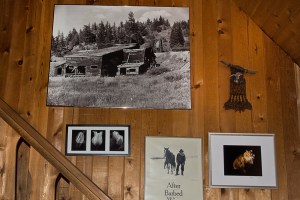
I also share is love for black and white prints. There are eight framed photographs that my wife and I made hanging on my walls. Including one that’s 3 feet by 4 feet. And there is even a B&W framed poster by Alfred Stieglitz on the wall behind the computer.

I agreed with him when he said that he thought that, black and white photographs, “convey a mood that stretches the imagination” and he mentioned that he admired several of the B&W portraits I have hanging in my shop.

That was a perfect time for me to quote Photojournalist Ted Grant, who is regarded as Canada’s premier living photographer, “When you photograph people in color, you photograph their clothes. But when you photograph people in black and white, you photograph their souls!”

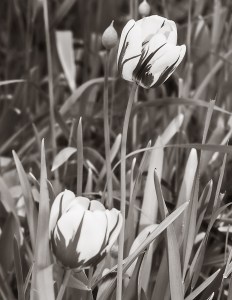
In an article in June of 2014 I wrote. “A black and white photograph depends on its ability to communicate, it doesn’t need to rely on eye-catching colours for its’ visual presentation. Those B&W images that stand and pass the test of time combine attention to subtle changes in light, composition, and perspective. And it stretches our creativity and forces us to visualize our world in different terms.”

I wouldn’t want to be limited to shooting black and white any more than I would want to be limited to only using one lens. Some images just seem stronger in colour. However, if I can again repeat what I also wrote in that 2014 article, “I remember a photographer once saying that he believed shooting in B&W refined one’s way of seeing. And I heartily agree.”


An early morning photo challenge                                         

My friend, neighbour, and photo pal Jo decided to give herself an early morning photo challenge. That meant after feeding her kids, 6 dogs, making sure her 13 year old son is ready for school and greeting her tired husband after his long night shift, she quickly sneaks out with her camera to create artistic images out of normally uninspiring objects she finds close to her rural home.

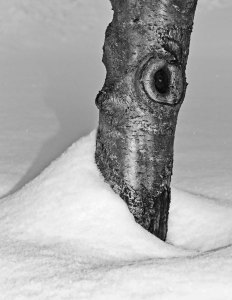
I first knew Jo was taking this challenge on when she texted me a picture of deer chomping on her neighbour’s bushes one morning. She casually added a close-up of snow that had drifted around a small tree trunk. I was thrilled with how she captured the play of light and shadow on something most photographers would walk past.

The mundane, normal features people ignore along the snow laden winter neighbourhood street as they dash from their warm homes, coffee in hand to jump in their cold cars, and join the morning battalion on the icy highway, are Jo’s chosen subjects.

I wonder what people think as they look out their windows at Jo all bundled up, holding her camera in gloved hands as she wanders the vacant streets. I can imagine her dodging oncoming cars as they slip along the icy snow packed street.

What those drivers are thinking when they see her standing calf deep in the snow, photographing a tree branch.

I’ll add this first quote by the iconic American photographer Annie Leibovitz, “The camera makes you forget you’re there. It’s not like you are hiding but you forget, you are just looking so much.”

I like her words, and I am pretty sure that most serious photographers get lost in the moment when they look into a scene searching to create interest out of some normally unremarkable object.

Of all the photography challenges people post on the many social media sites I think I like this one the most. It is hard for us to find interest in the world we walk by everyday. And forcing oneself to be creative with some unremarkable subject is a struggle, let alone wandering around on a cold February morning just after sun up.

I asked Jo why she likes to meander around with her camera in the early morning. She wasn’t sure, and at first only said, “because its peaceful”. However, I think there is more to that kind of challenge than searching for a peaceful moment. I know her enough to say that she is demanding in her photography, and is always exploring alternatives.

Photography is such an exciting medium that lets us examine the world around us in our own personal way. This kind of photographer’s challenge does just that.

I’ll end this with a couple quotes by Depression era photojournalist Dorothea Lange who wrote, “A camera is a tool for learning how to see without a camera.” And she also wrote “To know ahead of time what you’re looking for means you’re then only photographing your own preconceptions, which is very limiting, and often false.”

Volunteering your photography and using a flash           


This Christmas I volunteered to be a helper and photographer for a neighbourhood community friendship group.

Each year Dale Northcott, owner operator of Northcott’s New and Used, joins other local help organizations to put on a Christmas Meal for anyone in Kamloops that would like a big home cooked meal during Christmas.  This year Northcott asked me if I would take a few pictures of the event.

For those that might wonder about photographing a large room full of people, I’ll remind them that I use flash. I always have a flash attached to my camera when I photograph people close up, indoors or out. However, I never use the ineffective little pop-up flash that is part of the most modern digital cameras and I also don’t just slide a flash on the hotshoe.

I have never liked that bright directional light created by being inches away from the center of the lens. It is harsh and unflattering. The best would be to carry an off-camera flash mounted on a stand, but in crowded circumstances that doesn’t work very well. So the next choice is to have the flash mounted on a bracket that puts the flash up and off camera at least four or five inches.

That flash bracket is my choice. Most of the time it puts the subject’s shadow down and behind them and its slight distance from the lens makes a more flattering light. My Nikon flash comes with a frosted diffusion cup fitted over the flash head that modifies and softens the harsh, direct light of the flash.

I always test my location and try for a balanced light. Fortunately, in this location I was able to adjust the room lights to get plenty of ambient light bouncing off the walls and the ceiling so I wouldn’t get that “deer-in-the-headlights” effect.

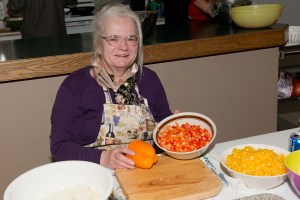
I think sometimes photos are of the organizers and volunteers get overlooked, and those were the people I approached as soon as I got to the hall. I am not one of those that nervously says, “Hi my name is so and so, can I please take your picture”?  I walk right up to the person and start talking as if we’ve always been friends. I rarely have to ask questions, because my new friends usually tell me about themselves, their organization and how important the event is. Then all I have to say is, “I gotta get a picture of you, hey grab that bowl or how about you wash some dishes…this is going to be a great picture.” And in this case I also said, “ I’ll be giving the pictures to Dale Northcott so you can get one.”

There was another photographer that knew many of the people sitting down to eat and I let him take their pictures. As I was about to leave he commented that one person asked him to delete their picture. I said, “and of course you did”, and he smiled and said, “yes I did”.

It was a fun event to attend, I liked taking pictures of the volunteers and organizers, and I got in great conversations with people that finished eating. My favourite comment was “did you get enough to eat” and “can I get you more”?

I know there are those that seem to believe their cameras are too valuable to be used for free, and the photographs they make are also too valuable to be given away. In the forty plus years I earned a living in this exciting medium of photography, I have never been one of those people.

My best wishes to readers on this festive season. And I hope everyone has a Happy New Year.

Photos in the alleyways.  


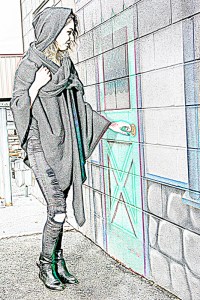
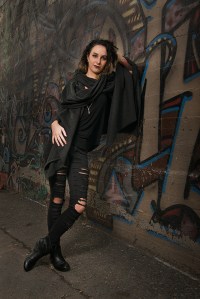
This past week my friend Jo McAvany asked me if I would be willing to help her with using off-camera flash in daylight. I like controlled studio lighting, but I’ll admit that balancing flash lighting in the bright daylight is much more fun.

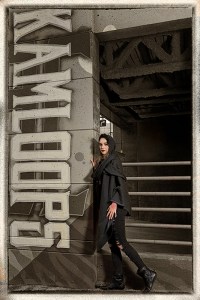
She texted me saying she had asked her friend Heather to be our subject. My question was “where do you want to do this”. I think I held my breath at that moment hoping she wouldn’t suggest wandering around in the woods to photograph our young model. If she had I probably would have feigned an attack of the flu or something just to get out of spending a boring day doing what every beginning photographer seems to be doing now days. However, Jo said, “I’d like to go downtown.”   My response was, “Great lets pose your friend in the alleys”.

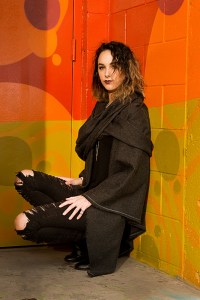
I am not sure if it was because of the shopkeepers or random artists, but the alleyways in downtown Kamloops are damn colourful. There are murals, wildly painted back entrances and large brightly coloured signs that fill complete walls. One might expect to find trash, discarded store goods and rusting garbage bins. But nope, it was as if someone had said, “Hey, there might be a photographer or two that want photograph our alleys so lets make ‘em nice.”

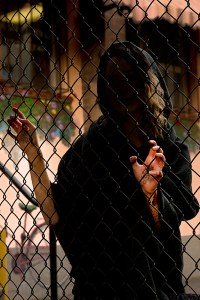
We went from coloured wall to coloured wall, posing our ever-patient subject in doorways, against brightly decorated enclosures and behind fenced walkways. I think this was Heather’s first time posing for photographers, or at least having two cameras pointed at her. And yes, she had to endure my constant discourse about balancing light, shadows, exposure and off-camera flash.

Sunday was a good choice. Other than the cold breezy November day, it was quite pleasant. Well, except when the wind caught the umbrella that was attached to the flash and stand and sent everything crashing to the ground.

There was no traffic zooming down the ally and other than some fellows sitting out of the wind behind a building and a street cleaning machine quickly scrubbing by, we had the alley to ourselves.

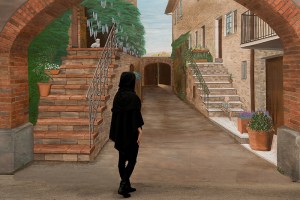
The three of us ambled up and down the alleys. There were so many places that demanded Heather to pose for us in front of. We even tried adding her into one of the large murals that looked like a walkway into an Italian villa. There was a small green door that someone had painted, and both Jo and Heather agreed that it would be like Alice in Wonderland if Heather reached down for the doorknob. We could have spent the day wandering the alleys photographing Heather, but eventually the cold crept in and we decided it was time to finish photo session talking and warming up at a coffee shop.

We had a good day. We discovered a new place where we can do photography and we all worked together to produce some interesting photographs.  Heather is leaving town for a job in the fast paced coastal city of Vancouver, and our photos will surely give her some great memories of the city she has been living in for some time now.

I think Jo and I might invite a few photographers and models to join us another time to do a bit more exploring around the back alleys.


Light the Portrait workshop        


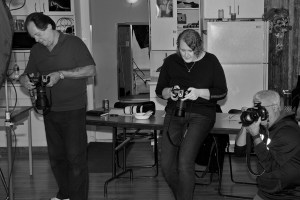
This past weekend I lead the first day of a workshop titled “Light the Portrait”. My goal during the two sessions was to help photographers understand how to use light, indoors or out, when they photograph people.

Fear-of-Flash has always been a topic of discussion for photographers photographing weddings, and portraits both indoors and out.

American photographer and author of the Strobist.com blog David Hobby said,  “…You hear a photographer say, “I’m a strictly available light photographer, I’m a purist.”  He continues, ” What I hear is, I’m scared of using light so I’m going to do this instead. Well, for me lighting was a way to start to create interesting pictures in a way that I could do it.”

It’s with those words that I began the workshop that would discuss using both studio lights and speed lights. Adding that personally, I always use a flash when I make a portrait of someone inside or outside. I don’t care if the ambient light is bright or dim.

My goal is to not only help photographers gain an understanding of off-camera lighting, but to also convince them that using flash will separate their photography from those that rely on natural or as I prefer calling it, “ambient light”.

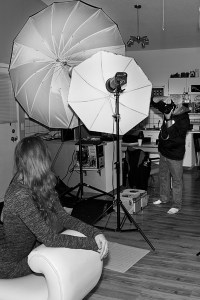
The first session was about the big studio lights and accompanying light modifiers like, umbrellas, softboxes and reflectors, to name a few we employed during the day.

Those of us in Kamloops British Columbia are fortunate to have a local portrait studio that is not only large enough for a class, but also is packed with all sorts of lighting equipment, backdrops and change rooms for models. The portrait studio, Versatile Studio, also comes complete with a kitchen and dining area. And there are all sorts of props for posing.  All I needed to do was write up my lesson plan, print some handouts, book the studio, hire a model and show up in time to start leading participants into the exciting world of off-camera lighting.

I enjoy leading; I like that word better than “teaching”. I know to teach “is to show or explain to people how to do something”, but most of those that attend know a lot about photography and have already been shooting portraits for some time. All I need to do is build a bridge for them between what they already know and what I am presenting.  And as I stand with them in the studio/classroom I get watch that quick tightening of shoulders, widening of eyes and smiles when they suddenly get it. When that happens I can’t help but smile too.

Well, the first day is over and, as usual, they tired me out. However, I am already looking forward to next week with those enthusiastic photographers (and our energetic model). I wonder if I should begin next week’s session with the words of legendary filmmaker from the 1920s, D.W. Griffith. “Lights camera action”.


A Convocation of eagles                                                


I have always liked eagles.

I grew up in Salt Lake City Utah where the state bird was the California gull. There were seagulls everywhere and one couldn’t go anywhere without lots of them overhead. We affectionately called them “Mormon Bombers”. But eagles weren’t all that common and there were only I few times that I can remember ever seeing an eagle near the city, and on those rare occasions they were high and off in the distance. At that time one had to be somewhere high in the mountains that circle Salt Lake City, and even then, spotting one wasn’t that common.

I lived in many places, but until moving to British Columbia my eagle sightings were a rarity. Imagine my excitement I when found that no matter where one lives in the province I came to call home there seemed to always be eagles. Gosh, go to any fishing town and the skies and wharfs will be crowded with eagles.

Where I live, spring, summer or fall, and even sometimes in the frozen winter, while on my 45-minute drive to Kamloops along the Thompson River there are eagles watching from the trees.

This spring the water has been unusually high in the small streams and lakes in the countryside around Kamloops, and now that the rains have ceased and the drying summer heat is here, the once flooded farmlands, lakes, and meandering streams have trapped fish.

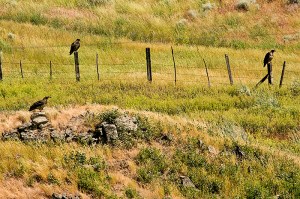
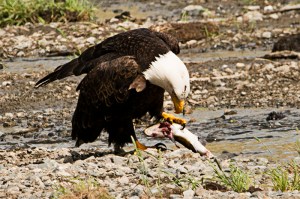
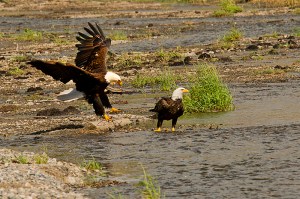
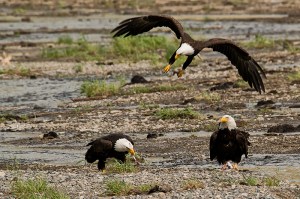
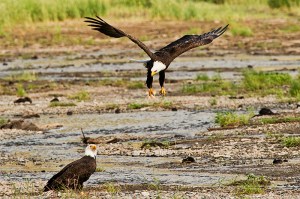
All one has to do is drive up into the farmlands out of town, pull the car over, wait a bit and there will be eagles. Until I stopped I hadn’t noticed how many were sitting on fence posts and in the trees along the road taking turns eating hapless fish caught in shallow creeks along the road.

They were spooky, eagles usually are. I pulled over and waited as other people excitedly stood by their cars pointing, talking loudly, and holding their cellphones at arms length to snap pictures of the many eagles flapping low to the ground and eating.

I positioned my car so I could open the door with my beanbag lens rest on the window ledge. I knelt comfortably, put my 150-600 on the bag and drank my coffee as I waited for the big birds to calm down and return after all the cellphone photographers left.

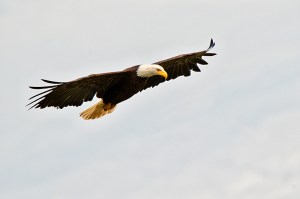
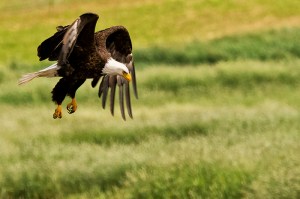
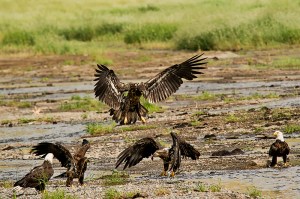
And return they did. I have seen larger convocations of eagles (yes. That’s the right word, “convocation”) when I visited towns on the coast, but that many eagles sitting, eating and flying around a few feet off the ground so darn close to a busy road was a bit unusual.

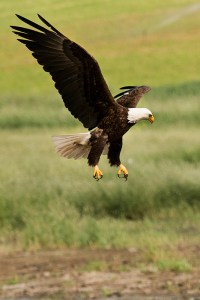
I haven’t had my big zoom lens very long, so this was my first experience using it to photograph flying birds. It took me a few shots to get comfortable with all the movement. There was a lot of commotion around one big trout, with several adults and youngsters demanding their turn. Nevertheless, the eagles were easy to photograph, their movements are slow and predictable. That excited gathering ignored my big lens poking over the car door, and they only flew off when another car stopped and people got out. When that happened I just relaxed, had another drink of coffee, and waited till I could start taking pictures again.