Photographing the Holiday Train   

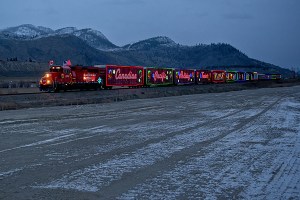
Here come the train

Train 2

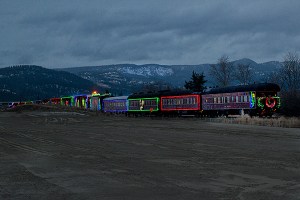
Holiday Train 3

Passing Train


Last week I wrote about how I enjoy everything about the Christmas holidays; the bright colours, the gaudy decorations, the sentimental music, the silly TV programs, and especially the festive city lights.

To that fun list I must add the Canadian Pacific Holiday Train. Each December, for the past 17 years, the CP Holiday train has travelled east to west across Canada. And fortunately for my wife, Linda, and I the Canadian Pacific Holiday Train rolls along the railroad tracks that follow the wide South Thompson River a short distance from our home in Pritchard, British Columbia.

As with last year, the train passes by just as the light begins fading around 4PM. The timing could not be better. There is still some illumination in the sky, but not enough to ruin the bright coloured Christmas lights on the train’s engine and cars.

Last year we positioned ourselves across the river for a wide panorama of the train. However, this year because of the construction and repositioning of the highway, we were able to choose a location very near the tracks that gave us plenty of time to prepare when the train first came into view and an interesting three-quarter perspective as it rushed towards us.

When we were across the river last year the long focal length lenses worked best, but this because we were so close this year we chose wide-angle lenses. Linda had her 24mm and I used my 24-70mm. Both were perfect.

We arrived about ten minutes early, made some test shots to check the fading late afternoon light, then waited with our hot chocolate to keep warm.

With the train’s movement I knew we would need fast shutterspeeds. I selected ISO 3200, which let us both use 1/350th of a second.

Linda said, “There it is!” When the train roared into sight, we jumped out of the car into the cold wind that was coming at us off the river and took pictures as it passed. The engineer tooted the horn at us but we didn’t have time to wave back and take pictures too. The whole event was over in about 40 seconds. Ha, what a rush! Then we got back in the car and ten minutes later we were sitting in our warm home finishing up our hot chocolate.

Well, one more holiday photographic occasion is over, but I know there will be more opportunities between now and January 1st. This is such a grand time of the year.


There is Nothing Like Photography  

White church

Fraser River view

Anacortis Oil Refinery

Lilloet

Coastal tree view

Hay Field


“In visual terms there has been nothing like photography in the history of the world. There is no vocabulary for it. Photography literally stops something dead. It’s the death of the moment. The second a picture is taken that life is held, stopped and over. That moment is over.”
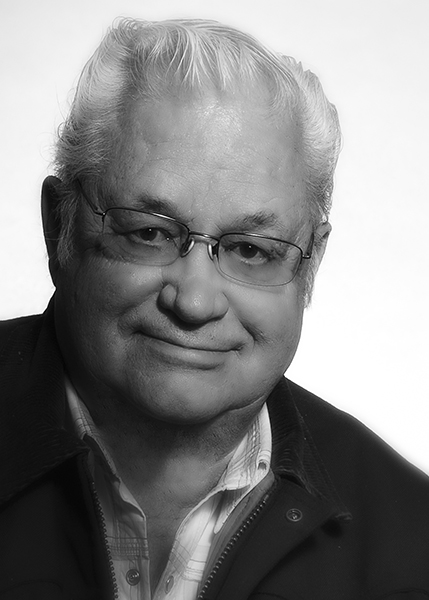
I found this quote by photographer Richard Avedon that I had tucked away years ago into the pages of a book of photography by Eliot Porter entitled, “Intimate Landscapes”.
Photography is powerful that way. There has never been a medium that has captured the interest of so many people like photography. When it became popular in the 1800s, no one could have envisioned how important to the world and to our personal lives photography would become.

For those of us in Canada the first known photograph was by an Englishman named Pattinson, here on a business trip in 1840. He was a student of an early form of photography perfected by Louis Jacques Mande Daguerre and had stopped at Niagara Falls to produce the now cherished historical Daguerreotype photograph.

The Daguerreotype would have taken more than 20 minutes for the scene to expose on a silver-coated plate inside his camera. Later he would surround the plate with warm mercury fumes that would slowly make the image visible.

I begin to think about photographing the landscape near my home this morning and I almost headed out, but the flat light and icy cold rain made me change my mind.

To keep myself in the mood I decided Eliot Porter’s book of photographs from northwestern New Mexico and southeastern Utah would be perfect to review with a cup of coffee. I find Porter’s photography stimulating.

Porter wrote, “The natural world has always attracted my eye: associations of living and inanimate phenomena, from the tropics to the poles and from rain forests to deserts, have been favourite photographic subjects for almost half a century. Grasses and sedges, especially, appeal to me – an appeal like disordered hair across a face, or a windblown field of hay before the mowing…”

Reading his or any other book on photography for that matter, helps me examine the way I make photographs and try to photograph things differently.

I do think photographic ideas and opportunities sometimes happen in a moment that once passed will never be the same. Many times I just want to make a photograph for no other reason than it is fun to make.

Here is another quote from Porter’s book that I endorse as well. Porter says, “I do not photograph for ulterior purposes. I photograph for the thing itself – for the photograph…” I like that. Sometimes just the process of making a photograph for no other reason than doing it is enough.

Photography in this digital age has become so very easy, but I think good photography can be as time consuming as it ever has been, requiring practice and education by those that take it seriously.

As I turned the pages of Porter’s book I thought about how nice it would be if the hills above my home get lots of snow in the coming winter. If you have a moment check out landscape photographer Eliot Porter in your local library, or on-line, and hopefully his photographs will inspire you as he does me. You might also look up Richard Avedon.


Infrared, A Completely Different Feeling….

Pritchard Station

Riverside

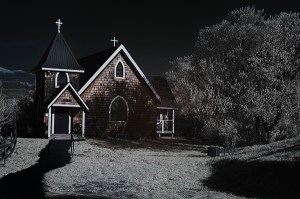
Monty Creek church

Fence along a dirt road

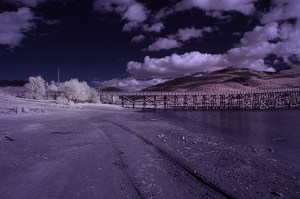
Pritchard Bridge

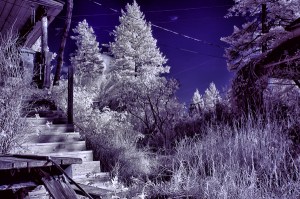
Back Porch

Infrared, A Completely Different Feeling

In my last article I discussed how easy it is to make creative changes in one’s photography by using a camera converted to infrared. I wrote that photographers have the option to creatively challenge themselves by selecting different lenses, choosing to produce black and white images, electing to use highly manipulative post-production techniques, etc., or any combination just to mention a few. Then I added one more creative tool to the list that I use, a camera converted to only capture images of the world around me in infrared.

Infrared allows a photographer, and gives the viewer, a completely different feeling of a subject. Making an image with a modified camera is an exploration and a discovery that moves a photographer far from the usual. I like the sometimes-surprising tones that I can obtain when I convert the image to black and white. Like any form of photography, or art, it’s all a matter of taste.

Reflected IR light produces an array of surreal effects, vegetation sometimes appears white or near white. Black surfaces can appear gray or almost white depending on the angle of reflected light, and if the sky (my favourite part of the infrared image) is photographed from the right direction it becomes black. The bluer the sky, the greater the likelihood of an unworldly effect; and white surfaces can glow with an ethereal brightness.

The response I received from readers got me thinking about how much I like shooting infrared. That’s been a long relationship. My first forays with infrared during the 1970’s were began with infrared colour transparency film and then with infrared black and white film.

Now that I have set film aside I am more than content to use a converted digital camera. Besides it’s much easier with digital than the arduous process we had to contend with when we used film. Infrared film had to be loaded and unloaded in complete darkness, then processed in metal tanks that kept the film from getting fogged. We attached a deep red filter to the lens. The deeper the red the better the effect, and because of the dark red filter things become very hard to see. Oh, and the exposures were long if the sun wasn’t bright.

In spite of that infrared photography has had a strong following of creative photographers for as long as I have been involved in photography. And now with the light gathering ability of modern sensors I think that following is stronger than ever.

In an article I wrote about using infrared film titled “Photographing a Different Kind of Light” I said, “There are those who believe a fine art photograph must represent reality, but reality doesn’t necessarily take into account that there are differences between what one sees, what the photographer’s camera produces, and what the photographer was trying to capture.” I think a photograph is only a representation of a particular vision of reality.

Infrared allows us to photograph a world illuminated by infrared light, that part of the colour spectrum we can’t normally see, and produces intriguing, exquisite and sometimes unearthly photographs that can’t be captured in any other way.

Photographing Eagles along the Highway       

Eagle of all atitudes

Young eagles

Young eagle

Waiting eagle

In the warm sun

Watching young ones

Fly, there's a photographer

Fly away


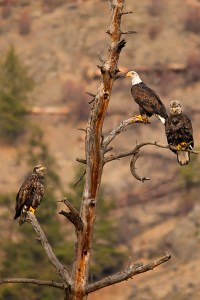
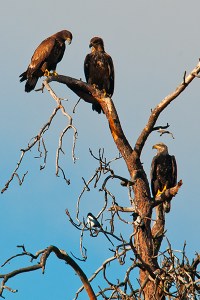
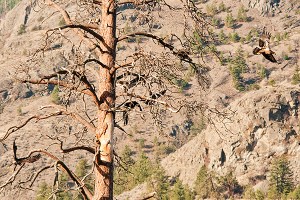
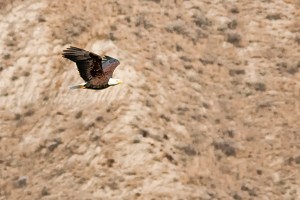
Eagles come in all shapes and sizes, but you will recognize them chiefly by their attitudes.” I don’t think British economist, E. F. Schumacher was really discussing the kind of eagles my wife and I saw perched in trees along the river, but his quote perfectly describes a picture Linda took of three eagles

Winter is on its way and eagles have been moving west along the South Thompson River towards the warmer feeding grounds on the pacific coast.

My commute to Kamloops from my home in Pritchard is on the Trans Canada highway that runs parallel with that wide river and this year it has been fun to see how many eagles we can count before reaching Kamloops.

After counting 35 eagles on our way to town the previous week Linda mentioned that she’d like to try taking some pictures. So after waiting until the sun was high to the south last Wednesday we made the drive to see what we could find.

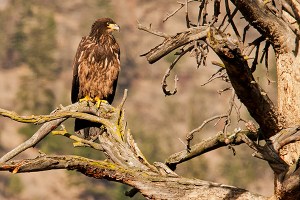
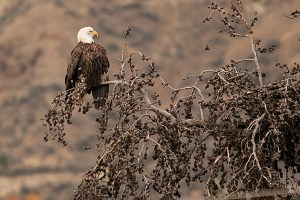
The traffic on the Trans Canada is constant and fast moving with lots of big, transport trucks. But with some preparation it isn’t that big of a deal to quickly pull a safe distance off the road to photograph eagles in the tall, dead trees along the river in which the eagles like to perch to watch for fish. In one tree alone we counted fourteen eagles, some mature but mostly adolescent.

My job is to drive and my wife’s is to photograph eagles. I pull over, stop and turn off the car to reduce vibration caused by the engine, and Linda rolls the window down, plops a beanbag on the frame and positions her heavy 150-500mm Sigma lens out the window and starts shooting.

It would have been nicer if we had a way to get closer. However, even if one got out of the car, struggled through a deep ditch, crossed the railroad tracks and climbed over farmers’ wire fences, I am sure the skittish eagles would just fly off anyway.

Linda had a pretty easy time of photographing those eagles from the car anyway. She had selected Shutter Priority on her camera with a shutter speed of 1/650th of a second and 650 ISO. Yes, there were some shots that didn’t turn out, the car would shake when big trucks passed by and every so often clouds would block the sun. But she got some great keepers.

As exciting as it is for those of us here in the BC Interior to see 40 or 50 eagles in the trees along the river, in a few days lots of those big birds will be making their way down the river to join many, many more eagles congregating on the Harrison River to feast on spawning salmon.

The Fraser Valley Bald Eagle Festival began 20 years ago and this year it will begin on November 28th at Harrison, British Columbia. This is an annual event with the migration of thousands of Bald Eagles returning to the Harrison Mills area to take advantage of the spawning salmon.

For photographers the place to be is where the Harrison River widens with shallow gravel bars for the returning salmon to spawn. Organizers say it is possible to see up to 10,000 Bald Eagles feasting on salmon.

Bridge Lake Workshop Wireless Off-Camera Flash              

OffCamera Workshop 1

OffCamera Workshop 2

OffCamera Workshop3

OffCamera Workshop4

OffCamera Workshop5

OffCamera Workshop7

OffCamera Workshop8

OffCamera Workshop9

OffCamera Workshop10

OffCamera Workshop11


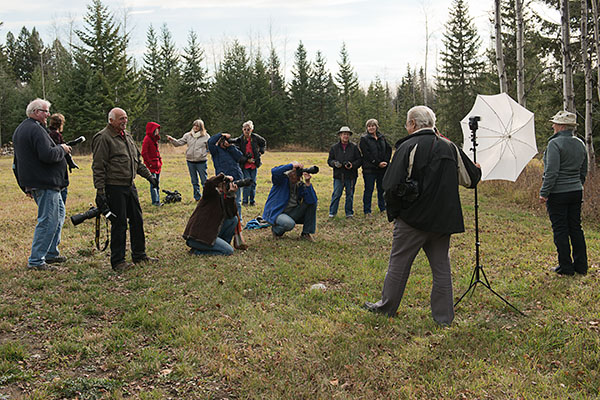
Last Sunday saw me making the scenic two-hour drive north to join the Bridge Lake Photography Group. I have been following that creative and talented group of photographers, (www.bridgelakephotogroup.com) since a long time friend, Derek Chambers, got in touch with me about a year ago. On Sunday I led a full day workshop for them about using off-camera speedlights indoors and out-of-doors.

There is so much that I want to tell photographers when they first attempt to use flash as a tool to create better photos instead of the flash being an uncontrollable device photographers perch on the top of the camera when it’s too dark in a room to take a photo.

In my opening presentation I had to hold myself back as I sometimes realize I am talking too fast. But I get excited and I really want to move from lecturing in front of students, and go to the studio setup where the learners, not me, are center stage. That’s where my fun, and, assuredly, the participants’ fun begin.

I always enjoy the enlivened interaction that occurs when a student of flash photography takes that first shot with one of the flash set ups. Usually, no one ever wants to be first. Everything is strange. The flash that usually is attached to their camera is now attached to a softbox or an umbrella. I always have to prod and coax the students to begin, but I can hardly wait for the first “oohs and aahs” that happen when they see the results of their first photos.

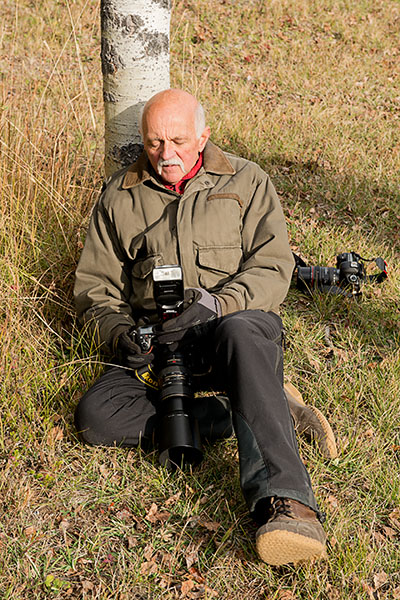
My job is to present information on the subject, and keep things going. I don’t like to be a demonstrator on stage and rarely pick up a camera during the workshops I lead. That is left to the participants, and watching them learn is the fun part for me. After everyone crowds around that first volunteer’s camera and sees the picture it is all I can do to hold them back.

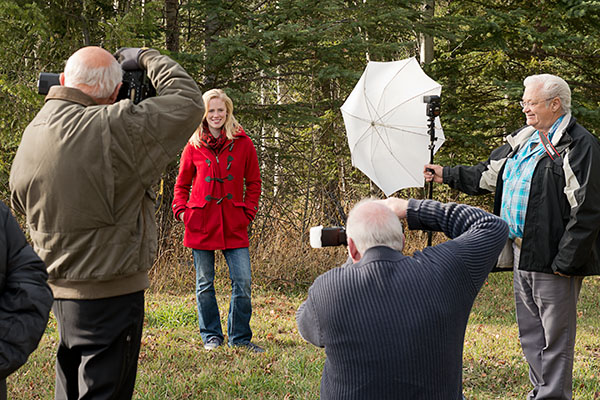
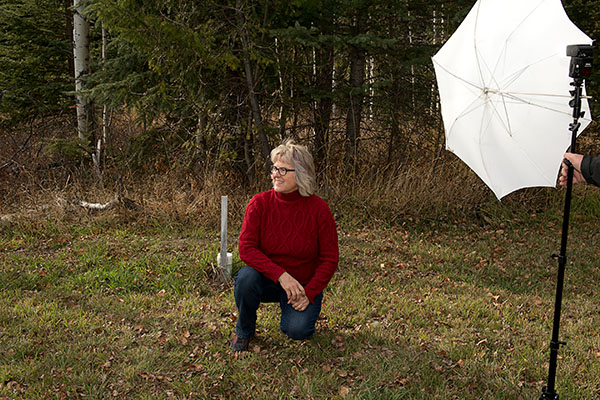
Our ever-patient model was overwhelmed as she tried to pose for everyone at the same time. She pleaded, “Where do I look?”   I laughed and loudly said to that excited scrum of photographers, “If you want her to look at you yell, ’Me! Me! Me!’”

We spent the morning shooting in the inside studio. For that session I had the flashes set to manual mode so their output would always have the same power. That is the easiest way. If more light is wanted on the subject move the flash forward. Less? Move the flash away.

After lunch we moved outside and I set up one flash with a shoot-through umbrella, however, this time the flash was set to TTL mode. When using flash in an indoor studio one synchronizes the camera’s shutterspeed to the studio flash, and uses the aperture to determine the exposure of the light reflecting off a subject. Progressing, however, to an out-of-doors situation with TTL a photographer must balance the natural, ambient light with the off-camera flash; and using flash effectively is more about creating and controlling shadows than about filling them.

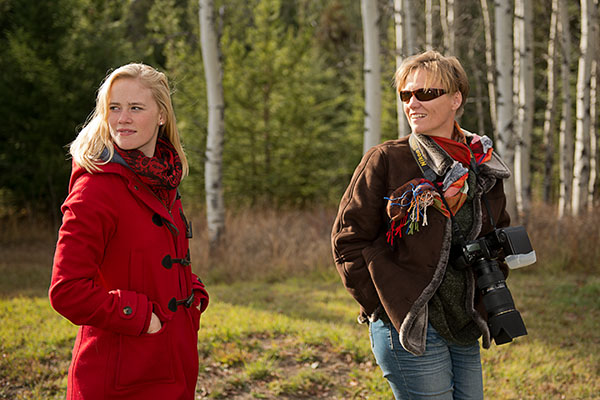
We walked out into the bright day and our model had barely reached a location in the meadow before 15 excited photographers got down to business. By then they weren’t at all shy about getting shoulder to shoulder in the process of experimenting, exploring, and learning about outdoor lighting.

I just received an email from Chambers saying, “You’ve definitely added a whole new dimension to our photographic adventures. Thanks a lot.” Gosh, a whole new dimension to their photographic adventures. That is one of the best “thank you’s” I have ever received.

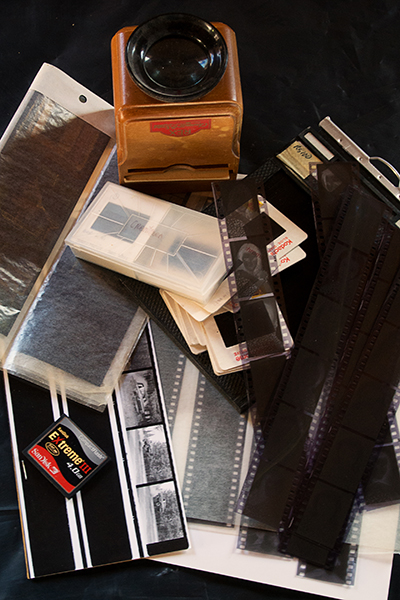
Film Cameras     

Film Photography

I was a bit surprised this past week when a couple loudly told me they preferred using film and doubted they would ever bother with digital. They smiled knowingly while pronouncing digital as an in inferior way of doing photography, and that those that used digital cameras couldn’t make good pictures without a computer. Of course, I told them I disagreed, but I also had to say that they should use whatever makes them comfortable. I like black and white film and mentioned that also.

I find that many photographers who use film cameras instead of digital constantly make sure others know their choice, and like to offer a rationale for using film with statements as they did, and saying, “This camera has always taken very good pictures why would I change”. I can’t argue with what seems to me a reasonable statement, however, in my opinion, the difference between digital and film is like driving a 1970’s car and the latest 2015 model car across Canada.

As with film, I really liked those old fuel-guzzling, muscle cars, but the smooth, inexpensive performance, the stylish comfort and the myriad of options available for the operator of the 2015 model car will make the experience safer and more relaxing and than the 1970 version, just like using a digital camera does.

This couple were so emphatic about how great the pictures were that their film cameras produced pictures that I naturally assumed they do their own darkroom work. But no, they take their film into a lab that processes it, then scans it to a computer, then with predetermined settings determined by a computer set up by some technician they get their prints. Hmmm…., not much photographer input there, and a lot more “digital technology” then I cared to mention. Oh well, at least they are taking pictures.

Later I as I contemplated about when I used to shoot film I thought, there was something to be said about the permanence, and how it demanded we get it right the first time. There were no second chances, and if more than 36 exposures of some subject were needed there was that “dead in the water” moment while changing film unless I had a second camera hanging around my neck. Forethought was a required option; and with regard to multiple cameras I can remember packing a bag with one body loaded with black and white film, another with colour film, and a third with slide film.

When referring to the time when we both earned a living as photographers using film, my friend Alex commented, “Oh, the days of click and pray.” As I wrote, there are no second chances. Especially for a photographer that relies on a lab for processing and printing that roll of film.

I will say that shooting film certainly slows one down. Shooting a roll of film every now and then might be a good idea. One can easily pick up an old film camera and put a roll of film in it for less than a $100. Relying on a lab for colour processing might lift the cost much, but I have no doubt with a bit of searching we all could find someone with a home dark room to process a roll of black and white film. I don’t know if that is getting back to basics, as a photographer that I met called shooting film, nevertheless, it would be fun to use one of those heavy, old, shiny, metal cameras again. And who knows, using film might become a regular way to, hmmm….get back to the basics of a time gone by.

What Inspired or Inspires you to do Photography     

Inspiring Viewpoint 2

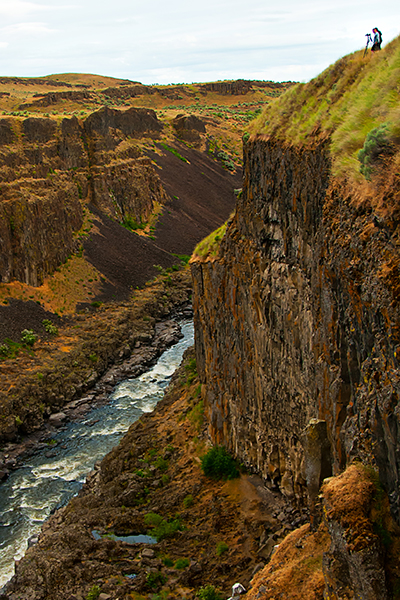
Palouse river canyon 2


A member of a photography site I frequented some time ago posed the question, “What inspired you?”

I took that to mean what inspired you as a photographer?

One would think that a question on a photographer’s website page would be a great opportunity for photographers to talk about those that encouraged, influenced, or affected their development in this exciting medium.

Anticipating discussions on celebrated photographers who had inspired others on that forum to get into photography I looked forward to reading members replies. However, I was surprised and disappointed with how few took the time to respond, and those that did seemed silly by only naming long gone painters like Rembrandt. Rembrandt? Not one member on that photographer’s forum mentioned another photographer.

Unable to contain myself I wrote, “I was inspired to do photography by photographers not painters. Those I admired and inspired me at different times include Man Ray, Richard Avedon, Irving Penn, Arnold Neuman, Gregory Heisler, Sarah Moon, Sheila Metzner and Annie Leibovitz. I must also mention scenic photographers like Elliott Porter, Ansel Adams, Edward Steichen and Edward Weston.”

Today I sent a friend a picture I had taken of him and several other friends in the early 1970s. I remembered at that time I was rarely without a camera, and how frustrating that was to some that just got tired of my constant picture taking. That’s when I recalled the preceding post on inspiration and my response.

I suppose there are painters and sculptors I like, but do they inspire my photography? No not really – I look to photographers for that. The first photographer and artist that inspired me all those years ago was Man Ray. It was after viewing his fascinating pictures that I began to study photography.

However, it is the second photographer on my inspiration list, Richard Avedon that I’ll quote here, “I think many photographers create in order to survive, both emotionally as well as financially. For a photographer, taking a photo is just as important as breathing”.

Sometimes when I see a photograph that I like I get excited. I might not be able to go to the location or find the subject of that picture, but it still makes me want to grab my camera and begin searching for something. I could say that photograph inspired me to create one of my own in my own personal way.

In my list to that forum I forgot to include the famous Canadian nature photographer and author, Freeman Patterson. I think any photographer interested in photographing gardens or landscapes will find inspiration in his photographs and his writing. Patterson wrote,  “Seeing, in the finest and broadest sense, means using your senses, your intellect, and your emotions. It means encountering your subject matter with your whole being. It means looking beyond the labels of things and discovering the remarkable world around you.”

There are many things and people that inspire me, too many to write down here, but the original post was on a photographer’s forum, so it’s photographers not painters that I thought about. There are many photographers past and present whose images are worth searching for, looking at, learning from, and of course, gaining inspiration from that will surely affect one’s own photography.

I always enjoy everyone’s comments. Please don’t hesitate if you have a moment.

Thanks, John

Viewing Scenic Photographs   


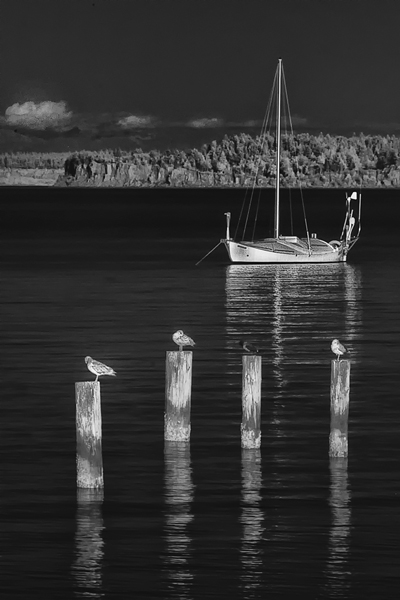
seagulls and boat 2

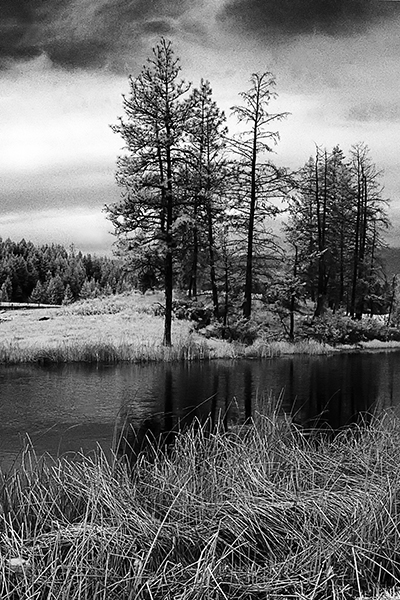
Falis Pond 2

Wolf ranch

I enjoy looking at photographs that seem to have been made with the goal of saying something about a moment in time or place. Sometimes I even get a sense of the struggle the photographer had while trying capture a particular mood and how hard it was to convey that mood to the viewer. I think creativity takes a lot of effort.

This week I thumbed through a hard cover book I have had for years by one of my favorite landscape photographers, Eliot Porter. The book, entitled Intimate Landscapes, is from an exhibition of fifty-five color photographs by Eliot Porter, at The Metropolitan Museum of Art.

I enjoy how he eliminates those elements that add nothing to the composition and selects those that add meaning to his visual statement. He had an amazing awareness of how colors create mood. A review I read went on to say that his photographs, “reflect the standards of excellence that are Eliot Porter’s greatest contribution to the field of color photography. Upon seeing these photographs, the viewer is immediately struck by the artist’s distinctly individual and intimate interpretation of the natural world.” His photographs are different and specific, and have a personality that I think come from the experiences of the photographer.

When I finally put down the book I thought about how many of the scenic photographs that populate photography forums I currently read are mostly documentary type photographs, and I wonder if the photographers believe that any vista with lots of space and colour is worthy of photographing. They might be of the opinion that all it takes is a wide-angle lens to miraculously convey the feeling and emotional reaction they personally felt at that moment. Perhaps that is why the viewers’ responses they get are sometimes limited to, “nice sky and good composition”.

My long-time friend, Bob Clark, used to critically suggest that all one needs for people to like your landscape or scenic photo was to have a “National-Geographic-sky”, a magazine that was filled with pretty pictures of places from around the world with blue skies and billowy white clouds.

I prefer scenics that make an impression on me and convey a mood. I want to look at a photograph that allows me to find a story in it; or at least be able to search for one, and hope for a photograph that I can respond to on some level. A photograph should try to accomplish something, and should have a strong sense of self-expression. Photographers should look for something in the landscape that is unique, and that will set their photograph apart. As photographers we should try to express our personal viewpoints and hope to summon an emotional response from those who view our photographs.

Photographing People   

Michael

Dave Monsees

By John 001

Monica

Bailea

Kevin


This week a friend asked me what my favourite photography subject is. After our talk I decided to post this rewrite of an article I wrote some time ago.

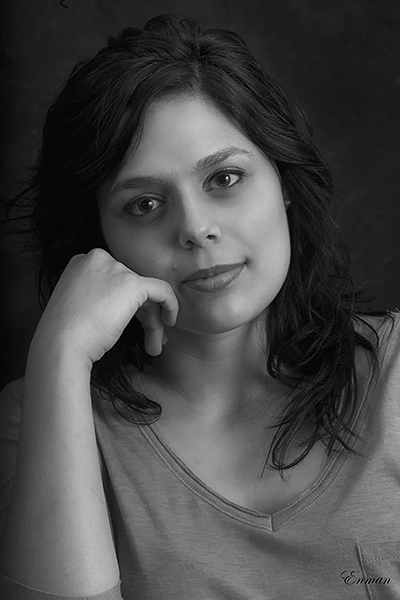
I enjoy photographing just about anything. Nevertheless, I’d have to answer that I probably take pleasure in photographing people the most.

I’ve been employed doing many types of photography since I began earning my living as a photographer in the 1970’s. I have done different kinds of photographic work for all types of organizations; however, I have found myself photographing people most of the time.

That’s not that unique; I think most photography is really about people. We take pictures of our family, friends, and people at celebrations and other events.

When I taught photography in the 1980s I would ask the question about a favourite subject of my students and “people” was a rare response. However, since the introduction of digital cameras and the relaxed point and shoot style many employ today, I’ll bet people photography ranks near the top as a reply.

If indeed, as I confessed to my friend, my favourite subject is people, I suppose I might put together a few tips for him and my readers on my favourite subject.

I quickly jotted down 10 suggestions to help readers be successful when photographing people.

  1. When you take pictures of people look at them and pay attention to their appearance so you ensure they look their best for the photograph. Don’t just rapidly snap away and realize later that you should have had your subject adjust something, e.g., a necklace, glasses, or especially that tie.
  2. Choose interesting and flattering angles or points of view. Also try three-quarter poses of single subjects. By that I mean that the person turns their body so that they view the camera from over their shoulder.
  3. Focus on the subject’s eyes. When we talk to people we make eye contact. There is a greater chance of your subject liking the photo if their eyes are sharp and not closed or looking away. Ensure that subjects smile or at least have a pleasant look. In my experience when subjects say they want a serious photo without a smile they appear sour or unhappy in the final photo. Do one of each as a compromise.
  4. I don’t like lenses shorter than 85mm. My favourite is 105mm. (Although recently I have been choosing my 70-200mm.) Longer focal length lenses always create a flattering perspective.
  5. For photographing one or two people an aperture of f/4 or wider will soften the background and make your subject stand out, but for group photos use an aperture of at least f/8 or smaller to increase the depth of field.
  6. Pay attention to your subject’s background especially when doing outdoor portraitures. You don’t want the photo to appear to have something growing out of a person’s head (e.g. like a stop sign), or have objects in your photograph that are distracting.
  7. Watch out for uncomplimentary shadows created by the sun, your flash, or other light sources.
  8. Get things ready first. Contemplate the poses before you photograph your subject. The best way to bore people and loose the moment is to make them wait.
  9. Tighten up the shot. Again, get rid of unwanted elements in the photograph that do nothing for it. If there is more than one person make them get close together.
  1. Talk to your subjects. The most successful portrait photographers are those who talk to and interact with their subjects. We are dealing with people and we communicate by talking. Don’t hide behind the camera.

And as always be positive about the photograph you are about to make. Get excited. Your excitement will be contagious and affect those around you.

Which Button is for the Composition Mode?        

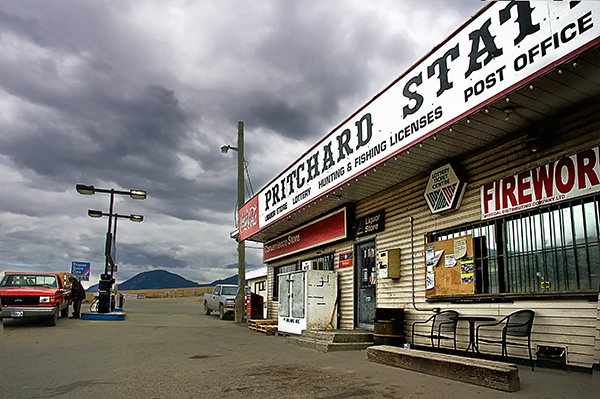
Pritchard store

Open Gates bw

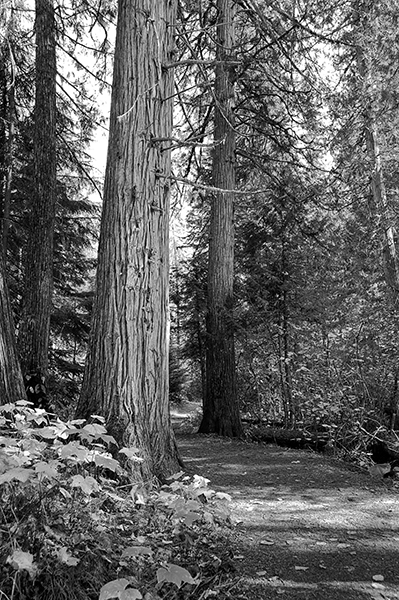
Forest path

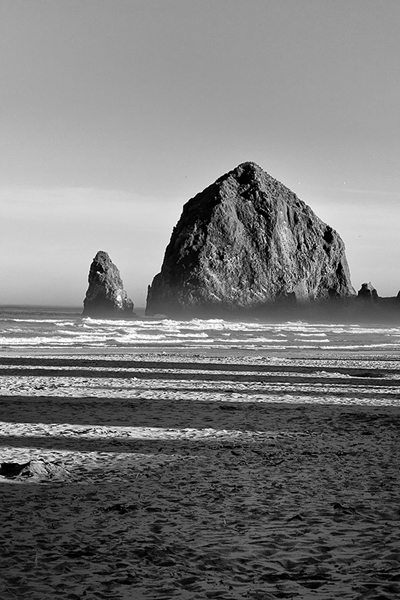
Canon Beach 2

Palouse falls 2

Which button is for the composition mode?     Yes, I did get asked that question the other day, but it is not as silly as it first sounds. I’ll go back to the conversation from which it comes.

A customer stopped by my shop wanting to get a different camera other than the one he had been using for over 20 years.

I was showing him a couple of cameras and explaining the different modes like “aperture priority”, “shutter priority”, “program” and “manual” when he made the statement, “All that seems a bit complicated, just show me which button is for the composition mode because mostly I like taking scenics”.

The other customer in the store stopped her browsing, turned, and just looked at me. I’m not sure if she was troubled by his statement, or also wanted to know about this secret button.

I replied, “Composition is what you do, not the camera, to position your subject within the viewfinder frame,” and added; “composition also deals with perspective and the relationship you create between subjects in the foreground and background.”

Does all that seem too complicated of an answer? I was making squares and rectangles with my hand and moving things around on the counter as I explained it hoping to make it clear to him. Now, however, let us go back to his question of the “composition button” and what he was trying to achieve with his camera. Remember his last camera was from the 1970’s. Even auto focus was new to him.

Cameras programmed since the 1980s are pretty capable of getting the exposure correct in all but the most contrasty lighting conditions. If he were to get serious now that he was about to get a DSLR he would be trying to discover how other successful photographers compose a scenic. Or he would be doing some reading, joining a camera club, or taking some classes that would teach him composition. My impression was that he just liked to take pictures and capture memories of the places he has been. So I think either the mode with the “little mountains” or with the “running person” on the dial of the camera I was showing him would give him exactly what he was looking for and we could, if we wanted to, call them composition modes.

The exposure mode I feel most comfortable with is manual and I am continually thumbing through the different menus on my camera to reset things. I make my living using a camera so I have a camera in my hand a lot of the time. I think each of us needs to use our cameras in ways that make us comfortable so we won’t happen to be confused and experimenting with the settings at that moment when the action happens in front of our camera.

I used to call that a “Kodak moment”. Hmmm, I think I need to find a new phrase now that I am no longer using Kodak films and that company has pretty much disappeared.

In any event, I recommended that he not worry too much about composition and experiment with the different modes his camera has to offer other than “P”. Hopefully he’ll stop by again and I can get him using his DSLR as more than just a point and shoot camera.

In closing this article that started with thoughts of composition, I particularly like this quote of Alexander Lee Nyerges of the Art Institute of Dayton, Ohio, when discussing an exhibition of Ansel Adams of the American West.

“His landscapes were operatic in composition, complete with lighting, tragedy and drama—luring those who viewed his works to seek Nature and capture the spirit of the wilderness.” I am certain Adams had a special button for composition.