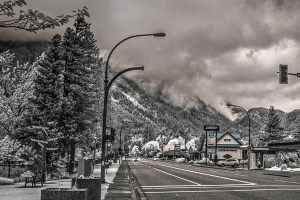
A Rainy Day in Hope, BC – Photographing with Infrared

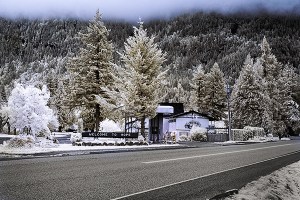
Wecome to Hope 1

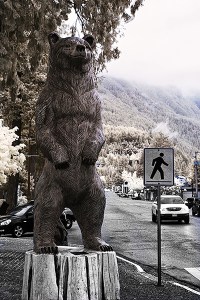
bear crossing 1

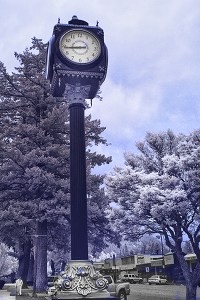
Town clock 1

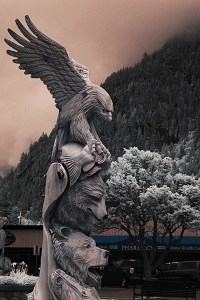
Animal totem 1

Driving thru Hope 1

After leaving the Vancouver Camera Show and Swap Meet last Sunday I decided that rather than make the long drive all the way back to Kamloops and then Pritchard, I would make a stop for the night in Hope along the way.

Hope, British Columbia, is usually just a location to make a quick pull off at a fast food restaurant, or coffee shop. as I drive between Vancouver and Kamloops.

I have always liked the appearance of the picturesque little town just off the highway along the Fraser River. That was first settled when explorer, Simon Fraser, arrived there in 1808. The Hudson’s Bay Company started a trading post in 1848.

In more recent history Hope received acclaim when it was the location for the Sylvester Stallone Rambo movie, “First Blood”, and then, “Shoot to Kill”, staring Sidney Poitier and Kirstie Alley. The area’s mountains also stood in for the Himalayas in the movie “K2″.

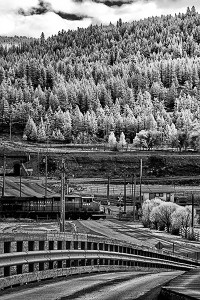
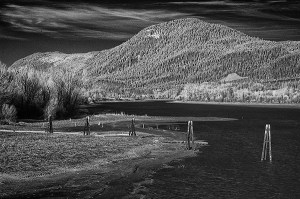
However, in spite of all that the main reason for my stop was I knew I’d be tired after my long day at the swap meet, and, in addition, I thought it would be fun to wander around town with my camera the next morning. I chose to bring the camera I had converted to infrared. I thought shooting infrared would bring a fresh and very different visual interpretation to the heavily forested setting.

There is a poem by Robert Burns wherein he writes, “the best laid plans of mice and men often go awry”. I thought of his prophetic words as I checked out of my motel room the next morning under a pouring rain. Disgusted with my crappy luck I stopped for a coffee and doughnut before leaving town. I was resigned to just head home. But as I sat in my car sipping on my coffee texting my wife that I was heading out, the rain lightened up and I decided that in spite of the cloudy overcast I would try my infrared camera anyway. I thought, what the heck, any photography is fun and the worst that can happen is I’ll have wet hair for the trip back.

I meandered down to the riverfront and zigzagged back through town. I discovered that at some point town residents began erecting large chain saw carvings everywhere. So I took pictures of them along with those of the city streets until the rain picked up again and my glasses got too wet to see.

The best time to shoot infrared is on sunny days, so the rainy, heavily overcast environment wasn’t all that exciting. But I was intent on the pictures by this time.

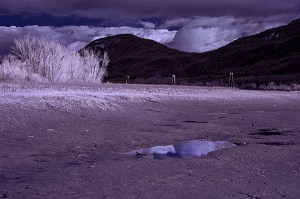
I must say that I wasn’t really successful, but there were a few images, that with some postproduction help worked out reasonably well.

The rain won this time, but I think I might go back to that scenic little town nestled in the Fraser Canyon. It’s not that far from my home and a nice easy drive, and I’ll take Linda with me. However, we’ll wait for a sunny, dry day and I definitely will try infrared again.

Infrared is such a fun change from normal digital shooting. And similar to purchasing another lens, the cost of having an old camera converted is well worth it.
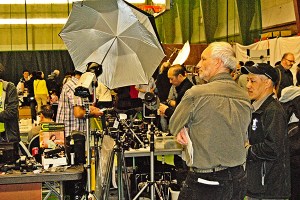
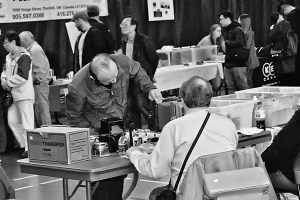
The Vancouver Camera Show and Swap Meet       


Lots to buy

Wow a 4X5

Sales tecnique

What about this tripod?

Try this one

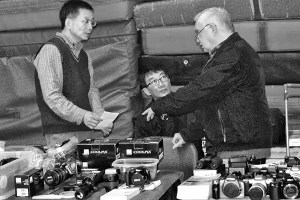
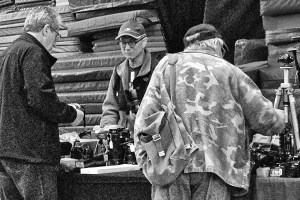
One of my favorite photography events, the The Vancouver Camera Show and Swap Meet, has come and gone again this year. For over 20 years I have spent the weeks prior to this long-running event, that has now reached it’s 40th year, looking forward to the day I get to attend this ever-so-fun photographer’s gathering put on by the Western Canada Photographic Historic Association, and organized by Siggi and Brigitte Rohde.

There cannot be a better way to spending a rainy spring day than being surrounded by a vast array of cameras and photography equipment, all the while getting a chance to talk with other photographers.

Again this year I made the journey from Kamloops the day before and lodged overnight so I could arrive bright eyed and eager to join the other vendors setting up at early the next morning.

I go wondering what the latest trends will be, or what is popular with the photographers that attend. And, of course, keeping my fingers crossed that the equipment I have on my table is what they are looking for.

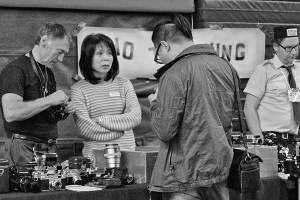
The last few years there’s been a major change in the venders being replaced by a much younger crowd. The stuff they have on their tables is much the same, but the vendors’ faces are younger, and there are a lot more women standing behind the tables discussing and selling photography equipment than there was when I first started attending.

As I have said before, the word “diversity” is the best way to describe the mixture of photographic types coming to this camera swap meet. There were all kinds of lifestyles and interests, and specialties in photography, film, digital, past and present technology. However, what they all had in common was that they all were excited, searching for sweet deals that I am certain they got.

This year was no different than last, in that I spent an exhilarating day talking non-stop with other photographers about their different interests in photography and, as always, it was invigorating.

The Vancouver Camera Swap Meet is a splendid way to meet and exchange information with other photographers, and to look at and check out a grand selection of photographic equipment that would not be so accessible anywhere else in Canada.

I write this every year, but I’ll say it again anyway. I had a great time with the photographers I met this year and the depending on who joined me at my table, the conversations always changed. My day of selling was a success, as it was for most of the dealers and very happy bargain hunters I talked to at the end of the day.

Camera's Shot

And…when the camera decides to take a picture by it’s self….


Photographing Flowers by Bathroom Window Light       

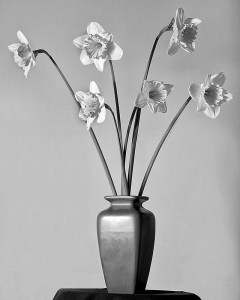
Daffodil BW

This week my wife and I had our first serious walk of the year around her garden.

Everything was competing for a place in the sun and the colours were beginning with white being the most prominent. I guess that might be because the first flowers to bloom in my wife’s garden this year were her white daffodils, and there are lots. We were looking for flowers to bring inside the house, so the abundant daffodils were the natural selection.

In March of 2013 I wrote, “Photographing an Orchid in the Bathtub.” In that article I discussed how one morning, I realized that a lone blooming orchid that my wife was watering on top of an upside down plastic barrel in our bathroom tub was a photo opportunity in the making.

At that time I could see a back light beginning to come through the frosted bathroom window and the slight beginnings of a back glow on the flower. It as in the morning and I knew within an hour or so the sun would move to that side of the house and continue in a southern arc for the rest of the day.

It was with that in mind that we decided it would be fun to photograph the daffodils before Linda choose a final location to display them in the living room.

One could set up a small studio for flower photography anywhere in a house. I even have a small diffusion box especially designed for product photography. Nevertheless the soft diffuse light coming through the frosted bathroom window glass is almost perfect for flowers.

I found another plastic 5-gallon barrel, placed it up side down in the tub with the white daffodils on top, and set up a speedlight coupled with an umbrella on a lightstand to photograph the daffodils.

When I photographed that orchid it was early morning. However, this time it was late morning and a more direct light was coming through the bathroom window. So I took the outer cover off the big 5-in-1 reflector I have and it became another layer of diffusion when I placed it between the daffodils and the window.

All I had to do then was point my 135mm lens, shoot, arrange the flowers, shoot again and rearrange. When I mentioned to Linda that the flowers would look good as a black and white photo she said. “Everything is pretty much monochromatic anyway”, so it was with a final b&w image in mind that I took the picture.

Trip to Harrison Hot Springs, British Columbia        

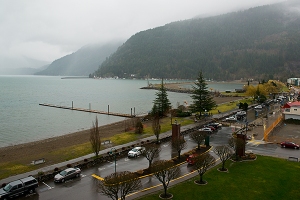
Lake view

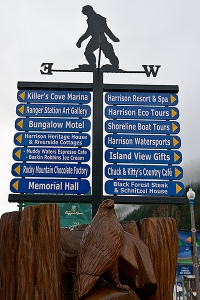
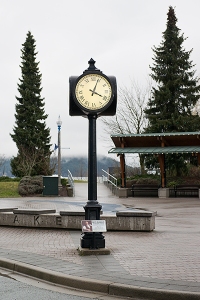
Town Directions sign

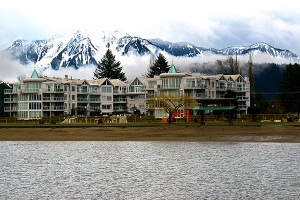
Harrison town

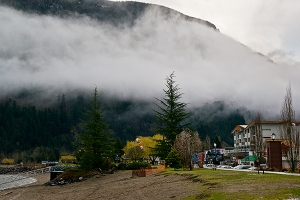
Coastal mountains

4PM at Harrison

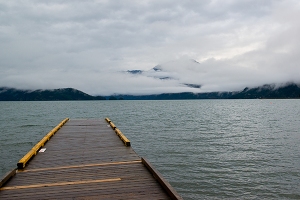
Pier

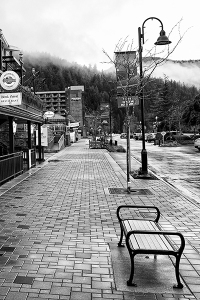
Wet Street

Hoter Bear

The best laid plans of mice and men often go awry”. That verse from the famous Scottish poet, Robert burns fit perfectly with our long anticipated plan to have a pleasant vacation at Harrison Hot springs.

My wife and I had been looking forward to a few days soaking in the luxurious Harrison Hotel’s mineral springs, and doing photography in the small waterfront town, and the nearby Sasquatch Provincial Park trails.

The weather report was for a sunny Monday, with some rain on Tuesday and a clear partly cloudy Wednesday. So we thought, rather than abandon our reservation (with the accompanying cancellation fees) we’d put up with the showers and stay close to the hotel. After all, shooting in the rain isn’t all that bad as long as it’s not too hard. However, “hard” is just what we got for our one full day at the resort town.

The first evening was so much fun with a soothing dip in the hot pool and a nice walk down the esplanade for a nice meal of fresh mussels and clams. And we sat talking about our plans for an early morning soak and a day of photography.

I rose early the next morning raring to go and went to the balcony to see what the day had in store for us outdoors. Well, what it had in store was a heavily cloud-covered town and one of the heaviest torrential downpours I could remember.

Trying to be optimistic we wandered down to have coffee, then headed for the hot pools in hopes of waiting the morning rain out. I will say that my short description of that event was that we were getting as wet from the rain as from the pool.

The rest of the day was much of the same with occasional short trips out when the rain lightened enough for some photos. As long as the rain was light I could wipe any accumulation off my camera with a towel. And the lens hood fended off rain as long as I didn’t angle the camera and lens in an upward direction.

My planned hikes in the dripping wet forest were out, so my short excursions were limited to the small town and beachfront. I liked the overcast and low hanging clouds. But those expeditions were short and I hesitated to get to far away from the safety of my hotel.

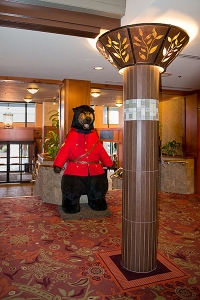
I normally take time to wander about indoors and had packed a flash for some interior photography. But along with a wet visit to the Harrison Hotel, we had also selected a time when there was a large convention. My one attempt at photographing the large 12-foot plush RCMP bear in the lobby took about 20 minutes as I waited for people to pass by so I could get a clear shot.

Oh well, so much for photography. I worked hard to get the few photos I got. In spite of the rain we did have a great time relaxing in the very hot mineral pool, chatting with other guests, and we had some enjoyable meals in local restaurants. In future I will need to take coastal weather reports more seriously if I want more than that.


A Good Day for Infrared Photography            

Pritchard Train crossing 1a

Reflection

Log jams 1b

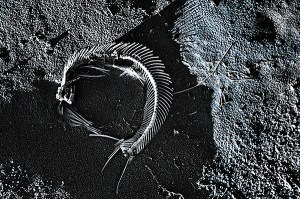
Salmon 2b

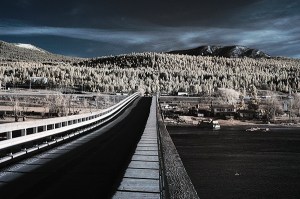
Bridge crossing 1a


The past few weeks have been apparent with flat and overcast skies. That’s certainly not inviting for anyone chomping at the bit to get out with a camera around Kamloops, British Columbia.

Only a short month ago the landscape was covered with glistening white snow that even on overcast days created some interest. However, that snow has melted this month leaving colourless meadows and a washed-out-looking, green forest of trees. In my opinion, the best word to describe the landscape, even with today’s sparkling sun, is grey.

I suppose many landscape photographers get creative and spend some time behind a computer manipulating that grey landscape. There are a myriad of programs designed to manipulate image files allowing black and white conversion or gritty oversaturation. But those conversions, although creative, in my opinion, don’t really give much life to the landscape.

However, for me it’s simple. I just grabbed my infrared camera and drove down to the large Thompson River that cuts through the valley on its way to Kamloops and then to the Canadian west coast.

For years I have enjoyed capturing landscapes (and cityscapes) using first, infrared film, and then for the past ten years, a camera converted to only “see” infrared light.

Infrared light is invisible to the human eye. To capture it with a modern DSLR, the camera is converted by blocking all but the infrared light from hitting the sensor.

I enjoy how infrared photography gives me a scene illuminated by that part of the colour spectrum we can’t see, with delightful images that couldn’t be captured in any other way.

Dark skies and glowing white trees are some of my favourite infrared effects. It is those fresh and exciting photographs (done with very little computer work) that separated my photography from both the monotone conversions, and the oversaturated scenic, that had been viewed on posts by other local photographers.

I like to wander along the winter beach not far from my rural home. Normally the turn-off and sparsely tree-lined beach is well used by locals with motorbikes and bicycles, walking their dogs, or launching their fishing boats. However, the winter beach on the river is empty, especially on cold days, and it’s those days that I enjoy the most. I can stroll along the narrow walkway that goes over the bridge while taking pictures of the river valley. And although there is a sign that tells walkers not to loiter or fish from the bridge, in all the years that I have been making pictures from it, no one has ever bothered me. Most of the time people smile and wave from their vehicles as the pass me.

I roam under the bridge and search the sandy riverside photographing interesting features and trash left over from winters’ storms, and, in spite of everything being shades of grey, infrared changes everything, and I have the choice in post-production to choose surreal coloured, or unique black and white images.

I’ll repeat what I wrote when discussing infrared in my article last November, “Infrared allows a photographer, and gives the viewer, a completely different feeling of a subject. Making an image with a modified camera is an exploration and a discovery that moves a photographer far from the usual”.

Printing Your Own Digital Photographs    

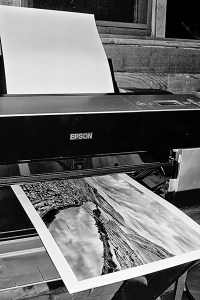
Printing Photos

I had a good time this past week talking with a couple of long time photographers about printing photographs. It was a walk down memory lane as we talked about using film, and how we would spend hours in darkened rooms printing black and white photographs, and about the exciting, and enjoyable, shift to digital images and modern printmaking.

Just like those days when commercial photo labs struggled to match what, with a little practice, a photographer could produce in his or her basement darkroom, I have no doubt that today’s affordable high tech home printers allow us to produce fine art prints that can surpass what most big box commercial labs will give us.

In my opinion it comes down to a battle between visions: The Lab’s or ours. For example, imagine packing your camera equipment off to some isolated location, waiting for hours for the light to reach a colour and effect that matched the artistic vision you desire. Then setting your cameras’ controls with all the experience and skill that you have, and finally releasing the shutter.

Until recently when photographers shot in colour they had to rely on the skill of lab technicians who would hopefully process the images the way they wanted.

Lab technicians, even though well skilled, could only guess at what the conditions were like when the photographer released the shutter, and I suspect much of the time found it rather difficult to recreate and could only guess at the shooting conditions.

Sometimes a slight change in exposure or shift in color will make our photograph stand out, and only we can determine that. For example, those photographers that have bracketed the exposure values of an image know what I am referring to when they are frustrated because they got back several differently exposed prints all printed exactly the same from the lab. The vision in that case becomes the Lab’s; not theirs.

Yes, if we are unsatisfied we would return the film and prints to the lab for a redo. However, more often that not, we just give up and accept the best the lab can do, or try other labs till we get close to what we remembered trying to capture on our film.

I am not going to get into a discussion of printers and papers right now – I’ll save that for another time. I want to go back to where I talked about what happens after we have captured that image we took at that isolated location.

We look on our digital camera’s LCD screen, and check the Histogram to make sure we have captures from which we can work. Now, instead of leaving our vision to the choices of an unknown technician and waiting for the photographs, we download our memory card into our computer, enjoy immediate visual feedback on our photographs, and by using whatever post production software we have we can follow our vision with precision to the final outcome: a photograph that shows exactly what we want it to show; our personal vision. How exciting is that?

With today’s digital technology we can follow our photographic vision from start to finish, from idea to finished print in a way that is far better that ever before possible. And, by using quality photographic printer equipment, photographers can make spectacular enlargements that will give their photography another dimension of control and creativity.


Digital isn’t Real Photography!   

What about Film

The medium of photography has become very accessible for everyone. There was a time when photographers had to be an engineer, a chemist, and to be successful, serious practitioners needed to spend time educating themselves. Photographers actually had to understand the combinations of shutter and aperture for a properly exposed image, and worried about camera shake and, of course, film choice.

With modern technology, today’s supercharged cameras with their machine-gun-like shutters, and seemingly speed of light focusing, and amazing low light capability, many photographers are able to make great photos without any knowledge whatsoever of photography.

This week I talked to a woman that pulled her 1980’s film camera out of a well-worn canvas bag saying, “Digital isn’t real photography!” (I remember writing about another person upset with digital almost exactly a year ago.)

I let her rant for a while about how inferior digital is, and how one can’t get a good picture unless they used film. However, because I wasn’t in a mood to get into an argument I knew wouldn’t win, I just nodded and said that I do like the tactile quality one can get with a properly printed picture. And to smooth things out I mentioned that I have several enlargements hanging on the wall in my shop that I took with film years ago.

That conversation is becoming rather infrequent these days, but it still is kind of humorous when someone wants to complain about modern photographers and the high tech equipment available. Unfortunately, the argument is one-sided and not really worth getting into because any opinion but theirs is going to be ignored.

There are still a few people intent on complaining that with the end of film comes the end of photography. That’s just silly. Personally, I don’t think film is going away any time soon. Film is just one of many ways to make a photograph.

The big box outlets here in Canada may not carry it much longer, but there are lots of specialty items artists use that are only available in specialty stores, and I think there are still plenty of camera shops that handle film. And going to a store that specializes in photography makes the chances of getting the correct advice from the person behind the counter more likely.

It seems like everyone is taking pictures nowadays. (Another thing that lady complained about) But I think that’s a good thing and not something to complain about.

There are lots of excellent photographs being taken. People just want visual memories and the multitude of cameras that are available these days are perfect for that. Who cares what kind of camera or how the image is captured.

I think I might stop by and talk to that woman again. She has a small store down the street from mine. My conversation won’t really be to talk her out of film and into digital, She hasn’t used her camera in a while and I’d like her to start taking pictures again instead of complaining about young people with their digital cameras.

I hope she will start having fun with that old 35mm film camera. It doesn’t matter what camera she uses, film or digital, as long as she is happy with the photographs she makes. I’ll be sure to help her out, and with a bit of subversive work, I might get her using a digital camera after all.

Your comments? Thanks, John


Copying Photographs   


Violet Walch copy

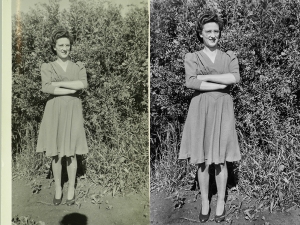
This week I noticed some pictures that were posted on a Facebook page. They were old, family pictures that were low quality, which I thought were more from the poor copying techniques of the person who posted the photos than a problem with Facebook, and I am sure the person that added them to her FB page in spite of the shoddy reproductions thought she couldn’t do better. Seeing those poor quality images reminded me of an article that I wrote about copying old photos some time ago, and wanted to remind readers how to do this.

In the article, I had been asked if I could make quality copies of old photographs that a family wanted to use for a book of genealogy they planned on publishing. They required image files with enough quality for good enlargements, and reproduction, and had tried to copy several images using inexpensive home scanners meant for documents (not photographs), and thus far were only able to produce pictures that lacked detail.

I recall they told me they also tried copying the photographs with their little digicams, but that exercise resulted in bright, white reflection spots from it’s flash that obscured features giving them unacceptable results.  A camera with an on-camera flash will produce glare on reflective surfaces, and inexpensive document scanners rarely produce good facial identification of old family photos that have languished in boxes for years. The result was much the same as those old, family photos I saw on Facebook.

When I copy photographs I lay the photographs flat and mount my camera on a copy stand that I have had for years, (a sturdy tripod would also do nicely) and use a small level to make sure the camera lens and the photographs are parallel. I use two photographic umbrellas to diffuse the flash. If I didn’t have the umbrellas I could also get reasonable results by placing some translucent material in front of the flashes, or by bouncing the light off large, white cards.  Two umbrellas allow me to balance the light. Then I make a test shot to check the exposure for reflection. In any case, the light needs to softly and broadly, not sharply, expose the old photograph’s surface.

The wonder of digital technology is that it allows a photographer to quickly review the image and retake it if needed. I also recommend taking several shots at different apertures.  And, of course using the camera’s Manual Mode. I prefer working with slightly under exposed image files. That way I can bring the detail up in postproduction without loosing the highlights in the original photographs.

If the next question readers ask is, “What kind of camera?” my answer will be that it depends on what is the desired outcome. If the final image is going to be a print, or something that is to be big enough to identify a person in the background, the file needs to be reasonably large. I prefer a DSLR, but for a small website image, a digicam that will accept an off-camera flash will do just fine.

If there isn’t access to an off-camera flash then wait for the opportunity to photograph the picture on a “flat” overcast or cloudy day.

The final step for me is PhotoShop, (there are several other programs that will also work) which I use to colour balance (and change a sometimes faded old photograph), and then go on to use for cropping, increasing contrast, and sharpening.

One could purchase an expensive scanner that takes up more room on the desk. But photographers that have already invested in their camera and have lenses that work perfectly well, (which I think are faster to use than a scanner) are perfectly capable of producing very high quality final images.

Photographer’s New Year’s Resolutions for 2016    

2016 approaching

This month is half over already and I am thinking with all that’s happening in photography that 2016 is going to rush past like a freight train. The prospect of all the new opportunities for this year is exciting, and it may be worth jotting down a list of personal photography goals for this year, or a list of resolutions, as a good idea.

Every New Year I am interested in what plans other photographers will make for the year ahead and most respond with a usual list, for example, use a tripod more, turn off Auto mode, shoot RAW, make a photo-a-day challenge, and so forth. This year, however, I wanted more inspirational ideas for the year to come.

I revisited ideas from January 2015 that seemed to say a lot about ways to improve with this exciting medium and pulled these out. So for the future, for 2016 here is my “Lucky Seven” .

  1. Pay more attention to creative ideas. “This could be the year to begin evolving  creatively”.
  1. There is too much focus on what is the best camera. When we spend too much time worrying about the camera we forget about the story. “We should be concerned with making images that tell a story”.
  1. Take risks photographically and move away from always trying to please, to fit in with what everyone else is doing. Make this the year to push beyond the comfort zone without being concerned with other’s opinions, to be pleased first for oneself. Maybe this will be the year to put “me” in the photograph.
  1. Learn a new technique. Wonder about how the technique will impact your work and whether you will revert or continue to follow up in that direction. I think it’s as simple as experimenting, and definitely taking the time to “read up on something and then give it a try”. Photographers should always make the effort to learn new techniques. Maybe by taking a class, or at least buying some books, or CDs, written by accomplished photographic writers.
  1. Select new subjects to “get out of the rut of shooting the same thing over and over”. While practicing portraiture or landscapes is good, doing the same thing the same way over and over can result in a lack of inventiveness and creativity in our work.
  1. Make every shot count and stay away from the spray-and-pray shooting style. “It’s about quality photographs, not about the volume of pictures snapped during sessions”.
  1. Become viciously ruthless with one’s own photography and what is done in post-production, to be more critical, to keep “conditioning oneself to throw out the crap is the only way to keep improving.”

I’ll finish with a quote by award winning English author, Neil Gaiman.

I hope that in this year to come, you make mistakes. Because if you are making mistakes, then you are making new things, trying new things, learning, living, pushing yourself, changing yourself, changing your world. You’re doing things you’ve never done before, and more importantly, you’re doing something.


I’ve Been Robbed!


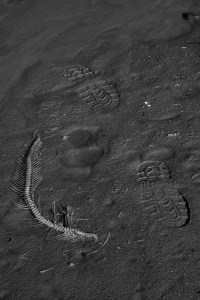
foot prints in the snow

A phone call at 3:30 in the morning is never good.  And sure enough the call I got last Monday morning met my worst expectations.

As I answered the phone I wondered, “Is this a call about a fire or a break-in”. Sure enough it was the latter. There was a break-in at my store.

Somehow three thieves gained entry into the main building from the alley door, and as the alarm blared, they made their way towards my storefront shop. Thereafter, they easily smashed the glass of the door entering my camera store, rushed to a display cabinet containing cameras and lenses; and because I found some lenses scattered on the floor, I think they rudely shoved equipment from two shelves into a camera case that contained my digital projector, and then ran back through the building to exit the rear door.

The tenant that resides on the second floor added her 911 call to the notification the security company was getting from the alarm, and looking through her window watched the burglars making off though the falling snow. Fortunately, the police arrived very soon after and using their tracking dogs easily followed the criminals to their hideout and apprehended them.

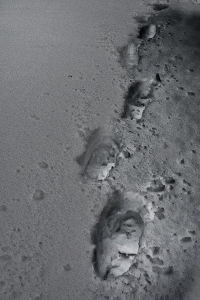
I give credit to the fast work of the local RCMP. They were certainly aided by the freshly fallen snow that at that time in the morning revealed the tracks of those thieves that entered and exited my shop. I would like to have watched those Mounties with their dogs chasing down the bad guys.

As I child of the 1950s radio shows like, “The Lone Ranger” and “The Green Hornet”, I listened with excitement as Sgt. Preston of the North West Mounted Police, and his dog, Yukon King, fought evildoers in the Northern Canadian wilderness.

I don’t want to make light of the excellent police force we have here in Kamloops, but as I stood outside the back door in the eerie, 4am light talking to the woman from the upstairs apartment I looked down the snow covered landscape and thought of that radio program of my childhood days from all those years ago. I cannot say the reason. Perhaps it was the lack of sleep, or the stress of the break-in, but when she mentioned the police and their dogs following the tracks in the snow, that’s what came to mind.

I received a call from a constable regarding the photography equipment stolen from my shop, who told me they recovered cameras and lenses in a black case. I assume that’s the missing projector case.

There is a good chance that most of, or hopefully all, of my property will be returned. Now I just have to wait for the lead inspector to determine how long they need to keep things as evidence. After posting the incident on Facebook, I received lots of concern from local photographers. That was nice. I found it interesting when someone would write, “You must feel violated”. For me that isn’t the word I would use. “Irritated” was a much better word to fit my mood as I cleaned up the glass, covered the opening with wood, and now must wait for the police to return my camera equipment.

I will get through this incident, survive my disappointment, and today returned to selling good, used, photography equipment, but now I also have a story to tell of yet another of those stressful events. There are so many photographers out there that have, as me, been photography equipment and have lost their prized photography equipment to, as one officer I talked to called them, “rats that scurry around in the darkness looking for an opportunity”. As I am sure readers know, we must be vigilant against thieves.

As I write this I remember how Sgt. Preston would hug his dog at the end of each episode and say, “Well, King, it looks like this case is closed.”

Thank you to the Royal Canadian Mounted Police for helping me recover my merchandise.