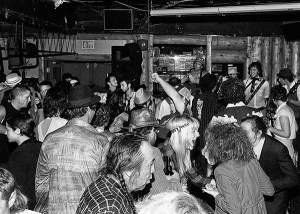

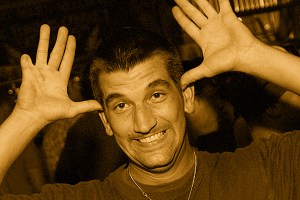
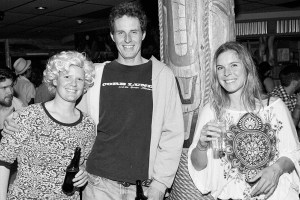
Photography at the Christmas Party   

tree-planters-4

tree-planters-1

tree-planter-5

tree-planters-7

tree-planters-6

I talked to a person this week that has been asked to be the staff photographer at an upcoming event. With that, I thought I would revisit an article I wrote December 2014.

The Christmas season is here and that means photographers will happily begin filling memory cards with photographic opportunities as they join family, friends, and co-workers at this month’s festive events.

The act of picture taking has become easy and so much fun as people rush over to take a picture and then quickly show other partyers the images from the LCD. Some seem more interested in that quickly snapped candid than what is actually happening at the moment. For many, it is more about the activity of picture taking than it is about making memorable photographs of the party.

Images made in this fashion rarely become more than stored files on computers and cell phones. People have good intentions, but after that initial viewing, most photos loose value because there are too many, and very few are good enough to give to others anyway.

What is my advice for photography at the next Christmas party? Yes, continue to make candid photographs of people having fun, but, perhaps, think about making pictures that tell a story, capture an exciting moment, and importantly, flatter the subjects. Most people don’t mind seeing a picture of them being silly or having fun, but they don’t like pictures that make them look stupid or unattractive.

My approach is to take a moment to look at the room in which I intend to make photographs, make a couple of test shots using longer shutter speeds (my favourite is 1/60th of a second), to include the room’s ambient light. And I always use a flash so as not to end up with brightly lit faces surrounded by a black environment.

I suggest taking group shots with two or three people. Get them to position themselves squeezed together with a tight composition, and include only a little background or foreground. Don’t shoot fast. Steady the camera. Select a shutter speed that includes the ambient light. Use a flash. Fortunately most modern DSLRs easily allow ISO sensitivity that can be set to 1600, and some can go a lot higher.

Shutter speeds of 1/60th of a second, or less, doesn’t always work for children (or adults) playing in the snow during the day because moving subjects will be blurry, but, with limited indoor lighting, moving subjects will only be properly illuminated when the flash goes off.

Lighting everything with complicated studio equipment would be great, but that would ruin the party for everyone. The occasion would become more about the photography and less about the fun and festivities. I use a hotshoe mounted flash and make adjustments as I go. I want to join in on the fun, blend in, and not act like a photojournalist.

Family and friends don’t mind having their pictures taken as long as it’s enjoyable and I want pictures that show them having a good time. So, along with those quick candids I make posed portraits with smiling faces, and if I select some pictures to give away later I want people to like and not be embarrassed by the pictures taken of them.



Twelve Gifts for a Photographer’s 12 days of Christmas     

xmas-tree

night-porch

We finished setting up our Christmas tree, and sat down to celebrate with a glass of eggnog, while listening Christmas music coming from the TV music station. As we rested Linda just asked me that question that I had been side tracking, “You haven’t told me yet what you want for Christmas. Do you want something for photography?”

I hadn’t thought about what I wanted. And regarding anything to do with photography, if I thought I could afford it, I would usually just get it for myself.

I had been enjoying the tree, and the Christmas music, but as far as a gift for me, especially, “something for photography” left me at a loss of what to say, so I replied, “I suppose I want everything and anything that will fit my camera.”

I watched the train go round the tree, and I listened to the music, but I am still thinking about what I should tell my wife.

In keeping with that subject, I decided to pose that question to some photographers I know. There are so many different genres of photography with different ideas on what would be the perfect photography gift for each. I edited them and selected twelve in keeping with the tradition of twelve days of Christmas.

I am sure readers have their own Christmas list, however, here are some items that I picked out for this year.

(1) I had more than one person say, “I would like to move up to a newer model.” And their discussion for preferring full or cropped frame is always fun. The first on this list is one of many that wanted a particular camera. I think a photographer would have to have been real good to deserve this.

(2) I wasn’t surprised with this one, “I asked Santa Claus for the new Tamron 150-600mm lens.”

(3) When I heard this from a very serious photographer I thought, “me too”, “There is a new program called Aurora I would really like to try out over the Xmas Holidays.”

(4) More than one photographer upon retiring has gone this way so I wasn’t surprised with when some said, “After all these years of packing around a big DSLR, I would really like Santa to give me a small, lightweight Mirrorless camera.”

(6) Hey, this idea is just smart, “I’ve asked for gift cards, better chance of getting some of those than the Nikon D500 I really want.”

(7) “A new graphite tripod would be great to find under the Christmas tree.”

(8) I have my fingers crossed for this person, “A new camera backpack to hold the 70-200mm lens I hope I am getting.”

(9) A budding portraitist said, “I am hoping for several things this Christmas. A flash, a wireless off-camera trigger and a light stand with a softbox.”

(10) This is a great choice, “I really would be happy if I could get a macro ring flash for Christmas.”

(11) And I thought, “well of course” with this, “I think I’ll request that Santa Claus puts a couple of good quality, 32GB memory cards in my stocking.”

(12) This last one is practical for both portraiture and garden photographers “I’d be happy with a 5-in-1 collapsible reflector.

Personally, I could suggest many of the previous, but there are two photographers in our household and there needs to be some money left for my wife. So I’ll to put more thought into this before I reply.

There is still time to get your list to Santa. Good luck and Merry Christmas.

Photographing a Late Fall Garden   

oregon-grape

thistle-2

thistle

grass

thorns

yellow

I try to wander about in our garden with my camera each and every time the season changes; spring, summer, fall and winter.

I have photographed the changing garden throughout the years and, although it always seems very familiar and comforting, I find myself discovering different ways to capture the life that begins, grows, blossoms and then retreats into sleep. There are times when I have constructed elaborate sets with reflectors to capture and control the light. I have built mini studios much like the controlled indoor setups that portrait photographers are familiar with. I’ve lain in the snow and employed umbrellas on rainy days. However, on this particular day I wanted light, and waited all day for sunlight that seemed reluctant to bring me one day of fall warmth I wanted to photograph before the snow that was predicted in a day or two.

When 3pm rolled around I worried that if I didn’t get something done in the quickly dropping light, other than look out the window, I wouldn’t get any pictures at all.

My camera was waiting with a manual 200mm macro, wireless sender and two light stands with a flash and umbrella mounted on each. However, when I finally walked outside (yep, I already said “quickly dropping light) I realised I was doomed to failure if I relied on taking the time to set up that equipment.

Years ago I was asked to give a lecture to the Abbotsford Photo Arts Club. I won’t go into that long discussion, but the title I chose was, “A problem solving approach to photography”. And I realised that this was the time to move into a problem-solving mode.

I removed the 200mm macro from my camera and replaced it with my wife’s 70-180mm macro. I prefer my old manual lens for close up photography, but that Auto focus zoom macro is really easy to use.

I also put aside the light stands and attached a single flash to an eight-foot TTL flash cord. I could have set things up wireless, but I was going for quick and easy and with the TTL cord I just let the flash hang off my shoulder until I wanted it.

I could have used a high ISO, a wide aperture, and just popped a bit of light for a proper exposure. But a high ISO would increase the ambient light and show the lifeless colours of surrounding foliage. A wide aperture would limit my depth of field, and TTL is fast and easy to light, compose and relight a subject.

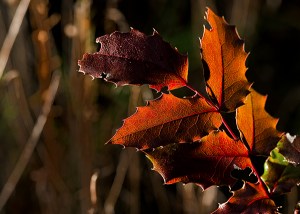
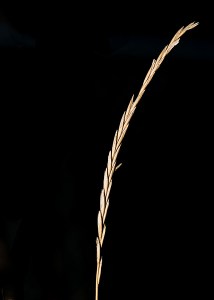
I under-exposed my exposure by several stops, and let the dedicated TTL flash (with a diffusor cup) do what it was designed for, to deliver just the right amount of light on my subject.   That gave me a dark background that I could later make completely black by adjusting the contrast in Photoshop.

I didn’t have a lot of time before more clouds moved in making an already dark afternoon even darker, but my portable set-up made things easy and even gave me a moment to pause and watch our three legged, feral cat flee as it ran out from the cover of the shrubbery. Gosh, in spite of the damage to her one back leg, she sure can move.

I had been trying for three days to get some pictures, but unpleasant weather and life in general got in the way. However, with a bit of problem solving and the will to finally get out and do something, a person can end up with a few photographs worth keeping.


Time To Print Christmas Cards 

xmas-geese

santas-workshop

winter-christmas-view

xmas-chicken-1

xmas-chickens

holiday-train-2016

November isn’t even over and stores and television commercials are filled with Christmas advertising. Oh well, it always sneaks up on me, and anyway, I like all the festive celebration and excitement of Christmas. The early start means I get to enjoy all the colourful decorations, and listen to the Christmas music for a longer time. Yes, I like Christmas music.

All year long those photographer social media sites I belong to have been filled with photos made by members, but images posted on the internet quickly fade into memories and are easily forgotten when an hour later someone else posts theirs.

I like photographic prints. Prints have a life, whether framed and hung on the wall, taped on the refrigerator, or thumbtacked in an open space in the workroom. To me a print of any size has more importance than a digital image on my computer or iPhone screen.

Christmas is a great time for photographers that now have and an excuse (and an opportunity) to give our friends and family our photographs.

I suppose that could mean a big framed photograph, but what I am writing about is Christmas cards. Cards easier and less expensive than framed prints. Nevertheless, any card of a photographer’s work is more of a statement as a gift than an email.

I don’t want to believe that any photographer would be satisfied with mass produced generic Christmas cards. Personally, I want people enjoy my photography. Even if it’s only as a 5×7 card, and that’s better than having my pictures left languishing in some hard-drive.

Right now my wife, Linda and I are going through our many image files from this year’s photographs selecting those we want for Christmas cards. I’ll print up lots of different images and place all sorts of greetings on them. It is rare that we give the same picture to more than one person. And not all the cards say Merry Christmas. Although I like “Merry Christmas” what goes on a card doesn’t really matter. Happy Holidays, Seasons greetings, Have fun, A good New Year, and anything else I think fits a particular picture.

I have written before that my wife and I always produce a new monthly calendar, doing alternating months. I always get December even if it’s Linda’s turn. Doing a calendar is a neat way to enjoy our photography, but cards are a lot more fun because they are for others to enjoy. I also make cards for all occasions, like birthday’s, Valentine’s, Mother’s day, etc.,

My family expects me to share my photography. Sometimes it’s only a picture of something we’ve done, but if it’s a special occasion they always get a card. For those photographers that don’t have their own printer, it’s as easy as having a 4×5 print made at a local lab. Then get some construction paper, glue a picture on it, fold the paper, write something like Merry Christmas inside and give it away. And don’t make all the cards the same.                                 What would be the fun in that?

Twin Lens Reflex Film Camera   

twin-lens-reflex

hay-field

Linda chose a hay field

plymouth

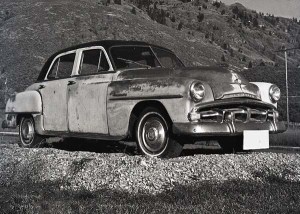
I liked this old Plymouth

underwood-hotel

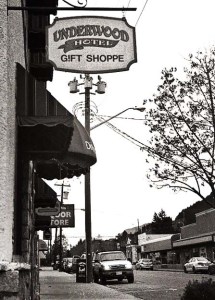
Town view by Linda

downtown

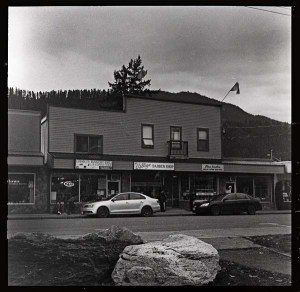
I thought a photo of our black Honda would be great.

chase-church

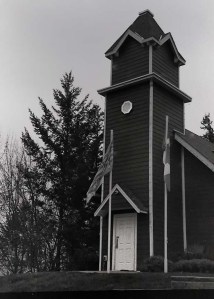
It started raining as I photographed the church

kamloops-bighorn-sheep

Linda leaned out the window for this shot

big-horn-sheep-hill

I held the camera out the window upside down for this photo


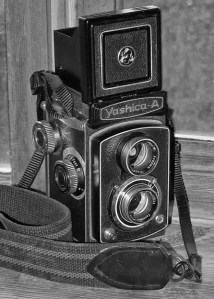
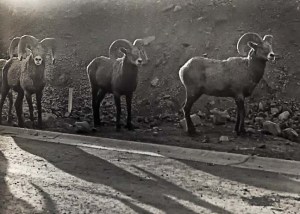
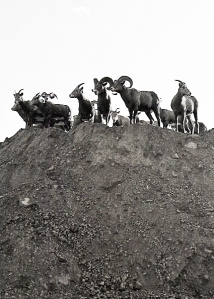
At the close of my last article about the Vancouver Camera Swap Meet I wrote that I had purchased a neat 1960s twin lens reflex Yashica camera for myself. To clarify, the camera is a 120mm format film camera, which gives 2¼x2¼ inch negatives, and does it with twin lenses (or two); a top lens for focusing, and a bottom lens for making the image.

Unlike modern DSLR cameras, photographers don’t hold the camera up to their eye to peer though a tiny hole, and instead view the subject by holding the camera at waist level while focusing on a 2¼” square ground glass.

My wife, Linda, got herself a TLR camera some time ago. Her intention was to force herself to slow down and pay more attention to proper composition, and being limited to only 12-exposure roll film certainly helps one to slow down. So when, a few weeks before the Vancouver Camera Swap meet, she mentioned that she hadn’t had a chance to put a roll of film through her TLR Yashica-Matt since early spring, I decided I might look for the same kind of camera so we could go out together.

I need to say that I am not one of those that thinks film is better than digital. Gosh, not for a minute! I like digital and I really like digital post-production software. For that matter I prefer modern digital technology. However, readers will remember from an earlier article that I wrote, “Happiness is a day with my camera.” To me, that means any camera that is fun to use. And a slow focusing, waist level viewing, twelve-exposure film camera is exactly that, “fun to use”.

Both Linda and I used twin lens cameras in the 1980s. Linda even had a big and heavy Mamiya that she packed on a glacier-climbing trip we once took. When I think of that hefty camera I can’t help but laugh at those modern photographers that complain about how heavy their DSLR cameras are.

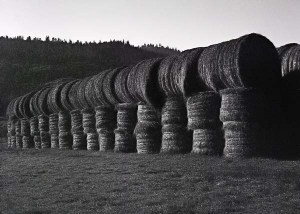
We have spent two days since I got my camera going out on photo-excursions. One day driving the back roads near home and one photographing the small nearby town of Chase. However, the day in Chase was cut short because of rain. Then, instead of arriving home and being able to quickly edit image files on a big computer screen, the procedure is to take the film into a completely dark room, unroll the film from the paper backing, put it in a light-tight processing tank, and then spend the better part of the next hour pouring chemicals on, rinsing, and hanging the film up to dry overnight. The next day I scan film and edit in Photoshop.

I don’t know if I can say that the processing part of the journey is all that fun. But using the camera is, and I’ll just have to put up with film developing so Linda and I can play with our vintage film cameras.

So far we have been using some really dated film that expired back in 2002. That old film won’t yield the spectacular results one expects from medium format film. We have two more rolls of that fatigued old film to use as we get used to our cameras, then I’ll get some newer film and we will be able to produce photographs that match the resolution of some of the best modern DSLRs.

But sharp pictures aren’t really why so many photographers like Linda and I are returning to those old medium format cameras. The cameras from the past have now become unusual in this day of instant gratification. And there is something quite rewarding and even fulfilling, and as one photographer remarked “intimate” in the slow process of using a TLR.

November 2016 Vancouver Camera Swap meet  

helpful

must-sell

neat-tripod

great-find

filters

nice-camera

a-dollar-each

i-like-this-camera

vintage-cameras

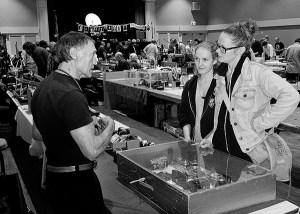
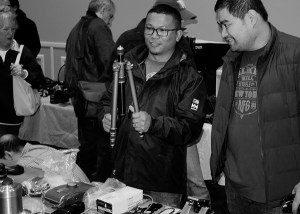
Last weekend my wife and I again ventured over British Columbia’s coastal mountains, this time to attend a camera swap meet. This was the last camera swap meet of the year. And I had a blast!

The event has been taken over by a new coordinator and moved closer to a more central location for photographers that live in Vancouver. There was more parking available for the swap meet, and we were able to find a reasonably priced hotel that was located nearby (only about five minutes drive away.) And for folks like us from out-of-town, the new location offered better access to a variety of restaurants.

The new venue was smaller, but the tables were less spread out and had an intimate atmosphere that I really enjoyed. Our day started at 9am with the long line-up of photography enthusiasts rushing in as fast as they could.

Vancouver is a large multicultural city and for those of us living in smaller communities in the BC interior, the sudden barrage of dialects and different languages being spoken takes a moment to get used to. However, everyone there spoke “Photography”, and that made for a fun and friendly day of showing, demonstrating, explaining, and, of course, bargaining with savvy photographers of all kinds.

I was pleased to find that I had a table next to my long time friend Brian Wilson. That was a treat, Brian is the guy that got me into this business 20 plus years ago and there is no doubt his knowledge on cameras and their history is second to none.

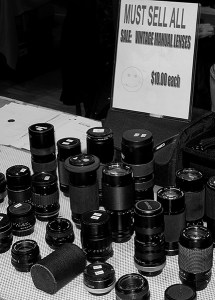
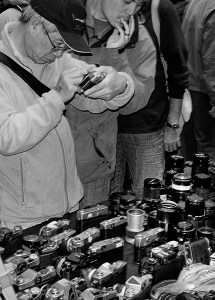
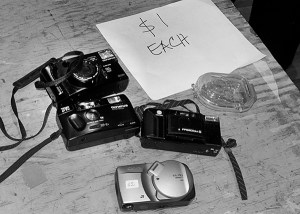
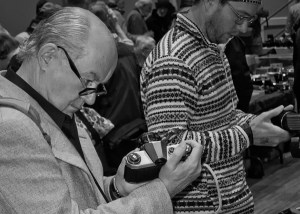
The place was packed and there were many bargains, and I doubt anyone that had rented a table had much time to themselves until things slowed down for a short time around lunch. After splitting a great big deli sandwich with Brian I decided to take advantage of the lull to have a quick walk around to see what was for sale and take a few pictures for this article.

I’ll sum up my walk-about in one word, Wow!   The variety of equipment was exciting. I felt like the little kids I sometime see safely tucked in a shopping cart going down the grocery store candy or cookie aisle, hands reaching out pleading with their mother for the goodies on the shelves. It was all I could do to keep myself from reaching in my pocket for the proceeds of the morning sales ready to buy. Nevertheless I touched everything I could before safely returning to my table to be out of temptation’s grip.

I talked to lots of people, renewed some long-time friendships, made new friends, sold a few cameras and lenses, and had a good time. Oh, and like icing on the cake, I was able to find a neat 1960s Twin Lens Yashica camera for myself.

As usual, the Vancouver Swap meet was exhilarating, and even though the day was tiring and after packing up what I had left from the show, Linda and I ignored the comfort of our quite hotel room and headed to downtown Vancouver to spend the evening in a pleasant Broadway bar for a meal of fish and chips with locally crafted beer, all in all, a perfect way to end the day.


Happiness Is A Day With My Camera                                           


shooting-field-patterns-b

checkn-settings-a

getting-the-shot-b

waiting-c

linda Walch

Today as I drove to town some expert on the radio said that there are 12 states of happiness.

I can’t remember what they were or how “happiness” is determined, but after a bit of searching I found a short article that said to be happy we must “anticipate with pleasure, savor the moment, express happiness, and reflect on happy memories”.

I know there are times and things that make me happy. However, there are also moments that no matter what my surroundings are or the circumstances I am in, I am just not happy.

My wife makes me happy, and even when I know she is mad at me for something I have said or done, I am still happy when she’s with me. Maybe that’s one of those states.

I doubt there has ever been any studies done on the states of happiness for photographers. So while those reading this think about what makes them happy I’m going to delve into that mysterious state.

Happiness might be about things like camera equipment, or about creating a good photograph.

Most photographers are devastated when they receive a poor review on a picture, so there is lots of ego involved in their happiness.

I know sitting around with other photographers talking about anything photographic is just plain blissful.

I don’t have any science that I can call up and haven’t discussed happiness with any philosophers, but I have always felt that photographers have a culture of their own. There are those who might argue that concept, but I am absolutely convinced that it is so.

I constantly interact with other photographers in online forums, or talk to them personally, and those photographers are always ready and willing to tell me when they are happy or not with their photography.

Some seem to be more interested in the technology of photography then the process of making pictures and there are others that care little about the equipment as long as they can make a picture.

I once knew a photographer that was happiest when he found a problem with a piece of photography equipment. He delighted in making test after test and would sometimes spread twenty or more prints on my counter explaining how a particular camera or lens didn’t match what the manufacturer or other photographers claimed. Personally, I’m disappointed when something doesn’t work as described, but he would actually be cheery.

I remember a fellow that used to spend all his spare time hunting (with his camera). He’ll show up at my shop with a grin as wide as all outdoors and happily describe how he crawled thru the sagebrush, waded some creek, or slowly froze as he hung off some cliff. What made him happy was the process of making pictures.

I know photographers that are continually changing equipment. Not because of problems with what they own, but because they read something, or talked to someone, about a new addition from their manufacturer of choice, and can’t live without it.

Sometimes their choices don’t so much meet a practical need as an emotional one, but they make it easy for me, and anyone else they talk to, to observe how very happy they are with their new acquisitions.

This medium has so many genres and outlets to make one happy.  There are portrait photographers, wildlife photographers, scenic and landscape photographers, street and sports photographers, those that specialize in plant photography and, of course, many more, each with differing sets of skills, and, to my mind, their own states of happiness.

I don’t know if photographers have twelve states of happiness, or only the four I found in that short article, but I will say that I meet lots of people that are happy to be doing photography, and being involved with it in their own way.

Maybe its just as simple as the words I once saw written on a wall, “Happiness is a day with my camera.”


The Final Photographic Performance   

enlarger-2workstation-2

This week I wrote to photographer and blogger David Lockwood (https://davidalockwoodphotography.com) about why he seemed to be returning to film. His replied, “The whole process of using film, gives me a feeling of accomplishment; probably like the painter putting on the last brush stroke. Film gives me a feeling of control over the final image.” And regarding film vs. digital he wrote, “The question of film or digital shouldn’t really be asked, it’s a bit like asking why does one paint with oils, and the other watercolours. Both can produce an image, but both give a totally different sensation to the mind eye.”

During the time I taught photography in the 1980s and 1990s for the University College of the Cariboo (now Thompson River University) my students used film. In my initial lectures I would tell them that as well as learning to acquire skills using a camera, they would need to learn how to become proficient in negative development and printing. I would emphasize that those serious enough to strive for a perfect final photograph would come to realize that what they did with the camera was only the beginning, and that their final print would set them apart as photographers. I would quote famous photographer Ansel Adams who said, “The negative is comparable to the composer’s score and the print to its performance…”

Film has now been set aside by many of those serious about photography, although I expect artists will use film creatively for years, nevertheless, even with advancing photographic digital technology Adams’ words from the past are still significant.

I intend to spend time discussing Mr. Lockwood’s insightful thoughts about film photography later, but first I want to say a few words about digital image making.

The digital camera doesn’t make a picture in the sense of light permanently imprinting itself with different intensities on a chemically sensitized surface like film. Instead there are sensors and in-camera computers processing light from thousands of photosites that we transfer to our computers as data files for conversion into countless pictorial possibilities.

I once attended a photography workshop during which one of the speakers said in the past he would get up early and drive to some scenic location hoping to capture an exotic sunrise, after which he would package up his film and send it to the lab and leave all decisions to some technician’s personal vision. However, now he transfers his image files to his computer and he alone controls how his photograph will be processed for viewing and finally printing.

As in the days when I processed negatives in special chemicals and manipulated prints by adding and subtracting light, I now use computer programs to process my RAW images in my quest to perfect my vision.

I say the same thing to modern photographers as I did to my students, that what they do with the camera is only the beginning,

The image on exposed on film, although now a RAW image file, is only the “score” to the “final performance” – the photographic print.

A young photographer came into my shop announcing, with some kind of misplaced pride, that he would never use PhotoShop on any of his pictures because he was only into true reality. Although I didn’t comment, I thought about the manufacturer presets that were applied in-camera to his image files and the limited colour spaces his inadequate JPG files gave him, and his confused notion of photographic reality.

If he really wanted to step away from the unreality of computerized image making he should talk to David Lockwood who wrote, “The camera, light meter, film, paper and chemicals all go towards producing a single and unique image. That does not happen with digital; from the moment the shutter is pressed, the whole thing becomes a cloning process from which endless exact copies can be produced.” However, as Lockwood also says, “The question of film or digital shouldn’t really be asked… Both can produce an image…that give a totally different sensation to the mind eye.”


Shooting Infrared on a Colourful October Day      

canyon

blue-falls

pool

stream-bed

driveby

chase-pier

fisheye

Fisheye is so much fun


Fall snuck up on me this year. I guess I wasn’t paying attention. Maybe that sharp and very quick transition from season to season will become the norm.

I had an appointment that meant a drive down and along the river valley to the village of Chase.  As I walked out the door not thinking about anything but the 20 minute drive that would probably turn into 30+ minutes if I got caught in the extensive road construction going on between my home in Pritchard and my appointment in Chase, Linda called “take your camera”.

Oh, right. Taking my camera is always a good idea.

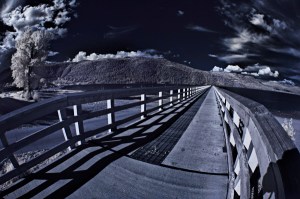
As I drove along looking at the changing colours I thought about the constant submissions of fall pictures I have been seeing on the local photographer’s facebook group, however, I had decided I would have more fun being different and instead chose my infrared converted camera and added a 10.5mm fisheye lens I had just got into my shop.

I pulled onto the Trans Canada and turned into Chase 20 minutes later. The traffic was fast and I had driven through the construction without a stop. I made my appointment in plenty of time, but the receptionist informed me they had decided to close early and I would have to come back another time.

In frustration I walked back to my car, but fortunately I had my camera. So instead of returning home I decided to wander around Chase.

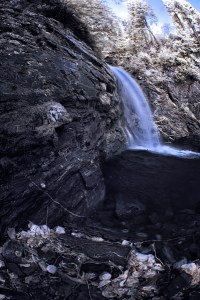
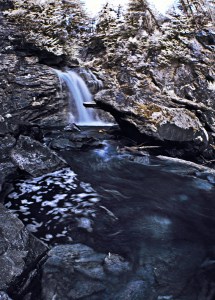
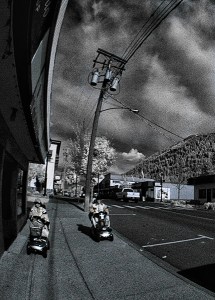
The fisheye was fun. I could take pictures of people on the sidewalk without pointing the camera at them. Admittedly the pictures were pretty weird with everything on the edges bending inward and I got bored with the town’s limitations. Fortunately Chase has a neat waterfall on one side and a big lake on the other. I left downtown and began with Chase Falls.
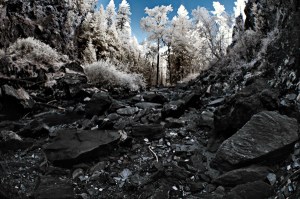
I photograph Chase Falls quite often, but this was the first time I was shooting in infrared and the first time I used a fisheye.   One can set up a tripod and capture the wonderful October colours that surround that inviting waterfall anytime, but capturing Chase Falls in infrared and with a fisheye is great fun, and a long ways off from what most photographers would every think of doing.

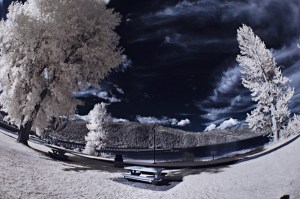
After an interesting time manipulating that environment I headed over to the lake for a complete change of scenery. Instead of large rocks, overhanging trees and falling water, there is a long pier jutting out into Shuswap Lake, large trees on the edges of a small park, and a wide sandy beach.

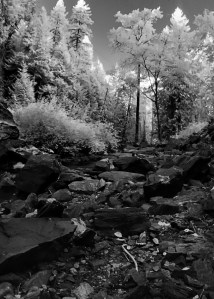
Infrared turned the trees to white, the sky a strange shade of blue and everything else a slight magenta. And what about the fisheye lens? Well, the fisheye lens just added to the already unreal quality of the image.

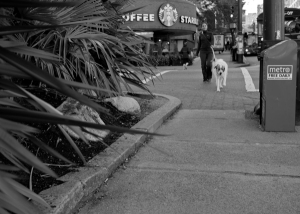
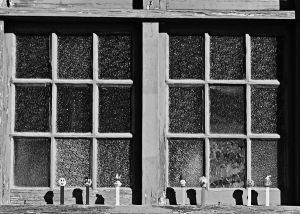
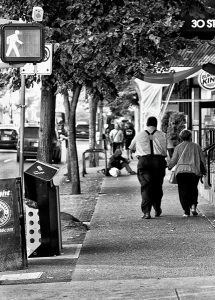
Trying Street Photography   

delanys-coffee

morning-riders

metro-free-daily

street-window

walking-down-the-street


Last week I wrote about my short adventure wandering Denman Street and the Stanley Park area of Vancouver, BC, with my camera.

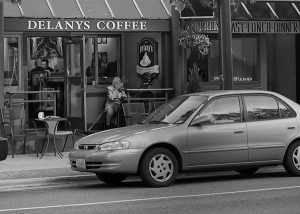
Each morning I got up early so I could stroll Denman Street before the sidewalks filled with too many people. I wanted to try to find the kind of people some street photographers do find, but I’ll admit that I am not very comfortable with that invasive type of photography.

I am sure there are some street photographers that might laugh at my reticence at photographing people going about their life in any area, be it city street or a back alley, with their various paraphernalia of shopping carts, back packs, box houses, or bicycles. I really like the genre of street photography; I mean to say I really enjoy looking at photographs made by photographers that are good at street photography.

I think that successful street photography captures a moment from the society around us. It’s a moment in time that is an important for the present and future.

I am sure some photographers shoot for the challenge, and there are some that wander the city with their cameras as a release of stress from everyday existence, while others have a need to make some statement about the world in which they live.

I try to do a bit but I expect it will take me more preparation than a few early morning walks to get my head in the correct creative space it takes to do street photography.

I searched for some street photography tips and here are a few I found.

  1. Use a wide-angle lens.
  2. Get close.
  3. Look for juxtaposition.
  4. Focus on the essential.
  5. Look for the light and shadows
  6. Look at the foreground and the background.
  7. Tell a story.

I read that in a good street photograph it is possible for a viewer to see and maybe imagine more than the original photographer intended. Practicing street photographers capture fleeting moments, interpreting life around them, and challenging our perceptions of the world.

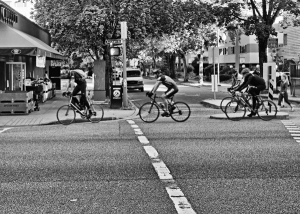
I have had some limited success at country fairs and city festivals in the past. This time I intended to get pictures of people going about their daily life on Denman. There is so much happening on a city street, or even within a small neighborhood, that it takes a good eye, and a fast camera, to capture it all.

Most of the street photographers I follow online shoot with small mirrorless cameras and are good at getting up close, but, personally, I would have been more comfortable with a mid-range telephoto. However, attaching a big lens on big DSLRs makes a photographer stand out. When I pointed my camera along the walk people would actually stop and wait for me, or change course to walk around me. Oh well, there will be another time and I can plan on trying again.

Wikipedia defines Street photography as ”Photography conducted for art or enquiry that features unmediated chance encounters and random incidents within public places”.

The genre of street photography is an old one and since the early days of photography there are those that have left us with their own styles of street photography that affects each viewer on an emotional level.

I welcome the comments of street photographers.