Photography on an overcast day

I have been trying to get outside to wander in the snow the past week with my camera, but everything kept getting in the way. So when Jo told me she had to take her daughter to a doctor appointment I asked her to drop me off at my favourite wandering place, Chase Creek Falls.

I figured that would give me at least an hour to take some photos and I was hoping to be alone in that snowy canyon on the cold, overcast Monday morning.

I like storms and I like the mood one can get in a photograph on an overcast day.

Jo dropped me off along the road and I walked down along the well-worn path through the snow. I picked a good day. From the looks of all the trodden snow, Sunday must have been pretty active.

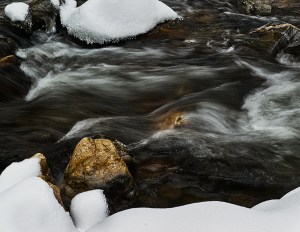
Stopping along the creek to take a long exposure of a rock glowing golden in the cold water I thought about why I like digital cameras and all the photographic creativity that goes along with modern technology.

I continually meet people that assume someone my age would still be using film. Gosh, I could fill page writing about why I don’t bother photographing anything with a film camera. At that moment as I mounted my camera on my tripod to photograph that glowing gold rock I thought about how hard it used to be to make pictures on overcast days and was glad for the modern equipment I have.

I mounted my 24-70mm lens on my camera and selected an ISO of 1600. Then set my shutterspeed to eight seconds, chose an aperture of f/11 and with the camera’s self-timer activated, I pushed the shutter release.

I refocused on a couple different rocks in the creek besides the golden centre of interest to make sure my depth of field would cover everything in my viewfinder. Then I released the shutter a few time and moved on down the stream.

Sunny days are such a struggle for a photographer wanting to photograph a waterfall.

Sure one can get a pretty, bright landscape, but I like to have contrast in the water when I use a long exposure, so overcast is great. And on this day I wanted to capture the cold winter mood and if I really needed to highlight a particular feature like a rock or log or foliage I’d just do that in later in post.

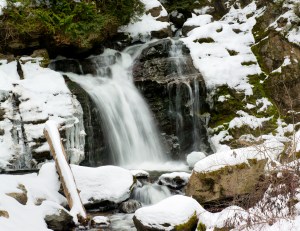
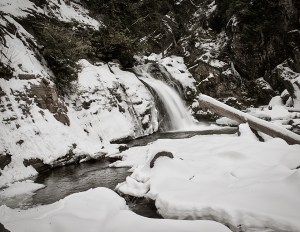
The Chase Falls is always a perfect subject. All I had to do was poke around in the snow with my tripod to make sure there weren’t any spaces between the rocks or soft spots in the ice as I moved around photographing the falls from different locations, eventually I sat on a bare rock to listen for a while and look at the monochromatic January landscape.

I am fortunate not to have to drive and hike hours to enjoy such a photogenic location. Now I am waiting for more snow so I can collect winter photographs in the garden that hides my home from the road. Today there is a light covering of snow, but it’s been so warm that the snow isn’t clinging to the plants.

Ah, but its January and there’s a few more months of snow to come and more winter photography.
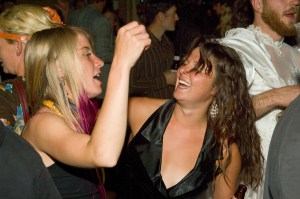
Photography at that year’s end party.


I’ll be having some friends over to my house to bring in the New Year with me and I want to make sure I get some fun photographs that I can give them to remember the end of 2018.

With that in mind I decided to repost this article I wrote back in 2013 about photographing parties.

I can hardly believe how fast this year has gone by, wasn’t everyone just complaining about the unforgiving summer heat? Now, here we are bundled up in the -6c cold and snow with snow tires mounted on our cars. Gosh, there is even an advertisement on television about what wine to bring to upcoming New Years Eve parties.

Don’t get me wrong I like this time of year and everything that goes with it, but I am not ready for winter’s snow yet, and neither is all the stuff in my yard that will get covered if I don’t get off my-lazy-whatever and pick them up.

Even though it seems early, the year’s end is here and that means photographic opportunities as we join family, friends, and co-workers at all the festive events.

Photographer friends are going to dive in, digital cameras in hand, happily filling memory cards with candid photos.  Picture taking has become so easy and so much fun as photographers rush over to take a picture, look at the LCD, and quickly slide back to show others those tiny images.

Photography for many has become more about the process of picture taking than it is about creating art, or even documenting the party; it seems its more about standing in front of people, taking lots of quick snapshots, than it is about making memorable photographs.

Most images made in this fashion never become more than space-taking files stored on computers or phones that after quickly being looked at, laughed at, or just smiled at, are tucked away with good intentions to be used in some fashion in the future. But after that initial viewing they loose their value because there are too many, and very few are good enough to give to others anyway.

How should readers approach photography at the next party?  I do think we should continue to make candid photographs of people having fun, but, perhaps, one might also think about making pictures that tell a story, capture an exciting moment, and importantly, flatter the subjects.

Most people don’t mind seeing a picture of themselves being silly or having fun, but they don’t like pictures that make them look stupid or unattractive.

My approach is to take a moment to look at the room in which I intend to make photographs, make a couple of test shots with longer shutter speeds (my favourite is 1/60th of a second), to include some ambient light when making exposures using a flash mounted on-camera (bounce flash of course) so as not to end up with brightly lit faces surrounded by a black environment.

When taking group shots with two or three people, get them to position themselves so they are squeezed together with a tight composition, and include only a little background or foreground. Don’t shoot fast, steady the camera, and select a shutter speed that includes the ambient light.

Fortunately most modern DSLRs easily allow ISO sensitivity that is 1600, and some go a lot higher.

Shutter speeds of 1/60th of a second, or less, don’t always work for children playing in the snow during the day because moving subjects will be blurry, but, with limited indoor lighting moving subjects will only be exposed properly when the flash goes off.

Lighting everything with complicated studio equipment would be great. However, the occasion would become more about the photography than about the fun and festivities.  I use an on-camera flash and make adjustments as I go. I want to join in on the fun, not act like a photojournalist.

Family and friends don’t mind having their pictures taken as long as its enjoyable and I want pictures that show them having a good time. So, along with those quick candids I make posed portraits with smiling faces, and if I select some prints to give away later I want people to like the pictures and honestly thank me.

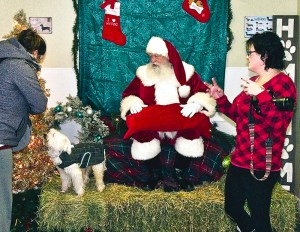
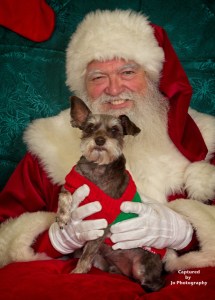
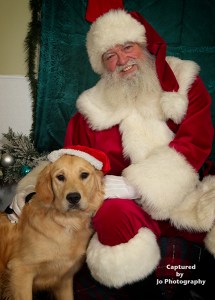
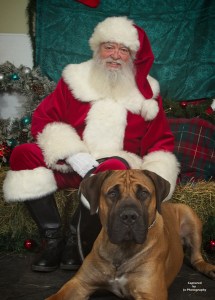
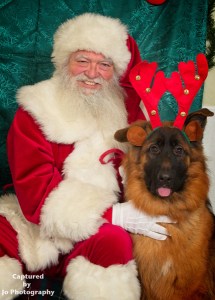
Santa Photos with dogs 


This past week my friend and photographer Jo McAvany phoned to tell me she had volunteered to do photographs for a local business called the “Brazilian Dog Guru”.

The owner, Fernando Silva, had a great idea to photograph people’s dogs with Santa Claus for donations to support a local dog rescue organization.

I wasn’t surprised when Jo said she jumped at the offer to be the photographer. As well as an avid photographer, Jo has opened her home to a lot of rescued dogs over the years.

I was delighted that she would be doing that, and wasn’t surprised when she first asked if she could borrow some of my lights and second, suggested that I come too.

I thought it would be an unusual and fun way to spend the day. After all, I like dogs and they usually like me, so there we were at 11am on the following Sunday setting up lights in a small room while saying hello to Santa.

Soon excited people and their best friends were lining up outside waiting for the elves to take them inside for their photographs.

During the Christmas shopping days I sometimes like to watch the Mall Santa photographers as they work. The technology has changed over the years. Its digital cameras tethered to computers so that parents can instantly see the pictures, make their choices, pay and walk off with a matted print.

For a few years I set up the photography for local malls. Although that was back in the 1990s, not much has really changed much. However, back then instead of the digital camera and computer, the photographer would take the rolls of film to the one-hour processing lab at the end of the day and parents would have to return to get their pictures.

Most of the dogs and owners that came for Jo to photograph with Santa were well behaved. Although like some of the children I saw at the mall’s Santa booth, they weren’t having anything to do with that stranger sitting on a bale of hay.

The owners would bring them in to meet Santa and their eyes would roll and they would almost pull their person over trying to get away. More than once that meant finding a human that wasn’t wearing a red costume. Sometimes the dogs ran back to their owners, but more than once Jo almost was knocked over when they chose her as a safe refuge from the scary man that was grabbing at them from high on a bale of hay that probably seemed dangerous when it moved under their feet.

After setting up the lights I had nothing to do but pet all the dogs and be entertained by the goings on in the room set aside for Santa and my friend Jo. (A tough job, but someone had to do it)

By the end of the day I am sure Jo not only had a sore back from bending over, (we decided a tripod might get in the way of dogs and dog leashes) and although she didn’t mention it, she probably had a bruise or two from the big dogs that thought she was there to jump on.

What a fun way to spend a day.

Dogs and photography, it doesn’t get much better than that, unless one includes that this event was for a very good cause; collecting donations for the “Pom and Pals Country Rescue” dog shelter.

Oh, and there are now over 50 dogs that have a picture of themselves with Santa. I think some people are going to get some great Christmas cards this year.

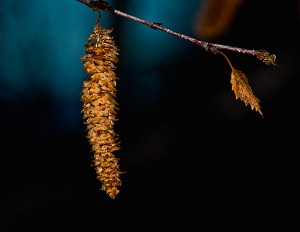
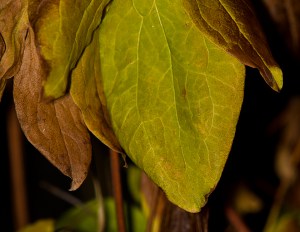
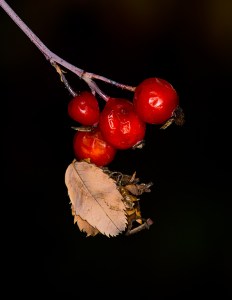
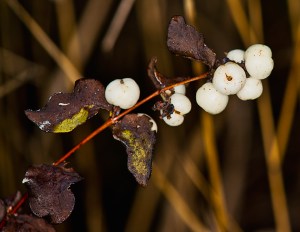
Photographing a November garden   


For years I have made sure to wander my garden with my camera in every season.

I know most photographers are only interested in the bloom of spring or glorious colours or fall, but to me it’s as much how the yearly changes shape the plants as it is the colourful presentation of spring and fall.

I like to walk around the garden that hides my home from the country road that borders my property. Spring, summer, fall or winter. I enjoy it.

It was on a late afternoon just after 4PM. I walked out on my porch to listen to the coyotes serenading the neighbourhood. Or maybe they were complaining loudly that the wet cold weather was making it hard to find food that normally scurries in the meadows.

Friends have commented that it must be nice to live away from the noise of the hustling city. However, at that moment it wasn’t only the coyotes that were disturbing my supposedly quiet rural life. Three roosters, fourteen chickens and five ducks were all making sure I knew they were as important as the coyotes in their forest home.

As I lazily kicked some fir tree branches out of my path I thought about how the cold plants looked interesting and decided to get my camera.

I mounted my 200mm macro on my camera and attached the ring flash and walked along the little pond to take some pictures. After about five not-so-sharp captures I chastised myself for being lazy and returned to my house to grab a tripod.

A photographer I met that worked for a couple magazines once asked me, “What is the difference between using a tripod and not using a tripod?   “The shot with the tripod is the one the editor chooses for the cover.”   I am not sure if that’s always true, but I am sure using a tripod (and a flash) when photographing plants and gardens give me more keepers.

The ring-flash creates a smooth direct light that is very different from the flash mounted top of the camera. There is a sparkle to the subjects.

I always use a flash for plants.

I begin by metering the ambient light as if I were about to photograph the flower without a flash. Then I stop the aperture down to under expose the picture. In the low, bright November light I wanted to darken everything but my subject.

Sure one could open the aperture to reduce the depth-of-field and soften the background. But the closer the lens is to the subject when doing a macro or close-up photograph the less the field of focus in front of and behind the subject will be anyway.

I want as much sharpness as I can get around the flower. So instead of relying on the aperture to separate my subject from a busy background, I reduce the ambient light.

My ring-flash is set to manual so all I need to do is experiment with flash distance. I move forward and back to give the plant the light I want.

The ring-flash has a diffuser and I use a 200mm macro lens. The magnification is the same as with a 50mm or 105mm macro. I just get to be further away and that distance is more effective for the ring-flash.

There isn’t much more relaxing photography than garden photography because the subjects usually cooperate.

December has just overtaken me and I have no doubt that festive Canadian month will bring a totally different garden to photograph.


“It no longer matters if a person knows anything about photography, anyone can take a picture”      

I met a young creative photographer that is working hard to make sure his photographs stand out amongst the legions of picture-takers in this popular and expanding medium. He leaned on my counter and gestured into space as he made that seemingly painful statement to me. “It no longer matters if a person knows anything about photography, anyone can take a picture”

His goal is to produce images that are visual statements of how he feels about the subjects he photographs. He has studied and studied and wants his work to be seen as more than just documents of the world around him.

The medium of photography has become very accessible for everyone. The days when most serious photographers actually went to school to learn about photography and had to be an engineer and chemist are long gone.

With today’s supercharged and computerized cameras many photographers get away without any knowledge whatsoever of photography.
Historically, photographers had to understand the combinations of shutter and aperture for a properly exposed image, and worried about camera shake and film choice. Photographers would carry more than one camera because they wanted the resulting photographs to be in both color and black and white.

One must remember that a few short generations ago photography needed large glass plates, hazardous chemicals, bulky cameras and wagons to carry everything.

I am not sure that the photographers of the late 1800’s or early 1900’s were actually interested in photography as a creative medium as much as a way to document reality of their unknown world.

Whether trying to convince some person to sit as still as possible for long time periods or setting up unwieldy photographic equipment on a cold mountaintop to photograph the view, photography was once a challenge that most of today’s photographers would shy away from.

There are those that are intent on complaining that with the end of film comes the end of photography. Personally, I don’t think film is going away any time soon. (Film is just one way to make a photograph.) The big box outlets may not carry it much longer, but there are lots of specialty items artists use that are only available in specialty stores, and I think film is still available at some small shops. However, the chances of getting the correct advice from the person behind the counter doesn’t seem likely.
Yes, anyone can take a picture nowadays. That’s a good thing and not something to complain about. There are lots of good photographs being taken and although most of them fall into the category of documentary or snapshot photography. People want visual memories of their world and the many camera incarnations are perfect for that.

I look forward to seeing more photographs made by that young photographer and others like him. My advice to him would be to embrace all the exciting technological advancements he comes across as he strives to make his photographs stand out in. After all photography has always been about technology.

I am sure he will work at producing images that will be technically perfect visual statements about what he feels or wants to say.

There are many, myself included, who are interested in the viewing good photographs. It doesn’t matter how the image is produced as long as the final photograph has something to say and is visually exciting!

That critical comment “anyone can take a picture” shouldn’t make any of us worry as we look forward to the future of this exciting medium.

Home studio Lighting set-ups for Beginning Photographers      


I am always pleased when I know that someone has actually read my articles.

Twice this past week I was visited by different aspiring photographers, that had read my last article on using lights and stopped by to ask advice on setting up home portrait studios.

For them and others that missed my past article on setting up a home studio, here it is again:

In each instance the photographers were quite troubled by the kind of lighting equipment other photographers were advising them to purchase and how much it was going to cost to get large and expensive studio lights.

They complained that they would have to wait till they had the money before a home studio lighting situation could be set up. I believe they were paying attention to those that included expensive manufacturer’s names for their studio type lighting setups.

One might be able to locate used studio lights with a bit of searching online. However, there will be shipping costs, plus there is a chance that they will arrive not working.

There usually isn’t lot of quality studio lights locally, and to confuse new photographers more there will be lots of those cheap, inadequate, constant light kits that were purchased by other unsuspecting beginners for sale.

My opinion is they don’t really need to go to the bank just yet, and would be better starting out with the smaller speedlight type flashes.

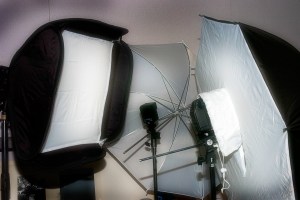
With the money they save by not purchasing those big studio type lights they could buy a couple inexpensive light stands, umbrellas and maybe even a softbox and backdrop.

Most small home photography studios are in the basement with equipment stored to the side until the photographer quickly sets up for a portrait session.

And if the room is less than twelve feet high, thirty feet long and only used for children, small groups or single person portraits, those big powerful and expensive studio lights may be overkill, and a real hassle when one wants to soften the background by shooting a wide aperture because there is just too much light power for small spaces.

Photographers intent on setting up small home studios for portraits and small groups don’t need to go to the expense of the brawny, studio type lights. They can easily, and without much initial cost, set up a studio with what I personally use, and call my “portrait kit”.

My portrait kit is four older hotshoe type flashes, each with it’s own wireless receiver and two stands. I can choose a shoot-through umbrella, a reflector umbrella, or once in a while a softbox, and might include a reflector. It’s an inexpensive and easily stored “portrait kit” that I would recommend for most first-time, home studio photographers.

Wireless senders and receivers come in all sorts of inexpensive incarnations, and it’s the same with lightstands and flash to umbrella mounts.

All of this is much less expensive, and a lot easier to store and/or move around than the big studio-type flash units.

Even if there were a wad of cash burning a hole it your pocket, my advice would be to proceed slowly, and learn how use light to best photograph a person first.

I have been using multiple flashes off-camera since the 1970s. I prefer inexpensive used units that I can cheaply replace if they get knocked over or I wear them out.

Hotshoe type speedlights off-camera will be perfect for that educational process, and when they are no longer a good fit with one’s creative growth, the choices as to the next step in lighting equipment will be educated decisions.

Kelowna’s October waterfront  


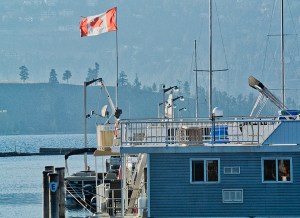
My friends Shaun and Jo McAvany decided to join me on a on a two-day trip to Kelowna.

Their anniversary had just passed and they had spent their honeymoon 9 years ago in Kelowna so I guess the trip was appropriate for them.

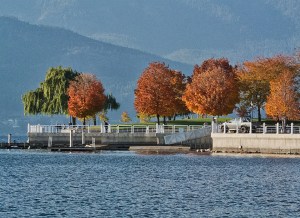
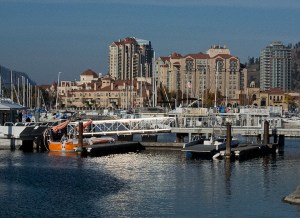
For me it was a chance to spend some time in a bigger city with it’s fancy eateries and, of course, to wander Kelowna’s waterfront with my camera before winter’s snow and ice covered everything.

They dropped off their kids at their grandma and grandpa’s place, found a friend to take care of the menagerie of dogs, cats, rabbits and what ever other animal they have rescued the weekend and jumped into my car to join me for the scenic two hour drive.

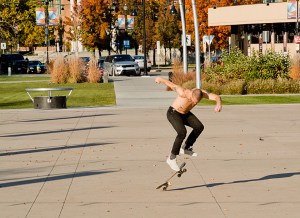
Although the Kelowna lake waterfront doesn’t have exactly the same feeling as Vancouver’s seaside, it’s pretty close. And the last days of summer are a perfect time to photograph the colour and mood of the freshwater foliage that mixes with city structures dedicated to tourism.

For this photographic trip both Jo and I carried our little Nikon mirrorless cameras. The Nikon 1 series doesn’t have a very big sensor, but if one isn’t going to be printing 11X14 or 16X20 enlargements, it’s the perfect interchangeable lens travel camera.

The weekend was sunny and it was light jacket weather. In the morning we shopped at 2nd hand stores, then ate lunch at a restaurant called Memphis Blues. (One of my favourite dinning establishments in that city) then spent the rest of the afternoon taking pictures along the waterfront.

One might say that my goal is to experience a different aspect of photography each week. I’ll admit I try very hard. Last week I was at a wondrous wilderness park with few people and this week at one of British Columbia’s premier vacation cities with lots of people.

I am not sure if it’s those changing opportunities that called me to photography, but the range available to those that answered the call of photography is certainly a grand side effect.

Doing photography with another person is fulfilling. One might be at the same location, and even with the exact same camera, but how each person chooses to creatively photograph that location, in my experience, is always very different.

Well that photography adventure is over, I have looked at Jo’s photographs and she has looked at mine. Yes we were at the same place, but our view was very different.


October 1st Granville Island photography wanderings       

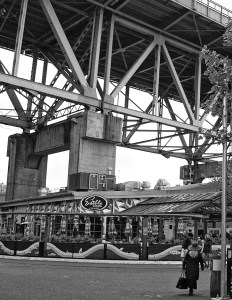
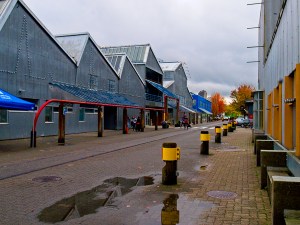
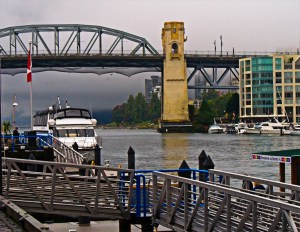
As luck would have it my second Granville Island visit this year was again on a rainy day.

I suppose any Vancouverite would tell me I shouldn’t be surprised. Rain is normal in both spring and fall in that part of the province.

One could rationalize and say, “well, the colours are deeper on wet over-cast days”.

That is so true, but I still worried about getting my little Panasonic mirrorless camera wet as I strolled with wet hair between the colourful buildings, dodging people clad in rain coats and hiding under umbrellas.

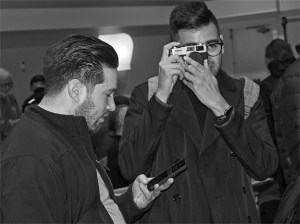
My friend Laurie and I spent previous day at the Vancouver Camera Show and Sale. Laurie had brought a camera that needed repair and we were waiting till after 1’oclock for a camera technician to return home.

There was no discussion for a photographer; Granville Island rain or shine was the prefect place to kill time and wander with a camera.

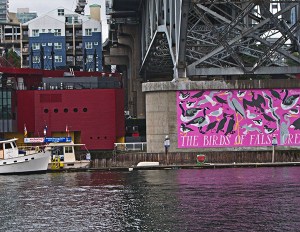
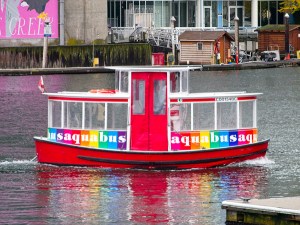
Buildings filled with expensive artwork, a food fair, farmer’s market, artist studios and, of course the Emily Carr University of Art and Design, are all great places to take pictures. Laurie was forever loosing site of, and then catching up to me as I meandered only thinking about the next photograph.

Heck, I knew where our truck was and was sure he’d find his way there when we both were tired of getting wet in the constant drizzle.

But I did have my camera.

I always find a reason to go there before or after the camera show. It’s also a grand place to shop if one has money in their pocket. And in spite of the sometimes-long wait, buying lunch or breakfast and relaxing among the excited and busy throngs of people from all over the world are fun.

I searched for some info on Granville Island, and the city’s info page says that Granville Island draws 10.5 million people each year. And the island’s architecture, much of which comprises remodelled warehouses, still show the island’s industrial past.

“Granville Island is a peninsula and shopping district in VancouverBritish Columbia. It is located across False Creek from Downtown Vancouver.”

“The peninsula was once an industrial manufacturing area, but today it is a hotspot for tourism and entertainment. The area was named after Granville Leveson-Gower, 2nd Earl Granville.”

That is great trivia, but for me, the lure of the place is photography. Sure, I enjoy an early morning coffee and bagel, but the urge to keep photographing the place doesn’t allow me to sit for long.

I think the famous American photographer Annie Leibovitz describes my wanderings in Vancouver’s Granville Island when she said,   “The camera makes you forget you’re there. It’s not like you are hiding but you forget, you are just looking so much.”

Another Vancouver Camera Sale & Swap Meet   

Vancouver is famous for it’s rain.

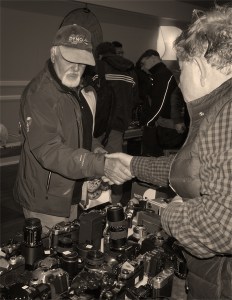
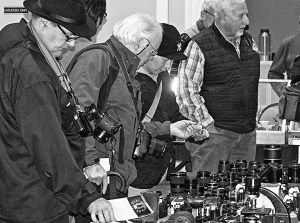
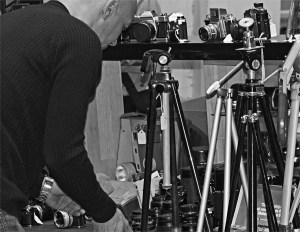
Pounding Vancouver rain was what greeted my friend Laurie Patmore and I as we rolled our loaded carts into a large room filled wet shouldered people that were arranging all sorts of camera gear on their tables for the Vancouver Camera Show and Sale.

It was 7:30AM and we had two hours to say hello to long time friends and get our equipment ready for an excited crowd of photographers anxious to exchange their hard earned money for the shiny items on our table.

Laurie, as always, disappeared and left me readying the table. Selling stuff is fun, but searching for and finding treasure is way more fun.

This time I had lots of old manual zoom lenses that I just wanted to get rid of any way I could and I wanted to organize my cameras so people would see them first.

Those zooms lenses were prized and sought after back in the 1970s and early 80s, but now they have lost their allure and aren’t even used as paperweights. Nevertheless, I keep trying to sell them. Actually, “get rid of them” are much better words.

Every show I go through the guessing game of what will sell. Last time anything from the 1970s was popular and digital equipment was totally ignored. However, this show there was little interest in the old manual equipment. It was mostly digital equipment that attending photographers were interested in.

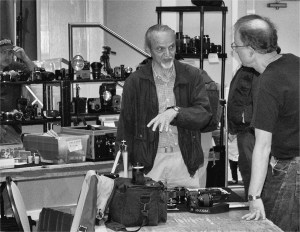
What keeps me coming back year after year? Well the people, of course.

The large, bustling, international, coastal metropolis of Vancouver British offers almost anything one could wish for, and events like the Vancouver Camera Show are always a great excuse to spend time there.

The advertisement says. “ Antique, vintage, digital, and everything else for photography, new and used. Do not miss this opportunity to the fascinating world of photography”.

I agree. What an opportunity to enjoy the exciting and fascinating “world of photography”.

I enjoy the people.

Of course looking at, touching and discussing some precious piece of camera equipment is darn fun, making pictures is stimulating, exciting and a rousing force.

I know we all can hardly wait to look at our latest picture on the computer screen as soon as we depress the shutter and making those pictures is all consuming. But talking with other photographers is exhilarating.

The Vancouver camera show and sale is over for 2018 and I’ll have to wait till the spring of 2019 for the next show. I am more than satisfied knowing that I have already planned a couple more photography excursions for this year.

I found this fun quote by the famous Canadian singer Celine Dion,

“I don’t know if the camera likes me, but I do like the camera”.


The best lens (for the price) to photograph wildlife.    

In my experience, any image can be altered (sometimes dramatically) when one changes lenses.  A subject can be isolated and the perspective in front of, and behind, the subject flattened with a telephoto lens. And landscapes are changed using a wide-angle lens as the field of focus increases the view around the subject.

To add a bit more to my last article, “what is the best lens for scenic photography” I thought I’d continue with a discussion I had with a budding wildlife photographer.

I select my lenses depending on what I want my photograph to say about the subject. And to me, control over my image is important so I ask my self two questions.

What lens will show my subject best? And second, what final result do I want?

This past week I spent some time talking about lenses with a photographer after he read my last article and said, What about the best option for the price to photograph wildlife here in the interior of British Columbia.

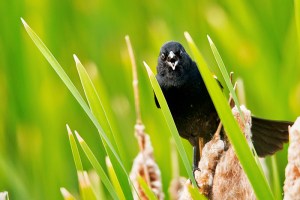
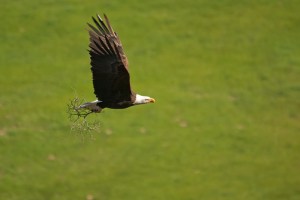
I suggested starting with a zoom that can reach 300mm and then purchase a 150-600mm in the future. Each of those lenses has a narrow angle of view and plenty of magnification for wildlife photography.  I thought he might start with a lens that is inexpensive, lightweight, easy to pack around and hand holdable. The smaller multifocal length lenses are generally lightweight and excellent for vacations or just walking around.
He told me he is hesitant to dig into his savings for a super zoom at the present, so I thought moderately priced lenses like the might do for his introduction to long lens photography.
There are interesting lenses like the 300mm and more impressive lenses like a 400mm, 500mm and even the favourite of bird photographers, the 600mm. But for an introduction I thought a zoom might be more versatile until he was ready to make the financial commitment to a large prime or zoom.
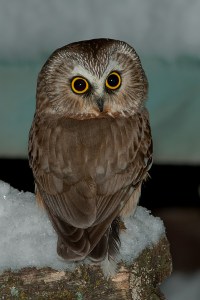
When he gets serious and willing to spend a bit more there are big lenses with maximum apertures of f/2.8. Those large high quality lenses give the user lots of light gathering capability and the ability to use higher shutter speeds for reducing camera shake, and help stop fast moving subjects.

To explain that, there is an optimum amount of light that reaches the camera’s sensor for a correct exposure. When the aperture is closed down it lets in less light and one must slow the shutter speed.  With large aperture lenses the shutter opening can be increased and let in a lot more light, therefore one has the ability to increase the shutter speed for less camera shake and still get a proper exposure.

All this also affects “depth of field”.  Depth of field is best defined as “that area around the main subject, in front of and behind, that is acceptably sharp”.  Photographers like to blur non-essential elements in the background by reducing the depth of field, and do that by increasing the size of the lens aperture.  In addition, letting in more light makes shooting in low light conditions less difficult.

And to that photographer’s question:  What lens do I need?  There are lots of other choices that will better help him visually discuss his subject. I don’t think there is one lens that fits all.

Each year manufacturers introduce more lenses with different technology, which improves imaging capabilities, and naturally, increases the price.

One of the favourite sayings in photography is “it’s all about the glass”.

Photographers I know that spend their free time photographing birds tend to stay with long fixed-focal length, or prime lenses. However an opportunist like myself will prefer the versatility of a multifocal length (zoom) lens.

With regards to that soon to be wildlife photographer, I expect to see him with more than one lens choice as he pursues his hobby and selects different lenses that meet his photographer’s vision. I know he will be cautious with his purchases, but ultimately his choice of lens comes down to what he wants viewers to feel and see.