Will New Cameras Make Better Photographers?   

A new camera?

Will a different camera and more megapixels make a difference?

I received an email the other day from a photographer who is trying to earn some money at photography. She had been submitting prints to companies that purchase stock photography, but has not had any luck. Discouraged, she wondered if her problem might be that her camera wasn’t making high enough quality images, and thought purchasing a new camera with more megapixels might be the answer.

I began by saying that she should keep on submitting photography and suggested she take a look at her style and preferences in photography and to determine if there is a niche market that fits her subjects.

I suppose any excuse is a good enough to get a new camera. I am OK with that, however, I am not sure that “more megapixels” is the answer.

As long as I have been in photography photographers have blamed their failures on their cameras. It used to be that photographers wanting to become professional, would discard their 35mm and buy a medium format camera because they believed it was necessary to take professional pictures. Then they would decide their pictures still weren’t good enough, so they would sell their Mamiya to buy a Hasselblad, thinking that would really allow them to take professional pictures.

That attitude and rational about cameras hasn’t changed, only now instead of medium format cameras the answer is a bigger sensor with more pixels, and, of course, the belief that one camera company might be better than the other.

Will different camera models and more megapixels make a difference to the image quality? Well, maybe. Perhaps it could depend upon what an image buyer wants and how large the final image file needs to be. Research into that means pages of confusing charts and hours of reading other photographer’s opinions.

I believe we need to be comfortable with our cameras and learn how to make them perform the best. I taught photography for many years and I was always amazed at how much money students spent on camera equipment in order to achieve an A grade, when all they needed to do was learn better techniques.

I am not saying that one shouldn’t get the newest and best photographic equipment available. My advice is to make the choice the depending on the kind of photography one likes to do. However, the camera isn’t going to make a person become a better photographer.

As I write this I am beginning to wonder about that last statement. If a photographer purchases a new camera, they get really excited and go out and shoot, and shoot. More shooting equals more practice and when all is said and done more practice is what actually makes for a better photographer.

With that rationale we could say if a person bought a new camera every six or eight months (that seems about how fast new models are appearing) then that means a person would be improving at least twice a year. Gosh, in two years a person would be four times better than when he/she started!

Hmm… with that reasoning I should tell that photographer to go ahead and buy herself a new camera with as many pixels as she can afford.

Nevertheless, if after her hours of research she can’t make a decision on which new camera to spend her money my advice will be to study the work of successful photographers in her subject area, and spend lots of time experimenting and practicing with the camera she has.
What Influenced My Photography of Landscapes?  


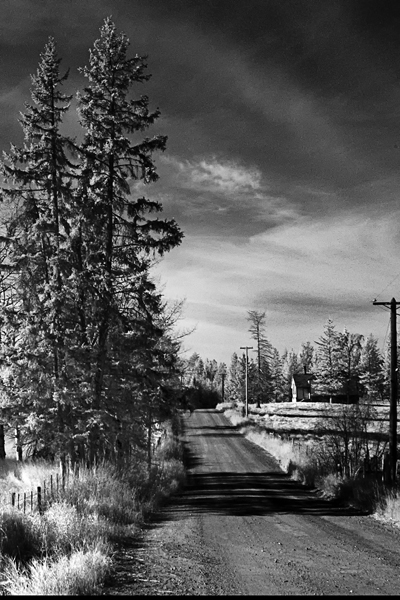
Along the back road 2

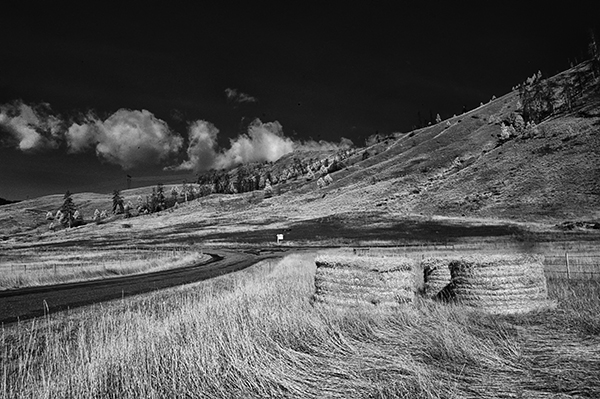
Bales along the road 2

River view

Lake view

Scout

Memories of roadside photography.


My interest in photography began in the early 1970s. I had grown up with cameras, but until that time they were no more than a simple boxy device with which to document family and friends. When I look at my tattered old albums packed with fading pictures taped to construction paper pages, I see lots of poorly composed and poorly exposed images, partly due to the inadequate technology of the day and my ignorance in using it.

When I did decide the medium of photography was worth using for more than documenting friends and family my first progression was into arty, creative images. I have mentioned before that the great photographer, Man Ray, was my first inspiration, but now thinking about my photography of those days I am amused at my youth, and contemplate how far I have progressed and of course how far the technology has come.

I think my influence with the photography of landscapes and other subjects in nature may have begun with the early advertisements by the American Automobile Association. That organization was the best place to get maps for road trips in North America. They sent their employees out, with cameras and mapping instruments, across the continent finding the best and most scenic routes. I remember seeing pictures of big, four-door International vehicles with people poised on platforms on top with camera and binoculars in hand on a dirt road in the middle of “no-where North America”. It all looked very exciting.

Then I was introduced to the writings and photography of Ansel Adams, and saw pictures of him standing on a platform on top of a vehicle very much like those used by the American Automobile Association with his large format camera making wonderful photographs any scenic photographer would admire. So, I saved my dollars, sold my jaunty little MG Midget, that was so easy to get around in on the streets of Los Angeles, and bought a bright yellow International Scout 4×4. Underpowered, poor turning capability, uncomfortable on long trips with back seats that were only accessed by climbing over a metal barrier behind the front seats; it was perfect in my young mind and meant that I, like Ansel Adams and the folks from the AAA, could travel the back roads in a cool looking vehicle with my camera gleefully capturing the natural world on film.

Years have passed and technology has changed and so have I. There are still lots of back roads to explore and photograph, but the days of climbing on my car roof are long gone. The American Automobile Association no longer explores the country and today I check maps on my iPhone. I don’t need a large 8×10 view camera like Ansel Adams used with the accompanying long hours working in a chemical darkroom to make good enlargements and certainly don’t want to drive around in that uncomfortable, gas guzzling International anymore.

I thought about all this as I was heading towards the city of Kelowna last week. My wife and I left early so we could stop for some pictures and still be there for a 5PM appointment. My car of choice is now a Honda Accord. Comfortable, fuel-efficient and if I drop the back seat down I can carry lots of equipment. As I drove I mentally made photographic compositions of the countryside and thought about how nice the day was for photography.

I reminisced about the many times I have made this same drive over the years, and the different photographic equipment I have used to photograph many of the subjects and scenes I was driving past, and the different vehicles I have used, and we talked about how easy it is to make pictures today. As the cameras get better and better, and equipment like tripods and lenses get lighter, and our vehicles are more fuel efficient, the life of roadside photographers like me is just great.


Viewing Scenic Photographs   


seagulls and boat 2

Falis Pond 2

Wolf ranch

I enjoy looking at photographs that seem to have been made with the goal of saying something about a moment in time or place. Sometimes I even get a sense of the struggle the photographer had while trying capture a particular mood and how hard it was to convey that mood to the viewer. I think creativity takes a lot of effort.

This week I thumbed through a hard cover book I have had for years by one of my favorite landscape photographers, Eliot Porter. The book, entitled Intimate Landscapes, is from an exhibition of fifty-five color photographs by Eliot Porter, at The Metropolitan Museum of Art.

I enjoy how he eliminates those elements that add nothing to the composition and selects those that add meaning to his visual statement. He had an amazing awareness of how colors create mood. A review I read went on to say that his photographs, “reflect the standards of excellence that are Eliot Porter’s greatest contribution to the field of color photography. Upon seeing these photographs, the viewer is immediately struck by the artist’s distinctly individual and intimate interpretation of the natural world.” His photographs are different and specific, and have a personality that I think come from the experiences of the photographer.

When I finally put down the book I thought about how many of the scenic photographs that populate photography forums I currently read are mostly documentary type photographs, and I wonder if the photographers believe that any vista with lots of space and colour is worthy of photographing. They might be of the opinion that all it takes is a wide-angle lens to miraculously convey the feeling and emotional reaction they personally felt at that moment. Perhaps that is why the viewers’ responses they get are sometimes limited to, “nice sky and good composition”.

My long-time friend, Bob Clark, used to critically suggest that all one needs for people to like your landscape or scenic photo was to have a “National-Geographic-sky”, a magazine that was filled with pretty pictures of places from around the world with blue skies and billowy white clouds.

I prefer scenics that make an impression on me and convey a mood. I want to look at a photograph that allows me to find a story in it; or at least be able to search for one, and hope for a photograph that I can respond to on some level. A photograph should try to accomplish something, and should have a strong sense of self-expression. Photographers should look for something in the landscape that is unique, and that will set their photograph apart. As photographers we should try to express our personal viewpoints and hope to summon an emotional response from those who view our photographs.

Photographer’s Workflow   

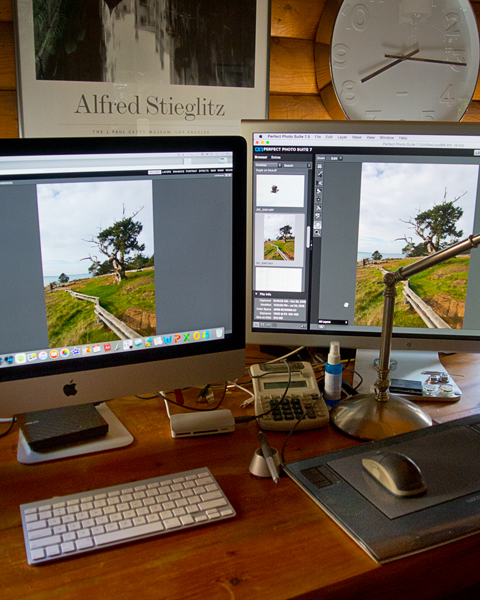
WorkStation

This week there was quite a discussion in my shop about the selection of software for producing quality images. Today photographers are clicking camera shutters more than compared to just a few short years ago when photography was ruled by film. Exposing four or five 36-exposure rolls while on vacation, or at a family event, was pretty much the norm instead of the 600, or 1600, captures filling memory cards today.

We each talked about our personal workflow for editing images. The following is some of what I added regarding my own workflow, and some of the programs I use to speed things up.

When I get home with images in my camera the first thing I do is remove the memory card, insert it in the card reader attached to my computer, and begin
the process of downloading. I am usually excited with anticipation about the 
images I have just captured and I want to see them right away.

I begin with a program called Photo Mechanic from Camerabits.com. Photo Mechanic is a fast and easy way to 
work with and manage groups of photos.  I open up a screen full of pictures, select those I want to keep, batch-rename them, and move them to a 
new folder.  The process is very fast and in a short while I can go through and review what I have just photographed.

I don’t leave my image files waiting very long before I start to work on them. 
I am always excited; I hate waiting, and I enjoy working on my pictures. Years ago I would be in my photo lab, with the stereo turned up, happily developing, and printing enlargements in a darkened room only illuminated with red and amber 
lights.

Nowadays I am still happily “developing”, but with the music coming from bigger speakers in my living room and I am sitting in a comfortable chair
instead of standing on a rubber mat in my basement darkroom.  There are no wet trays; there are no coloured lights, just a couple of big, bright computer displays with colourful 
pictures.

I then start the process of enhancing images and for that I employ several programs. Of course there is the ever-familiar Photoshop, however, depending on how I decide to fine tune my images I might choose to use the feature packed Perfect Suite program from Ononesoftware.com. Perfect Suite is a photo editor that works as either a standalone application, or plug-in editor, to Adobe Photoshop that includes some pretty exciting tools.

For years photographers have used graduated filters to cope with the contrasts of bright sky, and low light foregrounds with deep shadows, or bright highlights, when photographing landscapes. Although I don’t recommend getting rid of those filters yet, there is a program that may save lots of time usually spent in Photoshop lightening 
and darkening those landscape pictures. It is called Photomatix from HDRsoftware.com. Photomatix combines more than one exposure of a single subject that is exposed from the darkest shadow to the brightest highlights by creating an HDR (High Dynamic Range) image.

Finally, I will reach into a powerful and fun collection of fine-tuning programs from Niksoftware.com’s easy to use image editor that allows me to compare and make different adjustments quickly.

Most of my images are pretty good when I finish them in Photoshop. However, in my continual quest to speed up my post-processing of images, reduce my time behind the computer, and still produce quality images I find that combining these five programs fits my workflow perfectly.

I know that new cameras and lenses are what most photographers lust after, but I think if you are trying to justify expensive equipment purchases to your spouse, partner, or banker, it might be easier if you are already making show stopping, eye-catching pictures. Check the programs I have mentioned (always try their trial copies first) and see if they are for you.


Two Photographers Are More Fun Than One

Linda

Linda


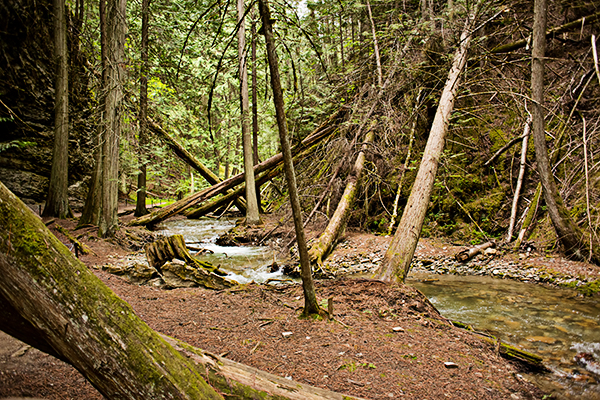
Fallen Cedars by John

By John


Fallen Cedars by Linda

By Linda

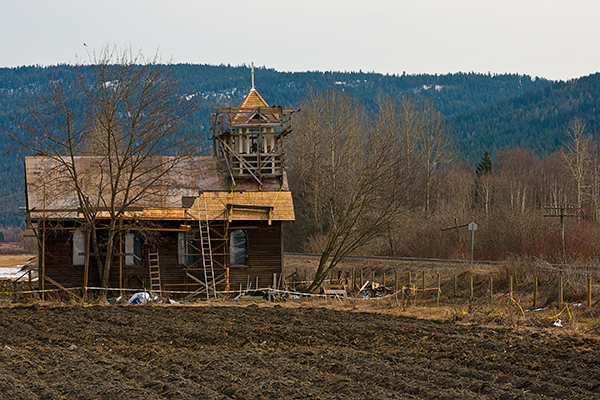
Notch hill church. Linda

By Linda

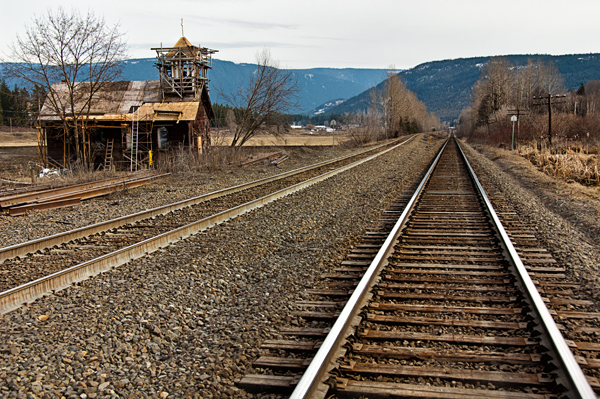
The train goes by

By John

This week I talked with a fellow that grumbled about how his wife complains about waiting for him when he wants to stop to take a pictures. I suggested that he find a way to get his wife involved in his hobby. After he left I remembered the following article I wrote back in August of 2011. For those who may have missed it, I thought I’d post it again.

I received a most encouraging email from a reader: “In talking to you I noted that you and your wife both are into photography, so I proposed giving my wife a DSLR and get her into shooting her own pictures. She was a little hesitant to the idea saying she did not have the “artist’s eye”. However, I printed out your blogs on ‘What Makes a Good Photograph’.

After reading it she commented that “each person has their own take on what makes a good picture”, and the short of it is, she is willing to take up photography with me”.

Personally, I think much of my enjoyment of photography would be missing if my wife, Linda, was not also a photographer, and it is great that we both enjoy this exciting medium and can share the experience of making photographs.

My advice to any photographers that are interested in getting their spouse involved in photography is as follows.

Match the equipment. I mean with regard to cameras, both DSLR (digital single lens reflex) cameras should operate in much the same way. The models can be a few years apart, but should be the same brand and the controls should operate similarly and if two of the latest models are affordable, so much the better.

Don’t be cheap with lenses for your spouse. If it isn’t good enough for you, it isn’t good enough for the most important person in your life. Just as you would select a lens for the subject and the way you like to shoot, your spouse should select lenses for his or her preferences. I know your mother told you to share, but my recommendation is don’t share. That just leaves someone behind. If you both like long telephoto lenses, get two.

I can remember the exact moment I thought about the concept of equality. I was in Yellowstone National Park in Wyoming waiting for Old Faithful geyser to erupt. While I waited I noticed a man and woman with their tripods setting up closer than me. I could see that he had a large, professional looking camera and she had a tiny, almost toy like camera. I knew that his photographs would be good and hers not so good. It didn’t matter if she was the better photographer or had the better eye, his pictures would be better, and I wondered why would she even try.

Shop for accessories together. Each photographer has his or her preferences and should make equipment choices for the subjects they like to shoot.

Education is always a good idea. Attend a photography class or workshop. Search for them on line or check local camera shops. Take turns going to photography classes or take part in the same workshop. One of my wife’s and my most memorable vacations was when we both attended a weeklong wilderness photography workshop on Mt. Rainier. In my opinion we may have got more out of that class than the other participants because we were able to share information and experiences.

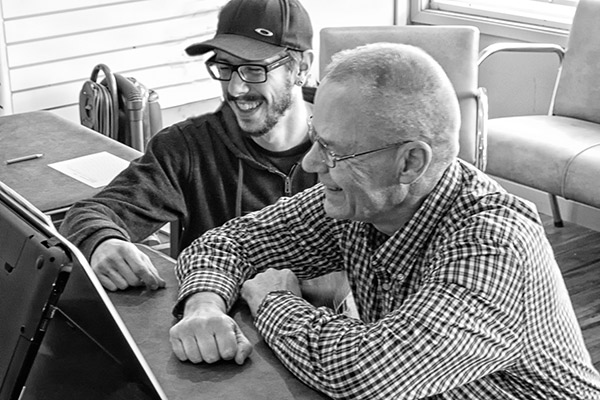
Gently critique each other’s photography. Don’t just store pictures away on the computer. Sit in front to the computer display together and decide which photographs work and which that don’t, delete all the failures, and make a combined presentation of all the successful images to show your friends and family.

One photographer in the family is cool, but two photographers, in my opinion, are much better. If you want your partner to have the same excitement about photography as you do, don’t be stingy with the compliments. And if your spouse is fortunate enough to make a better picture of that waterfall or running deer than you, be sure to tell them.

The Best Camera for Outdoor and Wildlife Photography

Outdoor camera

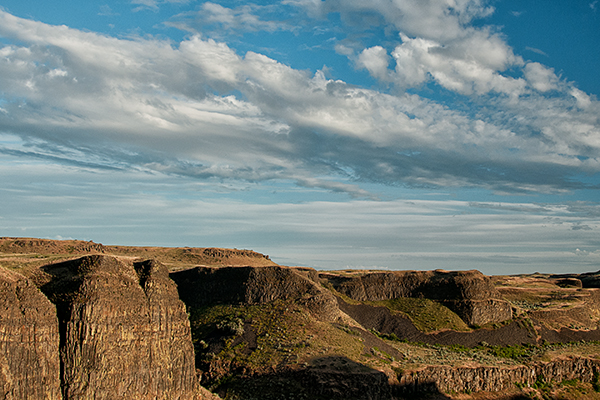
Washington Landscape

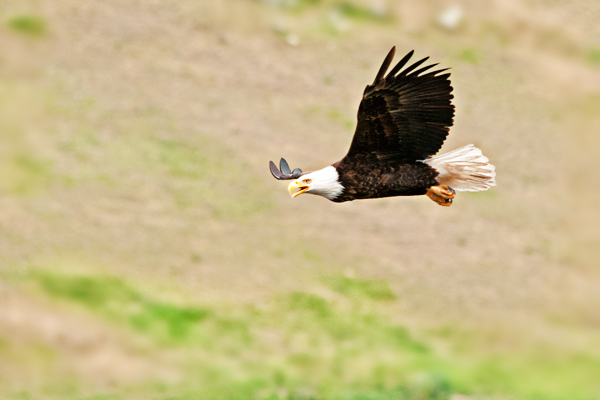
Eagle

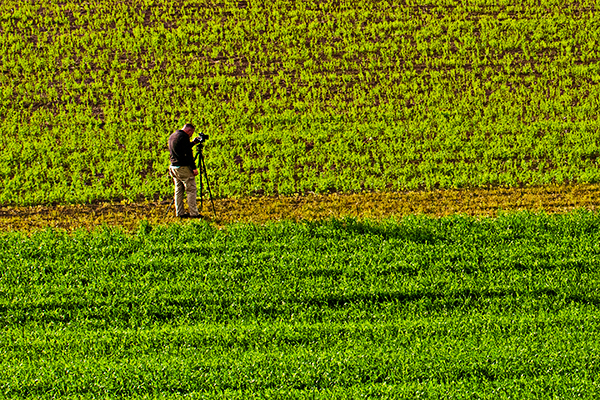
Landscape Photographer

Digital technology has been around long enough that I occasionally forget there are many people that have never used anything but small-sensored point and shoot digicams. I recently talked with an amateur photographer who was planning to discard his well-used point-and-shoot camera hoping that a DSLR would help him take better pictures. No, that’s not exactly right. He believed like so many others that a better camera would make him a better photographer. Actually, his question was, “What would be the best camera for outdoors and wildlife photography?” He is an outdoorsman and “needed the whole meal deal,” although I am not sure what he actually meant by that. Perhaps he wanted one camera that would be capable of doing everything.

What should be my advice to an aspiring wildlife photographer? I could give him my personal perspective, and I could suggest he search out wildlife and scenic photographer sites online to make his own decisions.

I will summarize what I got from a check of advice from avid wildlife photographers. Wildlife photography is harder on a camera than any other type of photography. Most of the time photographers will need to push the limits of their cameras. And, photographing wildlife will demand speed, resolution, and a well-built, quality camera, and, therefore, the best cameras for wildlife photos are usually the most expensive ones.

The photographer then should begin by looking at cameras that are durable, and capable of taking some bumping around, and be sturdy enough to take some abuse from the weather. And because the photographer would be shooting in all types of lighting conditions, especially low light, early in the morning, or at the end of the day, I would recommend looking at, and expecting to pay more for models capable of higher ISO.

Unlike a tiny digicam the photographer will need to concern him/herself with the lens, as well as with the camera. Personally, I would save my money on the camera and spend it on a quality lens. A saying I have heard over and over ever since I have been in this medium is that “it’s all about the glass,” referring to the lens. A photographer, like any craftsperson, needs the correct tools.

Then there is the discussion of full frame versus crop-sensor cameras when one is deciding on which is the best DSLR. Hmm…I think that’s a can of worms best left for later. There are enough confusing choices to keep a photographer awake at night with topics like which camera manufacturer, which model, and which lens. And I suppose there are also the possibilities with the new host of lightweight, mirror-less cameras making their way into photographer’s bags.

I plan on spending some time helping this about-to-be wildlife/scenic photographer make his own choice about his camera equipment. I would rather not be one of those that advise a particular manufacturer. That choice should be the photographer’s.

If we were able to ask Ansel Adams, one of the most famous scenic photographers, for his thoughts, he would say, “The single most important component of a camera is twelve inches behind it.”

I know that does not assist with the decision of what camera that photographer should get, but it does let him know that whatever he gets, he will absolutely need to spend time learning how to use it.

I always enjoy comments. Thank you, John

Photographing Falkland in the afternoon

Falkland afternoon

Falkland, British Columbia


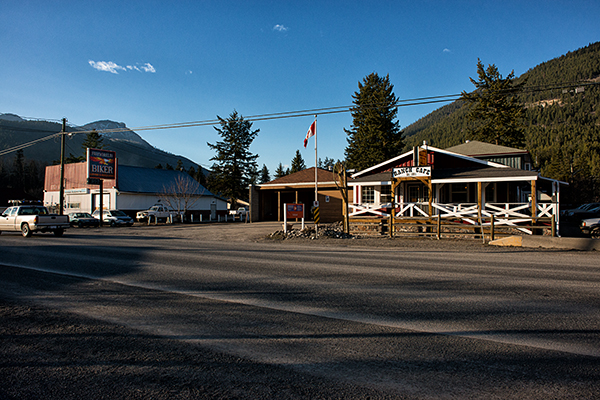
Ranch cafe

afternoon pub

street shadow

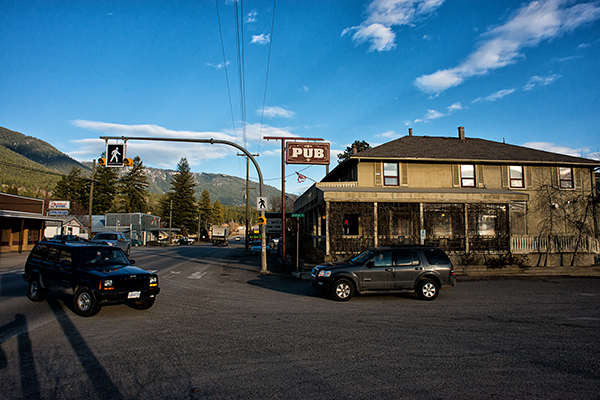
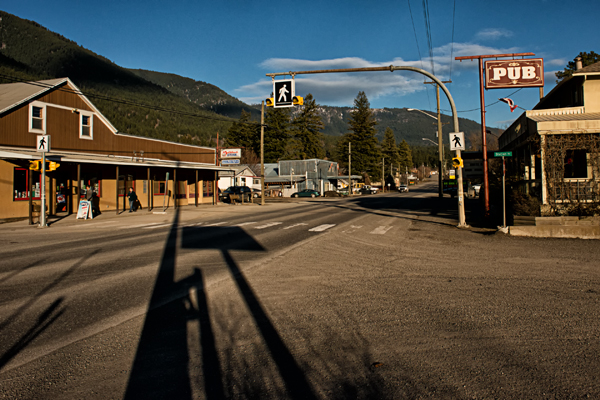
Falkland is one of the many small towns nestled along winding highway 97 that drivers almost miss if there weren’t signs posted at both ends of the village requiring them to slow down. Although I pass through there regularly, the only time I stop is when locals hold their roadside market during the summer. Usually I just reduce my speed to 50 km, watch for pedestrians and approaching vehicles from covered side streets, then resume speed without even thinking.   Falkland has about 600 residents, and is notable because each year on Victoria Day they host the Falkland Stampede (one of Canada’s oldest rodeos); and they also claim to have the biggest Canadian flag in western Canada.

My wife recently purchased a 24mm wide-angle lens and we were looking forward to checking it out. We had spent the day in Kelowna, about an hour south of Falkland and I thought that with the drive there would be lots of opportunity to see how her new lens would perform. I had read mixed reviews online, and I was anxious for my own results. I had made a few shots of the fence in front of our home, and allowed some side-lighted images to catch sunlight to check lens flare, but I hadn’t made any practical images.

I know reviewers can be very strict with their lens testing and even go so far to include charts and exaggerated enlargements when they evaluate a lens. However, in my opinion, all that most users care about is if a new lens is reasonably sharp and consistent in how it reproduces a subject; and regarding wide angles, if there is any unflattering distortion.

The day had been long and I wasn’t thinking about much of anything except getting home and out of that car before we lost daylight. I don’t mind winter very much, but I do mind driving that narrow, slippery, winding road after dark. However, traffic had been light and we hadn’t got stuck behind any big trucks. So we were making good time when we approached Falkland.

Photographers talk about that “Golden Hour” just before sunset when the light is warmer and softer than when the sun is higher in the sky. I doubt there is much of a golden “hour” in canyon towns like Falkland, but the light certainly was inviting at the moment and we had my wife’s camera and 24mm lens waiting for testing.

Linda was tired from our long day and was only willing to make a couple of shots of an old shop before handing me her camera. She said, “You walk around”. So I did. In Falkland it doesn’t take much time to see everything on the main street.

I like buildings, shop signs and afternoon deep shadows and the narrow street was perfect for testing that lens and anyway, I was happy to finally make a few pictures while the light was exciting in that interesting little town.

I only walked around for about ten minutes and had so much fun that I forgot I was supposed to be testing that lens. I have lived in this part of British Columbia for over 30 years, and as I walked around I wondered why the only pictures I have ever seen of Falkland were a few of cowboys being bucked off at the rodeo. I guess it is hard to stop and look. And some photographers might feel locals would be uncomfortable with outsiders intruding. I doubt that unless someone stuck a lens in a local’s face they wouldn’t even notice a person standing along the street, like I was, taking a few pictures in that neat little town.

Oh, and that Nikon 24mm was just fine. For those that wanted a review, I think my aperture was mostly at f8, f11 and f16 because I was interested in getting as much depth of field as I could get. So I can’t comment on how well it performs wide open.

I always appreciate your comments. Thanks, John

My website is at www.enmanscamera.com


Judging Photography

Ben-&-Dave-judging

Exhibition judges Ben and Dave.


I have written about judging photography previously, and I have also used the following quote by John Loengard, who worked as a photographer for Life, for Time, and for People magazines.                         “It is not important if photographs are “good.” It’s important that they are interesting”.

I agree with that statement and when I was asked to be part of the jury committee for a local exhibition by members of the Kamloops Photo Arts Club it was Loengard’s words that I first thought of.   I looked forward to a firsthand look at submissions and wasn’t let down by the interesting and creative work.

They entitled the upcoming juried exhibit of photographs taken within British Columbia as “Wild and Wet” and described it as displaying the impact of water on the environment and residents of this region.

To me, the poorest photographs are those that don’t speak to us, it’s those photographs appear boring. I think the viewer should feel something, should feel a level of emotion when they look at the images. A good photograph is one that creates an emotional response.

As I looked at the photographs I asked myself the following five questions that I think are questions any serious photographer should think about, as they are about to press the shutter.

  1. Is there a clear center of interest? In a successful photo, the viewer can immediately identify the subject.
  1. Is the image composed well? There should be a sense of overall organization.
  1. Is the focus tack sharp and is the exposure appropriate? With the exception of photos that intentionally show motion or soft-focus images (both should be obvious), tack-sharp focus is the first thing viewers’ notice about an image.
  1. Does the photo tell a story? The difference between a photograph one remembers and one that is easily forgotten depends on whether the photo tells a story.
  1. Is the approach creative? Creativity in an image involves more than predictable techniques and perspective. The creative photographer handles the subject in extraordinary ways that the viewer normally would not have seen.

I joined photographers Dave Snyder and Ben Verwey in an interesting discussion of the images as we reviewed the photographs. All the show’s photographs are worth taking the time to view and I look forward to the exhibition that will be held from March 12 until April 1, 2015. As this was to be a juried show, we ranked each submission and selected those that, in our opinion, stood out from the rest.

Whether readers attend this exhibition or any other, my suggestion to take along my guidelines and see how they apply. Then think about how the photographs appeal you. Are the photographs interesting and engaging? Do they capture a moment in time and what do they communicate to you the viewer.

I look forward to your comments. Thanks, John

My website is at www.enmanscamera.com

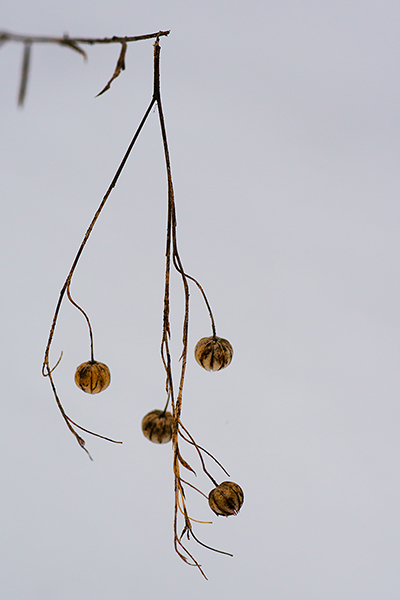
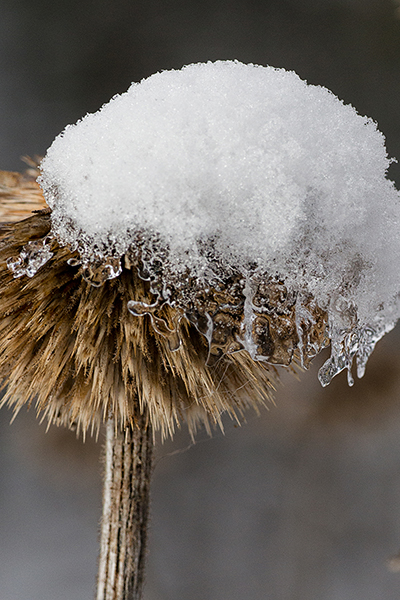
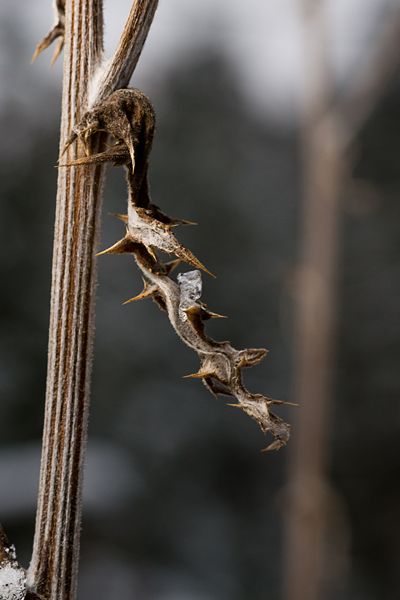
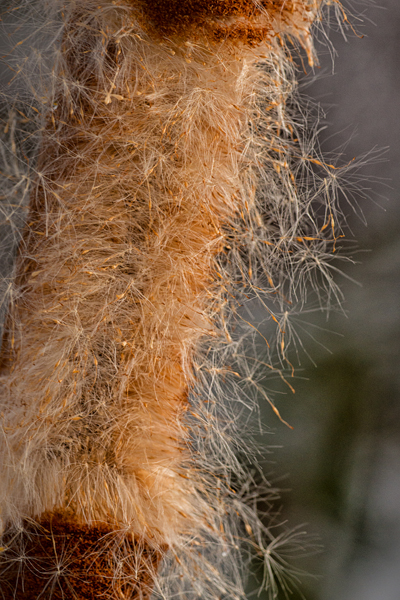
Photographing the Winter Garden

Outdoor lighting kit  Clematis

Erigron  Erigron b

Winter blown bullrush

Step Ladder


Sunday was one of those “let’s see how many small jobs I can do” days. One would think there is no chance of being bored on a day like that, but I finally decided it was time to relax and sat down with a glass of wine, and enjoyed lunch with my wife and listened to some jazz.

As I made my way from one chore to another I kept looking at the snow in the garden and wondering if there was an opportunity waiting to make a photo or two, but I pushed along thinking “maybe later”.   However, as I started on my second glass of wine I complained that the outside light was gray and flat and that maybe I should just forget it. Could that have been the wine talking, or that I am just lazy?

Ever one to keep me on my toes, my wife, Linda, reminded me of a lecture we once attended by Canadian photographer, and author, Sherman Hines. (I recommend readers check him out) As she remembered Hines had said something like; “there is always something to photograph when the weather is poor, look for the small stuff”. There was the challenge. I left the room to get my camera.

The snow was getting wet on the plus 1 degree C afternoon so I decide to leave my tripod behind and mounted my wife’s 70-180mm AF macro on my camera. That unique, fun to use lens is the only true zoom Micro (macro) lens ever made by Nikon. And I get to borrow it anytime, well, almost anytime.

I got my camera and put together my lighting for what would be an excursion to search out the intimate features poking through the snow in my wife’s garden.

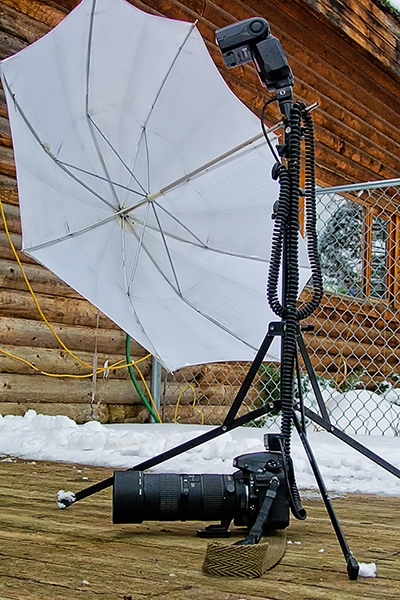
I attached a flash on a stand and chose a shoot-through umbrella. I could have connected a wireless sender and receiver, but I decided to use a TTL camera-to-flash cord that would allow the camera’s computer to direct the flash to provide the correct exposure for the close-up kind of subjects I would be photographing.

Although I had complained about the limited light on the heavy overcast day, I knew it would be perfect for my sojourn through the garden. I could easily meter the ambient light, then under expose slightly so the flash would become the main light instead of the hazy sun. The modified light from a shoot-through umbrella is even across the image with a gradual transition from highlights to midtones to shadows, or a soft light.

I stuck the stand through the snow and easily positioned the flash. And unlike a snowless landscape, the snow kept the stand steady no matter the angle. All I had to do was choose an angle and release the shutter. That particular zoom lens allows for a constant macro at every focal length. It was pretty neat and easy.

I choose to photograph that garden in every season. I know there are many photographers that only take pictures of plants when they are in bloom and prefer colourful representations. However, spring, summer, fall, winter, snow, rain, sunny, or overcast, I find that our garden is filled with ever changing subjects that always offer something new and I expect that Sherman Hines surely would approve. My advise to photographers that think they must wait for inspiring weather before their next garden safari, is to take Mr. Hines’ advice, because there is always something to photograph when the weather is poor, just get up close and look for the small stuff.

I enjoy everyone’s comments. Thanks, John

My website is at www.enmanscamera.com


Photographer’s 2015 New Years Resolutions


Auld-lang-sine


Marmot-b


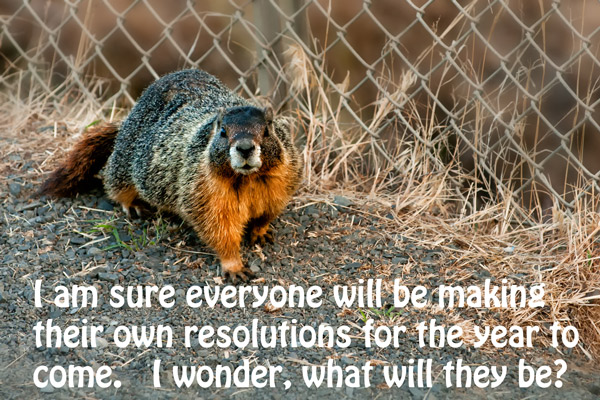
It is time for me to write about New Year’s resolutions. The prospect of new opportunities is always exciting and jotting down a personal list of goals (resolutions) at the beginning of each year is a good idea if one wants personal growth.

This past month I have been asking people that come into my shop what their resolutions for the New Year would be. Here are a few from the many I heard that, in my opinion, are good solid resolutions.

Use a tripod more.

Turn off Auto mode.

Buy a new camera or lens.

Try shooting RAW.

Learn more about lighting.

Take more photos.

Learn about Composition and the Rule of Thirds

Learn to use Photoshop or Lightroom.

However, as good as those are I am adding seven that are a bit more inspirational (is philosophical a better word?) New Year Resolutions that I have put together (seven is a lucky number after all) this past year from all the long, coffee fueled discussions on ways to make improvements in the future with this exciting medium.

  1. Pay more attention to creative ideas. Without creativity a photographer doesn’t have a chance at moving forward. “This could be the year to begin evolving creatively”.
  1. There is too much focus on what is the best camera. When we spend too much time worrying and making everything about the camera we forget about the story. How about this year being more concerned with making images that tell a story”.
  1. Take risks photographically and move away from always trying to please. Make this the year to push-the-envelope beyond the comfort zone without being concerned with other’s opinions. Maybe this will be the year to put “me” in the photograph.
  1. Learn a New Technique. I think it’s as simple as experimenting, and definitely taking the time to “read up on some technique and then give it a try”. Photographers should always make the effort to learn new techniques, maybe by taking a class, or at least buying some books, or CDs, written or taught by experienced, educated photographers.
  1. Choosing new subjects to “get out of the rut of shooting the same thing over and over”. While practicing portraiture or landscapes is good, photographing the same thing the same way over and over can result in a lack of inventiveness and creativity. Sure it’s nice to stay in a comfortable rut, but as with Resolution #4, “Maybe this will be the year to put “me” in the photograph”.
  1. Make every shot count and stay away from the “spray and pray” shooting style. It should be about making each image a quality photograph, not massive picture snapping sessions hoping that a few to turn out.
  1. Become more ruthless with one’s photography and what is done in post-production; conditioning oneself to throw out the crap is the only way to keep improving.

Finally, I’ll wish everyone a great 2015, and end with a quote by award winning English author, Neil Gaiman. “I hope that in this year to come, you make mistakes. Because if you are making mistakes, then you are making new things, trying new things, learning, living, pushing yourself, changing yourself, changing your world. You’re doing things you’ve never done before, and more importantly, you’re doing something.”

Do you have any to add? I will be happy to read them.

My website is at www.enmanscamera.com. Thanks, John