What is a Good Photograph?

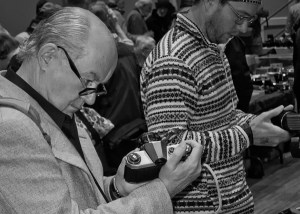
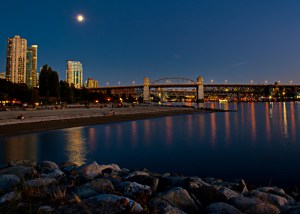
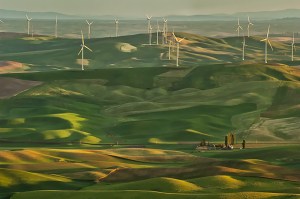
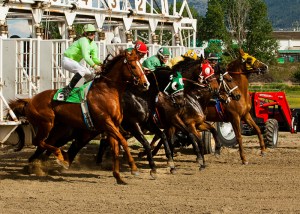
Just what defines a good photograph is, and will always be, a topic of heated discussion with serious photographers; and in my opinion, is one that is certainly worth regular examination because, simply put, a “good photograph” is what those who enjoy this medium want to make.

There are, of course, those that believe a good photograph must capture an image absolutely true to life, while others might say it’s totally about how creative the photographer is, however, if one relies on they number of “likes” they receive on social media sites a good photograph probably depends on the beauty of the subject.

When I taught photography I told my students that a good photograph includes acceptable composition, exposure, and an interesting perspective.

I also said that a good photograph makes us have a connection with, or think about the subject, and might help us understand what the photographer feels about that subject; and if successful, evokes some kind of mood, whether good or bad.

American photographer Ansel Adams said, “A great photograph is one that fully expresses what one feels, in the deepest sense, about what is being photographed.” And he elaborates, “Simply look with perceptive eyes at the world about you, and trust to your own reactions and convictions. Ask yourself: “Does this subject move me to feel, think and dream? Can I visualize a print – my own personal statement of what I feel and want to convey – from the subject before me?”

And Adams reminds us, “There are always two people in every picture: the photographer and the viewer.”

Another of my favorite scenic photographers, Elliott Porter, commented, “You learn to see by practice. It’s just like playing tennis; you get better the more you play. The more you look around at things, the more you see. The more you photograph, the more you realize what can be photographed and what can’t be photographed. You just have to keep doing it.”

Vogue magazine Editorial photographer Irving Penn, wrote, “A good photograph is one that communicates a fact, touches the heart and leaves the viewer a changed person for having seen it. It is, in a word, effective.”

What is a good photograph? That might only be in the “eye of the beholder”. If one is a camera club member there will be rules on how a photograph is judged. And when I graded my students’ work I was mostly interested in their knowledge.

Sometimes we see a photograph that moves or inspires us, makes us feel, think and dream. And when a photographer is able to convey that to viewers he or she has truly made a good photograph.
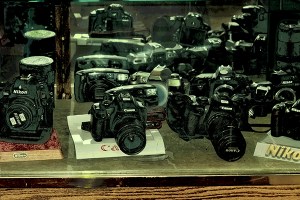
The Excitement Of A New Camera   

camera-on-display

I could tell that the camera a customer had just purchased was going to inspire him in new and exciting ways. He held the camera up to his eye and talked fast about what he was going to photograph on his next day off. As I watched and listened to his excitement with that used DSLR I contemplated how photographers like to make additions and changes to their equipment inventories. There are different needs for different types of photography, and personal growth within the medium changes the kinds and types of cameras and accessories needed.

I really like to be around other photographers. I recall when I first started seriously making pictures in the early 1970s that my friends and I did lots of backpacking in the rolling hills of southern California, but my fellow backpacker’s adventure goals were different than mine. While they would begin the journey with the goal of reaching a particular the location, I was more interested in what I could photograph along the way. Much of the time I lingered behind somewhere on the trail and wandered into camp near dark, and in the mornings while they were enjoying breakfast over the campfire I was off in the search for some intriguing photo.

I doubt that artists using mediums other than photography get as excited about equipment as photographers do. Photography has been a succession of inventions and technological advancements. The first practitioners like Joseph Nicéphore Niépce in 1826 using surfaces like pewter for one-of-a-kind positive photographs and Louis-Jacques-Mandé Daguerre and his announcement of the Daguerreotype in 1896 were making continual advancements in photography similar to what is occurring today. Those advancements were exciting for would be photographers of that time much as advancing technology excites those of us serious about photography today.

Keeping up with the changing technology of photography has always been a struggle, and also expensive, as photographers change camera equipment completely or upgrade their systems to get the maximum benefit and enjoyment in the medium. I know there are those that will say, ”Just learn to use the camera you have. It’s the photographer, not the camera.”

That is certainly right, however, the thrill of learning to operate and use a new camera is, (can I use the word?) cathartic.

I can remember in 1972 being just as excited with my new Pentax Spotmatic II as that customer was with the camera he just purchased. It came with a 50mm lens that I quickly discarded for a versatile 70-210mm Vivitar zoom. Gosh, I felt fortunate to be getting such an advanced camera and lens. In 1970s it was all about the increasing availability of quality lenses and cameras with built-in light meters.

There are many used DSLR cameras that would work just fine for the kind of photography this person would be doing. In the used camera market it always comes down to condition and price, and of course, the brand that suits the buyer. He looked until he found one at a bargain that met his criteria.

Now that he has his new camera, I suggested he join the local photographers Facebook page and I look forward to the pictures he posts, and of course, watching his growth in as a photographer.

Photography on a Winter Beach    

beach-abbott

waters-edge-tree


Bootprints in the sand

beach-boat-docks

beach-bench-solitude

the-only-vacationers

February found Linda and I spending a couple weeks in the lakeside town of Kelowna. Linda had 10 days of appointments so we decided rather than commute for four hours a day (it’s two hours each way) we would take accommodation.

Kelowna in the summer is packed. Parking is always at a premium, the cost of lodging anywhere near the beach is prohibitive and the traffic is, well the traffic is what one would expect in a city filled with vacationers. However, the days and nights in February are below freezing, and that pretty much reduces the beach crowd.

Linda’s appointments vary through out the week, but Tuesday’s was early so after a big lunch when she decided to relax with a couple magazines, I took the opportunity to grab my camera and headed to the beach.

I know that beach area pretty well. I have never seen a parking space during the summer, and any photographer wanting to capture photos of the beach, the lake, or distant mountains has to be content with lots of people included in their photographs.

My thought was to build a series of images that discussed the cold, empty winter lakeside. And I decided no matter what I saw I would limit myself to only photographs of the waterfront.

That meant to ignore the extravagant architecture of the beachfront homes, expensive cars and, of course, people. However, I was tempted to get shots of a guy eating a cup of ice cream while walking with his dog, and later on, two women slurping milk shakes while walking along on the breezy minus 6 Celsius day. There’s something to be said about Canadians.

I even declined when two tattered guys came up to me and suggested they would make good photo subjects. One fellow was waving a broken golf club handle and I stepped back saying, “I am not doing people today”. We all laughed and they ambled on leaving me alone on the beach.

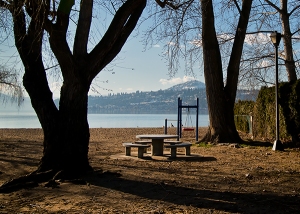
The winter beach is interesting. Shoeprints in the sand instead of bare feet, the hordes of sun worshippers and swimmers are absent and the lake that’s usually a waterscape of boats has only ducks and geese this time of year.

I walked for two hours along the waterfront before deciding to turn back. And when I found a deserted bench I just sat enjoying the solitude. There is something about wandering alone along a big lake that is bordered by a large active city. I guess there is some isolation, but the noise never stops. Nevertheless, it’s an excellent opportunity to creatively point a camera without any interference.

Why Is The Concept of Depth Of Field So Elusive?     

depth-of-field-2

d-of-f-1a

d-of-f-2a


The topic of Depth of Field just keeps coming up and I suppose it deserves a revisit for this year. There must be a reason why Depth of Field is so elusive to photographers.

I wonder if it is because modern cameras have computers that focus, balance the colour, and control the exposure. All are impressive functions that make new users believe all they need to get a good photo is to point and shoot.

I have discussed Depth of Field in my blog numerous times. And find myself constantly explaining how depth of field works to photographers that visit my shop. I must admit that many photographers just smile and nod like they understand what I am talking about. However, unfortunately, when I see their photographs I realize otherwise, and I expect most would have been much happier if I just told them the reason their picture wasn’t really sharp was because they needed a new lens. (Buying a new lens is so much easier than taking a class in photography.)

Understanding of the concept (and I guess technique) of depth of field will make their photographs better and save them money, as they did not really need a new lens.

This past week, I viewed an image a photographer posted online. He wrote that he was proud with his creative and unusual view. The overall exposure was fairly good, the colours were close to reality, and the centre of the picture was in focus. Nevertheless, other than that small, in-focus, central area the rest of his subject wasn’t in focus at all. The foreground was blurry and the background was blurry.

The definition of depth of field is, “that area around the main subject, in front of and behind, that is in acceptably sharp focus”. In application the wider the lens’ aperture is the less the depth of field, or that area of sharp focus, around the main subject will be. Practically, the depth of the field of focus will be 1/3rd in front and 2/3rds behind the subject.

Using a wide aperture can increase the exposure in limited lighting conditions; but, along with the benefit of additional light reaching the camera’s sensor, the resulting effect is reduced depth of field. Creating a field of focus behind the subject of 4 inches or so might look really good when making a portrait, but it is not effective in a scenic.

The smaller the lens aperture the more the area of focus around the subject will be. I prefer using a small aperture for scenic photography. I am concerned with all elements in the photograph, front to back, of being sharp and in “acceptably sharp focus”.

The Internet is packed with information on scenic photography, and there are thousands (millions?) of books on photography that are easy to read. I expect that any discussion on scenic photography will include a full discussion of Depth of Field.

Infrared Photography On A Cold Winter Day   

blue-horizon

frozen-pond

winter-grass

tracks-and-cliffs

orange-sky

Gosh, this cold weather is uncomfortable! Mostly I have been huddling inside except to feed my chickens, and dig through the latest snowfall so I can get my car out of the driveway. However, the morning’s sky was so clear and blue that, in spite of the negative -19C, I just had to bundle up against the cold and head outside with my infrared camera.

The contrast of clear blue against the fresh white snow would make for a colourful scene, but there is something about infrared that has always intrigued me.

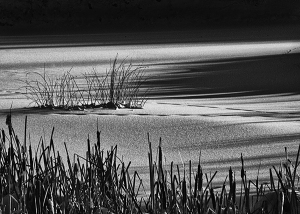
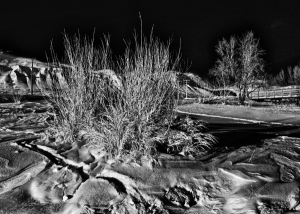
Maybe it’s the black sky against the brighter foreground. There is a word I remember my art instructors would sometimes use in their discussions and it is, “juxtaposition”, or elements in an image placed together with a contrasting effect.

In the summer infrared turns the trees to white, the sky a strange shade of magenta, and everything else a slight blue. But in the winter one can create an image with magenta tinted snow and clouds, with a blue cast to the sky by adjusting the colour channels in Photoshop, or convert to a striking black and white image. B&W is always my favourite. I guess that it is from the many years of exposing rolls of Kodak infrared film. And as I said, I like the black skies.

Infrared creates a completely different feeling. I have written before that using a modified camera is an exploration that moves a photographer far from the usual setting with the effect being surreal and unworldly. The bluer the sky, the greater the likelihood of that unworldly effect; and white surfaces can glow with an ethereal brightness.

I haven’t used my IR camera since last October when I decided to try out a fisheye lens.

Since then I acquired an 18-35mm, so I took that and my favourite, a 24-85mm lens out to see what I could get. I prefer a plan as opposed to just driving around, but this time I wouldn’t venture very far from my warm car. Besides the cold I was too lazy to get my shoeshoes and the snow was too deep to go off the plowed road.

I am not a prolific shooter. I guess that’s an oddity in this day of shotgun style photography when it’s not unusual for photographers to return with a hundred or so images from only a few hours of shooting. I spent a lot of time just standing and looking, and as was the case this time, freezing my fingers.

The low-angled light from the afternoon created lots of deep shadows on the drifts of snow and from fence posts, train tracks, and stark, leafless trees. All are excellent subjects for infrared.

If there was a goal for this outing it was to get a picture for next month’s calendar. My wife Linda and I alternate monthly as to who’s picture is displayed for each month’s calendar, and one of my infrared captures should work perfectly for February.

Photographer’s resolutions for 2017  

The snows and drab colours of 2016 with the growth and bright colours of 2017.

The snows and drab colours of 2016 with the growth and bright colours of 2017.

So many people are saying they are relieved 2016 is over. I don’t know if I am really ready for this year to be over yet, there are lot of things I have enjoyed. That said, this year, 2016, like so many before it has passed by like a rocket. And there surely are new and exciting opportunities in the year to come, so I asked some friends if they had any resolutions or personal photography goals for 2017.

I knew they would struggle a bit knowing I wanted more than the usual simple ones we read about on some forums like, use a tripod more, turn off Auto mode, shoot RAW, make a photo-a-day challenge, and so on.

These first five are from my friends. I have edited them a bit, but the following is what I liked best from their resolutions for 2017.

  1. “This year my approach to photography is going to be to romance the simple things.” I like that. So much of the time photographers get so involved with the latest technology and spread themselve’s over everything while forgetting about the small stuff. And I think adding a bit of romance (whatever that means to each of us) is always a good thing.
  1. “I’ll be learning lots, I just got lights an they’ll give me plenty of opportunity to develop my own style. I want my knowledge to show in my work.” There is nothing like education. I can’t think of a better goal for any photographer.

3. “To grow and improve, as a photographer.” Now that is a good resolution.

  1. “Try new techniques and explore new places”. I could also use words like “examine” and “research.”

5.   “Despite how busy things get, make the time to shoot.” That is a great resolution for any one that enjoys this                                                  exciting medium.

I want to finish by adding two from previous years so as to give us a “Lucky Seven” for a lucky year for 2017.

  1. “Be more ruthless with the seeing and editing process; conditioning oneself to throw out the crap is the only way to keep improving.” This resolution is “quality not quantity”.

And I’ll suggest a final resolution number for everyone:

  1. “That they should take risks photographically and move away from always trying to please, and fitting in with what everyone else is doing.”

Make this the year to push beyond the comfort zone without being concerned with other’s opinions, to be pleased  first for oneself. Make this the year to put “me” in the photograph.   Linda and I are wishing everyone a Happy and eventful New Year.
Do you have a resolution for your photography for 2017 you’d like to share?

Twelve Gifts for a Photographer’s 12 days of Christmas     

xmas-tree

night-porch

We finished setting up our Christmas tree, and sat down to celebrate with a glass of eggnog, while listening Christmas music coming from the TV music station. As we rested Linda just asked me that question that I had been side tracking, “You haven’t told me yet what you want for Christmas. Do you want something for photography?”

I hadn’t thought about what I wanted. And regarding anything to do with photography, if I thought I could afford it, I would usually just get it for myself.

I had been enjoying the tree, and the Christmas music, but as far as a gift for me, especially, “something for photography” left me at a loss of what to say, so I replied, “I suppose I want everything and anything that will fit my camera.”

I watched the train go round the tree, and I listened to the music, but I am still thinking about what I should tell my wife.

In keeping with that subject, I decided to pose that question to some photographers I know. There are so many different genres of photography with different ideas on what would be the perfect photography gift for each. I edited them and selected twelve in keeping with the tradition of twelve days of Christmas.
I am sure readers have their own Christmas list, however, here are some items that I picked out for this year.

(1) I had more than one person say, “I would like to move up to a newer model.” And their discussion for preferring full or cropped frame is always fun. The first on this list is one of many that wanted a particular camera. I think a photographer would have to have been real good to deserve this.

(2) I wasn’t surprised with this one, “I asked Santa Claus for the new Tamron 150-600mm lens.”

(3) When I heard this from a very serious photographer I thought, “me too”, “There is a new program called Aurora I would really like to try out over the Xmas Holidays.”

(4) More than one photographer upon retiring has gone this way so I wasn’t surprised with when some said, “After all these years of packing around a big DSLR, I would really like Santa to give me a small, lightweight Mirrorless camera.”

(6) Hey, this idea is just smart, “I’ve asked for gift cards, better chance of getting some of those than the Nikon D500 I really want.”

(7) “A new graphite tripod would be great to find under the Christmas tree.”

(8) I have my fingers crossed for this person, “A new camera backpack to hold the 70-200mm lens I hope I am getting.”

(9) A budding portraitist said, “I am hoping for several things this Christmas. A flash, a wireless off-camera trigger and a light stand with a softbox.”

(10) This is a great choice, “I really would be happy if I could get a macro ring flash for Christmas.”

(11) And I thought, “well of course” with this, “I think I’ll request that Santa Claus puts a couple of good quality, 32GB memory cards in my stocking.”

(12) This last one is practical for both portraiture and garden photographers “I’d be happy with a 5-in-1 collapsible reflector.

Personally, I could suggest many of the previous, but there are two photographers in our household and there needs to be some money left for my wife. So I’ll to put more thought into this before I reply.

There is still time to get your list to Santa. Good luck and Merry Christmas.

Time To Print Christmas Cards 

xmas-geese

santas-workshop

winter-christmas-view

xmas-chicken-1

xmas-chickens

holiday-train-2016

November isn’t even over and stores and television commercials are filled with Christmas advertising. Oh well, it always sneaks up on me, and anyway, I like all the festive celebration and excitement of Christmas. The early start means I get to enjoy all the colourful decorations, and listen to the Christmas music for a longer time. Yes, I like Christmas music.

All year long those photographer social media sites I belong to have been filled with photos made by members, but images posted on the internet quickly fade into memories and are easily forgotten when an hour later someone else posts theirs.

I like photographic prints. Prints have a life, whether framed and hung on the wall, taped on the refrigerator, or thumbtacked in an open space in the workroom. To me a print of any size has more importance than a digital image on my computer or iPhone screen.

Christmas is a great time for photographers that now have and an excuse (and an opportunity) to give our friends and family our photographs.

I suppose that could mean a big framed photograph, but what I am writing about is Christmas cards. Cards easier and less expensive than framed prints. Nevertheless, any card of a photographer’s work is more of a statement as a gift than an email.

I don’t want to believe that any photographer would be satisfied with mass produced generic Christmas cards. Personally, I want people enjoy my photography. Even if it’s only as a 5×7 card, and that’s better than having my pictures left languishing in some hard-drive.

Right now my wife, Linda and I are going through our many image files from this year’s photographs selecting those we want for Christmas cards. I’ll print up lots of different images and place all sorts of greetings on them. It is rare that we give the same picture to more than one person. And not all the cards say Merry Christmas. Although I like “Merry Christmas” what goes on a card doesn’t really matter. Happy Holidays, Seasons greetings, Have fun, A good New Year, and anything else I think fits a particular picture.

I have written before that my wife and I always produce a new monthly calendar, doing alternating months. I always get December even if it’s Linda’s turn. Doing a calendar is a neat way to enjoy our photography, but cards are a lot more fun because they are for others to enjoy. I also make cards for all occasions, like birthday’s, Valentine’s, Mother’s day, etc.,

My family expects me to share my photography. Sometimes it’s only a picture of something we’ve done, but if it’s a special occasion they always get a card. For those photographers that don’t have their own printer, it’s as easy as having a 4×5 print made at a local lab. Then get some construction paper, glue a picture on it, fold the paper, write something like Merry Christmas inside and give it away. And don’t make all the cards the same.                                 What would be the fun in that?

Twin Lens Reflex Film Camera   

twin-lens-reflex

hay-field

Linda chose a hay field

plymouth

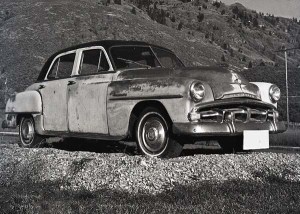
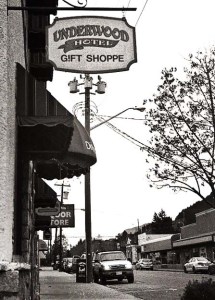
I liked this old Plymouth

underwood-hotel

Town view by Linda

downtown

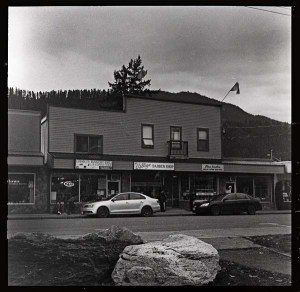
I thought a photo of our black Honda would be great.

chase-church

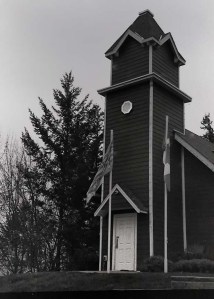
It started raining as I photographed the church

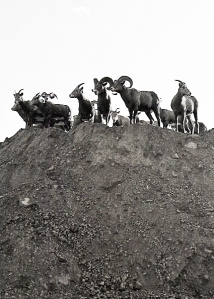
kamloops-bighorn-sheep

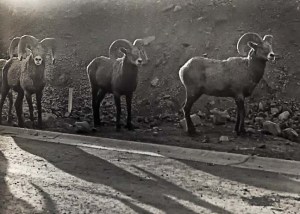
Linda leaned out the window for this shot

big-horn-sheep-hill

I held the camera out the window upside down for this photo


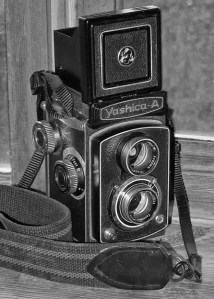
At the close of my last article about the Vancouver Camera Swap Meet I wrote that I had purchased a neat 1960s twin lens reflex Yashica camera for myself. To clarify, the camera is a 120mm format film camera, which gives 2¼x2¼ inch negatives, and does it with twin lenses (or two); a top lens for focusing, and a bottom lens for making the image.

Unlike modern DSLR cameras, photographers don’t hold the camera up to their eye to peer though a tiny hole, and instead view the subject by holding the camera at waist level while focusing on a 2¼” square ground glass.

My wife, Linda, got herself a TLR camera some time ago. Her intention was to force herself to slow down and pay more attention to proper composition, and being limited to only 12-exposure roll film certainly helps one to slow down. So when, a few weeks before the Vancouver Camera Swap meet, she mentioned that she hadn’t had a chance to put a roll of film through her TLR Yashica-Matt since early spring, I decided I might look for the same kind of camera so we could go out together.

I need to say that I am not one of those that thinks film is better than digital. Gosh, not for a minute! I like digital and I really like digital post-production software. For that matter I prefer modern digital technology. However, readers will remember from an earlier article that I wrote, “Happiness is a day with my camera.” To me, that means any camera that is fun to use. And a slow focusing, waist level viewing, twelve-exposure film camera is exactly that, “fun to use”.

Both Linda and I used twin lens cameras in the 1980s. Linda even had a big and heavy Mamiya that she packed on a glacier-climbing trip we once took. When I think of that hefty camera I can’t help but laugh at those modern photographers that complain about how heavy their DSLR cameras are.

We have spent two days since I got my camera going out on photo-excursions. One day driving the back roads near home and one photographing the small nearby town of Chase. However, the day in Chase was cut short because of rain. Then, instead of arriving home and being able to quickly edit image files on a big computer screen, the procedure is to take the film into a completely dark room, unroll the film from the paper backing, put it in a light-tight processing tank, and then spend the better part of the next hour pouring chemicals on, rinsing, and hanging the film up to dry overnight. The next day I scan film and edit in Photoshop.

I don’t know if I can say that the processing part of the journey is all that fun. But using the camera is, and I’ll just have to put up with film developing so Linda and I can play with our vintage film cameras.

So far we have been using some really dated film that expired back in 2002. That old film won’t yield the spectacular results one expects from medium format film. We have two more rolls of that fatigued old film to use as we get used to our cameras, then I’ll get some newer film and we will be able to produce photographs that match the resolution of some of the best modern DSLRs.

But sharp pictures aren’t really why so many photographers like Linda and I are returning to those old medium format cameras. The cameras from the past have now become unusual in this day of instant gratification. And there is something quite rewarding and even fulfilling, and as one photographer remarked “intimate” in the slow process of using a TLR.

November 2016 Vancouver Camera Swap meet  

helpful

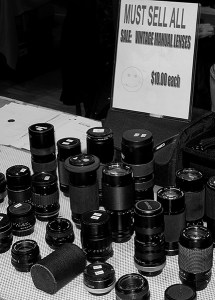
must-sell

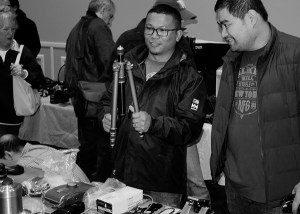
neat-tripod

great-find

filters

nice-camera

a-dollar-each

i-like-this-camera

vintage-cameras

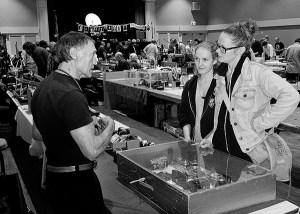
Last weekend my wife and I again ventured over British Columbia’s coastal mountains, this time to attend a camera swap meet. This was the last camera swap meet of the year. And I had a blast!

The event has been taken over by a new coordinator and moved closer to a more central location for photographers that live in Vancouver. There was more parking available for the swap meet, and we were able to find a reasonably priced hotel that was located nearby (only about five minutes drive away.) And for folks like us from out-of-town, the new location offered better access to a variety of restaurants.

The new venue was smaller, but the tables were less spread out and had an intimate atmosphere that I really enjoyed. Our day started at 9am with the long line-up of photography enthusiasts rushing in as fast as they could.

Vancouver is a large multicultural city and for those of us living in smaller communities in the BC interior, the sudden barrage of dialects and different languages being spoken takes a moment to get used to. However, everyone there spoke “Photography”, and that made for a fun and friendly day of showing, demonstrating, explaining, and, of course, bargaining with savvy photographers of all kinds.

I was pleased to find that I had a table next to my long time friend Brian Wilson. That was a treat, Brian is the guy that got me into this business 20 plus years ago and there is no doubt his knowledge on cameras and their history is second to none.

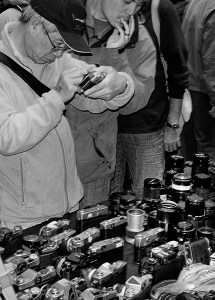
The place was packed and there were many bargains, and I doubt anyone that had rented a table had much time to themselves until things slowed down for a short time around lunch. After splitting a great big deli sandwich with Brian I decided to take advantage of the lull to have a quick walk around to see what was for sale and take a few pictures for this article.

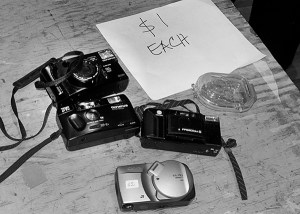
I’ll sum up my walk-about in one word, Wow!   The variety of equipment was exciting. I felt like the little kids I sometime see safely tucked in a shopping cart going down the grocery store candy or cookie aisle, hands reaching out pleading with their mother for the goodies on the shelves. It was all I could do to keep myself from reaching in my pocket for the proceeds of the morning sales ready to buy. Nevertheless I touched everything I could before safely returning to my table to be out of temptation’s grip.

I talked to lots of people, renewed some long-time friendships, made new friends, sold a few cameras and lenses, and had a good time. Oh, and like icing on the cake, I was able to find a neat 1960s Twin Lens Yashica camera for myself.

As usual, the Vancouver Swap meet was exhilarating, and even though the day was tiring and after packing up what I had left from the show, Linda and I ignored the comfort of our quite hotel room and headed to downtown Vancouver to spend the evening in a pleasant Broadway bar for a meal of fish and chips with locally crafted beer, all in all, a perfect way to end the day.