Roadside Photography in February   


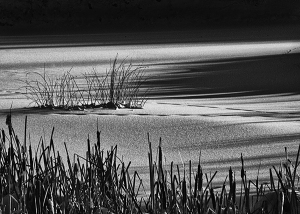
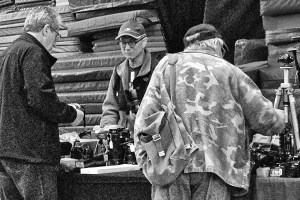
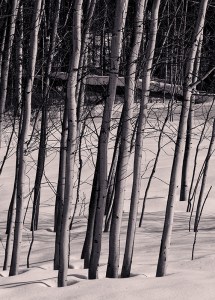
jre_3150bw 

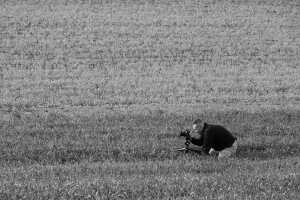
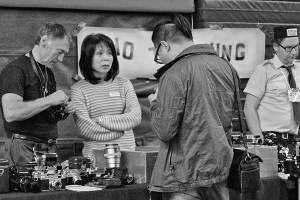
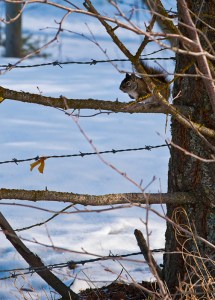
february-watcher

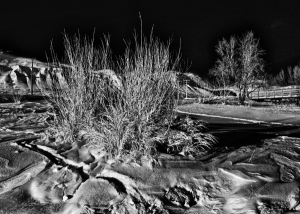
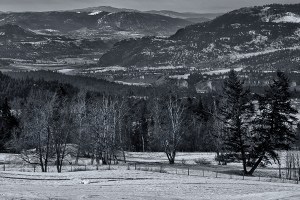
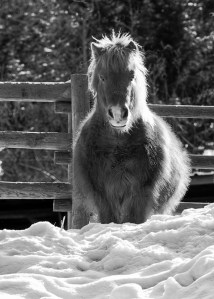
jre_3138bwponys-winter-coat

February is finally done. Gosh, that month always seems so darn long. Yes, I know it is the shortest month in actual days, but it hasn’t seemed that way for me. This past February was a bleak, grey, and lifeless time that one must endure. And try as I did during the past few weeks since my Kelowna beach walk, I just couldn’t garner the energy to wander the frozen landscape with my camera. However, when the sun finally made an unusual appearance on the last day of the month it didn’t take much coaxing to get me out.

All my wife had to say was, “Its nice out, let’s take a drive.” That sounded good to me. It’s always relaxing to take a drive around our rural neighbourhood. There still is a few feet of snow covering everything but the roads were clear.

I selected my 70-200mm lens. When I use one of my wide-angle lenses I am looking over the landscape, with a telephoto I get to look into it.

Mid-week is a perfect time to drive around, we had the roads to ourselves and I could drive slowly, stop to look around, or back up and get out just about any location to take a picture.

If it were just me, I would have headed down to the river. I like prowling the riverbank, but as we got into the car my wife said, “I don’t want to go down to the river.” I guess she didn’t want me taking chances tromping on the not-so-stable ice along the edge of the river.

My term for drive-around kind of picture taking is, “roadside photography”. The good thing about driving and looking for things to photograph is you cover a lot of distance and see a lot of stuff. The bad thing about driving around is once you are in motion it’s hard to stop. I am sure that without my wife reminding me, and at times, demanding I stop I’d just motor by many good subjects.

I don’t like to shoot from inside my car. A quick search on the Internet will bring up article after article explaining how easy it for those that don’t want to get out of their car to take pictures.

I can’t get comfortable. Everything is in the way and it’s hard to turn around with a steering wheel restricting my movements.

I prefer to stop, get out, close the car door, get my camera off the back seat, close that door, look at my subject for a while, and think about how I want to take the picture (remember “Previsualization” from my last article) then release the shutter.

Nevertheless, I expect I will be a roadside photographer for years to come. And I’ll keep getting in and out of my car and depending on my wife, Linda, to keep reminding me to stop.

I think sitting in the back seat would be a better and roomier place to take pictures from. My long-range plan is to have my granddaughters to drive me around. I mentioned this to the oldest at her last birthday, but I’ll have to wait a while because she’s only ten and can’t reach the pedals yet.

Photography lessons with Black And White Film 

5-flower

port-view

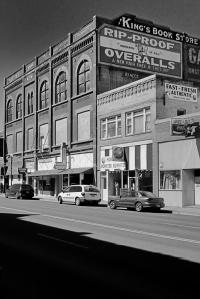
rip-proof-overalls

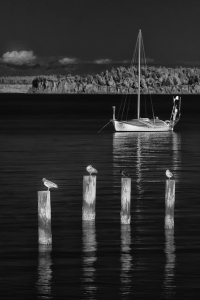
seagulls-and-boat-2

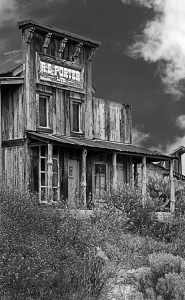
deadman-junction-building

windowpane

I have recently been talking with many photographers that are very interested in the process of black and white film photography. Most had their introduction to photography in high school using film and although they moved forward to iPhones and digital cameras, they were pulled back to film by memories of the unique “hands-on” experience they had with film.

With all that interest I thought I would revisit an article I wrote in June 2014,  “What I Learned About Photography by Shooting with Black /White Film”.

I began using black and white film because it was cheap and it’s what we used in my first college photography class. After I began to understand the medium as being creative instead of just a way to records things, I grew to like B&W and for years refused to shoot with anything else.

With film, once the camera’s shutter was released what one got was, well, what one got was-what-one-got. There were no second chances as enjoyed today. Photographers were left with only a memory of that moment until the film was printed.

We used a term called “Previsualization”. Previsualization is attributed to photographer and educator Minor White. While studying their subject a photographer predetermines how the final image would be processed and printed. Ansel Adam referred to that as “the ability to anticipate a finished image before making the exposure”.

There was also the Zone System. American photographers Fred Archer and Ansel Adams collaborated on the technique for determining optimal film exposure and development for a method to precisely define the relationship between the way one visualized the subject and the final results.

Those techniques helped us determine how the final print could look. Colour film had to be printed in an almost lightless room, whereas labs for printing B&W were quite bright allowing us to see the image and control an image as it was printed.

With B&W film I learned to previsualize, and as I selected my subject I would think about how I would process the film and make the final print. I could alter the exposure rating, as with the Zone system, and depending on which chemicals I planned on using, how I would develop the film. I would select different papers and chemicals to change contrast or tonal values in the final print.

Shooting with black and white film taught me to think about tonal shifts from black, to mid grey, and finally, to white with detail. Managing the process of developing and printing taught me that the camera and film (now the sensor) are just the starting point to making a photograph match my personal vision, and my personal vision is much more important than the camera’s.

A B&W photograph is a matter for the eye of the beholder, the intuition, and finally the intellect. Of course colour is all that, but much of the time it seems photographers are overwhelmed by colour, rarely seeing anything of importance in a scene other than the colours.

Because black and white images don’t attract with a play of colours, they seem subtle and demand close attention to composition, lighting, perspective, and the context the image is shot in as important factors.


The Excitement Of A New Camera   

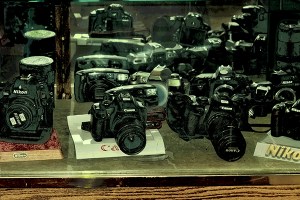
camera-on-display

I could tell that the camera a customer had just purchased was going to inspire him in new and exciting ways. He held the camera up to his eye and talked fast about what he was going to photograph on his next day off. As I watched and listened to his excitement with that used DSLR I contemplated how photographers like to make additions and changes to their equipment inventories. There are different needs for different types of photography, and personal growth within the medium changes the kinds and types of cameras and accessories needed.

I really like to be around other photographers. I recall when I first started seriously making pictures in the early 1970s that my friends and I did lots of backpacking in the rolling hills of southern California, but my fellow backpacker’s adventure goals were different than mine. While they would begin the journey with the goal of reaching a particular the location, I was more interested in what I could photograph along the way. Much of the time I lingered behind somewhere on the trail and wandered into camp near dark, and in the mornings while they were enjoying breakfast over the campfire I was off in the search for some intriguing photo.

I doubt that artists using mediums other than photography get as excited about equipment as photographers do. Photography has been a succession of inventions and technological advancements. The first practitioners like Joseph Nicéphore Niépce in 1826 using surfaces like pewter for one-of-a-kind positive photographs and Louis-Jacques-Mandé Daguerre and his announcement of the Daguerreotype in 1896 were making continual advancements in photography similar to what is occurring today. Those advancements were exciting for would be photographers of that time much as advancing technology excites those of us serious about photography today.

Keeping up with the changing technology of photography has always been a struggle, and also expensive, as photographers change camera equipment completely or upgrade their systems to get the maximum benefit and enjoyment in the medium. I know there are those that will say, ”Just learn to use the camera you have. It’s the photographer, not the camera.”

That is certainly right, however, the thrill of learning to operate and use a new camera is, (can I use the word?) cathartic.

I can remember in 1972 being just as excited with my new Pentax Spotmatic II as that customer was with the camera he just purchased. It came with a 50mm lens that I quickly discarded for a versatile 70-210mm Vivitar zoom. Gosh, I felt fortunate to be getting such an advanced camera and lens. In 1970s it was all about the increasing availability of quality lenses and cameras with built-in light meters.

There are many used DSLR cameras that would work just fine for the kind of photography this person would be doing. In the used camera market it always comes down to condition and price, and of course, the brand that suits the buyer. He looked until he found one at a bargain that met his criteria.

Now that he has his new camera, I suggested he join the local photographers Facebook page and I look forward to the pictures he posts, and of course, watching his growth in as a photographer.

Looking Forward to Another Vancouver Camera Swap Meet          


just-buy-it

vancouver-swap-meet-find

viinage-cameras

check-that-out

“Hi John! I have been waiting for your call. The swap meet tables are completely sold out, and I have been holding a table for you.”

Those were the words I received when I finally got around to calling Tonchi Matinic, the organizer of this year’s (2017) Vancouver Camera Swap Meet. I had received his email reminder about the April’s swap meet, but the warm, wet weather of April seems so distant from the cold, snowing weather of February, that I just put it out of my mind.

I immediately sent in my table registration so now I can start getting excited about one of my favourite events of the year. As I put down the phone after talking to Tonchi (actually we talked for a while) Linda remarked that she could tell I was happy.

It isn’t just that I like selling camera equipment. Of course it’s fun matching an excited buyer with a new treasure, not to mention making a buck or two, but there is so much more that is involved with it.

In my opinion it doesn’t get much better than spending the day surrounded by a huge selection of cameras and other photography equipment. And it’s a great chance to talk with other photographers from all over British Columbia about their different interests. Gosh, it is just so invigorating. And, even after all these years I always learn something.

I have been attending the Vancouver Camera Swap meet since the 1980s, and I have written in my past articles that one may find photographers of every age group; from experienced elders to young people accompanied by their patient parents. This assemblage is a diverse fellowship that includes all kinds of lifestyles, interests, and photographic specialties. An observer will find there are those that are dedicated to film and vintage cameras, and processes of the past, walking alongside others carrying, and looking for, the latest and greatest in modern photographic technology.

Other than actually photographing some inspiring subject, a gathering like the Vancouver Swap is a superb way to meet and exchange information with other photographers, and to look at and check out the many kinds of photographic equipment that would not be so easily available anywhere else.

Yep, I am already thinking about how much fun Linda and I will have before, during, and after that event. We usually go down the day before so we can search out some fun dining experience that evening. There was a time when we partied late, but these days I want to be back before midnight so I will be raring to go for the early start-up.

As always, I plan to have an enjoyable time, busy for sure, but I enjoy every minute. I remember at the last swap that I forgot lunch until a friend stopped by and asked me if I was hungry. I told him I’d worry about food later, but handing me one of his sandwiches, he said “ya gotta have this then”.
This year’s show will be on Sunday, April 2nd. I hope to see long time friends, and those readers that are close enough should come down and get excited about photo-trinkets you have been searching for. Photography events where one can spend the day wandering, touching, handling, buying and, of course, talking with other photographers will leave anyone with new finds, friends, and lasting memories.


Infrared Photography On A Cold Winter Day   

blue-horizon

frozen-pond

winter-grass

tracks-and-cliffs

orange-sky

Gosh, this cold weather is uncomfortable! Mostly I have been huddling inside except to feed my chickens, and dig through the latest snowfall so I can get my car out of the driveway. However, the morning’s sky was so clear and blue that, in spite of the negative -19C, I just had to bundle up against the cold and head outside with my infrared camera.

The contrast of clear blue against the fresh white snow would make for a colourful scene, but there is something about infrared that has always intrigued me.

Maybe it’s the black sky against the brighter foreground. There is a word I remember my art instructors would sometimes use in their discussions and it is, “juxtaposition”, or elements in an image placed together with a contrasting effect.

In the summer infrared turns the trees to white, the sky a strange shade of magenta, and everything else a slight blue. But in the winter one can create an image with magenta tinted snow and clouds, with a blue cast to the sky by adjusting the colour channels in Photoshop, or convert to a striking black and white image. B&W is always my favourite. I guess that it is from the many years of exposing rolls of Kodak infrared film. And as I said, I like the black skies.

Infrared creates a completely different feeling. I have written before that using a modified camera is an exploration that moves a photographer far from the usual setting with the effect being surreal and unworldly. The bluer the sky, the greater the likelihood of that unworldly effect; and white surfaces can glow with an ethereal brightness.

I haven’t used my IR camera since last October when I decided to try out a fisheye lens.

Since then I acquired an 18-35mm, so I took that and my favourite, a 24-85mm lens out to see what I could get. I prefer a plan as opposed to just driving around, but this time I wouldn’t venture very far from my warm car. Besides the cold I was too lazy to get my shoeshoes and the snow was too deep to go off the plowed road.

I am not a prolific shooter. I guess that’s an oddity in this day of shotgun style photography when it’s not unusual for photographers to return with a hundred or so images from only a few hours of shooting. I spent a lot of time just standing and looking, and as was the case this time, freezing my fingers.

The low-angled light from the afternoon created lots of deep shadows on the drifts of snow and from fence posts, train tracks, and stark, leafless trees. All are excellent subjects for infrared.

If there was a goal for this outing it was to get a picture for next month’s calendar. My wife Linda and I alternate monthly as to who’s picture is displayed for each month’s calendar, and one of my infrared captures should work perfectly for February.

Twelve Gifts for a Photographer’s 12 days of Christmas     

xmas-tree

night-porch

We finished setting up our Christmas tree, and sat down to celebrate with a glass of eggnog, while listening Christmas music coming from the TV music station. As we rested Linda just asked me that question that I had been side tracking, “You haven’t told me yet what you want for Christmas. Do you want something for photography?”

I hadn’t thought about what I wanted. And regarding anything to do with photography, if I thought I could afford it, I would usually just get it for myself.

I had been enjoying the tree, and the Christmas music, but as far as a gift for me, especially, “something for photography” left me at a loss of what to say, so I replied, “I suppose I want everything and anything that will fit my camera.”

I watched the train go round the tree, and I listened to the music, but I am still thinking about what I should tell my wife.

In keeping with that subject, I decided to pose that question to some photographers I know. There are so many different genres of photography with different ideas on what would be the perfect photography gift for each. I edited them and selected twelve in keeping with the tradition of twelve days of Christmas.

I am sure readers have their own Christmas list, however, here are some items that I picked out for this year.

(1) I had more than one person say, “I would like to move up to a newer model.” And their discussion for preferring full or cropped frame is always fun. The first on this list is one of many that wanted a particular camera. I think a photographer would have to have been real good to deserve this.

(2) I wasn’t surprised with this one, “I asked Santa Claus for the new Tamron 150-600mm lens.”

(3) When I heard this from a very serious photographer I thought, “me too”, “There is a new program called Aurora I would really like to try out over the Xmas Holidays.”

(4) More than one photographer upon retiring has gone this way so I wasn’t surprised with when some said, “After all these years of packing around a big DSLR, I would really like Santa to give me a small, lightweight Mirrorless camera.”

(6) Hey, this idea is just smart, “I’ve asked for gift cards, better chance of getting some of those than the Nikon D500 I really want.”

(7) “A new graphite tripod would be great to find under the Christmas tree.”

(8) I have my fingers crossed for this person, “A new camera backpack to hold the 70-200mm lens I hope I am getting.”

(9) A budding portraitist said, “I am hoping for several things this Christmas. A flash, a wireless off-camera trigger and a light stand with a softbox.”

(10) This is a great choice, “I really would be happy if I could get a macro ring flash for Christmas.”

(11) And I thought, “well of course” with this, “I think I’ll request that Santa Claus puts a couple of good quality, 32GB memory cards in my stocking.”

(12) This last one is practical for both portraiture and garden photographers “I’d be happy with a 5-in-1 collapsible reflector.

Personally, I could suggest many of the previous, but there are two photographers in our household and there needs to be some money left for my wife. So I’ll to put more thought into this before I reply.

There is still time to get your list to Santa. Good luck and Merry Christmas.

Happiness Is A Day With My Camera                                           


shooting-field-patterns-b

checkn-settings-a

getting-the-shot-b

waiting-c

linda Walch

Today as I drove to town some expert on the radio said that there are 12 states of happiness.

I can’t remember what they were or how “happiness” is determined, but after a bit of searching I found a short article that said to be happy we must “anticipate with pleasure, savor the moment, express happiness, and reflect on happy memories”.

I know there are times and things that make me happy. However, there are also moments that no matter what my surroundings are or the circumstances I am in, I am just not happy.

My wife makes me happy, and even when I know she is mad at me for something I have said or done, I am still happy when she’s with me. Maybe that’s one of those states.

I doubt there has ever been any studies done on the states of happiness for photographers. So while those reading this think about what makes them happy I’m going to delve into that mysterious state.

Happiness might be about things like camera equipment, or about creating a good photograph.

Most photographers are devastated when they receive a poor review on a picture, so there is lots of ego involved in their happiness.

I know sitting around with other photographers talking about anything photographic is just plain blissful.

I don’t have any science that I can call up and haven’t discussed happiness with any philosophers, but I have always felt that photographers have a culture of their own. There are those who might argue that concept, but I am absolutely convinced that it is so.

I constantly interact with other photographers in online forums, or talk to them personally, and those photographers are always ready and willing to tell me when they are happy or not with their photography.

Some seem to be more interested in the technology of photography then the process of making pictures and there are others that care little about the equipment as long as they can make a picture.

I once knew a photographer that was happiest when he found a problem with a piece of photography equipment. He delighted in making test after test and would sometimes spread twenty or more prints on my counter explaining how a particular camera or lens didn’t match what the manufacturer or other photographers claimed. Personally, I’m disappointed when something doesn’t work as described, but he would actually be cheery.

I remember a fellow that used to spend all his spare time hunting (with his camera). He’ll show up at my shop with a grin as wide as all outdoors and happily describe how he crawled thru the sagebrush, waded some creek, or slowly froze as he hung off some cliff. What made him happy was the process of making pictures.

I know photographers that are continually changing equipment. Not because of problems with what they own, but because they read something, or talked to someone, about a new addition from their manufacturer of choice, and can’t live without it.

Sometimes their choices don’t so much meet a practical need as an emotional one, but they make it easy for me, and anyone else they talk to, to observe how very happy they are with their new acquisitions.

This medium has so many genres and outlets to make one happy.  There are portrait photographers, wildlife photographers, scenic and landscape photographers, street and sports photographers, those that specialize in plant photography and, of course, many more, each with differing sets of skills, and, to my mind, their own states of happiness.

I don’t know if photographers have twelve states of happiness, or only the four I found in that short article, but I will say that I meet lots of people that are happy to be doing photography, and being involved with it in their own way.

Maybe its just as simple as the words I once saw written on a wall, “Happiness is a day with my camera.”


The Final Photographic Performance   

enlarger-2workstation-2

This week I wrote to photographer and blogger David Lockwood (https://davidalockwoodphotography.com) about why he seemed to be returning to film. His replied, “The whole process of using film, gives me a feeling of accomplishment; probably like the painter putting on the last brush stroke. Film gives me a feeling of control over the final image.” And regarding film vs. digital he wrote, “The question of film or digital shouldn’t really be asked, it’s a bit like asking why does one paint with oils, and the other watercolours. Both can produce an image, but both give a totally different sensation to the mind eye.”

During the time I taught photography in the 1980s and 1990s for the University College of the Cariboo (now Thompson River University) my students used film. In my initial lectures I would tell them that as well as learning to acquire skills using a camera, they would need to learn how to become proficient in negative development and printing. I would emphasize that those serious enough to strive for a perfect final photograph would come to realize that what they did with the camera was only the beginning, and that their final print would set them apart as photographers. I would quote famous photographer Ansel Adams who said, “The negative is comparable to the composer’s score and the print to its performance…”

Film has now been set aside by many of those serious about photography, although I expect artists will use film creatively for years, nevertheless, even with advancing photographic digital technology Adams’ words from the past are still significant.

I intend to spend time discussing Mr. Lockwood’s insightful thoughts about film photography later, but first I want to say a few words about digital image making.

The digital camera doesn’t make a picture in the sense of light permanently imprinting itself with different intensities on a chemically sensitized surface like film. Instead there are sensors and in-camera computers processing light from thousands of photosites that we transfer to our computers as data files for conversion into countless pictorial possibilities.

I once attended a photography workshop during which one of the speakers said in the past he would get up early and drive to some scenic location hoping to capture an exotic sunrise, after which he would package up his film and send it to the lab and leave all decisions to some technician’s personal vision. However, now he transfers his image files to his computer and he alone controls how his photograph will be processed for viewing and finally printing.

As in the days when I processed negatives in special chemicals and manipulated prints by adding and subtracting light, I now use computer programs to process my RAW images in my quest to perfect my vision.

I say the same thing to modern photographers as I did to my students, that what they do with the camera is only the beginning,

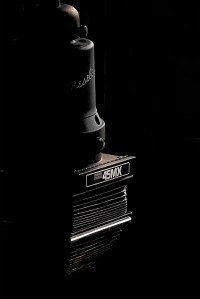
The image on exposed on film, although now a RAW image file, is only the “score” to the “final performance” – the photographic print.

A young photographer came into my shop announcing, with some kind of misplaced pride, that he would never use PhotoShop on any of his pictures because he was only into true reality. Although I didn’t comment, I thought about the manufacturer presets that were applied in-camera to his image files and the limited colour spaces his inadequate JPG files gave him, and his confused notion of photographic reality.

If he really wanted to step away from the unreality of computerized image making he should talk to David Lockwood who wrote, “The camera, light meter, film, paper and chemicals all go towards producing a single and unique image. That does not happen with digital; from the moment the shutter is pressed, the whole thing becomes a cloning process from which endless exact copies can be produced.” However, as Lockwood also says, “The question of film or digital shouldn’t really be asked… Both can produce an image…that give a totally different sensation to the mind eye.”


Home Studio Lighting for Photographers      

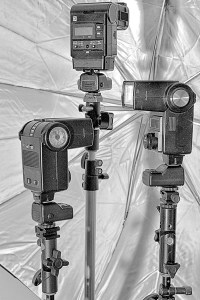
Flash Kit 3

I have written about using off-camera flash several times. Nevertheless, with the conversations I had with two separate, aspiring portrait photographers this past week asking my recommendations for setting up a home portrait studio I have decided to revisit that conversation.

In each instance they were troubled by the kinds of lighting equipment other photographers were advising them to purchase.  Both were upset at how much it was going to cost to get large and expensive studio lights other people were suggesting, and complained that they would have to wait until they had the money before a home studio lighting situation could be set up.

With serious searching they might be able to find used studio lights listed on craigslist, or similar online sales, but that will include additional shipping costs. Further, they won’t have experience with the many brands of equipment available, and are taking a chance that the units will arrive in working condition. And, to confuse them even more they will be offered lots of those cheap, and inadequate, Constant Light kits that were purchased by other unsuspecting beginners.

I knew they were both new to portraiture and just want to learn about lighting. My opinion is they don’t really need to go to the bank just yet, and would be better off starting out with smaller, speedlight type flashes. With the money saved by not purchasing the big, studio type lights they can buy a couple of inexpensive light stands, umbrellas, and maybe even add a soft-box, and a backdrop.

Photographers intent on setting up small home studios for portraits and small groups don’t need to go to the expense of the brawny, studio type lights. They can easily, and without much initial cost, set up a studio with what I personally use, and call my “portrait kit”.

I use older hotshoe flashes for my portrait kit, each with it’s own wireless receiver and stand. I can choose a shoot-through umbrella, a reflector umbrella, or a softbox, and much of the time I include a reflector. It is an inexpensive and easily stored or transported “portrait kit” that I would recommend for home studio photographers.

Wireless sender/receivers come in all sorts of inexpensive incarnations, and it is the same with lightstands and flash-to-umbrella mounts. All of this is much less expensive, and a lot easier to store and/or move around than the big studio-type flash units.

I have been using multiple flashes off-camera since the 1980s, and I always choose inexpensive, used units that I can cheaply replace if they get knocked over, or if I wear them out.

Hotshoe type, off-camera speedlights are perfect for the educational process of learning to use flash effectively, and if they are no longer a good fit for one’s creative growth, the choices as to the next step in lighting equipment will be educated decisions instead of emotional.


The Vancouver Camera Show and Swap Meet       


Lots to buy

Wow a 4X5

Sales tecnique

What about this tripod?

Try this one

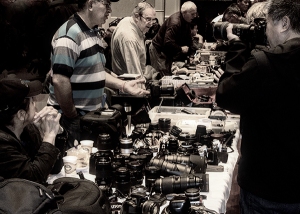
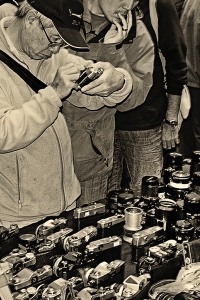
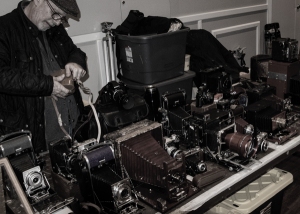
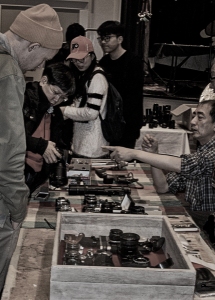
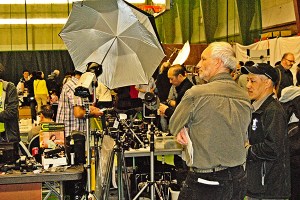
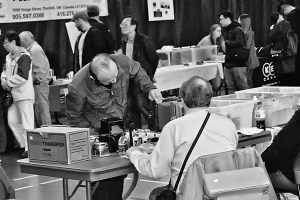
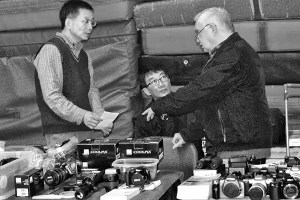
One of my favorite photography events, the The Vancouver Camera Show and Swap Meet, has come and gone again this year. For over 20 years I have spent the weeks prior to this long-running event, that has now reached it’s 40th year, looking forward to the day I get to attend this ever-so-fun photographer’s gathering put on by the Western Canada Photographic Historic Association, and organized by Siggi and Brigitte Rohde.

There cannot be a better way to spending a rainy spring day than being surrounded by a vast array of cameras and photography equipment, all the while getting a chance to talk with other photographers.

Again this year I made the journey from Kamloops the day before and lodged overnight so I could arrive bright eyed and eager to join the other vendors setting up at early the next morning.

I go wondering what the latest trends will be, or what is popular with the photographers that attend. And, of course, keeping my fingers crossed that the equipment I have on my table is what they are looking for.

The last few years there’s been a major change in the venders being replaced by a much younger crowd. The stuff they have on their tables is much the same, but the vendors’ faces are younger, and there are a lot more women standing behind the tables discussing and selling photography equipment than there was when I first started attending.

As I have said before, the word “diversity” is the best way to describe the mixture of photographic types coming to this camera swap meet. There were all kinds of lifestyles and interests, and specialties in photography, film, digital, past and present technology. However, what they all had in common was that they all were excited, searching for sweet deals that I am certain they got.

This year was no different than last, in that I spent an exhilarating day talking non-stop with other photographers about their different interests in photography and, as always, it was invigorating.

The Vancouver Camera Swap Meet is a splendid way to meet and exchange information with other photographers, and to look at and check out a grand selection of photographic equipment that would not be so accessible anywhere else in Canada.

I write this every year, but I’ll say it again anyway. I had a great time with the photographers I met this year and the depending on who joined me at my table, the conversations always changed. My day of selling was a success, as it was for most of the dealers and very happy bargain hunters I talked to at the end of the day.

Camera's Shot

And…when the camera decides to take a picture by it’s self….