Critiquing Photography at the Kamloops Photo Arts Club

At the club critique

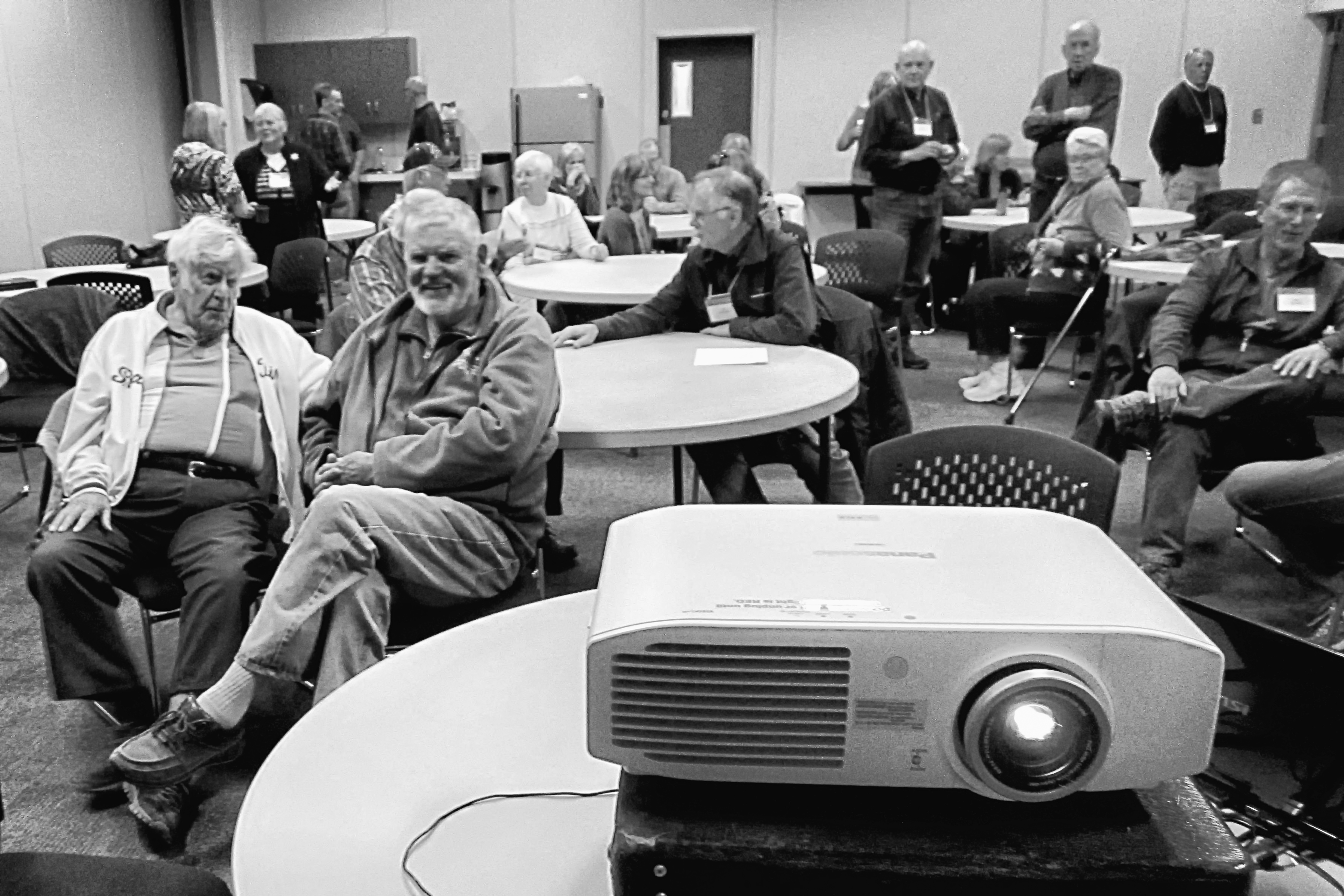
This past week I was invited to be the guest critic at the Kamloops Photo Arts Club.

Although I like discussing photographs, I was at first hesitant with that request. Organized photography clubs in Canada are accustomed to using specific competition rules of The Canadian Association for Photographic Art. Those rules are, of course, specific and must be very stringent.

Unlike that credible and important organization, my critiques of photographs tend to be filled with feedback, I am not selecting the best of the crowd, and I am more interested with what works than what doesn’t. However, the request came from photographer and club member, Linda Davidson, who wrote in the clubs newsletter about having me as a photography instructor in university, “The thing that Linda remembers from her classes with John were his critiques. He had the ability to see things that you may not see in your own work, look at images from a different perspective, not the usual point of view. He was always helpful and inspiring.” So with kind words like that I had no choice.

I remember a quote from the book “Impact – Photography For Advertising” by William Reedy, that puts into words how I view those photographers that are making good photography when he wrote, “To stop the eye, to set the mood, to make the sale.”  I believe that successful photographs must be interesting and thought provoking.

There is a general perception that “critique” means “to find fault with.” When I discuss a photograph I am not seeking to find fault. To me, the word critique means to respond to something, either positively or negatively, or both. The success of an image is how is works for the viewer.

Personally I prefer to use the word “Feedback”. Feedback is information-specific and based on opinion and observation. I have found that the best way to turn someone off is to find fault with their photograph. When I give feedback on a photograph I prefer to discuss what I like, or would like.

When a photographer seeks to make themselves better at their craft they, of course, need input from others about technical control like Exposure, Depth-of-Field and Composition. All those are important in creating a technically correct image. However, things like the mood the photographer set, and the story within the image, are what makes the viewer pay attention, and may not be so technically significant, but those are important all the same. Yet many critics fail to respond to those aspects.

Regarding the critique I provided for the Kamloops Photo Arts Club; I walked into a large meeting room with lots of people sitting around tables in conversation (catching up on each other’s photography I’m sure). The hall was set up with screen and digital projector, and after the club’s president quickly covered business and some announcements about future events I was introduced, handed a remote, the room darkened and I began to scroll through member’s images.

As I began I got a flashback of the years I spent teaching photography. I remember the slow growth as learners struggled with not only the concepts of photography and getting used to their cameras, but the long hours in the busy, darkened and sometimes smelly developing and printing labs. And I mentioned to those in attendance how much more I liked the shorter learning curve of digital image making and the amazing creativity one has with modern photographic post-production.

As I expected, the photography I was to discuss was a top-notch selection of quality images that crossed into all interests of photography. I felt like I should just sit back and clap as I scrolled through the selections and thank those present for the invitation. What a nice way to spend an evening.

I did discuss each image as it was presented on the large screen, and suggested a tighter crop on several, gave my perspective on what I liked about each, and asked questions about several. I think it would have been hard indeed to give negative feed on most of the photography I was fortunate enough to view.

I like to look at pictures. After all the dialogue about photographic equipment and where and what to take on that next photo excursion, what is really left is the final product of everything, the image. Whether in print form, on the computer monitor or, like that evening with the Photo Arts Club, on a large screen, everything comes down to that photograph “stopping the eye, setting the mood, and making the sale.”

I welcome readers comments. Thanks, John

My website is at www.enmanscamera.com
 

Waiting for the Best Light.

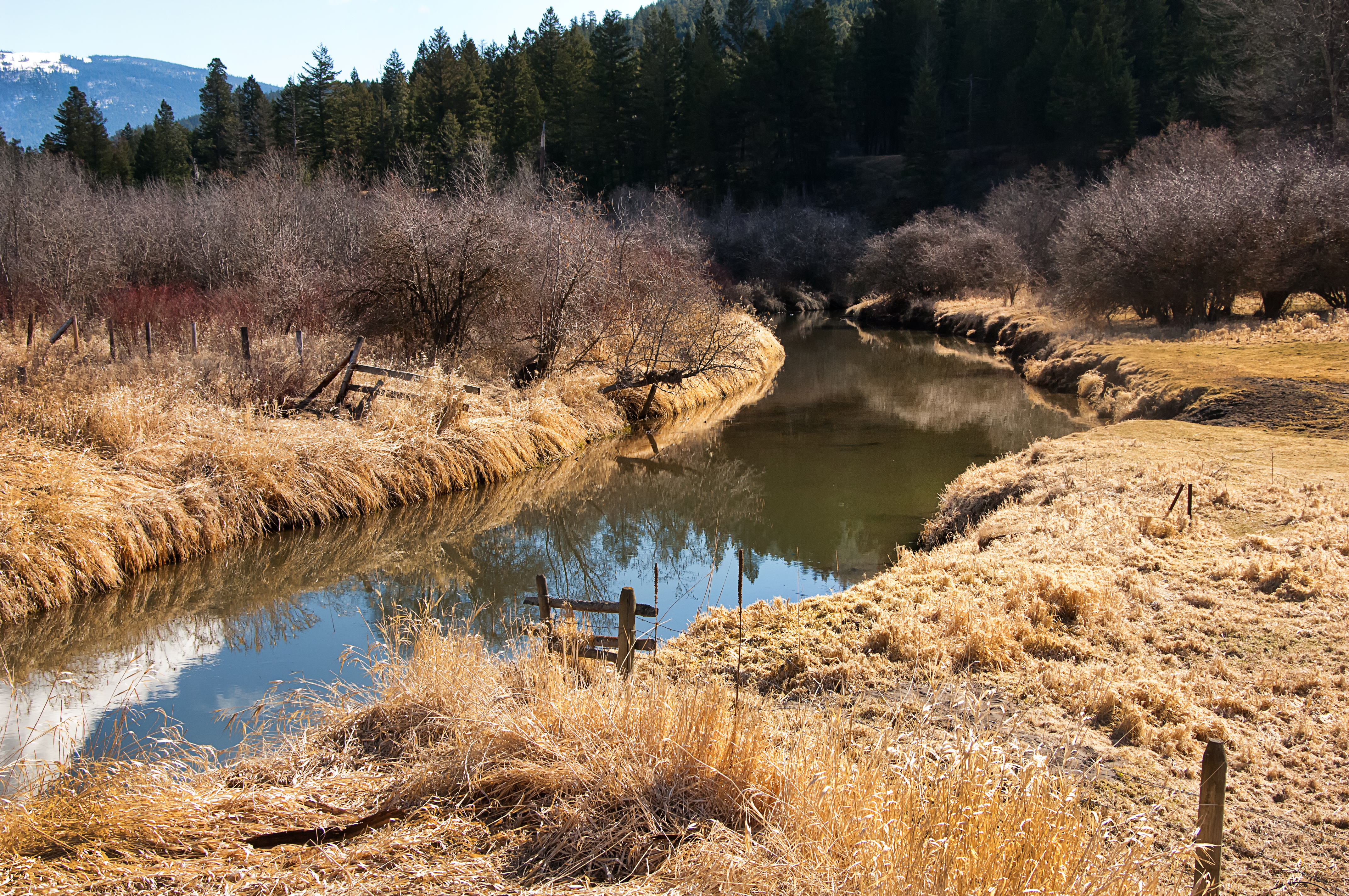
Early spring stream

I am sure there are lots of photographers that have discovered a special location, or scenic spot, that looks good, but when the photograph just isn’t working out and the day just isn’t making things look good, photographers return again and again, hoping for the light to be just right. That bridge on the way to work or the gnarled tree outside of town bent from the wind, that never looks the way we want it. That was always the problem with a location that my wife and I regularly drive past along Highway 97 south of our home. We always, winter, summer, spring, or fall, slow down at a bridge crossing a drainage stream that flows out and onto wide lush hayfields. The stream turns a corner as it flows past bushy native shrubs and out of a pine forest.

The image I mention is a grass and foliage lined stream that for the past six years is usually  a shady, dark, flat, and poorly illuminated possibility. The elusive landscape is perfect with a fence in the foreground that creates three-dimensionality. Depth is easily achieved as a viewer’s eye easily moves from the objects in the fore, middle and background.

I always want a center of interest and the reflective meandering stream becomes that. The composition follows the rule of thirds without any effort. Walk off the road, stand in the deep grass and put a shoulder to the bridge-post to steady the shot, and the rest just comes natural. All that is required is interesting light (that has not been cooperating) to bring everything together to create interest.

At last, this week on a clear spring morning about 9:30am, the light was working. There are times when that open space along the road actually has had an all-illuminating bright light , but that defuses detail, or sometimes it’s cloudy and overcast with everything to be lost in shadow. However, to my great pleasure, this time the light was cool, and without glare, and the shadows weren’t dark and deep. I couldn’t have asked for a better morning to stop and make an exposure or two.

As I wrote earlier, we always slow down, and cast a glance up the stream (the constant traffic willing) as we cross the bridge in hopes that the light is working. I have even parked on a sunny day, got out and walked across the road, only to have some large cloud move in.

This location has been frustrating, but I just add it to the many other landscapes that I refuse to waste my time with unless the conditions are what I want. I recall the concrete bridge on the Thompson River that I watched every morning and evening for years as I drove to work. Everything has changed now, but once there was a young tree and a grass edged road leading to that bridge. I wanted to stand in the middle of the small road and make a low-angled photograph of that grey bridge. When the light was perfect I didn’t have my camera, when I had my camera there was no light. I struggled for five or six years with that picture. Film ruled photography in those days and I was determined that when I made the picture it would be with my medium format Hasselblad camera.

When the day finally came about 7am one foggy morning the low-angled light thinned at the bridge entrance and gave the young tree a golden glow and I was, for once, ready.   I originally called that image “six years” because that’s how long it took me to take the picture. However, when I sold several copies to an organization that gave them as gifts to visiting NASA scientists from the United States, they renamed it “Pathway to the Future”.

Well here I am again at another six-year point and thanks to my wife demanding that I stop the car and pull over, I finally have the image I have been after for all those years.

Photography can be a patient thing and I like having the time to think about my subject. Six years might be a long time for some, but I have always liked the process, and there are a few more landscape scenes out there waiting for the light and me to come together in agreement in the next few years.

As always, I remind readers that I really enjoy your comments. Thanks, John

My website is at www.enmanscamera.com

Photographers – What is your studio lighting setup?

My inexpensive and very portable "Portrait kit". Works easily for indoor or out of doors lighting.

My inexpensive and very portable “Portrait kit” works easily for indoor or out of doors lighting.

Last week an online forum in which I participated asked the question, “What is your studio lighting setup?”

Most participants were posting the brand name they used, and how many lights they owned, however, my post was about what I would call “kits”, that I used for each different situation or environment.

My opinion has always been that there are different tools for different jobs, and I have four individual lighting setups that fit particular photographic undertakings.

My “event kit” consists of four TTL hot shoe flashes. My “portrait kit” consists of three older manual hotshoe flashes mounted on wireless receivers. I also have two “studio kits”. The first studio kit, for those situations where I can find power, has a 1000w power pack with four strobe heads. The second kit is a battery-operated 280w strobe that will go anywhere.

Some forum members complained that they would have to wait till they had the money before a home studio lighting situation could be set up. I believe they only paid attention to those responders that included the manufacturer’s names for their expensive studio type lighting setups.

Yes, I agree, if one wants big powerful studio strobes there will be a considerable price attached.  And each manufacturer will hope to sell their own brand of light stands and light modifiers along with the lighting units. Yes indeed, all that will be expensive.

Most home photography studios are in the basement, or in a spare room to be quickly set up for a portrait session. However, the big name brands never discuss light volume or power vs. studio size.

My opinion is, if the room is less than twelve feet high, thirty feet long and only used for small group or single person portraits, those big, powerful, fast recycling, and expensive studio lights might be overkill, and a real hassle when one wants to soften the background by shooting a wide aperture because there is just too much power.

I wrote about the four kits that I use for different situations. The small hotshoe flashes I use for events and portraits, and the bigger less portable units I use with large groups, moving subjects, or when I just want coverage out of doors. I think those photographers intent on setting up small home studios for portraits and small groups don’t need to go to the expense of the brawny, studio type lights. Photographers can easily, and without much initial cost, set up a studio with what I called my “portrait kit”.

My portrait kit only has three hotshoe flashes, each with it’s own wireless receiver and two stands. Depending on the space a client provides for me to use, I use a small shoot-through umbrella, an umbrella brolly box, once in a while I use a soft box, and sometimes include a reflector. And it’s the inexpensive and easily stored “portrait kit” that I would recommend for most first-time, home studio photographers.

Wireless senders and receivers come in all sorts of incarnations, and can be, depending on brand and manufacturer, if one shops around, purchased for prices less than $100 for two receivers and a sender.

I use the inexpensive sender/receivers that fit under my flash, seated on a light stand bracket, and holds an umbrella, a brolly, or sometimes a softbox. And I use three Vivitar 283 flashes dating from the 1970s that I bought used.

My total cost for 3 flashes, the wireless sender & receivers, 2 shoot through umbrellas, stands, and 2 flash/stand brackets, and a small tabletop tripod that I can place behind my portrait subject was under $400 Canadian.  All of this is much less expensive, and a lot easier to store and/or move around than the big. studio-type flash units.

I make lighting tests before the person who I will be photographing arrives to get the correct exposure, and when he/she does show up, I take two or three more test shots as I move the lights for the most flattering effect.

Even if there were a wad of cash burning a hole it your pocket, my advice would be to proceed slowly, and learn how best to photograph a person first. Using hotshoe speedlights off-camera will be perfect for that educational process, and when they are no longer a good fit with your creative growth, the choices as to the next step in lighting equipment will be educated decisions instead of emotional.

As always I look forward to any comments. Thanks, John

My website is at www.enmanscamera.com
Why Photographers Use a Tripod

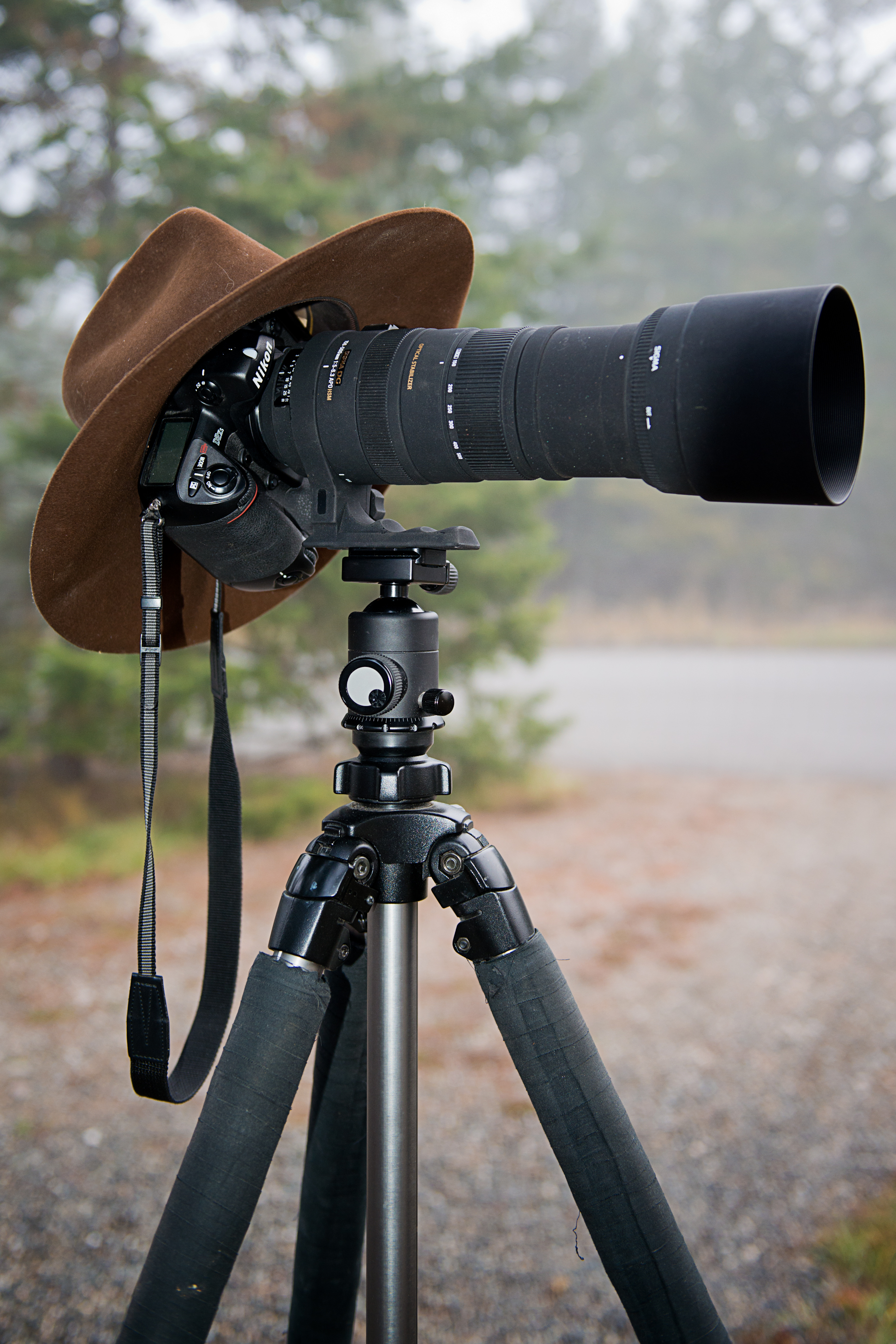
Tripod & Hat

In his book, “Backcountry Journal, Reminiscences of a Wilderness Photographer,” Dave Bohn, mountain and wilderness photographer writes, “The trouble with photographers, and anyone else attempting anything creative, and in fact doing anything, is that they get addicted…(and)…I was addicted to the tripod as a necessity for the photography of large landscapes.”

I will admit that there are times when I use my camera lazily, releasing the shutter after having aimed my camera at some interesting landscape without using a tripod. Then I quickly view the LCD in the hope of seeing a sharp image file. But, if I really care about the image, and want the best success at producing a quality enlargement, I should definitely use my tripod.

Last night I picked up my tattered old copy of Bohn’s book, “Backcountry Journal, Reminiscences of a Wilderness Photographer” and read for a while. I have had it since it was printed in 1974, and like to reread a few pages every so often.  Photographers I know are aware that I like using a tripod for landscape photography, and have heard me say, “ If you don’t like using a tripod it means you never have used a good one”. Today it’s popular to spend extra money on “vibration reduction,” or “image stabilizing,” lenses with the notion that this technology will allow the photographer to do scenic photography without needing a tripod. Many modern photographers are of the belief that the difference between a blurry and a sharp enlargement is megapixels or vibration reduction lenses. I disagree and say the difference is a good, stable tripod.

I’m not saying photographers shouldn’t get image stabilizing lenses, as they are great to use in certain situations and conditions when you can’t use a tripod, and must use slower shutter speeds. Nevertheless, using a good tripod that allows one to stand up straight, take time to analyze the scene, problem solve, compose, and contemplate is an excellent experience. In addition, it keeps the camera from moving.

When I select a tripod I want one that extends above my head so I can use it on hills. I don’t like bending over to peer through my camera’s viewfinder. I prefer tripod legs that can be extended out horizontally when the ground is uneven.  I don’t want a crank to raise the center column as that is just added weight, and becomes one more thing to get caught on things. I like a column lock that turns to lock and unlock so I can easily move the camera when I need to adjust it up or down.  An important feature on the tripod I select is a strong and easily available quick release on the tripod head. The tripod head is another subject completely and my advice is get one that has a reasonable size ball surface and that is lightweight.  A tripod shouldn’t be so heavy that it’s a bother to carry as I walk up and down the hills around my backwoods home. And here is an important reason: I also want a sturdy-enough tripod that is capable of supporting my camera, and I am always amazed when someone buys a cheap, little tripod to hold their camera and lens which are worth well over the thousand dollar plus mark.

I suggest buying from people that have used, or at least can discuss, the tripods they sell.  The department store outlets will allow you to bring it back if you aren’t satisfied, but I am sure they are not interested in paying for the damages to your camera and lens that crashed to the ground while using their bargain tripod.

In recent years more and more quality tripods have become available and are worth owning and using. All one needs to do is spend some time researching and checking reviews. Hopefully you spent time selecting your digital camera and lenses and my advice is to take the time and also purchase a really good tripod to go along with them.

I really enjoy everyone’s comments. Thanks, John

My website is at at www.enmanscamera.com

Fifteen Photographers at Open House

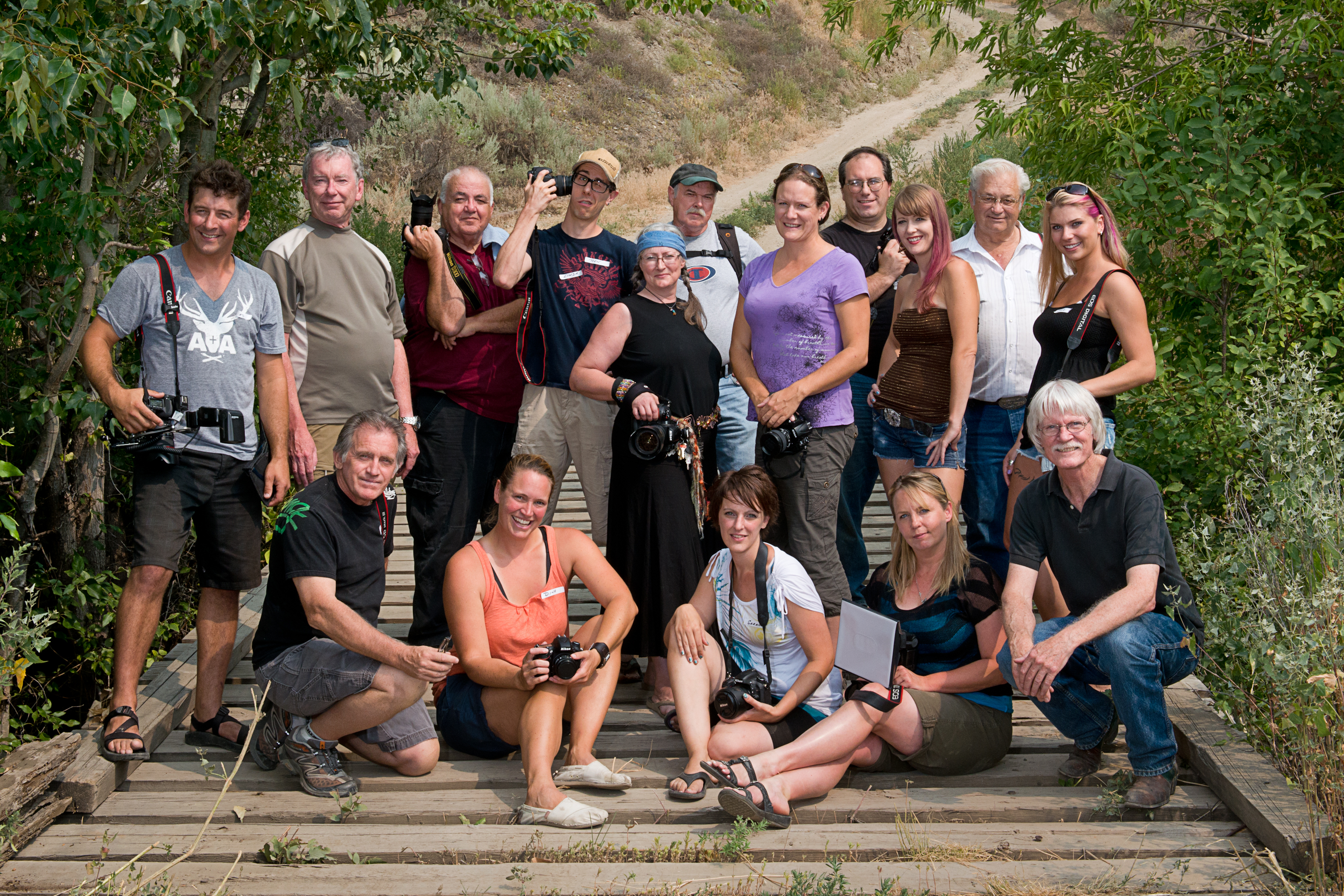
fifteen photgraphers & a Model  Creek shooters  Modeling session  Lighting a portrait

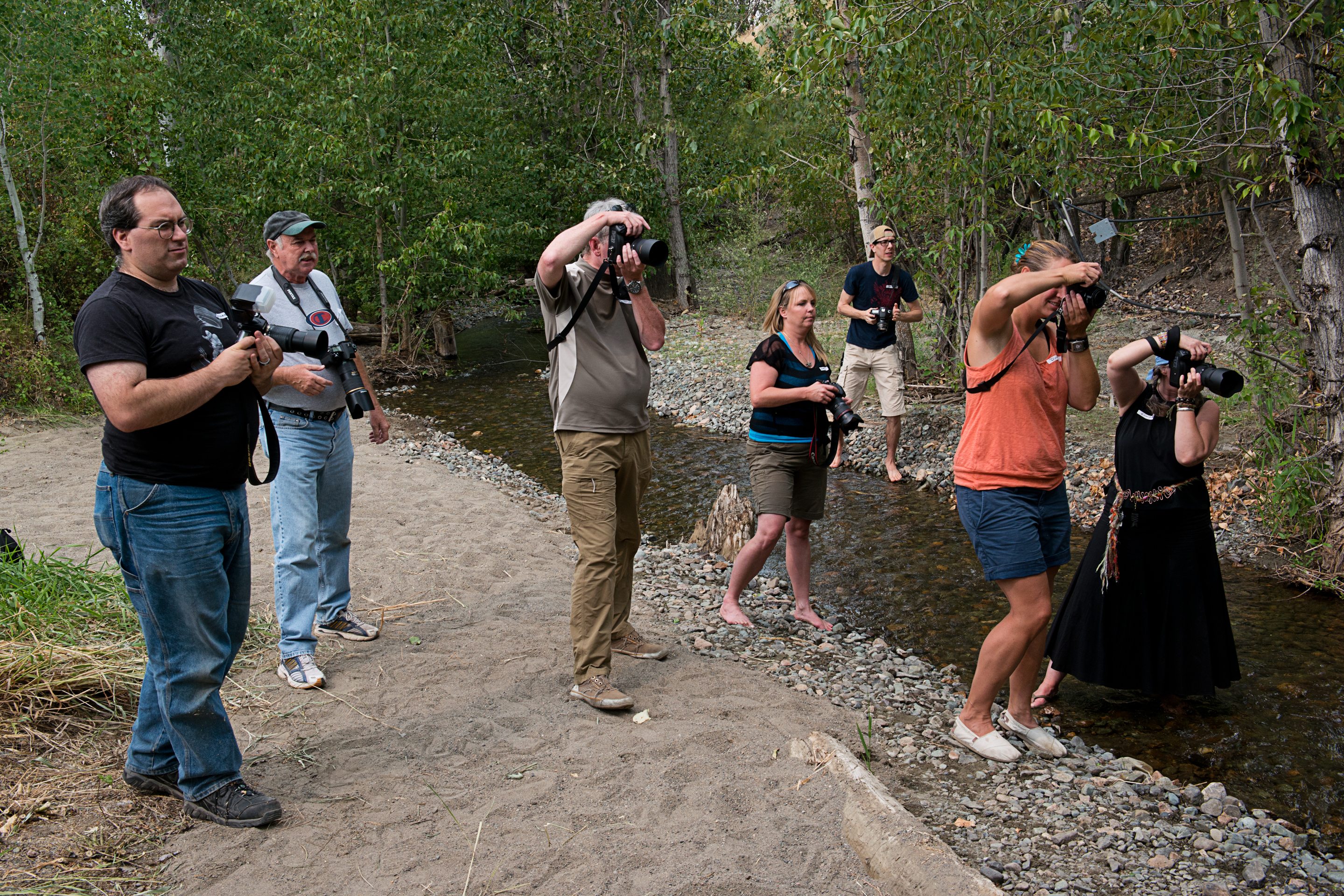
Last weekend fifteen dedicated, and I think, pretty excited, photographers attended the Versatile Studio’s photography open house just outside of Kamloops, British Columbia. It is aptly named Versatile Studio because it provides multiple locations for portrait photography inside and out.

The day began with coffee and numerous discussions on portrait photography. At one point I got up to refill my coffee and then stood back, realizing this group of photographers, with their many different styles and approaches was going to make the day interesting, educational, and a lot of fun.

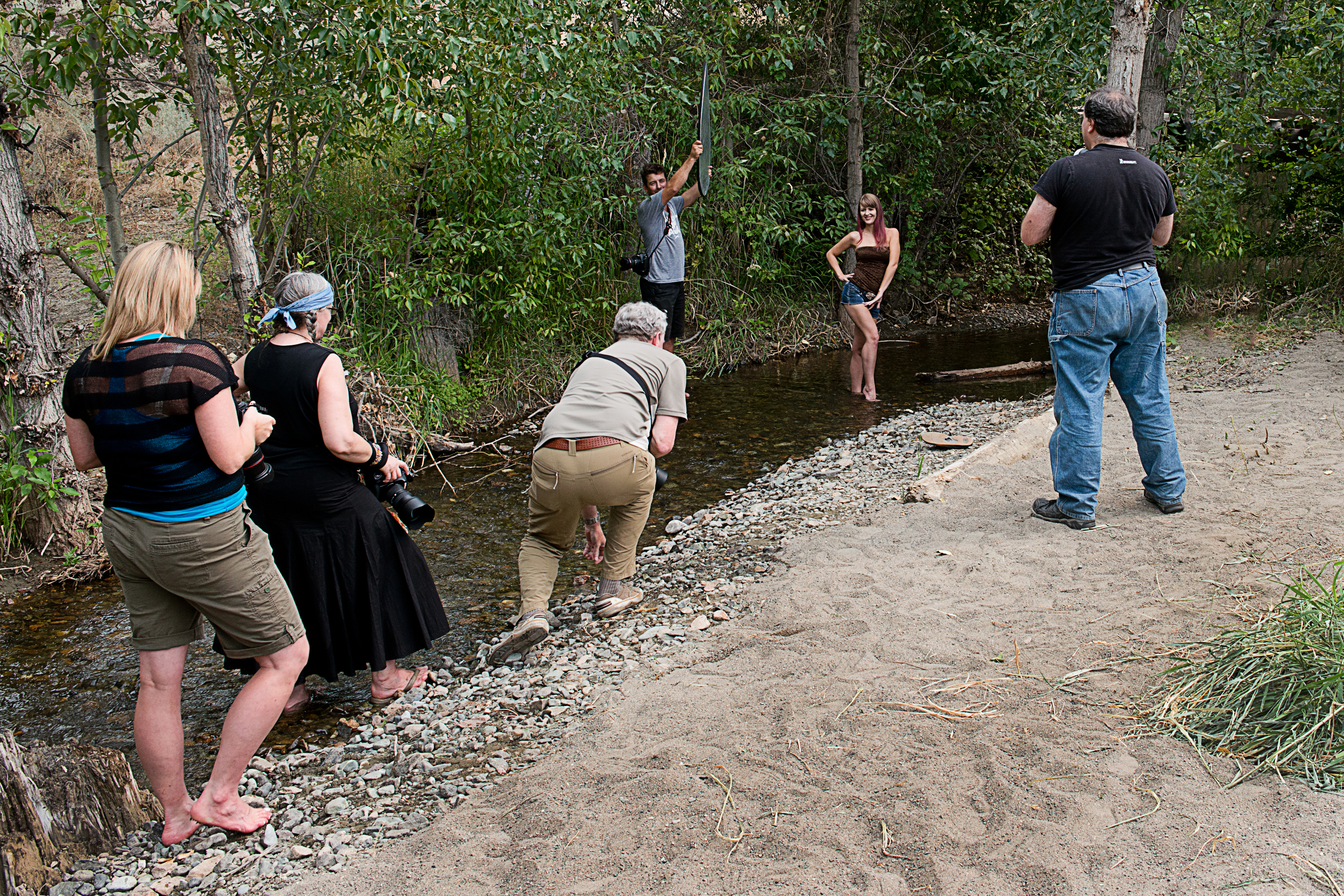
Of course, it immediately began with a hitch, as only one (thank you, Ali) of the four models that promised to appear showed up; nevertheless, these relentless photographers didn’t miss a beat, and decided to split into three informal groups using each other as subjects.

Those that wanted to work with lights in the large studio space chose two of their number with the most experience in studio strobe lighting to lead, and they took turns modeling, moving lights, backgrounds, etc, and making pictures that delved into some interesting experimentation.

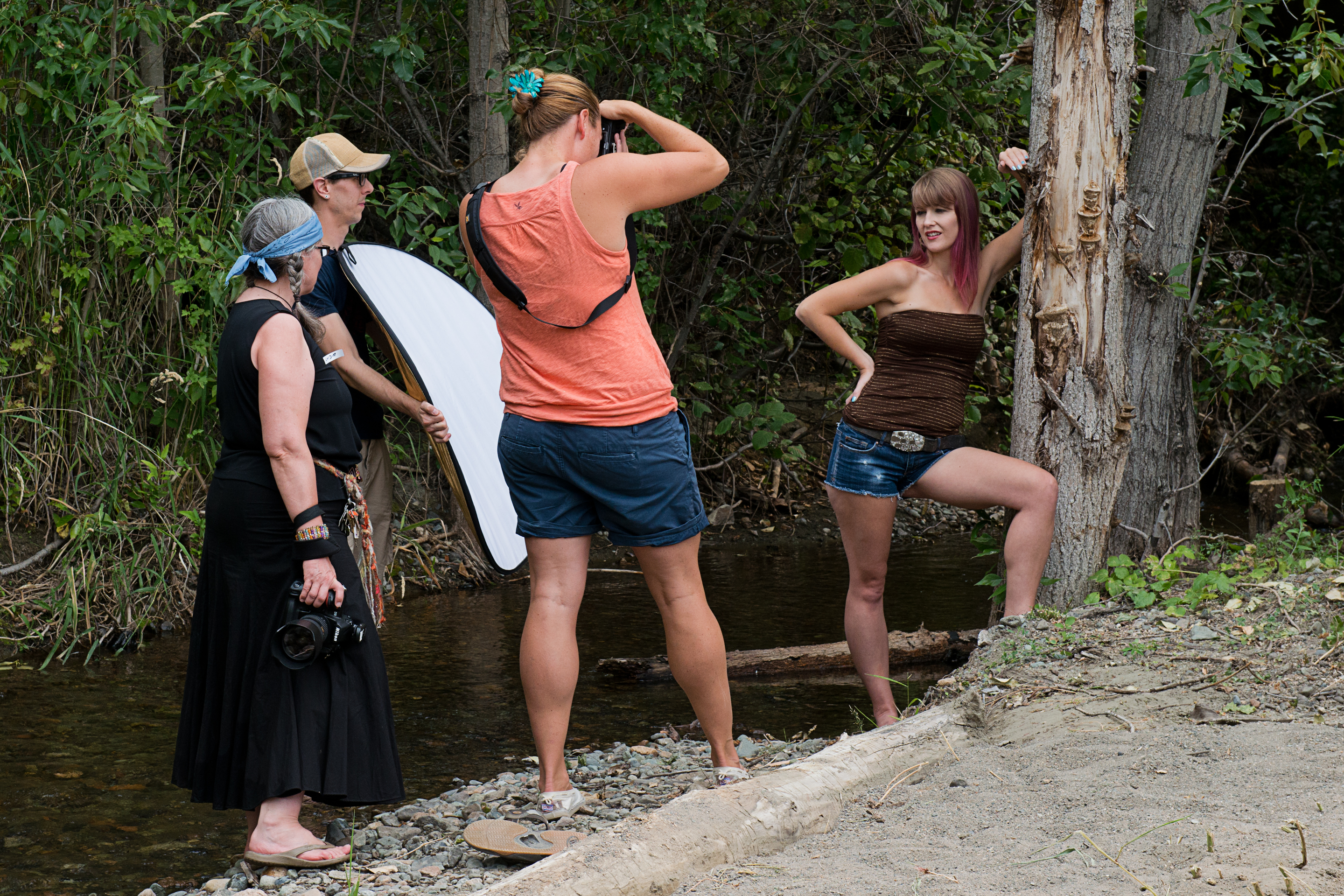
Several others picked up reflectors and gathered at the stream with the one model, Ali. The light filtering through the trees was perfect for the large reflectors, and I think wading in the cool running water was also enticing on the hot August day.

A few decided to try out the light-diffusion panels I had set up in the meadow behind the studio, and later made portraits using the portable strobe I had placed in what was once a large farm equipment/hay storage shed.

Small groups interacted, gathering to discuss different techniques and to exchange thoughts on photography, and in my opinion, it was that exchange of personal experience between the photographers that made the day a success.

As I got the chance to peak at the LCD of several photographers’ cameras, I was intrigued at how differently each photographer captured the same subject. As I write I think of some famous quotes, the first by iconic photographer Ansel Adams, “Photography, as a powerful medium of expression and communications, offers an infinite variety of perception, interpretation and execution.”   His words more than fit what I saw created by those assembled at Versatile Studio that day, and I also like this quote, by author Peter Bunnel, who in his book, “Creative Camera International” writes, “There is no single form or style of portraiture. Portraiture means individualism and as such means diversity, self-expression, private point of view. The most successful images seem to be those which exist on several planes at once and which reflect the fantasy and understanding of many.”

So of course, you can understand why I would include that quote because, indeed, I saw many styles of portraits being made on that day. That’s the interesting and enjoyable thing about getting together with other photographers, especially a collection of photographers as large and diverse in talent and experience as was there; everyone is an individual and creates from their own personal perspective.

Versatile Studio, situated in the small community about fifteen minutes from my shop in Kamloops, hosted this photographer’s event with the help of accomplished photographer, Gary Risdale and myself. Our roles weren’t that of instructors as much as we were there to introduce, demonstrate, and facilitate.

I was so involved with what others were doing that, other than the images I have posted, I didn’t get a chance for anything else.

The studio’s owner, Dave Monsees, commented to me that he liked being around fun people with a true passion for photography and said he enjoyed himself so much that he intends to try to have photographer and model get-togethers like this in his studio on an occasional basis, every month or so.

I enjoyed spending time with those photographers; some were long time friends, and some were new acquaintances; and, I must admit, some of my most favorite times of all, have been either doing photography, or being with people that are doing photography.

It is always great to have your comments, John

My website is at www.enmanscamera.com
Using Flash – even – for Sunny Day Portraits

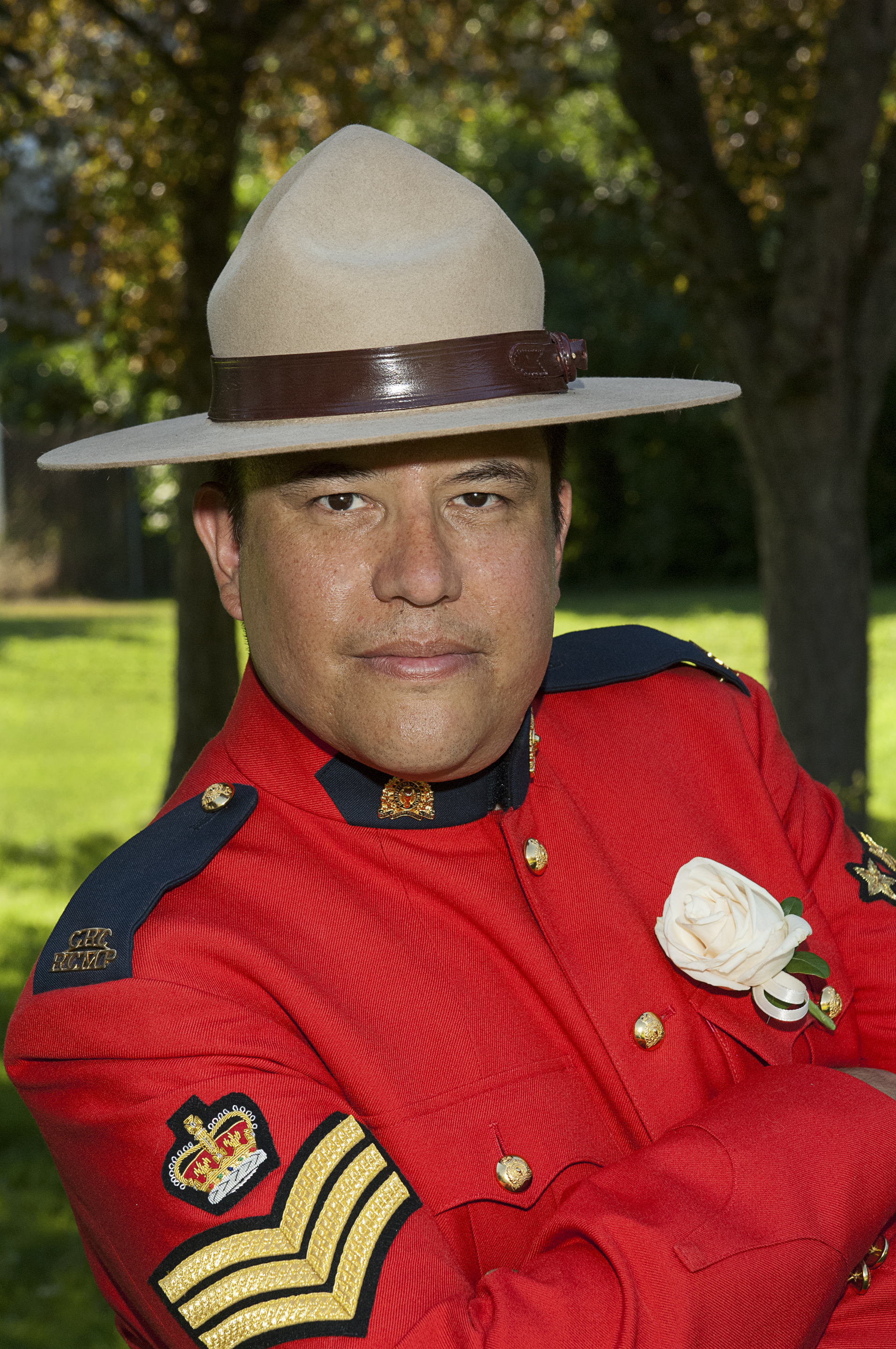
John Mike & Shannon Constable Mike Moyer View from the Bonniville Royal Canadian Mounted Ploice

Using a hot shoe or auxiliary flash is confusing for many photographers, and when I say that I prefer adding flash to all my portraits whether inside or outside, on overcast or bright sunny days, and that I rarely make a portrait without one, will often produce quizzical and disbelieving looks from photographers.

I got one of those looks recently at a wedding I was photographing under a cloudless +35C day. The unforgiving conditions were sunny and bright with participants’ faces constantly affected by strong shadows. A guest, wielding a sophisticated DSLR that was sporting a very wide angle lens, inquired about my bracket-mounted flash and politely listened when I said I always used flash, however, I could tell that he walked away still confused as to why I would bother to use a flash when there was plenty of daylight. I suspect that the unflattering shadows across the subjects’ faces were not all that evident on his camera’s LCD, or he just did not see the problem. Besides, he might have thought himself more of an event chronicler, or, because of the wide-angle lens he was employing, an artist.

I read a query in an online photographer’s forum asking, “I’ve been shooting headshots recently and it got me thinking a lot about metering. How do I meter for flash portrait photography on location? I know that without a flash, I would just spot meter their face…and snap. What happens when I have an off camera flash? Do I just meter normally then shoot? Because when I do this, once the flash goes off, the exposure would be completely different than what I’ve just metered, which would usually mean overexposed. This is so very confusing. Please shed some light on this (no pun intended).”

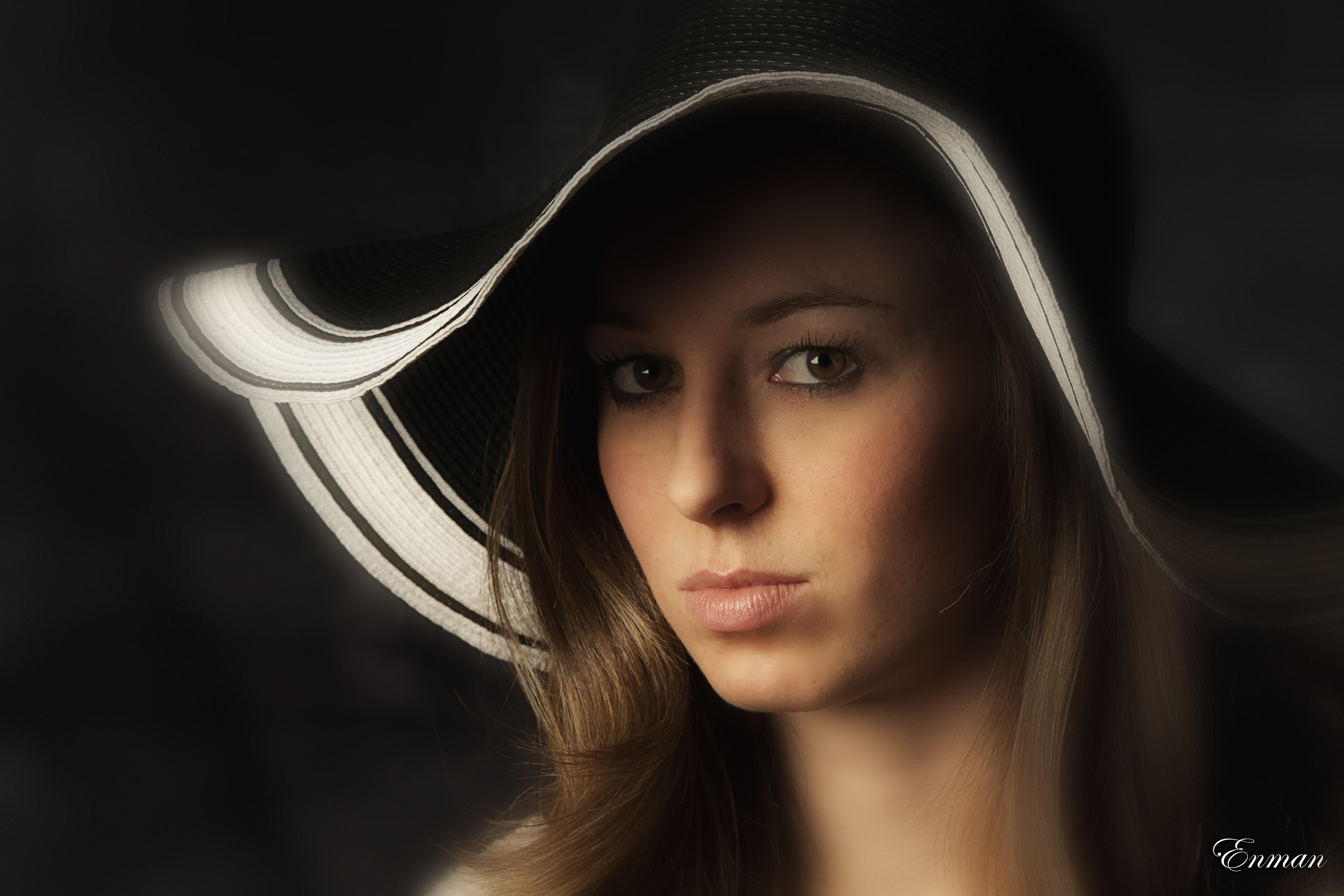
I also recall a friend’s class assignment to photograph someone wearing a wide brimmed hat under the midday sun. (My apologies to those that adhere to the words from Noel Coward that “only mad dogs and Englishmen go out in the midday sun”).

She explained, “Our assignment was to light the shadowed face under the hat and still have properly exposed surroundings.” At that time flash technology only produced constant light. The solution was to diffuse the light by placing a white handkerchief folded once or twice over the flash head to open up the deep shadow.

Fortunately, modern TTL flash is almost foolproof and only a modicum of thought is required on the part of the photographer as to how much light should be added for the subject’s exposure.

My camera is usually set to manual exposure mode. That allows me, not the camera, to choose the overall ambient exposure, and to add flash to those areas that are underexposed by shadows.  I meter the existing light, set the exposure, and make tests using the flash’s exposure compensation feature to increase or decrease the output level. I then check the histogram to see if there are blinking borders around any white areas indicating over exposure, and if I observe them I dial the exposure compensation down, till the flashing borders disappear on further test shots. That highlight-warning feature is set in the camera’s menu.

My photographs from that wedding day are evenly exposed with attractive, open shadows and do not appear as if there was a flash involved. Besides, using a flash really was not much more effort than if I didn’t, and I did not have to spend hours using postproduction software to lighten and darken my subjects from that day.

I use a bracket that places the flash high above the camera that can be quickly removed if I want to light the subject from one side. The bracket isn’t a must, however, I recommend a connecting cord from camera to flash so it can be used off camera.

I also advise reviewing the camera manual to determine if it has a feature called “high speed sync” that allows for a high shutter speed when using a flash. That’s a discussion for another time, but I recommend doing some recon on the web where there is lots of information.

Blending flash with ambient light isn’t really a mystery. The combination of off-camera flash, and a light meter to measure ambient and flash contributions, will give you complete control to craft portraits your friends and family will love.

A burst of flash will reveal your subject’s eyes and soften shadows all round, so it’s definitely a good thing and will improve your pictures.

I appreciate comments. Thanks, John

My website is at www.enmanscamera.com
Photography Excursion in the Garden – After the Rain

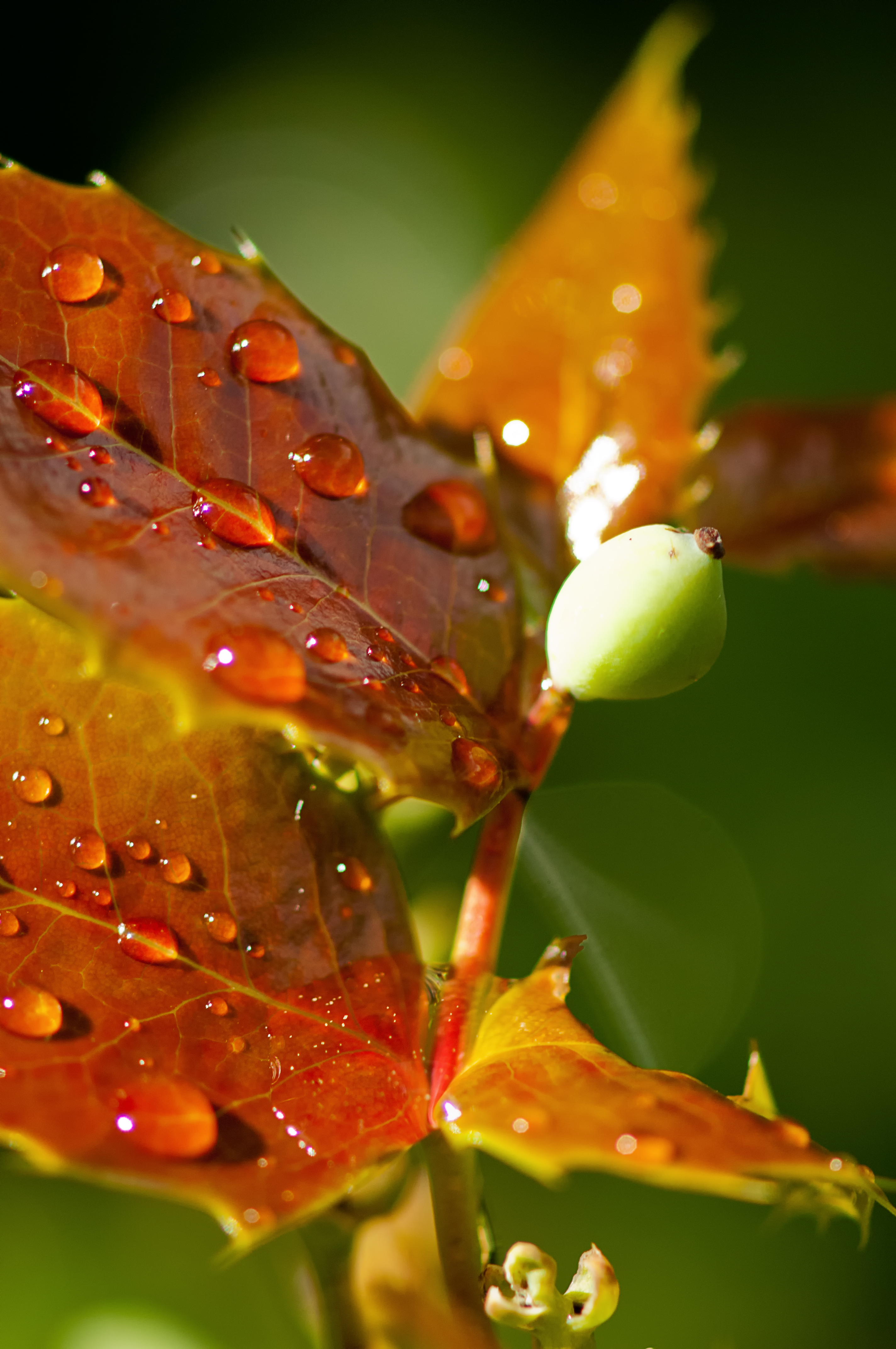
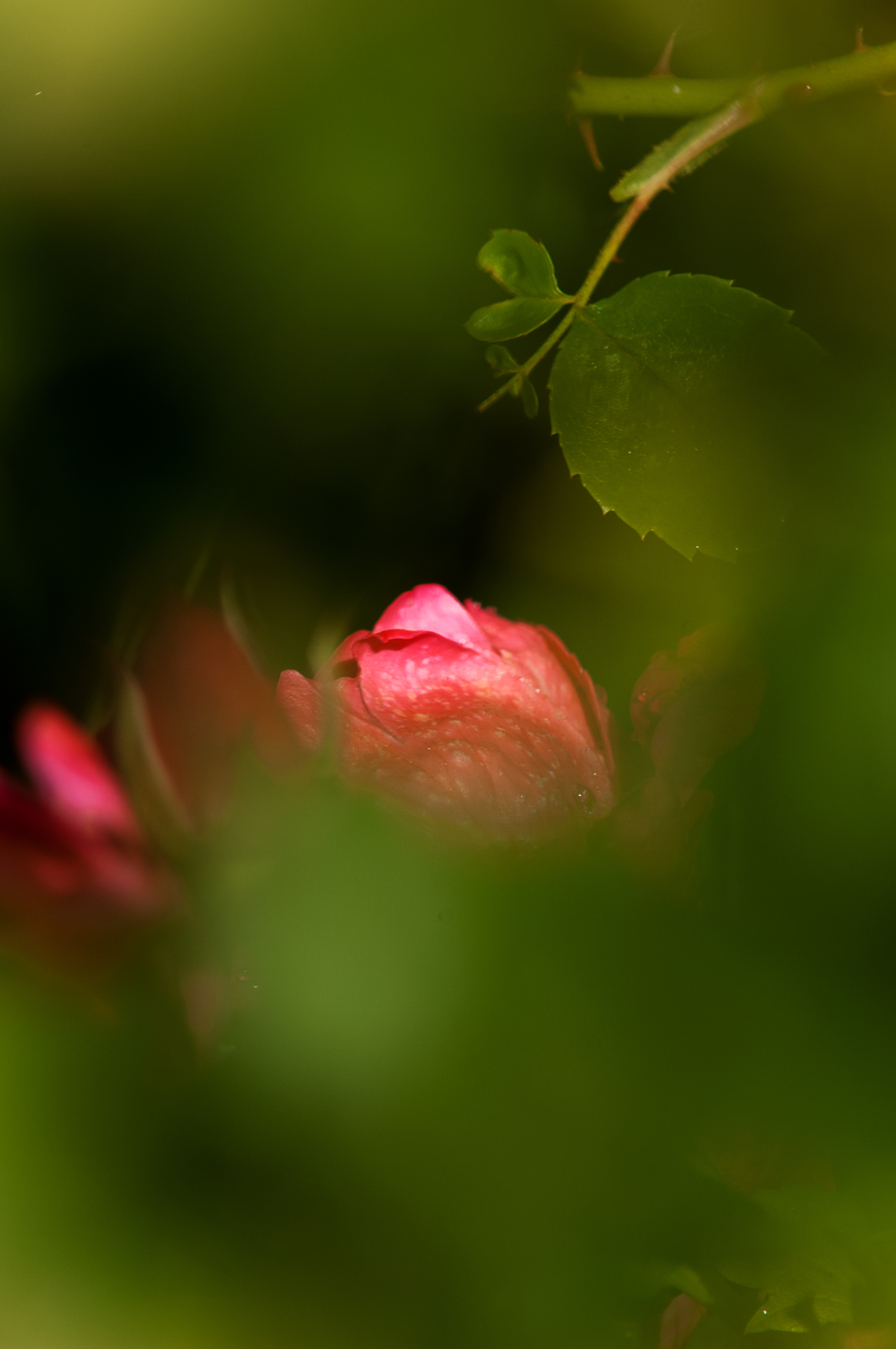
Red Mahonia/ Oregon grape  Rose bloom

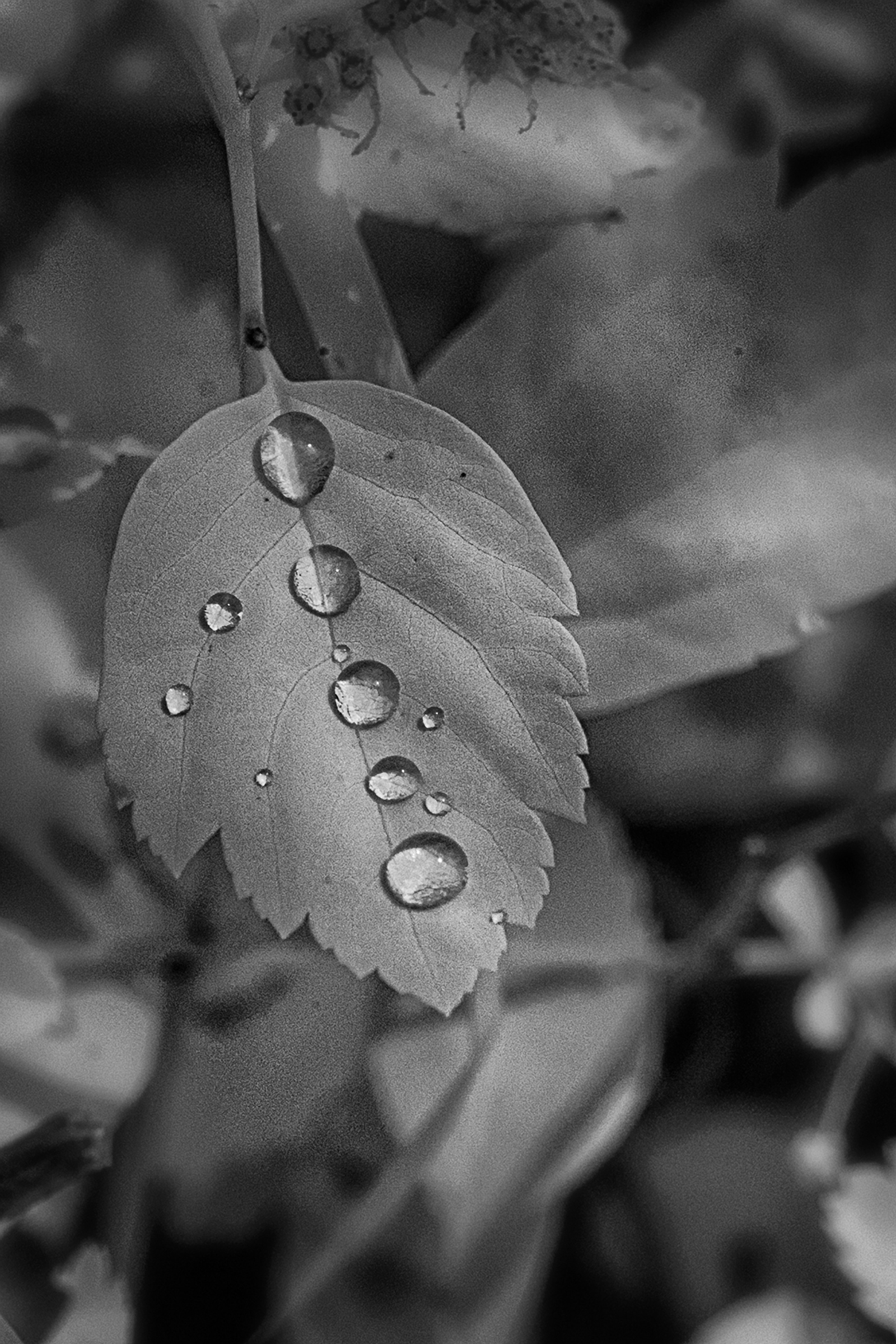
Crab apple tree after the rain

Crab apple tree after the rain – Infrared.

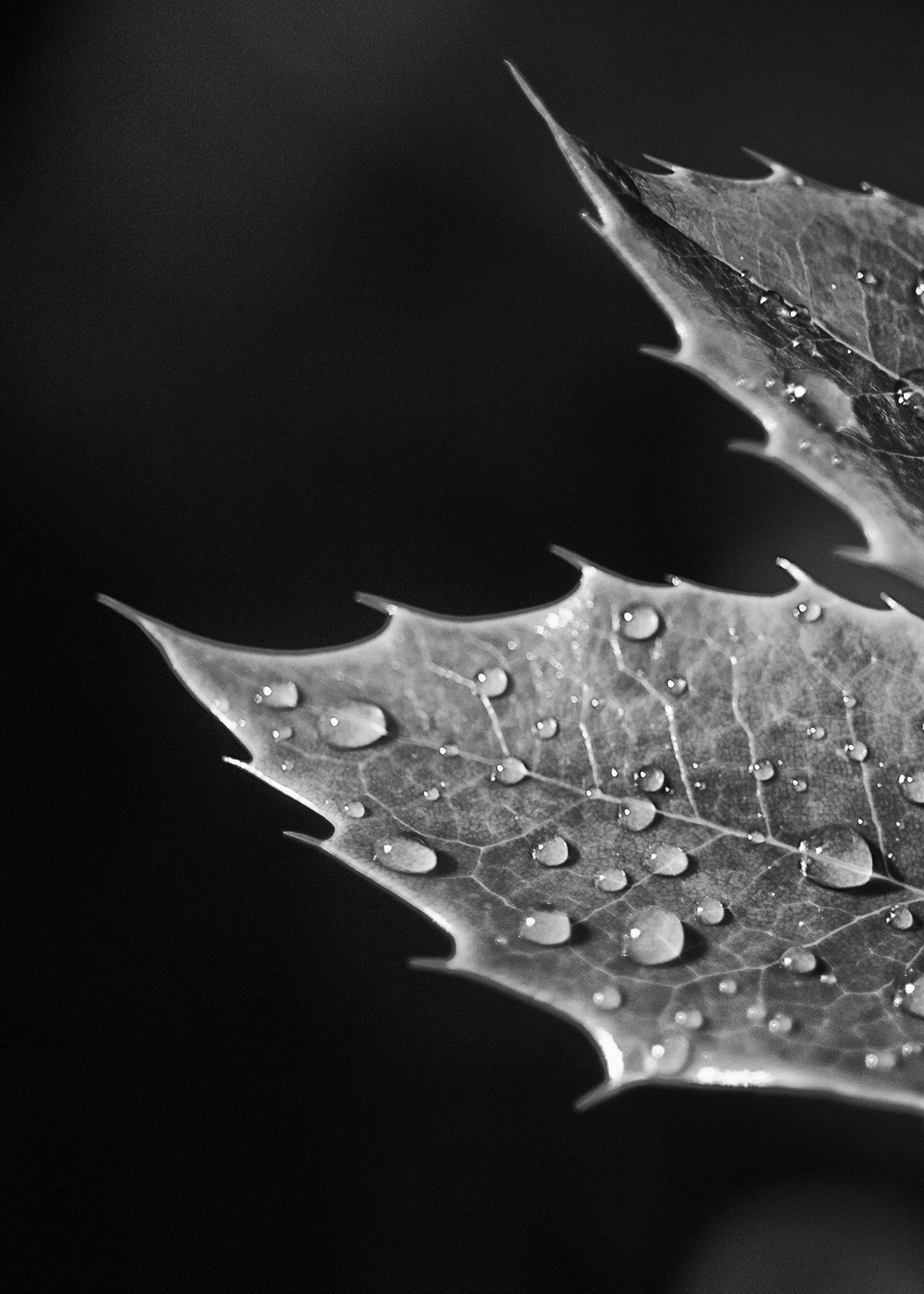
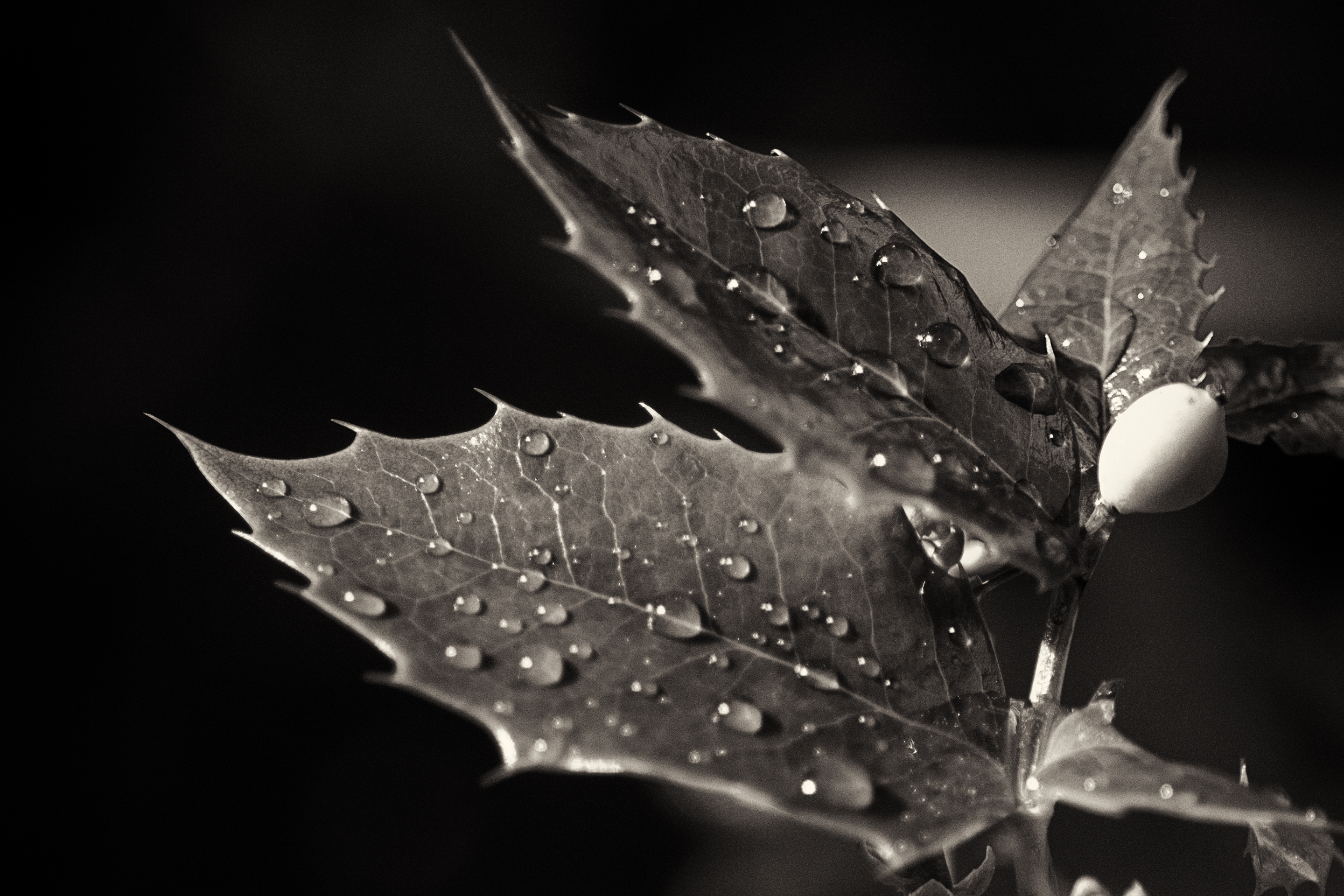
Oregon grape on a rainy day

Oregon grape on a rainy day

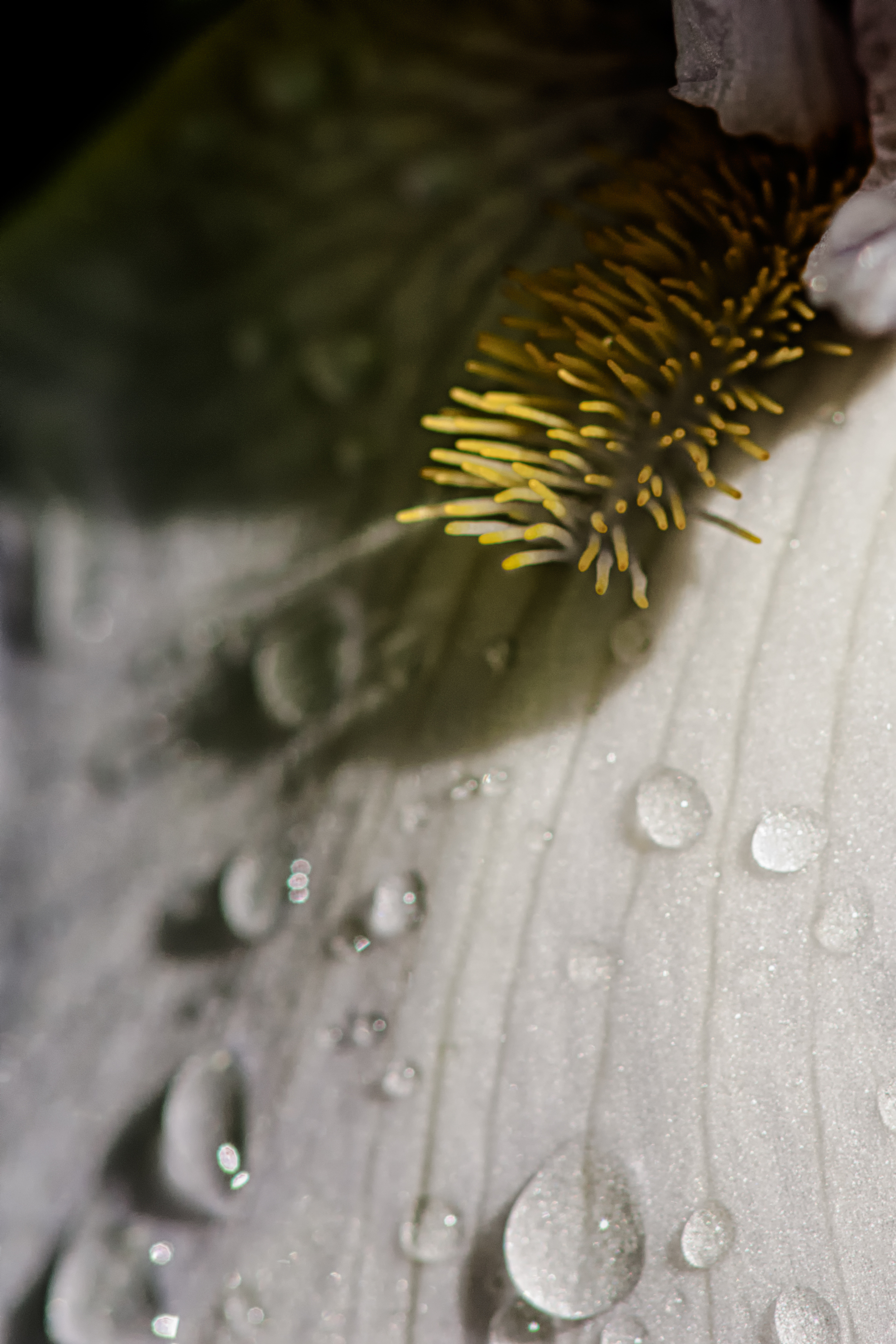
Close up of an Iris on a rainy day

Close up of an Iris on a rainy day

Mahonia in black and white

I have heard complaints recently from photographers that they haven’t been able to get away from the wet weather this month and have only been offered a few rain free days to plan photography events.

The last three days has seen rain, sun, and shortly thereafter, rain again; nevertheless that needn’t be a reason to be depressed about the weather. Of course, the rain meant delaying a trip to the mountain waterfalls; and landscape photography might not be as dramatic unless one is willing to wait for the clouds to part. But, in my opinion, one doesn’t need to stray far from the back door to pursue that insatiable need to make pictures.

I have heard of groups having photographic challenges and I suggest that because of the rain that they have a challenge in their own back yard.  My goal this week was to get out during the rain to make pictures of the wet plants in my wife’s garden. I had planned to attach two small umbrellas to light stands, one for a flash and one for my camera and me. However, when the rain came down the last three days it really came down hard. So even though I don’t mind getting wet, there was no way I could be successful in the kind of deluge I faced each day.

The rain would come fast and hard, then abruptly stop. Next would come a strong breeze and bright hot sun that quickly dried the leaves. All perfect if one wanted to go for a walk, but I wanted wet leaves and water drops that I could add sparkle to by using a flash.

After waiting three days I put my umbrellas, light stands and flash away, slipped on rubber boots, and dashed out into the still wet garden as soon as the rain began to ease up.

As had been the pattern for the past few days, the sun came out quickly, hot and bright, and, as usual, the breeze began. Fortunately, the bright sun allowed shutterspeeds of 1/600th of a second and above, and, in most cases, made up for the plants moving with the light wind.

I used two cameras; one converted to infrared with a 70-180mm macro lens and the other shooting normal with a manual focus 200mm macro.  Some plants looked as though they might be perfect for infrared while others were so colourful that I knew I wanted the image to end up as close as possible to natural, although some would be converted to black and white. As I mentioned I wanted something unexpected and that also meant I photographed some plants taking into consideration that I might do some altering in post-production.

Wandering around the home garden is relaxing. My intention is to find something unexpected in the familiar plants. When I’ve chosen my subject, I look at it from all angles paying attention to the background so that whatever is behind won’t interfere, and I want the shadows, colours, and other plants to add interest to my composition.

I know many photographers may be content with aiming their programmed, little point and shoot cameras straight forward at some particular flower or foliage, and that is acceptable if all one wants is a life-like representation for a club’s plant catalogue, however, I find much more interesting photographs are from photographers with their DSLRs who are more intent in creating artistic representations of the flowers and other plants.

I think photographers get themselves all tied up with a need to have inspiring subjects, and ignore the commonplace subjects just outside the door.  When I want to try out some new piece of equipment, or software, I don’t wait for an excursion; I just walk out in my yard and make pictures of anything and everything. I can easily return to the computer to test some recent exposure, then go out again; and on days like I just wrote about it is easy to change out of wet cloths immediately at home, instead of driving home uncomfortably for several miles.

I always appreciate your comments. Thanks, John

My website is at www.enmanscamera.com
Another Enjoyable Event – Vancouver Camera Swap Meet

Swap 4 Swap 3Swap 2Swap 1

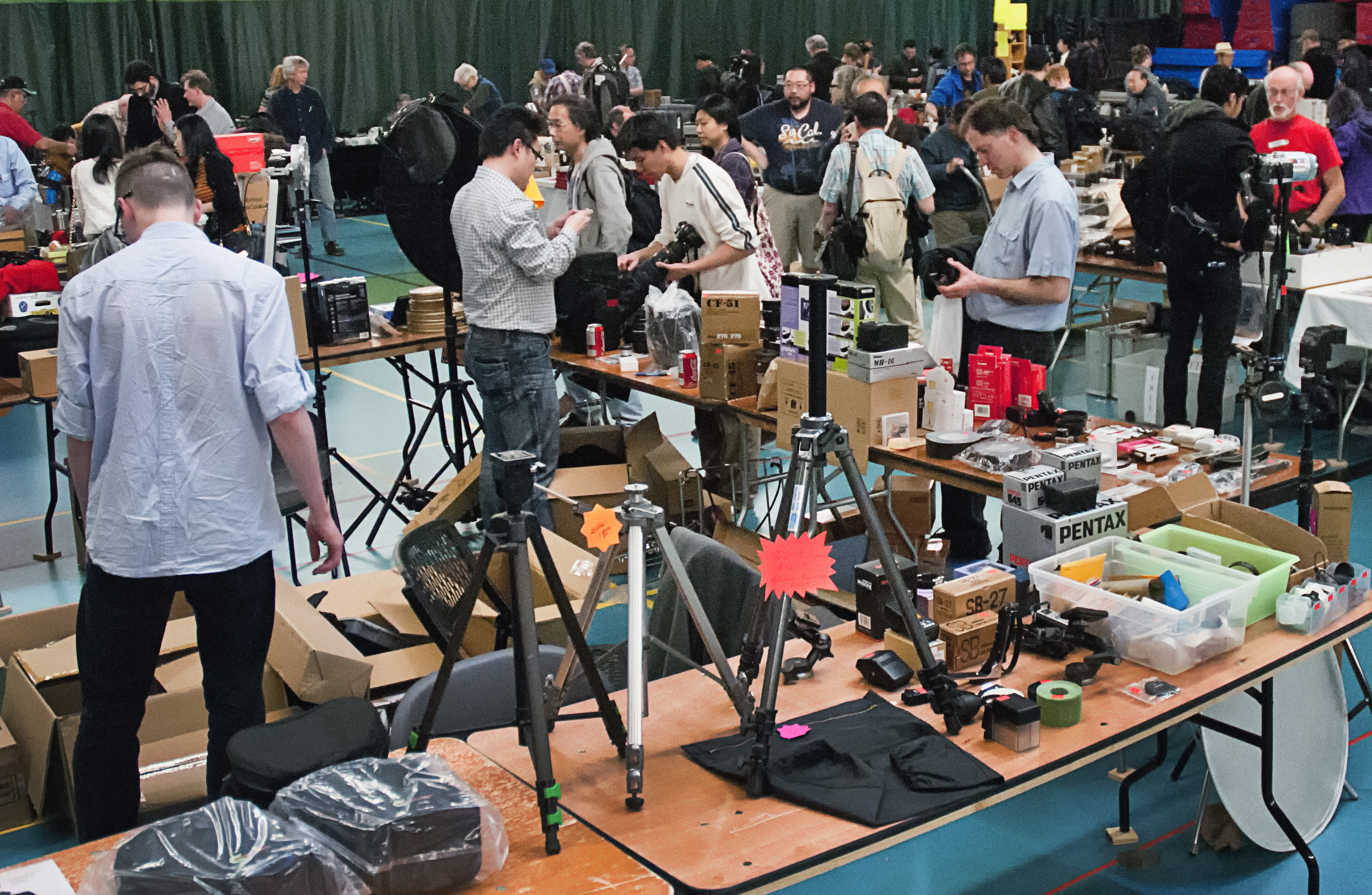
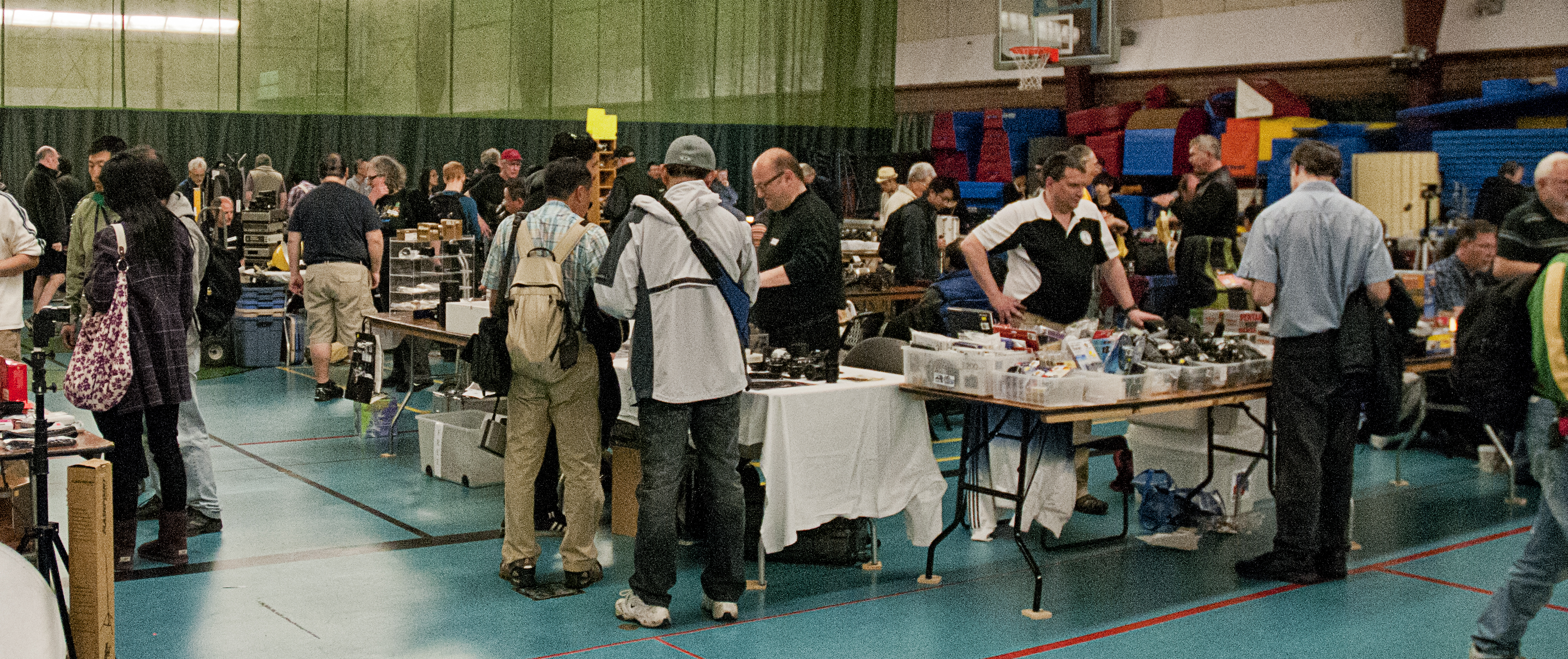
Another one of my favorite events, and one I look forward to attending every year: The Vancouver Camera Show and Swap Meet was held this past weekend at the Cameron Recreation Centre in Coquitlam, British Columbia.

This long-running show, put on by the Western Canada Photographic Historic Association, and organized by Siggi and Brigitte Rohde, has now reached it’s 37th year and makes the claim of being the largest (and maybe the best) in Canada with well over 1,000 people walking through the doors.

Speaking of walking through the door, participants that did walk into the large photographic-equipment-packed hall joined an amazing diversity of other photographers all looking for deals and eager to exchange information and ideas. In my opinion, there isn’t better way of spending a spring day than being surrounded by a vast array of cameras and photography equipment, all the while getting a chance to talk with other photographers.

My wife and I always make the three-hour drive from Kamloops the day before and lodge overnight so I am fresh for the early 7:30AM setup.  I enjoy the early morning scene and have come to expect an exciting buzz from other vendors who are busy setting up, talking, and buying as one sees lots of early deals before the show even begins. I walked to my table greeting people I have known for years, and organize my table quickly so I’d be ready for the swap meet’s early bird shoppers who pay a premium to shop exclusively starting at 9am.  This year there was a long line of early birds waiting at the door. That line extended all the way down the hall and stretched all the way out into the parking lot.

By the 10am regular admission I was almost out of breath from non-stop showing, demonstrating, explaining, and, of course, bargaining with photographers who were checking out what I had on my table.

Every year I go wondering what the latest trends are, or what is popular with photographers I will meet there. Last year I noted that I saw a change in the attendees in that long time sellers and attendees were absent and replaced by a much younger crowd. I could still repeat some of that this year, but my observation about the younger crowd was far from the truth this year. I’ll use the word “diversity” to describe the mixed bag of photographer types at this year’s Camera Show and Swap Meet. They were of every age, from folks using walkers for assistance, to young people accompanied by their patient parents. That included all kinds of lifestyles and interests, and specialties in photography, film, digital, past and present technology.  They all were excited, searching for some sweet deals that I am certain they got.

In my opinion, other than actually pointing a camera at some inspiring subject to make a picture, an occasion like the Vancouver Swap is the quintessential place of happiness to meet and exchange information with other photographers, and of course look at and check out the many kinds of photographic equipment that would not be so easily available anywhere else.  An interesting example would be my old friend, Hai from Calgary, who said he has become interested in taking 3D photographs and I viewed some of his 3D photos taken in the Vancouver area since he arrived.  I knew of the 3D technology, however, I had not had the opportunity to check out any of the new cameras, until his.

Overall, I had a great time talking with other photographers; the conversations were many and constantly changed depending on who joined me at my table. My day of selling was a success, as it was for most of the dealers I talked to at the end of the day.  And I even had some time to purchase a few things for myself, which is always nice.

As always, I appreciate any comments.

My website is at www.enmanscamera.com
Another Strobist Meet-up for Photographers

Demetra Koutsopdiotis  Monica Nicklas   Monica Nicklas 2

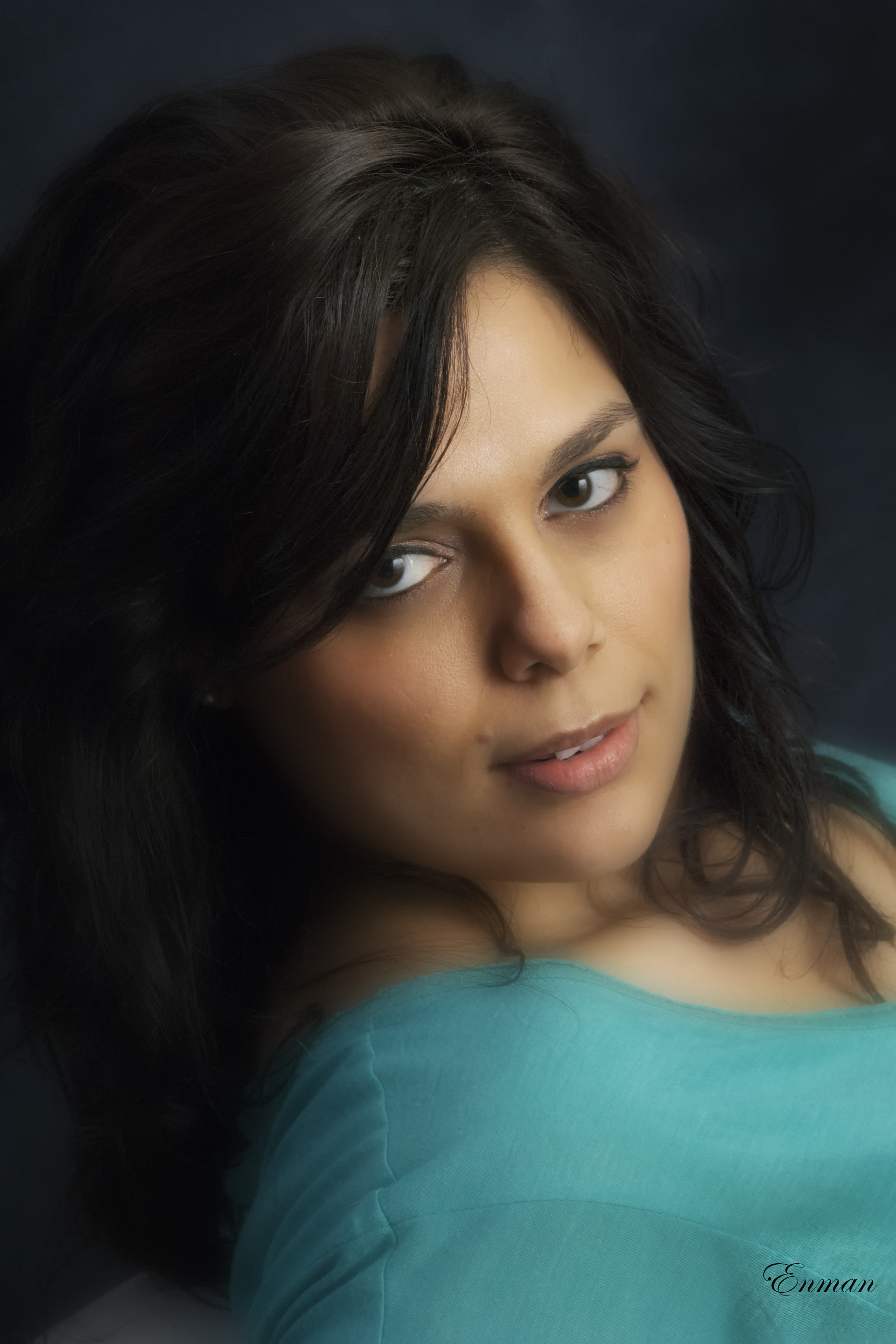
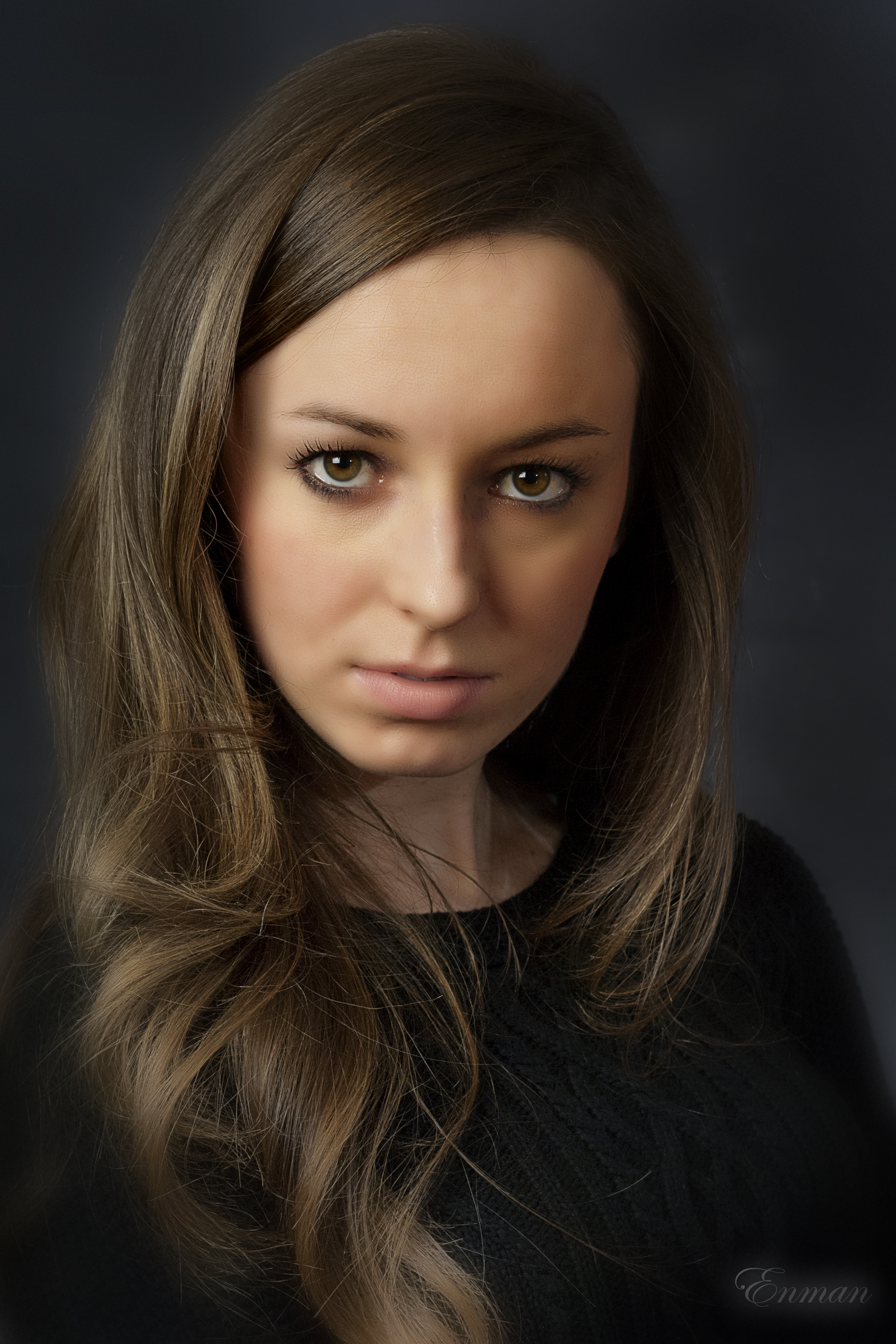
My friend, Dave Monsees, decided to host another Strobist Meet-up at his photography studio, and I was definitely up for that. I like trudging around photographing snowy scenics, but, the thought of spending a photo-filled day in a warm, wood-heated studio was enticing, and when he extended the invite I didn’t hesitate to accept.

My request to the other photographers was to continually change the two lighting setups  that we were using. I had participated in past meets, and, they were fun and photographers got to make lots of pictures of models; however, even though the resulting pictures were great, the lighting remained basically static for every image. For this day I wanted to change the modeling lights and modifiers every hour.

That meant photographers and models had to rethink what they were trying to do, but after the first change everyone got into the swing and began to get really innovative. Photographers changed lenses, shooting angles, helped each other out by moving the lighting around, and our models went through several clothing changes and were as involved in the creative process as the photographers.

The studio had lots of lighting equipment set up with wireless camera connectors for each photographer. There were two different backdrop set-ups, and we had our choice of lights and modifiers like softboxes, umbrellas, snoots, barn doors, and reflectors.

When I wrote about the last studio meet-up I attended I said that photographers always need to explore and experiment, and get-togethers like this are perfect for practicing off-camera lighting in a studio (that most photographers don’t have access to) without the pressure of actual clients, and it is a fun way to refine one’s skills. Monsees commented that he liked being around fun people with a true passion for photography, and dedicated to off-camera flash.  He also said that he enjoyed himself so much that he intends to try to have photographer and model get-togethers in his studio every month if he can.

Although photographers have been using off-camera light nearly as long as they have been making portraits of people, that practice has really been limited to a few that owned studios. Recently all that has been changing what with quickly advancing camera technology, and the word “strobist” now refers to a photographer who uses off-camera flash to take pictures, instead of the usual pop-up flash, or hotshoe flash attached on top of the camera.

I am often asked, “Why use off-camera flash?” Instead of using just a camera, one must lug around a light stand and a flash. That means carrying extra weight. Sometimes a photographer would require an assistant since weather conditions might knock over the light when shooting outdoors.  My response to the question is, “Better pictures.” Light is the language of photography. Without light there are no photos. With off-camera light one adds light and control over the final image. Adding light might introduce drama in a picture and can increase detail or hide it. The extra work greatly affects the output.

I like quotes and here is one regarding light from George Eastman, American innovator and entrepreneur, who founded the Eastman Kodak Company and invented roll film. He summed it up for me when he said, “Light makes photography. Embrace light. Admire it. Love it. But above all, know light. Know it for all you are worth, and you will know the key to photography.”

I always appreciate your comments, Thanks

My website is at www.enmanscamera.com

Infrared Photography on a winter day

old truck in infrared Infrared roadside Farm in Infrared

Photographers always tell me that they are participating on some kind of photo challenge or another: a photograph-a-day for a year, or once-a-month for some specific time, or some have even decided to follow a particular subject through each season. I like the idea, however, I expect dedicating time to making a photograph every day (unless one works in a busy studio and is doing it as part of the work day) could become quite a chore.

Personally, I have tried projects that require that kind of stick-to-it dedication, but I get side tracked easily and rarely complete what I started. Last February I thought I might photograph a bridge a month. I live near a big river so how hard could that be? I did get a few and then I just forgot.

When it comes to my personal photography fun stuff just happens. For example, it was one of those days when I was too lazy to do the stuff around the house that I should have been doing.  I was reading some and just thinking about photography in general. OK, for me thinking about photography isn’t that unusual, it is actually what I prefer to do.

I was lazy, reading and thinking about how I should have a photo project. OK, the project: drive up the road a couple miles and photograph neighbour’s places poking out of the snow and do it with my infrared camera which is fun.  Criteria: Hope for some sun.

I have an older digital SLR camera (Nikon D100) that has been modified to only see infrared light. Infrared (IR) light is light that has longer wavelengths on the red edge of the spectrum and is invisible to human eyes.

The sensors for digital cameras are sensitive to more than just the visible light spectrum. This causes problems with colour balance, so camera manufacturers place a filter in front of the sensor that blocks the infrared part of the spectrum that only allows visible light, and not infrared, to pass through. The modification for my D100 was accomplished by removing that filter, and installing one instead that blocks visible light, allowing mostly infrared light to reach the camera’s sensor.

The camera still functions normally with full autofocus and autoexposure, except that it’s now able to record the infrared wavelengths that are just beyond what the human eye is capable of seeing.  When infrared photographs are produced as black and white the photographs show trees with glowing white leaves and black skies opening up new visual opportunities for photographing the world around us.

Many think of infrared photography as the stuff of military night reconnaissance, or, as frequently portrayed in movies, as aerial thermal imaging that finds the bad guys. With thermal imaging one sees the heat the subject is producing, however, infrared as photographers use it, with our modified cameras, is about capturing the light or radiation that is reflected off a subject and doesn’t involve thermal imaging at all.

In 1800 Sir Frederick William Hershel described the relationship between heat and light and let the world know about the existence of infrared light in the electromagnetic spectrum.

I don’t know how conversions are accomplished with modern sensors. With my old D100 I need to preset the white balance and be aware of a meter that is easily tricked with the white snow. I must check my camera histogram after every release of the shutter and usually make two or three exposures just in case. However, everything appears normal through the camera’s viewfinder.  Also, because so much light reaches the sensor one can use high shutter speeds and so it is easy to hand hold while exposing a photograph.

I would have liked a clear sky with more sun to increase the infrared effect, but the high clouds let in just enough light to make things interesting and challenging. Some subjects don’t work very well with infrared, so I just experiment, take lots of pictures and hope for the best. I knew on that not-so-bright-day my images would take some work with PhotoShop and NIK’s SilverEfex.

Infrared photography is fun. I was only out wandering my neighborhood for a little over an hour before I hurried home to work on what I got. Everything changes when one is working with infrared, forcing even the least creative among us to think creatively. I can leave my images with blue trees the LCD displays or move the white balance off the preset to cloudy and get red and black pictures instead. Opening an image file in PhotoShop is always a bit of a surprise and from there on its all experimenting and personal vision. Yes, infrared is fun.

As always, I appreciate your comments.

My website is at www.enmanscamera.com