The Portrait   

The conversation – a Portrait.

For most photographers a portrait is an artistic representation of an individual or individuals, with the goal of capturing some likeness as to who they are.

Famous American photographer, Richard Avedon carried this further when he said, “A portrait is not a likeness. The moment an emotion or fact is transformed into a photograph it is no longer a fact but an opinion. There is no such thing as inaccuracy in a photograph. All photographs are accurate. None of them is the truth. ”

Popular American painter Jamie Wyeth wrote, “Everything I paint is a portrait, whatever the subject.”

For years most of the photography I did was portraiture, whether wedding pictures for a family, or private sessions. My opinion is that portraits are pretty narcissistic and because of that, can be much harder to do properly than many other photographic pastimes.

Make a bad landscape and no one will really care, capture a bird flying poorly and it’s no big deal; however if you give someone an unflattering photograph of themself and you have might make an enemy for life.

A portrait can be a representation of anything and doesn’t necessarily need to only be of people. Years ago my wife and I had show dogs and would regularly attend and participate in events in hopes of having the judges select our dog as best from some group; and when we did win, we would walk our dogs to a photography booth set up by a skilled dog portraitist to have a portraits taken that day when they looked so good and performed so well.

As I watched a TV show earlier this week I noticed framed pictures of the owner’s cat hanging on the wall, and I have seen all types of pet portraits in friends’ homes. I suppose a picture of a favourite or special car, motorcycle, boat or even treasured holiday snapshot, might be called a portrait.

I wonder if many photographers might agree with the painter Wyeth’s contention that, “Everything I paint (or photograph) is a portrait, whatever the subject.”

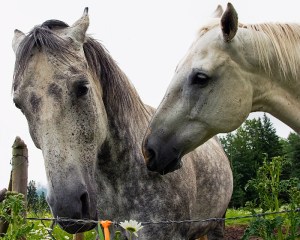
Some time ago I went for a slow drive along the winding roads high above my place in Pritchard hoping to find some cows, horses, or deer to photograph. I wanted head and shoulder compositions (or portraits), not animals in the landscape.

I leisurely drove around, passing lots of roadside deer; cows quietly chewing the cud, and finally stopped near two horses standing very close to a fence. My choice was to compose of portrait of them instead of just a pleasing documentary of two horses in a field. So I mounted a 24-85mm lens on my camera, walked through the wet grass to the fence to take their picture, and worked angle after angle for a portrait.

I suppose the words “artistic representation” and “goal of capturing some likeness” are appropriate when a photographer captures human-like qualities in animal portraits. I wanted a picture that included me, or at least inferred some conversation between the horses about me. My image is, as Avedon said, “….an opinion”.
What is a Good Photograph?

Just what defines a good photograph is, and will always be, a topic of heated discussion with serious photographers; and in my opinion, is one that is certainly worth regular examination because, simply put, a “good photograph” is what those who enjoy this medium want to make.

There are, of course, those that believe a good photograph must capture an image absolutely true to life, while others might say it’s totally about how creative the photographer is, however, if one relies on they number of “likes” they receive on social media sites a good photograph probably depends on the beauty of the subject.

When I taught photography I told my students that a good photograph includes acceptable composition, exposure, and an interesting perspective.

I also said that a good photograph makes us have a connection with, or think about the subject, and might help us understand what the photographer feels about that subject; and if successful, evokes some kind of mood, whether good or bad.

American photographer Ansel Adams said, “A great photograph is one that fully expresses what one feels, in the deepest sense, about what is being photographed.” And he elaborates, “Simply look with perceptive eyes at the world about you, and trust to your own reactions and convictions. Ask yourself: “Does this subject move me to feel, think and dream? Can I visualize a print – my own personal statement of what I feel and want to convey – from the subject before me?”

And Adams reminds us, “There are always two people in every picture: the photographer and the viewer.”

Another of my favorite scenic photographers, Elliott Porter, commented, “You learn to see by practice. It’s just like playing tennis; you get better the more you play. The more you look around at things, the more you see. The more you photograph, the more you realize what can be photographed and what can’t be photographed. You just have to keep doing it.”

Vogue magazine Editorial photographer Irving Penn, wrote, “A good photograph is one that communicates a fact, touches the heart and leaves the viewer a changed person for having seen it. It is, in a word, effective.”

What is a good photograph? That might only be in the “eye of the beholder”. If one is a camera club member there will be rules on how a photograph is judged. And when I graded my students’ work I was mostly interested in their knowledge.

Sometimes we see a photograph that moves or inspires us, makes us feel, think and dream. And when a photographer is able to convey that to viewers he or she has truly made a good photograph.

Flowers as Portraits   

Easter is about a month away and I expect a few readers will be getting flowers from someone or giving flowers to someone. Those flowers will be a great photo-opp.

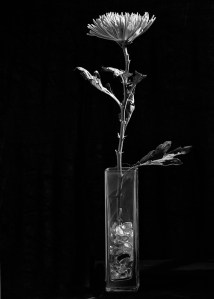
A portrait photographer’s studio set-up usually includes a backdrop and lighting equipment. The lighting, from small, or large flash units, is controlled by an array of modifiers that can include reflectors, umbrellas and softboxes. And the backdrop is chosen not so much because it is a flat surface but because it is a background to flatter the subject seated in the foreground.

The lighting illuminates the subject and separates it from that background as well as creates depth and dimensional form.

When producing an outdoor portrait most experienced photographers will begin by placing their subject in front of a neutral background or sometimes erect a backdrop and use either flash, or reflectors, to control the light on their subject and create depth and interest.

However, if I asked those same photographers to make me a good picture of a plant they would likely just kneel down next to some pretty flower and snap the picture with little thought to background or lighting.

After years of doing just that to lazily document some plant that caught my eye, I decided that I wanted more from my images. I realized that it was the shapes and plant forms that drew me to gardens.

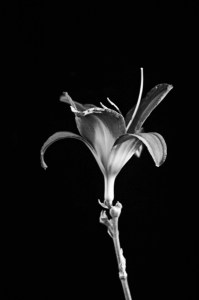
During my quest to make my plant and garden photos more than flat, lifeless documents, I discovered the flower photography of Robert Mapplethorpe. His portraits of flowers are always posed and include the kind of dynamic lighting one would expect in photographs of beautiful people. His spectacular and thoughtful compositions of flowers, like orchids and calla lilies, convey moods that to me reveal more with each viewing.

When I photograph people I try to be both creative and flattering with my lighting, remembering that a good portrait should have lasting power. I want future generations to see a portrait of their parent or grandparent and still like it. If one gets too edgy, or trendy, the portrait will not stand the test of time and be discarded when trends change.

I have come to think the same way about photographs of plants. Flowers, of course, are so much easier to photograph than people, especially potted plants. Select a good location, turn the pot until the pose looks good and add light. Plants don’t get tired, nervous or jittery. Maybe that’s why I like photographing flowers, they (almost) always cooperate.

Photographing a plant in the garden or in a pot should be more than quickly pointing a camera at that flower in a garden or a windowsill and releasing the shutter.

Put that boring iPhone away, and take the time to make it more than just a repetitive, unimaginative record. Don’t be in a rush; take time to develop a plan, don’t take the lighting for granted, work with it, and above all, be creative.


Movies about Photography              


This past week my wife commented to some evening guests that I always have something to say about any camera that one appears in a TV show.

Yes, I do that. I can tell her I am sorry for interrupting movies she is watching, but I’ll just do it again the next time I see an actor with a camera.

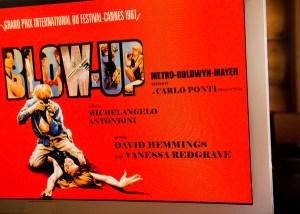
I enjoy watching movies about photographers. I guess the number one classic was “Blow Up” in 1966, staring Vanessa Redgrave and David Hemmings. The plot was about a fashion photographer that takes some casual shots of people while he walks through a park. However, when he blows up his prints he realizes he’s also photographed a murder. It is a worthwhile “time period” movie to watch if one is interested in what was “hip” in 1966 and likes symbolism.

I have seen it several times and enjoy critiquing the photography, and the cumbersome way the lead actor uses his Nikon. The stylish photographer kept enlarging, cropping, and enlarging the prints from his 35mm camera. Impossibly, the prints were always sharp and without any grain.

Another of my favourites was an awkward movie called “Nights in White Satin”. The story line was weak, but one has to watch a movie with a title and lead song by the Moody Blues. The music throughout was pretty good, and made up for the simplistic story revolving around a photographer who gets involved with a homeless woman.

The photographer tooled around on a Harley Davidson, used a Leica rangefinder, and, in spite of hurriedly taking pictures in dimly lit flophouses and back alleys the resulting pictures were always perfectly exposed with studio lighting. Of course, the woman living on the street was beautiful, well washed, and used makeup.

The third and last movie I’ll mention was packed with delightful clichés. It would be forgetful if not for those.

It was a made-for-TV British show entitled “Midsomer Murders”. The director sets his main characters, a couple of detectives, investigating the murders of camera club members.

The members were at odds over which technology is better, film or digital. The club members who used film had old Rolleiflexes, Leicas, and wooden 4×5 cameras, and all wore those campy, khaki-coloured, photography vests with all the pockets we occasionally see from time to time. The club members that preferred digital DSLRs had electronic flashes, and wore black leather jackets with black pants.

The directors must have had fun searching out every photo cliché imaginable, and, those of us old enough to remember film processing will laugh at the darkroom scene, where one fellow developed and printed colour film in a brightly lit room with what could only have been black and white chemicals in a tray.

I am a sucker for any movie or TV show that involves photography. They usually are poorly done, and I am sure I ruin it for anyone unfortunate enough to be in the same room because I am so vocal about everything photographic.

I do have a great time and can’t resist outbursts pointing out everything right or wrong (gosh, my wife is so patient) however, I expect some readers may share my enthusiasm and I am sure are thinking of movies with cameras that they critiqued out loud.

I wonder if there is a group called Photography Movie Addicts Anonymous?

Roadside Photography in February   


jre_3150bw 

february-watcher

jre_3138bwponys-winter-coat

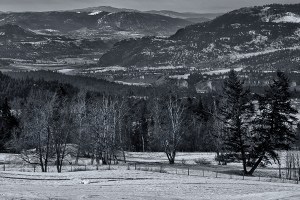
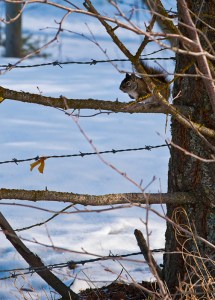
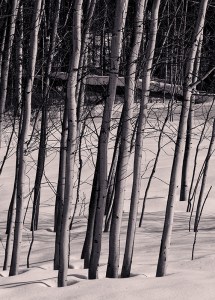
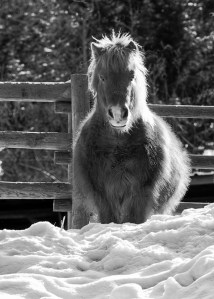
February is finally done. Gosh, that month always seems so darn long. Yes, I know it is the shortest month in actual days, but it hasn’t seemed that way for me. This past February was a bleak, grey, and lifeless time that one must endure. And try as I did during the past few weeks since my Kelowna beach walk, I just couldn’t garner the energy to wander the frozen landscape with my camera. However, when the sun finally made an unusual appearance on the last day of the month it didn’t take much coaxing to get me out.

All my wife had to say was, “Its nice out, let’s take a drive.” That sounded good to me. It’s always relaxing to take a drive around our rural neighbourhood. There still is a few feet of snow covering everything but the roads were clear.

I selected my 70-200mm lens. When I use one of my wide-angle lenses I am looking over the landscape, with a telephoto I get to look into it.

Mid-week is a perfect time to drive around, we had the roads to ourselves and I could drive slowly, stop to look around, or back up and get out just about any location to take a picture.

If it were just me, I would have headed down to the river. I like prowling the riverbank, but as we got into the car my wife said, “I don’t want to go down to the river.” I guess she didn’t want me taking chances tromping on the not-so-stable ice along the edge of the river.

My term for drive-around kind of picture taking is, “roadside photography”. The good thing about driving and looking for things to photograph is you cover a lot of distance and see a lot of stuff. The bad thing about driving around is once you are in motion it’s hard to stop. I am sure that without my wife reminding me, and at times, demanding I stop I’d just motor by many good subjects.

I don’t like to shoot from inside my car. A quick search on the Internet will bring up article after article explaining how easy it for those that don’t want to get out of their car to take pictures.

I can’t get comfortable. Everything is in the way and it’s hard to turn around with a steering wheel restricting my movements.

I prefer to stop, get out, close the car door, get my camera off the back seat, close that door, look at my subject for a while, and think about how I want to take the picture (remember “Previsualization” from my last article) then release the shutter.

Nevertheless, I expect I will be a roadside photographer for years to come. And I’ll keep getting in and out of my car and depending on my wife, Linda, to keep reminding me to stop.

I think sitting in the back seat would be a better and roomier place to take pictures from. My long-range plan is to have my granddaughters to drive me around. I mentioned this to the oldest at her last birthday, but I’ll have to wait a while because she’s only ten and can’t reach the pedals yet.

Photography lessons with Black And White Film 

5-flower

port-view

rip-proof-overalls

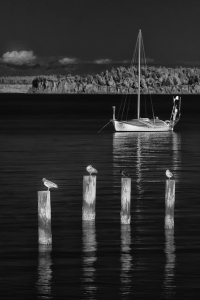
seagulls-and-boat-2

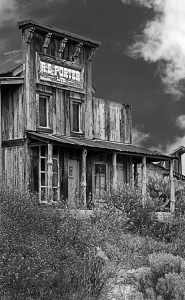
deadman-junction-building

windowpane

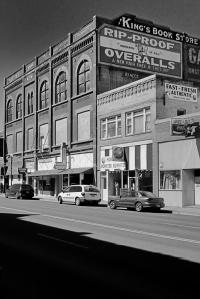
I have recently been talking with many photographers that are very interested in the process of black and white film photography. Most had their introduction to photography in high school using film and although they moved forward to iPhones and digital cameras, they were pulled back to film by memories of the unique “hands-on” experience they had with film.

With all that interest I thought I would revisit an article I wrote in June 2014,  “What I Learned About Photography by Shooting with Black /White Film”.

I began using black and white film because it was cheap and it’s what we used in my first college photography class. After I began to understand the medium as being creative instead of just a way to records things, I grew to like B&W and for years refused to shoot with anything else.

With film, once the camera’s shutter was released what one got was, well, what one got was-what-one-got. There were no second chances as enjoyed today. Photographers were left with only a memory of that moment until the film was printed.

We used a term called “Previsualization”. Previsualization is attributed to photographer and educator Minor White. While studying their subject a photographer predetermines how the final image would be processed and printed. Ansel Adam referred to that as “the ability to anticipate a finished image before making the exposure”.

There was also the Zone System. American photographers Fred Archer and Ansel Adams collaborated on the technique for determining optimal film exposure and development for a method to precisely define the relationship between the way one visualized the subject and the final results.

Those techniques helped us determine how the final print could look. Colour film had to be printed in an almost lightless room, whereas labs for printing B&W were quite bright allowing us to see the image and control an image as it was printed.

With B&W film I learned to previsualize, and as I selected my subject I would think about how I would process the film and make the final print. I could alter the exposure rating, as with the Zone system, and depending on which chemicals I planned on using, how I would develop the film. I would select different papers and chemicals to change contrast or tonal values in the final print.

Shooting with black and white film taught me to think about tonal shifts from black, to mid grey, and finally, to white with detail. Managing the process of developing and printing taught me that the camera and film (now the sensor) are just the starting point to making a photograph match my personal vision, and my personal vision is much more important than the camera’s.

A B&W photograph is a matter for the eye of the beholder, the intuition, and finally the intellect. Of course colour is all that, but much of the time it seems photographers are overwhelmed by colour, rarely seeing anything of importance in a scene other than the colours.

Because black and white images don’t attract with a play of colours, they seem subtle and demand close attention to composition, lighting, perspective, and the context the image is shot in as important factors.


The Excitement Of A New Camera   

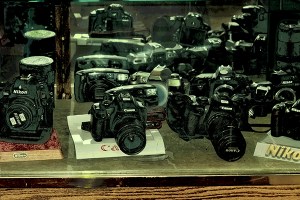
camera-on-display

I could tell that the camera a customer had just purchased was going to inspire him in new and exciting ways. He held the camera up to his eye and talked fast about what he was going to photograph on his next day off. As I watched and listened to his excitement with that used DSLR I contemplated how photographers like to make additions and changes to their equipment inventories. There are different needs for different types of photography, and personal growth within the medium changes the kinds and types of cameras and accessories needed.

I really like to be around other photographers. I recall when I first started seriously making pictures in the early 1970s that my friends and I did lots of backpacking in the rolling hills of southern California, but my fellow backpacker’s adventure goals were different than mine. While they would begin the journey with the goal of reaching a particular the location, I was more interested in what I could photograph along the way. Much of the time I lingered behind somewhere on the trail and wandered into camp near dark, and in the mornings while they were enjoying breakfast over the campfire I was off in the search for some intriguing photo.

I doubt that artists using mediums other than photography get as excited about equipment as photographers do. Photography has been a succession of inventions and technological advancements. The first practitioners like Joseph Nicéphore Niépce in 1826 using surfaces like pewter for one-of-a-kind positive photographs and Louis-Jacques-Mandé Daguerre and his announcement of the Daguerreotype in 1896 were making continual advancements in photography similar to what is occurring today. Those advancements were exciting for would be photographers of that time much as advancing technology excites those of us serious about photography today.

Keeping up with the changing technology of photography has always been a struggle, and also expensive, as photographers change camera equipment completely or upgrade their systems to get the maximum benefit and enjoyment in the medium. I know there are those that will say, ”Just learn to use the camera you have. It’s the photographer, not the camera.”

That is certainly right, however, the thrill of learning to operate and use a new camera is, (can I use the word?) cathartic.

I can remember in 1972 being just as excited with my new Pentax Spotmatic II as that customer was with the camera he just purchased. It came with a 50mm lens that I quickly discarded for a versatile 70-210mm Vivitar zoom. Gosh, I felt fortunate to be getting such an advanced camera and lens. In 1970s it was all about the increasing availability of quality lenses and cameras with built-in light meters.

There are many used DSLR cameras that would work just fine for the kind of photography this person would be doing. In the used camera market it always comes down to condition and price, and of course, the brand that suits the buyer. He looked until he found one at a bargain that met his criteria.

Now that he has his new camera, I suggested he join the local photographers Facebook page and I look forward to the pictures he posts, and of course, watching his growth in as a photographer.

Looking Forward to Another Vancouver Camera Swap Meet          


just-buy-it

vancouver-swap-meet-find

viinage-cameras

check-that-out

“Hi John! I have been waiting for your call. The swap meet tables are completely sold out, and I have been holding a table for you.”

Those were the words I received when I finally got around to calling Tonchi Matinic, the organizer of this year’s (2017) Vancouver Camera Swap Meet. I had received his email reminder about the April’s swap meet, but the warm, wet weather of April seems so distant from the cold, snowing weather of February, that I just put it out of my mind.

I immediately sent in my table registration so now I can start getting excited about one of my favourite events of the year. As I put down the phone after talking to Tonchi (actually we talked for a while) Linda remarked that she could tell I was happy.

It isn’t just that I like selling camera equipment. Of course it’s fun matching an excited buyer with a new treasure, not to mention making a buck or two, but there is so much more that is involved with it.

In my opinion it doesn’t get much better than spending the day surrounded by a huge selection of cameras and other photography equipment. And it’s a great chance to talk with other photographers from all over British Columbia about their different interests. Gosh, it is just so invigorating. And, even after all these years I always learn something.

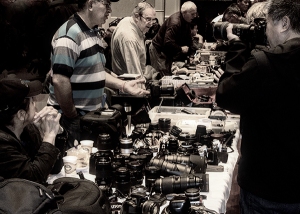
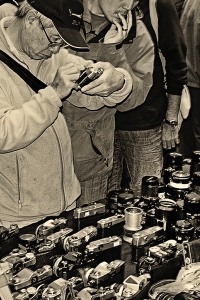
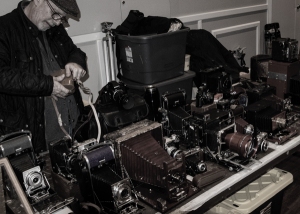
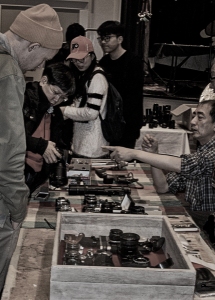
I have been attending the Vancouver Camera Swap meet since the 1980s, and I have written in my past articles that one may find photographers of every age group; from experienced elders to young people accompanied by their patient parents. This assemblage is a diverse fellowship that includes all kinds of lifestyles, interests, and photographic specialties. An observer will find there are those that are dedicated to film and vintage cameras, and processes of the past, walking alongside others carrying, and looking for, the latest and greatest in modern photographic technology.

Other than actually photographing some inspiring subject, a gathering like the Vancouver Swap is a superb way to meet and exchange information with other photographers, and to look at and check out the many kinds of photographic equipment that would not be so easily available anywhere else.

Yep, I am already thinking about how much fun Linda and I will have before, during, and after that event. We usually go down the day before so we can search out some fun dining experience that evening. There was a time when we partied late, but these days I want to be back before midnight so I will be raring to go for the early start-up.

As always, I plan to have an enjoyable time, busy for sure, but I enjoy every minute. I remember at the last swap that I forgot lunch until a friend stopped by and asked me if I was hungry. I told him I’d worry about food later, but handing me one of his sandwiches, he said “ya gotta have this then”.
This year’s show will be on Sunday, April 2nd. I hope to see long time friends, and those readers that are close enough should come down and get excited about photo-trinkets you have been searching for. Photography events where one can spend the day wandering, touching, handling, buying and, of course, talking with other photographers will leave anyone with new finds, friends, and lasting memories.


Photography on a Winter Beach    

beach-abbott

waters-edge-tree


Bootprints in the sand

beach-boat-docks

beach-bench-solitude

the-only-vacationers

February found Linda and I spending a couple weeks in the lakeside town of Kelowna. Linda had 10 days of appointments so we decided rather than commute for four hours a day (it’s two hours each way) we would take accommodation.

Kelowna in the summer is packed. Parking is always at a premium, the cost of lodging anywhere near the beach is prohibitive and the traffic is, well the traffic is what one would expect in a city filled with vacationers. However, the days and nights in February are below freezing, and that pretty much reduces the beach crowd.

Linda’s appointments vary through out the week, but Tuesday’s was early so after a big lunch when she decided to relax with a couple magazines, I took the opportunity to grab my camera and headed to the beach.

I know that beach area pretty well. I have never seen a parking space during the summer, and any photographer wanting to capture photos of the beach, the lake, or distant mountains has to be content with lots of people included in their photographs.

My thought was to build a series of images that discussed the cold, empty winter lakeside. And I decided no matter what I saw I would limit myself to only photographs of the waterfront.

That meant to ignore the extravagant architecture of the beachfront homes, expensive cars and, of course, people. However, I was tempted to get shots of a guy eating a cup of ice cream while walking with his dog, and later on, two women slurping milk shakes while walking along on the breezy minus 6 Celsius day. There’s something to be said about Canadians.

I even declined when two tattered guys came up to me and suggested they would make good photo subjects. One fellow was waving a broken golf club handle and I stepped back saying, “I am not doing people today”. We all laughed and they ambled on leaving me alone on the beach.

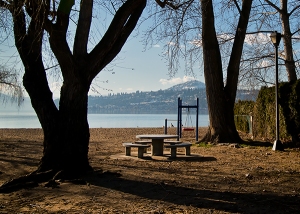
The winter beach is interesting. Shoeprints in the sand instead of bare feet, the hordes of sun worshippers and swimmers are absent and the lake that’s usually a waterscape of boats has only ducks and geese this time of year.

I walked for two hours along the waterfront before deciding to turn back. And when I found a deserted bench I just sat enjoying the solitude. There is something about wandering alone along a big lake that is bordered by a large active city. I guess there is some isolation, but the noise never stops. Nevertheless, it’s an excellent opportunity to creatively point a camera without any interference.

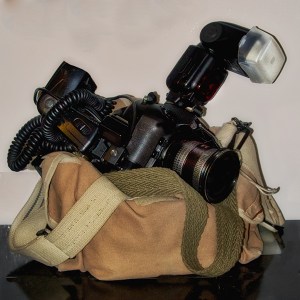
Modern TTL Flash    

ttl-flash-camera

Attaching a flash to one’s camera has been, and still is, a hot topic of discussion that was going on long before I got serious about photography in the 1970’s.

I remember being confused, well actually, really confused, and read everything I could find trying to understand how a flash attached to my camera’s hotshoe worked, and how adding light from a flash (on and off camera) could be used to enhance my photography.

Early flashes produced a constant amount of light no matter how close the subject was, and over or under exposures were common. The most frequent way of controlling flash power was to use exotic technology like a white handkerchief, a translucent soap holder, or attaching a white bounce card to the flash.

Later technological development included light measuring sensors in the flash that read the light reflected back from the subject and shut off the flash when a predetermined amount was reached.

Then TTL (through-the-lens) flash came along and small computers in the camera controlled the flash. The reflected light was read by the camera, making the lens focal length, the aperture, and the distance all part of the exposure equation.

Today’s hotshoe connected flash is nothing short of amazing, and there is absolute control over the flash.

Subtracting light intended for the subject no longer needs some translucent material placed over the flash head.

Using devices like white cups, and bounce cards with a TTL flash have become all about softening or diffusing the light instead of only reducing it.

The latest flashes easily control power output, and can be comfortably used with wireless off-camera technology. Alternatively, the flash can also be connected by a dedicated cord and still remain off-camera allowing the photographer to point the flash toward the subject at flattering angles without time consuming calculations.

A photographer can, while shooting, easily select the exposure in camera, or dial the flash power output up or down. It is now so simple to reduce or increase the ambient exposure while maintaining or brightening the subject alone for more natural looking photographs than it was with early flash photography.

When I began using a flash many years ago it changed the quality of my photography. It became just like the image change I gained by using different focal length lenses.

I no longer had to rely on ambient light and I began to notice my subjects had more “pop” than those without the flash and I was pleased at being able to fill unflattering shadows coming from overhead lighting and reduce deep shadows caused by sunlight.

The modern speedlight (hotshoe) flash gives a photographer control over the quality of light and using a flash (or several flash units off-camera) when photographing people is more than just brightening up subjects in a darkened room.