Thoughts on upgrading to a better camera.     


In the previous era of film cameras many serious photographers would come to a point when they would consider whether to upgrade from an automated point and shoot type camera to a 35mm interchangeable lens SLR or to trade in the their well used 35mm SLR for a medium format 120mm camera, and maybe even to take the climb to a 4X5 view camera.

For film-based cameras it was all about the size of the film and bigger was better.  I recall feeling bad for those people that had friends photograph their wedding with a 35mm camera. The only way to get quality-wedding photographs was really only by photographers using larger film in their 120mm medium format cameras.  If one wanted a colourful, sharp, grain free enlargement then 120mm or larger was a must.

What do I now say to a photographer that is considering a more serious approach to photography?   I will always begin with the question, “what are your interests and what subjects do you like to photograph?”

My short answer for digicam and iPhone users is, if sports and fast action, wildlife or quality print enlargements are the goal, then, yes absolutely get a DSLR.    DSLR cameras don’t have shutter lag so sports photography is easy and action demands a camera (and quality lenses) that can adjust shutter speed and aperture. Wildlife photographers prefer a selection of telephoto lenses that can be changed at will, and obviously the best images are produced with sensors that are considerably larger than digicams and iPhones.

Digicams & iPhones are convenient for candid shots. Most of us have ’em in our pocket anyway. However, for photographers that are aware of the huge limitation of those tiny sensors and cheap little lenses the next question is, what is the best choice for a first time DSLR?

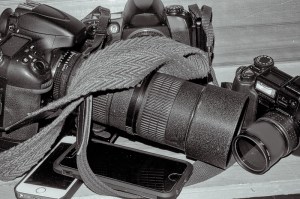
For this discussion I will put DSLR cameras in two simple categories, amateur and professional.  The difference between amateur and pro cameras has surely become hazy. If I were to offer a short comment I would say the most obvious difference is durability.  Pro cameras feel sturdy, are heavy and sealed against the elements. When dropped, they usually don’t break, and even with hard use will last a long time.  The amateur camera generally has lighter weight and smaller size.

When the first DSLRs came onto the scene there was definitely a difference in the quality of the images between entry level and professional level cameras, but that is not as distinct now. The technology for sensors and in-camera processing has rocketed.  The latest entry-level model may well have the same sensor as the previous year’s expensive pro model as the technology is transferred over.  The main difference is in the weight, substance, durability, and controls.

The new models are always being introduced, with that many previously great camera models will be reduced in price, discontinued and there are opportunities to purchase at reduced prices.  As always there will be a flurry of megapixel chasers that change their camera with every new model upgrade, making used cameras available.

Whatever the camera availability, my advice to those photographers asking the “upgrading” question is to consider what kind of photography they want to do. Talk to other photographers about the cameras that are interesting, go online and check out the many photography forums to find out what others with that same interest are using, and attend some classes.

So what are my thoughts on upgrading to a better camera? If it’s affordable, don’t hesitate, do it. Using a new camera is always fun, educational, and I believe the process of learning how to control and effectively use the unfamiliar technology a new camera offers is like a shot in the arm that gets the excitement going and ultimately helps one become a better photographer.
I have always liked Christmas lights.   


When I was a child my parents used to bundle my brothers and I into the family car and drive up along the high avenues around Salt Lake City so we could look down on all the decorative lights in the valley. And we even got hot chocolate, so needless to say I am a Christmas light junky.

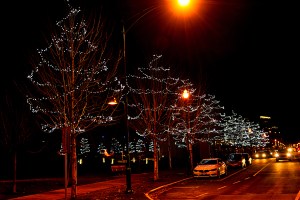
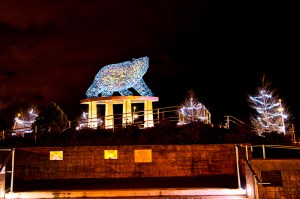
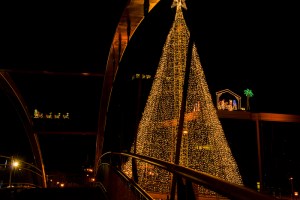
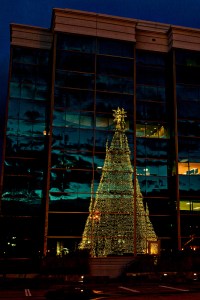
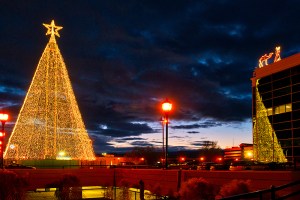
For years I have had business in Kelowna, British Columbia during December and I always brought my camera so I could go out at night and then again at morning’s first light to photograph the Christmas lights along the city streets.

This year I had to come down much earlier, on the last day of November. It was an early day for me and I finished just before lunch, so I wandered around looking through the store windows near my hotel until It had started to rain, no not the snow I was hoping for, but I had hours to wait till sundown so I went into an eatery called the Memphis Blues.  When I entered the place was filled with wonderfully loud southern blues music. I was delighted to find they had the perfect food for a damp cool day, southern barbecued chicken. Gosh, I am sure somewhere it might get better than that, but to me it was the perfect place to pass the time till evening and could photograph the bright Christmas lights in the city.  In spite of the rain, when I finished I decided to wander a bit with my camera for some low light afternoon photos. The last light of the day is always interesting, even on a drizzling over cast day.

Last year I photographed decorated boats moored along the lake harbor and people skating on the outdoor rink. However, to my dismay the barkeep gave me the bad news that the Kelowna winter light festival was days away and it was too warm to use the skating rink. Gosh, I might just be forced to make the winding two-hour drive again in a few weeks. Blast my bad luck.

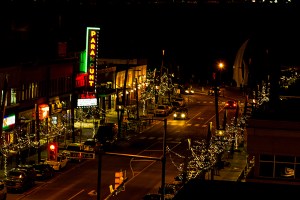
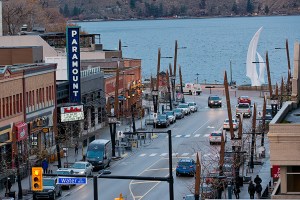
I snapped a few from my hotel room. My room was on the 5th floor above the street so I had an excellent shot with my 70-200mm down the street towards the lake and after that I meandered along the street and beside the lake making photographs. There weren’t a lot of people, but those I did pass must have already been in a holiday mood because every person either smiled and nodded or said hello. Maybe they just liked seeing an old grey haired guy enjoying himself taking pictures of the city they lived in.

The cold wind coming off the lake finally worked it’s way in and I decided to return to my hotel room to warm up till night fall.

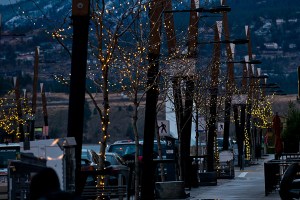
By 7PM the light had gone down. I began by again taking a photograph down the street toward the lake, then grabbed my tripod and camera and went out for another ‘bout with the lake’s cold wind. I photographed many of the same things I had in the afternoon light, except this time the Christmas lights were sparkling in the dark sky.

Sun-up is at 7:30 here in southern British Columbia. I like the light just before that when I am photographing city lights. I want just enough to give the feeling of nighttime without covering building details.

There I was waiting at 6:30 in the cold morning air, and by 7ish I was sadly done. I always have to tear myself away. When I was back at my hotel some time later drinking coffee and having my morning yogurt I got a text from my friend Dave. He wondered how it was going and I replied that standing alone at 6:30 AM on a cold, windy, dark deserted overpass with frozen fingers while taking pictures of street lights is damned enjoyable, Gosh, it doesn’t get much better than that. The only thing that could have made it better was if it started snowing.

Night photography (well actually, early morning photography) gives a city such a nice mood that isn’t really manifest during the day. I like the mystery and, of course, this time of year the frosting on the cake is the wonderful Christmas lights.

Variety makes photography interesting.               


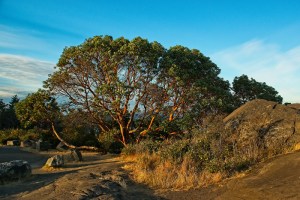
Washington Park’s Leaning Tree

Tesoro

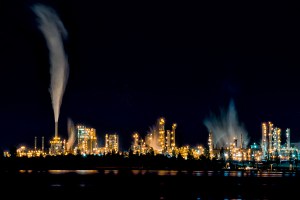
NIght refinery

Pacific Madrone tree

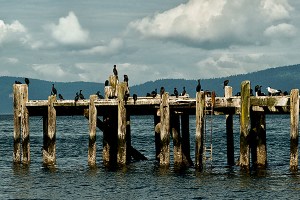
Cormorants and a seagull


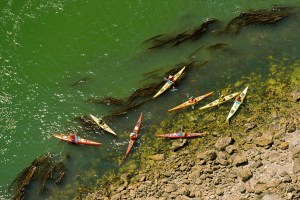
Deception Pass kayaks

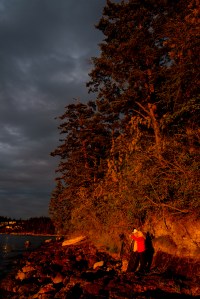
Dave and Cynthia at sunset


I have never been one of those photographers that proudly declares myself limited to one kind of subject. My visual interests depend a lot on what is happening when I have a camera in my hand, and when on vacation I never restrict myself to one subject. My past two articles were about my photographic experiences on a three-day weekend in Anacortes Washington with my friends Dave and Cynthia Monsees.

If I didn’t have a camera my goal would simply have been to attend the annual Shipwreck Festival, but I do have a camera and photography is always a major part of any vacation for me. When I plan my getaways I look for a variety in the subjects I will photograph. This trip was easy, I began by photographing the festival committee volunteers the first afternoon, then spent most of the second day photographing the festival, and on the third day we photographed the scenic coast from dawn to dusk.

The Rotary volunteers were waiting to meet me and were all looking forward to being photographed. The Festival photography was, well it was a street festival filled with excellent subjects. And finally, photographing a coastal landscape is pretty easy when one is on an island.

I am not sure if Dave and Cynthia were aware that I’d be constantly dragging them from location to location for three days, but there were so many places that after my three years away that I wanted to return to, and I was determined they should see and photograph as much of Washington state’s Fidalgo island as possible.

Someone, a long time ago said, “variety is the spice of life”. I have always liked that old saying that reminds me to try different things, and change my approach, especially in photography. Varity when it came to the subjects I photograph has kept my life with a camera interesting.

My dictionary defines Perspective as; outlook, point of view, attitude, frame of mind and reference, approach and interpretation. Unlike many other creative mediums photography not only allows, but encourages one to change their perspective and interpretation of reality. That change might be as simple as removing the 28mm lens and replacing it with a 105mm. (or changing the focal length on that zoom lens from 28mm to 105mm)

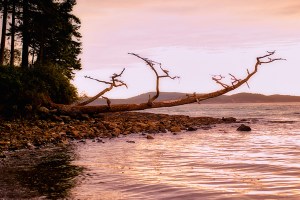
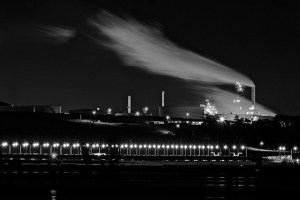
Anyone watching the three of us standing on a rocky beach as we waited for the right light to photograph the famous Washington park leaning tree might notice that although we were all photographing the same subject, our approach, perspective and interpretation was very different. Not only where our tripods were positioned, but also with our selection of lenses. And adding the word “variety” that evening, well that’s easy, as soon as the tide came in and it got too dark for the tree, we drove to the other side of town to photograph Tesoro Refinery’s bright lights shimmering on the dark ocean waters across the bay.

As I wrote in the beginning, “my visual interests depend a lot on what is happening when I have a camera in my hand, and when on vacation I never limit myself to one subject.”

Practicing Street Photography      

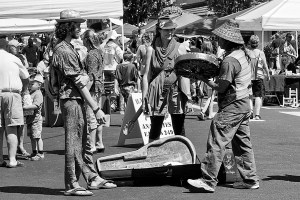
I have read that Street photography is the practice of photographing chance encounters and random incidents in public places, Well, like the street.

In an article about my experiences in Vancouver BC some time ago I wrote, “I think that successful street photography captures a moment from the society around us. It’s a moment in time that is an important for the present and future.”

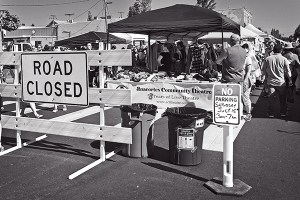
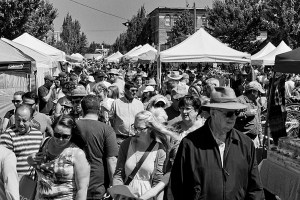
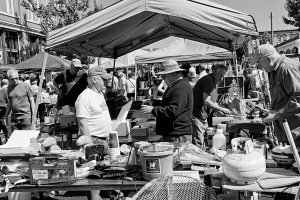
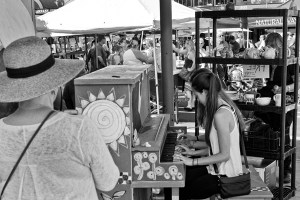
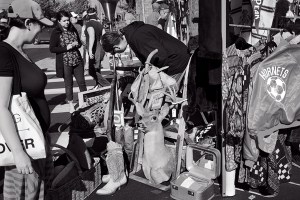
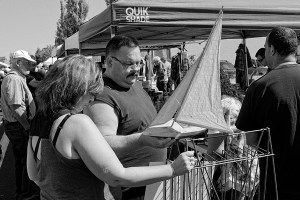
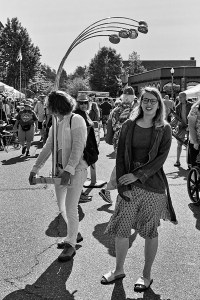
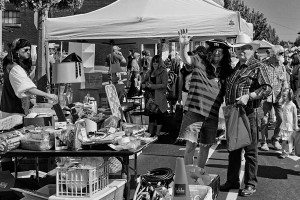
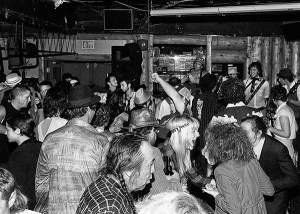
I am fascinated with this kind of candid photography that has been around since people began to carrying cameras in public, and I am always up to any occasion that allows my somewhat reserved and not so confident approach to photographing strangers going about their life on any public street. So when that opportunity presented itself at the giant outdoor flea market in Anacortes Washington I was excited.

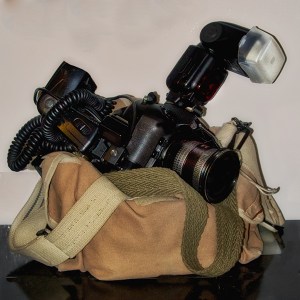
Most modern street photographers seem to be recommending small, inconspicuous mirrorless cameras. However, in spite advice posted on many of the forums I have visited I still wondered if I could again try using my big DSLR with a battery grip and 24-70mm attached. I admit that’s a huge and very noticeable combination that the last time I tried at this event had curious by-passers looking right at me.

I remembered a 1969 Algerian-French movie, called “Z”, about some foreign dictatorship and a photojournalist who helped to uncover evidence about a murder. The photographer, wielding a big camera with a loud motor drive, continually shot from his hip. So I thought, what the heck, lets see if I can get away with that. Also, knowing I could easily crop, I moved the lens to its widest 24mm and photographed everything holding my camera at my waist.

I also figured that people at the street sale would be so absorbed with their treasure searching that if I didn’t hold my camera up to my eye, like I did last time, they would be oblivious to my photography.

My results were much better than last time. I wandered releasing the shutter anytime I observed people doing something interesting. There were a few camera conscious people that remarked about how big and nice my camera was, and one guy even asked the model I had. Nevertheless, none of my pictures showed people turning to look at me as I was taking a picture, except for those times when actually I asked someone to pose.

The big street market made things easy, and my new “stealth” photography technique made me more comfortable. And as I said, my results were much better this time. Whether it will work when I am not at an event that distracts people’s attention away from me remains to be seen.

The Portrait   

The conversation – a Portrait.

For most photographers a portrait is an artistic representation of an individual or individuals, with the goal of capturing some likeness as to who they are.

Famous American photographer, Richard Avedon carried this further when he said, “A portrait is not a likeness. The moment an emotion or fact is transformed into a photograph it is no longer a fact but an opinion. There is no such thing as inaccuracy in a photograph. All photographs are accurate. None of them is the truth. ”

Popular American painter Jamie Wyeth wrote, “Everything I paint is a portrait, whatever the subject.”

For years most of the photography I did was portraiture, whether wedding pictures for a family, or private sessions. My opinion is that portraits are pretty narcissistic and because of that, can be much harder to do properly than many other photographic pastimes.

Make a bad landscape and no one will really care, capture a bird flying poorly and it’s no big deal; however if you give someone an unflattering photograph of themself and you have might make an enemy for life.

A portrait can be a representation of anything and doesn’t necessarily need to only be of people. Years ago my wife and I had show dogs and would regularly attend and participate in events in hopes of having the judges select our dog as best from some group; and when we did win, we would walk our dogs to a photography booth set up by a skilled dog portraitist to have a portraits taken that day when they looked so good and performed so well.

As I watched a TV show earlier this week I noticed framed pictures of the owner’s cat hanging on the wall, and I have seen all types of pet portraits in friends’ homes. I suppose a picture of a favourite or special car, motorcycle, boat or even treasured holiday snapshot, might be called a portrait.

I wonder if many photographers might agree with the painter Wyeth’s contention that, “Everything I paint (or photograph) is a portrait, whatever the subject.”

Some time ago I went for a slow drive along the winding roads high above my place in Pritchard hoping to find some cows, horses, or deer to photograph. I wanted head and shoulder compositions (or portraits), not animals in the landscape.

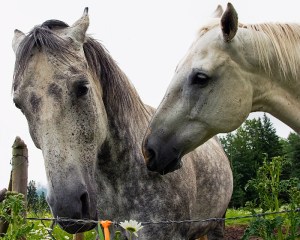
I leisurely drove around, passing lots of roadside deer; cows quietly chewing the cud, and finally stopped near two horses standing very close to a fence. My choice was to compose of portrait of them instead of just a pleasing documentary of two horses in a field. So I mounted a 24-85mm lens on my camera, walked through the wet grass to the fence to take their picture, and worked angle after angle for a portrait.

I suppose the words “artistic representation” and “goal of capturing some likeness” are appropriate when a photographer captures human-like qualities in animal portraits. I wanted a picture that included me, or at least inferred some conversation between the horses about me. My image is, as Avedon said, “….an opinion”.

Movies about Photography              


This past week my wife commented to some evening guests that I always have something to say about any camera that one appears in a TV show.

Yes, I do that. I can tell her I am sorry for interrupting movies she is watching, but I’ll just do it again the next time I see an actor with a camera.

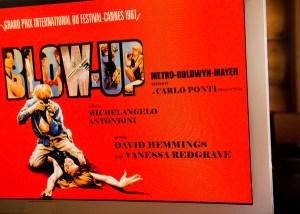
I enjoy watching movies about photographers. I guess the number one classic was “Blow Up” in 1966, staring Vanessa Redgrave and David Hemmings. The plot was about a fashion photographer that takes some casual shots of people while he walks through a park. However, when he blows up his prints he realizes he’s also photographed a murder. It is a worthwhile “time period” movie to watch if one is interested in what was “hip” in 1966 and likes symbolism.

I have seen it several times and enjoy critiquing the photography, and the cumbersome way the lead actor uses his Nikon. The stylish photographer kept enlarging, cropping, and enlarging the prints from his 35mm camera. Impossibly, the prints were always sharp and without any grain.

Another of my favourites was an awkward movie called “Nights in White Satin”. The story line was weak, but one has to watch a movie with a title and lead song by the Moody Blues. The music throughout was pretty good, and made up for the simplistic story revolving around a photographer who gets involved with a homeless woman.

The photographer tooled around on a Harley Davidson, used a Leica rangefinder, and, in spite of hurriedly taking pictures in dimly lit flophouses and back alleys the resulting pictures were always perfectly exposed with studio lighting. Of course, the woman living on the street was beautiful, well washed, and used makeup.

The third and last movie I’ll mention was packed with delightful clichés. It would be forgetful if not for those.

It was a made-for-TV British show entitled “Midsomer Murders”. The director sets his main characters, a couple of detectives, investigating the murders of camera club members.

The members were at odds over which technology is better, film or digital. The club members who used film had old Rolleiflexes, Leicas, and wooden 4×5 cameras, and all wore those campy, khaki-coloured, photography vests with all the pockets we occasionally see from time to time. The club members that preferred digital DSLRs had electronic flashes, and wore black leather jackets with black pants.

The directors must have had fun searching out every photo cliché imaginable, and, those of us old enough to remember film processing will laugh at the darkroom scene, where one fellow developed and printed colour film in a brightly lit room with what could only have been black and white chemicals in a tray.

I am a sucker for any movie or TV show that involves photography. They usually are poorly done, and I am sure I ruin it for anyone unfortunate enough to be in the same room because I am so vocal about everything photographic.

I do have a great time and can’t resist outbursts pointing out everything right or wrong (gosh, my wife is so patient) however, I expect some readers may share my enthusiasm and I am sure are thinking of movies with cameras that they critiqued out loud.

I wonder if there is a group called Photography Movie Addicts Anonymous?

Looking Forward to Another Vancouver Camera Swap Meet          


just-buy-it

vancouver-swap-meet-find

viinage-cameras

check-that-out

“Hi John! I have been waiting for your call. The swap meet tables are completely sold out, and I have been holding a table for you.”

Those were the words I received when I finally got around to calling Tonchi Matinic, the organizer of this year’s (2017) Vancouver Camera Swap Meet. I had received his email reminder about the April’s swap meet, but the warm, wet weather of April seems so distant from the cold, snowing weather of February, that I just put it out of my mind.

I immediately sent in my table registration so now I can start getting excited about one of my favourite events of the year. As I put down the phone after talking to Tonchi (actually we talked for a while) Linda remarked that she could tell I was happy.

It isn’t just that I like selling camera equipment. Of course it’s fun matching an excited buyer with a new treasure, not to mention making a buck or two, but there is so much more that is involved with it.

In my opinion it doesn’t get much better than spending the day surrounded by a huge selection of cameras and other photography equipment. And it’s a great chance to talk with other photographers from all over British Columbia about their different interests. Gosh, it is just so invigorating. And, even after all these years I always learn something.

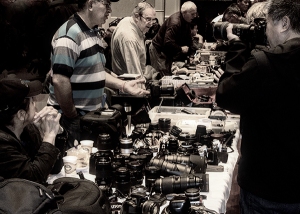
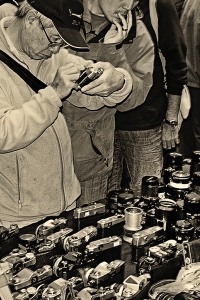
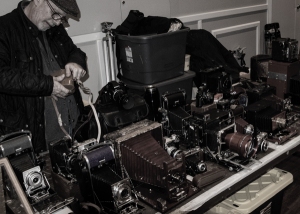
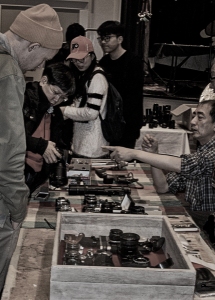
I have been attending the Vancouver Camera Swap meet since the 1980s, and I have written in my past articles that one may find photographers of every age group; from experienced elders to young people accompanied by their patient parents. This assemblage is a diverse fellowship that includes all kinds of lifestyles, interests, and photographic specialties. An observer will find there are those that are dedicated to film and vintage cameras, and processes of the past, walking alongside others carrying, and looking for, the latest and greatest in modern photographic technology.

Other than actually photographing some inspiring subject, a gathering like the Vancouver Swap is a superb way to meet and exchange information with other photographers, and to look at and check out the many kinds of photographic equipment that would not be so easily available anywhere else.

Yep, I am already thinking about how much fun Linda and I will have before, during, and after that event. We usually go down the day before so we can search out some fun dining experience that evening. There was a time when we partied late, but these days I want to be back before midnight so I will be raring to go for the early start-up.

As always, I plan to have an enjoyable time, busy for sure, but I enjoy every minute. I remember at the last swap that I forgot lunch until a friend stopped by and asked me if I was hungry. I told him I’d worry about food later, but handing me one of his sandwiches, he said “ya gotta have this then”.
This year’s show will be on Sunday, April 2nd. I hope to see long time friends, and those readers that are close enough should come down and get excited about photo-trinkets you have been searching for. Photography events where one can spend the day wandering, touching, handling, buying and, of course, talking with other photographers will leave anyone with new finds, friends, and lasting memories.


Modern TTL Flash    

ttl-flash-camera

Attaching a flash to one’s camera has been, and still is, a hot topic of discussion that was going on long before I got serious about photography in the 1970’s.

I remember being confused, well actually, really confused, and read everything I could find trying to understand how a flash attached to my camera’s hotshoe worked, and how adding light from a flash (on and off camera) could be used to enhance my photography.

Early flashes produced a constant amount of light no matter how close the subject was, and over or under exposures were common. The most frequent way of controlling flash power was to use exotic technology like a white handkerchief, a translucent soap holder, or attaching a white bounce card to the flash.

Later technological development included light measuring sensors in the flash that read the light reflected back from the subject and shut off the flash when a predetermined amount was reached.

Then TTL (through-the-lens) flash came along and small computers in the camera controlled the flash. The reflected light was read by the camera, making the lens focal length, the aperture, and the distance all part of the exposure equation.

Today’s hotshoe connected flash is nothing short of amazing, and there is absolute control over the flash.

Subtracting light intended for the subject no longer needs some translucent material placed over the flash head.

Using devices like white cups, and bounce cards with a TTL flash have become all about softening or diffusing the light instead of only reducing it.

The latest flashes easily control power output, and can be comfortably used with wireless off-camera technology. Alternatively, the flash can also be connected by a dedicated cord and still remain off-camera allowing the photographer to point the flash toward the subject at flattering angles without time consuming calculations.

A photographer can, while shooting, easily select the exposure in camera, or dial the flash power output up or down. It is now so simple to reduce or increase the ambient exposure while maintaining or brightening the subject alone for more natural looking photographs than it was with early flash photography.

When I began using a flash many years ago it changed the quality of my photography. It became just like the image change I gained by using different focal length lenses.

I no longer had to rely on ambient light and I began to notice my subjects had more “pop” than those without the flash and I was pleased at being able to fill unflattering shadows coming from overhead lighting and reduce deep shadows caused by sunlight.

The modern speedlight (hotshoe) flash gives a photographer control over the quality of light and using a flash (or several flash units off-camera) when photographing people is more than just brightening up subjects in a darkened room.


Photography at the Christmas Party   

tree-planters-4

tree-planters-1

tree-planter-5

tree-planters-7

tree-planters-6

I talked to a person this week that has been asked to be the staff photographer at an upcoming event. With that, I thought I would revisit an article I wrote December 2014.

The Christmas season is here and that means photographers will happily begin filling memory cards with photographic opportunities as they join family, friends, and co-workers at this month’s festive events.

The act of picture taking has become easy and so much fun as people rush over to take a picture and then quickly show other partyers the images from the LCD. Some seem more interested in that quickly snapped candid than what is actually happening at the moment. For many, it is more about the activity of picture taking than it is about making memorable photographs of the party.

Images made in this fashion rarely become more than stored files on computers and cell phones. People have good intentions, but after that initial viewing, most photos loose value because there are too many, and very few are good enough to give to others anyway.

What is my advice for photography at the next Christmas party? Yes, continue to make candid photographs of people having fun, but, perhaps, think about making pictures that tell a story, capture an exciting moment, and importantly, flatter the subjects. Most people don’t mind seeing a picture of them being silly or having fun, but they don’t like pictures that make them look stupid or unattractive.

My approach is to take a moment to look at the room in which I intend to make photographs, make a couple of test shots using longer shutter speeds (my favourite is 1/60th of a second), to include the room’s ambient light. And I always use a flash so as not to end up with brightly lit faces surrounded by a black environment.

I suggest taking group shots with two or three people. Get them to position themselves squeezed together with a tight composition, and include only a little background or foreground. Don’t shoot fast. Steady the camera. Select a shutter speed that includes the ambient light. Use a flash. Fortunately most modern DSLRs easily allow ISO sensitivity that can be set to 1600, and some can go a lot higher.
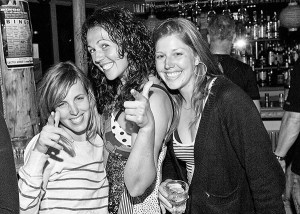
Shutter speeds of 1/60th of a second, or less, doesn’t always work for children (or adults) playing in the snow during the day because moving subjects will be blurry, but, with limited indoor lighting, moving subjects will only be properly illuminated when the flash goes off.

Lighting everything with complicated studio equipment would be great, but that would ruin the party for everyone. The occasion would become more about the photography and less about the fun and festivities. I use a hotshoe mounted flash and make adjustments as I go. I want to join in on the fun, blend in, and not act like a photojournalist.

Family and friends don’t mind having their pictures taken as long as it’s enjoyable and I want pictures that show them having a good time. So, along with those quick candids I make posed portraits with smiling faces, and if I select some pictures to give away later I want people to like and not be embarrassed by the pictures taken of them.


Photographing a Late Fall Garden   

oregon-grape

thistle-2

thistle

grass

thorns

yellow

I try to wander about in our garden with my camera each and every time the season changes; spring, summer, fall and winter.
I have photographed the changing garden throughout the years and, although it always seems very familiar and comforting, I find myself discovering different ways to capture the life that begins, grows, blossoms and then retreats into sleep. There are times when I have constructed elaborate sets with reflectors to capture and control the light. I have built mini studios much like the controlled indoor setups that portrait photographers are familiar with. I’ve lain in the snow and employed umbrellas on rainy days. However, on this particular day I wanted light, and waited all day for sunlight that seemed reluctant to bring me one day of fall warmth I wanted to photograph before the snow that was predicted in a day or two.
When 3pm rolled around I worried that if I didn’t get something done in the quickly dropping light, other than look out the window, I wouldn’t get any pictures at all.

My camera was waiting with a manual 200mm macro, wireless sender and two light stands with a flash and umbrella mounted on each. However, when I finally walked outside (yep, I already said “quickly dropping light) I realised I was doomed to failure if I relied on taking the time to set up that equipment.

Years ago I was asked to give a lecture to the Abbotsford Photo Arts Club. I won’t go into that long discussion, but the title I chose was, “A problem solving approach to photography”. And I realised that this was the time to move into a problem-solving mode.

I removed the 200mm macro from my camera and replaced it with my wife’s 70-180mm macro. I prefer my old manual lens for close up photography, but that Auto focus zoom macro is really easy to use.

I also put aside the light stands and attached a single flash to an eight-foot TTL flash cord. I could have set things up wireless, but I was going for quick and easy and with the TTL cord I just let the flash hang off my shoulder until I wanted it.

I could have used a high ISO, a wide aperture, and just popped a bit of light for a proper exposure. But a high ISO would increase the ambient light and show the lifeless colours of surrounding foliage. A wide aperture would limit my depth of field, and TTL is fast and easy to light, compose and relight a subject.

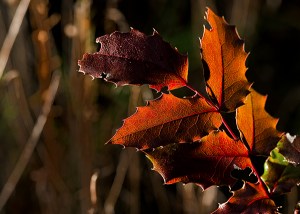
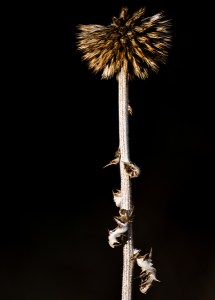
I under-exposed my exposure by several stops, and let the dedicated TTL flash (with a diffusor cup) do what it was designed for, to deliver just the right amount of light on my subject.   That gave me a dark background that I could later make completely black by adjusting the contrast in Photoshop.

I didn’t have a lot of time before more clouds moved in making an already dark afternoon even darker, but my portable set-up made things easy and even gave me a moment to pause and watch our three legged, feral cat flee as it ran out from the cover of the shrubbery. Gosh, in spite of the damage to her one back leg, she sure can move.

I had been trying for three days to get some pictures, but unpleasant weather and life in general got in the way. However, with a bit of problem solving and the will to finally get out and do something, a person can end up with a few photographs worth keeping.