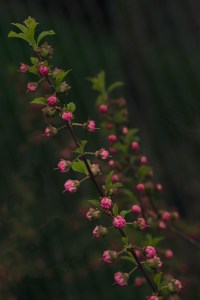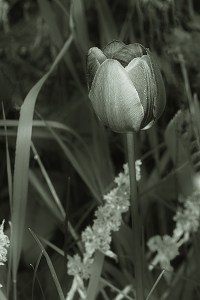
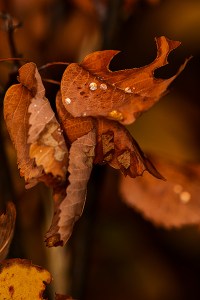
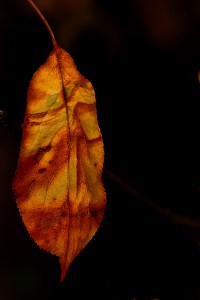
Photographing a late summer garden.   


I woke up to a wet day.

There was a light shower overnight, not the strong rain everything is dying for here in the southern part of British Columbia, but it did dampen things down the most since those rainy weeks last June. However, any rain is good and if I had better hearing I surely would have heard happy sounds coming from the garden outside my door.

The drizzle ended and as I lazily finished my morning coffee, like any serious photographer, I knew there was an opportunity waiting.

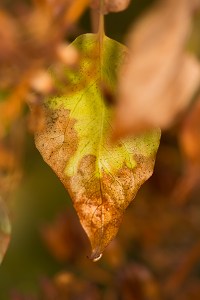
Many photographers that are excited with all the brilliant colours of spring ignore the dry plants at the end of summer. Sure the reds, blues, purples, bright yellows and greens have mostly gone, but there is still an abundance of colours if one just takes a moment to look.

I like photographing the garden. As that well-worn quote attributed to Mark Twain goes, “ I don’t know much about Art, but I know what I like”, I admit that I have no memory for plant names, but I like all the flowers, trees and bushes one finds in a garden.

With me, it’s not really the colour as much as it is the shapes. My approach to a spring, summer, fall and winter garden is much the same. I search for the shapes, differing tones and, of course, the light.

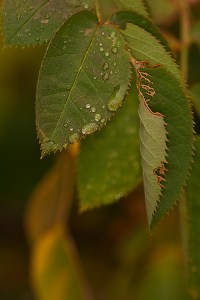
My favourite accessory for rainy days is my ring-flash. As I would with any portrait, person or plant, I always use flash. I usually operate my flash off-camera using light stands and light modifiers. Sometimes just holding my flash at arms length works at the end of the day. But after a rain I like the sparkling direct light a ring flash produces.

The ring flash is a flash that fits around the front of a lens instead of on the camera. I prefer keeping the flash at some distance by employing longer focal length macro lenses. My macro lens, a true macro, is a 200mm. That lens keeps me out of the garden ensuring that I don’t step on other plants.

I photographing the garden, spring, summer, fall and winter, calming. Maybe that’s because I am looking into and at the small details of a landscape ignoring the world around me

When my wife and I photographed the garden together her final images were about space, design and how all the bushes and flowers fit together and how the colours interacted. Linda’s visuals discussed the landscape rather than individual flowers. Mine are more intimate. As I wrote, I am always, “looking into…at the details” when I wander our garden.

As with any portrait, I am rarely satisfied with natural light and almost always add light from a flash. And during those hours of low light as the storm slowly drifts away adding a bit of light to makes a normally flat subject come to life.

That garden just outside my door is always waiting. I never ignore it and am always looking to see what it offers.

I found this quote by the famous Canadian nature photographer and writer Freeman Patterson, “Seeing, in the finest and broadest sense, means using your senses, you intellect, and your emotions. It means encountering your subject matter with your whole being. It means looking beyond the labels of things and discovering the remarkable world around you.”
Memories and photography   


I joined a friend for lunch last week and he began reminiscing about his long ago trip to Japan. We hadn’t been talking about that place, but something in the restaurant (could it have been the sushi?) brought his memories on. With that in mind I thought I’d revisit this article from 2011.

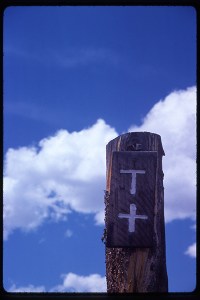
I am sure many of us experience that flash of instant memories when some song comes on the radio. That happed to me this morning as I drove to town. A 1970’s song by the Bee Gees came on the radio, and suddenly I was thinking about July 1978 when I played their tape over and over during my journey to a place in Wyoming’s Teton Mountain range called the T Cross Ranch. I was there attending a photography workshop lead by photographer, and writer, Boyd Norton.

I had been given Norton’s book “Wilderness Photography”. I poured over that book with its instructions and ideas about photographing the great out-of-doors. I don’t recall how I found out about his class, nevertheless I was so determined to attend that I sold my VW to pay for it. The cash from that sale was enough for my tuition and expenses to Wyoming, it also helped pay for an airline ticket for my girl friend (later my wife) to Salt Lake City, Utah. Our plan was to meet up there after my course and spend time photographing Arches National Monument, Zion Park and the Grand Canyon.

The T Cross Ranch was just outside of Dubois, Wyoming, and our class was comprised of photographers from Germany, New York, Florida, Idaho, Colorado, Tennessee, and two of us from Kamloops British Columbia.

We hiked and wandered during the days, photographed everything, and in the evenings had lectures in a wonderful 100-year-old antique-filled log house.

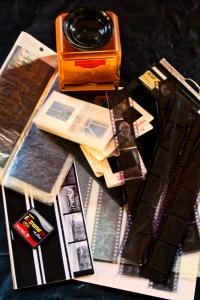
Our instructor wanted to provide instant feedback for us and had a new three-chemical-process for developing slide film. The first morning I noticed him reading the instructions and without thinking I said I could figure it out and immediately became the official class technician. So each evening while my classmates were sitting around the fire talking about the day’s events I was in an abandoned walk-in cold room removing film from cassettes, rolling them into large processing tanks, then developing and hanging the rolls for overnight drying. Hmm…me and my big mouth! We were excited that we could have our images for critique so quickly. I thought that film technology had finally become the best it could be.

I preferred using a huge Mamiya RB67 at that time. The RB used 120mm medium format film and the negatives were 2¼x2¾ inches.

One afternoon we trucked up to a mountain plateau and Norton said, “There is a lightning storm to the west and we’ll see antelope coming this way to stay out it. Find yourself a good position for some great shots.” I waited behind an old salt lick as several antelope came bounding our way. The lens on the RB67 racked back and forth on a rail instead of turning like modern lenses. I tried to keep the antelopes in focus as they ran toward us, but to my dismay I couldn’t. I didn’t get a shot!
When I came back within weeks I sold the RB and purchased a jaunty little Hasselblad that I used for years, until, coincidentally, I attended another wilderness class in 1999, that time in Washington State, and was introduced to digital. I returned to Kamloops after that class and bought my first DSLR. Both instances were because of the influence of other photographers. Getting together with other photographers, in my opinion, not only creates excitement, but also is the best thing one can do to become a better photographer.

Reminiscing about that trip while I listened to the Be Gees was fun. However it also reminded me was how important it is to interact with other photographers and participate in workshops, classes, and photo tours. The other thing I thought about as I sat rewriting this article is how dramatically and constantly, technology changes for those of us dedicated to this exciting medium of photography.

“All this digital isn’t real photography”        
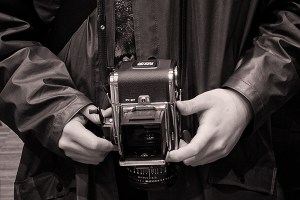
I talked to a confused young photographer that wondered if he should do as a friend that was using a 1970’s film camera and discard his DSLR for a film camera. His friend told him, “all this digital isn’t real photography”,

I doubt his opinionated pal even thought about or was aware that it has only been a bit over a century ago that photographers needed large glass plates, hazardous chemicals, bulky cameras and wagons to carry everything. And I wonder if there were some photographers that, when roll film first became available, said about the same thing when they saw people hand-holding their little box cameras.

The medium of photography has become very accessible for everyone. The days when a photographer had to be an engineer and chemist are long gone. With modern technology, today’s supercharged cameras with their machine-gun-like shutters and seemingly speed of light focusing allow many photographers to get great pictures on their first try. Photographers once had to understand the combinations of shutter and aperture for a properly exposed image, and worried about camera shake and film choice. Gosh, it’s only around 20 years ago that photographers carried more than one camera if they wanted black & white as well as colour prints of some subject.

I am not sure that the photographers of the late 1800’s or early 1900’s were really interested in photography as a creative medium as much as they were striving to document reality. No doubt they struggled to convince their subjects to sit as still as possible for long time periods while they set up unwieldy photographic equipment. And I am convinced that many people that tried photography “pre-digital” would not be shooting if it had remained like that.

There are those that are intent on complaining that with the end of film came the end of photography. Personally, I don’t think film is going away any time soon. I expect most outlets may not carry film or offer processing much longer, but there are lots of distributers that still supply film. I’d like to see the return of film to larger camera shops, along with people capable of giving the correct advice to users.

I rarely shoot with film these days, but I still have a film camera and I did put a roll thru it this past year and had fun. Nevertheless, I will admit to being frustrated at all the work it took to get to the final images. Digital is easier.

I am afraid I couldn’t give that photographer any advice. Although I disagreed with his friend’s comment, I told him I’d look forward to seeing his photographs and be there to help what ever his choice.

Photography has always been about technology. I hope that photographer works at producing images (digital or film) that are good visual statements about what he feels or wants to say. Most people viewing his photography will only be interested in the resulting photos and won’t really care how his images were produced as long as the final photograph has something to say, shows control over the technology used, and is visually exciting.


Practicing Street Photography      

I have read that Street photography is the practice of photographing chance encounters and random incidents in public places, Well, like the street.

In an article about my experiences in Vancouver BC some time ago I wrote, “I think that successful street photography captures a moment from the society around us. It’s a moment in time that is an important for the present and future.”

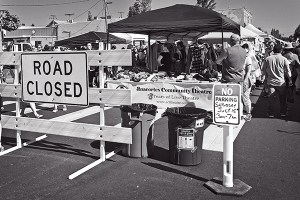
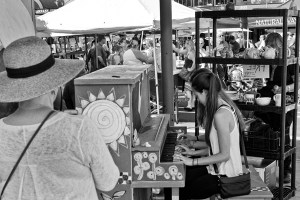
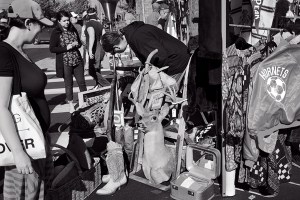
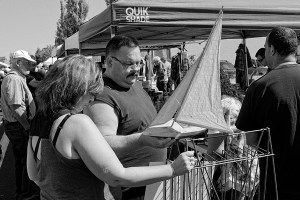
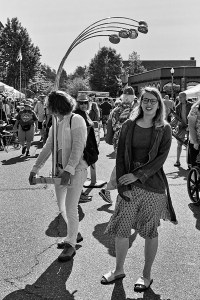
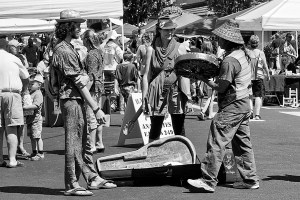
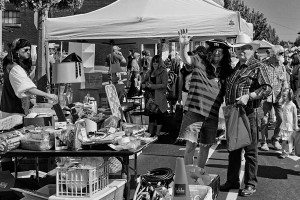
I am fascinated with this kind of candid photography that has been around since people began to carrying cameras in public, and I am always up to any occasion that allows my somewhat reserved and not so confident approach to photographing strangers going about their life on any public street. So when that opportunity presented itself at the giant outdoor flea market in Anacortes Washington I was excited.

Most modern street photographers seem to be recommending small, inconspicuous mirrorless cameras. However, in spite advice posted on many of the forums I have visited I still wondered if I could again try using my big DSLR with a battery grip and 24-70mm attached. I admit that’s a huge and very noticeable combination that the last time I tried at this event had curious by-passers looking right at me.

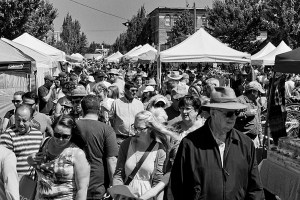
I remembered a 1969 Algerian-French movie, called “Z”, about some foreign dictatorship and a photojournalist who helped to uncover evidence about a murder. The photographer, wielding a big camera with a loud motor drive, continually shot from his hip. So I thought, what the heck, lets see if I can get away with that. Also, knowing I could easily crop, I moved the lens to its widest 24mm and photographed everything holding my camera at my waist.

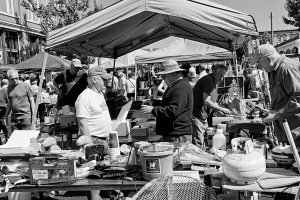
I also figured that people at the street sale would be so absorbed with their treasure searching that if I didn’t hold my camera up to my eye, like I did last time, they would be oblivious to my photography.

My results were much better than last time. I wandered releasing the shutter anytime I observed people doing something interesting. There were a few camera conscious people that remarked about how big and nice my camera was, and one guy even asked the model I had. Nevertheless, none of my pictures showed people turning to look at me as I was taking a picture, except for those times when actually I asked someone to pose.

The big street market made things easy, and my new “stealth” photography technique made me more comfortable. And as I said, my results were much better this time. Whether it will work when I am not at an event that distracts people’s attention away from me remains to be seen.

Another trip to Chase Falls             


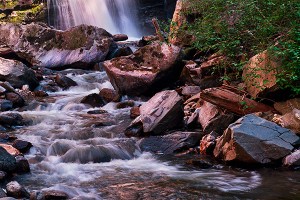
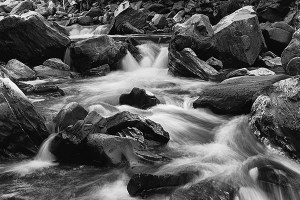
When I suggested to my friend, photographer Jo McAvany that we should drive over to nearby Chase Falls I imagined we’d be walking up a water filled creek to an overflowing falls and expected to be spending as much time wiping the water spray off my camera as I was taking pictures.  However, to my surprise the water coming over the falls was really diminished from its usual early summer flow.

The narrow stream canyon had been assaulted by a lot of water at sometime in the last month or so because there were lots of large rocks where there once was sand and my usual place for wide pictures was covered by a large pile of washed out trees.

3PM on a hot, cloudless July afternoon was definitely the wrong time to photograph the falls. The bright sun was cutting its way across the left side of the canyon leaving the right side in deep shade.  Even with graduated ND filters, trying to balance the scene’s high contrast was impossible.  Nevertheless I scrambled up and over the scattered boulders to find a better position, while Jo chose to work along the bank under the trees accompanied by, as she soon noticed, an ever-growing swarm of mosquitoes.

I guess there were enough breezes coming from the falls to push the mosquitoes away from my position, or maybe I was so fixed on my struggle to get some kind of image out of the contrasty scene that I didn’t notice their feasting.

I stacked ND filters over my lens and pointed my camera either into the sun or into the shade. It was one or the other if I didn’t want over or under exposures in my captures.

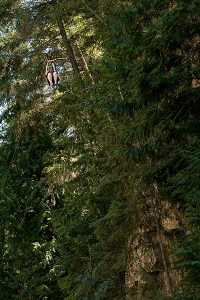
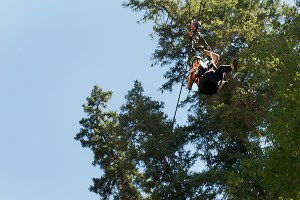
When I clambered back to where Jo was I found she had all but given up on the harsh lighting and was photographing people zip-lining above us. Well, that and giving her self up to the blood sucking hoards. She mentioned to me that she was being bitten everywhere, but dedicated photog that she was she still stood waiting for another zip-liner to zoom by screaming over-head.

I climbed down the bank and got a few more shots of the fast moving water and, of course, I just had to snap a couple shots of the people flying by.

Jo had just about had it with the mosquitoes and I finally began to notice the pesky creatures, so even though it was cooler by the creek than back at the car, we tore ourselves away from the falls with a promise to come back covered with repellent on an overcast day.

I will admit that what I like best about Chase Falls is they are only a few minutes drive from my home. It’s a cool location to scramble around and even though I have photographed it multiple times in every season during the last 40 years I have lived nearby I still enjoy making the trip there with my camera.

I guess there are lots of us photographers that have photographed local subjects over and over and over again.

I remember a long time old friend complaining. (Well he seemed to be) about a high mountain place we had climbed to countless times before. As we waited for the sun to rise he said, “I have taken every photograph that can be ever taken here”.  I quietly continued to drink my coffee without replying.

I am sure he knew I disagreed.


An excellent tool for a roadside photographer           

I live in a wooded rural location just short of an hour from the city of Kamloops in British Columbia, and it’s so easy to hop in my car to drive along the winding back roads. I suppose I could hike or climb, but truth be told I have the most fun as a roadside photographer.

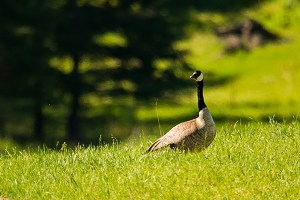
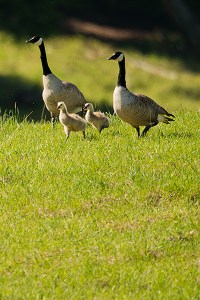
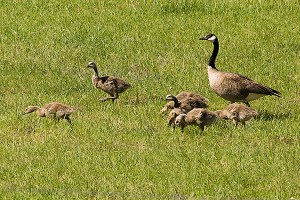
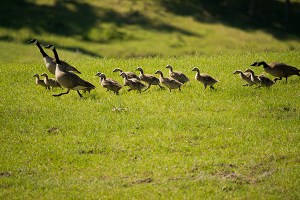
For years, each spring, my wife and I looked forward to seeing geese hatchings at a near by pond. There are normally two, or sometimes three adults with six or eight goslings hiding in the long grass just across the reed filled pond. However, this spring there are at least eight adult geese and maybe twenty soft yellow goslings residing at the pond.

To photograph them we would stealthily slow the car down and ease to a prolonged stop. Coming to a sudden stop spooks the apprehensive geese causing them to dash away. Do geese “dash”?   Anyway the fearful gaggle of geese would quickly move from sight. And opening the car door to try photographing them is a waste of time.

Having decided on the time of day that gives me the best light, I first slowly drive by so as to determine where I want to stop for the best photos and I shoot from the car. The geese are usually far enough away that anything shorter than a 300mm lens isn’t close enough. Actually, 300mm isn’t really close enough.

In the past twenty plus years Linda and I used countless kinds of equipment to stabilize our lenses. And the best, in my opinion, is a beanbag. A beanbag fits nicely on the car’s windowsill and allows the photographer to nestle down and rest any size lens on it for shake free shooting.

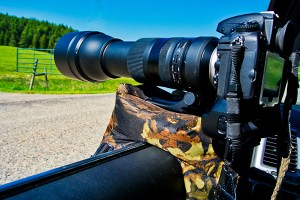
This year I purchased, after months of research and selling off some of my other lenses, the latest Tamron 150-600mm lens. The lens weighs just over four pounds and although it does have vibration control, shooting from a seated position in a car isn’t the best for sharp, shake free photographs. So out comes the beanbag. However,  I quickly realized that big lens demanded a larger beanbag than the one I hastily stitched together years ago.

With a bit of online searching I found a company called Movophoto.com that makes a large and unique beanbag that fits like a saddle over the car window. With my limited sewing skills I could never have made such a perfect beanbag for that big lens. I ordered it, and when it finally arrived I filled it with rice, and although it’s heavy it resides in the car and stays put on the window, so the weight is a good thing. There are a lot of gadgets that I could spend my money on, but for now that beanbag is my favourite.

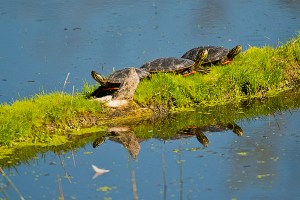
I slowed my car to a stop next to the pond, shut the engine off, positioned my camera on the large beanbag, and waited for the geese to resume their browsing along the grassy hill beside the pond. At 600mm I was able to frame pretty darn close. Then, when I wanted a different position, I’d just move the car a bit, and take more pictures. I photographed those geese (and some nearby turtles) for about thirty minutes.

Suddenly I heard loud honking from some unseen goose that must have been hiding in the tall pond reeds, and, like a crowd scene from a movie, they all turned at once and rushed into the pond.

I am sure there are experienced photographers that would have set up a blind and waited for hours to get the perfect shot. There is no doubt they will get my respect. But I know where those geese are and what time of day is the best to photograph them. And anyway my car is really comfortable and when I am done I just drive home. I guess I am just a roadside photographer.

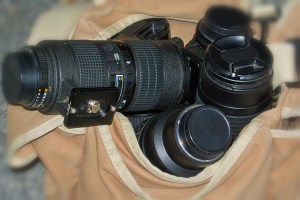
The Lens –“its all about the glass”.  


I had a discussion with a photographer this week about whether she should buy a new lens or not. At the time I wished we were close to my computer so I could bring out this article I wrote back in November of 2014. With that, here it is again for the few that didn’t get to read it back then.

Ask any experienced photographer whether to buy a new camera or a new lens and the answer will usually be, “it’s all about the glass,” or, “a good lens is more important than a good camera.”

A bad lens on a good camera will still make poor images, but a good lens on a poor or average camera will still give the photographer good results.

I listened to several friends talking over coffee about reviews they had read about the latest camera offering from Canon. The discussion began with questions like, “why does a photographer that doesn’t shoot sports need a camera with 7 or 8 frames a second” and “I really don’t spend much time shooting in low light situations, so why would I spend extra money on a camera because it is capable of a high ISO.” However, as expected, it wasn’t long before the talk turned to an exchange of views on lenses. Remember, after all, “it’s all about the glass.”

The conversation easily moved from a difference of opinion between those that preferred prime (fixed focal length) lenses, and those, like me, that chose multi-focal length (zoom) lenses. We talked about the importance of wide angle and, of course, wide aperture lenses.

Just because you can change the lens doesn’t mean you have to, but I don’t know many photographers that are that sensible. Most of us are willing to add a new lens to our camera bag as soon as we have extra cash in our pockets. Hmm…that might be more emotional and impulsive than sensible.

I know very few that are content with the short zoom “kit lenses” they got with their camera any more than they are with the tires the manufacturer installed on their car. Yes, the lenses, just like the tires aren’t high quality, but when we change the lens it alters the visual personality of the image, and most photographers I know are engaged in, what I’ll call, a search for a perspective that fits their personal vision.

The camera might capture some subject’s personality, but the lens, in my opinion, allows the resulting image to say something about the photographer.

Several photographers standing on a picturesque hillside using the same camera and lens will probably produce much the same image, but give them each a different lens and the resulting images will be diverse, distinct, and individual.

Yes, it is all about the glass, and there is an exciting diversity of lenses out there waiting for each photographer to choose, discard, and choose again as they explore and create within this stimulating medium.

As I wrote those words I wondered if there were other words that I could use that were more applicable than stimulating. I could have used, intoxicating, invigorating, or even compelling. They all fit and, I think, could apply to some of the feelings those photographers lounging around my shop drinking warm coffee on a cold day as they talked about the lenses they used and would like to use.

A new camera is a lot of fun, but it really is “all about the glass.


Photographing in the garden on a stormy day                                   


During my many years enjoying the exciting medium of photography I have photographed all most anything that happened to be in front of my camera.

I haven’t bothered with restrictions or claimed specialties. Sure, I have worked for all kind of clients, and most of the images I produced included people. That was how I put bread on our table for years. But when it came to my personal photography I always have been, and still am, an opportunist.

The process of creating an image on a roll of film or capturing data on my camera’s sensor excites me. Thinking the picture through, capturing a feeling and making technical decisions stimulates and excites me. However, I will admit all that also drains me. Photography has never been relaxing.

When I go out to photograph something it’s hard for me to think about anything else. Back when I when I spent almost every weekend photographing weddings my wife learned to just leave me alone. Nevertheless, over the past 40 plus years I did find a way to relax. No, not getting drunk.

No matter how wired I am or how mad something (or someone) has made me, if I pick up my camera and wander my wife’s garden the tension drifts away. I suppose any garden or quiet wooded area would work as well.

My wife could find enjoyment walking, smelling and looking at her flowers, but I don’t really care about the flowers unless I am pointing my camera at them. Where the colours would have mesmerized her, I would be thinking about how some plant’s tonality would look as a black and white photograph.

This week the storm clouds have been coming at me from all directions, not just the sky. Some photographers might chose to search out large birds that frequent the river or lakeside, while others would select the nearest sporting event to work out frustrations. I have friends that seek out the camaraderie of others and spend time in their studio creating masterful portraits. But for me a solitary walk, searching out shapes in a garden always lifts my mood or at least helps me cope with the storm clouds in my head.

Wednesday was as stormy as my mood and the clouds were darkening the landscape. There was a time when low light was bothersome for photographers, but with the technological marvels we now hang around our necks, low light is no problem at all. I just selected ISO 800, (I could easily have gone to ISO1600 or higher) and kept my shutterspeed at 1/250th to reduce camera shake and started taking pictures.

As readers know I prefer to use a flash to balance the overall exposure. In this case I mounted a ring flash on my wife’s 70-180 macro lens. I usually like to use a tripod, but I needed to walk and besides I was pretty sure I was going to get wet.

On flat overcast days it isn’t the colours that attract me, it’s shapes, interesting locations and the position of the plants. I spent a lot of time lying on the ground shooting at plant level.

The nice thing about using a flash is one can easily brighten or darken the background by either slowing down or speeding up the shutterspeed. And when the background has fewer details I stop down my aperture to disguise elements by under exposing them.

An afternoon garden is quiet, the plants are just there waiting and unlike locations with people one doesn’t have to engage in conversation.   How does it work for me? I like this quote by American photographer Annie Leibovitz, “The camera makes you forget you’re there. It’s not like you are hiding but you forget, you are just looking so much.”


Used Cameras                


Spring is here again and with the colours of the first plants poking up from the ground comes the annual speculation of what camera manufacturers are going to do in 2017.

The forums are also speculating with members guessing what Nikon, Canon, Sony, Fuji and Pentax will offer this year. Yes, it is so intoxicating for anyone that has money to spend in his or her pockets.

With the digital camera revolution came a new kind of photo enthusiast that seems to be as excited about changing their camera model as they are about photography.

The good thing for those consumers is that by summer time the prices on new cameras will start to drop. The bad thing for those that decide to sell off the cameras they have been using for the last year or two is they will join thousands of others doing the same thing and the price of their 2015 and older cameras will be much less than they were new.

As manufacturers compete and put sales on 2017 models, 2015 models will take a sharp drop, and the photographer wanting to sell his or her 2013 or 2012 camera will loose even more. And like a stone rolling down a steep hill those that have held on to cameras that have reached five years (considered old in this digital world) are having a hard time selling.

However, for those that just want a newer model than what they have been using, spring camera prices are as welcome as the green grass on the hills and the fields of flowers I see along the roadways on my drive to town.

Now it is the time for those of us that don’t mind a two-year old model that comes without a warranty. Sure, there might be some scratches on the bottom where the tripod is attached, but as long as the memory card door isn’t broken, and the rubber isn’t pealing off, it’ll be just fine.

Buying used is a great way to participate in the yearly new camera frenzy. One might be a couple years behind, but the money saved can be put towards that used dream lens.

Cameras aren’t like cars. Used cars might hide worn out parts, but that’s hard to do with a camera. My quick advice is to bring a memory card when testing that “new” camera. Take some pictures inside with a high ISO and then some outside with a low ISO.

One should always take the time to do some research before purchasing. I remember spending months reading magazines when I wanted to buy my camera back in the 1970s. But now I can find out everything I need to know about any camera in 10 minutes by searching online.

Read the reviews and join some forum and just ask the question. “I am buying X-00 camera what do you think?” It’s as easy as that to have a good understanding of what used camera to buy and which ones to avoid.

And lastly another reason to buy used is instead of loosing hundreds of dollars when selling the loss (and there is always a loss), the loss on that used camera won’t be as painful because it was purchased for a lot less than it would have cost new.


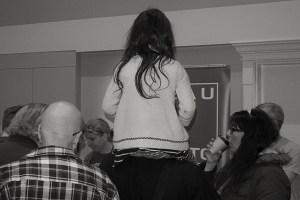
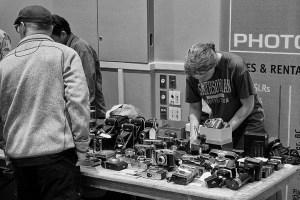
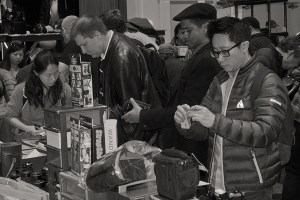
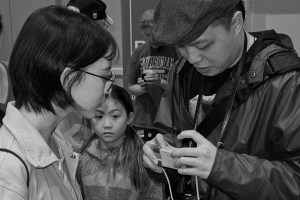
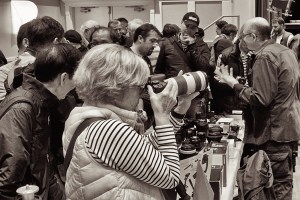
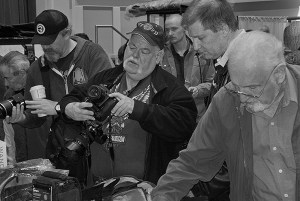
At The 2017 Vancouver Camera Swap Meet  


A great way to search for bargains

Last minute pricing

Ya gotta concentrate

Check this out

A photographer with attitude

Gosh, a 110 camera

Trying a lens

I like this camera


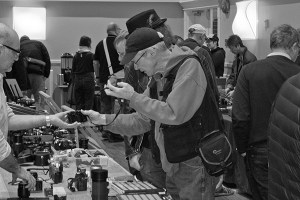
I am usually greeted in the morning by the sounds of my two roosters crowing and the high-flying, neighbourhood crows cawing. But early last Sunday, as I walked across the parking lot to my hotel room carrying two cups of coffee, my morning greeting from the birds was from a loud colony of seagulls. I thought that the sound of the seagulls was a nice hello as I prepared to go to the Vancouver Camera Swap Meet.

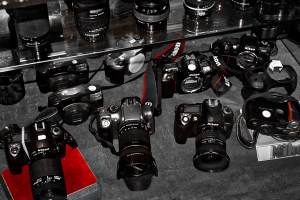
Last February I wrote about how I look forward to this event, and that in my opinion, it doesn’t get much better than to spend the day surrounded by a huge selection of cameras and other photography equipment all for sale.

Well, there I was on the first Sunday in April having a great time again. I have been a regular at the Vancouver Camera Swap meet since the 1980s. And as I have written so many times in past articles, I look forward to meeting and talking with the diverse gathering of photographers of all interests, specialties, and lifestyles.

I always rent a table and after my customary quick walk around the hall, I was ready for the 9am rush of photographers looking for bargains. And as usual I was guessing about the latest trend and hoping I brought the right camera equipment to sell.

I only bring what I can fit in my car and space is limited on the eight-foot table the organizers provide. I have found that piling too much on the table not only invites theft, but makes it too hard for people to see what I have as they jostle shoulder to shoulder with other bargain hunters.

Those bargain hunters include all kinds of lifestyles, interests, and photographic specialties. What they all have in common is an interest in photography. That’s it! Everyone there is interested in photography, whether they are looking for film and vintage cameras, or searching for modern digital technology, it’s just all about photography.

As always, I had a great time talking with other photographers. Sure, I like selling things, but selling is only half the fun. Renewing long time friendships, meeting people from all over everywhere, and finding out about their different interests is the other half.

Another Camera Swap Meet is over, and this year was no different than last in that I spent an exhilarating day talking non-stop with other photographers, and even got time to wander a bit checking out all the neat photography equipment.

It was hmm…what’s a good word to describe the Vancouver Camera Swap meet? Invigorating, energizing, stimulating, exhilarating? Or maybe I should just say it was just good fun.

The Vancouver Camera Swap Meet is an excellent way to meet and exchange information with other photographers, and to look at and check out an impressive selection of used photographic equipment that would not be so accessible anywhere else in Canada.