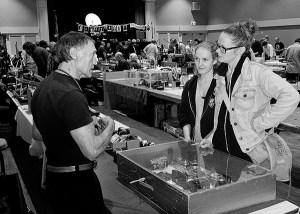
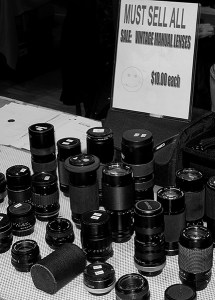
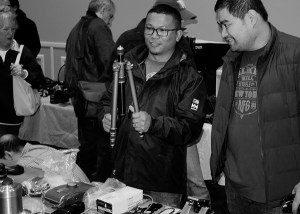
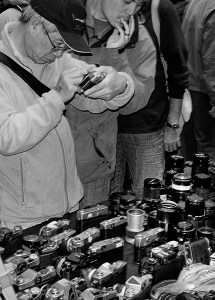
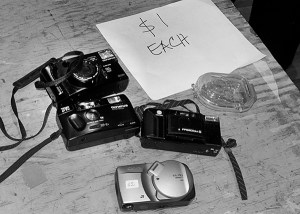
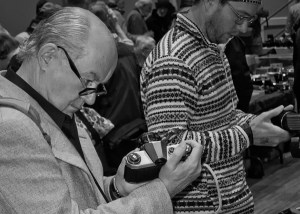
November 2016 Vancouver Camera Swap meet  

helpful

must-sell

neat-tripod

great-find

filters

nice-camera

a-dollar-each

i-like-this-camera

vintage-cameras

Last weekend my wife and I again ventured over British Columbia’s coastal mountains, this time to attend a camera swap meet. This was the last camera swap meet of the year. And I had a blast!

The event has been taken over by a new coordinator and moved closer to a more central location for photographers that live in Vancouver. There was more parking available for the swap meet, and we were able to find a reasonably priced hotel that was located nearby (only about five minutes drive away.) And for folks like us from out-of-town, the new location offered better access to a variety of restaurants.

The new venue was smaller, but the tables were less spread out and had an intimate atmosphere that I really enjoyed. Our day started at 9am with the long line-up of photography enthusiasts rushing in as fast as they could.

Vancouver is a large multicultural city and for those of us living in smaller communities in the BC interior, the sudden barrage of dialects and different languages being spoken takes a moment to get used to. However, everyone there spoke “Photography”, and that made for a fun and friendly day of showing, demonstrating, explaining, and, of course, bargaining with savvy photographers of all kinds.

I was pleased to find that I had a table next to my long time friend Brian Wilson. That was a treat, Brian is the guy that got me into this business 20 plus years ago and there is no doubt his knowledge on cameras and their history is second to none.

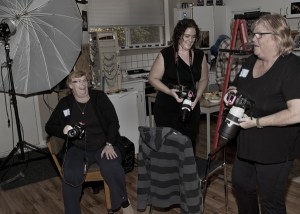
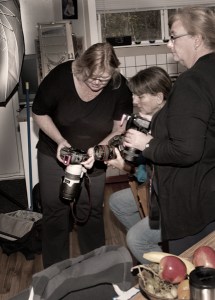
The place was packed and there were many bargains, and I doubt anyone that had rented a table had much time to themselves until things slowed down for a short time around lunch. After splitting a great big deli sandwich with Brian I decided to take advantage of the lull to have a quick walk around to see what was for sale and take a few pictures for this article.

I’ll sum up my walk-about in one word, Wow!   The variety of equipment was exciting. I felt like the little kids I sometime see safely tucked in a shopping cart going down the grocery store candy or cookie aisle, hands reaching out pleading with their mother for the goodies on the shelves. It was all I could do to keep myself from reaching in my pocket for the proceeds of the morning sales ready to buy. Nevertheless I touched everything I could before safely returning to my table to be out of temptation’s grip.

I talked to lots of people, renewed some long-time friendships, made new friends, sold a few cameras and lenses, and had a good time. Oh, and like icing on the cake, I was able to find a neat 1960s Twin Lens Yashica camera for myself.

As usual, the Vancouver Swap meet was exhilarating, and even though the day was tiring and after packing up what I had left from the show, Linda and I ignored the comfort of our quite hotel room and headed to downtown Vancouver to spend the evening in a pleasant Broadway bar for a meal of fish and chips with locally crafted beer, all in all, a perfect way to end the day.


Happiness Is A Day With My Camera                                           


shooting-field-patterns-b

checkn-settings-a

getting-the-shot-b

waiting-c

linda Walch

Today as I drove to town some expert on the radio said that there are 12 states of happiness.

I can’t remember what they were or how “happiness” is determined, but after a bit of searching I found a short article that said to be happy we must “anticipate with pleasure, savor the moment, express happiness, and reflect on happy memories”.

I know there are times and things that make me happy. However, there are also moments that no matter what my surroundings are or the circumstances I am in, I am just not happy.

My wife makes me happy, and even when I know she is mad at me for something I have said or done, I am still happy when she’s with me. Maybe that’s one of those states.

I doubt there has ever been any studies done on the states of happiness for photographers. So while those reading this think about what makes them happy I’m going to delve into that mysterious state.

Happiness might be about things like camera equipment, or about creating a good photograph.

Most photographers are devastated when they receive a poor review on a picture, so there is lots of ego involved in their happiness.

I know sitting around with other photographers talking about anything photographic is just plain blissful.

I don’t have any science that I can call up and haven’t discussed happiness with any philosophers, but I have always felt that photographers have a culture of their own. There are those who might argue that concept, but I am absolutely convinced that it is so.

I constantly interact with other photographers in online forums, or talk to them personally, and those photographers are always ready and willing to tell me when they are happy or not with their photography.

Some seem to be more interested in the technology of photography then the process of making pictures and there are others that care little about the equipment as long as they can make a picture.

I once knew a photographer that was happiest when he found a problem with a piece of photography equipment. He delighted in making test after test and would sometimes spread twenty or more prints on my counter explaining how a particular camera or lens didn’t match what the manufacturer or other photographers claimed. Personally, I’m disappointed when something doesn’t work as described, but he would actually be cheery.

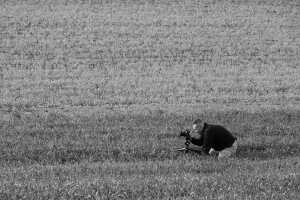
I remember a fellow that used to spend all his spare time hunting (with his camera). He’ll show up at my shop with a grin as wide as all outdoors and happily describe how he crawled thru the sagebrush, waded some creek, or slowly froze as he hung off some cliff. What made him happy was the process of making pictures.

I know photographers that are continually changing equipment. Not because of problems with what they own, but because they read something, or talked to someone, about a new addition from their manufacturer of choice, and can’t live without it.

Sometimes their choices don’t so much meet a practical need as an emotional one, but they make it easy for me, and anyone else they talk to, to observe how very happy they are with their new acquisitions.

This medium has so many genres and outlets to make one happy.  There are portrait photographers, wildlife photographers, scenic and landscape photographers, street and sports photographers, those that specialize in plant photography and, of course, many more, each with differing sets of skills, and, to my mind, their own states of happiness.

I don’t know if photographers have twelve states of happiness, or only the four I found in that short article, but I will say that I meet lots of people that are happy to be doing photography, and being involved with it in their own way.

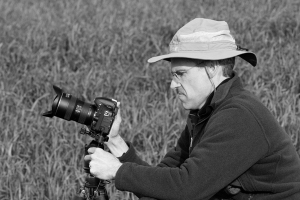
Maybe its just as simple as the words I once saw written on a wall, “Happiness is a day with my camera.”


Leading a Photography Lighting Workshop   

getting-ready

photographers

reflector

modeling

having-fun

checking

American photographer David Hobby, author of the lighting blog Strobist that promotes lighting techniques, wrote about learning to use flash, “You may not realize it yet, but you have just stepped through a door that may change your photography forever…Photography is literally writing with light.” And he continues, “…you’ll learn how to take control of your electronic flash. If you can imagine it, you’ll be able to create it.”

I like using flash, and in my many years as a working photographer I rarely photographed people indoors or out without using a flash; and last Sunday with Hobby’s words in mind I led yet another interactive lighting workshop.

Actually I wonder if “study group” might be a better description of what happens when several photographers get together to experiment with flash. Nevertheless, these sessions are always an enjoyable whirlwind session for me as I try to present as much information as I can without reaching information-overload for the participants.

As photographers in the workshop begin to realize how much better, and more creative, their portraits are when they begin taking control of electronic flash they get excited. That excitement is contagious. So much so that I have to remind myself to slow down and explain what I am doing and why I am doing it when I add lights to a portrait setup.

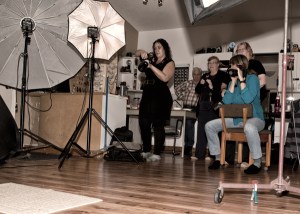
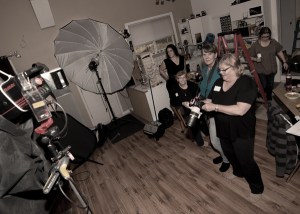
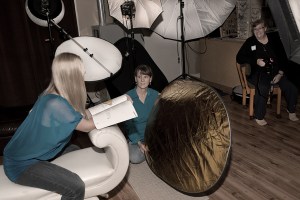
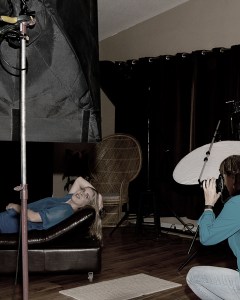
Sunday’s group of photographers were quick learners and were demanding as they pushed limits and exhausted the model, then without skipping a beat, when our ever-so-patient model needed a break, one of the photographers took her place and the group kept on going.

I remember reading a book entitled, Teaching as a Subversive Activity, about student-centered learning over teacher-centered teaching. Sometimes one has to step back from being the center of attention and let people learn by themselves.

When I realized those photographers had reached the point where they were beginning to understand where I was leading them, I just got out of their way and let them be, besides that gave me some time to wander a bit and take some pictures of what was happening.

This first of two sessions, Modeling with Lighting in the Studio is now over.

Next Sunday we’ll be braving British Columbia’s cool October weather as we take our model outdoors to pose in several different locations with different lighting conditions in each. I entitled that, Balancing Lighting Out-Of-Doors.

In the studio we used large and powerful studio lights that recycled instantly. Next Sunday we will use much less powerful, small wireless speedlights that require waiting for batteries to recycle. The quick recycling studio lights are grand, but I like the slower speedlights because they force photographers to think about and plan their next shot.

Last weekend was a lot a fun. It is great being with other photographers and watching them get excited about learning something new. Saying that, I will add a quote by French photographerJacques-Henri Lartigue that I have used several times before, “It’s marvellous, marvellous! Nothing will ever be as much fun. I’m going to photograph everything, everything!”


The Final Photographic Performance   

enlarger-2workstation-2

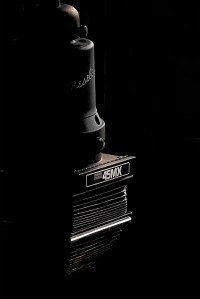
This week I wrote to photographer and blogger David Lockwood (https://davidalockwoodphotography.com) about why he seemed to be returning to film. His replied, “The whole process of using film, gives me a feeling of accomplishment; probably like the painter putting on the last brush stroke. Film gives me a feeling of control over the final image.” And regarding film vs. digital he wrote, “The question of film or digital shouldn’t really be asked, it’s a bit like asking why does one paint with oils, and the other watercolours. Both can produce an image, but both give a totally different sensation to the mind eye.”

During the time I taught photography in the 1980s and 1990s for the University College of the Cariboo (now Thompson River University) my students used film. In my initial lectures I would tell them that as well as learning to acquire skills using a camera, they would need to learn how to become proficient in negative development and printing. I would emphasize that those serious enough to strive for a perfect final photograph would come to realize that what they did with the camera was only the beginning, and that their final print would set them apart as photographers. I would quote famous photographer Ansel Adams who said, “The negative is comparable to the composer’s score and the print to its performance…”

Film has now been set aside by many of those serious about photography, although I expect artists will use film creatively for years, nevertheless, even with advancing photographic digital technology Adams’ words from the past are still significant.

I intend to spend time discussing Mr. Lockwood’s insightful thoughts about film photography later, but first I want to say a few words about digital image making.

The digital camera doesn’t make a picture in the sense of light permanently imprinting itself with different intensities on a chemically sensitized surface like film. Instead there are sensors and in-camera computers processing light from thousands of photosites that we transfer to our computers as data files for conversion into countless pictorial possibilities.

I once attended a photography workshop during which one of the speakers said in the past he would get up early and drive to some scenic location hoping to capture an exotic sunrise, after which he would package up his film and send it to the lab and leave all decisions to some technician’s personal vision. However, now he transfers his image files to his computer and he alone controls how his photograph will be processed for viewing and finally printing.

As in the days when I processed negatives in special chemicals and manipulated prints by adding and subtracting light, I now use computer programs to process my RAW images in my quest to perfect my vision.

I say the same thing to modern photographers as I did to my students, that what they do with the camera is only the beginning,

The image on exposed on film, although now a RAW image file, is only the “score” to the “final performance” – the photographic print.

A young photographer came into my shop announcing, with some kind of misplaced pride, that he would never use PhotoShop on any of his pictures because he was only into true reality. Although I didn’t comment, I thought about the manufacturer presets that were applied in-camera to his image files and the limited colour spaces his inadequate JPG files gave him, and his confused notion of photographic reality.

If he really wanted to step away from the unreality of computerized image making he should talk to David Lockwood who wrote, “The camera, light meter, film, paper and chemicals all go towards producing a single and unique image. That does not happen with digital; from the moment the shutter is pressed, the whole thing becomes a cloning process from which endless exact copies can be produced.” However, as Lockwood also says, “The question of film or digital shouldn’t really be asked… Both can produce an image…that give a totally different sensation to the mind eye.”


Shooting Infrared on a Colourful October Day      

canyon

blue-falls

pool

stream-bed

driveby

chase-pier

fisheye

Fisheye is so much fun


Fall snuck up on me this year. I guess I wasn’t paying attention. Maybe that sharp and very quick transition from season to season will become the norm.

I had an appointment that meant a drive down and along the river valley to the village of Chase.  As I walked out the door not thinking about anything but the 20 minute drive that would probably turn into 30+ minutes if I got caught in the extensive road construction going on between my home in Pritchard and my appointment in Chase, Linda called “take your camera”.

Oh, right. Taking my camera is always a good idea.

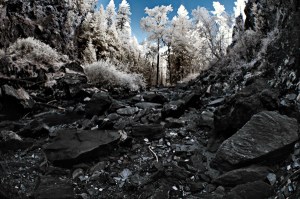
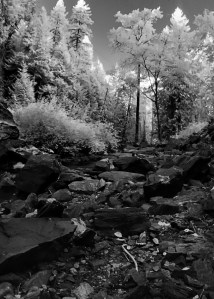
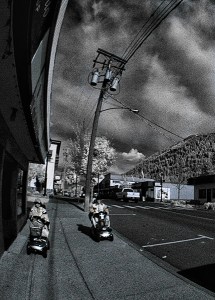
As I drove along looking at the changing colours I thought about the constant submissions of fall pictures I have been seeing on the local photographer’s facebook group, however, I had decided I would have more fun being different and instead chose my infrared converted camera and added a 10.5mm fisheye lens I had just got into my shop.

I pulled onto the Trans Canada and turned into Chase 20 minutes later. The traffic was fast and I had driven through the construction without a stop. I made my appointment in plenty of time, but the receptionist informed me they had decided to close early and I would have to come back another time.

In frustration I walked back to my car, but fortunately I had my camera. So instead of returning home I decided to wander around Chase.

The fisheye was fun. I could take pictures of people on the sidewalk without pointing the camera at them. Admittedly the pictures were pretty weird with everything on the edges bending inward and I got bored with the town’s limitations. Fortunately Chase has a neat waterfall on one side and a big lake on the other. I left downtown and began with Chase Falls.

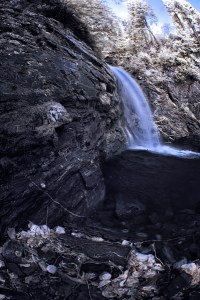
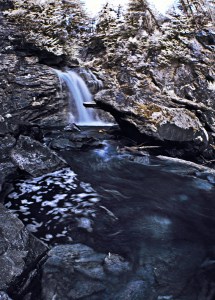
I photograph Chase Falls quite often, but this was the first time I was shooting in infrared and the first time I used a fisheye.   One can set up a tripod and capture the wonderful October colours that surround that inviting waterfall anytime, but capturing Chase Falls in infrared and with a fisheye is great fun, and a long ways off from what most photographers would every think of doing.

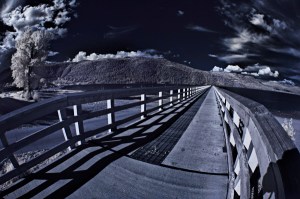
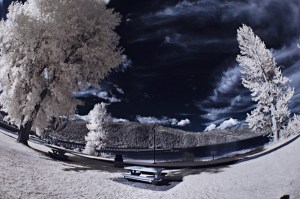
After an interesting time manipulating that environment I headed over to the lake for a complete change of scenery. Instead of large rocks, overhanging trees and falling water, there is a long pier jutting out into Shuswap Lake, large trees on the edges of a small park, and a wide sandy beach.

Infrared turned the trees to white, the sky a strange shade of blue and everything else a slight magenta. And what about the fisheye lens? Well, the fisheye lens just added to the already unreal quality of the image.

Trying Street Photography   

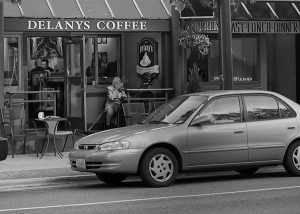
delanys-coffee

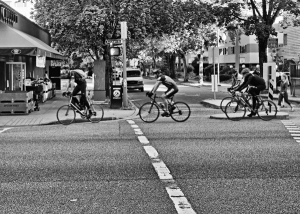
morning-riders

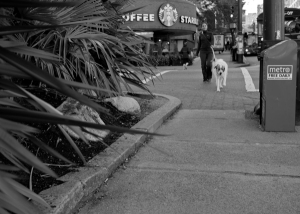
metro-free-daily

street-window

walking-down-the-street


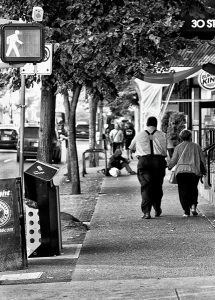
Last week I wrote about my short adventure wandering Denman Street and the Stanley Park area of Vancouver, BC, with my camera.

Each morning I got up early so I could stroll Denman Street before the sidewalks filled with too many people. I wanted to try to find the kind of people some street photographers do find, but I’ll admit that I am not very comfortable with that invasive type of photography.

I am sure there are some street photographers that might laugh at my reticence at photographing people going about their life in any area, be it city street or a back alley, with their various paraphernalia of shopping carts, back packs, box houses, or bicycles. I really like the genre of street photography; I mean to say I really enjoy looking at photographs made by photographers that are good at street photography.

I think that successful street photography captures a moment from the society around us. It’s a moment in time that is an important for the present and future.

I am sure some photographers shoot for the challenge, and there are some that wander the city with their cameras as a release of stress from everyday existence, while others have a need to make some statement about the world in which they live.

I try to do a bit but I expect it will take me more preparation than a few early morning walks to get my head in the correct creative space it takes to do street photography.

I searched for some street photography tips and here are a few I found.

  1. Use a wide-angle lens.
  2. Get close.
  3. Look for juxtaposition.
  4. Focus on the essential.
  5. Look for the light and shadows
  6. Look at the foreground and the background.
  7. Tell a story.

I read that in a good street photograph it is possible for a viewer to see and maybe imagine more than the original photographer intended. Practicing street photographers capture fleeting moments, interpreting life around them, and challenging our perceptions of the world.

I have had some limited success at country fairs and city festivals in the past. This time I intended to get pictures of people going about their daily life on Denman. There is so much happening on a city street, or even within a small neighborhood, that it takes a good eye, and a fast camera, to capture it all.

Most of the street photographers I follow online shoot with small mirrorless cameras and are good at getting up close, but, personally, I would have been more comfortable with a mid-range telephoto. However, attaching a big lens on big DSLRs makes a photographer stand out. When I pointed my camera along the walk people would actually stop and wait for me, or change course to walk around me. Oh well, there will be another time and I can plan on trying again.

Wikipedia defines Street photography as ”Photography conducted for art or enquiry that features unmediated chance encounters and random incidents within public places”.

The genre of street photography is an old one and since the early days of photography there are those that have left us with their own styles of street photography that affects each viewer on an emotional level.

I welcome the comments of street photographers.

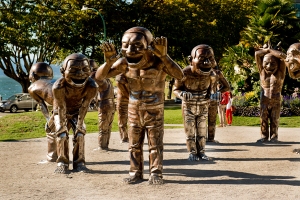
 On Vacation in Vancouver.     

2-laughing-sculpture

3-group-laughing

4-denman-street

5-bike-rentals

6-bicycles-only

7-english-bay-bike-path

8-english-bay

9-tree-top

9a-mounted-police

9b-harbour-air

9c-grandville-bridge

9e-night-harbour

9f-expo-sales

9g-vancouver-harbour-lights

9h-park-goose

“We should go on some kind of trip”.  When my wife said that a month ago she didn’t have to do much to convince me.  So about an hour later we had reserved a top floor room at the hotel on the corner of Davie and Denman Streets in Vancouver.

We chose Monday, Tuesday and Wednesday, so we would miss the weekend rush.  After a picturesque five-hour drive through British Columbia’s coastal mountains I was carrying suitcases and my bag loaded with our cameras up to our room.

What a great location. Not only were we moments away from the restaurant and bar scene of one of Vancouver’s most exciting areas that divides the city from the magnificent 400-hectare natural rainforest of Stanley Park, but right across the boulevard from our hotel was picturesque English Bay.

I discovered Denman Street when I first moved to Canada in the 1970s. Maybe it was the curiosity I had for a street that sounded and was spelled pretty closely to my name, I don’t know. But in any case the street was just as much fun then as it is all these years later.  One can either join others people watching while sitting at an out door pub, or choose food from almost any country in the world. We chose Greek at the English Bay for our first evening meal of the trip.

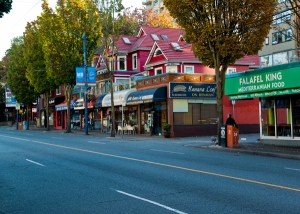
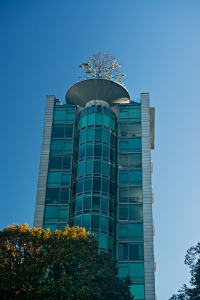
The next morning, while my wife slept I put a 24-70mm lens on my camera and headed out. There wasn’t much traffic on the street, or people walking along Denman. It was easy to photograph the buildings and I picked out a funky little coffee shop that we could go to later.  I walked the street and wandered the alley behind our hotel, (I like alleys) then headed for the beach.

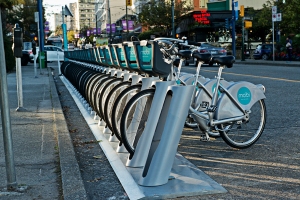
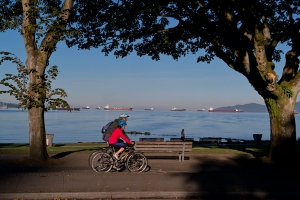
My mother always told me to look both ways and be careful of cars when I crossed the street, but she never told me how dangerous it was to cross the bike path along English Bay. I dodged several riders and jumped to the lawn covered with slippery geese droppings when a woman rider zoomed by yelling, “Bikes only!”

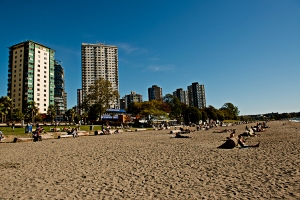
I suppose I have become one of those hick tourists gawking at all the sights of the big city, but I reached the safety of the beach where I could meander along pointing my camera where I pleased.  Gosh, I even got to meet local Vancouver photographer Trent Watts, who was kind enough to take time out of his morning to talk with me.

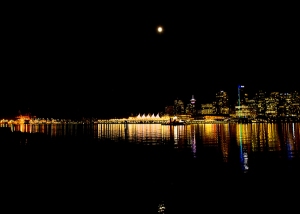
Linda finally got up, and after coffee at the little shop I found earlier, we decided to drive into Stanley Park to take pictures of the harbour and stopped for anything we thought might make a fun picture. We also were looking for a good vantage to take some night pictures of the bright city across the harbour. Gosh, we had so much fun we overlooked having lunch.

Much later we wanted to try our hotel’s fish n’ chips special being offered for supper, however even that had to wait because I stopped to photograph and talk with the two Canadian Mounties who have special dispensation to rest their horses after touring through the park in the cool pleasant entrance of our hotel’s basement parkade.

After supper I went out for night shots of the Granville Street Bridge that crosses both a boat filled water way into English Bay and the shopping district of Granville Island and joined several other photographers on the beach as the sun went down. Then just after 8:30 packed up and drove off for more photos at the location we had chosen in the park.


The next morning I must have been tired after all the previous day’s activities, because after I had photographed a white goose honking loudly at me on the beach I checked my watch and it was a late 7AM.  Oh, well I had a good time and anyway I was on vacation!

Camera Care On Wet Days    

linda-shooting-in-the-rain

Barriere, British Columbia Star Journal newspaper Editor, Jill Hayward, asked me to discuss the use, care of, and protection of cameras, lenses, and other photographic equipment during wet conditions. She worried about people carrying and using their cameras under the wet conditions at the North Thompson Fall Fair this past weekend. She also mentioned that she meets many local photographers that have scratched lenses.

I rarely let wet days limit my photography. Nevertheless, with the exception of those expensive pro level DSLRs and, of course, a few small waterproof cameras, most of the cameras photographers use don’t have much resistance to water.

Several years ago my wife, Linda, and I took a photography vacation on Vancouver Island. The weather was forecast to be completely rainy, so we prepared with plastic bags to cover our cameras, umbrellas to deflect water off our viewfinders, hairdryers to dry out cameras and tripods every evening, and wet weather attire because we didn’t want wet clothing. The trip was a bit uncomfortable, but the coastal downpour didn’t stop us from doing photography, and we didn’t waste a day of that trip huddled indoors. We were outside, cameras in hand, every day of that excursion and returned with great pictures, and a fun experience of shooting in the rain.

We had a good experience because we were prepared. That’s the secret. I always carry an old towel in my camera bag. And when water (or soon snow) begins to gather on my camera I continually wipe it off. Those areas I worry about are around the pop-up flash, where the lens mounts, the LCD, and the info window, and anywhere else that I think water might find a way into my camera.

I keep a lens cap on my lens. But what about when one is taking pictures? I know there will be those that advise putting a UV filter on every lens.

UV filters are from a time when we had a necessity to colour balance our film and in the spring we would use (U)ltra (V)iolet filters to warm the colours. Using an old UV filter is fine, as are any of the many different clear filters manufactures are selling for lens protection, but digital sensors no longer need colour correction filters and many photographers worry that inexpensive filters placed in front of their expensive lens glass might degrade the image.

Whether you agree with that notion or not, I think that using a lens hood is much better insurance than clear protection lenses. My advice is to get a plastic lens hood for every lens. Plastic lens hoods protect our lenses by bending, bouncing, and sometimes even breaking in the process of absorbing the impact and saving the lens. Personally I feel safer with a lens hood than a tight fitting glass filter. Anyway, we should always be using lens hoods to keep glare off the lens front.

When I return home after a day of photography I remove the lens and check my equipment. I remove the memory card for downloading to my computer, recharge the battery and, especially after rain, wipe my camera and lenses.

As I already wrote, I don’t let rain limit my photography. And there are times when the rain adds something to a picture.

Country singer Roger Miller wrote, “Some people walk in the rain, others just get wet.” Those are good word for creative photographers. And for those afraid of taking pictures in the rain, another singer, Cher made me laugh when she said, “Don’t take your toys inside just because it’s raining.”


Two Photographers Are More Fun 

TwoPhotogs 1

It is always fun to do photography with someone else. This past week I have been talking to a friend who would really like his wife to get involved with photography, and I’ve told him how much enjoyment I get from this exciting medium of photography would be missing if my wife, Linda, were not also a photographer.

I have written about this in the past, but I am going to bring back a previous article for those readers that might have missed the original and would like their spouse to take up photography.

When we first got together 40 years ago Linda didn’t do photography, but that quickly changed.

I suppose she didn’t have any other option. Then and in all the years she has known me I have been I am either doing, teaching, talking or writing about photography.

My advice to any photographer that is actually interested in getting their spouse involved is as follows.

Match the equipment. I mean that with regard to cameras, both DSLRs should operate the same way. The models can be a year or so apart, but should be the same brand and the controls should operate similarly and if two of the latest models are affordable, so much the better.

Don’t be cheap with lenses or cameras for your spouse. If it isn’t good enough for you, it isn’t good enough for the most important person in your life. Just as you would select a lens for the subject and the way you like to shoot, your photo partner should select lenses for his or her preferences.

I know your mother told you to share, but my recommendation is don’t share. That just leaves someone behind. If you both like long telephoto lenses, get two.

I can remember the exact moment I thought about the concept of equality. I was in Yellowstone National Park in Wyoming waiting for Old Faithful Geyser to erupt. While I waited I noticed a man and woman with their tripods setting up closer than me. I was obvious they were both serious about getting good photos of the geyser, but I could see that his was larger and feature packed, while hers was just a tiny, toy-like, point-and-shoot camera.

In my mind, it didn’t matter who was the better photographer or had the better eye. That point-and-shoot reduced her chances, and I wondered why she would even try, or how long she would keep it up when her equipment kept her behind.

I had a friend who tried getting his wife interested in photography. He bought her a cheap, entry-level camera and while he would make 16×20 prints of his images, hers were rarely over 8×10. She lost interest.

Shop for accessories together. Each photographer has his or her own preferences and should make equipment choices for the subjects they like to shoot.

Education is always a good idea. Attend a photography class or workshop. Search for them online or check local camera shops. Take turns going to photography classes or better yet take part in the same workshop.

One of our most memorable vacations was when we both attended a weeklong wilderness photography workshop on Mt. Rainier.

In my opinion we may have gotten more out of that class than the other participants because we were able to share information and experiences during and after.

Gently critique each other’s photography. Don’t just store pictures away on the computer. Sit in front to the computer display together and decide which photographs work and which that don’t, and then delete all the failures. We make large prints and calendars of our pictures.

One photographer in the family is cool, but two photographers, in my opinion, are much better. If you want your partner to have the same excitement about photography as you do, don’t be stingy with the compliments. And on that occasion when your spouse makes a better picture of the waterfall or the running deer than you, be sure to tell them.

Oh, and I never have the worry or guilt about getting new equipment.


Why do photography?

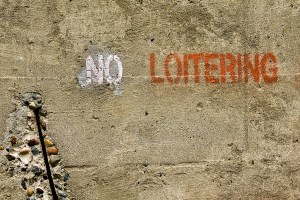
No Loitering

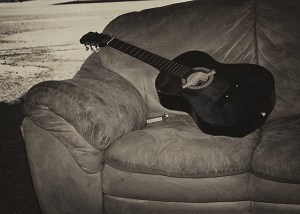
Guitar

St. Andrews

Tall ships Victoria

Kamloops Lake 2

Sternwheel

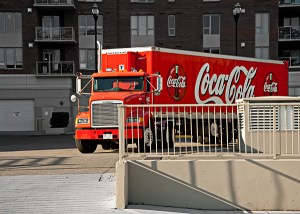
Coca-Cola

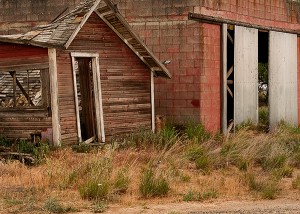
Forgotten shops

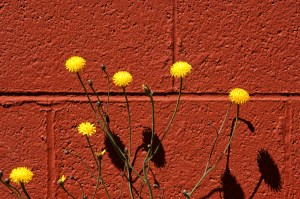
Yellow & Red

Just Waiting

After a discussion with a fellow who told me he has become bored with photography I thought I’d revisit the following from an earlier post.

I once asked “Why do photography” to members of an online forum and received some unremarkable responses like, “because I can” and “because I have a camera”.  Well, I suppose it is all about the camera to lots of people. However, there were two responses that I really liked, the first from someone called Soenda who eloquently wrote,

“ Because taking pictures has helped me see better. Before, I was less aware or the way light strikes leaves. I didn’t notice the symmetry of birds on a wire. Sunsets were masses of agreeable colour; now they are gold, pink, lavender and blue”.

The second from someone named Laura who philosophically said,

“Because when I look at my life, I cannot say I have done nothing. The proof exists that I have seen at least a wee bit of the world. I take pictures because it is artistic expression, and I think when we repress our artistic nature, we do ourselves no good, no good at all. I take pictures because it is fun. I can spend the entire day taking pictures, and it could not be a day better spent…”

For me, photography changes. There are times when I just want to play and am interested in nothing more than experimenting, my goal just seeing how something works.   I enjoy photographing my friends, family and pets. Pictures that have meaning only to me, but might never go anywhere other than on my computer’s screen saver.  And of course, until I retired, photography was the way I earned my living.

There are those times when I try to visually create an image that says something to others about how I see and feel about something. I can’t really say that the medium of photography is a passion for me, but I am enthusiastic. It’s just something I think about a lot and do.

Many use photography as a way to express themselves artistically, of which I heartily agree. Expressing oneself through photography is easy, as it doesn’t require the trapping of other mediums like painting or sculpture, and merely requires a camera.

Photography, for those who first wanted to make photographs, became accessible during the 1800s. The first surviving image made by Jacques Daguerre was of some artistically arranged plaster casts resting on a window ledge in 1837, and a short 20 years later photographers were wandering the North American wilderness and newly constructed cities creating photographs with the same intensity, all though not in the same numbers, as we are today.
Why take pictures? For some it is to document history, we know about the civil war in the 1860s through the photographs of Mathew Brady and the Vietnam War in the 1970s by David Kennerly.   Timothy O’Sullivan, William Henry Jackson, Ansel Adams, Elliott Porter, Imogene Cunningham, Bret Weston and others gave us their visual opinions of an early American landscapes.
There were those like Dorothea Lang and Walker Evens that during the great depression of the 1930s told us about the human condition. While Photographers Arnold Newman, Richard Avedon and Canadian Yousuf Karsh, celebrated the beauty of the human expression”  paving the way for modern portrait photographers.

For some the question “Why do photography?” may be very philosophical and for others practical. Soenda commented, “ Because taking pictures has helped me see better.” And Laura wrote, “I take pictures because, when I look at my life, I cannot say I have done nothing.”

I wonder what readers would answer.