A performance of the Photographic idea 


Ansel Adams, in the Forward to his popular selling 1950’s book “The Print” wrote,

“Photography, in the final analysis, can be reduced to a few simple principles. But, unlike most arts, it seems complex at the initial approach. The seeming complexity can never be resolved unless a fundamental understanding of both technique and application is sought and exercised from the start. Photography is more than a medium for factual communication of ideas. It is a creative art. Therefore emphasis on technique is justified only so far as it will simplify and clarify the statement of the photographer’s concept.”

I have flipped through “The Print” many times since I got into photography. I think that it was almost required reading for photographers at one time. Especially those of us dedicated to hours of time in dimly lit rooms, peering at paper prints as they slowly materialized in smelly, (and somewhat toxic) liquid-filled trays.

“The Print” by Adams is from a period when photography was about striving for the perfect negative and a quality final print (image). Concepts that are all but forgotten in this age of hi-tech computerized image making.

We don’t worry about a perfect negative any more, because even if the image file produced in-camera isn’t perfect RAW files are easily colour balanced, cropped, and sharpened. Contrast can be decreased or increased and the final picture doesn’t show any sign of resizing or noise reduction. And in my opinion, sadly, the trend for many photographers has become to not make prints at all.

I believe Adams’ forward in “The Print” is as worthwhile now as it was in 1950.

Even with the changes of how an image is managed and finally used (whether print or electronic) the thought process and technique should be important. Adams wrote about the technique of taking the picture, the method used to develop the negative, and then finally the printing procedure.

He might as well have been talking about transferring image data from a camera to computer, optimizing the RAW files in post-production, and outputting to a personal printer for the final print.

I thought about that as he continues, “We may draw an analogy with music: The composer entertains a musical idea. He sets it down in conventional musical notation. When he performs it, he may, although respecting the score, inject personal expressive interpretations on the basic patterns of the notes.”

“So it is in expressive photography: The concept of the photograph precedes the operation of the camera. Exposure and development of the negative (RAW image file) (my remarks in parentheses) follow technical patterns selected to achieve the qualities desired in the final print, and the print itself is somewhat of an interpretation, a performance of the photographic idea.” I have always liked that final sentence of his “…the print itself is somewhat of an interpretation, a performance of the photographic idea.”

Those words always remind me, as Adams put it that, “Photography is more than a medium for factual communication of ideas.”

Modern photographers appear to be obsessing with each new offering manufacturers place on the table, and the obsession with technology may often seem to be what photography is really about. Although I will admit that it is fun, I think photographers need to remember that, “The concept of the photograph precedes the operation of the camera.”

That seemingly out-dated book is still on my bookshelf, and I regularly flip through its pages.

After all the prattle about what the newest camera, or lens, or computer program is capable of, I like to be brought back to what, in the end, photography is about for me personally.
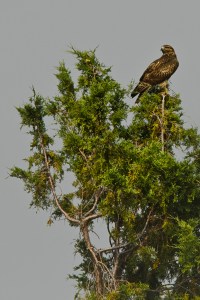
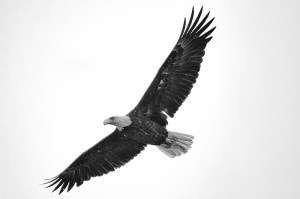
Looking for an eagle to photograph, but I guess any bird will do.   


Last week a Canon 300mm lens was brought into my shop by an owner had decided to downsize her equipment. By “downsize” I mean that she was changing from her big DSLR to a much smaller and lighter mirrorless camera.

I thought I’d entice buyers by showing photographs of birds using that neat telephoto lens with a 1.4 Canon telextender that I also had to sell.

Everyone likes eagles, and I had noticed a few clinging to trees along the river on my drive home. I was sure a couple shots of eagles in the dismal valley smoke would be proof as to the quality of that 300mm.

I don’t have a Canon DSLR so I called my friend Jo McAvany and suggested that I’d drive along the river as she looked for eagles. I could pull over for her to use the 300mm and the 1.4 telex on he cropped frame DSLR. That meant she could shoot from the open window with what would effectively be around a 550mm lens.

Jo showed up at my house around 9AM as I was having my morning coffee. (Jo is one of those strange people that don’t eat breakfast or drink coffee…Ya, I know)

Anyway, as we were going to my car, Jo called to me to wait. I could see her sneaking slowly through my bushy garden.

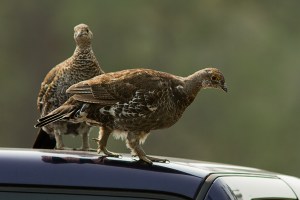
She had spotted five or six grouse sitting on her truck. They must have been drawn to the warm metal on the cool morning. I heard her say, “I wish I had my wide angle so I could get them all in”.

The first shot of the day was not an exotic eagle, but I think that a couple grouse standing on the top of he truck’s cab is pretty darned good.

Talking and laughing about the silly grouse, we drove along the winding country road that leads down to the river from my home. I slowed down when I saw a hawk taking off from a fence post beside an open field.

That hawk is always hanging around there. It must watch for mice feeding where the cows dig up the pasture. I have never been able to get a shot of it, but I slowed and Jo got out to photograph it landing on a treetop across the field.

No eagles yet.

We drove down into the gloomy smoke settled motionless in the river valley and then as slowly along the highway as the big transport trucks speeding along would let us.

One eagle. Yep, we only saw one blasted eagle on a distant tree. I pulled over onto a train crossing and ignored the “No Trespassing” sign to get close enough for Jo to get a shot. Just as she got out to position herself the big bird took off, I yelled, “shoot” and she did. One out of the three was perfect! I think that’s a good ratio. We left and continued down the highway with out seeing another eagle.

Disappointed, we turned to take the back road to my place hoping to see a few ducks at the pond I had tried unsuccessfully all spring to get photos of geese at.

The reeds along the edge blocked most of the shots. But Jo was determined, and ran across the road to photograph ten or so ducks resting on a log. By the time she got a shot there were only three left.

Well no eagles, and no more birds waiting to be photographed. We did stop for a photograph of a deer. Big deal, there are hundreds of those.

We got back to my house and as I brewed myself another cup of coffee, my never-say-die friend went out to take pictures of my chickens. Chickens.

We didn’t prove that lenses’ quality with pictures of eagles. Well one. Nevertheless, Jo got some neat bird photographs, and we had fun.

Making up a reason, like testing a lens, is a pretty good excuse to get out with your camera if you actually need one. However, I think what it is really about is being enthusiastic about photography and, of course, stimulated and excited by just about anything one points their camera at.

Photography on a smoky day      

Another summer is about half over and as usual, or what we here in the interior of British Columbia have come to regard as usual and normal, the sky and air is filled with an orange-grey choking smoke. It seems this year, to make life just a bit more uncomfortable, the days and most of the nights are also reaching record high temperatures.

Its cooler inside, I have fans blowing on every level and corner of my home. But as comfortable as that is I got to wondering what I could do with my camera to capture the feeling I had when walking down the street to pick up Monday’s mail.

I decided to drive cross the river and take the dusty road that runs along the riverbank from the Pritchard Bridge to Kamloops.

Making a proper exposure in the flat light was easy. I just selected my camera’s Aperture Priority mode, a handhold able shutterspeed of 1/250th, and an aperture small enough to give me a good depth of field.
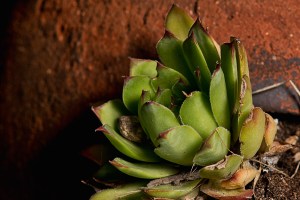
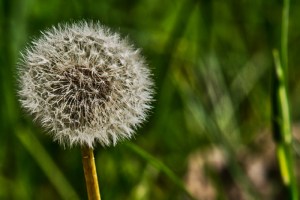
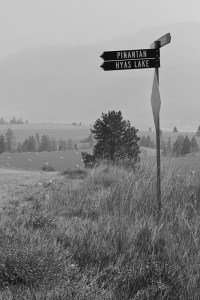
I quickly noticed that, like the fog, the moving smoke isn’t the best subject to focus on if one wants a sharp image. I always selected something in the scene that was stable, like a tree, sign post or hay bale.

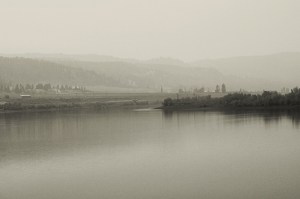
The heavy smoke filled sky never did allow the day to brighten up, and other than close objects most of the landscape was shrouded in an eerie slightly translucence with visibility probably a bit less than a mile.

I liked photographing the almost orange glow and the disappearing hills. Nearby features popped out with colour, while those in the distance lost detail and colour as they were swallowed up in the smoky gloom.

I am not one to join those stouthearted photographers standing behind the firefighters camera in hand capturing the terror and beauty of the advancing wildfire flames. I figure there are enough of those that are doing a great job.

What intrigue me is the fading light and the thickening smoke that changes the colourful landscape I am so accustomed to a monotone world of disappearing features.

I suppose one could hold up in some air-conditioned fortress and complain about what a person that camera into my shop today described as an “overwhelming campfire smell”. But for me, as I did this week and plan on again in a day or two, getting out in the changing landscape and take more pictures is interesting and stimulating.

I don’t for a moment loose the thought that there are thousands of men and women from all over the world fighting the multitude of dangerous fires here in BC. I also count myself fortunate that the fires are not yet threatening my home.

Nevertheless, the thick smoke is an opportunity to photograph in a different kind of light that I might as well take advantage of.

Another day with infrared        

The days here in Pritchard, British Columbia have been hot, dry, with air that has barely moved. A cloudless sky and constant sun that beats down on my head as I walk around my parched property, None of which has been that inspiring for photography.

So when I woke up to an overcast day this week I hurried through my morning chores with the thought of going off somewhere with my camera, and by the time I had finished my coffee I had decided to pull out my infrared converted camera and travel out along the dusty Stony Flats road to see how the overcast sky would show off the tall Fir trees that line it.

I drove along stopping for pictures every now and then, but I started feeling I was having a “photographer’s block”. It was then that I thought about the Chase falls.

I had been there only a couple months ago and thought about how nice it would to photograph the falls on a flat day without having to struggle with the hash contrast that accompanies a sunny day.

I knew the light would be unusual in that tight little canyon. It always is with infrared. Colour photos are so much easier there with the light is reflecting off the canyon walls.

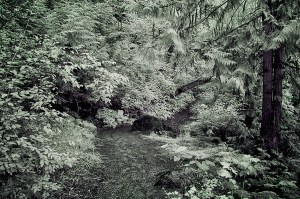
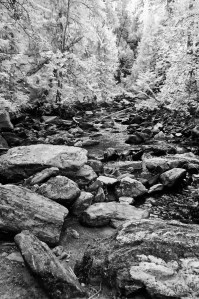
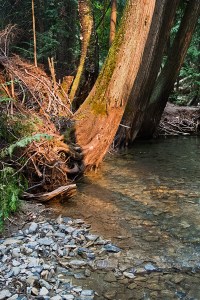
This time of year the path along the creek is overgrown and narrow. And in my opinion, was a perfect subject for infrared with the subtle changing shades of green to a tonal range of whites.

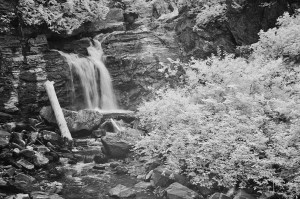
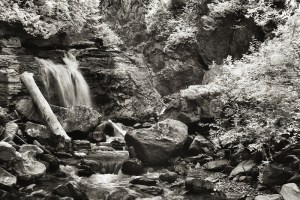
The most dramatic infrared photographs of the falls need to be wide enough to include vegetation. An unaltered infrared image turns out mostly brown with a few slashes of light drifting down to make some features blue. Without foliage converting the image to black and white that isn’t much different than a normal black and white picture.

To get the otherworldly effect of infrared one must find and angle that includes foliage that turns white.

When plants reflect infrared light the effect will show them as glowing white, and its that tonal change that one is after when using infrared.

My favourite photographs were not the falls. This time it was the tightly treed creek and the overgrown path leading to Chase falls. However, the falls will always be the focal point of any photographs and one needs to work with that so viewers have a feeling from that location

Patience is part of any scenic/landscape photographer’s tool kit. And anyone that has accompanied me knows that I don’t become annoyed or anxious if I have to wait.

On this outing as I waited for over a half and hour for a fellow poking a stick into the water moving dirt, then digging with his hands and sifting though the particles. I never talked to him. I was up along the rocks for wide shots and he was perched on rocks near the falls. I assume he was hoping to find gold in the streambed.

He was finding small bits of something because he kept putting his findings in his shirt pocket. I have never searched for gold along that creek, but I have noticed a lot of iron pyrite clusters glowing in the shallow water. Maybe “fools gold” was what he wanted. Or, who knows, maybe he actually was finding something valuable.

To me the value I find in that canyon stream is the photographs I get to make.

Anacortes Shipwreck Festival 2018   

On July 20th I made another six-hour highway drive from my home in Pritchard, British Columbia to the town of Anacortes at the tip of Fidalgo Island nestled in the Pacific Northwest’s San Juan Islands to their annual Shipwreck Festival. It’s certainly one of my favourite places and events of the year.

Again, as last year, long time friends Dave and Cynthia Monsees came along, and I was also very pleased that my photography partner Jo McAvany had decided to come along this year.

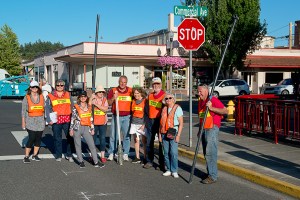
We arrived early enough so I could give Jo a quick tour of some of the places we would be photographing on Sunday, then drove down the main street of town to meet up with the hard working Fidalgo Island Rotary Club volunteers.

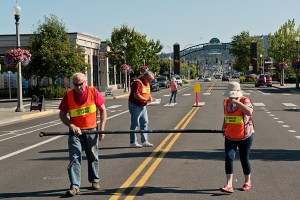
The Fidalgo Island Rotary Club organizes the Shipwreck Festival and again this year I volunteered to get a few pictures of them as they marked street locations for the next day’s vendors and also to take this year’s group photograph.

I’ll repeat what I wrote last year and say that over the many years I have been attending that popular festival in Washington State I have never heard or met with a sour word from anyone in the town. The people one encounters are always warm and generous and after a short time I always get the feeling they are old friends. Although I’m an out of town stranger, and a Canadian to boot, I immediately felt that way as I joined that group decked in their Rotary Volunteer vests.

I can’t remember what year I first started attending the annual Anacortes Shipwreck Festival, but it was some time in the mid-1990s I think, and although I have missed a few over the years, I am determined to make at least the next dozen plus. (Or at least till the Provincial Driver Licence Authority decide I am too old to be in charge of a vehicle)

After I photographed the festival committee, Jo and I set off for a picnic and pictures at the beach. After a quick stop at a close by grocery store and a short drive to Washington Park we spent the evening photographing everything, and of course each other, as we waited for the sun to sink into the ocean.

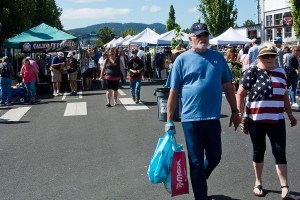
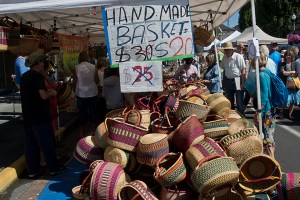
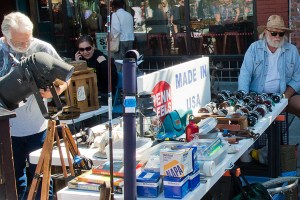
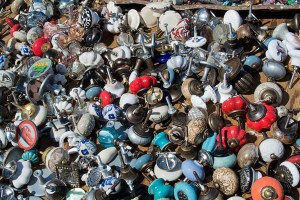
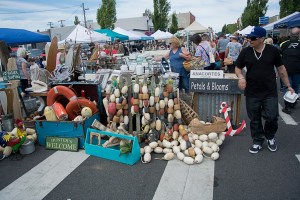
The next day was not only an exciting wander through the nine-block flee market on the main street of town, it was an excellent opportunity for us to try some “street photography” on the people packed avenue.

Whew, what a day. We saw, we touched, we photographed, and we talked to people from 9AM to 3PM. Then we stepped into a popular Commercial Avenue Alehouse called the Brown Lantern for a late lunch and I gladly got to rest my tired legs. I am sure Jo will recommend the crab and corn chowder and I agree that both my food and the two beers I drank were the refuelling I needed.

Then we were off for another quick look around and a few more pictures of the crowed street of happy bargain hunters.

Leaving the street festival we drove up to the high overlook at Cap Santé Park that offers a command view of the marina and city. We climbed over the large, smooth, flat rocks and photographed the city, ocean islands, and the many bright red Arbutus trees.

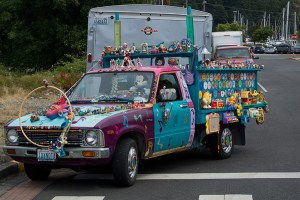
The next morning and for the rest of the day we drove around the island photographing many of the places I have visited in past years. The island location may be the same, but the image one creates in a different time is always a new creation.

I enjoy photographing just about anything. The Anacortes Shipwreck festival is always a good excuse to get me to the cool damp Pacific coast and away from what usually is a hot and dry July where I live in British Columbia.

Another Anacortes Shipwreck festival photography excursion has passed. We had fun and got creative and made lots of photographs. Now we are left with the memories and the photographs until next year. However, I am planning another trip in the fall, so the memories only have to last about three months because I’ll be back on the island and in Anacortes to make a few more.


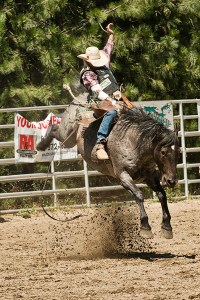
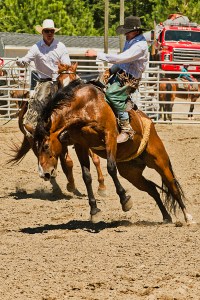
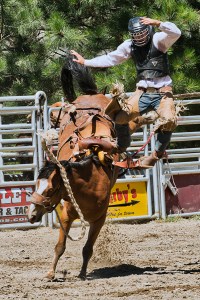
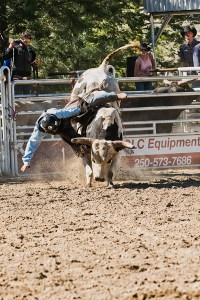
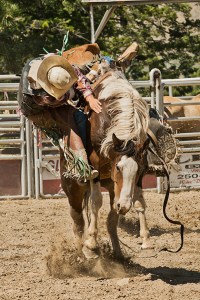
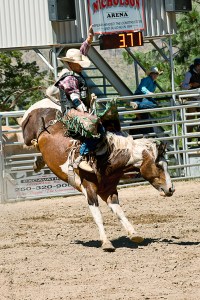
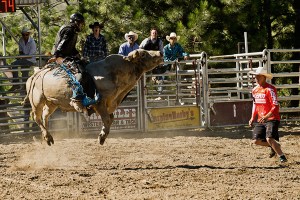
Photographing the 2018 Pritchard Rodeo       


The Pritchard rodeo has come and gone once again.

Gosh, its 2018. I need to dig though my storage of photographs to find out how long I have been attending and photographing that fun filled tournament.

I will say that it is a much smaller event than it was years ago. Maybe it’s a sign of the times. The numbers of participants has declined dramatically and so has the crowd.

There are so many opportunities for people to attend each weekend that spending the day at a hot, dusty rodeo may have become low on many peoples list. Nevertheless, for anyone, especially photographers, that want to see great action, our local rodeo is still a worthwhile way to spend the day.

I arrived an hour early expecting to beat the crowds. However, there were already several photographers ready and waiting ringside for the action to begin.

It’s always so much fun saying hello and trading quips with photographer friends I only get to see once a year. As I looked at the cowboy hatted gaggle of photographers I noticed that every dang one of them were sporting Canon cameras, all to evident by the large white lenses attached to their cameras. So I was ready and waiting for the Canon vs. Nikon jokes that never end.

That said, when the dust and the jokes clear, those that I stopped to talk to were experienced, talented and certainly dedicated rodeo photographers.

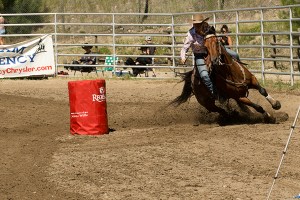
The first bronco-riding event started at 1AM and I comfortably positioned myself along the metal railing. I checked my camera and set my ISO to 400 so I could get a reasonable depth of field, selected Shutter Priority Mode and placed my shutterspeed at 1/500th of a second to stop the action.

My lens of choice for sports is the 70-200mm. There are longer focal lengths available, but my well used 70-200mm is easily hand holdable and quick focusing.

I like photographing any kind of action, and that especially goes for rodeos. Small venues like the one a few minutes drive from my home in Pritchard are photographically accessible and the organizers haven’t put restrictions that limit photographers. And for those new to rodeos, it’s a friendly and easy place to practice and, of course, experiment.

This hometown rodeo makes it easy for local participants to get quality photographs of themselves that can be made into wall prints. All they have to ask some one with a camera as they pass by.

I began this article with the words, “The Pritchard rodeo has come and gone once again”. As always, that fun packed rodeo was, well gosh, fun. I got to talk with other photographers and renew friendships with neighbours that I rarely see. And, of course, had a great time taking pictures.


Photographing a July garden.  


I waited all day for the bright harsh sun to dim. It was just after 8PM I was finally able to walk into my garden with camera and flash to photograph the July flowers.

June was, as usual, pretty wet and full of bloom, but I was waiting for the hot summer to present a change in the plants and flowers so I could continue with my photographs of the garden in all seasons.

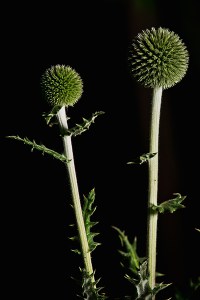
I am not so much impressed by flowers as I am by the shapes of them. To me the colour is only part of what I want to capture with my camera, and I don’t really care if I am photographing in the spring, the summer, and fall or in the cold of winter. Dry, wet, or covered with snow. It’s the shape and plays of light that intregues me.

I don’t like bright, contrasty sunlight. I prefer overcast or, at the least, the lower light at day’s end.

I wandered out with my camera, macro lens attached, tripod, light-stand and flash fitted with an umbrella in the still bright, but certainly not as glaring as mid-day or early afternoon light.

Regular readers know that I always employ a flash. The flash gives me control over direction and intensity of the light. Some photographers my say they prefer “natural light”. I will just say, “naturally, I add light.”

With digital came high-speed sync. High-speed sync gives me the opportunity to increase my shutter’s speed dramatically when using a flash. Even up to 1/8000th of a second. That increase in shutter speed means I can use a wide aperture even in the direct sun.

It also means that I can control flash exposure with the shutter speed instead of the normal way photographers control their flash power, the aperture.

I choose my well-used old 200mm macro. It’s from the time of manual cameras and doesn’t have the option of auto focus. I like it because I can select any point along its focal length when photographing flowers.

My flash was a big 800w battery powered, wireless off-camera strobe. I use it in manual power mode and, of course, High-Speed sync.

I under exposed the ambient light 4 or 5 stops so the proper illumination would come from my flash.

The garden, designed by my wife when she was alive, continually blooms from spring to fall. It colours, shapes change with the season.

All I have to do is choose what interested me all year long.

I have never talked to my neighbours about all the photography I do in my yard, but I wonder what they must think about the bursts of light coming from my bushy property at all times of the year.

My garden photo session ended as the light dropped at about 9:30, but by that time I had wandered all over and photographed shapes of flowers, some alive and some only memories of their glorious and colourful spring blooms.

The hot, drying July heat is now with us and I wonder what will survive till next spring for me to photograph.

First spring visit to photograph Chase Falls  

I have been keeping close to home with my last few posts.

With that in mind I decided a quick fifteen-minute highway drive to a waterfall that feeds a creek running through the small town of Chase would still fill that objective.

I try to visit that local falls for a few pictures every season and this past week was the first time I ventured there since I trudged to those falls through the deep snows last February.

On that excursion to the falls the deep snowy path was untouched except for small footprints made by some lonely racoon. This time there had been lots of people evidenced by discarded hamburger wrappers, plastic cups and the scattered remains of a styrofoam carton.

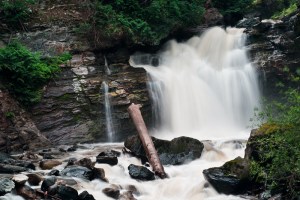
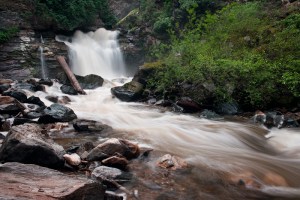
There was lots of spring water coming over the falls and by the looks of all the huge logs, boulders and the dangerously eroded path, it’s obvious that the early June melt must have produced a torrential flood of water in the small creek.

As with last February, I asked my photographer pal, Jo, to accompany me. She had remembered our last Chase falls adventure and mounted a 24-105mm on her camera while I had my trusty 24-70mm on mine.

Like that cold winter day it was cloudy and flat with just a bit of sun poking through to lighten up the forested creak a bit. Fortunately it was not enough to create shadows, although at times there were highlights on protruding rocks, tree limbs and the churning water.

I chose the day because of the slight overcast. On a bright day one will struggle with overexposure on the white, reflective waterfall. As I wrote in February, I prefer a slight overcast or a foggy day. Bright sun and deep shadows create too much contrast.

With our cameras tightly secured to tripods we set our lenses to apertures that would give us plenty of depth of field. Selected shutterspeeds over two minutes and placed neutral density filters in front of our lenses to reduce the amount of light so our slow shutterspeeds wouldn’t overexpose the scene.

We set and used the camera’s self-timer so as to reduce camera shake and started taking pictures from every angle we could get to. That meant a lot of climbing over the jumble of large stones.

Photographing waterfalls are easy and no special talent or equipment is needed. I use a DSLR, tripod and ND filters. There’s nothing that most serious scenic photographers won’t already have.

We had a great time and I will absolutely be back in another month or two. I like to photograph that little waterfall with my infrared converted camera. July and August will be perfect for that. I’ll also be back in September or October when the volume of water is dramatically decreased. Then winter, and everything starts over again.

Photography is like that to me, and pointing my camera at the same subjects over and over year after year is just plain fun. This past month I have been sticking close to home. However, I plan to go a bit further from home now that summer is here. My goal, no matter where I am or what the subject is, is the enjoyment of making photographs.

There was a 1950’s street photographer named Leon Levinsein that wrote, “I walk, I look, I see, I stop, I photograph.”

I suppose it’s as simple as that.


Infrared photography is a refreshing change                          


I just like to make pictures.

When I retired from pointing my camera for money I was reminded how much fun it is to photograph everything for my personal entertainment.

The past two weeks I have stayed close to home with my cameras and, yes I’ll say it, “focused’ on subjects that are within ten to fifteen minutes drive from my front door.

My subjects aren’t necessarily exotic and there aren’t troves of photographers traveling long distances to set their tripods up in anticipation of those once-in-a-lifetime photographs. But, for me the things I pass along the local roadside are always interesting and sometimes even stimulating.

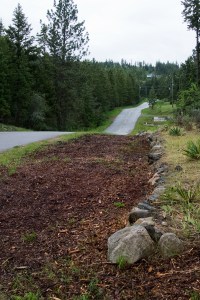
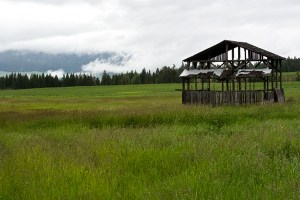
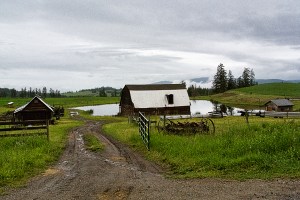
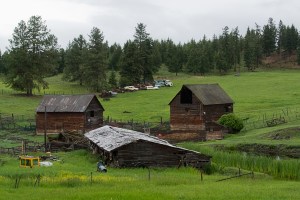
This spring I was unsuccessful in my attempt at photographing the geese and their goslings, but I easily pointed my camera in a different direction and had a good time photographing turtles instead. I then (driving along the same road) decided to photograph my way to work on a rainy day.

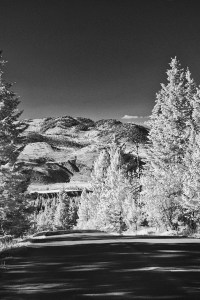
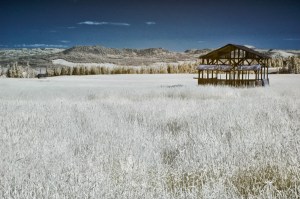
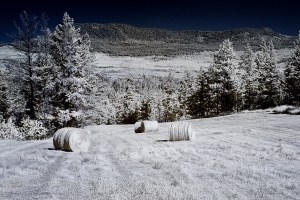
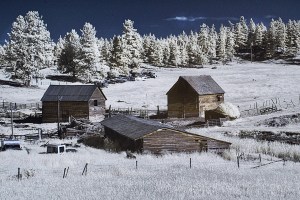
This week staying dedicated to Duck Range Road I dusted off the camera I had converted to infrared some years ago.

My previous trip around the countryside with it was in September of last year, so it was about time to create some images in a different light.

Infrared is always fun, and this time I’ll be able to compare four versions. I’ll have those I made last week that were colour and black & white, and then this weeks colour and black & white from infrared.

The first time I drove and photographed that route was back in 1977. I had just moved and had hooked up the electricity to a 20’ X 9’ trailer on a couple acres of heavily wooded land, I didn’t know anyone and was curious to see what I could find along the dusty dirt road.

I loaded my Pentax Spotmatic II with a roll of Ilford black and white film, jumped in my yellow 1962 International Scout 4X4 that I had recently changed the California licence plates to British Columbia plates, and slowly drove along the bumpy road in search of photographs.

Well, here it is 41 years later. I no longer reside in that cramped trailer, or use film for that matter, and there is no longer need of that 4X4 because the road is paved. However, I still slowly drive along that road in search of photographs.

I don’t need infrared to keep me excited with the photos I make along that road I know so well, but as I wrote in my title, “Infrared is a refreshing change”.

I thought about reusing last week’s quote by Elliott Erwitt. However, I wanted to find words by a photographer that described how I feel about pointing my camera at subjects I have photographed (hundreds of times?) before.

I searched some and found this quote by German photographer Helmut Newton.

“Look, I’m not an intellectual – I just take pictures.”

Photographing my way to work on a rainy day          


Last week I wrote about my frustrations with trying to photograph the young geese at a nearby pond. At the time I was so fixated on those blasted birds that I ignored the scenic country drive I take every day when I leave my rural home and head for the highway.

The geese were a bust, and I decided that on my next trip to town I would do some scenics no matter what the weather was like. I will say that I am not all that fond of sun-filled blue sky, and prefer fog, heavy clouds or even rain to an uninspiring sunny day.

I was pleased when I woke to rain pounding my cedar-shake roof. As I sat drinking my morning coffee and looking out the window I knew that there would be little chance that I’d be opening my shop on time.

My camera of choice on this day was my little Nikon V1 that easily sits on my lap while I drive. The small sensor doesn’t compare with the big full frame 36mp camera I prefer for serious photos, but for posting online or if I don’t mind limiting my prints to 8X12, it’s just great. And I have used it many times in the rain without problems.

As I walked to my car I was pleased that the rain had lightened a bit. One could still get wet if standing for a time, but I’d be quickly in and out of my car.

On this day I was interested in the contrast between the green fields, trees, the blue hills, the slowly brightening sky and the white billowing clouds. It would be impossible to get a bad exposure, as I just metered for the green fields.

As usual there were lots of deer, horses and cows, but the turtles I photographed last week were hiding under water, and those blasted geese were even further on the other side of the pond. So I put on a wide-angle lens and made a scenic of the pond.

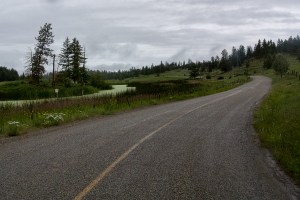
I liked the wet, winding road and the blue cloud covered hills and the fields were so green.

Neighbours would drive around my parked car and shake their head at me standing out in the rain. People that have lived here for a while are used to seeing me standing alongside the road pointing my camera at the distance. Long time residents don’t even bother to slow down to see what the heck I am photographing.

I doubt they would be “seeing’ the same way that I (or any other photographer) would. Photographers look “into” the landscape instead of “at” the landscape.

I only got a bit damp on my way to work.

Of course I opened my shop late and had damp hair after continually stopping to photograph things on my way to town (that I have photographed many, many times before)

Here is a fun quote by famous American photographer Elliott Erwitt, which seems perfect for those of us that carry our cameras to work.

“ Nothing happens when you sit at home. I always make it a point to carry a camera with me at all times…I just shoot at what interests me at that moment.”