Photographing the Canadian Pacific Holiday Train 

A couple weeks ago I wrote about how much I like Christmas lights.

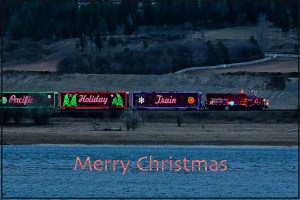
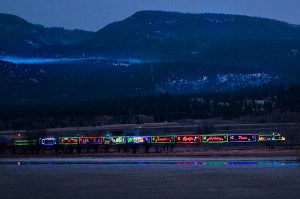
Well, the Christmas holiday season isn’t over yet and to prove it I got a chance to set my tripod up on the cold, winter’s river beach a few minutes down the hill from my home to photograph Canadian Pacific Railroad’s Holiday Train.

CP Rail’s website says, “The CP Holiday Train program launched in 1999 and has since raised more than $13 million and four million pounds of food for communities along CP’s routes in Canada and the United States…. The holiday season is the best time of the year, and we look forward to bringing together thousands of Canadians and Americans this season for this incredibly important cause and a great time.”

As I have in past years, I positioned myself on the beach across the river so I could get a wide shot of the brightly lighted train passing on the opposite side with the dark hills and forest behind.

I arrived an hour in advance while there was still plenty of light and made a few test shots. The schedule put the train at our location a bit after 4PM, just as the sun was going down. The time was about right for my preference of shooting just while there is still that cool, blue light illuminating the sky and I have enough light in my photograph to define the train from its surroundings.

I set my camera at ISO 3200. That allowed me to keep my aperture at f/5.6 for plenty of depth-of -field. I was a bit under exposed, but a stop or two really didn’t bother that kind of low light image. After all, the train’s lights were very bright.

As with past years there was a strong, cold wind blowing down river. In past years it was colder and I had bundled in the car drinking hot chocolate till the train arrived, but this year was warmer and I just stood there enjoying watching my neighbours children running around on the beach. When the train finally arrived the three year old boy and I both yelled, “The Christmas Train” I am sure his mother, shivering in the cold wind, just shook her head thinking, “Boys”.

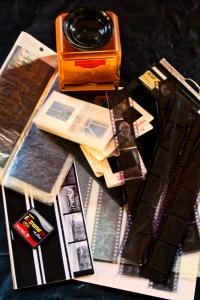
A young fellow purchased a 1980s film camera from my shop today and we talked for some time about how interesting prints made from film are. He was really thrilled to begin capturing the world around him with film.

As I selected the images that I had edited and worked over using several computer programs for this article I thought of that young photographer and the journey he is beginning with film.

I am sure he will have fun, but the photographs I made of the Holiday train would have been beyond the ability of most popular films he will find at local outlets, and I had the unfair advantage of computer programs with which I could squeeze every bit of data there was in the digital file I made.

Photographing the Holiday train was fun and I am always surprised that there aren’t carloads of photographers joining me on the beach when the train comes by.


How about Christmas cards?


I like all the festive celebration and excitement of Christmas, and truly enjoy all the colourful decorations, the lights and listening to Christmas music for a whole month.  Yes, I do like Christmas music.  I have also written about Xmas cards before.

All year long the photography social media sites on the Internet that I belong to have been filled with photos made by members, but images posted on the Internet quickly become faded memories and are easily forgotten when an hour later someone else posts theirs.

I like photographic prints. Prints have a life, whether framed and hung on a wall in our home, taped on the refrigerator, or thumbtacked in an open space in the workroom. To me a print of any size has more importance and life than a digital image on my computer or iPhone screen.

Christmas is a great time for photographers, and besides than just having fun taking pictures of anything and everything they now an opportunity to give friends and family their photographs.

I suppose that could mean a big framed photograph, but what I am writing about today is Christmas cards. Cards are easier and less expensive than framed prints, and any card of a photographer’s work is more personal as a gift than an email or little picture tagged to a text message.

I don’t want to believe that any photographer would ever be satisfied with mass produced generic Christmas cards. Personally, I want people enjoy my photography, even if it’s only as a 5×7 card.   A card to someone I care about is so much better than having my pictures left languishing as image files deep in some computer hard-drive that hasn’t been backed up.

Right now I am going through my many files from this year’s photographs selecting those I want for Christmas cards. I’ll print up different subjects and place all sorts of greetings on them. It is rare that I give the same picture to more than one person. And not all the cards say Merry Christmas. Although I like “Merry Christmas” what wording goes on a card doesn’t really matter to me. Happy Holidays, Seasons greetings, Have fun, A good New Year, and anything else I think fits a particular picture. It’s about the card, never the words.

I have written before that I always produce a new monthly calendar. My wife and I used to alternate our months.   Doing a calendar is a neat way to personally enjoy my photography, but cards are a lot more fun because they are for others to enjoy. I also make cards for all occasions, like birthday’s, Valentine’s, Mother’s day, etc., My family has come to expect me to share my photography. Sometimes it’s only a picture of something we’ve done, but if it’s a special occasion they always will get a card. Even when would I go to my granddaughter’s school Christmas concert, I always took their pictures, made a card and send it to them through the mail.

For those photographers that don’t have their own printer, it’s as easy as having a 4×5 print made at a local lab. Then get some construction paper, glue a picture on it, fold the paper, write something like Merry Christmas inside and give it away. And don’t make all the cards the same.

What would be the fun in that?

Wells Gray Provincial Park. 


The morning news said to expect snow, overcast days and cold weather. So I decided I had better take a last visit Wells Gray Provincial Park with out the snow. I had been lazily putting off spending a day in that scenic park. Gosh, it’s only a two and a half hour drive to get there, and I am not that busy, so I couldn’t come up with an excuse not to throw my camera gear in the car and make the drive.

I first visited Wells Gray back in 1971. A friend and I had driven up the east coast of the US into Canada, traveled around Cape Breton, and then had a leisurely drove across Canada to Kamloops, British Columbia. Someone we met in Kamloops suggested Wells Gray Park.

I remember driving along the rough, rutted dirt road into the park and marvelling at the quiet wilderness encroaching from both sides. Until the road became blocked by many stern looking women carrying placards and standing by a big sign demanding that the road should be paved.  When we stopped someone thrust a petition through the window, while telling how the school bus had driven off the dangerous road we were on, and required our signatures. I am sure they saw the California plates on the front of our 60s Ford Econoline van, but they didn’t seem to care so we quickly signed their petition and were allowed to carry on.

I smiled remembering that as I drove on the pleasant road that had been freshly paved, yet again, and slowed down to look at the Black Horse Saloon and guest cabins that now sits where those women were. I guess they got their way!

The park was empty. There were no cars or tourist filled busses on the roadside. Gosh, I felt special.

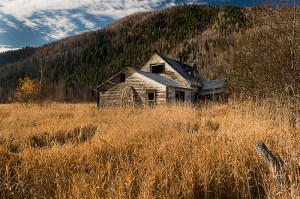
I have my favourite stops for when I don’t feel like hiking. There is an old abandoned building on the way into the park that I have been photographing for years. I am always surprised to see it still standing.

My second stop is to climb under the bridge that crosses the Murtle River. Going under the bridge gives a better location to photograph the “Mushbowl” and the large smooth rock surface is filled with big, round, deep holes. It’s a fun place to wander.

Then I made a fast drive to Helmcken Falls. Not so much because I really was in a hurry to get there, but because I had finished three cups of coffee and really needed to get to an outhouse. I got there and rushed to the privy only to find that the door had been unceremoniously pried open and the toilet paper had been shredded off it’s wall hanger. My friend Jo had mentioned that I should watch for bears, but if she does ask me I’ll just tell her that I am sure a large squirrel ripped up the toilet paper and the door was off its hinges because someone else (with long fingernails) that also too much coffee must have been in a hurry.

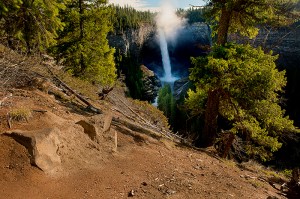
Helmcken fall was, as usual, in the shadow, but there was a nice fog and the sky had some clouds. Not that bad for photography. I like to wander away from the viewing platform, down past the end of the security fence, and just past the sign that warns hikers that they can fall over the edge of the canyon. That’s best because there is no fence to block my view.

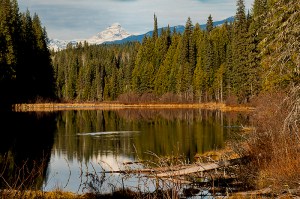
Then it’s only a short drive to my favourite place, Bailey’s Chute. As with the bridge, I climb down under the viewing platform.   My final spot is to park beside Shadow Lake. I like Shadow Lake because sometimes one can see a snow capped mountain to photograph in the distance.

Usually it’s hard to find and empty table at the end of Clearwater Lake to eat lunch at, but the park was empty.

My day couldn’t have been better. Although I have photographed that scenic park many times in the last forty plus years, I always enjoy the drive and the photography. And I am sure I have a good ten or maybe more years left in these old bones to be back photographing that park many, many more times.


Light the Portrait workshop        


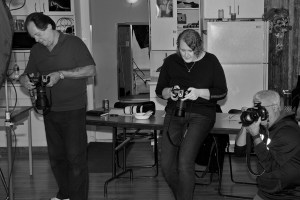
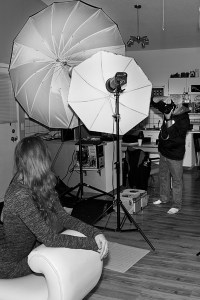
This past weekend I lead the first day of a workshop titled “Light the Portrait”. My goal during the two sessions was to help photographers understand how to use light, indoors or out, when they photograph people.

Fear-of-Flash has always been a topic of discussion for photographers photographing weddings, and portraits both indoors and out.

American photographer and author of the Strobist.com blog David Hobby said,  “…You hear a photographer say, “I’m a strictly available light photographer, I’m a purist.”  He continues, ” What I hear is, I’m scared of using light so I’m going to do this instead. Well, for me lighting was a way to start to create interesting pictures in a way that I could do it.”

It’s with those words that I began the workshop that would discuss using both studio lights and speed lights. Adding that personally, I always use a flash when I make a portrait of someone inside or outside. I don’t care if the ambient light is bright or dim.

My goal is to not only help photographers gain an understanding of off-camera lighting, but to also convince them that using flash will separate their photography from those that rely on natural or as I prefer calling it, “ambient light”.

The first session was about the big studio lights and accompanying light modifiers like, umbrellas, softboxes and reflectors, to name a few we employed during the day.

Those of us in Kamloops British Columbia are fortunate to have a local portrait studio that is not only large enough for a class, but also is packed with all sorts of lighting equipment, backdrops and change rooms for models. The portrait studio, Versatile Studio, also comes complete with a kitchen and dining area. And there are all sorts of props for posing.  All I needed to do was write up my lesson plan, print some handouts, book the studio, hire a model and show up in time to start leading participants into the exciting world of off-camera lighting.

I enjoy leading; I like that word better than “teaching”. I know to teach “is to show or explain to people how to do something”, but most of those that attend know a lot about photography and have already been shooting portraits for some time. All I need to do is build a bridge for them between what they already know and what I am presenting.  And as I stand with them in the studio/classroom I get watch that quick tightening of shoulders, widening of eyes and smiles when they suddenly get it. When that happens I can’t help but smile too.

Well, the first day is over and, as usual, they tired me out. However, I am already looking forward to next week with those enthusiastic photographers (and our energetic model). I wonder if I should begin next week’s session with the words of legendary filmmaker from the 1920s, D.W. Griffith. “Lights camera action”.


“All this digital isn’t real photography”        

I talked to a confused young photographer that wondered if he should do as a friend that was using a 1970’s film camera and discard his DSLR for a film camera. His friend told him, “all this digital isn’t real photography”,

I doubt his opinionated pal even thought about or was aware that it has only been a bit over a century ago that photographers needed large glass plates, hazardous chemicals, bulky cameras and wagons to carry everything. And I wonder if there were some photographers that, when roll film first became available, said about the same thing when they saw people hand-holding their little box cameras.

The medium of photography has become very accessible for everyone. The days when a photographer had to be an engineer and chemist are long gone. With modern technology, today’s supercharged cameras with their machine-gun-like shutters and seemingly speed of light focusing allow many photographers to get great pictures on their first try. Photographers once had to understand the combinations of shutter and aperture for a properly exposed image, and worried about camera shake and film choice. Gosh, it’s only around 20 years ago that photographers carried more than one camera if they wanted black & white as well as colour prints of some subject.

I am not sure that the photographers of the late 1800’s or early 1900’s were really interested in photography as a creative medium as much as they were striving to document reality. No doubt they struggled to convince their subjects to sit as still as possible for long time periods while they set up unwieldy photographic equipment. And I am convinced that many people that tried photography “pre-digital” would not be shooting if it had remained like that.

There are those that are intent on complaining that with the end of film came the end of photography. Personally, I don’t think film is going away any time soon. I expect most outlets may not carry film or offer processing much longer, but there are lots of distributers that still supply film. I’d like to see the return of film to larger camera shops, along with people capable of giving the correct advice to users.

I rarely shoot with film these days, but I still have a film camera and I did put a roll thru it this past year and had fun. Nevertheless, I will admit to being frustrated at all the work it took to get to the final images. Digital is easier.

I am afraid I couldn’t give that photographer any advice. Although I disagreed with his friend’s comment, I told him I’d look forward to seeing his photographs and be there to help what ever his choice.

Photography has always been about technology. I hope that photographer works at producing images (digital or film) that are good visual statements about what he feels or wants to say. Most people viewing his photography will only be interested in the resulting photos and won’t really care how his images were produced as long as the final photograph has something to say, shows control over the technology used, and is visually exciting.


The Photographic idea

This past week I got into a discussion with two local photographers about photography as Art. Their opinion was that photography has become mostly a point-and-shoot process that is really all about documenting one’s personal life.

I think defining Art has always been “in the eye of the beholder”.  

I remember a friend chastising me when I was too critical of a photographer’s image, by saying that all to familiar phrase, “I may not know about Art, but I do know what I like.” 

Ansel Adams, in the forward to his popular 1950’s book “The Print” said, “Photography, in the final analysis, can be reduced to a few simple principles…” and he continued, “Photography is more than a medium for factual communication of ideas. It is a creative art…technique is justified only so far as it will simplify and clarify the statement of the photographer’s concept.”

I remember the series of books by Adams when photography was about striving for the perfect negative and a good final print.

We don’t need to worry about a perfect negative any more, because even if the image file produced in-camera isn’t satisfactory it’s easily colour balanced, cropped, and sharpened later. Contrast can be changed and increasingly, the trend for many photographers has become to not make large prints at all. 

That said, I still think that Adams’ forward in “The Print” may be as worthwhile now as it was in 1950 for a photographer’s Art. Even with the changes of how an image is managed and finally used (whether print or electronic) the thought process is still important. Adams wrote about the technique of taking the picture, the negative, and the printing procedure. He might as well have been talking about transferring image data from a camera to computer, optimizing the files, and outputting to an online portfolio.

Adams wrote, “We may draw an analogy with music: The composer entertains a musical idea. He sets it down in conventional musical notation. When he performs it, he may, although respecting the score, inject personal expressive interpretations on the basic patterns of the notes. So it is in expressive photography: The concept of the photograph precedes the operation of the camera. Exposure and development of the negative…” He continues by saying, “the print itself is somewhat of an interpretation, a performance of the photographic idea.”

I have always liked that final sentence of his “…the print (image file?) itself is somewhat of an interpretation, a performance of the photographic idea.”   Those words remind me not to be as critical of other photographers work, if as Adams put it, “Photography is more than a medium for factual communication of ideas.”

I think what my friend meant when he said, ““I may not know Art, but I do know what I like.”   Was that I should be paying attention to what a photographer might be saying with his or her image and remind myself to think about “interpretation” and the “performance of the photographic idea.”

That is why its good that I still have that somewhat out-dated book, and why I should regularly open it up. After all the prattle about the newest camera, or lens, or computer programs, I need to be brought back to what, in the end, photography is about for me personally.

Photographing people and their dogs.  

This August has been one of those months that most people I talk to are looking forward ending. This quote from “The Secret Life of Bees” by Sue Monk Kidd, easily sums up my feelings, “The month of August had turned into a griddle where the days just lay there and sizzled.”  The dry lifeless heat and the all-consuming smoke from all the wildfires here in British Columbia have left me with little interest in wandering outside with my camera. That said I hope I won’t be to boorish by again returning to my mid July’s trip to Washington with it’s cool mornings and gosh, (no smoke) fresh morning air.

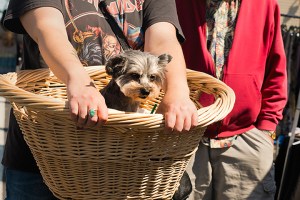
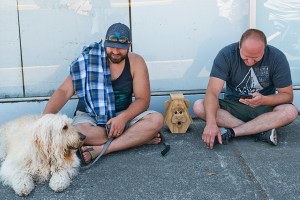
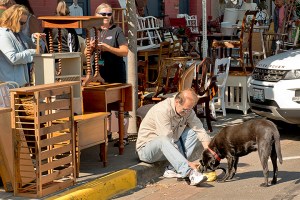
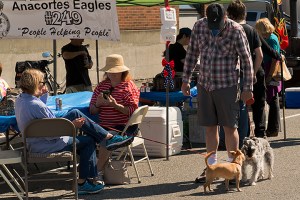
Dogs have become, actually I think they always have been, part of the family. And on my trip to the city of Anacortes there were dogs everywhere.

There were there dogs taking their owners on stop and go walks along the streets and alleys, There were dogs patiently waiting outside of grocery stores, restaurants, bars and shops along the main street, there were dogs lounging in the shade after a strenuous day of helping their people look for treasures at the giant flee market, and when I got up to leave for home in the morning I saw dogs excitedly stepping out of their motel lodgings and wait anxiously for vehicles to be packed.

Photographing dogs is always fun. Well, that’s my opinion.

Walk up to some stranger and ask if you can photograph them and all to often they will either say no or silently and quickly turn and walk away. But ask that same person if you can photograph their dog and you’ll usually be met with a smile and “sure”. People are proud of their dogs.

The accomplished street photographer and blogger, Han Dekker always includes at least one photo he calls “street dogs” in his posts each week. And it’s his photos that got me thinking I should spend some time photographing people with their dogs as I walked the streets of that small coastal town.

I like dogs, so photographing them and complementing them and their owners is always a pleasure. I did do street candids of some people and their dogs. However, mostly I would walk up and say, “I gotta take a picture of you and your dog.”

One will find lots of artistic dog photographers on social media. I would call some of them portraitists when I look at their creative depth of field and soft focused images. Others are more candid with their distant captures, and some are surely making social statements. However, my approach is as always, to just have fun as I move from subject to subject.


Practicing Street Photography      

I have read that Street photography is the practice of photographing chance encounters and random incidents in public places, Well, like the street.

In an article about my experiences in Vancouver BC some time ago I wrote, “I think that successful street photography captures a moment from the society around us. It’s a moment in time that is an important for the present and future.”

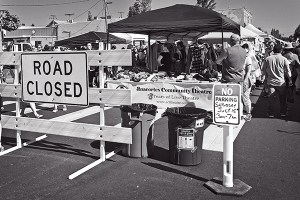
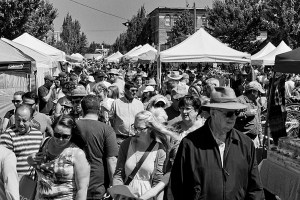
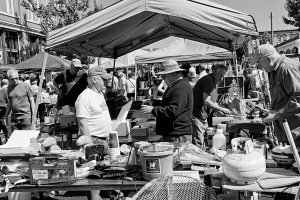
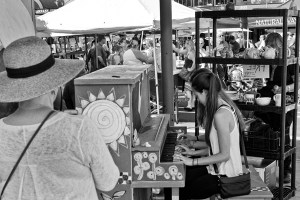
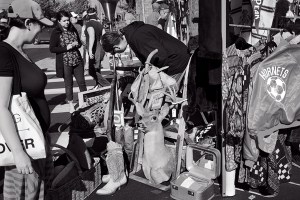
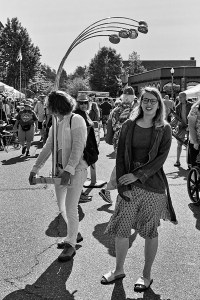
I am fascinated with this kind of candid photography that has been around since people began to carrying cameras in public, and I am always up to any occasion that allows my somewhat reserved and not so confident approach to photographing strangers going about their life on any public street. So when that opportunity presented itself at the giant outdoor flea market in Anacortes Washington I was excited.

Most modern street photographers seem to be recommending small, inconspicuous mirrorless cameras. However, in spite advice posted on many of the forums I have visited I still wondered if I could again try using my big DSLR with a battery grip and 24-70mm attached. I admit that’s a huge and very noticeable combination that the last time I tried at this event had curious by-passers looking right at me.

I remembered a 1969 Algerian-French movie, called “Z”, about some foreign dictatorship and a photojournalist who helped to uncover evidence about a murder. The photographer, wielding a big camera with a loud motor drive, continually shot from his hip. So I thought, what the heck, lets see if I can get away with that. Also, knowing I could easily crop, I moved the lens to its widest 24mm and photographed everything holding my camera at my waist.

I also figured that people at the street sale would be so absorbed with their treasure searching that if I didn’t hold my camera up to my eye, like I did last time, they would be oblivious to my photography.

My results were much better than last time. I wandered releasing the shutter anytime I observed people doing something interesting. There were a few camera conscious people that remarked about how big and nice my camera was, and one guy even asked the model I had. Nevertheless, none of my pictures showed people turning to look at me as I was taking a picture, except for those times when actually I asked someone to pose.

The big street market made things easy, and my new “stealth” photography technique made me more comfortable. And as I said, my results were much better this time. Whether it will work when I am not at an event that distracts people’s attention away from me remains to be seen.

Another trip to Chase Falls             


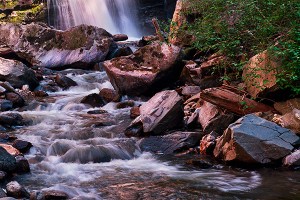
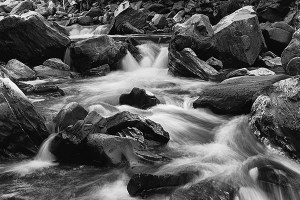
When I suggested to my friend, photographer Jo McAvany that we should drive over to nearby Chase Falls I imagined we’d be walking up a water filled creek to an overflowing falls and expected to be spending as much time wiping the water spray off my camera as I was taking pictures.  However, to my surprise the water coming over the falls was really diminished from its usual early summer flow.

The narrow stream canyon had been assaulted by a lot of water at sometime in the last month or so because there were lots of large rocks where there once was sand and my usual place for wide pictures was covered by a large pile of washed out trees.

3PM on a hot, cloudless July afternoon was definitely the wrong time to photograph the falls. The bright sun was cutting its way across the left side of the canyon leaving the right side in deep shade.  Even with graduated ND filters, trying to balance the scene’s high contrast was impossible.  Nevertheless I scrambled up and over the scattered boulders to find a better position, while Jo chose to work along the bank under the trees accompanied by, as she soon noticed, an ever-growing swarm of mosquitoes.

I guess there were enough breezes coming from the falls to push the mosquitoes away from my position, or maybe I was so fixed on my struggle to get some kind of image out of the contrasty scene that I didn’t notice their feasting.

I stacked ND filters over my lens and pointed my camera either into the sun or into the shade. It was one or the other if I didn’t want over or under exposures in my captures.

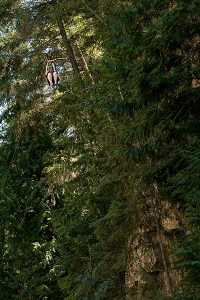
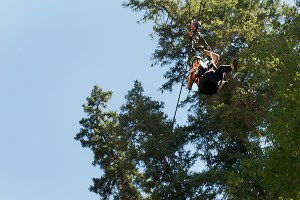
When I clambered back to where Jo was I found she had all but given up on the harsh lighting and was photographing people zip-lining above us. Well, that and giving her self up to the blood sucking hoards. She mentioned to me that she was being bitten everywhere, but dedicated photog that she was she still stood waiting for another zip-liner to zoom by screaming over-head.

I climbed down the bank and got a few more shots of the fast moving water and, of course, I just had to snap a couple shots of the people flying by.
Jo had just about had it with the mosquitoes and I finally began to notice the pesky creatures, so even though it was cooler by the creek than back at the car, we tore ourselves away from the falls with a promise to come back covered with repellent on an overcast day.
I will admit that what I like best about Chase Falls is they are only a few minutes drive from my home. It’s a cool location to scramble around and even though I have photographed it multiple times in every season during the last 40 years I have lived nearby I still enjoy making the trip there with my camera.
I guess there are lots of us photographers that have photographed local subjects over and over and over again.

I remember a long time old friend complaining. (Well he seemed to be) about a high mountain place we had climbed to countless times before. As we waited for the sun to rise he said, “I have taken every photograph that can be ever taken here”.  I quietly continued to drink my coffee without replying.

I am sure he knew I disagreed.


An excellent tool for a roadside photographer           

I live in a wooded rural location just short of an hour from the city of Kamloops in British Columbia, and it’s so easy to hop in my car to drive along the winding back roads. I suppose I could hike or climb, but truth be told I have the most fun as a roadside photographer.

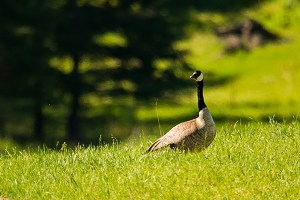
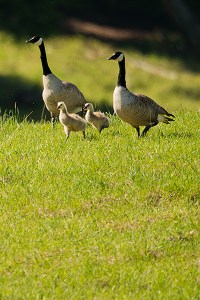
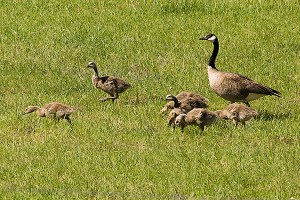
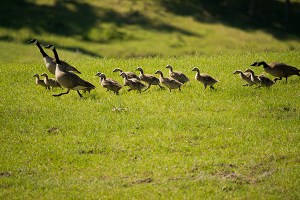
For years, each spring, my wife and I looked forward to seeing geese hatchings at a near by pond. There are normally two, or sometimes three adults with six or eight goslings hiding in the long grass just across the reed filled pond. However, this spring there are at least eight adult geese and maybe twenty soft yellow goslings residing at the pond.

To photograph them we would stealthily slow the car down and ease to a prolonged stop. Coming to a sudden stop spooks the apprehensive geese causing them to dash away. Do geese “dash”?   Anyway the fearful gaggle of geese would quickly move from sight. And opening the car door to try photographing them is a waste of time.

Having decided on the time of day that gives me the best light, I first slowly drive by so as to determine where I want to stop for the best photos and I shoot from the car. The geese are usually far enough away that anything shorter than a 300mm lens isn’t close enough. Actually, 300mm isn’t really close enough.

In the past twenty plus years Linda and I used countless kinds of equipment to stabilize our lenses. And the best, in my opinion, is a beanbag. A beanbag fits nicely on the car’s windowsill and allows the photographer to nestle down and rest any size lens on it for shake free shooting.

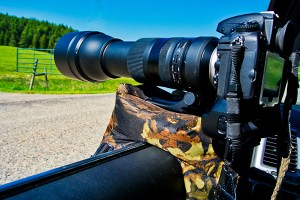
This year I purchased, after months of research and selling off some of my other lenses, the latest Tamron 150-600mm lens. The lens weighs just over four pounds and although it does have vibration control, shooting from a seated position in a car isn’t the best for sharp, shake free photographs. So out comes the beanbag. However,  I quickly realized that big lens demanded a larger beanbag than the one I hastily stitched together years ago.

With a bit of online searching I found a company called Movophoto.com that makes a large and unique beanbag that fits like a saddle over the car window. With my limited sewing skills I could never have made such a perfect beanbag for that big lens. I ordered it, and when it finally arrived I filled it with rice, and although it’s heavy it resides in the car and stays put on the window, so the weight is a good thing. There are a lot of gadgets that I could spend my money on, but for now that beanbag is my favourite.

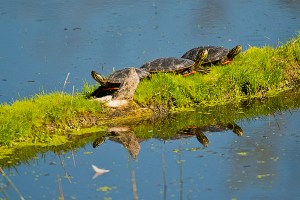
I slowed my car to a stop next to the pond, shut the engine off, positioned my camera on the large beanbag, and waited for the geese to resume their browsing along the grassy hill beside the pond. At 600mm I was able to frame pretty darn close. Then, when I wanted a different position, I’d just move the car a bit, and take more pictures. I photographed those geese (and some nearby turtles) for about thirty minutes.

Suddenly I heard loud honking from some unseen goose that must have been hiding in the tall pond reeds, and, like a crowd scene from a movie, they all turned at once and rushed into the pond.

I am sure there are experienced photographers that would have set up a blind and waited for hours to get the perfect shot. There is no doubt they will get my respect. But I know where those geese are and what time of day is the best to photograph them. And anyway my car is really comfortable and when I am done I just drive home. I guess I am just a roadside photographer.