A photographic discussion.     

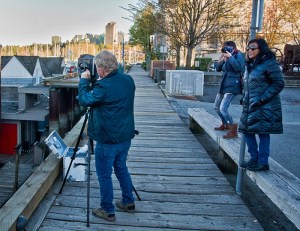
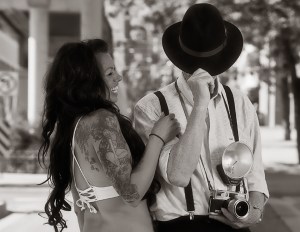
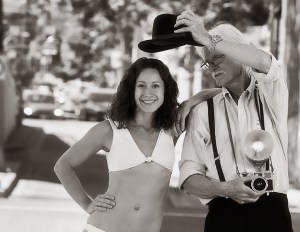
Photographer Jo McAvany’s loose goal was to create a visual contradiction (artists might call it a “juxtaposition”) that discussed a time when early photographers wandered cities documenting scenes of urban life for weekly newspapers and the modern era for women that gained momentum in the late 1950s and early 1960s.

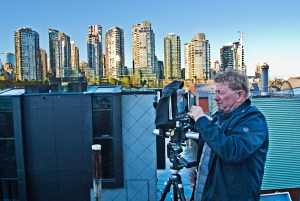
Jo wanted that look one might see newspaper reporters/photographers wearing in those early black and white movies. The fedora, a pinstriped shirt with rolled up sleeves, suspenders and an early 1940s 35mm film camera.

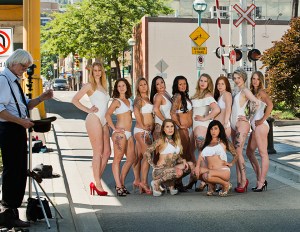
She came up with the white swimsuits after seeing a picture of Hugh Heffner surrounded by Playboy magazine playmates. When she sent me the picture my comment was “the robe?” She said, “no your Heff look.” I wasn’t sure about that, but I did like her idea about the 50s.

She chose to have women wearing white swimsuits to represent the modern era that was propelled, or at least gained momentum in the late 1950s, in part, do to Heffner’s magazine.

Jo put the call out and immediately had 14 or 15 replies. We had eleven at 9AM on the day of our shoot. I had no doubt that Jo could control and pose all those women. For my part, all I had to do was stand there, as a prop for them to pose against.

My main concern was the lighting. As regular readers know, I don’t much like flat, uncontrollable natural light. I brought two speedlights on stands with 40”umbrellas and asked my friend Drew Vye to assist with the lights when I was detained as a model.

The biggest problem was the bright morning light and clear blue sky. I quickly realized the speedlights weren’t powerful enough to balance the painful light at the first location. Drew, Jo and I started wandering, and after yelling back and forth down the sidewalk we chose the middle of the street location.

We would need to move when some car came through, but it was early and during the two hours we were there only one car angrily honked. Most drivers were amused to see all the attractive women in swimsuits and drove by smiling and waving.

The changing light from there wasn’t that much of a problem. Drew and I just kept moving the lights so there wouldn’t be ugly shadows and make sure Jo’s subjects had depth and were separated from the background.

The street location couldn’t have been better place to show the city. And when Jo used the 70-200mm the perspective was excellent.

I know the women all had fun. We even had them pose in front of a nearby restaurant with the reluctant manager that I dragged out. Oh, and when I suggested that they pose with Drew they all hooted and waved him over. He now wants enough prints to send to every relative he has in Canada.

As I stood in the street holding that old camera and tipping the brim of my hat down I thought about a press photographer from New York’s 1940s named Weegee, known for his stark, black and white photographs of urban life and hoped Jo would capture some of that feeling.

A photographer can make all kinds of statements. Jo’s visual discussion is about the changing times we live in and, in my opinion, how photographers have been playing an important role documenting those changes.


Eliminate the Irrelevant from your Photographs  

Years ago the Hasselblad camera company put out a series of photography pamphlets packed with great advice and information that I collected and studied.

Recently I thumbed through one I still had entitled “The Eye, The Camera, The Image”. And although meant for medium format film cameras it’s filled with information that is still appropriate for modern digital camera users.

I skimmed over topics like “Using the focusing hood magnifier, Colour film and light colour, Types of exposure measurement, X synchronization, Double exposure and Polaroid film”. All an interesting read if one is concerned with photographic history, however, not practical or useful for those searching to be a better photographer in the modern digital world.

One topic entitled “We see far to much” says, “The eye is our organ of sight. It’s lens has a focal length of about 17mm and covers a 150-degree vertical and 120 degree horizontal field; the binocular vision provided by our two eyes gives a 180-degree angular field. We seldom have any need for images encompassing so wide a field. The wealth of detail in such a field would be rendered small and insignificant when reduced to images formed in a camera when composing a photograph outdoors or elsewhere. We always need to crop our field of view.”

That paragraph is worth thinking about. Most successful photographers “tighten up” on their composition, and by that, I mean they only include those elements that add to the visual statement of a photograph. Beginners mostly just aim their cameras with only the excitement of their subject in mind and don’t pay attention to additional unimportant stuff captured by the sensor.

Photographers often look at their final image and find a picture filled with irrelevant and disruptive items that really should be to be cropped out. If they just took their time to move closer, or zoomed-in the lens they would have had an attractive composition in-camera.

Hasselblad continues, “This elimination of irrelevance is vital. The trick often involves excluding most of what you see. Making a selection is a basic feature of all art, whether it is painting, drawing or photography. Art consists of picking out the most interesting, most illustrative, most instructive, the loveliest or most emotional components among a myriad of components in a subject.”

Photographers must train themselves to be specific with a subject only showing the viewer what is important. Gosh, how do we slow down to do this in an age of auto focus, auto aperture and rapid-fire shutter release?

I have an easy answer – get a good tripod!

I know many photographers have never owned or used a tripod and some have only employed rickety, inexpensive models. My comment to anyone that says they don’t like a tripod is “You’ve never used a good one”.

Using a sturdy, well-made tripod makes one slow down and pay attention to the subject in the viewfinder or LCD. In addition, the process of setting up the tripod and attaching a camera gives photographers time to think about the composition. I agree with Hasselblad’s contention that “we see far to much” and the need to eliminate irrelevant items in our compositions.

When that neat and interesting subject is seen stop the car and get out. Don’t be lazy and merely hunker down against the window and take the shot. Get that sturdy tripod out of the trunk and as you do think about, or “previsualize”, the photograph about to be made.

Set up the tripod, attach the camera and look through the viewfinder. I suggest making several shots starting from a narrow, limited view and zooming the lens out to a wide-angle view. That way there will be several choices for that picture.

To sum up, eliminate those elements inconsequential to the picture and compose for only those items important to the final photograph. Not by looking at the subject and snapping away in a hurried fashion to include everything, and take my advice and use a tripod for scenics.


Event Photography   

When some photographer asks me my thoughts about photographing an event that comes with lots of people I tell them that, for me, the most important three things that make successful photos come with the letters: P.P & F.

The capital letters PPF stand for, have ‘Patience”, always “Pay Attention” and absolutely use a “Flash”.

These days everyone has a camera in his or her pocket.

When anything happens they quickly grab their phone and awkwardly start recording. That’s great and I am so pleased that kind of technology is readily available for everyone. However, for those that want photographs large enough to make the rare print, or sharp enough to withstand the inexpensive material that a newspaper is printed on, or even the quality of most in-house magazines, the tiny sensors of phone will be inadequate.

That’s when the call comes from knowledgeable organizers for those photographers I will call “event photographers” who are willing to spend long hours photographing that special occasion.

My PPF begins with “Patience”. Many untested photographers whose experience is family gatherings or short weddings may be willing, but are unaware that it’s their job to photograph anything their client deems important. Most of the time that means one or two photos of a speaker or award recipients or the recognition of that person of organizational importance.

The event photographer’s job is to patiently stand there at-the-ready, without blocking the audience’s view and get that picture.

“Paying attention” doesn’t need much description, because it’s simple. The photographer is always “Patiently Paying Attention” to everything that happens. Even if that means standing back out of the way poised to rush up for that important moment. So I’ll just leave it there.

Lastly, I have to get to the equipment part.

Most of today’s modern cameras are capable of high ISO. Basically, ISO means that the camera’s sensor sensitivity can be set to make exposures in very low light and for many cameras that low light capability is part of the manufacturers selling point.

What the manufactures don’t discuss is the quality of light. Sure the image can be made bright enough to make out someone way up on a stage, but the light always comes from overhead. And that light never balanced to what most of us consider as pleasant skin tones. The usually dim yellow or purplish overhead meeting hall or gymnasium light makes unflattering shadows everywhere.

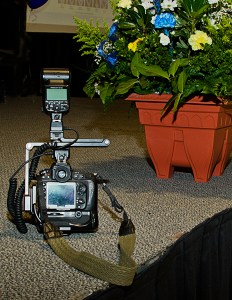
Having a flash, no not the tiny little thing that pops up when the light is low. But a flash that one connects on DSLR camera’s hotshoe.

With a modern dedicated flash it doesn’t matter what camera mode is selected the flash will always release a properly programed amount of light. Light that comes from the cameras and is in front of the subject, illuminating the face of everyone in that location. Light that dissolves the shadows. (Except for those directly behind someone or something) And finally light that is much more flattering than the off-coloured lights attached to the ceiling.

My mother used to tell me that “anything worth doing is worth doing right”.

Being more interested in some guest than the list of speakers, or missing that crucial shot because it’s uncomfortable (or embarrassing) to run across the hall to catch that important moment, or being to lazy to first learn how the flash works, or worse not even bothering to use one, is not doing something that should be “worth doing right”.


A spring drive with my infrared camera.

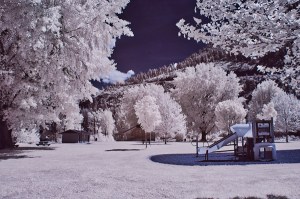
The bright sunny spring day was perfect for infrared photography.

I hadn’t used my old camera that I had converted to infrared for quite a while. The last time it was used was by my friend Jo last February. The images Jo made in on that winter day were a fun change for her from the colourful photographs she was used to with her big 36mp Nikon.

Infrared is always a crowd pleaser and using an infrared camera is the best way to step away from what other photographers are doing.

After my failures at finding and photographing those tricky geese I figured it was time to get that IR camera out. I charged the batteries, set the white balance, made sure I had an empty memory card, mounted my ever-so-sharp Sigma 20-40mm lens on it, finished my cup of coffee and finally sat it on the seat beside me as I drove off to see what there was waiting for me to photograph in the next few hours.

I drove the rural roads around my home for a while, and then decided to check out the waterfall a bit down the highway.

There was lots of fast spring runoff water coming over the falls, but the little canyon was still in too much shade. To get dramatic infrared photographs of the falls I prefer a wide shot that includes vegetation. But on this day the shade made my unaltered infrared image mostly brown with only a few slashes of bright light drifting down to make some features blue. Without strong light the there won’t be bright white foliage and the final image wouldn’t be much different than a normal black and white picture. So I gave up and crossed through the small town of Chase to the lakeside.

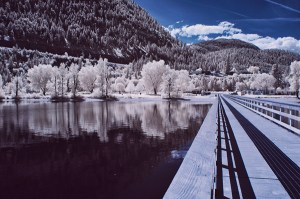
The lakeside was in bright morning sun with blue sky and was perfect for infrared. There weren’t many people and the small grassy beach park was empty.

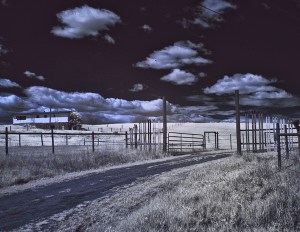
Infrared creates a completely different feeling. I have written before that using a modified camera is an exploration that moves a photographer far from the usual camera image and the final effect is quite unworldly. The bluer the sky, the greater the likelihood of that unworldly effect; and things that are white or have been turned white (like trees) can glow with an ethereal brightness.

My camera produces images that are limited it colour range. Unlike many modern infrared conversions that give many dramatic colours, the original pictures from my old 6mp camera are mostly shades of brown and blue. By altering the colour channels I can get a few different colours, but much of the time I prefer B&W.

At his writing I am thinking it might be time to see what Lifepixel.com has for sale with a newer, higher megapixel camera.

Black and white makes me think about the subject first and then the light, or how a subject looks in a particular light. Infrared, on the other hand, makes me think about the light first and then includes the subject. Of course the subject, and how it is composed and framed is important, but some things don’t look very different (depending on how the IR light is absorbed) than a colour image converted to black and white. With my old camera I must be thinking about the light first and then choose subjects that I think will look like they are photographed with infrared.

To me using an IR camera is always an exploration and certainly a discovery. And the best think about using infrared is how it allows me to create photographs “that are far from the usual.”


Photography after the Vancouver Camera Swap and Sale.                   

Last October I wrote, “There was a discussion. For a photographer; Granville Island rain or shine was the prefect place to wander with a camera”.

“Buildings filled with expensive artwork, a food fair, farmer’s market, artist studios and, of course the Emily Carr University of Art and Design, are all exciting places to take pictures”.

The Camera Swap and Sale was a success and we tried to sleep in the next morning. But Jo was up with the seagulls, full of energy and rearing to go to Granville Island. I was lucky she even gave me the time to eat the hotel’s complimentary breakfast.

I had told her we would spend as much time as we could doing photography on Granville Island. We had stopped for a short time on Saturday night (before Sunday’s event) so Laurie could photograph buildings across False Creek in the setting sun with his big 4X5 sheet film camera.

That night the light was dropping fast when we got there and we spent most of our time setting Laure’s camera up in different locations. There wasn’t much time for Jo to wander so she was excited to go back when the island was packed with people in the bright sun.

It rained the two last times Laurie and I were there.

Parking was tight on Sunday and it was a chore for Laurie to squeeze his truck into a parking space meant for small compact cars. But after what seemed like a lifetime he finally did, and without hitting the cars parked tightly on both sides. Hey, Laurie was a Canadian farm boy. I am sure he was driving a truck as soon as his feet could touch the gas pedal.

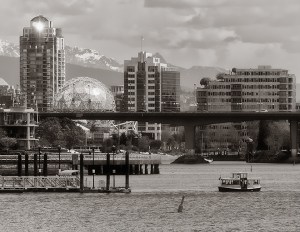
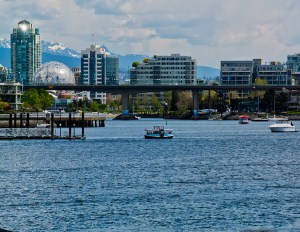
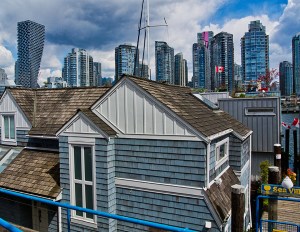
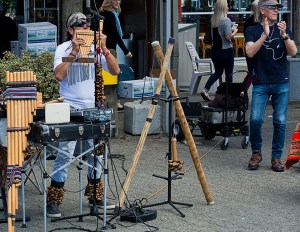
The place was packed with all kinds of people, and the colors were wild, inviting and perfect for photography. Seagulls posing on benches, street performers, fascinating buildings, an exotic and animated farmer’s market, the scenic Granville street bridge with snow capped mountains in the distance behind it, a cityscape of Vancouver across a boat filled waterway, and, of course, the four of us laughing and posing for each other.

For those that didn’t read my last article, “Granville Island is a peninsula and shopping district in VancouverBritish Columbia. It is located across False Creek from Downtown Vancouver. It was once an industrial manufacturing area. However, now it is mostly comprised of remodelled warehouses and has become a hotspot for tourism and entertainment. The area was named after Granville Leveson-Gower, 2nd Earl Granville.”

We wandered and lost the world as we discovered and photographed everything on that cool, clear, coastal spring day.

American photographer, Harold Feinstein, referred to as the “Unsung chronicler of Coney Island” wrote what I think is in the thoughts of many photographers.“I love this life. I feel like I am always catching my breath and saying, ‘Oh! Will you look at that?’

Photography has been my way of bearing witness to the joy I find in seeing the extraordinary in ordinary life.

You don’t look for pictures. Your pictures are looking for you.”

The spring Vancouver Camera Swap Meet.  

Spring comes so much earlier at the coast than where I live.

My friends Jo, Laurie, Habiba and I made the trek to Vancouver for the spring used camera equipment sale, and we couldn’t have asked for a more pleasant day.

The sky was clear and the rain that usually has us rushing from our truck to the building was uncharacteristically missing.

Last October Laurie and I had decided we needed help at our tables so Laurie somehow convinced his wife, Habiba, to come and I couldn’t have kept Jo away with a stick. She had wanted to come ever since reading my articles about the great time I always have.

I warned Jo and Habiba that our day would start early. We had a quick 6AM breakfast at our hotel and jumped into Laurie’s equipment packed truck to drive to the show by 7:30AM. Then rushed to unpack and have our tables ready before the Vancouver Camera Swap Meet and sale at 9AM.

Laurie and I always go though the guessing game of What will Sell? Last time anything from the 1970s was popular and digital equipment was totally ignored so we packed our tables with film cameras and old manual lenses.

I did bring several modern digital lenses, but the younger crowd showed little interest in them opting instead to go with the camera types that I had used before most of them were born.

Personally, I am relieved not to be using film anymore. I got my first DSLR back in 2001 and haven’t looked back since. However, I will admit talking with young photographers excited with film is fun. I don’t know how long this craze will last, but there are lots of people searching for and listening to records these days and like that “retro” trend I expect film will be popular for some time to come, and I will continue to search out and sell cameras from the 1960s and 1970s.

As usual the camera sale was packed and I saw friends from years past and, as always, made new friends.

Talking with other photographers is so much fun.

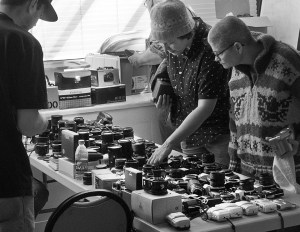
This was Jo’s first camera sale. I had talked about what we’d be doing and what the sale would be like, but I knew she had no idea of the all-day frenzy.

The Vancouver Camera swap meet is non-stop fun from 7:30AM to 4PM. And although Jo is a great photographer and quick study, the cameras that filled the table were not what she had ever used. But a camera is a camera and she dove in head first talking with and showing cameras to the shoulder-to-shoulder crowd. Way to go Jo.

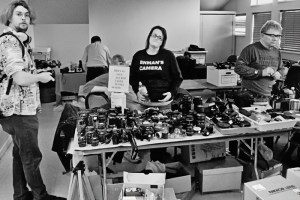
I do hope she won’t be upset with me for including a photo of her at our table just minutes before the things got going.

In my last article I asked. “What keeps me coming back year after year?” Then answered “The people, of course”.   I also wrote that this camera event has, “ Antique, vintage, digital, and everything else for photography, new and used.

Looking at, touching and discussing some precious piece of camera equipment with someone you just met is darn fun, almost as much fun as making pictures.

The Vancouver camera show and sale is over for now, but Jo, Laurie and I are already talking about returning for the October show.

Those that read my last article about the camera sale must forgive me for again using a quote by the famous Canadian singer Celine Dion again, but is just seems to fit so well.

“I don’t know if the camera likes me, but I do like the camera”.


Photographing Fallis Pond on a warm spring evening.  

I had been wondering how the pond up the road from my home was changing since my visit was only two weeks ago when the geese and ducks were wandering around on a thin layer of ice.

At that time the surrounding fields were beginning to turn green and the pond inhabitants seemed ready for spring. On that visit, other than a noisy goose on hill warning everyone of my presence, the pond was quiet.

This time I had checked my Honda’s manual and there wasn’t a stealth mode. But I suspected the geese would be hidden away nesting and doubted there would be any birds at all to photograph.

As I stopped at the pond and rolled down my window I was bombarded by a cacophony of sound. The sounds were not so much a warning as a celebration.

I pulled the car around and stopped at a high flat spot on the road so I would be out of danger from country drivers more intent on getting home along the winding road than watching for a parked car.

Although I had my camera and lens ready I just sat for a while listening to the discordant music of that country pond. There must have been hundreds of singing birds hidden out of sight.

As for the geese, I could see a few searching heads in the distance and there was only one big fellow guarding by the fence line.

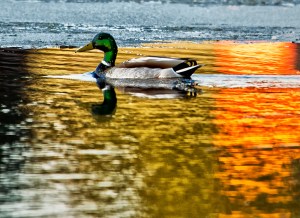
The sun was low and the pond was reflecting colors that ducks swam through.

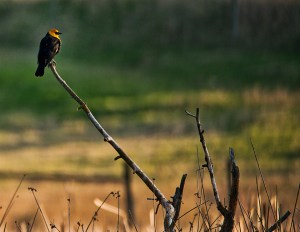
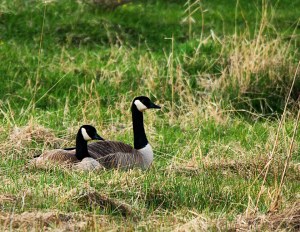
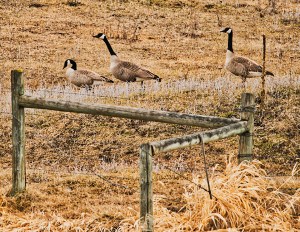
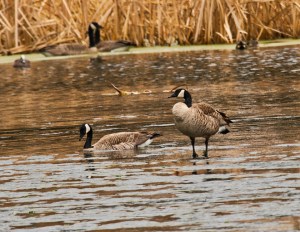
Not wanting to return with an empty memory card I took the opportunity to photograph two geese I spotted huddled close by and a bird or two perched on lifeless reeds still poking out along the pond’s edge.

I could have sat there till dark enjoying the evening concert, but I decided to head home, driving slowly in hopes of seeing other subject in the fading light.

I’ll return in a week or two just to keep up with the changes. There won’t be goslings or ducklings for me to photograph for about 30 days, but I the pond is only a short drive from my home, and I am sure there will be lots of “spring” opportunities to photograph as I wait.

I headed to Vancouver this past weekend with my camera. The substantial change of scenery was invigorating. I went with 3 friends and took the chance to wander the coast for some late afternoon. Ahh….the exciting life of a photographer.

My first geese photos of the year.  

The ice has been melting along the river all week long and I wondered if the pond up on Duck Range had melted enough for the geese to return.

The days have been warm, but the nights were staying at freezing or near freezing. However, in spite of the day’s constant drizzle of cool rain I was curious to see if there were geese on the pond and if there were any goslings yet.

I suspected I was early, but grabbed my camera, put the ISO up to 800, then mounted my 150-600mm on it, tossed the beanbag on the front seat of my car and headed out up the road to see.

I slowed down just before getting to the pond and rolled my window down. Hmmm, there is a hint that I am from a past generation. I haven’t seen a car that one must actually turn a crank to “roll down” a window in years. Anyway I pressed the switch and the window slowly and quietly sank out of sight.

I drove very slow hoping I wouldn’t disturb the geese. Ha, fat chance! From the rise above the pond there began a loud racket of honking sound. There went my attempt at sneaking up on the anything near that pond. I’ll have to check my Honda’s manual to see if there is a stealth mode.

The pond was filled with ducks and geese, but no ducklings or goslings yet.

I photographed the three sentinels before they could find cover. Then drove past and turned around so I could stop and shoot from the cover of my car.

Much of the pond still had a smooth cover of ice and there were more than one kind of duck paddling along the edge or just standing enjoying the slight drizzle that had been going all day.

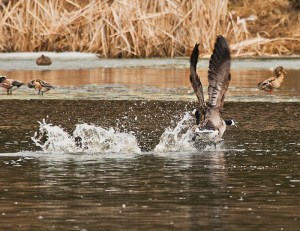
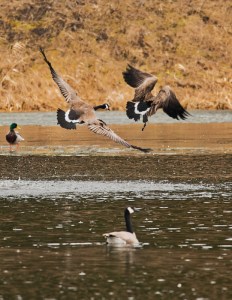
I photographed the ducks and what geese I could see on the pond and tried to get some good photos of the geese that noisily flew off.   I didn’t do badly, but I think some of the avid bird photographers I know in Kamloops would have been better prepared than I was when the pond exploded with splashing water and flapping feathers.

I stayed for a while and the pond calmed down and became quiet giving me at least a chance to photograph the ducks and geese that finally decided to ignore me.

Those that read my articles about trying to photograph the pond’s geese last year will remember my disappointment because they were nesting and feeding on the opposite side of the hill. This was my first trip to the pond to photograph the geese and I am determined to get some good shots this year and plan on a weekly visit.

I left the beanbag in my car just in case.

Photography is an art of finding something interesting.  

Gosh, the first day of spring (has passed) and the temperature is climbing.

I stood out on my porch looking at the melting snow along the walkway to the driveway thinking that winter seems to have come and gone in a rush this year.

It was a lazy day for me and I really didn’t want to do anything except have another cup of coffee and maybe snooze on my chair listening to music. However, I do like pointing my camera at things and this would probably be my last chance to photograph things poking out of the snow. And if this year is like most I expect the cool spring rains will be pounding on my roof in short order.

So, as hard as it was I ignored the waiting coffee grinder and went off get my camera.

My latest acquisition is a 300mm lens. I like that focal length and have had several since the first Pentax I owned back in the 1970s. This latest lens came with a 1.4 telextender that gave me a 450mm of reach.

I have a longer 150-600mm lens, but the 300mm takes up less room in a bag or on my car’s seat, it focuses very fast and is just darned fun to use.

Although I sometimes photograph wide landscape vistas my preference is tight close shots. It’s the intimate, close cropped “parts” of a scenic that catch my eye. So after making sure I had an empty memory card and charged battery I mounted the 300mm lens on my camera and set off to see if I could make some interesting photographs of things resting on, or poking out of the snow.

By the time I drove down the road the sun was high in a bright blue cloudless sky. My choice was to head up into the hills or down to the river. But I wondered if the small pond was still frozen over so I went up.

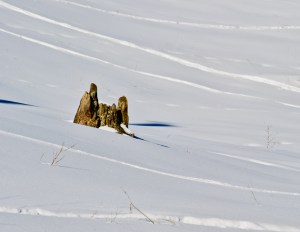
The pond was frozen without a footprint or even a lonely bird in the tall lifeless reeds that circle the pond. I was disappointed, but as it has for the past 40 years, this rural place where I live, always offers something that catches my eye. The long lens was the perfect tool to isolate and exclude as I focused on the remains of a tree poking out of the snow. That broken and rotted stump in a desert of white snow was crossed with neat long thin shadows that made up for the boring pond.

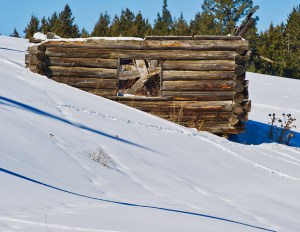
I stopped to photograph what was left of an old log building that once might have been for storage or maybe living quarters for some ranch hand. When I first drove down what was then a bumpy dirt road many years ago it still had a glass window and roof, but now only the decaying log walls remained.

I drove around getting out of the car and trudging through the wet snow trying to photograph subjects I have photographed before in a new way.

I often wonder what the people in the cars think when they, once again as they have many times before, pass me pointing my camera at some subject. Most are not photographers, making the things I am photographing of little interest to them.

It always seems new to me. A bit familiar for sure, but this was the first time I photographed anything in my neighbourhood with this particular lens.

So yes, new.

I know I’ll be back photographing everything again when it rains or maybe when the grass begins to grow or when there are geese in the pond or anytime I am in the mood.

I know I have included this quote from American photographer Elliott Erwitt before but it just seems to fit.

“To me, photography is an art of observation. It’s about finding something interesting in an ordinary place… I’ve found it has little to do with the things you see and everything to do with the way you see them.”

Photographing dogs and using flash outdoors.  

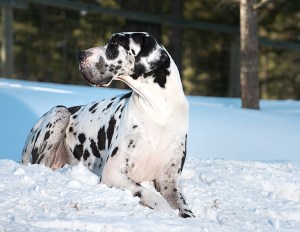
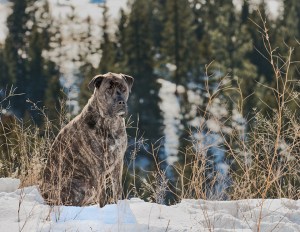
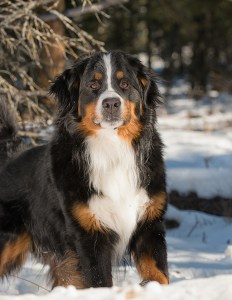
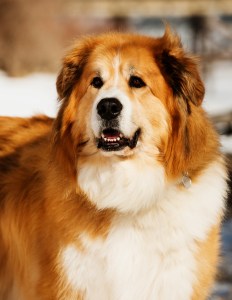
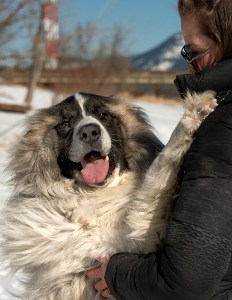
When my friend Jo McAvany told me she wanted to do something the combined her love of photography and love of large breed dogs I was intrigued. She said she was planning to make a photograph book of big dogs that live in the Kamloops area.

Jo intends to spend the next year photographing the dogs in all seasons and at different locations throughout the year.

For the past two years that I have known her I’ve been pushing her to use lighting when photographing people indoors and out. She began by attending my lighting workshops and eventually became my ever-helpful teaching partner.

I guess I shouldn’t have been surprised when she said. “Will you help me with the lighting on my project”. I readily said I would.

Flash technology made quite a leap from the manual settings we once used to when Nikon added TTL in the early 1980s. That was when I sold all my Pentax and Canon equipment and “jumped” to Nikon. (I am pretty sure all modern cameras have TTL flash capability)

Flash took another large step when digital cameras became the norm. TTL was already almost foolproof and digital technology offered added control. Then it again matured and “High-speed Sync” was introduced and mastery over light in any environment and condition became easy.

Manufacturers began offering portable wireless units that, unlike the dedicated speedlights a photographer usually purchases with their camera, are much like those powerful units used in serious studios.

For readers that aren’t familiar with flash, High-speed sync means a photographer is no longer limited to the normal 1/200th or 1/250th second flash sync most speedlights use. HSS allows a sync speed up to 1/8000 of a second.

When I teach workshops on Flash I tell participants that the Shutter controls the ambient light and the Aperture controls the flash power. And remind them that increasing the shutterspeed allows us to widen the aperture.

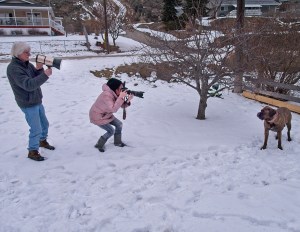
When Jo walked out in the white, painfully reflective snow on a bright cloudless day to photograph those dogs this past week the contrast between the shadows and highlights were enough to ruin the pictures. However, I added flash and moved around to change the direction of the light fell on her subject. All she had to do was reduce the ambient light by increasing her shutterspeed and change the flash brightness by stopping down or opening up her aperture. Our goal was to balance the light on the dogs as evenly as possible without Jo’s final image showing that a flash was even employed.
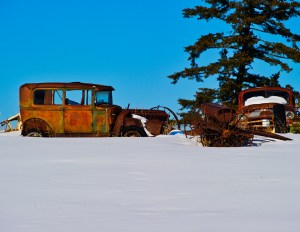
Jo worked with the owners to pose the dogs. She’s very precise when it comes to how she wants them to be for the photograph. My job was to pay attention to the flash-to-subject distance and keep checking to make sure the light wasn’t to bright or to dark.
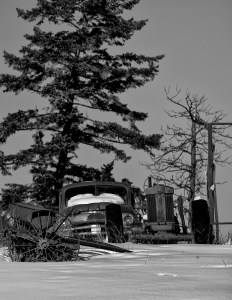
Confining oneself to only natural light means there will be elements beyond control. Natural light limits when and where one can shoot during the day. With the sun high in the sky at noon, there will either be a backlit silhouette, or the bright light will blind the subject and create black shadows. And if it starts snowing or raining, there usually won’t be enough light to shoot indoors.

Flash gives a photographer 100% control over the lighting. Whether completely doing away with the ambient light in the studio or adding flash with natural light outdoors, the photographer is in charge and can get the light to look exactly the way he or she wants it at any time of day.