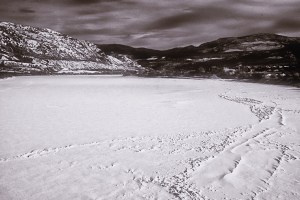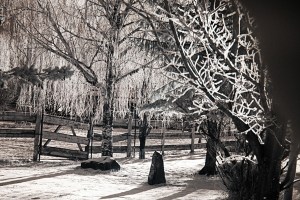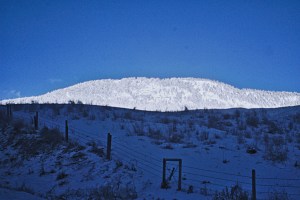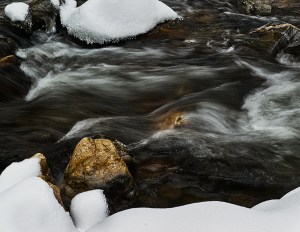
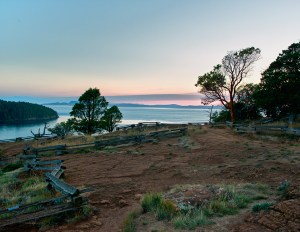
Scenic photography on Fidalgo Island        

Last week was my second article about my trip to the coast. I wrote that there were three very different photographic opportunities that I took advantage of on my four-day stay, the street photography during the festival, the architectural photography on a quiet Sunday morning and the scenic photography.

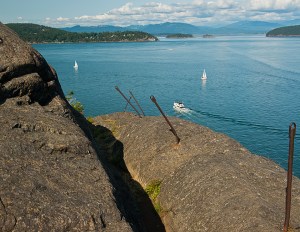
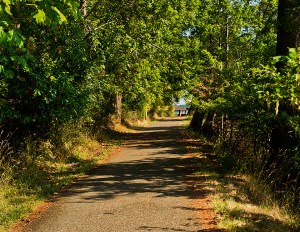
Jo and I wandered the beaches early in the morning. Walked along wooded paths during the day. Climbed the rock-covered breakwater beside a deteriorating wreck in the afternoon, and stood on a darkened pier at night.

We trudged to each location carrying equipment filled backpacks with tripods on our shoulders talking about, and making decisions concerning the photographs we would take.

As I sat down in the sand that first afternoon I thought about how hard it is for most people to do photography with me. Jumping out of the car, running to a view point, taking a picture, then jumping back in the car and driving to the next view is not my style.

I have to think, ponder and sit for a while. I am never in a hurry when it comes to scenic photographs. I have a need to experience the place. And, of course, I like to use a tripod.

On this trip we had my new 14-24mm and 28-300mm lenses to try out.

I have never been a fan of really wide photos, so using the 14mm was quite an experience. I purchased a 150mm polarizing filter and filter holder for that wide lens, and although that seemed to be a good setup the protruding front lens glass is vignetted by the filter holder resulting in a disappointing 19mm view.

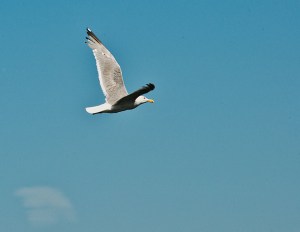
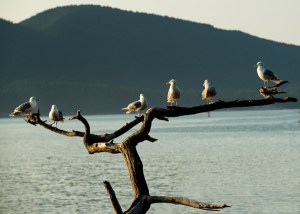
The 28-300mm was a surprise. I wasn’t expecting to like it after trying it in a dimly lighted studio. In the studio it had a hard time finding focus. However, I think the problem might be the lack of contrast in the studio because in that bright coastal light I was stopping birds in flight and getting sharp, colourful pictures.

I’ll hang on to both lenses. Like cameras, they are just tools and not every tool fits every job.

I had visited most of the places we photographed many time before. But all I have to do to make them different from past years is to place my tripod in a new location, crop my view and change the center of interest.

Even after all the years going there I still don’t have a favourite place, Although there are locations that I like to stop at depending on the time of day.

I always choose Cap Sante Park with its high lookout over Anacortes when I first arrive. During the day there are several rocky beaches that are waiting to be re-explored and photographed, and I always make time to walk out on the high Deception Park Bridge for a photo of the Deception Pass as it connects with the sea.

The evenings usually find me in Washington Park photographing both the leaning tree (it was still alive when I started visiting in the mid 1990s) that hangs out over the sea, and the island filled ocean from a high lookout as we complete the parks winding ring road on the way back to the city center.

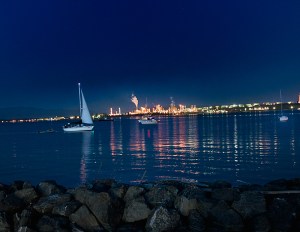
The best place to stand a tripod after dark is the beachside Seafarers Park for a long exposure night photograph across Fidalgo bay of the Marathon refinery’s lights.

I do enjoy my yearly excursions to Anacortes and plan on many more. I was having dinner with several people this past week and was asked about my trip to the coast. And as with many times before I talked about what I did, but I didn’t have any photographs to make clear as to why I return there year after year.

The famous American scenic photographer, Ansel Adams, explained it best when he said, “When words become unclear, I shall focus with photographs.  When images become inadequate, I shall be content with silence.”
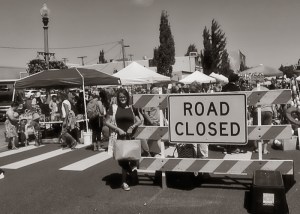
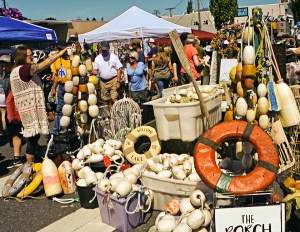
A photographer’s holiday at the Shipwreck festival      


Each year the month of July brings two of my favourite photography events.

The first is the Pritchard Rodeo and the second is the Anacortes Shipwreck Festival. Gosh, what an exciting month July is for photography.

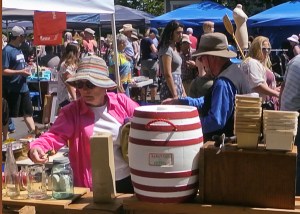
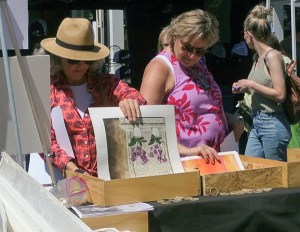
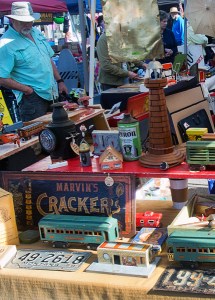
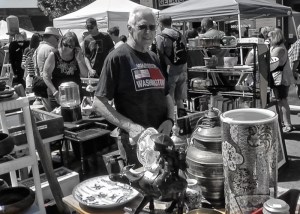
The preceding week had been cool and a bit rainy on the Washington coast, but when we reached the festival my friend Jo and I were met with a warm day that had just enough clouds in the sky to make it comfortable to walk around the 9 block street market filled with 400 interesting booths.

We had arrived in the town of Anacortes at the tip of Fidalgo Island after a pleasant drive the day before the annual Shipwreck Festival.

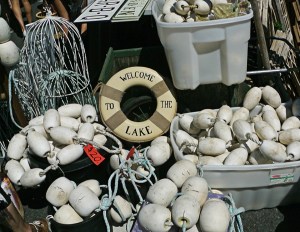
The locals say that the Shipwreck Festival began thirty-eight years ago when fishermen sold their used gear on the town’s main street. Since then the event has evolved into a giant garage sale/flea market that includes vendors that seem to be from as far away as Mexico.

Last year I wrote, “Whew, what a day. We saw, we touched, we photographed, and we talked to people from 9AM to 3PM. Then we stepped into a popular Commercial Avenue Alehouse called the Brown Lantern for a late lunch and I gladly got to rest my tired legs. I am sure Jo will recommend the crab and corn chowder she ate and I agree that both my food and the two beers I drank were the refuelling I needed.”

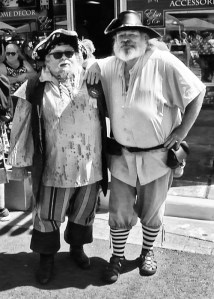
Well I can write that again this year, we again got to see, touch and even purchase unusual treasures, and I had a fun time photographing people on the crowded street.

Jo got to have that bowl of the crab & corn chowder she had been dreaming about since last July and I enjoyed two very dark beers while I rested my old legs. Then just as last year we were off for another look around and a few more pictures of the crowded street of happy bargain hunters.

I do like the treasure shopping as much as anyone, but watching the people and photographing everything on that island is what brings me back each year.

I have tried different cameras. When I first came in mid-1990s I used a Nikon F3 film camera. Then when digital arrived I used several different DSLRs until last year when I changed to a tiny Nikon 1 mirrorless.

What I like about the (recently discontinued) little interchangeable lens camera is it’s small size and quick focusing. I carry it in an old army bag that allows me to pull it out fast for street photos without getting attention from those around me.

The Nikon 1 doesn’t have the large higher quality sensors of the big and more expensive mirrorless cameras like the Fuji or Sony, but like any other tool that one might select for a specific job the little Nikon is great for the internet or even 8X10 prints.

This was the kind of vacation trip that I like, wandering the Shipwreck festival looking for treasures, (I bought a handmade flit blade knife) doing photography on the crowded avenue, meeting new people and getting to eat fresh seafood at local restaurants. All less than a day’s drive to from the very different environment where I live.

Eliminate the Irrelevant from your Photographs  

Years ago the Hasselblad camera company put out a series of photography pamphlets packed with great advice and information that I collected and studied.

Recently I thumbed through one I still had entitled “The Eye, The Camera, The Image”. And although meant for medium format film cameras it’s filled with information that is still appropriate for modern digital camera users.

I skimmed over topics like “Using the focusing hood magnifier, Colour film and light colour, Types of exposure measurement, X synchronization, Double exposure and Polaroid film”. All an interesting read if one is concerned with photographic history, however, not practical or useful for those searching to be a better photographer in the modern digital world.

One topic entitled “We see far to much” says, “The eye is our organ of sight. It’s lens has a focal length of about 17mm and covers a 150-degree vertical and 120 degree horizontal field; the binocular vision provided by our two eyes gives a 180-degree angular field. We seldom have any need for images encompassing so wide a field. The wealth of detail in such a field would be rendered small and insignificant when reduced to images formed in a camera when composing a photograph outdoors or elsewhere. We always need to crop our field of view.”

That paragraph is worth thinking about. Most successful photographers “tighten up” on their composition, and by that, I mean they only include those elements that add to the visual statement of a photograph. Beginners mostly just aim their cameras with only the excitement of their subject in mind and don’t pay attention to additional unimportant stuff captured by the sensor.

Photographers often look at their final image and find a picture filled with irrelevant and disruptive items that really should be to be cropped out. If they just took their time to move closer, or zoomed-in the lens they would have had an attractive composition in-camera.

Hasselblad continues, “This elimination of irrelevance is vital. The trick often involves excluding most of what you see. Making a selection is a basic feature of all art, whether it is painting, drawing or photography. Art consists of picking out the most interesting, most illustrative, most instructive, the loveliest or most emotional components among a myriad of components in a subject.”

Photographers must train themselves to be specific with a subject only showing the viewer what is important. Gosh, how do we slow down to do this in an age of auto focus, auto aperture and rapid-fire shutter release?

I have an easy answer – get a good tripod!

I know many photographers have never owned or used a tripod and some have only employed rickety, inexpensive models. My comment to anyone that says they don’t like a tripod is “You’ve never used a good one”.

Using a sturdy, well-made tripod makes one slow down and pay attention to the subject in the viewfinder or LCD. In addition, the process of setting up the tripod and attaching a camera gives photographers time to think about the composition. I agree with Hasselblad’s contention that “we see far to much” and the need to eliminate irrelevant items in our compositions.

When that neat and interesting subject is seen stop the car and get out. Don’t be lazy and merely hunker down against the window and take the shot. Get that sturdy tripod out of the trunk and as you do think about, or “previsualize”, the photograph about to be made.

Set up the tripod, attach the camera and look through the viewfinder. I suggest making several shots starting from a narrow, limited view and zooming the lens out to a wide-angle view. That way there will be several choices for that picture.

To sum up, eliminate those elements inconsequential to the picture and compose for only those items important to the final photograph. Not by looking at the subject and snapping away in a hurried fashion to include everything, and take my advice and use a tripod for scenics.


A spring drive with my infrared camera.

The bright sunny spring day was perfect for infrared photography.

I hadn’t used my old camera that I had converted to infrared for quite a while. The last time it was used was by my friend Jo last February. The images Jo made in on that winter day were a fun change for her from the colourful photographs she was used to with her big 36mp Nikon.

Infrared is always a crowd pleaser and using an infrared camera is the best way to step away from what other photographers are doing.

After my failures at finding and photographing those tricky geese I figured it was time to get that IR camera out. I charged the batteries, set the white balance, made sure I had an empty memory card, mounted my ever-so-sharp Sigma 20-40mm lens on it, finished my cup of coffee and finally sat it on the seat beside me as I drove off to see what there was waiting for me to photograph in the next few hours.

I drove the rural roads around my home for a while, and then decided to check out the waterfall a bit down the highway.

There was lots of fast spring runoff water coming over the falls, but the little canyon was still in too much shade. To get dramatic infrared photographs of the falls I prefer a wide shot that includes vegetation. But on this day the shade made my unaltered infrared image mostly brown with only a few slashes of bright light drifting down to make some features blue. Without strong light the there won’t be bright white foliage and the final image wouldn’t be much different than a normal black and white picture. So I gave up and crossed through the small town of Chase to the lakeside.

The lakeside was in bright morning sun with blue sky and was perfect for infrared. There weren’t many people and the small grassy beach park was empty.

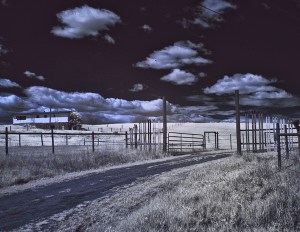
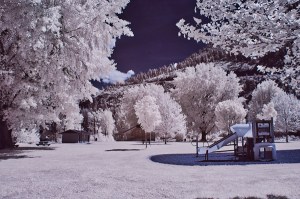
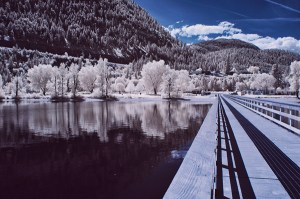
Infrared creates a completely different feeling. I have written before that using a modified camera is an exploration that moves a photographer far from the usual camera image and the final effect is quite unworldly. The bluer the sky, the greater the likelihood of that unworldly effect; and things that are white or have been turned white (like trees) can glow with an ethereal brightness.

My camera produces images that are limited it colour range. Unlike many modern infrared conversions that give many dramatic colours, the original pictures from my old 6mp camera are mostly shades of brown and blue. By altering the colour channels I can get a few different colours, but much of the time I prefer B&W.

At his writing I am thinking it might be time to see what Lifepixel.com has for sale with a newer, higher megapixel camera.

Black and white makes me think about the subject first and then the light, or how a subject looks in a particular light. Infrared, on the other hand, makes me think about the light first and then includes the subject. Of course the subject, and how it is composed and framed is important, but some things don’t look very different (depending on how the IR light is absorbed) than a colour image converted to black and white. With my old camera I must be thinking about the light first and then choose subjects that I think will look like they are photographed with infrared.

To me using an IR camera is always an exploration and certainly a discovery. And the best think about using infrared is how it allows me to create photographs “that are far from the usual.”


Photographing Fallis Pond on a warm spring evening.  

I had been wondering how the pond up the road from my home was changing since my visit was only two weeks ago when the geese and ducks were wandering around on a thin layer of ice.

At that time the surrounding fields were beginning to turn green and the pond inhabitants seemed ready for spring. On that visit, other than a noisy goose on hill warning everyone of my presence, the pond was quiet.

This time I had checked my Honda’s manual and there wasn’t a stealth mode. But I suspected the geese would be hidden away nesting and doubted there would be any birds at all to photograph.

As I stopped at the pond and rolled down my window I was bombarded by a cacophony of sound. The sounds were not so much a warning as a celebration.

I pulled the car around and stopped at a high flat spot on the road so I would be out of danger from country drivers more intent on getting home along the winding road than watching for a parked car.

Although I had my camera and lens ready I just sat for a while listening to the discordant music of that country pond. There must have been hundreds of singing birds hidden out of sight.

As for the geese, I could see a few searching heads in the distance and there was only one big fellow guarding by the fence line.

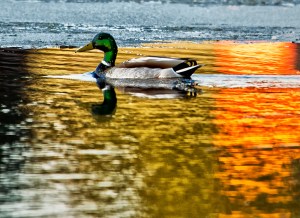
The sun was low and the pond was reflecting colors that ducks swam through.

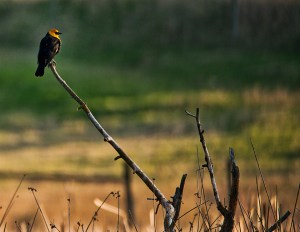
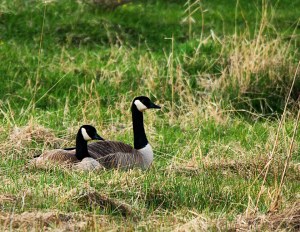
Not wanting to return with an empty memory card I took the opportunity to photograph two geese I spotted huddled close by and a bird or two perched on lifeless reeds still poking out along the pond’s edge.

I could have sat there till dark enjoying the evening concert, but I decided to head home, driving slowly in hopes of seeing other subject in the fading light.

I’ll return in a week or two just to keep up with the changes. There won’t be goslings or ducklings for me to photograph for about 30 days, but I the pond is only a short drive from my home, and I am sure there will be lots of “spring” opportunities to photograph as I wait.

I headed to Vancouver this past weekend with my camera. The substantial change of scenery was invigorating. I went with 3 friends and took the chance to wander the coast for some late afternoon. Ahh….the exciting life of a photographer.

Photography is an art of finding something interesting.  

Gosh, the first day of spring (has passed) and the temperature is climbing.

I stood out on my porch looking at the melting snow along the walkway to the driveway thinking that winter seems to have come and gone in a rush this year.

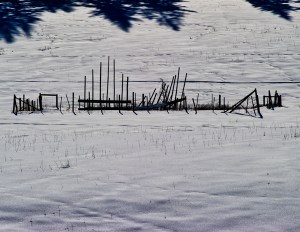
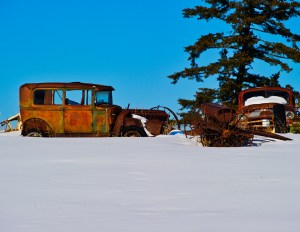
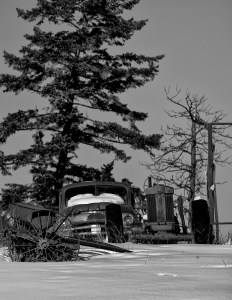
It was a lazy day for me and I really didn’t want to do anything except have another cup of coffee and maybe snooze on my chair listening to music. However, I do like pointing my camera at things and this would probably be my last chance to photograph things poking out of the snow. And if this year is like most I expect the cool spring rains will be pounding on my roof in short order.

So, as hard as it was I ignored the waiting coffee grinder and went off get my camera.

My latest acquisition is a 300mm lens. I like that focal length and have had several since the first Pentax I owned back in the 1970s. This latest lens came with a 1.4 telextender that gave me a 450mm of reach.

I have a longer 150-600mm lens, but the 300mm takes up less room in a bag or on my car’s seat, it focuses very fast and is just darned fun to use.

Although I sometimes photograph wide landscape vistas my preference is tight close shots. It’s the intimate, close cropped “parts” of a scenic that catch my eye. So after making sure I had an empty memory card and charged battery I mounted the 300mm lens on my camera and set off to see if I could make some interesting photographs of things resting on, or poking out of the snow.

By the time I drove down the road the sun was high in a bright blue cloudless sky. My choice was to head up into the hills or down to the river. But I wondered if the small pond was still frozen over so I went up.

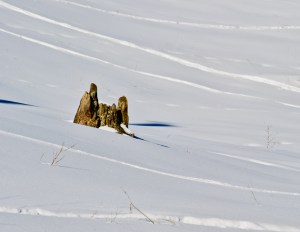
The pond was frozen without a footprint or even a lonely bird in the tall lifeless reeds that circle the pond. I was disappointed, but as it has for the past 40 years, this rural place where I live, always offers something that catches my eye. The long lens was the perfect tool to isolate and exclude as I focused on the remains of a tree poking out of the snow. That broken and rotted stump in a desert of white snow was crossed with neat long thin shadows that made up for the boring pond.

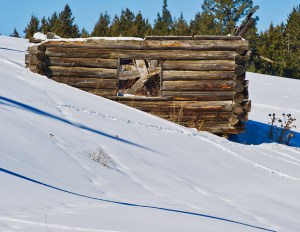
I stopped to photograph what was left of an old log building that once might have been for storage or maybe living quarters for some ranch hand. When I first drove down what was then a bumpy dirt road many years ago it still had a glass window and roof, but now only the decaying log walls remained.

I drove around getting out of the car and trudging through the wet snow trying to photograph subjects I have photographed before in a new way.

I often wonder what the people in the cars think when they, once again as they have many times before, pass me pointing my camera at some subject. Most are not photographers, making the things I am photographing of little interest to them.

It always seems new to me. A bit familiar for sure, but this was the first time I photographed anything in my neighbourhood with this particular lens.

So yes, new.

I know I’ll be back photographing everything again when it rains or maybe when the grass begins to grow or when there are geese in the pond or anytime I am in the mood.

I know I have included this quote from American photographer Elliott Erwitt before but it just seems to fit.

“To me, photography is an art of observation. It’s about finding something interesting in an ordinary place… I’ve found it has little to do with the things you see and everything to do with the way you see them.”

Infrared in the winter


My friend and photography partner, Jo McAvany, has been asking me to loan her my infrared converted camera for a while now.

Jo texted me when she went out to use it this morning.

She had hoped for a blue sky after the recent snowfall, but the sun was only peaking out slightly when she drove off along the frozen back road up into the low hills above her home at 8AM.

Infrared and the snow always give a creative photographer a lot to play with. I would have wished for a bit more sun so the infrared effect would have been stronger, but she got some neat images in spite of the overcast cloudy morning.

I was glad it was her wandering along the roadside on the -12c degree morning instead of me. I thought about how many times, in all sorts of weather I have photographed the roads around my home in the past 40 years and how it’s about time for someone else to take that up. Doing it with infrared is perfect.

I looked back over some of the articles I wrote about infrared and saw this entry,

“I grabbed my old IR modified Nikon D100, mounted a 24-70mm lens on it and set off along the winding roads that make up the wooded and hilly location I live in.”

“That old 6MP camera has served me well, I purchased it new when digital cameras were finally making images with enough quality to compete with film. I photographed weddings, scenics and everything else that I once shot with film. Then when Nikon began offering better sensors with more megapixels I sat it aside calling it my “car-trunk” camera because I just left it in the car all the time.”
“I had always shot black and white infrared film, but it was such a hassle. Loading and unloading the camera in the dark and even waiting till late in the evening to process it in metal tanks because I worried there might be some stray light creeping into my home photo lab.”

When I read about infrared conversions for digital cameras I sent that old Nikon away and about a month later for a few hundred bucks I had an infrared camera.

Jo has never shot with film. She began her photographic journey after digital took over. Now she gets to move into a different kind of light by using my IR camera.

There is not much difference between one digital and the next. Sure the sensors keep getting better and one can choose a full frame over a cropped frame, but if printing a large photograph isn’t part of the process its pretty hard to tell one camera from the next.

The images Jo got are a fun change from the colourful pictures or sharp black and white photographs she is used to. Infrared is always a crowd pleaser.

Using an infrared camera is the best way to step away from what other photographers are doing.

I have written about infrared photography many times before, so I’ll just end this by repeating myself, “Shooting infrared is always an exploration, a discovery and moves a photographer far from the usual.”


Photography on an overcast day

I have been trying to get outside to wander in the snow the past week with my camera, but everything kept getting in the way. So when Jo told me she had to take her daughter to a doctor appointment I asked her to drop me off at my favourite wandering place, Chase Creek Falls.

I figured that would give me at least an hour to take some photos and I was hoping to be alone in that snowy canyon on the cold, overcast Monday morning.

I like storms and I like the mood one can get in a photograph on an overcast day.

Jo dropped me off along the road and I walked down along the well-worn path through the snow. I picked a good day. From the looks of all the trodden snow, Sunday must have been pretty active.

Stopping along the creek to take a long exposure of a rock glowing golden in the cold water I thought about why I like digital cameras and all the photographic creativity that goes along with modern technology.

I continually meet people that assume someone my age would still be using film. Gosh, I could fill page writing about why I don’t bother photographing anything with a film camera. At that moment as I mounted my camera on my tripod to photograph that glowing gold rock I thought about how hard it used to be to make pictures on overcast days and was glad for the modern equipment I have.

I mounted my 24-70mm lens on my camera and selected an ISO of 1600. Then set my shutterspeed to eight seconds, chose an aperture of f/11 and with the camera’s self-timer activated, I pushed the shutter release.

I refocused on a couple different rocks in the creek besides the golden centre of interest to make sure my depth of field would cover everything in my viewfinder. Then I released the shutter a few time and moved on down the stream.

Sunny days are such a struggle for a photographer wanting to photograph a waterfall.

Sure one can get a pretty, bright landscape, but I like to have contrast in the water when I use a long exposure, so overcast is great. And on this day I wanted to capture the cold winter mood and if I really needed to highlight a particular feature like a rock or log or foliage I’d just do that in later in post.

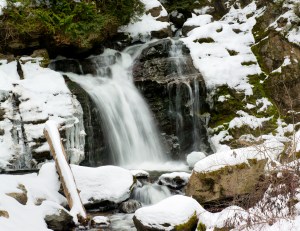
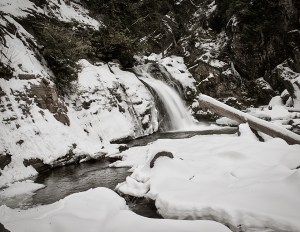
The Chase Falls is always a perfect subject. All I had to do was poke around in the snow with my tripod to make sure there weren’t any spaces between the rocks or soft spots in the ice as I moved around photographing the falls from different locations, eventually I sat on a bare rock to listen for a while and look at the monochromatic January landscape.

I am fortunate not to have to drive and hike hours to enjoy such a photogenic location. Now I am waiting for more snow so I can collect winter photographs in the garden that hides my home from the road. Today there is a light covering of snow, but it’s been so warm that the snow isn’t clinging to the plants.

Ah, but its January and there’s a few more months of snow to come and more winter photography.

The Canadian Pacific Railroad Holiday train 


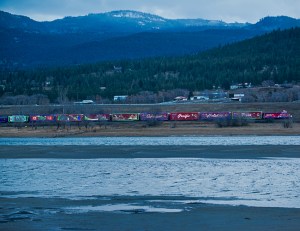
Every year the CPR holiday train chugs its colourful way across Canada from east to      west. The train makes stops at cities along the route where there are crowds of people waiting.

Those of us in rural Canada might miss assembly with all the festivities in the city, but we get to watch and, in my case, photograph that brightly lighted Christmas train as it winds its way through the wooded Canadian countryside.

As I drove from my home down to the river valley to again photograph the Holiday train I passed people waiting in their cars parked in the area between the little Pritchard store and the train tracks just off the highway.

I have tried that location in the past, but it’s so close to the train that the only shots are on an angle. And to make it worse this time, a long freight train was waiting in the perfect position to block the view of the train after only a couple minutes.

My favourite place to photograph the train is from across the river. I drove past my neighbours, crossed the bridge and stopped along the river and walked out on the wide beach to set my tripod up.

I like the long wide view across the Thompson River that even using my 70-200mm lens lets me photograph the whole train at 70mm or just a few cars at 200mm.

That beach location allows me to capture that locomotive and it’s bright boxcars in a scenic view.

The train usually passes through Pritchard when there still is enough light to see the train. I saw a few pictures that were taken after it stopped in Kamloops 30 minutes later, and they only showed neon lights with an empty black background.

I chose an ISO of 800 when I first got there and took a few test shots. I walked around to choose a nice flat place where I didn’t have to stand in the mud. Gosh, mid December and no ice.

I will say that, although I had a better location than those on the other side of the river, I envied the fact that those waiting at the Pritchard store had hills that blocked the unpleasant, cold wind that blew at me across the flat wide river.

I joined by my friends and their children out on the beach. Jo had her stocking hat pulled down over her face and was crouching with her camera trying to get out of the wind.

I covered my ears and set up my tripod as I watched her 3 and 4 year olds running around on the muddy beach, oblivious to the cold, as they excitedly waiting for the train.

They had been to town earlier in the day to meet Santa and now running on the beach and seeing the brightly lite Holiday train was like the icing on the cake.

By the time the train came I had to push my ISO up to 1600. I was using my tripod, but with the all movement I decided the higher ISO would let me keep my shutter at a safer speed.

I think this will be the last photos of Christmas lights for this year. As always, it’s been fun. There isn’t any snow yet, but the snow will come soon I am sure, and I’ll be out again with my camera to make some pictures of that white playground.

I can hardly wait for the snow. But for now I’ll wish a very Merry Christmas and a Happy Holiday to all of you.


Photographing the lights of Christmas  

I like Christmas. I like the gaudy colours, the music, and especially the lights.

Regular readers might remember that last December I wrote that as a child my parents used to bundle my brothers and I into the family car and drive up along the high avenues around Salt Lake City so we could look down on all the decorative lights in the valley.

We even got hot chocolate from my dad’s beat up old thermos that my mother would pour for us when we finally stopped on a hill high over the city to view the lights. Although these days my drink of choice is usually wine or beer, when Christmas rolls around I have a yearning for hot chocolate, and I’ll shamelessly admit to being a Christmas light junky.

Last year I also wrote that for years I had business in Kelowna, British Columbia. And during December I always made sure I brought my camera so I could go out at night and then again at morning’s first light to photograph the Christmas lights along the city streets and waterfront.

I no longer have work to do in that lakeside city, but on the weekend of December 8th I packed my camera into my car and headed south to what I suppose will become my overnight Christmas light photography sojourn for years to come.

I left early enough, wait…that’s not right. “We left” is more the accurate.

Last week when visiting my friends Jo and Shaun I mentioned that I was planning on spending Saturday night and Sunday morning photographing Christmas lights.

I had barely returned home when I received a text from Jo telling me that she had talked her husband into letting her go and could I get her a hotel room because she would be joining me if I didn’t mind. So “We” left early enough to stop for some quick shopping, check in to our hotel and walk down the street to the eatery I had spent my evening at last year before going out to photograph the lights.

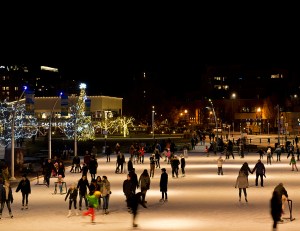
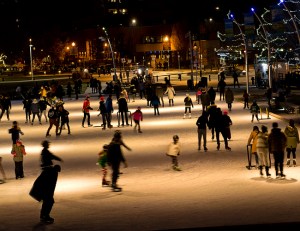
Last year I was disappointed that the weather was to warm and they wouldn’t be opening the outdoor skating rink until after I was gone. However, this time the days were colder and it was packed with people.

I don’t like choosing auto modes on my camera unless there is a good reason. Shutter Priority for a fast moving event like a rodeo, or Aperture Priority for subjects field like flowers that require controlling depth of field.

On dark nights with moving subjects I prefer the Manual mode. I can be in complete control of how I want my subject to look by changing the ISO, the Shutter and the aperture depending what I want. That way I can balance the light so the final image doesn’t look unnatural.

With the Skaters I wanted to see some movement. I knew there would be people stopping, moving slow, and of course passing very fast. All I had to do is work with those three controls to create the photograph I wanted.

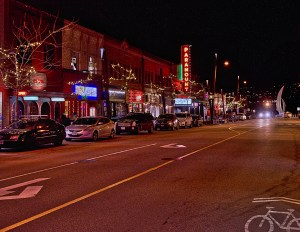
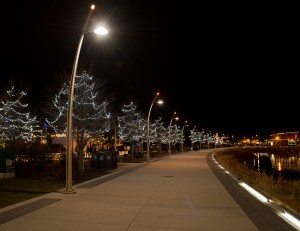
We spent the night photographing the streets, decorated boats moored along the lake, the lakefront walkway, lighted trees, buildings and just about anything in front of our cameras.

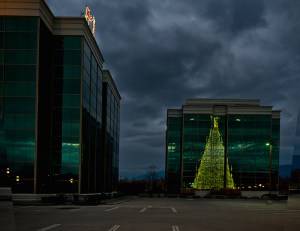
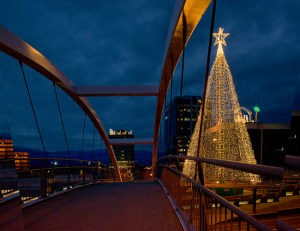
We were up before dawn waiting on a highway overpass for there to be just enough daylight to give buildings some definition. We were there to photograph Kelowna’s 120 foot tall Tree of Hope.

For 20 years, the Tree of Hope made up of about 25,000 LED bulbs has been a symbol of inspiration, giving, and hope to the community.

I like to photograph that light bulb tree. Most photos I see of it either shows no background because it is photographed after dark or too much background because it is photographed after the sun has come up.

I want to barely see beginning blue of the sky. To see buildings with the tree reflecting in their windows and I want the light to vivid and colourful. So we stood in the dark and waited for the early morning sun. This time we lucked out with a cloudy sky.

All we had was about 30 minutes of shooting before the sun came up. Then it was back to our hotel to eat breakfast, warm up, pack our gear and head home.

Repeating my words from last December, “Night photography (well actually, early morning photography) gives a city such a nice mood that isn’t really manifest during the day. I like the mystery and, of course, this time of year the frosting on the cake is the wonderful Christmas lights.”