What Shall I Photograph when its windy? 

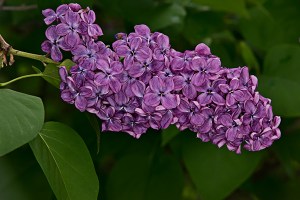
Lilac

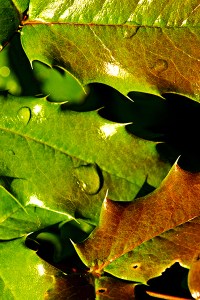
Oregon Grape

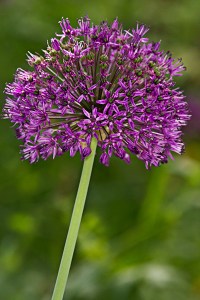
Allium

Oriental Poppy in wind

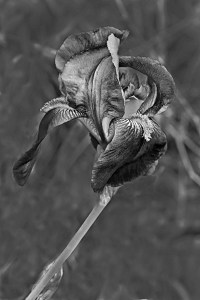
Iris in wind

B&W Iris in wind

I looked out the kitchen window at my wife’s garden. It was late afternoon, the sun was peaking out under the clouds after a light rain, and the garden was glowing with a gusty, light breeze.

Linda mentioned that we hadn’t taken any pictures of the spring garden yet and suggested that it looked so fresh after that rain that I should be able to get some good flower photos in spite of the wind.

Wind? Wind is not a problem if photographers take the time to problem solve. I could increase the ISO or shutterspeed, but that wouldn’t do much for the ambient light, and I like more control. My normal technique for photographing flowers is to underexpose the ambient and illuminate the subject with a flash. I recall years ago having given my photography students a “stop action” assignment. They were to go out at night or find a large, dimly lit room, and use a flash to stop a moving subject in a photograph. All they had to do was select enough flash power at a specific distance to illuminate their subject properly when they released the shutter.

Those were assignments given before modern, computerized cameras and TTL dedicated flash when the flash would always produce the same amount of light and the aperture controlled the amount of light exposing the subject.

My technique for my windy garden was the same. I placed my 200mm macro lens on my camera and attached a ring-light on it. I really like is using a ring light on rainy days. I keep it on manual mode and stay at a specific distance so it won’t under or over expose the subject I am photographing. My ring flash also has ¼ and ¾ power increments to reduce the flash power output if I need it.

Just as my photography students learned all those years ago, when I pressed the shutter the flash stops the movement of the flowers in the wind. Nevertheless, the wind was quickly drying out the plants, so I had to quickly search for leaves that still showed raindrops.

The movement problem was almost solved. I took extra shots when I thought some motion had wrecked my shots, however, it was the sun that became the biggest concern. I had hoped the high clouds would block the sun, but instead of getting more bad weather, I got less, and with the clearing sky I began to struggle with the bright light.

The bright light would have been fine if all I wanted to do was document plants in the sun, but I wanted to go beyond that. Just pointing and shooting is boring. I would have liked to get out lightstands, a couple of off-camera flashes, and even a black backdrop, but the wind continued on, and would probably blow all that stuff over and I never followed up on that option.

So while other photographers might have celebrated the sunny, clear sky and be willing to put up with windy landscapes, I was done for the day.

I think I am pretty lucky that I don’t have to go far when I want to take pictures. Over the years I have looked hard into what is close to me and instead of being one of those photographers that depends on a car to find a location to get inspired. I just look around the yard and adjust my thoughts and camera for what awaits me.
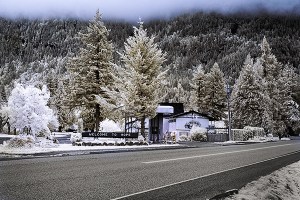


A Rainy Day in Hope, BC – Photographing with Infrared

Wecome to Hope 1

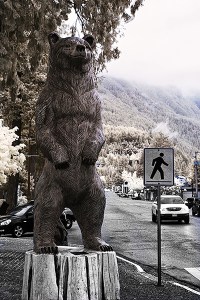
bear crossing 1

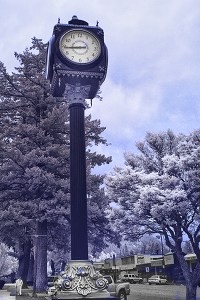
Town clock 1

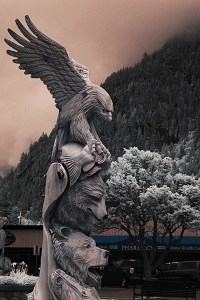
Animal totem 1

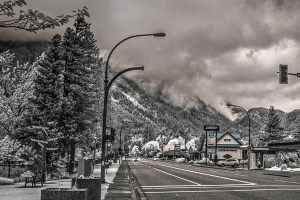
Driving thru Hope 1

After leaving the Vancouver Camera Show and Swap Meet last Sunday I decided that rather than make the long drive all the way back to Kamloops and then Pritchard, I would make a stop for the night in Hope along the way.

Hope, British Columbia, is usually just a location to make a quick pull off at a fast food restaurant, or coffee shop. as I drive between Vancouver and Kamloops.

I have always liked the appearance of the picturesque little town just off the highway along the Fraser River. That was first settled when explorer, Simon Fraser, arrived there in 1808. The Hudson’s Bay Company started a trading post in 1848.

In more recent history Hope received acclaim when it was the location for the Sylvester Stallone Rambo movie, “First Blood”, and then, “Shoot to Kill”, staring Sidney Poitier and Kirstie Alley. The area’s mountains also stood in for the Himalayas in the movie “K2″.

However, in spite of all that the main reason for my stop was I knew I’d be tired after my long day at the swap meet, and, in addition, I thought it would be fun to wander around town with my camera the next morning. I chose to bring the camera I had converted to infrared. I thought shooting infrared would bring a fresh and very different visual interpretation to the heavily forested setting.

There is a poem by Robert Burns wherein he writes, “the best laid plans of mice and men often go awry”. I thought of his prophetic words as I checked out of my motel room the next morning under a pouring rain. Disgusted with my crappy luck I stopped for a coffee and doughnut before leaving town. I was resigned to just head home. But as I sat in my car sipping on my coffee texting my wife that I was heading out, the rain lightened up and I decided that in spite of the cloudy overcast I would try my infrared camera anyway. I thought, what the heck, any photography is fun and the worst that can happen is I’ll have wet hair for the trip back.

I meandered down to the riverfront and zigzagged back through town. I discovered that at some point town residents began erecting large chain saw carvings everywhere. So I took pictures of them along with those of the city streets until the rain picked up again and my glasses got too wet to see.

The best time to shoot infrared is on sunny days, so the rainy, heavily overcast environment wasn’t all that exciting. But I was intent on the pictures by this time.

I must say that I wasn’t really successful, but there were a few images, that with some postproduction help worked out reasonably well.

The rain won this time, but I think I might go back to that scenic little town nestled in the Fraser Canyon. It’s not that far from my home and a nice easy drive, and I’ll take Linda with me. However, we’ll wait for a sunny, dry day and I definitely will try infrared again.
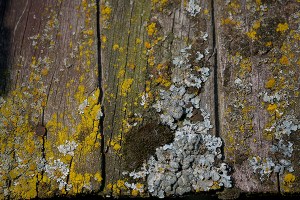
Infrared is such a fun change from normal digital shooting. And similar to purchasing another lens, the cost of having an old camera converted is well worth it.

The Vancouver Camera Show and Swap Meet       


Lots to buy

Wow a 4X5

Sales tecnique

What about this tripod?

Try this one

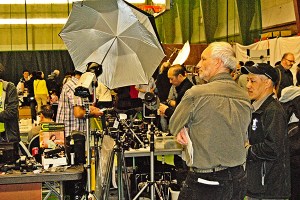
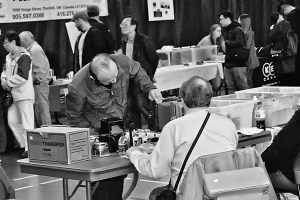
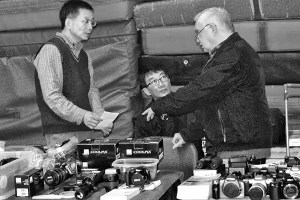
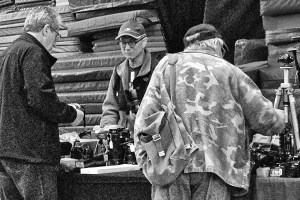
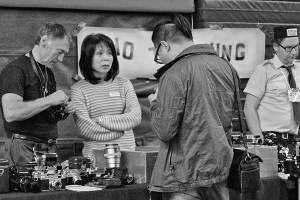
One of my favorite photography events, the The Vancouver Camera Show and Swap Meet, has come and gone again this year. For over 20 years I have spent the weeks prior to this long-running event, that has now reached it’s 40th year, looking forward to the day I get to attend this ever-so-fun photographer’s gathering put on by the Western Canada Photographic Historic Association, and organized by Siggi and Brigitte Rohde.

There cannot be a better way to spending a rainy spring day than being surrounded by a vast array of cameras and photography equipment, all the while getting a chance to talk with other photographers.

Again this year I made the journey from Kamloops the day before and lodged overnight so I could arrive bright eyed and eager to join the other vendors setting up at early the next morning.

I go wondering what the latest trends will be, or what is popular with the photographers that attend. And, of course, keeping my fingers crossed that the equipment I have on my table is what they are looking for.

The last few years there’s been a major change in the venders being replaced by a much younger crowd. The stuff they have on their tables is much the same, but the vendors’ faces are younger, and there are a lot more women standing behind the tables discussing and selling photography equipment than there was when I first started attending.

As I have said before, the word “diversity” is the best way to describe the mixture of photographic types coming to this camera swap meet. There were all kinds of lifestyles and interests, and specialties in photography, film, digital, past and present technology. However, what they all had in common was that they all were excited, searching for sweet deals that I am certain they got.

This year was no different than last, in that I spent an exhilarating day talking non-stop with other photographers about their different interests in photography and, as always, it was invigorating.

The Vancouver Camera Swap Meet is a splendid way to meet and exchange information with other photographers, and to look at and check out a grand selection of photographic equipment that would not be so accessible anywhere else in Canada.

I write this every year, but I’ll say it again anyway. I had a great time with the photographers I met this year and the depending on who joined me at my table, the conversations always changed. My day of selling was a success, as it was for most of the dealers and very happy bargain hunters I talked to at the end of the day.

Camera's Shot

And…when the camera decides to take a picture by it’s self….


Photographing Flowers by Bathroom Window Light       

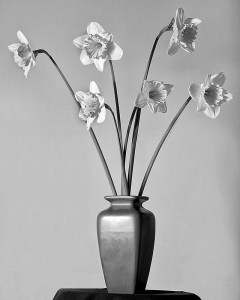
Daffodil BW

This week my wife and I had our first serious walk of the year around her garden.

Everything was competing for a place in the sun and the colours were beginning with white being the most prominent. I guess that might be because the first flowers to bloom in my wife’s garden this year were her white daffodils, and there are lots. We were looking for flowers to bring inside the house, so the abundant daffodils were the natural selection.

In March of 2013 I wrote, “Photographing an Orchid in the Bathtub.” In that article I discussed how one morning, I realized that a lone blooming orchid that my wife was watering on top of an upside down plastic barrel in our bathroom tub was a photo opportunity in the making.

At that time I could see a back light beginning to come through the frosted bathroom window and the slight beginnings of a back glow on the flower. It as in the morning and I knew within an hour or so the sun would move to that side of the house and continue in a southern arc for the rest of the day.

It was with that in mind that we decided it would be fun to photograph the daffodils before Linda choose a final location to display them in the living room.

One could set up a small studio for flower photography anywhere in a house. I even have a small diffusion box especially designed for product photography. Nevertheless the soft diffuse light coming through the frosted bathroom window glass is almost perfect for flowers.

I found another plastic 5-gallon barrel, placed it up side down in the tub with the white daffodils on top, and set up a speedlight coupled with an umbrella on a lightstand to photograph the daffodils.

When I photographed that orchid it was early morning. However, this time it was late morning and a more direct light was coming through the bathroom window. So I took the outer cover off the big 5-in-1 reflector I have and it became another layer of diffusion when I placed it between the daffodils and the window.

All I had to do then was point my 135mm lens, shoot, arrange the flowers, shoot again and rearrange. When I mentioned to Linda that the flowers would look good as a black and white photo she said. “Everything is pretty much monochromatic anyway”, so it was with a final b&w image in mind that I took the picture.

Photography Studio Workshop   

Studio 1a

Studio 3a

Studio 2a

Photographing Autumn 1a

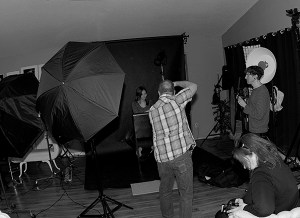
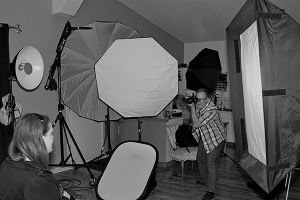
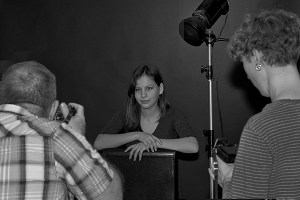
My latest photography workshop, Posing and Lighting, occurred just outside Kamloops this past weekend at a local studio owned by Dave Monsees of Cherry Creek.

I will begin with a perfect quote I have used before by photographer and author Frank Criccho that goes with what I was wanted the participants to think about. Criccho stated, “The success of a photographic portrait depends as much on the photographer’s artistic and creative use of lighting techniques as it does on his or her skill with the camera.”

Much of the time photographers either prefer to photograph people in the daylight or, if forced to shoot indoors, just increase their camera’s ISO. And there are too many that when they do decide to employ On or Off-camera flash go for the easiest method of just filling the space with lots of light.

During these sessions I lead my goal is to get participants thinking about not only posing our model, but also about the using the flash light as more than just a device to brighten up the environment.

I want them to begin making decisions as to how to apply light on their subject in the same way they might decide to use a long focal length lens rather than a short focal length lens.

As always, when I lead a full day session like this one, I feel my task is to present information and keep things going. And I always leave plenty of time for the participants to engage with the model and experiment with techniques. Watching workshop participants grasp and learn photographic lighting is a fun and satisfying activity for me.
I began the workshop with a quick slide show. Hmm…I guess we don’t have slide shows any more and instead connect a computer to a digital projector to provide a PowerPoint presentation. In any event we started the day off with a presentation that showed how different modifiers affected the light on a subject. So when our model Autumn arrived it was, “lights, camera, action.”

We spent the majority of the day (barely breaking for lunch) using many different light modifiers, changing the angle of the lights, applying light in creative ways, employing different backdrops, and of course, studying posing.

I will say these kinds of workshops are really demanding on a very patient and hard working model as she constantly and quickly alters her outlook and holds any pose the excited photographers request; all the while giving each photographer time to apply what I was continually introducing.

I can’t really say much regarding those enthusiastic photographers, I expect they were filled with the energy most photographers get when they are learning and creating, but by 4pm Autumn and I were ready to wind down. A good day well done.
“A portrait! What could be more simple and more complex, more obvious and more profound.” – Charles Baudelaire, Poet – 1859


Photographing Graffiti in The Tunnel   

Lighting the tunnel

Creek Tunnel

Kast

AWs

Creek tunnel North

There is a little creek that flows into Kamloops, British Columbia via a small waterfall. Petersen Creek is diverted underground for it’s journey through the city until it circulates out and spills into the South Thompson River.
There are several places along its cement banked route where Petersen Creek’s shallow flow is visible to passers-by, but it quickly runs out of sight again when it reaches a city street and is diverted underground.

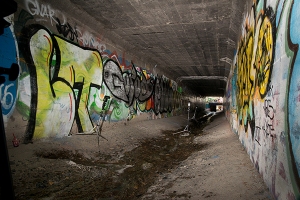
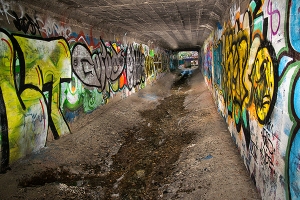
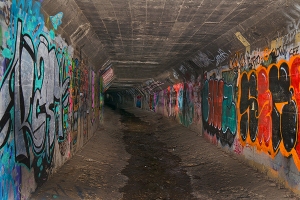
One would think there isn’t much interest to anyone other than the City Works employees who make sure it isn’t plugged up when there is a larger than normal volume of water coming down from the canyon. However, at the final concrete watercourse everything changes to several block-long tunnels that are 10-12 feet high and just as wide that have gained attention from very creative graffiti artists and, of course, locals that enjoy capturing that creativity with their cameras.

It was there that I climbed down into after parking my car on the street beside the drainage tunnel entrance. I had met a resident photo enthusiast named Shannon who has been smitten with all the graffiti she was seeing on backstreet walls and boxcars that had wandered into the tunnel and she realized that street artists were painting on the walls.

I joined Shannon, and her partner Max, a few weeks ago in the dim tunnels. They and most locals were relying on their camera’s ISO ability, but after ten or fifteen feet the light was gone.

I hadn’t been in those tunnels since I first came to Kamloops back in 1974. At that time I tried going in a bit, but the water was much higher then and other than a few crude messages spray painted at the opening there wasn’t really a reason to slosh into the dark tunnel. However, this time I decided it would be fun to light up more than just one or two paintings.

I returned with four stands with a flash on each and positioned them to cross light the tunnel. Then it was easy to begin by metering the light coming in from the road and balancing the light from each flash to match that.

When I got home it was simple to clone out each flash and use Photoshop’s burn and dodge tool to smooth out the areas where the flash had outlined its light on the floor or where ever there was a different brightness.

I chose to illuminate the street artist’s work as a whole instead of just documenting one section at a time. I know when we see what someone has left on a wall or on a train’s boxcar as it passes by, that we tend to isolate one piece of graffiti art, but as I stepped into the dark winding drainage tunnel I felt more than just a cold breeze and saw more than one bright statement. To me everything – the dark winding tunnel, and the graffiti – was all part of the whole, or one ongoing work of art. And I wanted to photograph that combination of a cold, colourful, wet, chaotic, winding tunnel displaying the work of many artists.


Photography is Marvellous

BaldEagle

Victoria harbor

Vacant

Brick doorway 1

Open

Canadian Flag


Storage Tanks

RaceCar

After the Rain

Toad in Pond

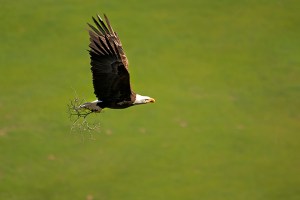
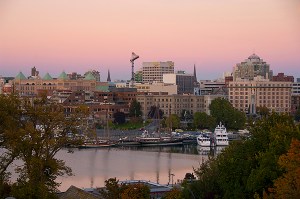
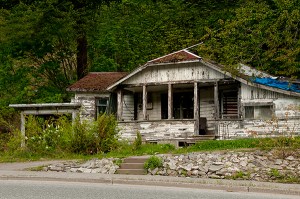
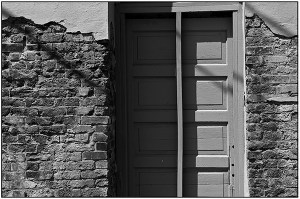
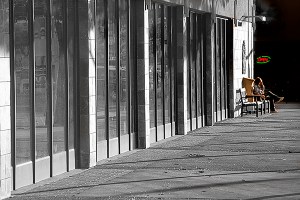
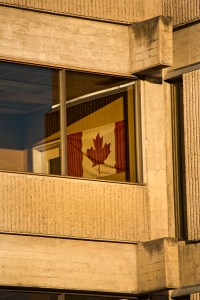
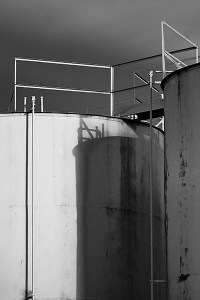
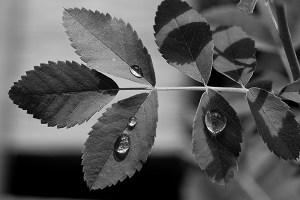
I must admit that I have never really thought of identifying myself with a particular photography specialty. When I was earning my living photographing people, weddings, family portraits, and such, I might have said that I was a portraitist, but not so much anymore. Nevertheless, when I was talking with a woman that had recently become a member of a local photography club, she mentioned that someone had told her she should always have a specialty and wondered about mine. I couldn’t be specific in a response.

I suppose that might be a good way to learn photography and that could be why other members are suggesting that to her. Choosing a particular course of study and getting real good at it is a great plan.

This woman told me she was having a great time learning photography and enjoyed her interaction with the new friends she was making at the photo club. But, she was worried some members would be critical that she hadn’t chosen a specialty because she likes to photograph lots of things and asked me what my specialty was.

Although I have a shop where I sell used camera equipment and I regularly teach classes, after 40+ years I have retired from client work. Nowadays I am just enjoying photography and can be very selective if I want to, but mostly I choose anything that finds it’s way in front of my camera. Everything is an exciting opportunity. I told her that, and suggested there are a whole bunch of really good photographers wandering around that are like me; opportunists when in comes to their subjects and who don’t specialize.

I have positioned a couple monitors in my shop so that people don’t have to crowd around my computer when I want to show them a particular picture. And for classes I set up a screen and turn on my digital projector. So I selected a file that I sometimes use and scrolled through it for her to show her how much fun I have photographing everything.

As readers can see from the posted images, I just enjoy photography.

French painter & photographer Jacques-Henri Lartigue said about photography, “It’s marvellous, marvellous! Nothing will ever be as much fun. I’m going to photograph everything, everything!”

Happy Easter 2016

Chicken


A Photography Excursion In My Own Yard     

Showtime

Rusty Chain

Painted wheel

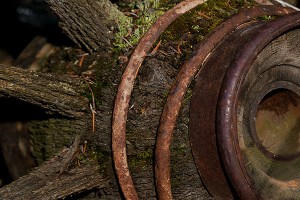
Lichen

Wagon wheel

Water tank

Window hinge

C.P.R.


It seems as though photographers get so hung up on traveling in search of exotic, or inspiring, locations that they forget about what is right out their own door.

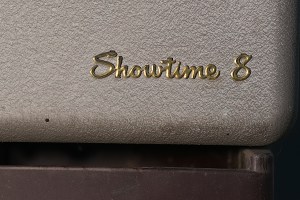
I must admit that unless I have decided to take pictures of a colourful plant, or quickly capture a photo of a feral cat looking for handouts, or a deer that has hopped the fence with hungry designs on the spring buds growing in my wife’s garden, I rarely wander our yard with my camera in hand. The items we pass by every day become so familiar and commonplace that we pay little attention to them.

Last Sunday I wondered if the ten lilac bushes I planted late last fall made it through the winter. So I walked along the fence to check for spring growth and sure enough all of the new shrubs made it and I later told my wife that all the lilacs she had shipped all the way from Quebec are doing just fine. Of course with the unusually warm winter we had here in British Columbia one would expect no less.

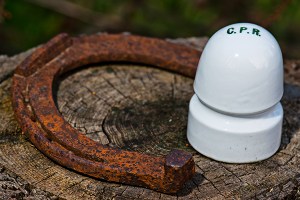
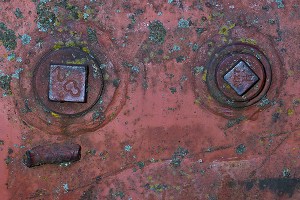
As I walked around I spied a pile of old chain rusting on a log and realized I might be missing an opportunity for a few pictures if I didn’t get my camera. I admit I am not the most fastidious person when it comes to keeping tidy the two acres of land we live on, and because bits of things interest me I am forever picking up stuff that is apt to spend lots of time resting wherever I place them when I got home. That chain has only been sitting there for a year or two, but there might come a time when I will need that well-rusted length of chain.

So I got out my camera and mounted my wife’s treasured 70-180mm macro, grabbed my flash, and headed out. The Nikon AF 70-180mm is unique. It is the only true macro zoom lens around which allows precise framing without having to change working distance and refocus. And so, yes, that lens is special to Linda.

This photo hunt was to look for those bits and pieces similar to the chain and that’s why I chose that macro lens, so I could get in close or zero in on just a part of what I wanted to photograph.

One of my favourite photographers, Robert Mapplethorpe wrote, “With photography, you zero in; you put a lot of energy into short moments, and then you go on to the next thing.

Those words were perfect for my walk through my spring-like yard. I’d find an object or feature, focus close with the macro lens, zoom in to crop tight, release the shutter a couple times and move on.

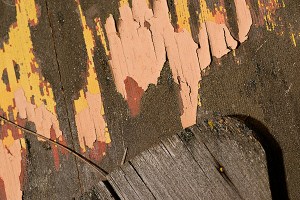
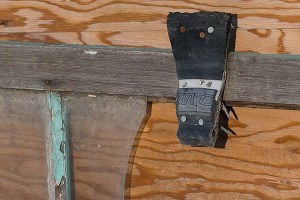
Although I can use my flash wireless off-camera, this time I chose to connect it to the camera with a dedicated TTL cord. I decided it would be easier to hold the flash and aim the light from different angles than it would be if I had to keep moving and adjusting a stand. Instead of fussing with a flash mounted on a stand all I did was put the flash in my pocket till I needed it to photograph flaking paint, rust, moss-covered wood and all sorts of things that have found a home in our yard.

I am of the opinion that those photographers that live in a well-kept, tidy yard are missing out on such an opportunity. Just think of how much fun I had on my safari discovering great things of which to take pictures.

Of course there is the possibility that my wife will come up with an altogether different kind of safari once she sees my pictures, one that will be a lot less fun for me.


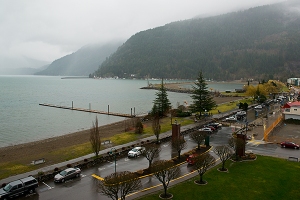
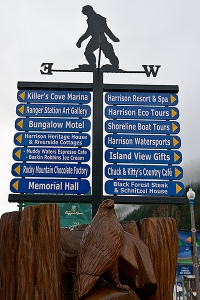
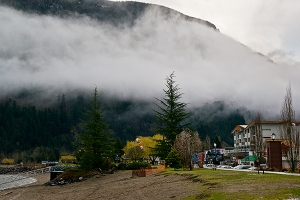
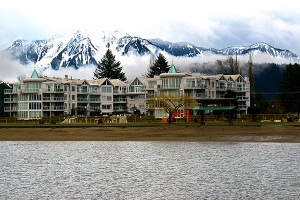
Trip to Harrison Hot Springs, British Columbia        

Lake view

Town Directions sign

Harrison town

Coastal mountains

4PM at Harrison

Pier

Wet Street

Hoter Bear

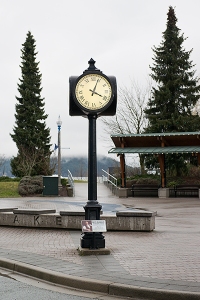
The best laid plans of mice and men often go awry”. That verse from the famous Scottish poet, Robert burns fit perfectly with our long anticipated plan to have a pleasant vacation at Harrison Hot springs.

My wife and I had been looking forward to a few days soaking in the luxurious Harrison Hotel’s mineral springs, and doing photography in the small waterfront town, and the nearby Sasquatch Provincial Park trails.

The weather report was for a sunny Monday, with some rain on Tuesday and a clear partly cloudy Wednesday. So we thought, rather than abandon our reservation (with the accompanying cancellation fees) we’d put up with the showers and stay close to the hotel. After all, shooting in the rain isn’t all that bad as long as it’s not too hard. However, “hard” is just what we got for our one full day at the resort town.

The first evening was so much fun with a soothing dip in the hot pool and a nice walk down the esplanade for a nice meal of fresh mussels and clams. And we sat talking about our plans for an early morning soak and a day of photography.

I rose early the next morning raring to go and went to the balcony to see what the day had in store for us outdoors. Well, what it had in store was a heavily cloud-covered town and one of the heaviest torrential downpours I could remember.

Trying to be optimistic we wandered down to have coffee, then headed for the hot pools in hopes of waiting the morning rain out. I will say that my short description of that event was that we were getting as wet from the rain as from the pool.

The rest of the day was much of the same with occasional short trips out when the rain lightened enough for some photos. As long as the rain was light I could wipe any accumulation off my camera with a towel. And the lens hood fended off rain as long as I didn’t angle the camera and lens in an upward direction.

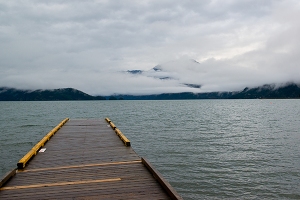
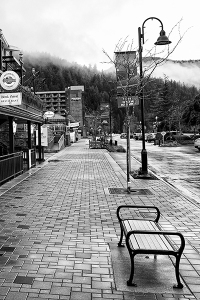
My planned hikes in the dripping wet forest were out, so my short excursions were limited to the small town and beachfront. I liked the overcast and low hanging clouds. But those expeditions were short and I hesitated to get to far away from the safety of my hotel.

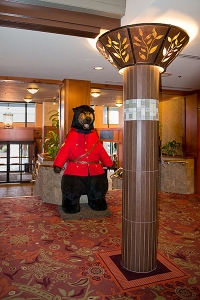
I normally take time to wander about indoors and had packed a flash for some interior photography. But along with a wet visit to the Harrison Hotel, we had also selected a time when there was a large convention. My one attempt at photographing the large 12-foot plush RCMP bear in the lobby took about 20 minutes as I waited for people to pass by so I could get a clear shot.

Oh well, so much for photography. I worked hard to get the few photos I got. In spite of the rain we did have a great time relaxing in the very hot mineral pool, chatting with other guests, and we had some enjoyable meals in local restaurants. In future I will need to take coastal weather reports more seriously if I want more than that.