The Dog Days of Summer are Perfect for Infrared Photography


For several days I have been listening to fellow photographers complain about the hot, bright days here in the interior of British Columbia. When they stop by my shop I welcome them with the question “ What have you been out photographing?”  But mostly I have been hearing “Naw, I haven’t been doing anything. It’s too hot, muggy, and the light is crappy anyway. I can’t wait till September.”  Well, I must agree that my personal photography also stagnated during these dog days of summer.  I prefer summer’s end, fall colours and I suppose, the cooler weather.

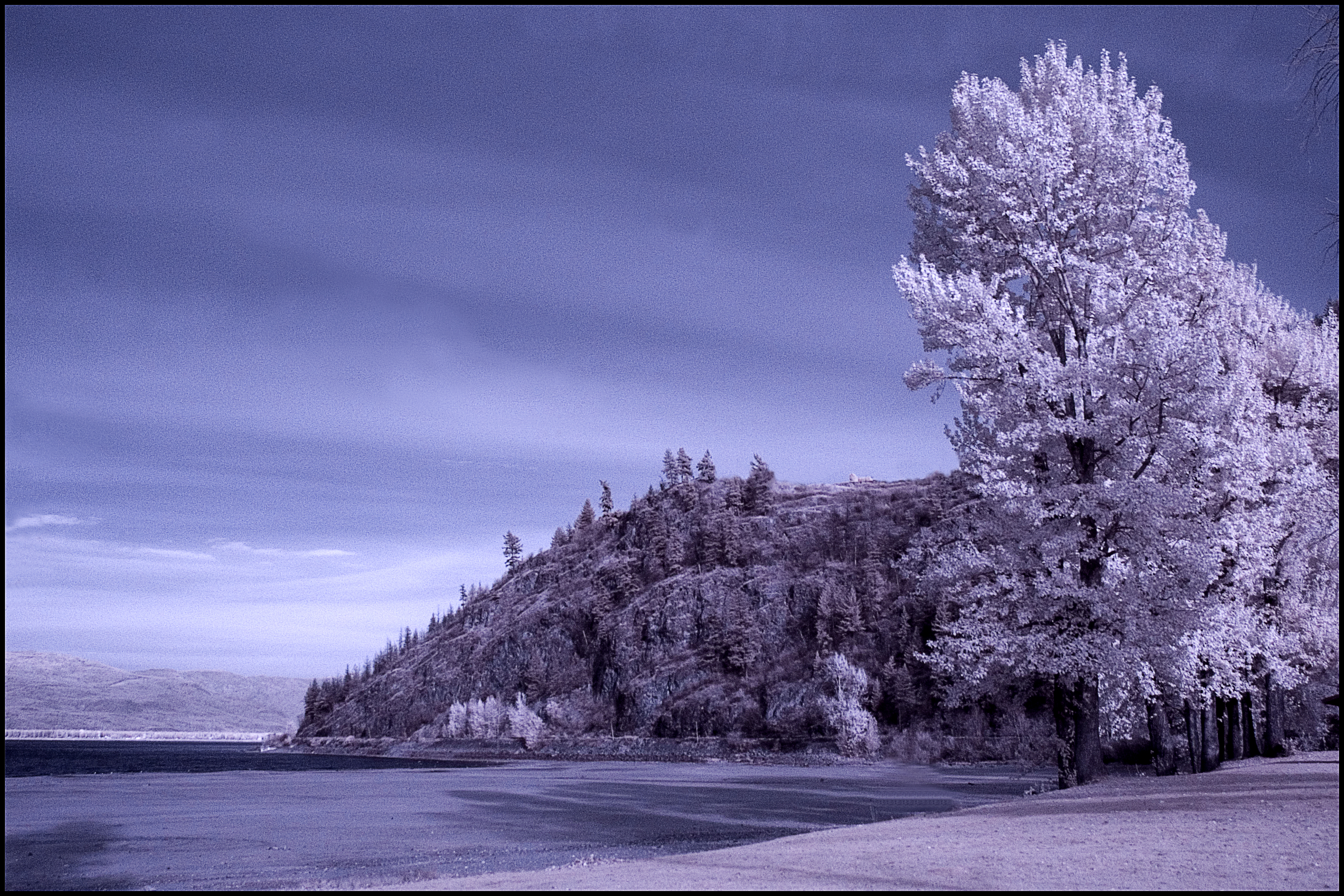
I had already spent a day doing stuff inside so when my wife mentioned that she wouldn’t mind a quick trip to the grocery store, so I grabbed a DSLR I had converted for infrared and we headed out. The closest town to our place is the small lakeside community of Chase, British Columbia. I like to drive the backroads when I go there and I thought the lake and bright sky would be perfect for a camera that only sees infrared light, plus I knew it would be nice and cool by the lake.

I have a camera that has been modified to only see infrared light and in my experience those harsh bright summer days are perfect for infrared image making. Infrared (IR) light is light that has longer wavelengths on the red edge of the spectrum and is invisible to human eyes.

Here is some trivia: In 1800 William Hershel described the relationship between heat and light and let the world know about his discovery of the existence of infrared light in the electromagnetic spectrum.

The sensors for digital cameras are sensitive to more than just the visible light spectrum. This causes problems with colour balance, so camera manufacturers place a filter in front of the sensor that blocks the infrared part of the spectrum that only allows visible light, and not infrared, to pass through.

The modification is accomplished by removing that filter, and then installing one instead that blocks visible light, allowing mostly infrared light to reach the camera’s sensor.

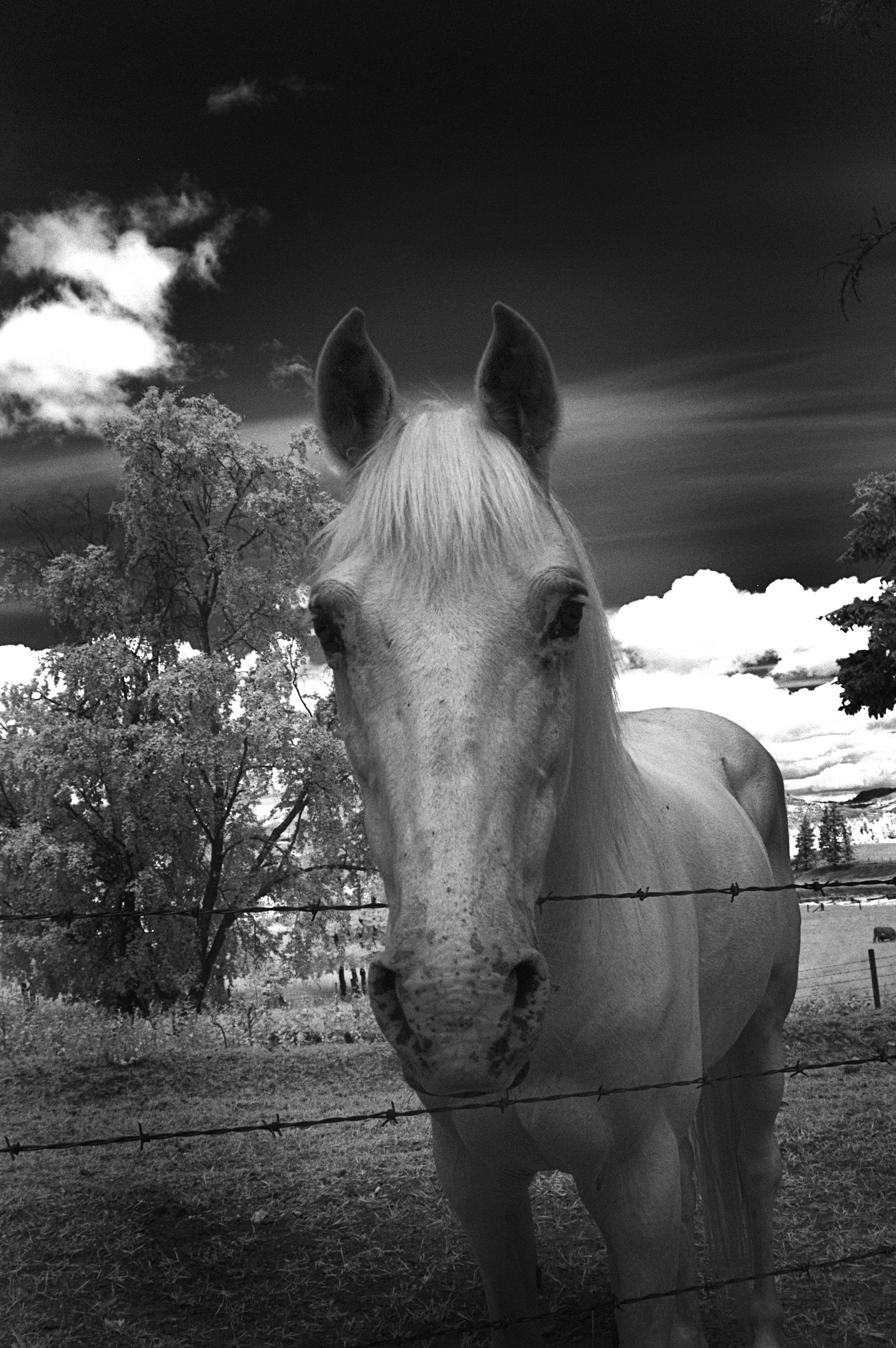
The camera still functions normally, with full auto focus and auto exposure, except that it’s now able to record the infrared wavelengths that are just beyond what the human eye is capable of seeing.  When infrared photographs are produced as black and white the photographs show trees with glowing white leaves and black skies opening up new visual opportunities for photographing the world around us.

Many think of infrared photography as the stuff of military night reconnaissance, or, as frequently portrayed in movies, as aerial thermal imaging that finds the bad guys. With thermal imaging one sees the heat the subject is producing, however, infrared as photographers use it, with our modified cameras is about capturing the light or radiation that is reflected off a subject and doesn’t involve thermal imaging at all.

I  wander around, and photograph pretty much anything, choosing different angles to see how the light would react. Some subjects don’t work very well with infrared, so I just experiment, take lots of pictures and hope for the best. Everything appears normal through the camera’s viewfinder and because so much light reaches the sensor on a sunny day one can use high shutter speeds and so it is easy to hand hold while exposing a picture.

I like infrared photography and have made prints from infrared film since the beginning of my career in photography, when infrared film had to be loaded and unloaded in complete darkness, and because dark red filters had to be used on the lens subjects were very hard to see through the viewfinder. When digital cameras were introduced all this changed.

For those interested, there is lots of information to be found on the internet. IR photography opens up a new visual dimension for the photographer willing to dust off that old DSLR and get it converted to an infrared camera.

Visit my website   at www.enmanscamera.com

Do Something Different with your Photography

I advise photographers to stick by the rules of composition and exposure to make successful photographs. But there is another valuable lesson that I don’t always discuss with photographers, and that is to experiment with their equipment and the photography they are producing and that subject came up during a discussion with a photographer that stopped by my shop last week.  His lament was “everyone’s a photographer now days and most of what I see (I think he was talking about the city he lived in) is pretty much the same…and I feel like I am just one of that crowd.”

I suggested trying to do photography in a different way, and to disregard advice from others and begin a personal exploration of creating and experimenting with photography to make something totally new and different from what is most comfortable.  Push the envelope and, in doing that, become more aware of what you are capable of doing, as well as what the equipment you own is capable of doing.

The famous photographer Ansel Adams once said, “You don’t take a photograph, you make it”.   I think that we might take the time to do just that.  Consider alternative and unique perspectives when photographing a new subject and try different camera techniques and try equipment you haven’t tried before.

That might be as simple as trying to shoot only from a tripod for a time period. If you don’t have own a tripod, borrow one, and make a commitment to use it for every photograph you take for the next month. Some times you’ll hate it, sometimes you’ll love it; but the outcome will be learning to “make pictures” in a different way.

Or perhaps, and maybe more difficult, select something that wouldn’t normally be considered a subject.  Use your camera to really photograph it and try angles that make people wonder if you have lost your mind. The opinion as to whether the photographs are successful will be yours, since the only opinion that really counts is yours when you have crawled through the dirt and photographed that flagpole from its base looking straight up through the flowers around it as a black crow flies overhead.

Try to be expressive with your photography.  When you photograph something think about getting rid of anything that complicates it.  Simplify, simplify, simplify.  Go for a minimalist effect.  I remember a photojournalist in the 1970’s telling me that the words he thought of before photographing a subject was “tighten up”.

Try a different way of photography and using light. See what happens when the color balance is absolutely wrong, or the lighting produces unusual colors and you photograph just the oddly colored items. One might carefully observe the lighting and wait.  Wait until it affects a subject in an interesting, and maybe better yet, in an incredible way.  Waiting for the light takes patience and that could mean waiting an hour, an afternoon, or all day for the light to become what a photographer wants when looking for something different.

Experimental photographs “made” from these efforts will have us thinking outside the box and when others view photos so different from what we normally produce it is they who probably won’t understand.  That’s a good thing because our objective to be different will have been achieved, and most importantly, we will have learned something new about photography.

One of the outstanding features of digital cameras is how delightfully easy and helpful they can be when experimenting.   The only real cost for to try something completely different with a digital camera is the time and effort.  Look at your images on a computer screen and decide if each worked for you or not.  I expect the result will not be boring and you will have learned more about, not only, how your camera works and responds, as well as any other equipment you tried for the first time, and you will likely have learned more about light, shadow, composition, and exposure.

You might well develop a way of photography that starts with the question, “How can I photograph my subject in such a way that makes it different?”

My website is at www.enmanscamera.com