An excellent tool for a roadside photographer           

I live in a wooded rural location just short of an hour from the city of Kamloops in British Columbia, and it’s so easy to hop in my car to drive along the winding back roads. I suppose I could hike or climb, but truth be told I have the most fun as a roadside photographer.

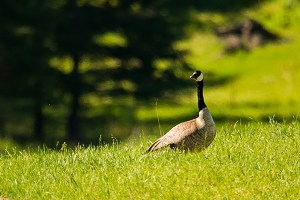
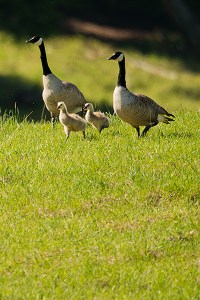
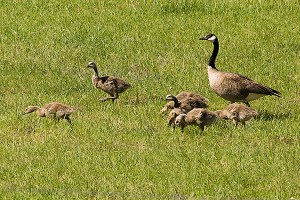
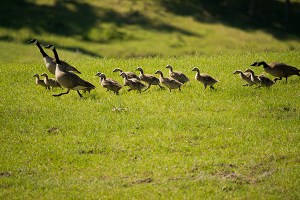
For years, each spring, my wife and I looked forward to seeing geese hatchings at a near by pond. There are normally two, or sometimes three adults with six or eight goslings hiding in the long grass just across the reed filled pond. However, this spring there are at least eight adult geese and maybe twenty soft yellow goslings residing at the pond.

To photograph them we would stealthily slow the car down and ease to a prolonged stop. Coming to a sudden stop spooks the apprehensive geese causing them to dash away. Do geese “dash”?   Anyway the fearful gaggle of geese would quickly move from sight. And opening the car door to try photographing them is a waste of time.

Having decided on the time of day that gives me the best light, I first slowly drive by so as to determine where I want to stop for the best photos and I shoot from the car. The geese are usually far enough away that anything shorter than a 300mm lens isn’t close enough. Actually, 300mm isn’t really close enough.

In the past twenty plus years Linda and I used countless kinds of equipment to stabilize our lenses. And the best, in my opinion, is a beanbag. A beanbag fits nicely on the car’s windowsill and allows the photographer to nestle down and rest any size lens on it for shake free shooting.

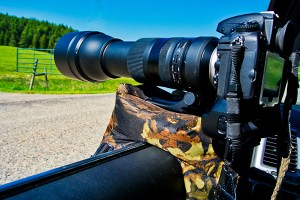
This year I purchased, after months of research and selling off some of my other lenses, the latest Tamron 150-600mm lens. The lens weighs just over four pounds and although it does have vibration control, shooting from a seated position in a car isn’t the best for sharp, shake free photographs. So out comes the beanbag. However,  I quickly realized that big lens demanded a larger beanbag than the one I hastily stitched together years ago.

With a bit of online searching I found a company called Movophoto.com that makes a large and unique beanbag that fits like a saddle over the car window. With my limited sewing skills I could never have made such a perfect beanbag for that big lens. I ordered it, and when it finally arrived I filled it with rice, and although it’s heavy it resides in the car and stays put on the window, so the weight is a good thing. There are a lot of gadgets that I could spend my money on, but for now that beanbag is my favourite.

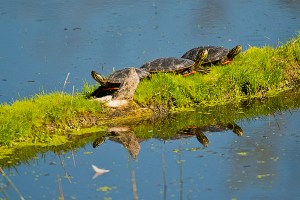
I slowed my car to a stop next to the pond, shut the engine off, positioned my camera on the large beanbag, and waited for the geese to resume their browsing along the grassy hill beside the pond. At 600mm I was able to frame pretty darn close. Then, when I wanted a different position, I’d just move the car a bit, and take more pictures. I photographed those geese (and some nearby turtles) for about thirty minutes.

Suddenly I heard loud honking from some unseen goose that must have been hiding in the tall pond reeds, and, like a crowd scene from a movie, they all turned at once and rushed into the pond.

I am sure there are experienced photographers that would have set up a blind and waited for hours to get the perfect shot. There is no doubt they will get my respect. But I know where those geese are and what time of day is the best to photograph them. And anyway my car is really comfortable and when I am done I just drive home. I guess I am just a roadside photographer.
The Excitement Of A New Camera   

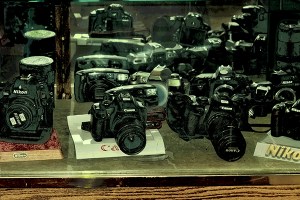
camera-on-display

I could tell that the camera a customer had just purchased was going to inspire him in new and exciting ways. He held the camera up to his eye and talked fast about what he was going to photograph on his next day off. As I watched and listened to his excitement with that used DSLR I contemplated how photographers like to make additions and changes to their equipment inventories. There are different needs for different types of photography, and personal growth within the medium changes the kinds and types of cameras and accessories needed.

I really like to be around other photographers. I recall when I first started seriously making pictures in the early 1970s that my friends and I did lots of backpacking in the rolling hills of southern California, but my fellow backpacker’s adventure goals were different than mine. While they would begin the journey with the goal of reaching a particular the location, I was more interested in what I could photograph along the way. Much of the time I lingered behind somewhere on the trail and wandered into camp near dark, and in the mornings while they were enjoying breakfast over the campfire I was off in the search for some intriguing photo.

I doubt that artists using mediums other than photography get as excited about equipment as photographers do. Photography has been a succession of inventions and technological advancements. The first practitioners like Joseph Nicéphore Niépce in 1826 using surfaces like pewter for one-of-a-kind positive photographs and Louis-Jacques-Mandé Daguerre and his announcement of the Daguerreotype in 1896 were making continual advancements in photography similar to what is occurring today. Those advancements were exciting for would be photographers of that time much as advancing technology excites those of us serious about photography today.

Keeping up with the changing technology of photography has always been a struggle, and also expensive, as photographers change camera equipment completely or upgrade their systems to get the maximum benefit and enjoyment in the medium. I know there are those that will say, ”Just learn to use the camera you have. It’s the photographer, not the camera.”

That is certainly right, however, the thrill of learning to operate and use a new camera is, (can I use the word?) cathartic.

I can remember in 1972 being just as excited with my new Pentax Spotmatic II as that customer was with the camera he just purchased. It came with a 50mm lens that I quickly discarded for a versatile 70-210mm Vivitar zoom. Gosh, I felt fortunate to be getting such an advanced camera and lens. In 1970s it was all about the increasing availability of quality lenses and cameras with built-in light meters.

There are many used DSLR cameras that would work just fine for the kind of photography this person would be doing. In the used camera market it always comes down to condition and price, and of course, the brand that suits the buyer. He looked until he found one at a bargain that met his criteria.

Now that he has his new camera, I suggested he join the local photographers Facebook page and I look forward to the pictures he posts, and of course, watching his growth in as a photographer.

A Rainy Day in Hope, BC – Photographing with Infrared

Wecome to Hope 1

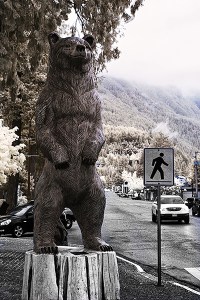
bear crossing 1

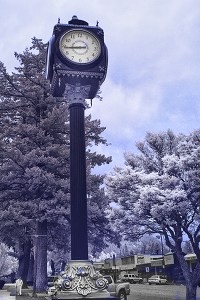
Town clock 1

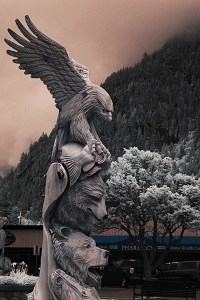
Animal totem 1

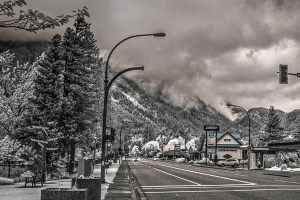
Driving thru Hope 1

After leaving the Vancouver Camera Show and Swap Meet last Sunday I decided that rather than make the long drive all the way back to Kamloops and then Pritchard, I would make a stop for the night in Hope along the way.

Hope, British Columbia, is usually just a location to make a quick pull off at a fast food restaurant, or coffee shop. as I drive between Vancouver and Kamloops.

I have always liked the appearance of the picturesque little town just off the highway along the Fraser River. That was first settled when explorer, Simon Fraser, arrived there in 1808. The Hudson’s Bay Company started a trading post in 1848.
In more recent history Hope received acclaim when it was the location for the Sylvester Stallone Rambo movie, “First Blood”, and then, “Shoot to Kill”, staring Sidney Poitier and Kirstie Alley. The area’s mountains also stood in for the Himalayas in the movie “K2″.

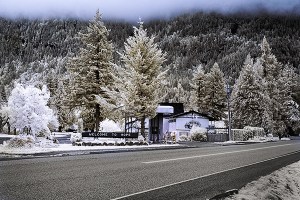
However, in spite of all that the main reason for my stop was I knew I’d be tired after my long day at the swap meet, and, in addition, I thought it would be fun to wander around town with my camera the next morning. I chose to bring the camera I had converted to infrared. I thought shooting infrared would bring a fresh and very different visual interpretation to the heavily forested setting.

There is a poem by Robert Burns wherein he writes, “the best laid plans of mice and men often go awry”. I thought of his prophetic words as I checked out of my motel room the next morning under a pouring rain. Disgusted with my crappy luck I stopped for a coffee and doughnut before leaving town. I was resigned to just head home. But as I sat in my car sipping on my coffee texting my wife that I was heading out, the rain lightened up and I decided that in spite of the cloudy overcast I would try my infrared camera anyway. I thought, what the heck, any photography is fun and the worst that can happen is I’ll have wet hair for the trip back.

I meandered down to the riverfront and zigzagged back through town. I discovered that at some point town residents began erecting large chain saw carvings everywhere. So I took pictures of them along with those of the city streets until the rain picked up again and my glasses got too wet to see.

The best time to shoot infrared is on sunny days, so the rainy, heavily overcast environment wasn’t all that exciting. But I was intent on the pictures by this time.

I must say that I wasn’t really successful, but there were a few images, that with some postproduction help worked out reasonably well.

The rain won this time, but I think I might go back to that scenic little town nestled in the Fraser Canyon. It’s not that far from my home and a nice easy drive, and I’ll take Linda with me. However, we’ll wait for a sunny, dry day and I definitely will try infrared again.

Infrared is such a fun change from normal digital shooting. And similar to purchasing another lens, the cost of having an old camera converted is well worth it.

Photography Studio Workshop   

Studio 1a

Studio 3a

Studio 2a

Photographing Autumn 1a

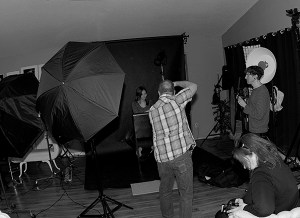
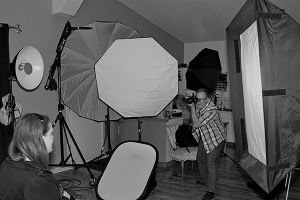
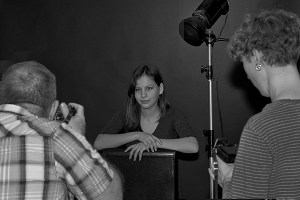
My latest photography workshop, Posing and Lighting, occurred just outside Kamloops this past weekend at a local studio owned by Dave Monsees of Cherry Creek.

I will begin with a perfect quote I have used before by photographer and author Frank Criccho that goes with what I was wanted the participants to think about. Criccho stated, “The success of a photographic portrait depends as much on the photographer’s artistic and creative use of lighting techniques as it does on his or her skill with the camera.”

Much of the time photographers either prefer to photograph people in the daylight or, if forced to shoot indoors, just increase their camera’s ISO. And there are too many that when they do decide to employ On or Off-camera flash go for the easiest method of just filling the space with lots of light.

During these sessions I lead my goal is to get participants thinking about not only posing our model, but also about the using the flash light as more than just a device to brighten up the environment.

I want them to begin making decisions as to how to apply light on their subject in the same way they might decide to use a long focal length lens rather than a short focal length lens.

As always, when I lead a full day session like this one, I feel my task is to present information and keep things going. And I always leave plenty of time for the participants to engage with the model and experiment with techniques. Watching workshop participants grasp and learn photographic lighting is a fun and satisfying activity for me.

I began the workshop with a quick slide show. Hmm…I guess we don’t have slide shows any more and instead connect a computer to a digital projector to provide a PowerPoint presentation. In any event we started the day off with a presentation that showed how different modifiers affected the light on a subject. So when our model Autumn arrived it was, “lights, camera, action.”

We spent the majority of the day (barely breaking for lunch) using many different light modifiers, changing the angle of the lights, applying light in creative ways, employing different backdrops, and of course, studying posing.

I will say these kinds of workshops are really demanding on a very patient and hard working model as she constantly and quickly alters her outlook and holds any pose the excited photographers request; all the while giving each photographer time to apply what I was continually introducing.

I can’t really say much regarding those enthusiastic photographers, I expect they were filled with the energy most photographers get when they are learning and creating, but by 4pm Autumn and I were ready to wind down. A good day well done.

“A portrait! What could be more simple and more complex, more obvious and more profound.” – Charles Baudelaire, Poet – 1859


Photographing Graffiti in The Tunnel   

Lighting the tunnel

Creek Tunnel

Kast

AWs

Creek tunnel North

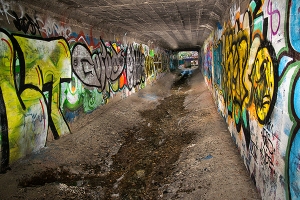
There is a little creek that flows into Kamloops, British Columbia via a small waterfall. Petersen Creek is diverted underground for it’s journey through the city until it circulates out and spills into the South Thompson River.
There are several places along its cement banked route where Petersen Creek’s shallow flow is visible to passers-by, but it quickly runs out of sight again when it reaches a city street and is diverted underground.
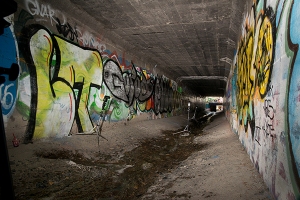
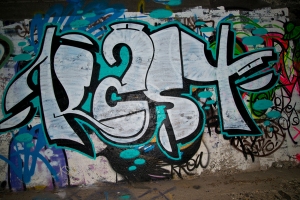
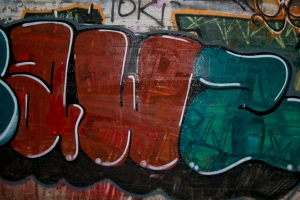
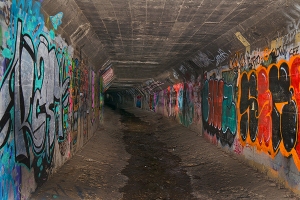
One would think there isn’t much interest to anyone other than the City Works employees who make sure it isn’t plugged up when there is a larger than normal volume of water coming down from the canyon. However, at the final concrete watercourse everything changes to several block-long tunnels that are 10-12 feet high and just as wide that have gained attention from very creative graffiti artists and, of course, locals that enjoy capturing that creativity with their cameras.

It was there that I climbed down into after parking my car on the street beside the drainage tunnel entrance. I had met a resident photo enthusiast named Shannon who has been smitten with all the graffiti she was seeing on backstreet walls and boxcars that had wandered into the tunnel and she realized that street artists were painting on the walls.

I joined Shannon, and her partner Max, a few weeks ago in the dim tunnels. They and most locals were relying on their camera’s ISO ability, but after ten or fifteen feet the light was gone.

I hadn’t been in those tunnels since I first came to Kamloops back in 1974. At that time I tried going in a bit, but the water was much higher then and other than a few crude messages spray painted at the opening there wasn’t really a reason to slosh into the dark tunnel. However, this time I decided it would be fun to light up more than just one or two paintings.

I returned with four stands with a flash on each and positioned them to cross light the tunnel. Then it was easy to begin by metering the light coming in from the road and balancing the light from each flash to match that.

When I got home it was simple to clone out each flash and use Photoshop’s burn and dodge tool to smooth out the areas where the flash had outlined its light on the floor or where ever there was a different brightness.

I chose to illuminate the street artist’s work as a whole instead of just documenting one section at a time. I know when we see what someone has left on a wall or on a train’s boxcar as it passes by, that we tend to isolate one piece of graffiti art, but as I stepped into the dark winding drainage tunnel I felt more than just a cold breeze and saw more than one bright statement. To me everything – the dark winding tunnel, and the graffiti – was all part of the whole, or one ongoing work of art. And I wanted to photograph that combination of a cold, colourful, wet, chaotic, winding tunnel displaying the work of many artists.


A Good Day for Infrared Photography            

Pritchard Train crossing 1a

Reflection

Log jams 1b

Salmon 2b

Bridge crossing 1a


The past few weeks have been apparent with flat and overcast skies. That’s certainly not inviting for anyone chomping at the bit to get out with a camera around Kamloops, British Columbia.

Only a short month ago the landscape was covered with glistening white snow that even on overcast days created some interest. However, that snow has melted this month leaving colourless meadows and a washed-out-looking, green forest of trees. In my opinion, the best word to describe the landscape, even with today’s sparkling sun, is grey.

I suppose many landscape photographers get creative and spend some time behind a computer manipulating that grey landscape. There are a myriad of programs designed to manipulate image files allowing black and white conversion or gritty oversaturation. But those conversions, although creative, in my opinion, don’t really give much life to the landscape.

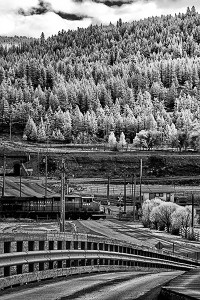
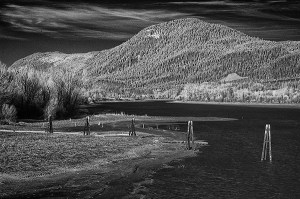
However, for me it’s simple. I just grabbed my infrared camera and drove down to the large Thompson River that cuts through the valley on its way to Kamloops and then to the Canadian west coast.

For years I have enjoyed capturing landscapes (and cityscapes) using first, infrared film, and then for the past ten years, a camera converted to only “see” infrared light.

Infrared light is invisible to the human eye. To capture it with a modern DSLR, the camera is converted by blocking all but the infrared light from hitting the sensor.

I enjoy how infrared photography gives me a scene illuminated by that part of the colour spectrum we can’t see, with delightful images that couldn’t be captured in any other way.

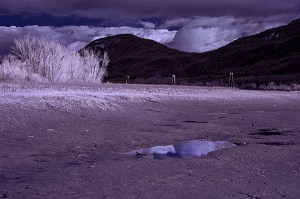
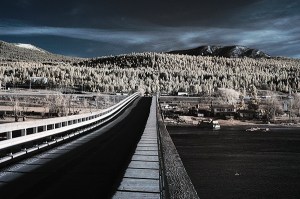
Dark skies and glowing white trees are some of my favourite infrared effects. It is those fresh and exciting photographs (done with very little computer work) that separated my photography from both the monotone conversions, and the oversaturated scenic, that had been viewed on posts by other local photographers.

I like to wander along the winter beach not far from my rural home. Normally the turn-off and sparsely tree-lined beach is well used by locals with motorbikes and bicycles, walking their dogs, or launching their fishing boats. However, the winter beach on the river is empty, especially on cold days, and it’s those days that I enjoy the most. I can stroll along the narrow walkway that goes over the bridge while taking pictures of the river valley. And although there is a sign that tells walkers not to loiter or fish from the bridge, in all the years that I have been making pictures from it, no one has ever bothered me. Most of the time people smile and wave from their vehicles as the pass me.

I roam under the bridge and search the sandy riverside photographing interesting features and trash left over from winters’ storms, and, in spite of everything being shades of grey, infrared changes everything, and I have the choice in post-production to choose surreal coloured, or unique black and white images.

I’ll repeat what I wrote when discussing infrared in my article last November, “Infrared allows a photographer, and gives the viewer, a completely different feeling of a subject. Making an image with a modified camera is an exploration and a discovery that moves a photographer far from the usual”.

I’ve Been Robbed!


foot prints in the snow

A phone call at 3:30 in the morning is never good.  And sure enough the call I got last Monday morning met my worst expectations.

As I answered the phone I wondered, “Is this a call about a fire or a break-in”. Sure enough it was the latter. There was a break-in at my store.

Somehow three thieves gained entry into the main building from the alley door, and as the alarm blared, they made their way towards my storefront shop. Thereafter, they easily smashed the glass of the door entering my camera store, rushed to a display cabinet containing cameras and lenses; and because I found some lenses scattered on the floor, I think they rudely shoved equipment from two shelves into a camera case that contained my digital projector, and then ran back through the building to exit the rear door.

The tenant that resides on the second floor added her 911 call to the notification the security company was getting from the alarm, and looking through her window watched the burglars making off though the falling snow. Fortunately, the police arrived very soon after and using their tracking dogs easily followed the criminals to their hideout and apprehended them.

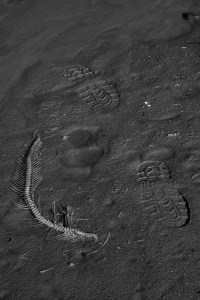
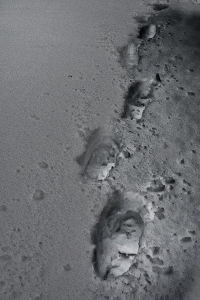
I give credit to the fast work of the local RCMP. They were certainly aided by the freshly fallen snow that at that time in the morning revealed the tracks of those thieves that entered and exited my shop. I would like to have watched those Mounties with their dogs chasing down the bad guys.

As I child of the 1950s radio shows like, “The Lone Ranger” and “The Green Hornet”, I listened with excitement as Sgt. Preston of the North West Mounted Police, and his dog, Yukon King, fought evildoers in the Northern Canadian wilderness.

I don’t want to make light of the excellent police force we have here in Kamloops, but as I stood outside the back door in the eerie, 4am light talking to the woman from the upstairs apartment I looked down the snow covered landscape and thought of that radio program of my childhood days from all those years ago. I cannot say the reason. Perhaps it was the lack of sleep, or the stress of the break-in, but when she mentioned the police and their dogs following the tracks in the snow, that’s what came to mind.

I received a call from a constable regarding the photography equipment stolen from my shop, who told me they recovered cameras and lenses in a black case. I assume that’s the missing projector case.

There is a good chance that most of, or hopefully all, of my property will be returned. Now I just have to wait for the lead inspector to determine how long they need to keep things as evidence. After posting the incident on Facebook, I received lots of concern from local photographers. That was nice. I found it interesting when someone would write, “You must feel violated”. For me that isn’t the word I would use. “Irritated” was a much better word to fit my mood as I cleaned up the glass, covered the opening with wood, and now must wait for the police to return my camera equipment.

I will get through this incident, survive my disappointment, and today returned to selling good, used, photography equipment, but now I also have a story to tell of yet another of those stressful events. There are so many photographers out there that have, as me, been photography equipment and have lost their prized photography equipment to, as one officer I talked to called them, “rats that scurry around in the darkness looking for an opportunity”. As I am sure readers know, we must be vigilant against thieves.

As I write this I remember how Sgt. Preston would hug his dog at the end of each episode and say, “Well, King, it looks like this case is closed.”

Thank you to the Royal Canadian Mounted Police for helping me recover my merchandise.


Photographing Eagles along the Highway       

Eagle of all atitudes

Young eagles

Young eagle

Waiting eagle

In the warm sun

Watching young ones

Fly, there's a photographer

Fly away


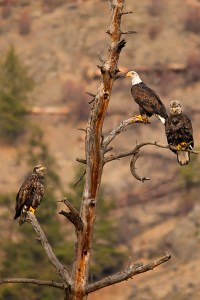
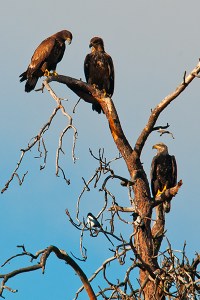
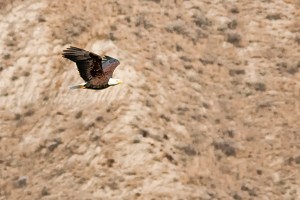
Eagles come in all shapes and sizes, but you will recognize them chiefly by their attitudes.” I don’t think British economist, E. F. Schumacher was really discussing the kind of eagles my wife and I saw perched in trees along the river, but his quote perfectly describes a picture Linda took of three eagles

Winter is on its way and eagles have been moving west along the South Thompson River towards the warmer feeding grounds on the pacific coast.

My commute to Kamloops from my home in Pritchard is on the Trans Canada highway that runs parallel with that wide river and this year it has been fun to see how many eagles we can count before reaching Kamloops.

After counting 35 eagles on our way to town the previous week Linda mentioned that she’d like to try taking some pictures. So after waiting until the sun was high to the south last Wednesday we made the drive to see what we could find.

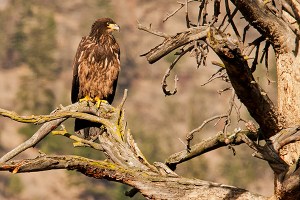
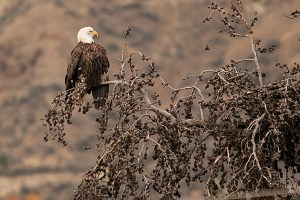
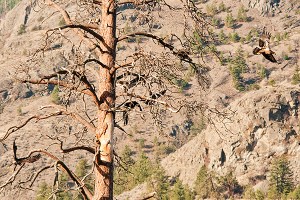
The traffic on the Trans Canada is constant and fast moving with lots of big, transport trucks. But with some preparation it isn’t that big of a deal to quickly pull a safe distance off the road to photograph eagles in the tall, dead trees along the river in which the eagles like to perch to watch for fish. In one tree alone we counted fourteen eagles, some mature but mostly adolescent.

My job is to drive and my wife’s is to photograph eagles. I pull over, stop and turn off the car to reduce vibration caused by the engine, and Linda rolls the window down, plops a beanbag on the frame and positions her heavy 150-500mm Sigma lens out the window and starts shooting.

It would have been nicer if we had a way to get closer. However, even if one got out of the car, struggled through a deep ditch, crossed the railroad tracks and climbed over farmers’ wire fences, I am sure the skittish eagles would just fly off anyway.

Linda had a pretty easy time of photographing those eagles from the car anyway. She had selected Shutter Priority on her camera with a shutter speed of 1/650th of a second and 650 ISO. Yes, there were some shots that didn’t turn out, the car would shake when big trucks passed by and every so often clouds would block the sun. But she got some great keepers.

As exciting as it is for those of us here in the BC Interior to see 40 or 50 eagles in the trees along the river, in a few days lots of those big birds will be making their way down the river to join many, many more eagles congregating on the Harrison River to feast on spawning salmon.

The Fraser Valley Bald Eagle Festival began 20 years ago and this year it will begin on November 28th at Harrison, British Columbia. This is an annual event with the migration of thousands of Bald Eagles returning to the Harrison Mills area to take advantage of the spawning salmon.

For photographers the place to be is where the Harrison River widens with shallow gravel bars for the returning salmon to spawn. Organizers say it is possible to see up to 10,000 Bald Eagles feasting on salmon.

What Influenced My Photography of Landscapes?  


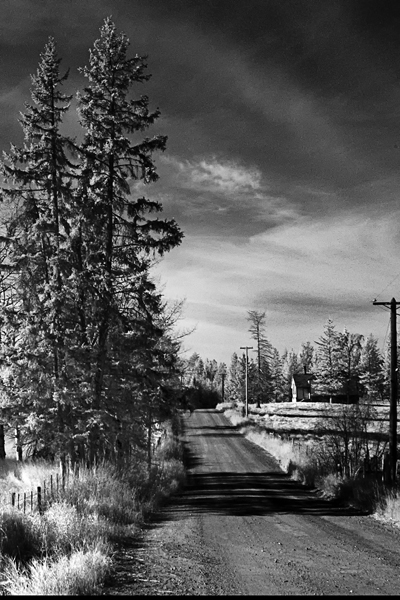
Along the back road 2

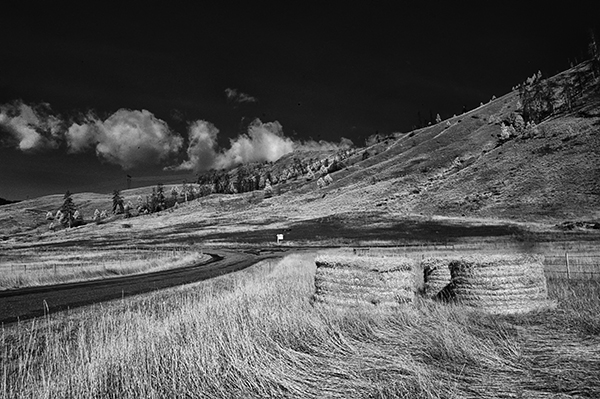
Bales along the road 2

River view

Lake view

Scout

Memories of roadside photography.


My interest in photography began in the early 1970s. I had grown up with cameras, but until that time they were no more than a simple boxy device with which to document family and friends. When I look at my tattered old albums packed with fading pictures taped to construction paper pages, I see lots of poorly composed and poorly exposed images, partly due to the inadequate technology of the day and my ignorance in using it.

When I did decide the medium of photography was worth using for more than documenting friends and family my first progression was into arty, creative images. I have mentioned before that the great photographer, Man Ray, was my first inspiration, but now thinking about my photography of those days I am amused at my youth, and contemplate how far I have progressed and of course how far the technology has come.

I think my influence with the photography of landscapes and other subjects in nature may have begun with the early advertisements by the American Automobile Association. That organization was the best place to get maps for road trips in North America. They sent their employees out, with cameras and mapping instruments, across the continent finding the best and most scenic routes. I remember seeing pictures of big, four-door International vehicles with people poised on platforms on top with camera and binoculars in hand on a dirt road in the middle of “no-where North America”. It all looked very exciting.

Then I was introduced to the writings and photography of Ansel Adams, and saw pictures of him standing on a platform on top of a vehicle very much like those used by the American Automobile Association with his large format camera making wonderful photographs any scenic photographer would admire. So, I saved my dollars, sold my jaunty little MG Midget, that was so easy to get around in on the streets of Los Angeles, and bought a bright yellow International Scout 4×4. Underpowered, poor turning capability, uncomfortable on long trips with back seats that were only accessed by climbing over a metal barrier behind the front seats; it was perfect in my young mind and meant that I, like Ansel Adams and the folks from the AAA, could travel the back roads in a cool looking vehicle with my camera gleefully capturing the natural world on film.

Years have passed and technology has changed and so have I. There are still lots of back roads to explore and photograph, but the days of climbing on my car roof are long gone. The American Automobile Association no longer explores the country and today I check maps on my iPhone. I don’t need a large 8×10 view camera like Ansel Adams used with the accompanying long hours working in a chemical darkroom to make good enlargements and certainly don’t want to drive around in that uncomfortable, gas guzzling International anymore.

I thought about all this as I was heading towards the city of Kelowna last week. My wife and I left early so we could stop for some pictures and still be there for a 5PM appointment. My car of choice is now a Honda Accord. Comfortable, fuel-efficient and if I drop the back seat down I can carry lots of equipment. As I drove I mentally made photographic compositions of the countryside and thought about how nice the day was for photography.

I reminisced about the many times I have made this same drive over the years, and the different photographic equipment I have used to photograph many of the subjects and scenes I was driving past, and the different vehicles I have used, and we talked about how easy it is to make pictures today. As the cameras get better and better, and equipment like tripods and lenses get lighter, and our vehicles are more fuel efficient, the life of roadside photographers like me is just great.


Photography, a personal vision.

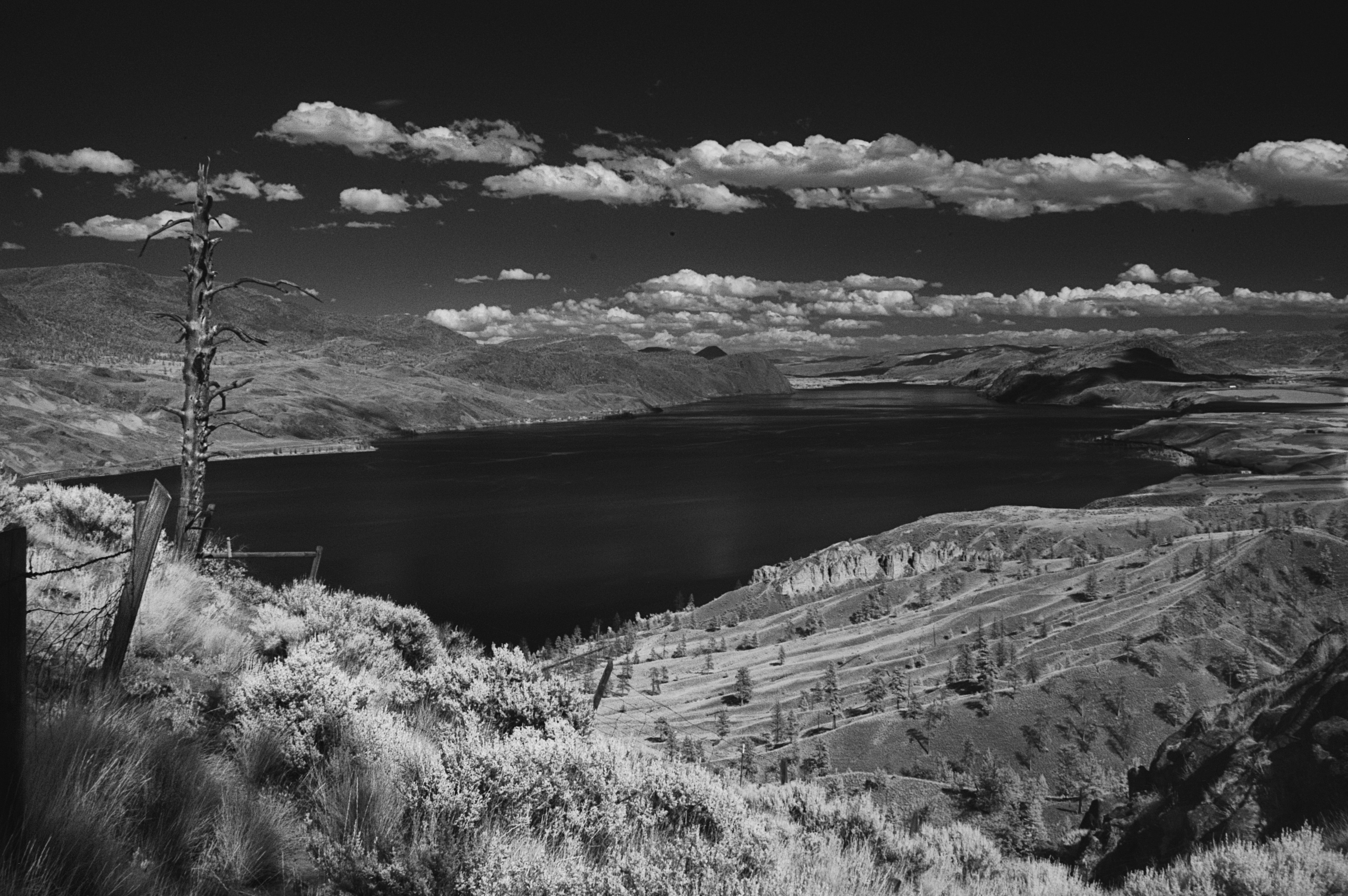
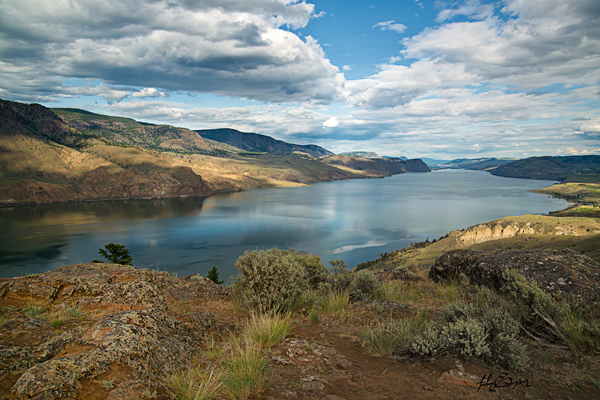
Kamloops Lake 1

Kamloops Lake

Kamloops Lake 1a

Lawnmower Race copy1

Lawnmower Race copy2

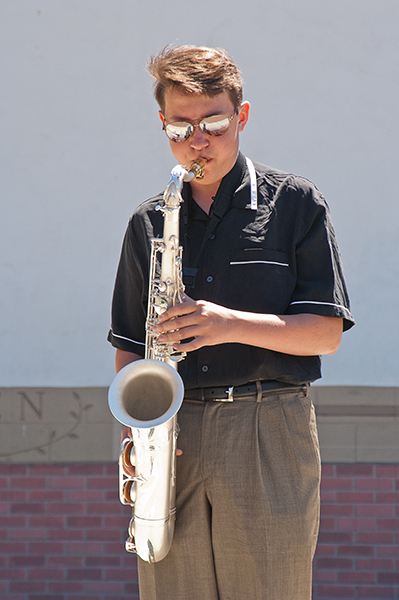
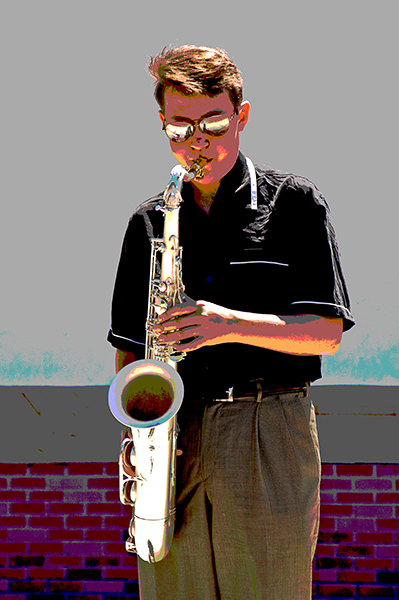
Sax player 1 Sax player 2


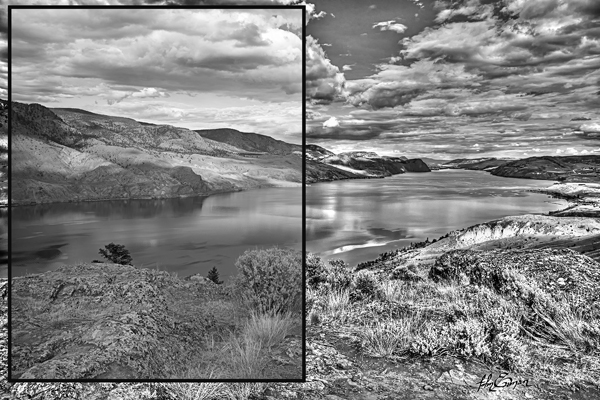
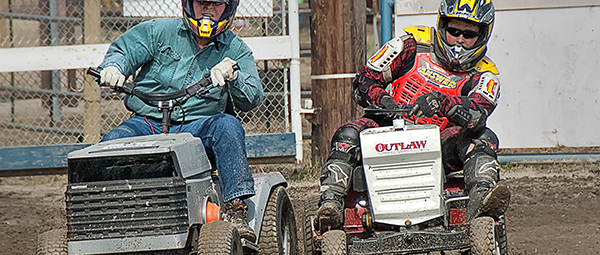
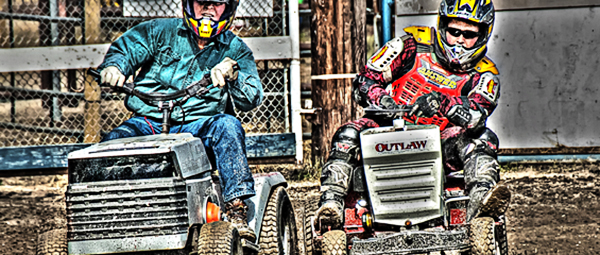
My photographer friend Greg posted the following statement on the Canadian photographer flickr.com/group: “Recently I’ve come across a number of photographs on the social media outlets that are absolutely stunning and amazing works of art, but there are a whole host of people who comment saying ‘it looks fake’, ‘it needs to be more real’, ‘that picture has no resemblance to reality’”. And he continues raising the question with “Should we be striving to produce photographs that are more ‘real’ to please the crowds who seem to have very little understanding of art?”

My quick and easy response is to quote Plato, “Beauty lies in the eyes of the beholder”. Even Shakespeare in his work, Love’s Labours Lost writes, “Beauty is bought by judgment of the eye”.

I understand his (and others) frustration with those that are ready to condemn anything that deviates from their personal interpretation of photography, but we need to remember that is just their opinion. I don’t think Greg or any other photographer should “be striving to produce photographs…to please the crowds”. However, when one displays a photograph on any social media site one needs to be ready for someone else’s opinion.

I used the following last January in my discussion of Photography as a Fine Art. Wikipedia’s on-line encyclopedia says, “Fine art photography is photography created in accordance with the vision of the artist as photographer.” That should be enough to ease my friend’s frustration. I will comment to him that those detractors didn’t understand the interpretation or artistic vision of the photographer’s work.

Some may disagree with me, but I think photography has always been a technology driven medium. And just as there are those willing to push the limits, there surely are also those that employ their cameras simply as devices to document the people, objects, and scenes in front of them, and I have no doubt their criticism might come swiftly to those that manipulate their images instead of maintaining the more conservative course of photographic reality.

Regarding Greg’s question about some people’s understanding, or lack of understanding of art, that is a question that countless generations may have struggled with possibly since the first humans decided to place a favourite rock in their cave or put coloured pigment on the wall.

I believe the question is actually, “What is Art and who has the right to define Art?”

Mark Twain is attributed with the words, “I don’t know much about art, but I know what I like.”   I expect most of us fall into that category.

Here are a number of quotes about art by artists. American architect and designer Frank Lloyd Wright said, “Art is a discovery and development of elementary principles of nature into beautiful forms suitable for human use.” However, I much preferred photographer Ansel Adams words, “Photography is more than a medium for factual communication of ideas. It is a creative art.” Or this from novelist Rainbow Rowell, “…and art wasn’t supposed to look nice; it was supposed to make you feel something.” And French Impressionist painter Edgar Degas wrote, “Art is not what you see, but what you make others see.”

When one has the need to be creative they should have the right to decide on their own particular style to fulfill their personal creative vision. What that vision is should be entirely up to the photographer, and the audience for whom the image is produced. I think the problem in this day of mass social media is how to select the right audience.

I do look forward to your comments. Thank you, John