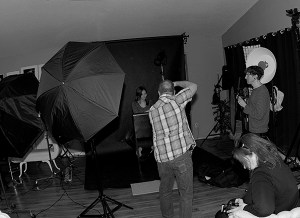
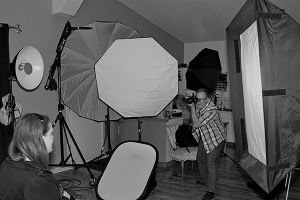
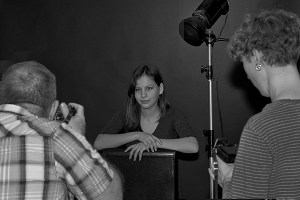
Photography Studio Workshop   

Studio 1a

Studio 3a

Studio 2a

Photographing Autumn 1a

My latest photography workshop, Posing and Lighting, occurred just outside Kamloops this past weekend at a local studio owned by Dave Monsees of Cherry Creek.

I will begin with a perfect quote I have used before by photographer and author Frank Criccho that goes with what I was wanted the participants to think about. Criccho stated, “The success of a photographic portrait depends as much on the photographer’s artistic and creative use of lighting techniques as it does on his or her skill with the camera.”

Much of the time photographers either prefer to photograph people in the daylight or, if forced to shoot indoors, just increase their camera’s ISO. And there are too many that when they do decide to employ On or Off-camera flash go for the easiest method of just filling the space with lots of light.

During these sessions I lead my goal is to get participants thinking about not only posing our model, but also about the using the flash light as more than just a device to brighten up the environment.

I want them to begin making decisions as to how to apply light on their subject in the same way they might decide to use a long focal length lens rather than a short focal length lens.

As always, when I lead a full day session like this one, I feel my task is to present information and keep things going. And I always leave plenty of time for the participants to engage with the model and experiment with techniques. Watching workshop participants grasp and learn photographic lighting is a fun and satisfying activity for me.

I began the workshop with a quick slide show. Hmm…I guess we don’t have slide shows any more and instead connect a computer to a digital projector to provide a PowerPoint presentation. In any event we started the day off with a presentation that showed how different modifiers affected the light on a subject. So when our model Autumn arrived it was, “lights, camera, action.”

We spent the majority of the day (barely breaking for lunch) using many different light modifiers, changing the angle of the lights, applying light in creative ways, employing different backdrops, and of course, studying posing.

I will say these kinds of workshops are really demanding on a very patient and hard working model as she constantly and quickly alters her outlook and holds any pose the excited photographers request; all the while giving each photographer time to apply what I was continually introducing.

I can’t really say much regarding those enthusiastic photographers, I expect they were filled with the energy most photographers get when they are learning and creating, but by 4pm Autumn and I were ready to wind down. A good day well done.

“A portrait! What could be more simple and more complex, more obvious and more profound.” – Charles Baudelaire, Poet – 1859
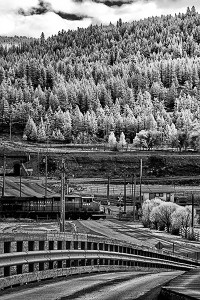
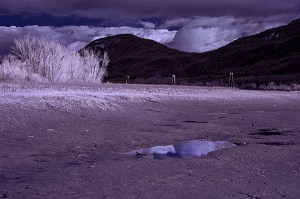


A Good Day for Infrared Photography            

Pritchard Train crossing 1a

Reflection

Log jams 1b

Salmon 2b

Bridge crossing 1a


The past few weeks have been apparent with flat and overcast skies. That’s certainly not inviting for anyone chomping at the bit to get out with a camera around Kamloops, British Columbia.

Only a short month ago the landscape was covered with glistening white snow that even on overcast days created some interest. However, that snow has melted this month leaving colourless meadows and a washed-out-looking, green forest of trees. In my opinion, the best word to describe the landscape, even with today’s sparkling sun, is grey.

I suppose many landscape photographers get creative and spend some time behind a computer manipulating that grey landscape. There are a myriad of programs designed to manipulate image files allowing black and white conversion or gritty oversaturation. But those conversions, although creative, in my opinion, don’t really give much life to the landscape.

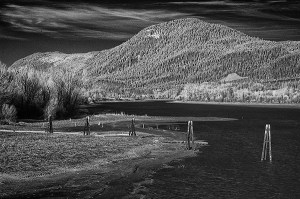
However, for me it’s simple. I just grabbed my infrared camera and drove down to the large Thompson River that cuts through the valley on its way to Kamloops and then to the Canadian west coast.

For years I have enjoyed capturing landscapes (and cityscapes) using first, infrared film, and then for the past ten years, a camera converted to only “see” infrared light.

Infrared light is invisible to the human eye. To capture it with a modern DSLR, the camera is converted by blocking all but the infrared light from hitting the sensor.

I enjoy how infrared photography gives me a scene illuminated by that part of the colour spectrum we can’t see, with delightful images that couldn’t be captured in any other way.

Dark skies and glowing white trees are some of my favourite infrared effects. It is those fresh and exciting photographs (done with very little computer work) that separated my photography from both the monotone conversions, and the oversaturated scenic, that had been viewed on posts by other local photographers.

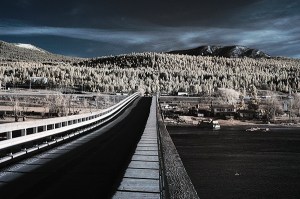
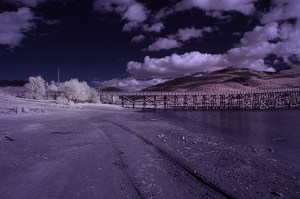
I like to wander along the winter beach not far from my rural home. Normally the turn-off and sparsely tree-lined beach is well used by locals with motorbikes and bicycles, walking their dogs, or launching their fishing boats. However, the winter beach on the river is empty, especially on cold days, and it’s those days that I enjoy the most. I can stroll along the narrow walkway that goes over the bridge while taking pictures of the river valley. And although there is a sign that tells walkers not to loiter or fish from the bridge, in all the years that I have been making pictures from it, no one has ever bothered me. Most of the time people smile and wave from their vehicles as the pass me.

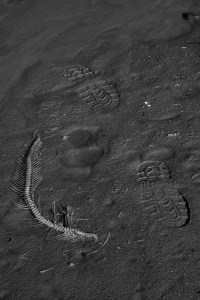
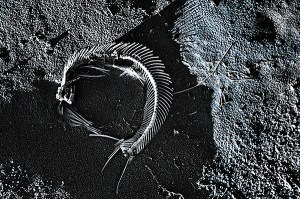
I roam under the bridge and search the sandy riverside photographing interesting features and trash left over from winters’ storms, and, in spite of everything being shades of grey, infrared changes everything, and I have the choice in post-production to choose surreal coloured, or unique black and white images.

I’ll repeat what I wrote when discussing infrared in my article last November, “Infrared allows a photographer, and gives the viewer, a completely different feeling of a subject. Making an image with a modified camera is an exploration and a discovery that moves a photographer far from the usual”.

Printing Your Own Digital Photographs    

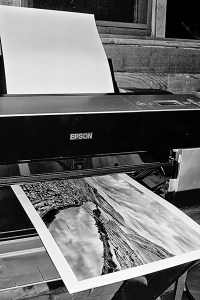
Printing Photos

I had a good time this past week talking with a couple of long time photographers about printing photographs. It was a walk down memory lane as we talked about using film, and how we would spend hours in darkened rooms printing black and white photographs, and about the exciting, and enjoyable, shift to digital images and modern printmaking.

Just like those days when commercial photo labs struggled to match what, with a little practice, a photographer could produce in his or her basement darkroom, I have no doubt that today’s affordable high tech home printers allow us to produce fine art prints that can surpass what most big box commercial labs will give us.

In my opinion it comes down to a battle between visions: The Lab’s or ours. For example, imagine packing your camera equipment off to some isolated location, waiting for hours for the light to reach a colour and effect that matched the artistic vision you desire. Then setting your cameras’ controls with all the experience and skill that you have, and finally releasing the shutter.

Until recently when photographers shot in colour they had to rely on the skill of lab technicians who would hopefully process the images the way they wanted.

Lab technicians, even though well skilled, could only guess at what the conditions were like when the photographer released the shutter, and I suspect much of the time found it rather difficult to recreate and could only guess at the shooting conditions.

Sometimes a slight change in exposure or shift in color will make our photograph stand out, and only we can determine that. For example, those photographers that have bracketed the exposure values of an image know what I am referring to when they are frustrated because they got back several differently exposed prints all printed exactly the same from the lab. The vision in that case becomes the Lab’s; not theirs.

Yes, if we are unsatisfied we would return the film and prints to the lab for a redo. However, more often that not, we just give up and accept the best the lab can do, or try other labs till we get close to what we remembered trying to capture on our film.

I am not going to get into a discussion of printers and papers right now – I’ll save that for another time. I want to go back to where I talked about what happens after we have captured that image we took at that isolated location.

We look on our digital camera’s LCD screen, and check the Histogram to make sure we have captures from which we can work. Now, instead of leaving our vision to the choices of an unknown technician and waiting for the photographs, we download our memory card into our computer, enjoy immediate visual feedback on our photographs, and by using whatever post production software we have we can follow our vision with precision to the final outcome: a photograph that shows exactly what we want it to show; our personal vision. How exciting is that?

With today’s digital technology we can follow our photographic vision from start to finish, from idea to finished print in a way that is far better that ever before possible. And, by using quality photographic printer equipment, photographers can make spectacular enlargements that will give their photography another dimension of control and creativity.


Photographer’s New Year’s Resolutions for 2016    

2016 approaching

This month is half over already and I am thinking with all that’s happening in photography that 2016 is going to rush past like a freight train. The prospect of all the new opportunities for this year is exciting, and it may be worth jotting down a list of personal photography goals for this year, or a list of resolutions, as a good idea.

Every New Year I am interested in what plans other photographers will make for the year ahead and most respond with a usual list, for example, use a tripod more, turn off Auto mode, shoot RAW, make a photo-a-day challenge, and so forth. This year, however, I wanted more inspirational ideas for the year to come.

I revisited ideas from January 2015 that seemed to say a lot about ways to improve with this exciting medium and pulled these out. So for the future, for 2016 here is my “Lucky Seven” .

  1. Pay more attention to creative ideas. “This could be the year to begin evolving  creatively”.
  1. There is too much focus on what is the best camera. When we spend too much time worrying about the camera we forget about the story. “We should be concerned with making images that tell a story”.
  1. Take risks photographically and move away from always trying to please, to fit in with what everyone else is doing. Make this the year to push beyond the comfort zone without being concerned with other’s opinions, to be pleased first for oneself. Maybe this will be the year to put “me” in the photograph.
  1. Learn a new technique. Wonder about how the technique will impact your work and whether you will revert or continue to follow up in that direction. I think it’s as simple as experimenting, and definitely taking the time to “read up on something and then give it a try”. Photographers should always make the effort to learn new techniques. Maybe by taking a class, or at least buying some books, or CDs, written by accomplished photographic writers.
  1. Select new subjects to “get out of the rut of shooting the same thing over and over”. While practicing portraiture or landscapes is good, doing the same thing the same way over and over can result in a lack of inventiveness and creativity in our work.
  1. Make every shot count and stay away from the spray-and-pray shooting style. “It’s about quality photographs, not about the volume of pictures snapped during sessions”.
  1. Become viciously ruthless with one’s own photography and what is done in post-production, to be more critical, to keep “conditioning oneself to throw out the crap is the only way to keep improving.”

I’ll finish with a quote by award winning English author, Neil Gaiman.

I hope that in this year to come, you make mistakes. Because if you are making mistakes, then you are making new things, trying new things, learning, living, pushing yourself, changing yourself, changing your world. You’re doing things you’ve never done before, and more importantly, you’re doing something.


Christmas Lights are Here Again         

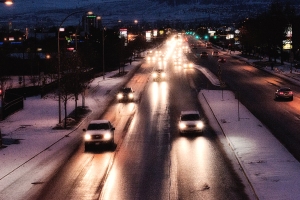
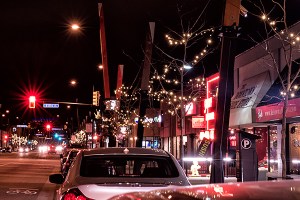
Street Lights

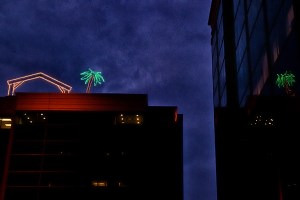
PalmTree Decor

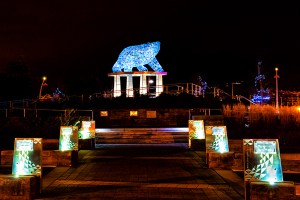
Tree of Hope

Xmas bear

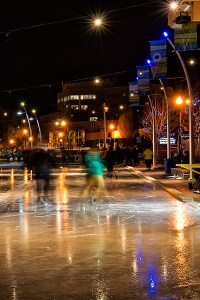
SKating rink

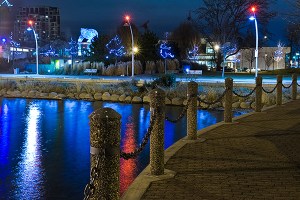
Beach walk

December is upon us again and the visual presentation of bright, festive lights has begun. Yes, the Christmas holidays are coming. The bright colours, the gaudy decorations, the sentimental music, the silly TV programs, and, for me especially, the Christmas lights in the city.

This past week my wife and I had to journey for a late afternoon meeting to Kelowna, which is two hours south from our home, however, that winding country road can be treacherous on dark, snowy nights and so we decided to stay overnight in Kelowna.

For some that means dinner out and just waiting the night out in a motel, but for me it’s an opportunity to have fun experimenting and photographing the season’s sparkling lights. In anticipation I had packed my camera with a 24-70mm lens and, of course, my tripod.

My preference for evening photography is to select a location before it gets dark, and to begin shooting when the lights are first turned on, when there is still some light in the sky, yet dark enough for the lights to be bright. However, our meeting lasted until after dark and I had lost the light.

I have been fascinated by Christmas lights since before I picked up my first camera, and remember family outings this time of year when my parents would pack us up in the old 1954 Ford station wagon for after dark drives along the high roads above the Salt Lake City valley. We would drink chocolate milk and look down on the colourful city lights. At that time my father was in charge of the awkward, accordion-like Kodak camera, that I doubt ever used anything but black and white film.

In spite of the late hour we drove by the downtown Kelowna lakeshore past the Yacht Club. I was sure the city would have lights along the sidewalk and hoped that some of the boats might be lit up. I had also heard that a public skating rink was opening and I wanted to experiment with a slow shutterspeed.

During the time when ISO ratings were limited, photographers who shot after dark ended up exposing for only the lights, and the resulting photographs would show lots of colours, but didn’t say anything about the location, or environment. Nowadays most modern cameras have no trouble with ISO 800 or 1600, with some even 3200, and don’t show the random speckles, which indicate degraded image quality.

Making some test shots I quickly found that the city lights were bright enough to allow me to use ISO 800. I also tried 1600, but I lost Christmas lights detail, and the buildings and walkways didn’t look like they were photographed after dark.

As usual Kelowna had lit up its tall “Tree of Hope”. I photographed that very tall electric tree last year and knew from experience that the best time to get pictures of it was early in the morning. When I left my hotel room at 6am the next morning I was greeted by a couple inches a fresh wet snow. Perfect. More light reflection.

I shot with my camera set to “aperture” priority. When I use aperture priority for this kind of photography I also employ the camera’s exposure compensation feature. If one just used the aperture priority mode the camera will, as it is programed to do, try to correct the lighting and that makes the sky too bright. This time I think I used -1.7 to darken the sky.

A drive this time of year through any town or city neighbourhood is an exciting visual presentation of bright, festive lights, and an opportunity for at least a few weeks, to have fun experimenting and photographing the season’s sparkling subjects.

Infrared, A Completely Different Feeling….

Pritchard Station

Riverside

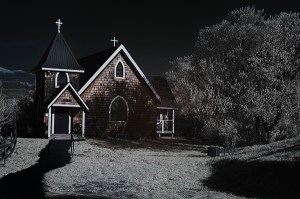
Monty Creek church

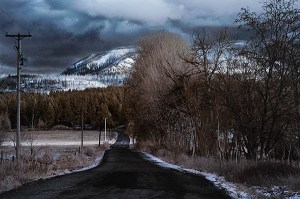
Fence along a dirt road

Pritchard Bridge

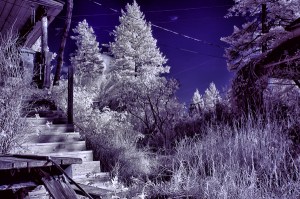
Back Porch

Infrared, A Completely Different Feeling

In my last article I discussed how easy it is to make creative changes in one’s photography by using a camera converted to infrared. I wrote that photographers have the option to creatively challenge themselves by selecting different lenses, choosing to produce black and white images, electing to use highly manipulative post-production techniques, etc., or any combination just to mention a few. Then I added one more creative tool to the list that I use, a camera converted to only capture images of the world around me in infrared.

Infrared allows a photographer, and gives the viewer, a completely different feeling of a subject. Making an image with a modified camera is an exploration and a discovery that moves a photographer far from the usual. I like the sometimes-surprising tones that I can obtain when I convert the image to black and white. Like any form of photography, or art, it’s all a matter of taste.

Reflected IR light produces an array of surreal effects, vegetation sometimes appears white or near white. Black surfaces can appear gray or almost white depending on the angle of reflected light, and if the sky (my favourite part of the infrared image) is photographed from the right direction it becomes black. The bluer the sky, the greater the likelihood of an unworldly effect; and white surfaces can glow with an ethereal brightness.

The response I received from readers got me thinking about how much I like shooting infrared. That’s been a long relationship. My first forays with infrared during the 1970’s were began with infrared colour transparency film and then with infrared black and white film.

Now that I have set film aside I am more than content to use a converted digital camera. Besides it’s much easier with digital than the arduous process we had to contend with when we used film. Infrared film had to be loaded and unloaded in complete darkness, then processed in metal tanks that kept the film from getting fogged. We attached a deep red filter to the lens. The deeper the red the better the effect, and because of the dark red filter things become very hard to see. Oh, and the exposures were long if the sun wasn’t bright.

In spite of that infrared photography has had a strong following of creative photographers for as long as I have been involved in photography. And now with the light gathering ability of modern sensors I think that following is stronger than ever.

In an article I wrote about using infrared film titled “Photographing a Different Kind of Light” I said, “There are those who believe a fine art photograph must represent reality, but reality doesn’t necessarily take into account that there are differences between what one sees, what the photographer’s camera produces, and what the photographer was trying to capture.” I think a photograph is only a representation of a particular vision of reality.

Infrared allows us to photograph a world illuminated by infrared light, that part of the colour spectrum we can’t normally see, and produces intriguing, exquisite and sometimes unearthly photographs that can’t be captured in any other way.

Infrared is a good way for me to change the way I make photographs.

Cattleguard 1

Martin Mountain 1

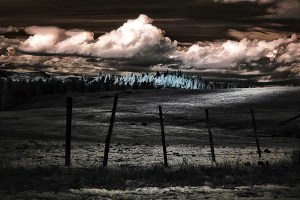
Fence 1

One of the things I like about the exciting medium of photography is how easy it is to change the tools with which we use to create photographs.

I suppose painters can change their brush to a different size, or use a pallet knife to apply paint on their canvas. They can step away from a canvas surface altogether and apply paint to any number of other materials. I guess photographers aren’t alone in the ability to change tools in pursuit of making an interesting picture.

However, photographers have the option to creatively challenge themselves by selecting different lenses, choosing black and white images, electing to use highly manipulative post-production techniques, etc., or any combination just to mention a few.

For myself, I’ll add one more item to that list: using a camera converted to only capture images of the world around me in infrared.

I have mentioned before the old Nikon that I had converted to infrared many years ago. I enjoyed using that old 6 mega pixel camera, it served me well. I purchased it in 2001 and it was my first DSLR, however, when the time came to move to a camera with a newer and better sensor, instead of selling it off like I have with many cameras since, I opted to have it converted to a dedicated infrared camera.

Infrared cameras like blue cloudless sky, and I think many of my most successful images have been late in the afternoon on sunny days. Nevertheless, this week I decided to wander the roads near my rural home in hope of getting some dramatic skies on the heavily clouded afternoon.

My experience on cloudy days has been that one has to pick subjects carefully. There are some objects that, in spite of a sensor that only sees infrared, look pretty much the same as they would if photographed with a roll of black and white film. Instead of taking on a light coloured, or white glow, trees might go black and meadows look normal.

With that in mind, my goal, as I drove along the snowy dirt roads was to find a camera angle that would do the most for the vegetation and still give me lots of dramatic sky.

Life Pixel, http://www.lifepixel.com/ writes on their website, “Are you tired of shooting the same stuff everyone else is shooting? Then be different & shoot infrared instead!”
I don’t think I care whether I’m shooting the same subjects as photographers, but I sure do like to change how other photographers see the stuff I do shoot, and infrared works perfectly for that.

The infrared camera allows me to change my tools and way of visualizing and capturing the world around me. It makes me think about my photographs in a different and challenging way.

Road Trip to Penticton  

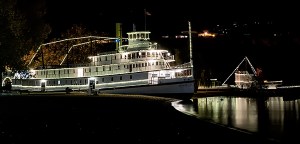
SS Sicamous

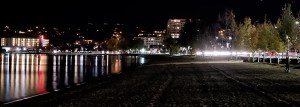
Walking the beach at night

SS Sicamous Penticton

StearnWheeler

Penticton Waterfront


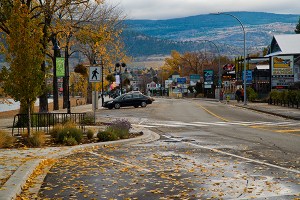
The month of November has began and my wife, Linda, and I thought it might be a good idea to take a drive south before the cold winds blow the last leaves of fall from the trees. Sometimes it’s just nice to go for a drive. So we decided on Penticton; a scenic three-hour drive from our home for a fun, fall, overnight getaway. Any pictures we could get would be a bonus.

During the summer the city of Penticton, situated at the southern tip of British Columbia’s Okanagan Lake, is a thriving tourist destination. And I didn’t doubt a friend’s statement when he suggested that Penticton, a city of 30,000 plus population easily doubles in the summer. However, everything changes in the lull between summer and winter. When I called a motel the clerk told me, “You don’t need to bother with a reservation as there are plenty of rooms.”

I like cities at night. The lights sparkle and beckon to those of us that have our camera and tripod ready. Arriving after dark and settling in to our room it was no time at all before we had bundled up against the cold lake breeze and rushed out into the dark to wander along the wide sandy beach.

It’s easy to get sharp, colourful night pictures. I was out to photograph the SS Sicamous, said to be the largest surviving sternwheeler in British Columbia. The SS Sicamous, now a museum, prowled Okanagan Lake until 1936, servicing the lakeside fruit growing communities of Penticton, Kelowna and Vernon.

The big stern wheeler had strings of lights that illuminated and outlined it bow to stern, and the lights were perfect for some night shots. As I mentioned, it is so easy. I selected Aperture priority, and chose a small aperture that would give me lots of depth of field, and with the camera securely mounted on my tripod, set it on self-timer to reduce camera shake, and released the shutter.

Then after four or five shots I turned around and shot down the beach toward the brightly lit, big casino hotel in the distance and walked back to our room to stow our gear so that Linda and I could go out for dinner. Even in the off-season the charming Italian style restaurant was filled with happy patrons.

In the morning I returned to the now sun-lit beach to photograph the SS Sicamous again.

I think fall is a great time to go for a two-day drive. We called it our end-of-summer, mini vacation. Most people are more interested in getting ready for winter, which leaves plenty of accommodation available and reasonable prices.

I expect Penticton will fill up again when the snows arrives, and vacationers that spent the summer boating, wind-surfing, playing golf, hiking and cycling will return for downhill skiing, snowboarding and cross-country skiing adventures in the winter.

For my wife and I the cool autumn stay in that lakeside city was perfect. And I couldn’t ask for a nicer time to take pictures.

Photographing Chase Creek Falls  

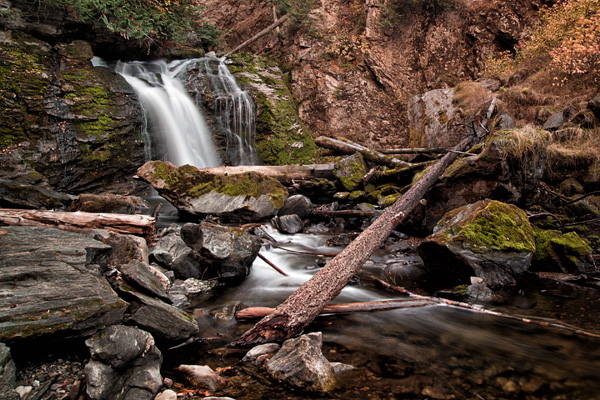
Chase Falls 1

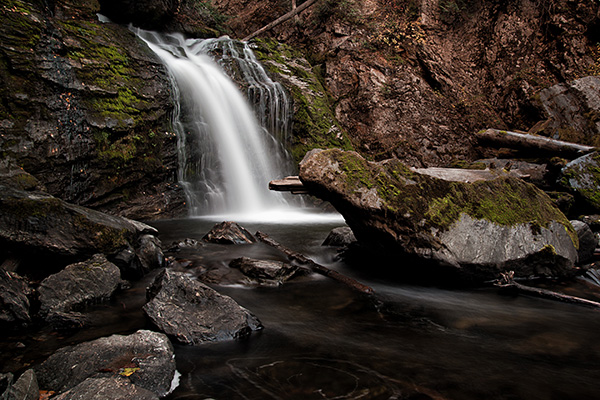
Chase Falls 2

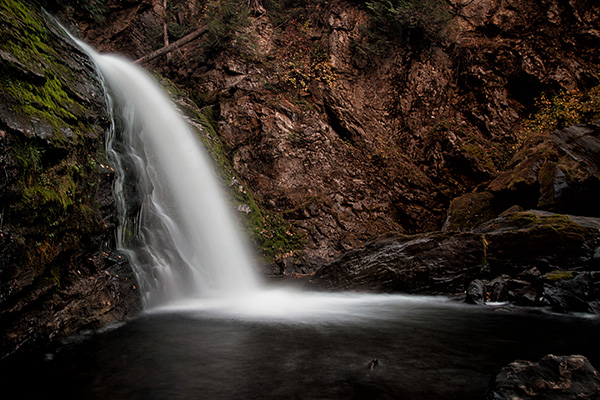
Chase Falls 3

Chase Falls 4

The third season of the year is here, and it is my favourite season of the year for photography. Fall or autumn, it doesn’t matter which word is used, is so darn colourful here in British Columbia; and I really enjoy the cooler air, a welcome relief from the heat of summer.

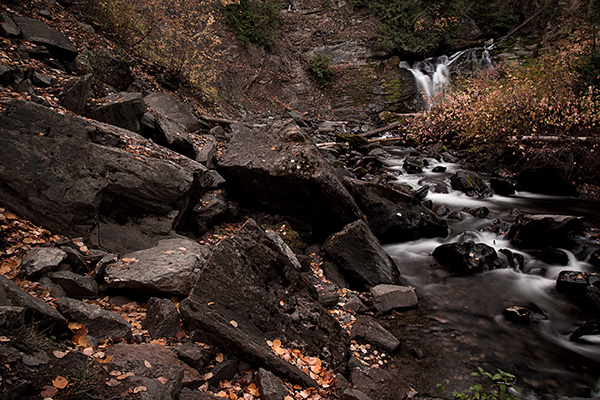
This week I drove the short distance down the road to Chase Creek Falls. I was in April just after the spring runoff when the high water began to subside. April is the second best time to go there, October the best. October has low water that makes scrambling along the colourful creek side easy, and lets photographers position their tripod and cameras close to the falls without getting wet.

In my April article I wrote that I have been photographing Chase Creek Falls since sometime in 1976. I have used 35mm, medium format, large format, film, and digital to photograph those falls every season of the year in every type of weather using black and white, colour, and even polaroid film.

I have gotten wet, walked away muddy after sliding down the steep bank, and bumped into the large river rocks a bit to hard. I’ve lost lens caps, a lens hood and even a polarizing filter on my visits. I have used the Chase Creek Falls once as a background for a large family reunion and another time for wedding portraits.

Photographing waterfalls is very easy and almost as relaxing as wandering around a garden. Modern digital cameras have improved the ease of taking photos by removing the requirement of much of the technical information that photographers once needed to know.

The equipment doesn’t need to be expensive or special. Select your favourite DSLR, a lens that has a wide enough focal length to see the falls, a tripod, and a neutral density filter. When I remember, I also like to use a cable release; but if forgotten the cable release isn’t a big deal, just use the camera’s self-timer instead.

Setting up the camera to get that soft looking water coming over the falls is very easy. Just choose a low ISO and a small aperture. The low ISO allows a slow shutter speed, and the small aperture gives lots of depth of field.

An ND, or neutral density, filter reduces the light going through the lens to the sensor and is the most trouble free filter for making long exposures. I prefer the square or rectangle ones that I can hold in front of my lens. I don’t use the fancy filter holder as that just gets in my way when I want to add additional ND filters to reduce the light.

I prefer shutter speeds of three or more seconds, and adjust the ISO, aperture and ND filters to accommodate that. Next, point the camera and start making pictures decreasing the shutter speed and checking the LCD as one goes along. It is all so easy.

This is a perfect time of year (here in British Columbia anyway) to spend some time photographing local waterfalls. They don’t have to be large and exotic, just have a bit of water going over them. And like me, after a dozen or so shots, put the camera back in it’s bag and sit quietly in the sand and lean back on a big smooth river rock so you can enjoy the sound of the water. Life is good.


What Inspired or Inspires you to do Photography     

Inspiring Viewpoint 2

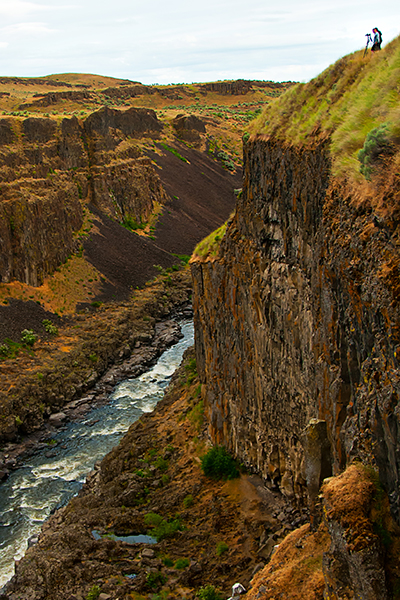
Palouse river canyon 2


A member of a photography site I frequented some time ago posed the question, “What inspired you?”

I took that to mean what inspired you as a photographer?

One would think that a question on a photographer’s website page would be a great opportunity for photographers to talk about those that encouraged, influenced, or affected their development in this exciting medium.

Anticipating discussions on celebrated photographers who had inspired others on that forum to get into photography I looked forward to reading members replies. However, I was surprised and disappointed with how few took the time to respond, and those that did seemed silly by only naming long gone painters like Rembrandt. Rembrandt? Not one member on that photographer’s forum mentioned another photographer.

Unable to contain myself I wrote, “I was inspired to do photography by photographers not painters. Those I admired and inspired me at different times include Man Ray, Richard Avedon, Irving Penn, Arnold Neuman, Gregory Heisler, Sarah Moon, Sheila Metzner and Annie Leibovitz. I must also mention scenic photographers like Elliott Porter, Ansel Adams, Edward Steichen and Edward Weston.”

Today I sent a friend a picture I had taken of him and several other friends in the early 1970s. I remembered at that time I was rarely without a camera, and how frustrating that was to some that just got tired of my constant picture taking. That’s when I recalled the preceding post on inspiration and my response.

I suppose there are painters and sculptors I like, but do they inspire my photography? No not really – I look to photographers for that. The first photographer and artist that inspired me all those years ago was Man Ray. It was after viewing his fascinating pictures that I began to study photography.

However, it is the second photographer on my inspiration list, Richard Avedon that I’ll quote here, “I think many photographers create in order to survive, both emotionally as well as financially. For a photographer, taking a photo is just as important as breathing”.

Sometimes when I see a photograph that I like I get excited. I might not be able to go to the location or find the subject of that picture, but it still makes me want to grab my camera and begin searching for something. I could say that photograph inspired me to create one of my own in my own personal way.

In my list to that forum I forgot to include the famous Canadian nature photographer and author, Freeman Patterson. I think any photographer interested in photographing gardens or landscapes will find inspiration in his photographs and his writing. Patterson wrote,  “Seeing, in the finest and broadest sense, means using your senses, your intellect, and your emotions. It means encountering your subject matter with your whole being. It means looking beyond the labels of things and discovering the remarkable world around you.”

There are many things and people that inspire me, too many to write down here, but the original post was on a photographer’s forum, so it’s photographers not painters that I thought about. There are many photographers past and present whose images are worth searching for, looking at, learning from, and of course, gaining inspiration from that will surely affect one’s own photography.

I always enjoy everyone’s comments. Please don’t hesitate if you have a moment.

Thanks, John