Photography Studio Workshop   

Studio 1a

Studio 3a

Studio 2a

Photographing Autumn 1a

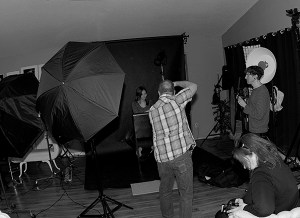
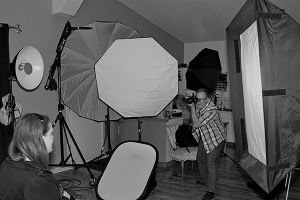
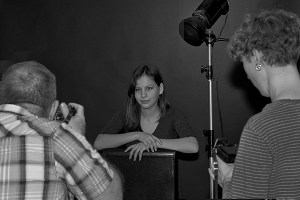
My latest photography workshop, Posing and Lighting, occurred just outside Kamloops this past weekend at a local studio owned by Dave Monsees of Cherry Creek.

I will begin with a perfect quote I have used before by photographer and author Frank Criccho that goes with what I was wanted the participants to think about. Criccho stated, “The success of a photographic portrait depends as much on the photographer’s artistic and creative use of lighting techniques as it does on his or her skill with the camera.”

Much of the time photographers either prefer to photograph people in the daylight or, if forced to shoot indoors, just increase their camera’s ISO. And there are too many that when they do decide to employ On or Off-camera flash go for the easiest method of just filling the space with lots of light.

During these sessions I lead my goal is to get participants thinking about not only posing our model, but also about the using the flash light as more than just a device to brighten up the environment.

I want them to begin making decisions as to how to apply light on their subject in the same way they might decide to use a long focal length lens rather than a short focal length lens.

As always, when I lead a full day session like this one, I feel my task is to present information and keep things going. And I always leave plenty of time for the participants to engage with the model and experiment with techniques. Watching workshop participants grasp and learn photographic lighting is a fun and satisfying activity for me.

I began the workshop with a quick slide show. Hmm…I guess we don’t have slide shows any more and instead connect a computer to a digital projector to provide a PowerPoint presentation. In any event we started the day off with a presentation that showed how different modifiers affected the light on a subject. So when our model Autumn arrived it was, “lights, camera, action.”

We spent the majority of the day (barely breaking for lunch) using many different light modifiers, changing the angle of the lights, applying light in creative ways, employing different backdrops, and of course, studying posing.

I will say these kinds of workshops are really demanding on a very patient and hard working model as she constantly and quickly alters her outlook and holds any pose the excited photographers request; all the while giving each photographer time to apply what I was continually introducing.

I can’t really say much regarding those enthusiastic photographers, I expect they were filled with the energy most photographers get when they are learning and creating, but by 4pm Autumn and I were ready to wind down. A good day well done.

“A portrait! What could be more simple and more complex, more obvious and more profound.” – Charles Baudelaire, Poet – 1859
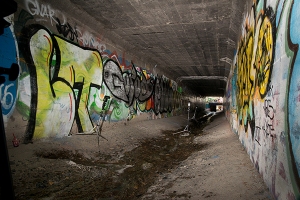
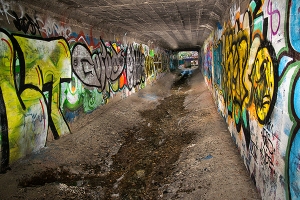


Photographing Graffiti in The Tunnel   

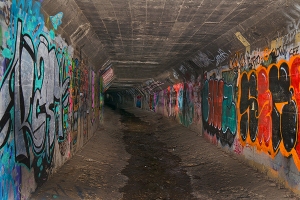
Lighting the tunnel

Creek Tunnel

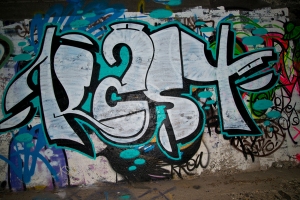
Kast

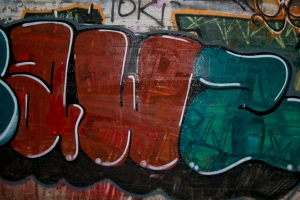
AWs

Creek tunnel North

There is a little creek that flows into Kamloops, British Columbia via a small waterfall. Petersen Creek is diverted underground for it’s journey through the city until it circulates out and spills into the South Thompson River.

There are several places along its cement banked route where Petersen Creek’s shallow flow is visible to passers-by, but it quickly runs out of sight again when it reaches a city street and is diverted underground.

One would think there isn’t much interest to anyone other than the City Works employees who make sure it isn’t plugged up when there is a larger than normal volume of water coming down from the canyon. However, at the final concrete watercourse everything changes to several block-long tunnels that are 10-12 feet high and just as wide that have gained attention from very creative graffiti artists and, of course, locals that enjoy capturing that creativity with their cameras.

It was there that I climbed down into after parking my car on the street beside the drainage tunnel entrance. I had met a resident photo enthusiast named Shannon who has been smitten with all the graffiti she was seeing on backstreet walls and boxcars that had wandered into the tunnel and she realized that street artists were painting on the walls.

I joined Shannon, and her partner Max, a few weeks ago in the dim tunnels. They and most locals were relying on their camera’s ISO ability, but after ten or fifteen feet the light was gone.

I hadn’t been in those tunnels since I first came to Kamloops back in 1974. At that time I tried going in a bit, but the water was much higher then and other than a few crude messages spray painted at the opening there wasn’t really a reason to slosh into the dark tunnel. However, this time I decided it would be fun to light up more than just one or two paintings.

I returned with four stands with a flash on each and positioned them to cross light the tunnel. Then it was easy to begin by metering the light coming in from the road and balancing the light from each flash to match that.

When I got home it was simple to clone out each flash and use Photoshop’s burn and dodge tool to smooth out the areas where the flash had outlined its light on the floor or where ever there was a different brightness.

I chose to illuminate the street artist’s work as a whole instead of just documenting one section at a time. I know when we see what someone has left on a wall or on a train’s boxcar as it passes by, that we tend to isolate one piece of graffiti art, but as I stepped into the dark winding drainage tunnel I felt more than just a cold breeze and saw more than one bright statement. To me everything – the dark winding tunnel, and the graffiti – was all part of the whole, or one ongoing work of art. And I wanted to photograph that combination of a cold, colourful, wet, chaotic, winding tunnel displaying the work of many artists.


A Photography Excursion In My Own Yard     

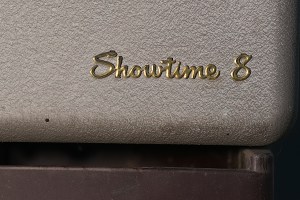
Showtime

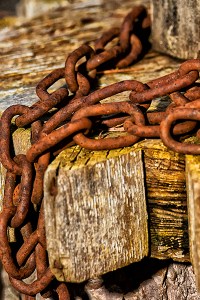
Rusty Chain

Painted wheel

Lichen

Wagon wheel

Water tank

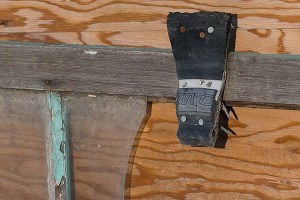
Window hinge

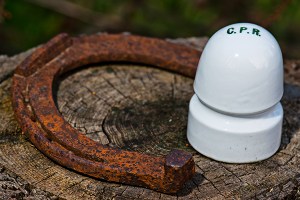
C.P.R.


It seems as though photographers get so hung up on traveling in search of exotic, or inspiring, locations that they forget about what is right out their own door.

I must admit that unless I have decided to take pictures of a colourful plant, or quickly capture a photo of a feral cat looking for handouts, or a deer that has hopped the fence with hungry designs on the spring buds growing in my wife’s garden, I rarely wander our yard with my camera in hand. The items we pass by every day become so familiar and commonplace that we pay little attention to them.

Last Sunday I wondered if the ten lilac bushes I planted late last fall made it through the winter. So I walked along the fence to check for spring growth and sure enough all of the new shrubs made it and I later told my wife that all the lilacs she had shipped all the way from Quebec are doing just fine. Of course with the unusually warm winter we had here in British Columbia one would expect no less.

As I walked around I spied a pile of old chain rusting on a log and realized I might be missing an opportunity for a few pictures if I didn’t get my camera. I admit I am not the most fastidious person when it comes to keeping tidy the two acres of land we live on, and because bits of things interest me I am forever picking up stuff that is apt to spend lots of time resting wherever I place them when I got home. That chain has only been sitting there for a year or two, but there might come a time when I will need that well-rusted length of chain.

So I got out my camera and mounted my wife’s treasured 70-180mm macro, grabbed my flash, and headed out. The Nikon AF 70-180mm is unique. It is the only true macro zoom lens around which allows precise framing without having to change working distance and refocus. And so, yes, that lens is special to Linda.

This photo hunt was to look for those bits and pieces similar to the chain and that’s why I chose that macro lens, so I could get in close or zero in on just a part of what I wanted to photograph.

One of my favourite photographers, Robert Mapplethorpe wrote, “With photography, you zero in; you put a lot of energy into short moments, and then you go on to the next thing.

Those words were perfect for my walk through my spring-like yard. I’d find an object or feature, focus close with the macro lens, zoom in to crop tight, release the shutter a couple times and move on.

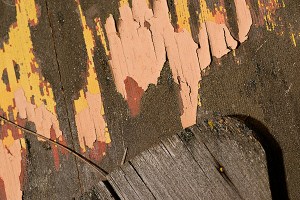
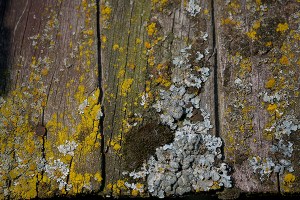
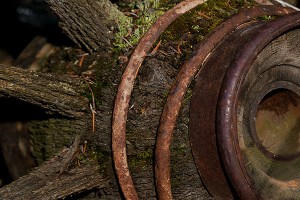
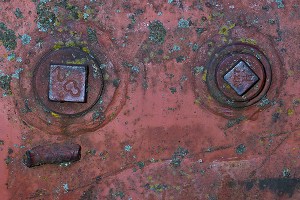
Although I can use my flash wireless off-camera, this time I chose to connect it to the camera with a dedicated TTL cord. I decided it would be easier to hold the flash and aim the light from different angles than it would be if I had to keep moving and adjusting a stand. Instead of fussing with a flash mounted on a stand all I did was put the flash in my pocket till I needed it to photograph flaking paint, rust, moss-covered wood and all sorts of things that have found a home in our yard.

I am of the opinion that those photographers that live in a well-kept, tidy yard are missing out on such an opportunity. Just think of how much fun I had on my safari discovering great things of which to take pictures.

Of course there is the possibility that my wife will come up with an altogether different kind of safari once she sees my pictures, one that will be a lot less fun for me.


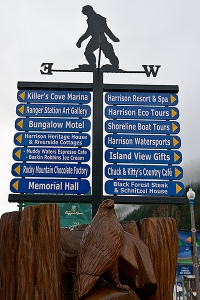
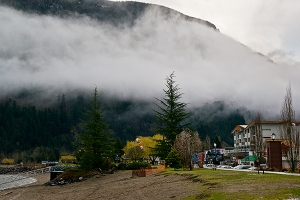
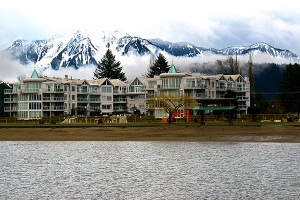
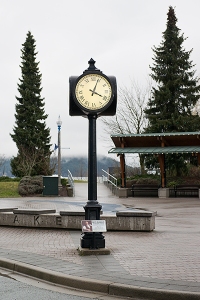
Trip to Harrison Hot Springs, British Columbia        

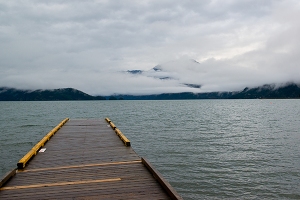
Lake view

Town Directions sign

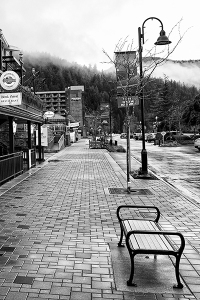
Harrison town

Coastal mountains

4PM at Harrison

Pier

Wet Street

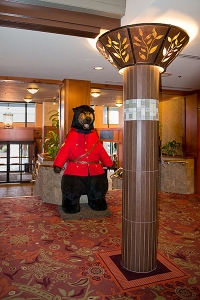
Hoter Bear

The best laid plans of mice and men often go awry”. That verse from the famous Scottish poet, Robert burns fit perfectly with our long anticipated plan to have a pleasant vacation at Harrison Hot springs.

My wife and I had been looking forward to a few days soaking in the luxurious Harrison Hotel’s mineral springs, and doing photography in the small waterfront town, and the nearby Sasquatch Provincial Park trails.

The weather report was for a sunny Monday, with some rain on Tuesday and a clear partly cloudy Wednesday. So we thought, rather than abandon our reservation (with the accompanying cancellation fees) we’d put up with the showers and stay close to the hotel. After all, shooting in the rain isn’t all that bad as long as it’s not too hard. However, “hard” is just what we got for our one full day at the resort town.

The first evening was so much fun with a soothing dip in the hot pool and a nice walk down the esplanade for a nice meal of fresh mussels and clams. And we sat talking about our plans for an early morning soak and a day of photography.

I rose early the next morning raring to go and went to the balcony to see what the day had in store for us outdoors. Well, what it had in store was a heavily cloud-covered town and one of the heaviest torrential downpours I could remember.

Trying to be optimistic we wandered down to have coffee, then headed for the hot pools in hopes of waiting the morning rain out. I will say that my short description of that event was that we were getting as wet from the rain as from the pool.

The rest of the day was much of the same with occasional short trips out when the rain lightened enough for some photos. As long as the rain was light I could wipe any accumulation off my camera with a towel. And the lens hood fended off rain as long as I didn’t angle the camera and lens in an upward direction.

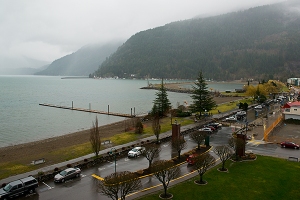
My planned hikes in the dripping wet forest were out, so my short excursions were limited to the small town and beachfront. I liked the overcast and low hanging clouds. But those expeditions were short and I hesitated to get to far away from the safety of my hotel.

I normally take time to wander about indoors and had packed a flash for some interior photography. But along with a wet visit to the Harrison Hotel, we had also selected a time when there was a large convention. My one attempt at photographing the large 12-foot plush RCMP bear in the lobby took about 20 minutes as I waited for people to pass by so I could get a clear shot.

Oh well, so much for photography. I worked hard to get the few photos I got. In spite of the rain we did have a great time relaxing in the very hot mineral pool, chatting with other guests, and we had some enjoyable meals in local restaurants. In future I will need to take coastal weather reports more seriously if I want more than that.


A Good Day for Infrared Photography            

Pritchard Train crossing 1a

Reflection

Log jams 1b

Salmon 2b

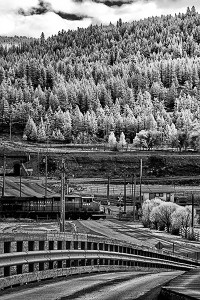
Bridge crossing 1a


The past few weeks have been apparent with flat and overcast skies. That’s certainly not inviting for anyone chomping at the bit to get out with a camera around Kamloops, British Columbia.

Only a short month ago the landscape was covered with glistening white snow that even on overcast days created some interest. However, that snow has melted this month leaving colourless meadows and a washed-out-looking, green forest of trees. In my opinion, the best word to describe the landscape, even with today’s sparkling sun, is grey.

I suppose many landscape photographers get creative and spend some time behind a computer manipulating that grey landscape. There are a myriad of programs designed to manipulate image files allowing black and white conversion or gritty oversaturation. But those conversions, although creative, in my opinion, don’t really give much life to the landscape.

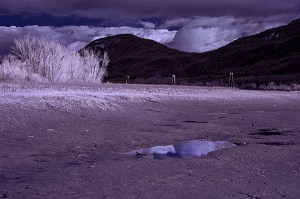
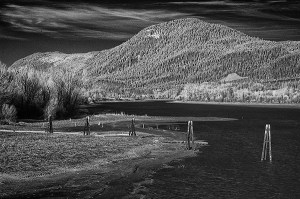
However, for me it’s simple. I just grabbed my infrared camera and drove down to the large Thompson River that cuts through the valley on its way to Kamloops and then to the Canadian west coast.

For years I have enjoyed capturing landscapes (and cityscapes) using first, infrared film, and then for the past ten years, a camera converted to only “see” infrared light.

Infrared light is invisible to the human eye. To capture it with a modern DSLR, the camera is converted by blocking all but the infrared light from hitting the sensor.

I enjoy how infrared photography gives me a scene illuminated by that part of the colour spectrum we can’t see, with delightful images that couldn’t be captured in any other way.

Dark skies and glowing white trees are some of my favourite infrared effects. It is those fresh and exciting photographs (done with very little computer work) that separated my photography from both the monotone conversions, and the oversaturated scenic, that had been viewed on posts by other local photographers.

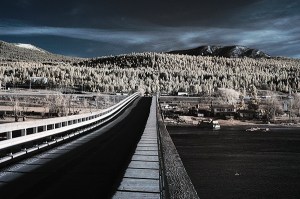
I like to wander along the winter beach not far from my rural home. Normally the turn-off and sparsely tree-lined beach is well used by locals with motorbikes and bicycles, walking their dogs, or launching their fishing boats. However, the winter beach on the river is empty, especially on cold days, and it’s those days that I enjoy the most. I can stroll along the narrow walkway that goes over the bridge while taking pictures of the river valley. And although there is a sign that tells walkers not to loiter or fish from the bridge, in all the years that I have been making pictures from it, no one has ever bothered me. Most of the time people smile and wave from their vehicles as the pass me.

I roam under the bridge and search the sandy riverside photographing interesting features and trash left over from winters’ storms, and, in spite of everything being shades of grey, infrared changes everything, and I have the choice in post-production to choose surreal coloured, or unique black and white images.

I’ll repeat what I wrote when discussing infrared in my article last November, “Infrared allows a photographer, and gives the viewer, a completely different feeling of a subject. Making an image with a modified camera is an exploration and a discovery that moves a photographer far from the usual”.

Snowshoes Are Perfect For Winter Photography         

Passing the shed

Afternoon sun

Melting snow

Barn View

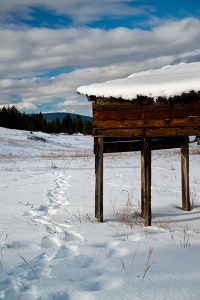
Winter is here and there is enough snow for me to put on my snowshoes and make my first winter hike to the high meadow above my home. Last January my walk up into that meadow’s deep snow was on a cold, -3C day, under a bright, almost-cloudless, blue sky, and I remember I was shooting with a lightweight, 18-105mm lens on my cropped-frame camera.

Yesterday I had chosen to mount a lightweight 24-85mm on my full-frame camera. Both this year and last I incorporated a polarizer to darken the skies, increase the contrast in the scene, and suppress glare from the surface of the bright white snow, on the partly cloudy +1C day that had me wishing I didn’t wear the extra undershirt.

I trekked up the hill, and as I had so many times before, I photographed everything. There are rarely any animals in sight in that long meadow. If so they can hear my snowshoes crunching through the snow on the long hill and stay hidden just out of sight. As there usually is when I begin to cross the meadow, a crow cries out a warning to the silent watchers. Then it got quiet with only the sounds from my snowshoes and camera’s shutter as I tramped around photographing the hilltop meadow above the Thompson River Valley.

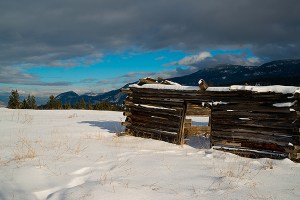
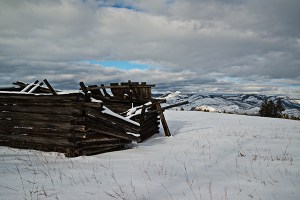
As I have done so in the past, and too many times to count, I wandered around the snow-covered grassland photographing the two remaining structures from an old homestead under the looming Martin Mountain. I don’t know how long ago that area was farmed, or how old the buildings are, but there is what’s left of an old car that appears to have been wrecked and left behind some time in the 1930s or 1940s. There is an abandoned cellar, a barn, a shed, a fruit tree, a garbage dump, the detritus of a family’s life, a family who shut down their farm and left.

I like the solitary walk. I closed the front gate to our yard and started out on the road following tracks a lonely coyote made during the early morning hours. The tracks led up the road to a lower field and headed uphill following snowshoe tracks that one of my other neighbor’s must have made. I always expect to be the only human making tracks up there, however, this time I followed someone that took much shorter strides than me, eventually crossing the creek at the far end of the meadow and to keep going out of sight through the trees without returning.

I like snowshoeing. When I was a youngster snowshoes were the perfect winter accessory. We’d snowshoe up the hill, change to our skis that had been strapped to our backs and ski back down. I remember a trip with my younger brother Rodger, and a friend named Alan. We traveled for three days sleeping in snow caves we made by digging into snowdrifts. Snowshoes got us up hills and skis got us down.

All these years later I am still wandering the winter backwoods, only now I always carry my camera. Snowshoes are perfect for the winter photographer. I have also skied with a camera, but there is always the chance of falling and covering the camera with wet snow. At my age snowshoes are safer and besides it’s easier to position and reposition oneself while composing a photograph. Skis would not work as well.

I’ve Been Robbed!


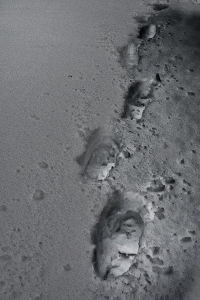
foot prints in the snow

A phone call at 3:30 in the morning is never good.  And sure enough the call I got last Monday morning met my worst expectations.

As I answered the phone I wondered, “Is this a call about a fire or a break-in”. Sure enough it was the latter. There was a break-in at my store.

Somehow three thieves gained entry into the main building from the alley door, and as the alarm blared, they made their way towards my storefront shop. Thereafter, they easily smashed the glass of the door entering my camera store, rushed to a display cabinet containing cameras and lenses; and because I found some lenses scattered on the floor, I think they rudely shoved equipment from two shelves into a camera case that contained my digital projector, and then ran back through the building to exit the rear door.

The tenant that resides on the second floor added her 911 call to the notification the security company was getting from the alarm, and looking through her window watched the burglars making off though the falling snow. Fortunately, the police arrived very soon after and using their tracking dogs easily followed the criminals to their hideout and apprehended them.

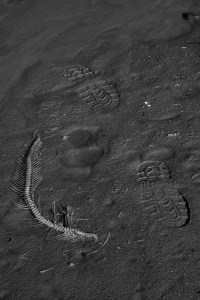
I give credit to the fast work of the local RCMP. They were certainly aided by the freshly fallen snow that at that time in the morning revealed the tracks of those thieves that entered and exited my shop. I would like to have watched those Mounties with their dogs chasing down the bad guys.

As I child of the 1950s radio shows like, “The Lone Ranger” and “The Green Hornet”, I listened with excitement as Sgt. Preston of the North West Mounted Police, and his dog, Yukon King, fought evildoers in the Northern Canadian wilderness.

I don’t want to make light of the excellent police force we have here in Kamloops, but as I stood outside the back door in the eerie, 4am light talking to the woman from the upstairs apartment I looked down the snow covered landscape and thought of that radio program of my childhood days from all those years ago. I cannot say the reason. Perhaps it was the lack of sleep, or the stress of the break-in, but when she mentioned the police and their dogs following the tracks in the snow, that’s what came to mind.

I received a call from a constable regarding the photography equipment stolen from my shop, who told me they recovered cameras and lenses in a black case. I assume that’s the missing projector case.

There is a good chance that most of, or hopefully all, of my property will be returned. Now I just have to wait for the lead inspector to determine how long they need to keep things as evidence. After posting the incident on Facebook, I received lots of concern from local photographers. That was nice. I found it interesting when someone would write, “You must feel violated”. For me that isn’t the word I would use. “Irritated” was a much better word to fit my mood as I cleaned up the glass, covered the opening with wood, and now must wait for the police to return my camera equipment.

I will get through this incident, survive my disappointment, and today returned to selling good, used, photography equipment, but now I also have a story to tell of yet another of those stressful events. There are so many photographers out there that have, as me, been photography equipment and have lost their prized photography equipment to, as one officer I talked to called them, “rats that scurry around in the darkness looking for an opportunity”. As I am sure readers know, we must be vigilant against thieves.

As I write this I remember how Sgt. Preston would hug his dog at the end of each episode and say, “Well, King, it looks like this case is closed.”

Thank you to the Royal Canadian Mounted Police for helping me recover my merchandise.


A Happy New Year with Lots of Photography     

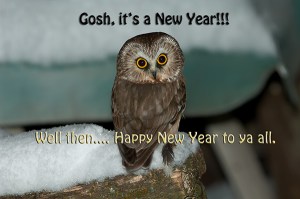
Happy New Year

Horse in NewYear Snow

Home for New years

Happy New Year

Another year has gone by, and with that I want to wish all that take the time to read my blog a very Happy New Year. I am sure it’s going to be a year filled with fun photography.

I do try to keep my articles interesting. When I first began to write weekly about photography my goal was to write articles that were a bit different from those I saw in magazines and on-line.

I knew I could easily post a couple of pictures each week, and discuss them as I did for my students in my years as a photography teacher; or I could join with those that provided reviews on their favourite equipment, but I thought that would be easily forgotten.

There were so many people writing about photography that I wondered if I had anything to add, so I decided to use a technique that worked during the many years I taught photography and that is to tell a story that included photo information I wanted to discuss.

Something else that I learned during my years teaching was to keep the subject fresh. That meant introducing something new each class and that is how I choose my topics, something different each week.

I admit that changing the subject each week does get hard. Like most readers there are those who acknowledge that there are other things in life than photography (I wish I could say it isn’t so) and it isn’t unusual for me to say to my wife, “Ok, what am I going to write about this week?”

Fortunately, with Linda’s help it usually works out and I come up with something to say each week.

This year I reviewed by work and the following were among my favourites articles and included “Which Button is for the Composition Mode?”, “What Makes Photographers Happy?”, “There is Nothing Like Photography”, “Interesting and Unconventional Photography”, and “Two Photographers Are More Fun Than One”.

My wife suggested I mention those subjects that I enjoyed photographing most but to that I will quote famous photographer, Imogen Cunningham, who replied, “Which of my photographs is my favorite? The one I’m going to take tomorrow.”

I’ll keep this short and again wish all photographers out there a grand New Year filled with lots of photography.

Photographing the Holiday Train   

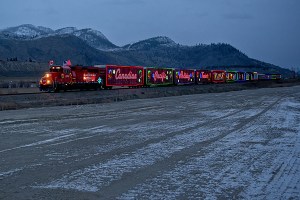
Here come the train

Train 2

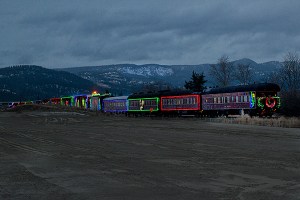
Holiday Train 3

Passing Train


Last week I wrote about how I enjoy everything about the Christmas holidays; the bright colours, the gaudy decorations, the sentimental music, the silly TV programs, and especially the festive city lights.

To that fun list I must add the Canadian Pacific Holiday Train. Each December, for the past 17 years, the CP Holiday train has travelled east to west across Canada. And fortunately for my wife, Linda, and I the Canadian Pacific Holiday Train rolls along the railroad tracks that follow the wide South Thompson River a short distance from our home in Pritchard, British Columbia.

As with last year, the train passes by just as the light begins fading around 4PM. The timing could not be better. There is still some illumination in the sky, but not enough to ruin the bright coloured Christmas lights on the train’s engine and cars.

Last year we positioned ourselves across the river for a wide panorama of the train. However, this year because of the construction and repositioning of the highway, we were able to choose a location very near the tracks that gave us plenty of time to prepare when the train first came into view and an interesting three-quarter perspective as it rushed towards us.

When we were across the river last year the long focal length lenses worked best, but this because we were so close this year we chose wide-angle lenses. Linda had her 24mm and I used my 24-70mm. Both were perfect.

We arrived about ten minutes early, made some test shots to check the fading late afternoon light, then waited with our hot chocolate to keep warm.

With the train’s movement I knew we would need fast shutterspeeds. I selected ISO 3200, which let us both use 1/350th of a second.

Linda said, “There it is!” When the train roared into sight, we jumped out of the car into the cold wind that was coming at us off the river and took pictures as it passed. The engineer tooted the horn at us but we didn’t have time to wave back and take pictures too. The whole event was over in about 40 seconds. Ha, what a rush! Then we got back in the car and ten minutes later we were sitting in our warm home finishing up our hot chocolate.

Well, one more holiday photographic occasion is over, but I know there will be more opportunities between now and January 1st. This is such a grand time of the year.


Christmas Lights are Here Again         

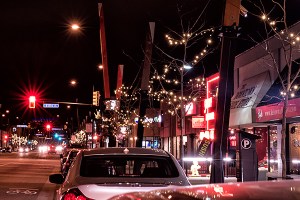
Street Lights

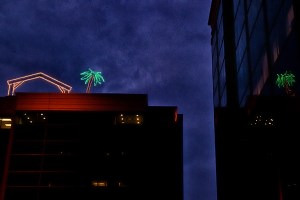
PalmTree Decor

Tree of Hope

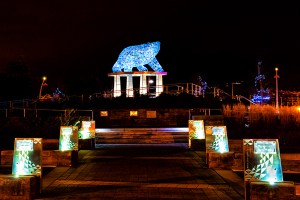
Xmas bear

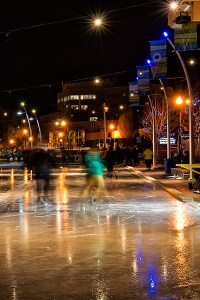
SKating rink

Beach walk

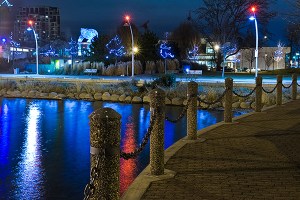
December is upon us again and the visual presentation of bright, festive lights has begun. Yes, the Christmas holidays are coming. The bright colours, the gaudy decorations, the sentimental music, the silly TV programs, and, for me especially, the Christmas lights in the city.

This past week my wife and I had to journey for a late afternoon meeting to Kelowna, which is two hours south from our home, however, that winding country road can be treacherous on dark, snowy nights and so we decided to stay overnight in Kelowna.

For some that means dinner out and just waiting the night out in a motel, but for me it’s an opportunity to have fun experimenting and photographing the season’s sparkling lights. In anticipation I had packed my camera with a 24-70mm lens and, of course, my tripod.

My preference for evening photography is to select a location before it gets dark, and to begin shooting when the lights are first turned on, when there is still some light in the sky, yet dark enough for the lights to be bright. However, our meeting lasted until after dark and I had lost the light.

I have been fascinated by Christmas lights since before I picked up my first camera, and remember family outings this time of year when my parents would pack us up in the old 1954 Ford station wagon for after dark drives along the high roads above the Salt Lake City valley. We would drink chocolate milk and look down on the colourful city lights. At that time my father was in charge of the awkward, accordion-like Kodak camera, that I doubt ever used anything but black and white film.

In spite of the late hour we drove by the downtown Kelowna lakeshore past the Yacht Club. I was sure the city would have lights along the sidewalk and hoped that some of the boats might be lit up. I had also heard that a public skating rink was opening and I wanted to experiment with a slow shutterspeed.

During the time when ISO ratings were limited, photographers who shot after dark ended up exposing for only the lights, and the resulting photographs would show lots of colours, but didn’t say anything about the location, or environment. Nowadays most modern cameras have no trouble with ISO 800 or 1600, with some even 3200, and don’t show the random speckles, which indicate degraded image quality.

Making some test shots I quickly found that the city lights were bright enough to allow me to use ISO 800. I also tried 1600, but I lost Christmas lights detail, and the buildings and walkways didn’t look like they were photographed after dark.

As usual Kelowna had lit up its tall “Tree of Hope”. I photographed that very tall electric tree last year and knew from experience that the best time to get pictures of it was early in the morning. When I left my hotel room at 6am the next morning I was greeted by a couple inches a fresh wet snow. Perfect. More light reflection.

I shot with my camera set to “aperture” priority. When I use aperture priority for this kind of photography I also employ the camera’s exposure compensation feature. If one just used the aperture priority mode the camera will, as it is programed to do, try to correct the lighting and that makes the sky too bright. This time I think I used -1.7 to darken the sky.

A drive this time of year through any town or city neighbourhood is an exciting visual presentation of bright, festive lights, and an opportunity for at least a few weeks, to have fun experimenting and photographing the season’s sparkling subjects.