A Modernist’s way to a view of photography

About the time of the of the First World War the presumption of art and photography exhibitions was shattered by innovations of modern painters like Picasso and Matisse. The fundamentally realistic medium of photography did not acknowledge that photographers could produce abstract or distortions to the extent that painters could and did. A growing number of artist-photographers like Alfred Stiegletz and Edward Steichen worked at bringing photography in line with modern painting by creating abstract images and processes.   They could be said to have “rediscovered” the “sharp focus realism” deemed unartistic by the then popular “Pictorialism” movement in photography. The pioneer of this “Modernist” movement in North America was Paul Strand.

The current age of digital photography seems to have vitalized photography more than any one could have guessed even ten years ago.  Attend any event and there will be lots of cameras ranging from little point and shoots to impressive DSLR’s (digital single lens reflex) documenting everything from every angle. The internet is packed with images, with all kinds of sites available for people to stack their documents of everyday life. 

In a moment of boredom I decided to do a search for a friend who lives in the US wondering if I would find his construction company. I not only found his company advertisement, but several pages of family Christmas photos he and his wife took of either daughter or son in-laws.  I browsed the site and will have to let him that I saw his photos.  My thoughts were that this is a reasonable document of people having fun; nothing creative, just a real nice family documentary.

Photographic documentation is more prolific than it has ever been, but I began to wonder about another creative part of photography; the abstract and the unusual.  There are lots of instances of PhotoShop manipulation one can find without looking very hard, yet I wonder at the style of abstract photography practiced by the greats like Stiegletz, Steichen, and Strand.  In my opinion, they were very much involved in looking at everyday subjects from different angles or perspectives. They photographed the usual in unique ways and photographed the unusual in unusual ways. They searched out things that many would ignore because they were ugly or boring, and chose diverse photographic views and visually discussed them in interesting and unconventional ways.

I am fortunate in that I get to see peoples’ photos all the time, landscapes, some portraits of people and animals, and a few close-up flower shots. Usually they are very nice and some are downright beautiful, but I think it is unusual and rare for someone to show me an abstract created by using their camera to photograph something using a unique view.

Abstract art and abstract photography may not be to everyone’s liking and I know when we show our photographs to other people we want them to comment favourably about our pictures. But when a photographer takes a chance and tries to visualize and photograph something differently, one cannot worry about whether or not one will receive praise or criticism.  Look for the unusual, the ugly, the boring, and the unique. Then contemplate about photographing it in a way personal to you. 

And if you have the interest, take some time and find out about those pioneer photographers Stiegletz, Steichen, and Strand.  Their photography is very interesting. 
http://www.enmanscamera.com 

A successful off-camera hotshoe flash workshop

The following is a quote credited to George Eastman, founder of Kodak. “Light makes photography. Embrace light. Admire it. Love it. But above all, know light. Know it for all you are worth, and you will know the key to photography.”

On Sunday 30 October, fellow photographer and friend, Rick Tolhurst and I held the first in a series of local lighting workshops we will be providing. We called it “Dawn of Light”. Yes, it is a catchy, almost meaningless title at first, but it actually fits if one applies a dictionary definition.  The word dawn means, “the first appearance of light in the sky…figurative or the beginning of a phenomenon or period of time…” so, consequently, that title works well for those trying to help photographers enter the world of using and controlling off-camera flash for the first time.

Photographers all work with their subjects differently. Some might be portraitists, some call themselves glamour photographers, there are those that do boudoir, baby, or maternity sessions, some shoot family groups, and, of course, there are those that photograph weddings. The approach may be different, however, the one thing in common is the need to use additional lighting.

As instructors, we weren’t concerned about anyone being a beginner at lighting, or having never used a flash off-camera, because, the fact that these photographers were there showed they were ready.

The discussion and action packed day began with coffee, donuts and introductions.  We had advertised, “This one-day workshop is really about one thing: using off-camera hotshoe flash with a DSLR to move your photography to the next level.  The main objective for this session is using wireless, off-camera hotshoe flashes and balancing (controlling) light with ambient lighting.”

After the morning session of instruction, questions, and demonstrations, the participants grabbed their cameras, split into teams of two or three photographers and went at it. In a large room Tolhurst and I had set up three lighting stations; the first with a shoot-through umbrella and some reflectors, the second employed an umbrella/softbox brolly and another shoot-through, and for the third we had a 24” softbox and a 40” reflector type umbrella. We also placed a beauty dish on a boom stand.  There were more light stands, umbrellas, softboxes and reflectors lying around ready for anyone who wanted them.

All the lighting equipment was fitted with wireless receivers, and all the learners needed to do was to take turns mounting senders on their cameras, and the large room became an animated, action packed scene. At this moment I stepped back to watch the enthusiastic photography students apply the information from the morning session into what can only be described as an exhilarating application. When this occurs my role is to act as a guide, an equipment mover, a resource for any questions, and the guy that congratulates successes. Tolhurst and I were busy interacting with the participants for the remainder of the day.

Many classes that are advertised as “workshops” actually are nothing more than long lectures with handouts. That works out easier for those putting on the session, as they present the subject, give demonstrations, answer questions and wait for acclamation.  Many participants are so eager and hungry for information, or are at least enthused by what seem to be prophetic words, that they leave happy, but has learning occurred? Some even return home and try to do what was presented in the “workshop”.  To me a “workshop” should be the same as those high school days when I took wood shop. I want to touch, experiment, and challenge what I just heard in the instructor’s lecture.

For this session we wanted an interactive class and that is harder, for the presenters become participants and loose the celebrity of standing in front.  However, this workshop was about participants actually learning to use off-camera flash to combine ambient and electronic lighting in order to flatter subjects instead of just brightening them up.

Judging from the smiling faces of the group, and the images seen on camera LCD screens, and the follow up emails and Facebook messages I have received since Sunday, the “Dawn of Light” lighting workshop was a strong success. To make it more successful, those that attended should review their notes, find a subject, and spend some time reinforcing what they learned using off-camera flashes.

www.enmanscamera.com

Retirement and Photography

Within the last few months I have been meeting recent retirees who have taken up photography as a way to fill anticipated free time and add an interesting challenge to their future.

I talked to a recently retired fellow last week about an expensive new lens he had purchased as a retirement present for himself. I was as excited as he is about his new lens and thought that it was a neat way to start his retirement. When I mentioned he will have lots of time to do photography, he made me laugh at his reply, “yes, as soon as it gets warmer”, but I know a bit of cold weather isn’t going to stop him. Anytime I get something new, I can’t wait to start using it. So, even though he complained about the cold, he’ll be out this week with his new telephoto lens putting it to use no matter the temperature. I know he wants to photograph birds, but I suggested he take a drive to a nearby area photograph the Bighorn sheep just for practice. 

Baby boomers are starting to retire and many are seriously taking up photography. I heard one fellow say, “I figure with the time I have I should enjoy every day.”  He had just retired and had spent well over $20K on a camera and lenses to set himself up for wildlife photography.  For those that gasp at that level of expenditure, be aware that his recreational investment won’t be taxed every year, won’t need expensive maintenance, and will give him years of enjoyment at no real additional cost, except perhaps expenses to drive to some exciting location.

Another retired friend just downsized to a small apartment, although an avid hunter all his life, he has given up packing a rifle, and instead packs a camera with a long lens attached. He explained to me that he really likes to hunt, but the fun ended and the work started when he shot something, however now it continues after the shutter is released and I expect he enjoys the compliments others given him when he displays a great photograph. He can hunt and photograph wildlife anytime and anywhere. His story of how he snuck up on an elk herd near Jasper by quietly wading a glacier fed river, and crawling through the underbrush, for many super images of majestic elk was superb. I can imagine him wet to his waist, covered with mud and pine needles, but happy and excited with the pictures he captured. Now that’s hunting.

Modern camera technology has freed photographers from equipment and production challenges of the past.  A photographer no longer is weighed down with heavy, metal-bodied SLR (single lens reflex) cameras, and lenses. Gone is the challenge of selecting the correct film for lighting conditions, and the need to worry about storage of film for long trips. Like me, those photographers with tired, old eyes now own cameras that quickly focus by themselves with focus assist indicators for fine detail. The days of returning home from vacation with film, and waiting for days to have it processed, or worrying about how to pay for the processing are happily long gone. Photographers immediately know if they got the shot right and can delete the errors.  We have passed the “click-and-pray” days.

Want to send a picture to the grandkids? It’s laughably easy.  I remember a three-month trip across Canada that I took in the 1970s. I would shoot slides, put them in mailers, and have them sent to my home address. My house-sitting friends would then get together and have slide shows wondering where I was when the picture was made. Today I could post my pictures for friends and family with commentary on a social network, or an image-sharing site like Flickr, from my motel room or while relaxing at Starbucks.

Photography is a tailor made pastime for retirement. It is supposed to be a great time of life and what better way to capture new memories, to be creative, to remain active, and to keep that brain stimulated by working with a camera.

www.enmanscamera.com.

A photographer’s impression of a Scott Kelby Photography Workshop

My friend Bob Clark (pictured) was fortunate to be able to attend photographer, and award-winning author, Scott Kelby’s, Light it, Shoot it, Retouch it seminar last month.   In his fact-filled tutorial Kelby showed participants how he produces a portrait; taking participants through an entire “live portrait” shoot – start to finish – controlling studio lighting with different lighting set-ups, a how-to on working with models, and his very latest PhotoShop portrait retouching techniques for finishing.

I have known Clark since my time at the University College of the Cariboo, (now Thompson Rivers University). He recently retired and opened a small photo studio located in a back space of the Public’s Own Market building at 970 Victoria Street. Bob’s clients are dancers, actors, and models looking for portfolios and in his own words “people that normally would not go to a traditional photographer”.

I would have liked to attend it, however my schedule didn’t work that day. I knew Clark was going and that I would be able to sit with him for a review of Kelby’s photographic discussion, so when he invited me over to check his studio out, of course, I made the time. We have always had fun bouncing ideas about photography off each other, and I wanted to see his new space, and knew I’d have the chance to quiz him on Kelby’s class.

I asked him about Scott Kelby and he said he was delighted with his lecture style. “He didn’t talk down to anyone no matter their experience, and it was obvious he could relate to everyone equally”. I asked Clark why he decided to take the class. He said he “had been reading and researching portrait lighting and photo retouching for some time, and Scot Kelby’s name came up continually, so when I saw that he was giving a workshop in Vancouver I knew I wanted to attend. I wanted to be surrounded by people of the same interest. This was not a social occasion for me, I wanted to be nothing more than a photo geek for one solid day.”

Clark told me he joined 500+ photographers in a spacious conference center fitted with two large video screens and equipment filled stage with many different portrait lighting set-ups. There was actually a full working studio on stage exhibiting moderately priced lighting equipment that the average photographer could afford, not the fancy out of reach, high priced stuff that he expected at a workshop of that caliber.

Kelby began with a basic one light setup, photographed his models using different backgrounds, showed how he would use PhotoShop for those subjects; then moved to a two light setup, photographed the models again changing backdrops a few times and took that subject to finish demonstrating PhotoShop techniques; then repeated the complete process using a three light setup.

I asked Bob if there was a high point or something that really got him excited during the class and he said definitely the part when Kelby photographed a model and in less than thirty minutes was able to change the background using PhotoShop. He had used a plain background then seamlessly placed the model on an album cover, and reminded participants that step-by-step instructions for that process were in the handbook provided.

Clark commented that one could easily reach information overload with all the information that was being shown and discussed, but Kelby reminded all the participants that everything in the workshop would be in the techniques book handed out at the beginning of the session and that if he had strayed a bit there would be additions available by going to his website.

Clark mentioned several times how much he enjoyed that class and highly recommended it to my readers. He said the class also comes in three distinct parts if one is reluctant to go for the whole package. And he emphasized that anyone will get something from Kelby’s Light it, Shoot it, Retouch it seminar, no matter his or her experience. I am hopeful the Scott Kelby road show will make the trip to British Columbia again next year and plan on attending if it does. This type of event features one of my ongoing bits of advice to aspiring photographers, and that is to continually upgrade photographic skills by attending appropriate educational seminars.

www.enmanscamera.com

Photographers talk about how wedding photography has changed.

My long time friend, and photographer, Alex Neidbala stopped by my shop. Who, until his formal retirement in 2005 owned and operated Billows Photography in Kamloops, British Columbia. 

As we talked about how we thought that changes in photography might affect the photographic art in the upcoming exhibition he had agreed to be one of the judges for, our conversation drifted into how we had photographed weddings in the 1980s and 1990s and how much different that is from today. 

If one wanted superior quality enlargements greater than 8×10 the only option was medium format film, and that meant using film that produced 2¼ x 2¼ negatives.  Medium format film could be purchased in rolls; mostly 120mm film size, and mostly 12 or 16 frames (pictures) per roll, depending on the camera.

At that time we both used a camera called a Hasselblad.  A roll of film was loaded in a 12-exposure film magazine and attached to the camera. When 12 exposures were taken another loaded magazine was exchanged for more photography.  This is one of the most significant changes and very different from the 190-image, 4GB memory card I normally use today.

Neidbala felt that our goal in those days was much harder than photographers have today, in that modern photographers can waste images, or give a client ten or twenty portraits of the same grouping to select from, without worrying about the cost of processing worthless prints.  When a photographer is limited to changing film every twelve frames at such an important event as a wedding, every shot had to count.  In addition, it took time to change film magazines, so photographers had to be prepared for every shot. 

The Hasselblad didn’t have auto focus lenses or any other programmable modes for that matter.  Photographers had to slowly change the manual focusing lenses that were much bigger, and heavier, in size then current DSLR lenses.  A metered focusing head that could be attached to the camera body was available for use, but most used a hand-held light meter and the heavy motorized model advanced film at a “sizzling one-frame-per-second”. 

Wedding albums contained either 5X5 or 8X8 and sometimes even 11X11 inch prints. The total number of prints shot was usually much less than 100 pictures, and each enlargement was printed in a custom lab, and any retouching was done by hand.

In modern photography we are able to take major risks with our photography; and if a creative shot didn’t work, delete it and try again.  Instead of being limited to 12 permanent exposures for a family grouping, one is able to make multiple exposures, select the best photo; with everyone smiling and eyes open, no grimaces or funny faces, and then delete the rest.  Retouching is no longer a long and laborious task with Photoshop; and even though there are custom labs high quality enlargements can be made at home; and the thought of less than 100 photographs in a wedding album is laughable. 

Because digital cameras can produce images that don’t cost anything until they are printed, photographers don’t hesitate to make multiple exposures of every subject.  It is not unusual for some photographers to arrive home from a wedding with over 1000 images stored on memory cards waiting for final selection.

Photography has been exciting for both Neidbala and I all these years because it has been an ever-changing medium, not only with the film and equipment we used, but also in the way we put that equipment to use working as professional photographers. I recall photographers older than me marvelling on my Hasselblad.  Some were intrigued while others, much like some I still meet today, felt it was better to hold on to the tried-and-true technology of years gone by. Both Alex and I sold our Hasselblads and purchased digital cameras over ten years ago and are happy we did. I wonder what the camera of choice will be for photographers ten years in the future.

www.enmanscamera.com

Wireless Hotshoe Flash for Photography

I have always been excited about technology changes in photography; for example, I remember how spectacular it was to have a workable, in-camera light meter when I got my Pentax Spotmatic II. Shortly thereafter I added a Vivitar 283 flash that allowed me to do preflash tests with my flash off camera and make adjustments to the lighting.  Within a couple years came the wonderful Nikon F3 with TTL (through the lens) on-camera, flash metering, and for me the world of photography changed even more. Since then a lot has happened to flash photography and I will confirm that the current trend of using off camera, wireless hotshoe camera flashes is exciting.

A greater number of serious photographers are learning to employ flash, from what was originally a flat, one-light source for an image, and they are starting to use the word “modelling” to show how the light affects their subject, and easily can wirelessly locate several small flashes at different positions around their subject.

I recently talked to a friend learned about portrait lighting by attending a Scott Kelby lighting workshop, however, there are other very well known photographer-writers worth researching, people such as David Hobby (www.strobist.com) and Joe McNally (www.joemcnally.com) that have created a world wide following with their books, blogs, and videos on using wireless hotshoe flashes instead of the heavy, cumbersome, power cord lighting that photographers have previously used for many years (like me).

So why go to wireless flash? Or, why a wireless hotshoe flash that we originally purchased to set on our camera?   For me it comes down to ease of use and portability as I regularly do staff portraits for businesses.  In the past I’ve arrived on site with two large bags of lighting equipment containing big strobe heads, stands, umbrellas and lots of power cords. Now, I carry lightweight stands and umbrellas in a small bag slung over my shoulder, and several small hotshoe flash units in a handbag. Both the equipment and the setup time is considerably less.

In his book “The Hot Shoe Diaries,” McNally writes, “it makes my job easier. It enables me to move fast, and have a flash system that thinks along with me and solves certain problems historically attached to flash photography (big heavy units, cables and wires everywhere…”

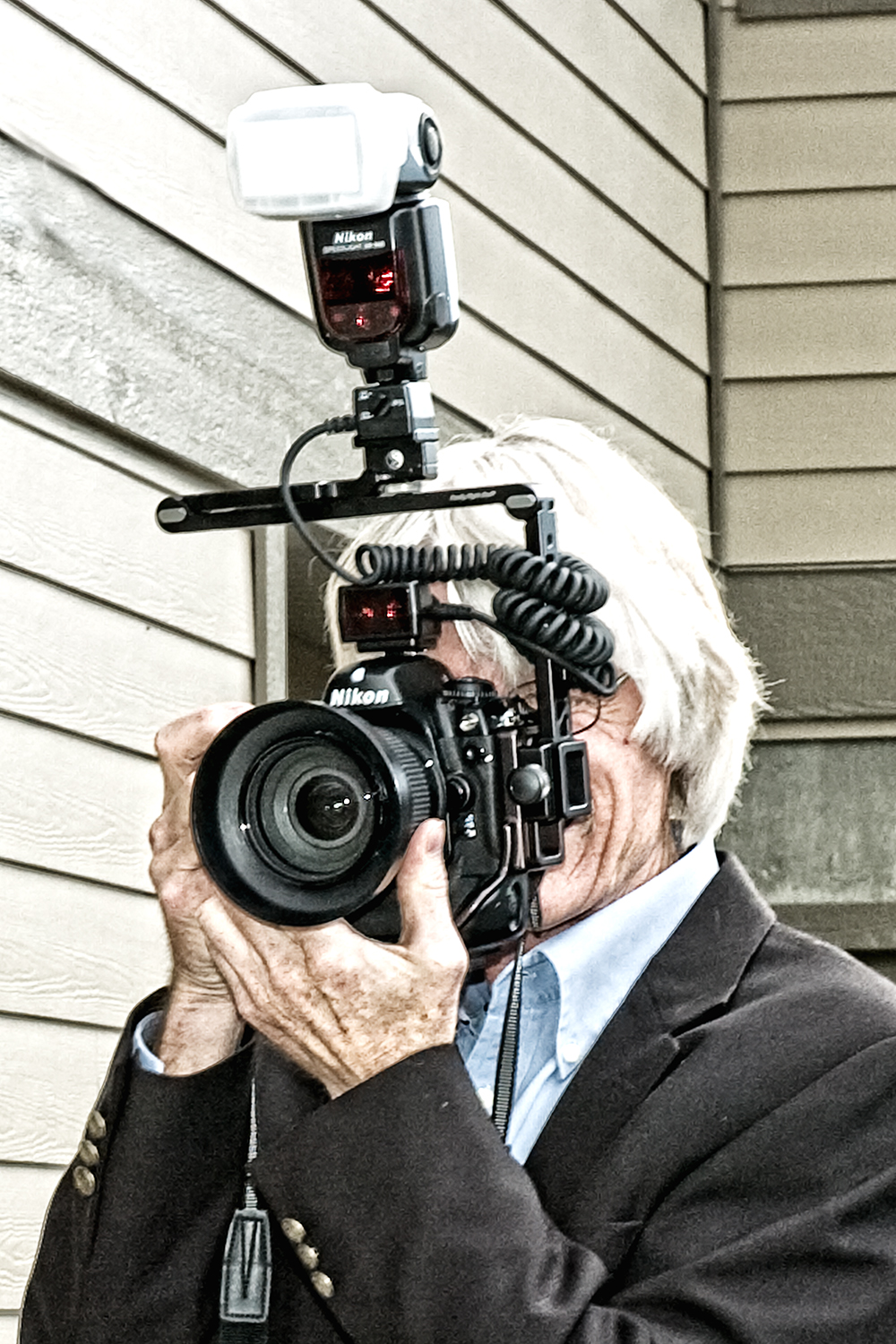
As I have written before, I like using flash indoors or out. There are those times when I am following a moving subject and have my flash mounted above my camera on a flash bracket. I rarely rely on a single ambient light source and prefer using a flash to add light to improve the quality of my photographs.

For occasions when my subject is stationary I use the wireless flash off camera; and for portraits I like three lights, one above and behind me, one off to the side and one behind the subject. My set up isn’t always the same, it depends on the available space, but for example, the flash above and behind might be either in a softbox or a reflector umbrella, the sidelight could be a small shoot-through umbrella or bounced off a reflector panel, and backlight directed at the background with only a small dome diffuser covering it.  That’s one quick, effortless setup that I can easily carry in two small bags – one bag for light stands and one for the flash units while my camera is comfortably hung around my neck as usual. All this, as I just wrote, is easy to setup without having to connect the flash to the camera with wires and the flash to the wall with power cords.

Because of the interest and questions fellow local photographer Rick Tolhurst (www.shotsbyrick.com) and I have been getting questions about how to setup and use small, off-camera, wireless flashes for portraits, we have decided to put on a simple lighting workshop. The interactive one-day session will discuss one, two, and three-light setups for portrait and glamour photography. For those interested the workshop will be held on Sunday, 30 October, 10am-4pm, cost is $60. Pre-registration is required and any photographers interested should call or email me for specifics.

Using small wireless hotshoe flash has made photographing people a lot easier and serious photographers that have not tried it yet are going to feel the same way as those that dragged their feet in moving from film to digital.

www.enmanscamera.com


The photographer asked, “Is it time to upgrade my camera?”


In the previous era of film cameras many serious photographers would come to a point when they would consider whether to upgrade from an automated point and shoot type camera to a 35mm interchangeable lens SLR (single lens reflex), or trade in the 35mm SLR for a medium format 120mm camera, and maybe even to take the climb to a 4X5 view camera.

For film-based cameras it was all about the size of the film and bigger was better.  I recall feeling bad for those people that had friends photograph their wedding with a 35mm camera at a time when quality wedding photography was really only produced by photographers wielding medium format 120mm film cameras.  If one wanted a colourful, sharp, grain free enlargement then 120mm or larger was a must.

What do I now say to a photographer that is considering a more serious approach to photography?

I will always begin with the question, “what are your interests and what subjects do you like to photograph?”   My short answer for digicam users is if sports, fast action, wildlife or enlargements bigger than 8×10 are the goal, then, yes, get a DSLR. DSLR cameras don’t have shutter lag when the release is pushed so sports photography is easy. Fast action demands a camera that can adjust shutter speed and aperture. Wild life photographers prefer a selection of super telephoto lenses that can be changed at will, and printing quality 11×14 or bigger enlargements are best produced with sensors that are considerably larger than what digicams provide.

Digicams are perfect for intimate, candid shots of family and friends. The compact size lets one put them in a pocket and go, and if used correctly and within their limits they will produce excellent images.   However, if photographers feel they have reached their camera’s limits then it is time to move on. So the question is what is the best choice for a first time DSLR?

For this discussion I will put DSLR cameras in two simple categories, amateur and professional.  The difference between amateur and pro cameras has surely become hazy. If I were to offer a short comment I would say the most obvious difference is durability.  Pro cameras feel sturdy, are heavy and sealed against the elements. When dropped, they bounce and usually don’t break, and even with hard use will last a long time.  The amateur camera generally has lighter weight and smaller size.  When the first DSLRs came onto the scene there was definitely a difference in the quality of the images between entry level and professional level cameras, but that is not as distinct now. The technology for sensors and in-camera processing has rocketed.  The latest entry-level model may well have the same sensor as the previous summer’s expensive pro model as the technology is transferred over.  The main difference is in the weight, substance, durability, and controls.

The new models are always being introduced, with that many previously great camera models will be reduced in price, or discontinued, and very soon there will be some great opportunities to purchase at reduced prices.  As always there will be a flurry of megapixel chasers that change their camera with every new model upgrade, making used cameras available. There are those people who will not buy a used digital camera and that is OK, however for those who are interested how does one know what is a reasonable price?  The easiest way is to go online and check out the sale prices at the big photography retailers for their new and used equipment. Know your prices before buying that camera from a good friend or family member and remember the money that you save can be put towards equipment like lenses and a good flash or tripod.

Whatever the camera availability, my advice to those photographers asking the “upgrading” question is to consider what kind of photography they want to do. Talk to other photographers about the cameras that are interesting, go on line and check out the many photography forums to find out what others with that same interest are using, and attend some classes. 

Using a new camera is always fun and I believe learning how to control the technology a new camera offers is like a shot in the arm that gets the excitement going and helps ultimately to make better photographers. 

www.enmanscamera.com


This photographer was challenged about always using flash.

I recently had an email conversation with photojournalist Ted Grant regarding my blog entitled, “I Have Never Used a Flash”.

In it I wrote that I like adding light using a flash under all conditions from dimly lit rooms to sunny days. My column began with a statement from a photographer just starting to photograph weddings of her friends who says, “I have never used a flash,” and to that I had responded, “I always use a flash indoors and outdoors when photographing people”, but she was surprised and said “even in bright sunlight?” 


I use the flash to reduce the shadows caused by bright sunlight. TTL (through the lens) flash technology is easy to use, almost fool proof, and the days of calculating distance and flash power are long gone. I also wrote, “When I learned to use a flash many years ago it changed the quality of my photography.  I no longer had to rely on ambient light and I began to notice my subjects had more “pop” than those without the flash.  Just like the control I gained by using different focal length lenses, using the flash allowed me to add light when I needed it, improving the quality of my photographs and separating my photography from who do not to use flash.” 

I believe it was that last line that piqued the interest of Mr. Grant who wrote to me, “If I were to suggest… “If you can see it? You can shoot it!” That means without any flash…. period.”

However, as photographers, we have different goals and my response to him was, “Many just getting into photography have not had the opportunity to spend years honing their skills, and, in my opinion, modern flash technology makes opening and preserving shadow details, and balancing ambient light conditions so easy that I am disappointed when I see over-exposed features or detail-less shadows.  A great number of photographers are currently embracing flash as a tool similar to using different focal length lenses for perspective control and tripods for camera stability, etc.  I’m sure that photographer’s camera would record anything she “can see”, but with the limited exposure range of digital I believe her images would be less that what you and I would categorize as acceptable.”

On a sunny day the dynamic range between the darkest and the brightest areas might mean a person wearing a dark shirt could have an exposure of f4 and 1/250th second whereas the surrounding landscape might be as bright as f22 @ 1/250th or brighter.


A photojournalist selects what is most important and only exposes for that, but for those of us photographing a family or a couple in their back yard, or a youngster posing beside the family pool, that isn’t an option. Our clients are probably proud of the work they put into their back yard and an over-exposed, washed out background would wreck the picture in my opinion.

For me that picture would be easy. I’d quickly meter and make an exposure of the back yard, check my LCD to make sure it was a good then put a flash on my camera, have someone stand in, make a couple of test exposures, and reduce or increase the flash output if needed, and I am ready with subjects and background all evenly exposed.

However, Mr. Grant is absolutely right. “If you can see it? You can shoot it!” I believe his quote came from his work on a book about women in medicine shot using a Leica 35mm and exposed on black and white film. He also likely didn’t have the luxury of fast auto focusing image stabilizing lenses, or being able to check the image and exposure history as he shot, and he likely was restrained from using TTL flash technology in his many endeavours.  There are, of course, differences between photographers and how they want their subjects to look. I suppose it is really about what in the final picture is important to them.

The photojournalist’s job is to capture the action as it happens, using a flash might not be possible, or even allowed in some circumstances. Whereas the type of photography I do is all about the subject who in all instances must be photographed in the most flattering way possible and in most cases that means including using a flash.

 www.enmanscamera.com


Digital Camera Terminology for photographers

A customer walked into my shop last week complaining.  She said, “ My camera isn’t working.  I think there is something wrong with the chip.”  I thought at first that the camera’s main computer wasn’t working and then I realized she was talking about her camera’s memory card, or the small picture storage hard-drive we insert in the camera.  Digital technology  confronts photographers with new terminology. I have written about terminology (or jargon)  in the past, but for those new to this the following may help to understand just what some of the words mean.

Digital Images:  The digital image is a grid of dots or picture elements (pixels). Each pixel is assigned tonal values (black, white, shades of gray, and color), the bits are then interpreted, read by the computer, and produced as an analog version for display or printing. 

Pixel: Picture Element: Digital photographs are comprised of thousands, or millions of them; they are the building blocks of a digital photo (see above).

Sensors: When a picture is taken, the sensor is struck by light coming through the camera’s lens. Each of the tiny pixels that make up the sensor converts this light into electrons. The number of electrons, usually described as the pixel’s accumulated charge, is measured and then converted to a digital value.   There are two most popular types:  CCD: Charge Coupled Device; and CMOS: Complementary Metal-Oxide Semiconductor.

White Balance:  Is a function on the digital camera. It refers to the relative intensity of colors in your image. Without correction, a picture taken at sunset can seem too yellow or orange and a picture taken under fluorescent lights might seem too green. Some cameras come with built-in automatic white balance correction.

DPIDots Per Inch is a measurement of the resolution of a digital photo or digital device. When printing, the higher the number the greater the print quality.

Image Resolution:  Is the number of pixels in a digital photo and that affects the image quality.                                                                         

LCD: Liquid Crystal Display: A low-power monitor often used on a digital camera to display settings or the photo itself.                                                                                                             

Histogram: A graphic representation available on the LCD, of the range of tones from dark to light in a photo.                                                                                                                            

ISO: International Standards Organization is a rating describing the sensitivity of the cameras sensor to light. Generally, as ISO speed climbs, image quality drops.                                                                                                         

JPEG:  A standard for compressing image data developed by the Joint Photographic Experts Group. It is referred to as a lossy format, which means some quality is lost in achieving JPEG’s high compression rates. Usually, if a high-quality, low-compression JPEG setting is chosen on a digital camera, the loss of quality is not detectable to the eye.                                                

RAW:  Is the image format data as it comes directly off the sensor, with no in-camera processing.                       

Megabyte (MB):  A measurement of data storage equal to 1024 kilobytes (KB).                                                         

Mega Pixel:  Equal to one million pixels.                                                                                                         

Noise:  Pixels in your digital image that were misinterpreted, usually at the higher ISO values. It appears as random groups of red, green or blue pixels.

Shutter Lag:  The time between pressing the shutter and actually capturing the image.  This is due to the camera having to calculate the exposure, set the white balance, and focus the lens. It is usually a problem with small point and shoot cameras.

www.enmanscamera.com


Portrait Photography: some thoughts


I enjoy looking at pictures, especially at portraits of people. I am not so interested in the image content, or subject, as I am in the process of how the image was made. I study the environment, background, camera angle, the subject’s pose, and, of course, lighting.  I am continually searching to add something new and valuable to my own photography, and there isn’t much better way to get new ideas, and learn new techniques, than studying how other photographers work with their subjects.

I was impressed at a lecture I attended given by Jim Britt, who in 1972 was photographer at Motown Records. (Britt did Michael Jackson’s early photographs.)  At the lecture Britt discussed studio portraiture lighting which was all very interesting, but what stuck with me was that he said we should continually be changing how we phototograph our subjects, to not be too predictable, or to get caught in a rut, and to emphasize that he remarked we should never say “it’s my style” because “That just makes you a cliché”.

I do try to be creative with my portraiture, remembering that a good portrait should have lasting power. I want future generations to see a portrait of their parent or grandparent and still like it. If one gets too edgy, or trendy, the portrait will not stand the test of time and be discarded by its owner when trends change. Many of the portraits I see show people too quickly photographed under unflattering lights, uncomfortable, awkwardly posed, and struggling to stay calm.

When someone asks me for a portrait I never move into candid mode; I try to gain a degree of mastery over the location, the lighting, and an understanding of person I am about to photograph. That means I evaluate the location, the background, and how much room I have between me and my subject. I check the ambient exposure, and decide if I need to add lighting. And when the person that I am about to photograph gets in front of my camera I start working at making them relax, and get in the mood. This usually means talking a lot and directing the session.

One of the most famous portraiture photographers, Helmut Newton said, “My job as a portrait photographer is to seduce, amuse, and entertain.” I absolutely agree with his assessment. A photographer standing with a camera up to their face waiting for the perfect expressive moment would generally make the subject to be photographed nervous.  I am sure there are times when candid portraits work quite well, and there are those people that are “naturals” and just know how to pose, but in my experience most people rely on the photographer for direction.

A photographer’s goal is to produce a photograph that visually speaks of the subject’s personality. Premier Canadian Photographer Yusuf Karsh states, “I try to photograph people’s spirits and thoughts. As to the soul-taking by the photographer, I don’t feel I take away, but rather that the sitter and I give to each other. It becomes an act of mutual participation.”

Portrait photography is a real challenge and the photographer usually doesn’t get to spend much time with their subject or get to know them all that well. Much of the time photographers struggle to get a likeness, let alone an image that says something about their subject. However, Richard Avedon commented,  “A portrait is not a likeness. The moment an emotion or fact is transformed into a photograph it is no longer a fact but an opinion. There is no such thing as inaccuracy in a photograph. All photographs are accurate. None of them is the truth.”

Portrait photography is more than pointing a camera at someone and releasing the shutter. However, there are those out there that obviously don’t agree with that, or we wouldn’t have as many portraits of uncomfortable, awkwardly posed people under unflattering lighting. Maybe the problem is the obsession so many have with camera technology, or maybe it’s something more egotistical with feelings that there isn’t any need to learn from others. My advice? Don’t be in a rush, interact with the subject having developed a plan, don’t take the lighting for granted, work with it; and remember that you, your subject, and any others who will view the portrait, have to like it.

www.enmanscamera.com

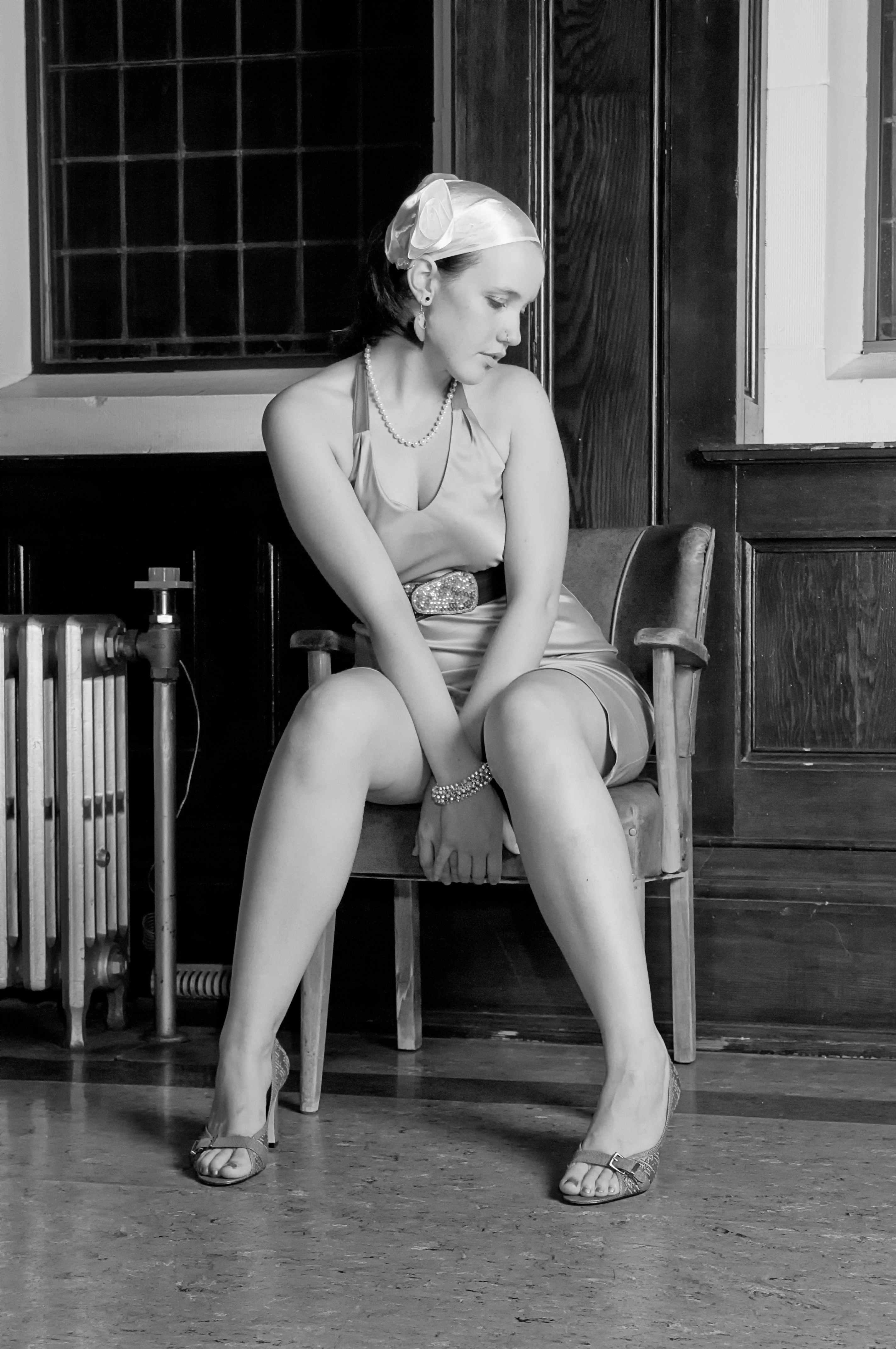
Thanks to my model, Kisa