Copying Photographs and Making a New Year’s Calendar

I was given an old photograph to copy, and retouch, in time for a Christmas present, which was not a big job.  All one needs is a camera, a lens that can focus close up and a tripod. 

My client had tried unsuccessfully to use a scanner, but I think most digital cameras have a better resolution, and will make a sharper enlargement unless the scanner is one of the few, expensive, high quality models specifically designed to copy film and photographs. All I needed was to select a window in my home with indirect light, and turned off any lights that could alter the proper white balance. My advice is to select ”daylight” instead of “auto” white balance on the camera.

 I placed the photograph on the floor, and set up my tripod, and made sure I didn’t have any shadows falling on it.  I then prepare the camera for readiness by using a level against the front of the lens.

 I usually like to take several exposures that start two stops under exposed, and eventually go to two stops over exposed, a range of five stops, to ensure that I have a lot of exposure choices when I open the image in PhotoShop for editing. I also prefer to release the shutter by using the camera’s self-timer so I didn’t get camera shake.  I retouched using PhotoShop, selected a cloning tool to remove scratches, corrected the old photograph’s faded colour, sharpened the image and made a print.  As I said, it is not a big job.  You may have an old photo that is starting to fade and crack that records something of your family’s history.  Get out your equipment and use my notes as a reference and start copying them.  This is a good project for the New Year.

 Do I write about this next topic every year?  Yes, I do, if only to remind photographers that this is a good and fun project in which to partake.

 Every December my wife and I start preparing for our January calendar, and we like to start January off with a photo that sets our mood for the New Year. Readers know my wife, Linda, and I, always photograph our own monthly calendars. We generally alternate responsibility each month and January will be Linda’s turn, and that will be special because she will be using her new Nikon D300s for the first time. And as any photographer knows, it’s always exciting using a new camera.

 We like a vertical calendar format with a horizontal picture on top and numbered squares for the month underneath. We find our monthly calendars at http://www.pdfpad.com/calendars each month. They are easy to download and print from various sites on the Internet and if I wish I could cut matt board to which I can glue calendar.  Then each month all we have to do is come up with an image to use. The plan is to share, so we will each provide six photographs to produce the calendar for the year. I am looking forward to printing lots of black and white photographs, and selecting the best from them will be enjoyable. This yearlong project will be fun and setting goals for photography is always a good thing.

 We used to go on a hunt for a calendar every December to hang on our wall for the year. There are lots of calendars out there, but many of the monthly images were weak and not up to the quality we would choose for photography to display on our wall. Yes, there is always an Ansel Adams calendar each year, but we have become very familiar with his work and wanted a change. 

 I have December’s calendar hanging and although I enjoy it (my photograph) I am looking forward to what my wife will come up with for January.  I think all serious photographers will enjoy their own photographs each month as calendars. I print my own, but for those that don’t, there are lots of good labs around and 8×11 enlargements are not expensive. You’ll have your own artwork on your wall. Or you can make more than one each month and give it to friends and relatives and let them enjoy your photography.
 www.enmanscamera.com

Recommendations for This Year’s Party Pictures.

I can hardly believe how fast this year has gone by!  Wasn’t I just complaining about the heat, the poor quality summer weather, and hoping we wouldn’t have any summer fires here in the BC Interior. Now I am bundling up in the cold, driving icy roads, and getting ready for Christmas and New Year’s Day parties. I bring up this subject every year, but I think it’s good to consider how to create lasting photographs of family and friends instead of unusable snapshots, and, all to frequently, will be discarded this holiday season.

There are so many opportunities for photography joining family and friends at all those year-end festive events, and many photographers’ dive in, digital camera in hands, happily filling memory cards with candid photos of friends.  The act of picture taking has become so much fun, to rush over to take a picture of someone, look at the LCD, and then quickly slide back to show others those tiny images.

Photography for many people is more about the process of using the digital camera than it is about creating art or even documenting the party; it’s more about standing in front of people, taking lots of quick snapshots and using the camera than it is about making memorable photographs.

Most images made in this fashion never become anything more than space-taking files stored on computers that after quickly being looked at, laughed at, or smiled at, are tucked away with good intentions to be used in some fashion in the future, but after viewing them a time or two they loose their value because there are so many pictures and very few are good enough to give to others anyway. 

How do we approach photography at the next party?  Yes, we should continue to make candid photographs of people having fun, but, perhaps, we also should think about making pictures that tell a story, capture an exciting moment, and importantly, flatter your subjects.  Most people don’t mind seeing a picture of themselves being silly or having fun, but they don’t like pictures that make them look stupid or unattractive.

My approach is to begin by taking a moment to look at the room in which I intend to make photographs, and then, as soon as I get a chance, I make a couple of test shots with longer shutter speeds so that I can include some ambient light when I make exposures using just the on-camera flash, and not end up with brightly lit faces surrounded by a black environment.

I suggest taking a few group shots with two or three people. Get them to squeeze together and compose the shot tightly, including only a little background or foreground. Don’t shoot fast, brace yourself, and select a shutter speed that includes the ambient light, even as low as 1/60th of a second.

Shutter speeds less than of 1/30th of a second won’t work for children playing in the snow during the day because moving subjects will be blurry, but with limited lighting moving subjects will only be exposed when the flash goes off.

 Lighting everything with complicated studio equipment would be great, but that would ruin the party for me and everyone else. It would be more about the photography then about the fun and festivities.  So I manage this by using an on-camera flash and make adjustments as I go.  I want to join in on the fun, not act like a photojournalist.

 Family and friends don’t mind having their pictures taken as long as it’s enjoyable and I want pictures that show them having a good time. So, along with those quick candids I make posed portraits with smiling faces, and if I select some pictures to give away later I want people to like them enough to honestly thank me.

Be sure to subscribe to my blog.

www.enmanscamera.com

Thinking about photographic Composition

I had intended to keep my writing in a Christmas mood. However, I think with all the gift cameras this might the perfect time for these thoughts on composition. 

I have always wondered what it is about today’s feature packed cameras that makes photographers disregard the basics of compositional strategies and just snap away excitedly.

My assumption has been that many photographers are so excited about the subject they are photographing that they forget to make that same subject interesting in their final photograph. 

There are more people making pictures today than ever before in the history of photography. Some estimates indicate that there are more photographs made in one year than all those made since photography became popular with the middle class in the mid-1800’s.  So, following that reasoning, there should be an abundance of wonderful photographs being made.   And the probability is that photographers, because of today’s technology, should be getting better and better.  The ability to compose on an LCD screen should also allow photographers to see all the elements in a given scene and compose wonderful pictures.  However, because so many photographers simply disregard composition, I am not sure that is really happening.

In Boyd Norton’s book “Wilderness Photography” he said it best in the chapter on Composition: “ In their first efforts at photography most people consider themselves successful if they produce technically correct pictures – that is, properly exposed. Some photographers never get beyond this stage, considering their work good so long as it remains technically correct and bad if the exposure is off.  It apparently never occurs to these people that with the sophisticated equipment nowadays credit for proper exposure lies more with the camera that with the photographer.  Most aspiring photographic artists soon learn that manipulation of f-stop and shutter speeds to produce proper exposure is only a small part of the photographic art. Successful expression in the medium lies in understanding and applying certain concepts of composition together with the technical manipulation required to produce the final photograph.”

There are a few rules to a composition that have come down to photographers through the ages from classical painters.  For example, “The Rule of Thirds”.  To begin, make a reference diagram that will fit most camera’s formats by drawing a 4×6 rectangle. Draw a line every 2 inches across the 6-inch side and draw two lines at about 1 5/16th inches apart across the 4-inch side.  There should be a 4×6 inch formatted rectangle divided into thirds both horizontally and vertically.

For those of use using the English language, reading begins at the upper left corner, scanning each line left to right, with the page ending at the lower right. Because we likely read more than we do anything else in our lives we have become conditioned to viewing a flat page in that way.  For example, the most expensive advertising location in a newspaper is the lower right because that is where our eyes will eventually end up if we are reading across a page. So when we “read” that 4×6 reference diagram we would see the upper left intersection first and the lower right last.

I don’t want to get complicated so I am going to simplify this rule and say that, from a compositional standpoint, where those lines intersect are the most important places on a photograph.

For example, a red ball is placed on a white piece of paper with the intersecting lines drawn on it. The red ball is first placed at the top left intersection, across to the right intersection, then to the bottom left intersection, and finally ending bottom right.  Most viewers are going to prefer the upper right location the best.  I suggest that readers should consider doing this exercise with the subject matter in their photos.  If one were to draw the 4×6 rectangle on a clear sheet of acetate and place it over 4×6 prints it would be possible to check the composition. An old friend of mine, who in his time was the top-selling landscape photographer in the Kamloops area, had an 8×10 matt cut and ran strings across the opening using The Rule of Thirds. He would then have his first selection of photographs printed 8×10, lay the matt on them and discard any image that didn’t adhere to the rule. He told me that any that didn’t adhere just wouldn’t sell.

Every photograph should have a main subject or center of interest.  Yes, even a landscape.  Take that element in the photograph that is the most interesting and place it in one of those intersections and the result will be a much more successful composition.  When dividing a landscape divide it into thirds.  As I look out at the South Thompson Valley I see the sky, the white bluffs and the river, the foreground, and place them each on a 1/3rd plane. Then I look for the most interesting feature(s) and make sure they are placed in one or more of the intersections.


There is a great deal more involved in the pursuit of pleasing compositions and I will discuss them in the future. This time I’ll end with the Rule of Thirds.

I’ll leave you with a wonderful quote by Victor Hasselblad from his 1976 “Composition” booklet: “Composition in a photograph is often the product of a photographer’s visual sensitivity and talent. And composition is just as important in a photograph as in a classical painting. Good composition is the product of inherent talent, judiciously exercised, and of untiring efforts to achieve satisfactory results.”

www.enmanscamera.com         If ya like my thoughts, be sure to subscribe.

A photographer’s Twelve Day of Christmas

I like Christmas. I like the music, the bright festive lights and decorations, and all those people, like me, that are in a Christmas mood. Yes, I like this time of year.

I have a friend that I call a rabid photographer; no, not avid, as rabid better describes his lust for picture taking. I never see him without a camera in his hand or a bag over his shoulder.  And yes, he creates lots of pictures, but more than that he is constantly buying camera equipment. He likes purchasing new photography gear as much as he likes using it. So, here is a made up version of what this year’s “Twelve Days of Christmas” might be for him.

On the first day of Christmas he bought himself another digital camera that will shoot with a high ISO for situations when the light is low, and that has a video mode that will be great for his family’s Christmas celebrations.

On the second day of Christmas he purchased a couple of 16GB memory cards so he’ll have lots of image space to hold picture files of “everything” during the holidays.

On the third day of Christmas he acquired an 18–200mm zoom lens.  This popular lens is neat and advantageous for when he’s on the move and it converts to approximately a 28-300mm lens when taking digital format into context.

On the fourth day of Christmas he obtained a roller camera pack.  Shoulder packs and backpacks are common for carrying equipment, but the new packs on wheels are super convenient for those times when he wants extra stuff.

On the fifth day of Christmas he purchased a big telephoto lens.  Yahoo!  I know he has wanted a super telephoto lens for years. Long telephotos are heavy and demand a good tripod, but now he’ll be out photographing wildlife with the rising sun.

On the sixth day of Christmas he obtained a compact point-and-shoot camera.   Sometimes a DSLR (digital single lens reflex) is too big and a small pocket camera is better. His only criterion for the little camera is that it has a viewfinder. A viewfinder lets him hold it close to his eye instead of shakily extending arms and squinting to see the image as the sun reflects off the LCD.

On the seventh day of Christmas he bought himself a carbon fiber tripod.  He wanted a strong lightweight tripod for hiking with his new telephoto lens.  A lightweight, carbon fiber tripod that weighs less than his old aluminum one is just right.

On the eighth day of Christmas he procured a set of wireless senders and receivers to use as a portable studio. The days of only using heavy, bulky studio lighting are gone, and anyone with three or four hotshoe type flashes can set up a multi-light studio anywhere.

On the ninth day of Christmas he bought a battery grip for the camera from the first day of Christmas. The grip increased the camera size and makes it more comfortable to hold horizontally or vertically.

On the tenth day of Christmas he got himself a new computer loaded with the latest image enhancing programs.  Although today’s cameras are amazing, he knows that to make his pictures all they can be, he will need to spend time in postproduction and what better way to do that than with a new computer.

On the eleventh day of Christmas he purchased himself a computer tablet so he can easily show everyone his excellent scenic and wildlife photographs.

On the twelfth day of Christmas he registered for a photography seminar and expedition to be held in Iceland next April. My friend knows one of the best ways to improve his photographic skills is to join a seminar or workshop. The Iceland itinerary includes the Fjallabak Nature Reserve and Sveinstindur by the Vatnajokull glacier. He is unfamiliar with those locations, but will come back with a new understanding of photography, lots of great pictures, and several new friends interested in photography.

That’s my imaginary list for him of the Twelve Days of Christmas. It has been fun and who knows how close I have been?

Give people gift of Photography this year.

How many pictures did you take last summer?  How many pictures did you take while on your last vacation?  What did you do with all those images?  Make lots of small prints? Or did you, heaven forbid, just store them away on your computer’s hard-drive?  Maybe you have thousands of images on CDs and DVDs?

Some of you enlarged a few and maybe joined other photographers in an exhibition and might now have a some matted and framed photographs looking for space on your walls and if you are like me wall space gets pretty limited.   At least I have a shop that I can fill with my framed or matted photographs, but I still have lots of photographs that, in my opinion, deserve a better place than to be stored away and never to be seen.

I have always printed my photographs.  Before digital I would remove my film from the camera, take it to my home lab, then process and print every frame on the negative I liked. I rarely made prints smaller than 8X10 and if I really liked one or more of the shots I would make 11×14 enlargements that including the matt and frame became 16X20.  Nowadays I probably print even more because it is so easy to just sit down to my computer and get excited about the images my wife and I have captured.

As always, I try different techniques, paper, and colours, with an outcome of lots of prints piling up.  Now to get to the point of this column, giving photography as gifts.  I heard about a local photographer that places quite a value on the photography he produces and believes no one should have any of his photography unless they pay for it. As a working photographer I cannot find fault with the value he puts on his work, but I also like people to enjoy my photography and come from the belief that my photography is better suited to being displayed than gathering dust because I want money for every shot.

I have neighbours and because they are loggers they have gladly cut down a tree or two about to fall on my fence. Another neighbour is a skilled mechanic has helped me with my truck when it needed work. The people next door always take care of my chickens, pond full of fish and old cat when my wife and I must be away. None of these people have requested money for their professional skills.  I have friends that are fun to spend the evening partying with, and others that I just want to say hello to without disturbing their busy schedule. I guess I could go out and buy them presents. However, what better gift than a photograph or photographs by me? 

My favourite gift is to photograph their family and give them prints and a CD. If they want an enlargement or two for their family, I’ll make that for them also.   What about all those prints piling up? I haven’t tried this, but I remember that while at a party, a photographer friend of mine brought out a wonderful selection of dry mounted 8×12 and 11×14 photographs and

told everyone they could have any print they wanted. Cards and calendars of our photographs make great gifts also.

Years ago I stopped to photograph a little girl riding her horse along a dusty back road I live on. I printed an 8×10 and gave it to her the next time I saw her. She has since moved to Kamloops, grown up, married, and had children and I suspect her children have made her a grandmother by now. That photograph made us good friends. I know anytime she sees me she will make her way through the crowd or cross the street just to say hi. (I even photographed her wedding many years later) I have photographed my son’s friends on bicycles, motorcycles and cars and given them enlargements.  At one time I could say I had made pictures for everyone on the street I live, but many have moved away and we have new neighbours everywhere. Maybe it’s time to start walking around the neighbourhood again with my camera.  What a great gift a photograph can be.

www.enmanscamera.com


Think about the gift of Photography

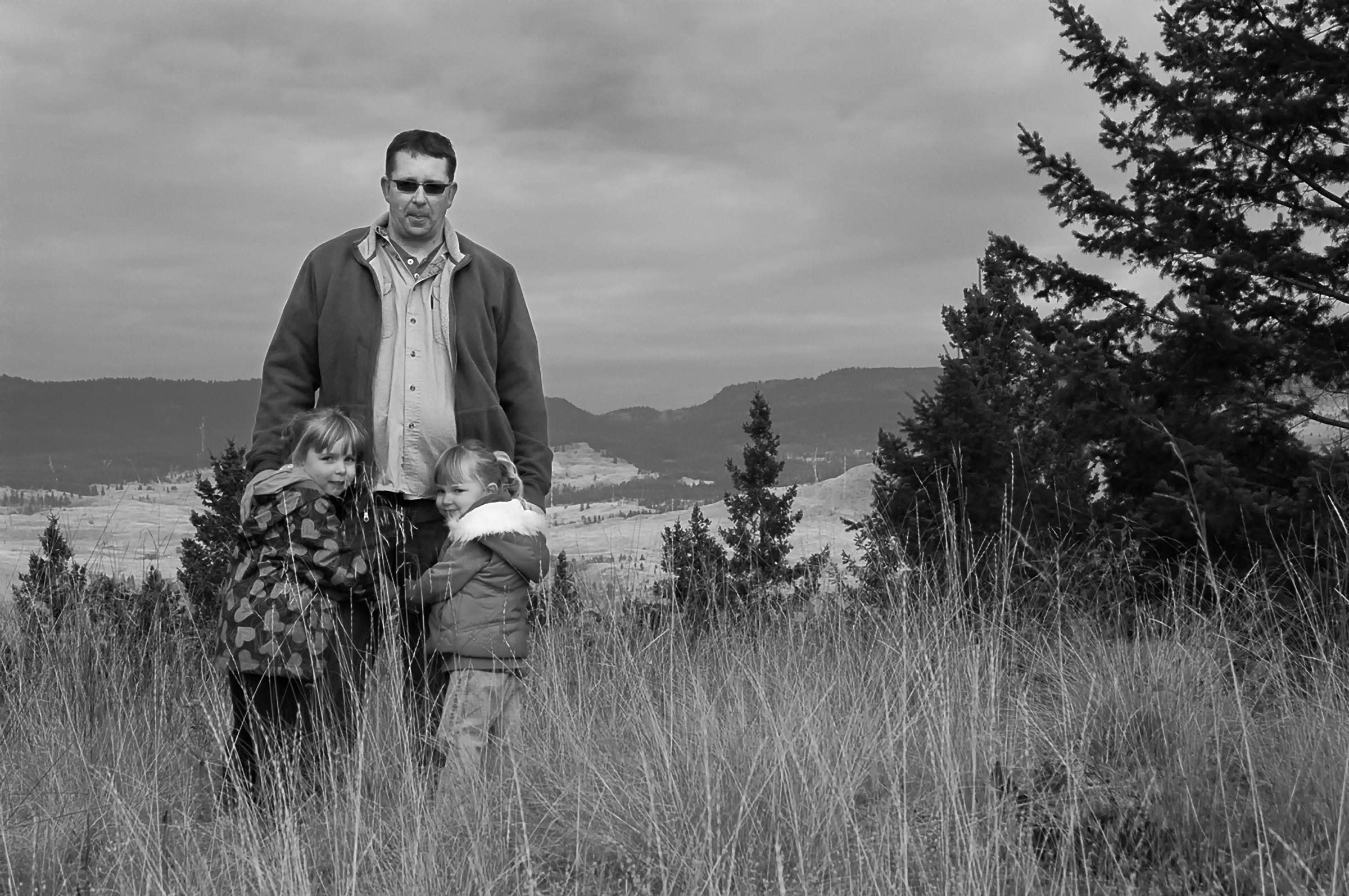
My son’s gift to his wife this Christmas will be five framed 16×20 photographs of him and their two young daughters.

I’ll start by saying that although I can’t think of any better gift than the gift of photography, and even though I always do commissions this time of year, I don’t push my photography on friends and family.  They all know I make pictures for a living, and am pretty good at it, and if they bring it up I am ready and willing, but I am tend to be silent the rest of the time.  Photography for me is the same as any other art displayed in a person’s home, and although there are large photographs on the walls of my home I do realize other people might have other tastes as to just what art is.

I could not have been more pleased when my son called me with his request. We decided to meet at our place in Pritchard and stroll through the wooded area across the road, and spend time taking pictures of the two granddaughters and of him. We wandered the trails of my son’s childhood through the woods, climbed on deadfalls, peaked around trees, ran up and down hills, stood overlooking the river valley behind and had lots of fun until we all tired out. The children loved the experience.  Then with the promise of hot chocolate we turned around and counted our steps home.  All this time I took pictures.

When I photograph children I am never in a hurry. I don’t try to coax a smile by saying, “smile at me”, because unlike adults most children haven’t spent any time practicing in front of a mirror smiling. They don’t know what to do and what usually comes is a face with a wide mouth full of tightly clenched teeth. I just talk a lot, get them to talk back, find many different places to pose, sitting or standing, and take enough time; and because I make sure they are having fun getting their pictures taken I will get relaxed poses, laughs, and smiles in my pictures.  I recognize that generally the first pictures won’t be the best, but who cares? I am shooting digital and just delete those I don’t like and keep taking pictures.

I don’t carry lots of equipment, just a camera with a medium-sized zoom lens and I don’t like long lenses like a 70-200 because I would be to far away from my subjects; I want to the session to be intimate and face-to-face, so for my granddaughter’s pictures I used my 24-70mm, and of course, as always, I used a flash.

There are times that I like off-camera flash and there are times when I keep my flash attached with a bracket that lifts it about eight inches above my camera. This was one of those times, as we were constantly moving. However, I easily could remove the flash whenever I wanted to change the light’s direction.

Modern technology is great. When we returned home I loaded all the pictures into my computer and we sat down to quickly review them all and made our selections. I usually do that by having people select the ones they like first. I moved them into another folder, and then I do the same again and again, moving the best to a new folder. Our goal was to end up with five pictures to be converted to black and white with a slight sepia tint, and then make into 11×14 inch prints.  That size fits perfectly in a 16×20 matt that will finally be displayed behind glass in 16×20 inch brushed silver frames.  I think my daughter-in-law will like this gift from her husband.

This is a good time for photographers to think about their personal photography as Christmas gifts.  I talk with many photographers that make statements like “photography is my passion”, but they never do anything with their pictures except posting them online, or showing them to others from their cell phones.  I see photography the same way I see any other artwork and am disappointed when I visit a photographer’s home and don’t see his/her photographs on the walls.

Are any of you planning on giving your photography as a gift?

www.enmanscamera.com


The basics to photographic Composition

Much of the time the photographers I meet and talk to really have only one interest in photography and that is to discuss equipment.  Nowadays, especially, they are very excited about the newest products.  Photographers should be building a selection of equipment that will allow them to do photography the way they like and that works effectively for the subject they want to photograph.

As much as I do like talking about cameras, lenses, and other assorted equipment, what I really like to talk about is photographs.  So, last week, when a photographer stopped by my shop with some nice enlargements, I was pleased to say the least.  We talked about how successful her photographs were at capturing the viewer’s attention, where the photos were taken, her objectives for each, the colors, and why she cropped them the way she had.  They were good photographs and looking at good photos sometimes lets you know a bit about the person who took them.  We started talking about photographic composition; not so much of the photos we were looking at, but just a general discussion.  So today I thought I’d put some thoughts down that people could think about when composing a photograph.

A person painting or drawing can truly compose an image; they have total freedom to place, arrange and alter the appearance of visual elements.  Photographers are limited by the actual physical appearance of the subject being photographed and depend on using camera position, point of view or the perspective created by different focal lengths of their lenses.  With photography we try to produce exciting, well balanced images, depending on the subject and how we want to communicate with those elements in the photograph.

What is your photograph about?  Instead of shooting right away, stop to decide which part of the scene you really want to show. Let the content determine the size and importance of the objects.   Try what I call the apple technique:  You are driving along and see an inspiring scene. Don’t just point your camera out the car window!  

1. Stop the car.

2. Get out.

3. Leave the camera in your bag.

4. Get an apple and eat it as you are looking at that inspiring scene.   Think about what you like about it. Make some choices. What would you like to say to the viewer?

5. Then get your camera and make the picture.

As you are making your basic choices and deciding on what visual elements are important think about what the famous War photographer Robert Capra, known for the intensity and immediacy of his images, said, “If your pictures aren’t good enough, you aren’t close enough.”  Getting closer eliminates distracting objects and simplifies the contents of a picture. It reduces busy backgrounds and focuses attention to the main subject or center of interest.

Another consideration is whether to photograph horizontal or vertical.  I listened to a discussion by successful magazine photographer, Scott Bourne.  He asked the question, “When do you take the horizontal?”  His answer was, “After you take the vertical.”

A final thought is to think about important visual elements and how best to arrange them in your photograph. The Rule of Thirds – Draw imaginary lines dividing the picture area into thirds horizontally, than vertically. Important subject areas should fall on the intersections of the lines.  For example, a photograph of an old barn in a field; move your viewfinder around to see how it would look placed in the upper right intersection the each other after that. If you take the time to decide and compose, your photographs will be much more successful.

What are your thoughts and opinions?

http://www.enmanscamera,com

The Importance of Depth of Field

Depth of field is defined as, “that area around the subject that is in acceptably clear focus”.   

I chanced upon a copy of a local magazine and took the time to look through its pages. I always go through magazines by first glancing at all the pictures then go back and review select articles. This particular magazine interested me because some articles were accompanied by photographs that were not in focus.  At first, I put it to poor printing, but this particular issue had a cover and several photographs in it by a friend of mine and they were sharp.

So why were some images “soft” and others as good as those we regularly get from the lab when we take our memory cards in for printing?  Modern cameras do the focusing for us and it is fairly difficult to get several images of stationary subjects that aren’t sharp.

Now I’ll go back to why I opened this column with the definition of depth of field; and why I think there are lots of photographers that are either spending time adding sharpness using PhotoShop or printing images that lack that overall sharpness. 

The problem I see happening all too much is that many photographers forget that basic concept of how depth of field works with a given lens and think “a wider aperture gives me more light therefore I can shoot with a faster shutter speed” and therefore, “I don’t need a flash or a tripod”.  Well, they are right to a point and (I’m not going to discuss at this time why I think most photos of people benefit from camera flash.) I think that photographers need to be reminded that limited depth of field comes with problems.

When I looked at those images in the magazine I thought about depth of field and how, although the lens may have been very capable of producing sharp images at F2.8, it couldn’t overcome the basic rules of depth of field.  I found there were sharp elements in the pictures, but so much was just out of the “limited area of focus” around the subject that the “softness” affected how the entire image was viewed. 

If one reads the internet forums or asks photographers what lens would be their favourite, of course they would come up with many different choices of focal length, but more often than not they would also indicate they wanted an aperture of F2.8.  The reasons given for that small aperture are either so that the photographer can “shoot in low light or so they can soften the background”.  That’s good, however, one of the purposes of the aperture is to control depth of field. The smaller the aperture the wider is that in-focus area around the subject, and the larger the aperture the narrower that in-focus area around the subject is.  Remember that means that a smaller aperture has a higher number like F16, and a larger aperture has a lower number like F4.   

I think it is a good idea for photographers to have equipment that allows different perspective. I own lenses that have apertures of F2.8 and larger, but I do not take them for granted. I select lenses and use their different apertures to create the effect on my subjects that I want. My advice? One should think about the picture about to be taken and select an aperture that works for and not against the subject.

http://www.enmanscamera.com

Predictions on photography from 1974

I happened on the May 1974 issue of Photo World Magazine, that in this day of fast changing camera technology and constant predictions in online photography forums was very interesting to read. In it was an article entitled “Tomorrow’s Camera: Report from Japan.”

The magazine article first discussed what would be the “next major technological breakthrough in Japanese-manufactured SLRs…a solid-state shutter, which would make cameras less prone to jamming, ”  and praised that break through. (That, of course happened years ago.)

The article was written by Tony Chiu and went on to discuss further topics. 

On Miniaturization – “The manufacturers had misgivings about reducing the current dimensions of their SLRs because the decreasing weight reduced protection against shutter vibration.”

On Lenses – “It is conceivable that 10 years from now a compound lens may weigh more than the SLR body. (my comment – a compound lens is one that has several elements, like all of our lenses have now) Although light weight plastic lenses have long been an industry dream, there is today no major research toward their development.” (Even now one really has to spend a lot of money to get a digicam with a real glass lens, and plastic non glass lenses are the norm.) 

The article also mentioned that electronic shutter cameras “in the next decade” would be an  “expensive option available only to top-of-the-line models.”  I am amazed at the changes that have happened since 1974 that the writer of that article, or any of the rest of us, never imagined that even inexpensive cameras would have electronics as they do today?

I found the next part is really interesting. Each of the companies was asked what their cameras of the future would be.

Canon – Suichi Ando visualized a portable camera small enough “to be carried in the pocket”, and capable of using 35mm film. Such an instrument would have a “universal lens, which can be changed by the flip of the finger from microphotography to telephotography.”

Nikon – Takateru Koakimoto said that the perfect camera would be one that excludes the chance of human error: “It will be fully automatic, perhaps with a small computer to control the exposure.”  I say that he wasn’t far off in his prediction. 

Olympus – Yoshihisa Maitanni believed the ideal camera would have a universal lens and one button will wind the film, focus the picture, frame the image and make the perfect exposure.  He also thought “Images will be projected directly on to a sensitized material, fully edited, and enlarged.”

Ricoh – Tomomasu Takeshita predicted that major advances in the film industry would reduce the film size. “Within 20 years the 16mm camera will replace today’s 35mm camera.” Such an instrument, as he saw it, would be considerably smaller and simpler – it would have a one-piece plastic lens in a partial return to the “pinhole concept” as well as an “electronic crystal” shutter.”


Yashica – Nobukazu Sato’s dream was one that would not utilize film. “Just put the paper into the camera, make the exposure, pull the paper out and spray it.” Such a camera would make use of ultraviolet rays, and would also feature a universal lens and a fully automatic focusing system.  (Both Ricoh and Yashica are no longer making cameras).

The writer of the article continued on to say “Will we see such marvels in or lifetime?”

“Perhaps by the end of this century” a photographer’s choice could be  “For the amateur, a single lightweight compound lens will replace three or four of today’s standard lenses. “And price – as it is today (1974) – will remain just within reach at the upper end of your budget.”

Digital camera technology wasn’t even a dream in 1974. Yes, photographers could have their photographs printing digitally, and I remember having that done by a local printer. The paper was flimsy, but the prints were very cheap and worked fine for the underground newspaper I took pictures for. However, there was no way to take pictures only reproduce them.  I can remember one of my first full time jobs working as a photographer for the California Office of Education in 1972 I bought myself the newest and coolest Pentax camera, a Spotmatic II.  There weren’t any zoom or auto focus lenses at that time and the batteries it used aren’t even made today. Will the cameras that we think are amazing today even be around in 20 years? I wonder what the future will bring? 

www.enmanscamera.com


How about telephoto Lenses for Scenic Photography


Last summer I wrote an article entitled, “What is the Best Lens for Scenics?” in which I discussed using different focal lengths, depth of field, and the effect upon perspective, however, I left the answer as to the preferred lens for each scenic location to individual photographers. My opinion then, as now, is that it really depends on what a photographer wants to say about a particular scene. I also said that I regularly used lenses such as my 24-120, or 18-200mm, because I like lightweight lenses if I have any distance to walk. Those two lenses offer lots of focal length choices that will allow me to include only whatever I want in a picture.

I thought about these comments earlier this week as I sold my 80-400mm lens.  My discussion with the new owner was mostly about the lens’ functions; its ability to produce sharp images, and how the vibration reduction mode easily allows handholding.  What we hadn’t talked about was what he intended to photograph with his new lens. I assumed he was into wildlife photography, but as we stood in my shop talking he mentioned that he would be going on a bit of a hike this next weekend and hoped it wasn’t going to be too cold. I mentioned that the cold weather might be good because it kept the bighorn sheep down in the valley west of the city. It was then that he said, “ I am mostly into scenics”.

Many photographers are of the opinion that scenic photography is about the landscape and needs to be as much of panorama as possible, and for that purpose, select wide-angle lenses as they trudge into the wilderness. They aren’t so much interested in what elements make up the scene they capture as to what the overall view is.  However, there are those photographers like the fellow who bought my 80-400mm lens that have discovered how to build exciting scenics with telephoto lenses.

A wide-angle lens has a curved front surface allowing for a wider view. The distance between the foreground and background subjects will seem extended, and objects closer to the lens will look much bigger in relation to those in the background. Whereas, with a long-focal-length lens like the 400mm all the elements will be compressed, depth of field reduced, and in the final image no one subject in the photograph gains significance over another.

Maybe it’s the compressed effect that makes scenic photographs made with telephoto lenses sometimes stand out, and I think the photograph is more dependent on how things front to back are placed. There seems to be more subject selection, or in artistic terms, a more specific visual discussion.

I don’t believe that every scenic photograph needs to be a wide landscape. I do, however, believe that successful scenic photographs need to say something and follow the rules of composition.

Using 300mm or 400mm telephoto lenses almost demands that a photographer slows down, and thinks about what one sees through the viewfinder as the image is composed. I am not saying that one can’t do that with a wide-angle lens, only that it is harder with a tight, cropped, limiting, and enlarged view from a long-focal-length telephoto lens.

If we think that the majority of successful scenic images are those that were photographed from the most interesting view, or where one sets the camera for the most pleasing perspective, why not try the longest focal length lens available, and take the time to move the viewfinder around to fill the frame while maintaining all the rules of composition?

www.enmanscamera.com