Snowshoes Are Perfect For Winter Photography         

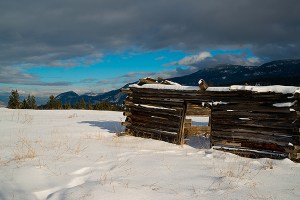
Passing the shed

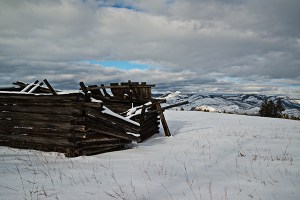
Afternoon sun

Melting snow

Barn View

Winter is here and there is enough snow for me to put on my snowshoes and make my first winter hike to the high meadow above my home. Last January my walk up into that meadow’s deep snow was on a cold, -3C day, under a bright, almost-cloudless, blue sky, and I remember I was shooting with a lightweight, 18-105mm lens on my cropped-frame camera.

Yesterday I had chosen to mount a lightweight 24-85mm on my full-frame camera. Both this year and last I incorporated a polarizer to darken the skies, increase the contrast in the scene, and suppress glare from the surface of the bright white snow, on the partly cloudy +1C day that had me wishing I didn’t wear the extra undershirt.

I trekked up the hill, and as I had so many times before, I photographed everything. There are rarely any animals in sight in that long meadow. If so they can hear my snowshoes crunching through the snow on the long hill and stay hidden just out of sight. As there usually is when I begin to cross the meadow, a crow cries out a warning to the silent watchers. Then it got quiet with only the sounds from my snowshoes and camera’s shutter as I tramped around photographing the hilltop meadow above the Thompson River Valley.

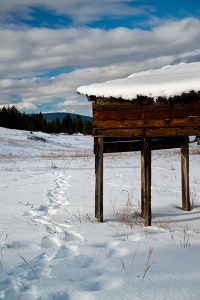
As I have done so in the past, and too many times to count, I wandered around the snow-covered grassland photographing the two remaining structures from an old homestead under the looming Martin Mountain. I don’t know how long ago that area was farmed, or how old the buildings are, but there is what’s left of an old car that appears to have been wrecked and left behind some time in the 1930s or 1940s. There is an abandoned cellar, a barn, a shed, a fruit tree, a garbage dump, the detritus of a family’s life, a family who shut down their farm and left.

I like the solitary walk. I closed the front gate to our yard and started out on the road following tracks a lonely coyote made during the early morning hours. The tracks led up the road to a lower field and headed uphill following snowshoe tracks that one of my other neighbor’s must have made. I always expect to be the only human making tracks up there, however, this time I followed someone that took much shorter strides than me, eventually crossing the creek at the far end of the meadow and to keep going out of sight through the trees without returning.

I like snowshoeing. When I was a youngster snowshoes were the perfect winter accessory. We’d snowshoe up the hill, change to our skis that had been strapped to our backs and ski back down. I remember a trip with my younger brother Rodger, and a friend named Alan. We traveled for three days sleeping in snow caves we made by digging into snowdrifts. Snowshoes got us up hills and skis got us down.

All these years later I am still wandering the winter backwoods, only now I always carry my camera. Snowshoes are perfect for the winter photographer. I have also skied with a camera, but there is always the chance of falling and covering the camera with wet snow. At my age snowshoes are safer and besides it’s easier to position and reposition oneself while composing a photograph. Skis would not work as well.
Photographer’s New Year’s Resolutions for 2016    

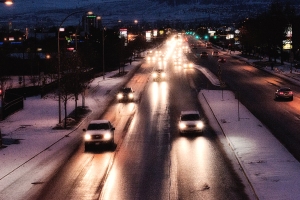
2016 approaching

This month is half over already and I am thinking with all that’s happening in photography that 2016 is going to rush past like a freight train. The prospect of all the new opportunities for this year is exciting, and it may be worth jotting down a list of personal photography goals for this year, or a list of resolutions, as a good idea.

Every New Year I am interested in what plans other photographers will make for the year ahead and most respond with a usual list, for example, use a tripod more, turn off Auto mode, shoot RAW, make a photo-a-day challenge, and so forth. This year, however, I wanted more inspirational ideas for the year to come.

I revisited ideas from January 2015 that seemed to say a lot about ways to improve with this exciting medium and pulled these out. So for the future, for 2016 here is my “Lucky Seven” .

  1. Pay more attention to creative ideas. “This could be the year to begin evolving  creatively”.
  1. There is too much focus on what is the best camera. When we spend too much time worrying about the camera we forget about the story. “We should be concerned with making images that tell a story”.
  1. Take risks photographically and move away from always trying to please, to fit in with what everyone else is doing. Make this the year to push beyond the comfort zone without being concerned with other’s opinions, to be pleased first for oneself. Maybe this will be the year to put “me” in the photograph.
  1. Learn a new technique. Wonder about how the technique will impact your work and whether you will revert or continue to follow up in that direction. I think it’s as simple as experimenting, and definitely taking the time to “read up on something and then give it a try”. Photographers should always make the effort to learn new techniques. Maybe by taking a class, or at least buying some books, or CDs, written by accomplished photographic writers.
  1. Select new subjects to “get out of the rut of shooting the same thing over and over”. While practicing portraiture or landscapes is good, doing the same thing the same way over and over can result in a lack of inventiveness and creativity in our work.
  1. Make every shot count and stay away from the spray-and-pray shooting style. “It’s about quality photographs, not about the volume of pictures snapped during sessions”.
  1. Become viciously ruthless with one’s own photography and what is done in post-production, to be more critical, to keep “conditioning oneself to throw out the crap is the only way to keep improving.”

I’ll finish with a quote by award winning English author, Neil Gaiman.

I hope that in this year to come, you make mistakes. Because if you are making mistakes, then you are making new things, trying new things, learning, living, pushing yourself, changing yourself, changing your world. You’re doing things you’ve never done before, and more importantly, you’re doing something.


I’ve Been Robbed!


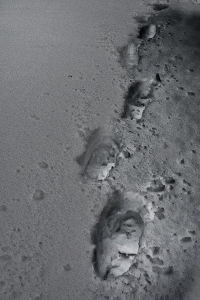
foot prints in the snow

A phone call at 3:30 in the morning is never good.  And sure enough the call I got last Monday morning met my worst expectations.

As I answered the phone I wondered, “Is this a call about a fire or a break-in”. Sure enough it was the latter. There was a break-in at my store.

Somehow three thieves gained entry into the main building from the alley door, and as the alarm blared, they made their way towards my storefront shop. Thereafter, they easily smashed the glass of the door entering my camera store, rushed to a display cabinet containing cameras and lenses; and because I found some lenses scattered on the floor, I think they rudely shoved equipment from two shelves into a camera case that contained my digital projector, and then ran back through the building to exit the rear door.

The tenant that resides on the second floor added her 911 call to the notification the security company was getting from the alarm, and looking through her window watched the burglars making off though the falling snow. Fortunately, the police arrived very soon after and using their tracking dogs easily followed the criminals to their hideout and apprehended them.

I give credit to the fast work of the local RCMP. They were certainly aided by the freshly fallen snow that at that time in the morning revealed the tracks of those thieves that entered and exited my shop. I would like to have watched those Mounties with their dogs chasing down the bad guys.

As I child of the 1950s radio shows like, “The Lone Ranger” and “The Green Hornet”, I listened with excitement as Sgt. Preston of the North West Mounted Police, and his dog, Yukon King, fought evildoers in the Northern Canadian wilderness.

I don’t want to make light of the excellent police force we have here in Kamloops, but as I stood outside the back door in the eerie, 4am light talking to the woman from the upstairs apartment I looked down the snow covered landscape and thought of that radio program of my childhood days from all those years ago. I cannot say the reason. Perhaps it was the lack of sleep, or the stress of the break-in, but when she mentioned the police and their dogs following the tracks in the snow, that’s what came to mind.

I received a call from a constable regarding the photography equipment stolen from my shop, who told me they recovered cameras and lenses in a black case. I assume that’s the missing projector case.

There is a good chance that most of, or hopefully all, of my property will be returned. Now I just have to wait for the lead inspector to determine how long they need to keep things as evidence. After posting the incident on Facebook, I received lots of concern from local photographers. That was nice. I found it interesting when someone would write, “You must feel violated”. For me that isn’t the word I would use. “Irritated” was a much better word to fit my mood as I cleaned up the glass, covered the opening with wood, and now must wait for the police to return my camera equipment.

I will get through this incident, survive my disappointment, and today returned to selling good, used, photography equipment, but now I also have a story to tell of yet another of those stressful events. There are so many photographers out there that have, as me, been photography equipment and have lost their prized photography equipment to, as one officer I talked to called them, “rats that scurry around in the darkness looking for an opportunity”. As I am sure readers know, we must be vigilant against thieves.

As I write this I remember how Sgt. Preston would hug his dog at the end of each episode and say, “Well, King, it looks like this case is closed.”

Thank you to the Royal Canadian Mounted Police for helping me recover my merchandise.


A Happy New Year with Lots of Photography     

Happy New Year

Horse in NewYear Snow

Home for New years

Happy New Year

Another year has gone by, and with that I want to wish all that take the time to read my blog a very Happy New Year. I am sure it’s going to be a year filled with fun photography.

I do try to keep my articles interesting. When I first began to write weekly about photography my goal was to write articles that were a bit different from those I saw in magazines and on-line.

I knew I could easily post a couple of pictures each week, and discuss them as I did for my students in my years as a photography teacher; or I could join with those that provided reviews on their favourite equipment, but I thought that would be easily forgotten.

There were so many people writing about photography that I wondered if I had anything to add, so I decided to use a technique that worked during the many years I taught photography and that is to tell a story that included photo information I wanted to discuss.

Something else that I learned during my years teaching was to keep the subject fresh. That meant introducing something new each class and that is how I choose my topics, something different each week.

I admit that changing the subject each week does get hard. Like most readers there are those who acknowledge that there are other things in life than photography (I wish I could say it isn’t so) and it isn’t unusual for me to say to my wife, “Ok, what am I going to write about this week?”

Fortunately, with Linda’s help it usually works out and I come up with something to say each week.

This year I reviewed by work and the following were among my favourites articles and included “Which Button is for the Composition Mode?”, “What Makes Photographers Happy?”, “There is Nothing Like Photography”, “Interesting and Unconventional Photography”, and “Two Photographers Are More Fun Than One”.

My wife suggested I mention those subjects that I enjoyed photographing most but to that I will quote famous photographer, Imogen Cunningham, who replied, “Which of my photographs is my favorite? The one I’m going to take tomorrow.”

I’ll keep this short and again wish all photographers out there a grand New Year filled with lots of photography.

Photographing the Holiday Train   

Here come the train

Train 2

Holiday Train 3

Passing Train


Last week I wrote about how I enjoy everything about the Christmas holidays; the bright colours, the gaudy decorations, the sentimental music, the silly TV programs, and especially the festive city lights.

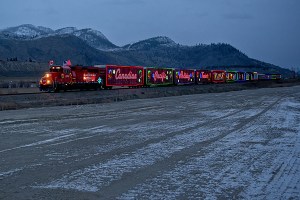
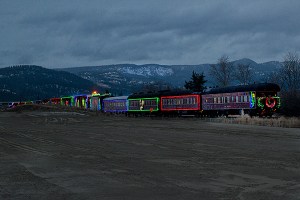
To that fun list I must add the Canadian Pacific Holiday Train. Each December, for the past 17 years, the CP Holiday train has travelled east to west across Canada. And fortunately for my wife, Linda, and I the Canadian Pacific Holiday Train rolls along the railroad tracks that follow the wide South Thompson River a short distance from our home in Pritchard, British Columbia.

As with last year, the train passes by just as the light begins fading around 4PM. The timing could not be better. There is still some illumination in the sky, but not enough to ruin the bright coloured Christmas lights on the train’s engine and cars.

Last year we positioned ourselves across the river for a wide panorama of the train. However, this year because of the construction and repositioning of the highway, we were able to choose a location very near the tracks that gave us plenty of time to prepare when the train first came into view and an interesting three-quarter perspective as it rushed towards us.

When we were across the river last year the long focal length lenses worked best, but this because we were so close this year we chose wide-angle lenses. Linda had her 24mm and I used my 24-70mm. Both were perfect.

We arrived about ten minutes early, made some test shots to check the fading late afternoon light, then waited with our hot chocolate to keep warm.

With the train’s movement I knew we would need fast shutterspeeds. I selected ISO 3200, which let us both use 1/350th of a second.

Linda said, “There it is!” When the train roared into sight, we jumped out of the car into the cold wind that was coming at us off the river and took pictures as it passed. The engineer tooted the horn at us but we didn’t have time to wave back and take pictures too. The whole event was over in about 40 seconds. Ha, what a rush! Then we got back in the car and ten minutes later we were sitting in our warm home finishing up our hot chocolate.

Well, one more holiday photographic occasion is over, but I know there will be more opportunities between now and January 1st. This is such a grand time of the year.


There is Nothing Like Photography  

White church

Fraser River view

Anacortis Oil Refinery

Lilloet

Coastal tree view

Hay Field


“In visual terms there has been nothing like photography in the history of the world. There is no vocabulary for it. Photography literally stops something dead. It’s the death of the moment. The second a picture is taken that life is held, stopped and over. That moment is over.”

I found this quote by photographer Richard Avedon that I had tucked away years ago into the pages of a book of photography by Eliot Porter entitled, “Intimate Landscapes”.

Photography is powerful that way. There has never been a medium that has captured the interest of so many people like photography. When it became popular in the 1800s, no one could have envisioned how important to the world and to our personal lives photography would become.

For those of us in Canada the first known photograph was by an Englishman named Pattinson, here on a business trip in 1840. He was a student of an early form of photography perfected by Louis Jacques Mande Daguerre and had stopped at Niagara Falls to produce the now cherished historical Daguerreotype photograph.

The Daguerreotype would have taken more than 20 minutes for the scene to expose on a silver-coated plate inside his camera. Later he would surround the plate with warm mercury fumes that would slowly make the image visible.

I begin to think about photographing the landscape near my home this morning and I almost headed out, but the flat light and icy cold rain made me change my mind.

To keep myself in the mood I decided Eliot Porter’s book of photographs from northwestern New Mexico and southeastern Utah would be perfect to review with a cup of coffee. I find Porter’s photography stimulating.

Porter wrote, “The natural world has always attracted my eye: associations of living and inanimate phenomena, from the tropics to the poles and from rain forests to deserts, have been favourite photographic subjects for almost half a century. Grasses and sedges, especially, appeal to me – an appeal like disordered hair across a face, or a windblown field of hay before the mowing…”

Reading his or any other book on photography for that matter, helps me examine the way I make photographs and try to photograph things differently.

I do think photographic ideas and opportunities sometimes happen in a moment that once passed will never be the same. Many times I just want to make a photograph for no other reason than it is fun to make.

Here is another quote from Porter’s book that I endorse as well. Porter says, “I do not photograph for ulterior purposes. I photograph for the thing itself – for the photograph…” I like that. Sometimes just the process of making a photograph for no other reason than doing it is enough.
Photography in this digital age has become so very easy, but I think good photography can be as time consuming as it ever has been, requiring practice and education by those that take it seriously.

As I turned the pages of Porter’s book I thought about how nice it would be if the hills above my home get lots of snow in the coming winter. If you have a moment check out landscape photographer Eliot Porter in your local library, or on-line, and hopefully his photographs will inspire you as he does me. You might also look up Richard Avedon.


Christmas Lights are Here Again         

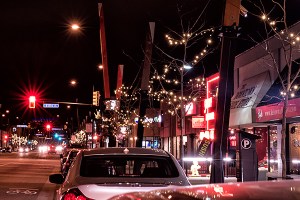
Street Lights

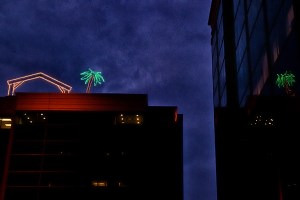
PalmTree Decor

Tree of Hope

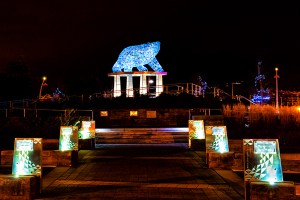
Xmas bear

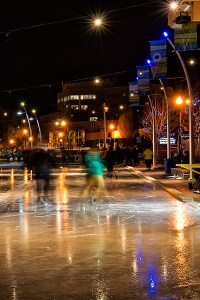
SKating rink

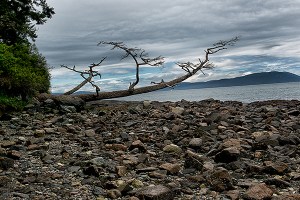
Beach walk

December is upon us again and the visual presentation of bright, festive lights has begun. Yes, the Christmas holidays are coming. The bright colours, the gaudy decorations, the sentimental music, the silly TV programs, and, for me especially, the Christmas lights in the city.

This past week my wife and I had to journey for a late afternoon meeting to Kelowna, which is two hours south from our home, however, that winding country road can be treacherous on dark, snowy nights and so we decided to stay overnight in Kelowna.

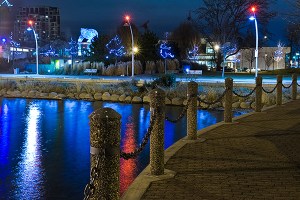
For some that means dinner out and just waiting the night out in a motel, but for me it’s an opportunity to have fun experimenting and photographing the season’s sparkling lights. In anticipation I had packed my camera with a 24-70mm lens and, of course, my tripod.

My preference for evening photography is to select a location before it gets dark, and to begin shooting when the lights are first turned on, when there is still some light in the sky, yet dark enough for the lights to be bright. However, our meeting lasted until after dark and I had lost the light.

I have been fascinated by Christmas lights since before I picked up my first camera, and remember family outings this time of year when my parents would pack us up in the old 1954 Ford station wagon for after dark drives along the high roads above the Salt Lake City valley. We would drink chocolate milk and look down on the colourful city lights. At that time my father was in charge of the awkward, accordion-like Kodak camera, that I doubt ever used anything but black and white film.

In spite of the late hour we drove by the downtown Kelowna lakeshore past the Yacht Club. I was sure the city would have lights along the sidewalk and hoped that some of the boats might be lit up. I had also heard that a public skating rink was opening and I wanted to experiment with a slow shutterspeed.

During the time when ISO ratings were limited, photographers who shot after dark ended up exposing for only the lights, and the resulting photographs would show lots of colours, but didn’t say anything about the location, or environment. Nowadays most modern cameras have no trouble with ISO 800 or 1600, with some even 3200, and don’t show the random speckles, which indicate degraded image quality.

Making some test shots I quickly found that the city lights were bright enough to allow me to use ISO 800. I also tried 1600, but I lost Christmas lights detail, and the buildings and walkways didn’t look like they were photographed after dark.

As usual Kelowna had lit up its tall “Tree of Hope”. I photographed that very tall electric tree last year and knew from experience that the best time to get pictures of it was early in the morning. When I left my hotel room at 6am the next morning I was greeted by a couple inches a fresh wet snow. Perfect. More light reflection.

I shot with my camera set to “aperture” priority. When I use aperture priority for this kind of photography I also employ the camera’s exposure compensation feature. If one just used the aperture priority mode the camera will, as it is programed to do, try to correct the lighting and that makes the sky too bright. This time I think I used -1.7 to darken the sky.

A drive this time of year through any town or city neighbourhood is an exciting visual presentation of bright, festive lights, and an opportunity for at least a few weeks, to have fun experimenting and photographing the season’s sparkling subjects.

Infrared, A Completely Different Feeling….

Pritchard Station

Riverside

Monty Creek church

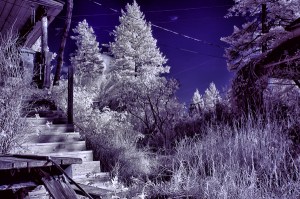
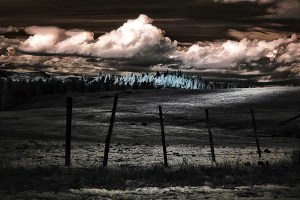
Fence along a dirt road

Pritchard Bridge

Back Porch

Infrared, A Completely Different Feeling

In my last article I discussed how easy it is to make creative changes in one’s photography by using a camera converted to infrared. I wrote that photographers have the option to creatively challenge themselves by selecting different lenses, choosing to produce black and white images, electing to use highly manipulative post-production techniques, etc., or any combination just to mention a few. Then I added one more creative tool to the list that I use, a camera converted to only capture images of the world around me in infrared.

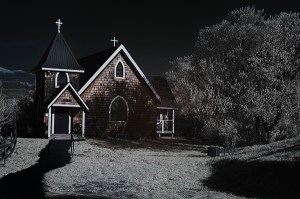
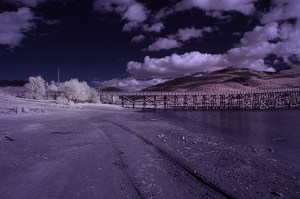
Infrared allows a photographer, and gives the viewer, a completely different feeling of a subject. Making an image with a modified camera is an exploration and a discovery that moves a photographer far from the usual. I like the sometimes-surprising tones that I can obtain when I convert the image to black and white. Like any form of photography, or art, it’s all a matter of taste.

Reflected IR light produces an array of surreal effects, vegetation sometimes appears white or near white. Black surfaces can appear gray or almost white depending on the angle of reflected light, and if the sky (my favourite part of the infrared image) is photographed from the right direction it becomes black. The bluer the sky, the greater the likelihood of an unworldly effect; and white surfaces can glow with an ethereal brightness.

The response I received from readers got me thinking about how much I like shooting infrared. That’s been a long relationship. My first forays with infrared during the 1970’s were began with infrared colour transparency film and then with infrared black and white film.

Now that I have set film aside I am more than content to use a converted digital camera. Besides it’s much easier with digital than the arduous process we had to contend with when we used film. Infrared film had to be loaded and unloaded in complete darkness, then processed in metal tanks that kept the film from getting fogged. We attached a deep red filter to the lens. The deeper the red the better the effect, and because of the dark red filter things become very hard to see. Oh, and the exposures were long if the sun wasn’t bright.

In spite of that infrared photography has had a strong following of creative photographers for as long as I have been involved in photography. And now with the light gathering ability of modern sensors I think that following is stronger than ever.

In an article I wrote about using infrared film titled “Photographing a Different Kind of Light” I said, “There are those who believe a fine art photograph must represent reality, but reality doesn’t necessarily take into account that there are differences between what one sees, what the photographer’s camera produces, and what the photographer was trying to capture.” I think a photograph is only a representation of a particular vision of reality.

Infrared allows us to photograph a world illuminated by infrared light, that part of the colour spectrum we can’t normally see, and produces intriguing, exquisite and sometimes unearthly photographs that can’t be captured in any other way.

Infrared is a good way for me to change the way I make photographs.

Cattleguard 1

Martin Mountain 1

Fence 1

One of the things I like about the exciting medium of photography is how easy it is to change the tools with which we use to create photographs.

I suppose painters can change their brush to a different size, or use a pallet knife to apply paint on their canvas. They can step away from a canvas surface altogether and apply paint to any number of other materials. I guess photographers aren’t alone in the ability to change tools in pursuit of making an interesting picture.

However, photographers have the option to creatively challenge themselves by selecting different lenses, choosing black and white images, electing to use highly manipulative post-production techniques, etc., or any combination just to mention a few.

For myself, I’ll add one more item to that list: using a camera converted to only capture images of the world around me in infrared.

I have mentioned before the old Nikon that I had converted to infrared many years ago. I enjoyed using that old 6 mega pixel camera, it served me well. I purchased it in 2001 and it was my first DSLR, however, when the time came to move to a camera with a newer and better sensor, instead of selling it off like I have with many cameras since, I opted to have it converted to a dedicated infrared camera.

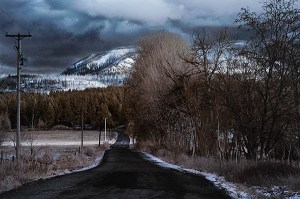
Infrared cameras like blue cloudless sky, and I think many of my most successful images have been late in the afternoon on sunny days. Nevertheless, this week I decided to wander the roads near my rural home in hope of getting some dramatic skies on the heavily clouded afternoon.

My experience on cloudy days has been that one has to pick subjects carefully. There are some objects that, in spite of a sensor that only sees infrared, look pretty much the same as they would if photographed with a roll of black and white film. Instead of taking on a light coloured, or white glow, trees might go black and meadows look normal.
With that in mind, my goal, as I drove along the snowy dirt roads was to find a camera angle that would do the most for the vegetation and still give me lots of dramatic sky.

Life Pixel, http://www.lifepixel.com/ writes on their website, “Are you tired of shooting the same stuff everyone else is shooting? Then be different & shoot infrared instead!”
I don’t think I care whether I’m shooting the same subjects as photographers, but I sure do like to change how other photographers see the stuff I do shoot, and infrared works perfectly for that.

The infrared camera allows me to change my tools and way of visualizing and capturing the world around me. It makes me think about my photographs in a different and challenging way.

Photographing Eagles along the Highway       

Eagle of all atitudes

Young eagles

Young eagle

Waiting eagle

In the warm sun

Watching young ones

Fly, there's a photographer

Fly away


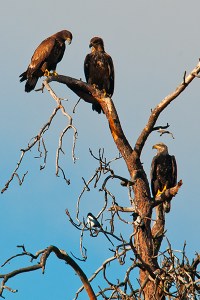
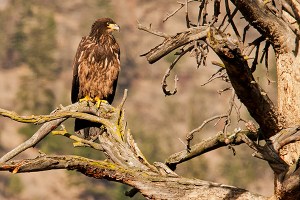
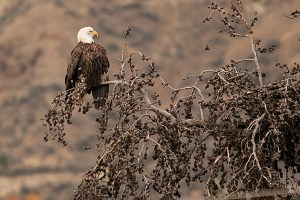
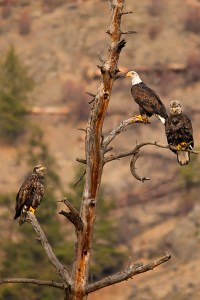
Eagles come in all shapes and sizes, but you will recognize them chiefly by their attitudes.” I don’t think British economist, E. F. Schumacher was really discussing the kind of eagles my wife and I saw perched in trees along the river, but his quote perfectly describes a picture Linda took of three eagles

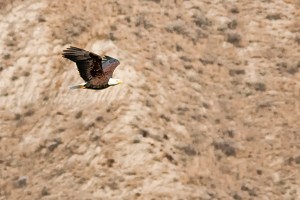
Winter is on its way and eagles have been moving west along the South Thompson River towards the warmer feeding grounds on the pacific coast.

My commute to Kamloops from my home in Pritchard is on the Trans Canada highway that runs parallel with that wide river and this year it has been fun to see how many eagles we can count before reaching Kamloops.

After counting 35 eagles on our way to town the previous week Linda mentioned that she’d like to try taking some pictures. So after waiting until the sun was high to the south last Wednesday we made the drive to see what we could find.

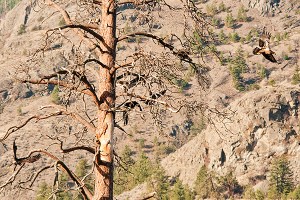
The traffic on the Trans Canada is constant and fast moving with lots of big, transport trucks. But with some preparation it isn’t that big of a deal to quickly pull a safe distance off the road to photograph eagles in the tall, dead trees along the river in which the eagles like to perch to watch for fish. In one tree alone we counted fourteen eagles, some mature but mostly adolescent.

My job is to drive and my wife’s is to photograph eagles. I pull over, stop and turn off the car to reduce vibration caused by the engine, and Linda rolls the window down, plops a beanbag on the frame and positions her heavy 150-500mm Sigma lens out the window and starts shooting.

It would have been nicer if we had a way to get closer. However, even if one got out of the car, struggled through a deep ditch, crossed the railroad tracks and climbed over farmers’ wire fences, I am sure the skittish eagles would just fly off anyway.

Linda had a pretty easy time of photographing those eagles from the car anyway. She had selected Shutter Priority on her camera with a shutter speed of 1/650th of a second and 650 ISO. Yes, there were some shots that didn’t turn out, the car would shake when big trucks passed by and every so often clouds would block the sun. But she got some great keepers.

As exciting as it is for those of us here in the BC Interior to see 40 or 50 eagles in the trees along the river, in a few days lots of those big birds will be making their way down the river to join many, many more eagles congregating on the Harrison River to feast on spawning salmon.

The Fraser Valley Bald Eagle Festival began 20 years ago and this year it will begin on November 28th at Harrison, British Columbia. This is an annual event with the migration of thousands of Bald Eagles returning to the Harrison Mills area to take advantage of the spawning salmon.

For photographers the place to be is where the Harrison River widens with shallow gravel bars for the returning salmon to spawn. Organizers say it is possible to see up to 10,000 Bald Eagles feasting on salmon.