Think about the gift of Photography

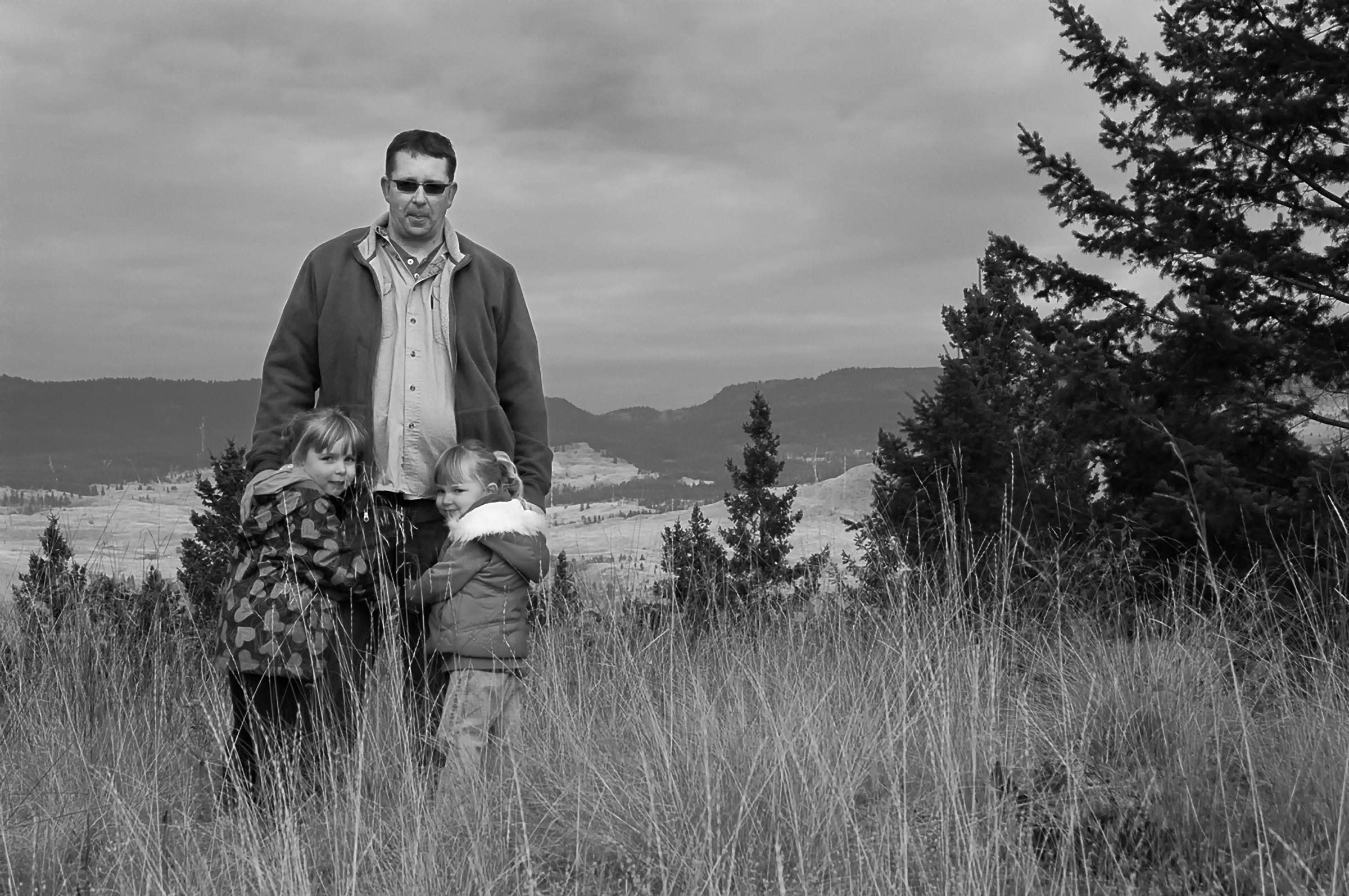
My son’s gift to his wife this Christmas will be five framed 16×20 photographs of him and their two young daughters.

I’ll start by saying that although I can’t think of any better gift than the gift of photography, and even though I always do commissions this time of year, I don’t push my photography on friends and family.  They all know I make pictures for a living, and am pretty good at it, and if they bring it up I am ready and willing, but I am tend to be silent the rest of the time.  Photography for me is the same as any other art displayed in a person’s home, and although there are large photographs on the walls of my home I do realize other people might have other tastes as to just what art is.

I could not have been more pleased when my son called me with his request. We decided to meet at our place in Pritchard and stroll through the wooded area across the road, and spend time taking pictures of the two granddaughters and of him. We wandered the trails of my son’s childhood through the woods, climbed on deadfalls, peaked around trees, ran up and down hills, stood overlooking the river valley behind and had lots of fun until we all tired out. The children loved the experience.  Then with the promise of hot chocolate we turned around and counted our steps home.  All this time I took pictures.

When I photograph children I am never in a hurry. I don’t try to coax a smile by saying, “smile at me”, because unlike adults most children haven’t spent any time practicing in front of a mirror smiling. They don’t know what to do and what usually comes is a face with a wide mouth full of tightly clenched teeth. I just talk a lot, get them to talk back, find many different places to pose, sitting or standing, and take enough time; and because I make sure they are having fun getting their pictures taken I will get relaxed poses, laughs, and smiles in my pictures.  I recognize that generally the first pictures won’t be the best, but who cares? I am shooting digital and just delete those I don’t like and keep taking pictures.

I don’t carry lots of equipment, just a camera with a medium-sized zoom lens and I don’t like long lenses like a 70-200 because I would be to far away from my subjects; I want to the session to be intimate and face-to-face, so for my granddaughter’s pictures I used my 24-70mm, and of course, as always, I used a flash.

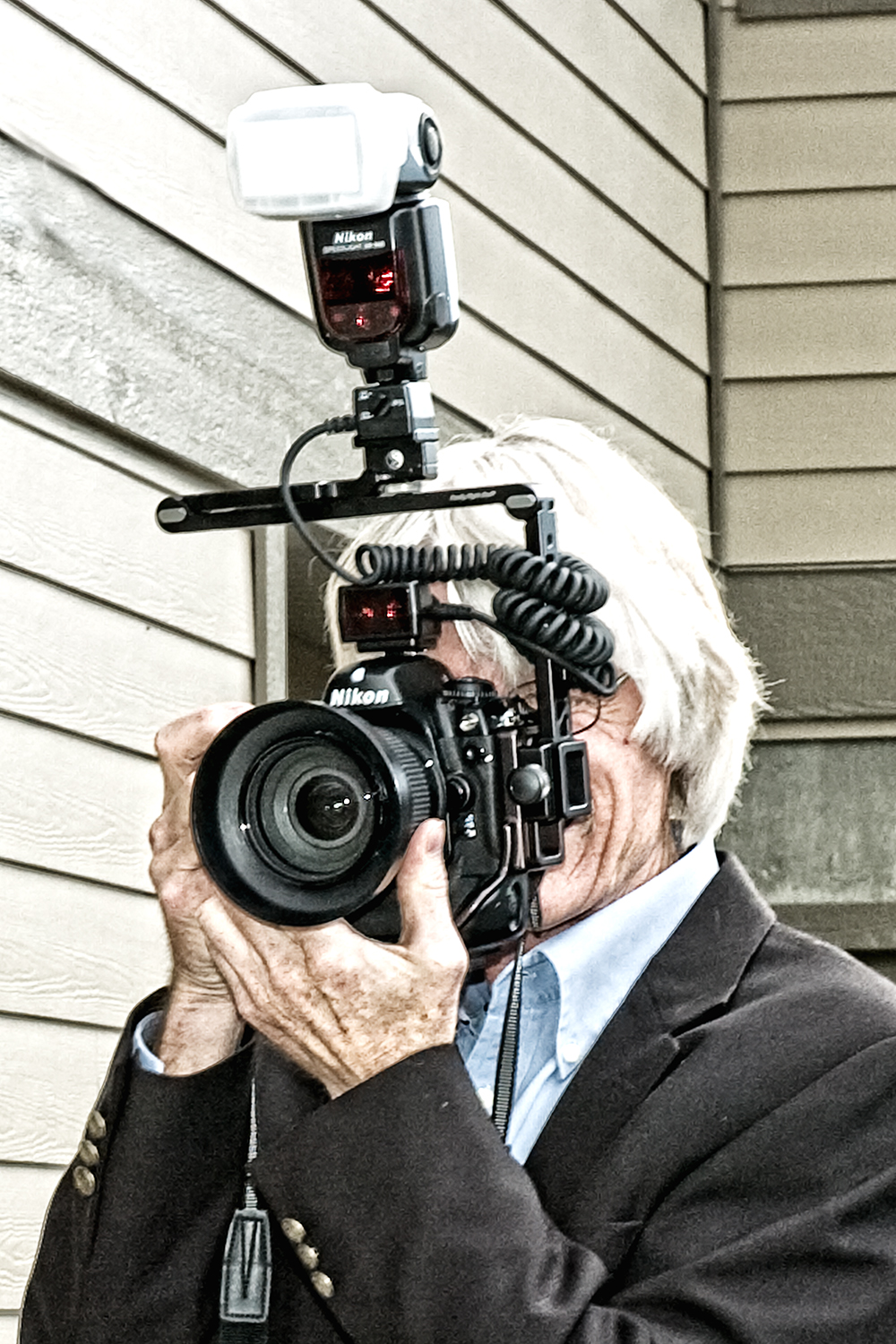
There are times that I like off-camera flash and there are times when I keep my flash attached with a bracket that lifts it about eight inches above my camera. This was one of those times, as we were constantly moving. However, I easily could remove the flash whenever I wanted to change the light’s direction.

Modern technology is great. When we returned home I loaded all the pictures into my computer and we sat down to quickly review them all and made our selections. I usually do that by having people select the ones they like first. I moved them into another folder, and then I do the same again and again, moving the best to a new folder. Our goal was to end up with five pictures to be converted to black and white with a slight sepia tint, and then make into 11×14 inch prints.  That size fits perfectly in a 16×20 matt that will finally be displayed behind glass in 16×20 inch brushed silver frames.  I think my daughter-in-law will like this gift from her husband.

This is a good time for photographers to think about their personal photography as Christmas gifts.  I talk with many photographers that make statements like “photography is my passion”, but they never do anything with their pictures except posting them online, or showing them to others from their cell phones.  I see photography the same way I see any other artwork and am disappointed when I visit a photographer’s home and don’t see his/her photographs on the walls.

Are any of you planning on giving your photography as a gift?
www.enmanscamera.com


A successful off-camera hotshoe flash workshop

The following is a quote credited to George Eastman, founder of Kodak. “Light makes photography. Embrace light. Admire it. Love it. But above all, know light. Know it for all you are worth, and you will know the key to photography.”

On Sunday 30 October, fellow photographer and friend, Rick Tolhurst and I held the first in a series of local lighting workshops we will be providing. We called it “Dawn of Light”. Yes, it is a catchy, almost meaningless title at first, but it actually fits if one applies a dictionary definition.  The word dawn means, “the first appearance of light in the sky…figurative or the beginning of a phenomenon or period of time…” so, consequently, that title works well for those trying to help photographers enter the world of using and controlling off-camera flash for the first time.

Photographers all work with their subjects differently. Some might be portraitists, some call themselves glamour photographers, there are those that do boudoir, baby, or maternity sessions, some shoot family groups, and, of course, there are those that photograph weddings. The approach may be different, however, the one thing in common is the need to use additional lighting.

As instructors, we weren’t concerned about anyone being a beginner at lighting, or having never used a flash off-camera, because, the fact that these photographers were there showed they were ready.

The discussion and action packed day began with coffee, donuts and introductions.  We had advertised, “This one-day workshop is really about one thing: using off-camera hotshoe flash with a DSLR to move your photography to the next level.  The main objective for this session is using wireless, off-camera hotshoe flashes and balancing (controlling) light with ambient lighting.”

After the morning session of instruction, questions, and demonstrations, the participants grabbed their cameras, split into teams of two or three photographers and went at it. In a large room Tolhurst and I had set up three lighting stations; the first with a shoot-through umbrella and some reflectors, the second employed an umbrella/softbox brolly and another shoot-through, and for the third we had a 24” softbox and a 40” reflector type umbrella. We also placed a beauty dish on a boom stand.  There were more light stands, umbrellas, softboxes and reflectors lying around ready for anyone who wanted them.

All the lighting equipment was fitted with wireless receivers, and all the learners needed to do was to take turns mounting senders on their cameras, and the large room became an animated, action packed scene. At this moment I stepped back to watch the enthusiastic photography students apply the information from the morning session into what can only be described as an exhilarating application. When this occurs my role is to act as a guide, an equipment mover, a resource for any questions, and the guy that congratulates successes. Tolhurst and I were busy interacting with the participants for the remainder of the day.

Many classes that are advertised as “workshops” actually are nothing more than long lectures with handouts. That works out easier for those putting on the session, as they present the subject, give demonstrations, answer questions and wait for acclamation.  Many participants are so eager and hungry for information, or are at least enthused by what seem to be prophetic words, that they leave happy, but has learning occurred? Some even return home and try to do what was presented in the “workshop”.  To me a “workshop” should be the same as those high school days when I took wood shop. I want to touch, experiment, and challenge what I just heard in the instructor’s lecture.

For this session we wanted an interactive class and that is harder, for the presenters become participants and loose the celebrity of standing in front.  However, this workshop was about participants actually learning to use off-camera flash to combine ambient and electronic lighting in order to flatter subjects instead of just brightening them up.

Judging from the smiling faces of the group, and the images seen on camera LCD screens, and the follow up emails and Facebook messages I have received since Sunday, the “Dawn of Light” lighting workshop was a strong success. To make it more successful, those that attended should review their notes, find a subject, and spend some time reinforcing what they learned using off-camera flashes.

www.enmanscamera.com

Retirement and Photography

Within the last few months I have been meeting recent retirees who have taken up photography as a way to fill anticipated free time and add an interesting challenge to their future.

I talked to a recently retired fellow last week about an expensive new lens he had purchased as a retirement present for himself. I was as excited as he is about his new lens and thought that it was a neat way to start his retirement. When I mentioned he will have lots of time to do photography, he made me laugh at his reply, “yes, as soon as it gets warmer”, but I know a bit of cold weather isn’t going to stop him. Anytime I get something new, I can’t wait to start using it. So, even though he complained about the cold, he’ll be out this week with his new telephoto lens putting it to use no matter the temperature. I know he wants to photograph birds, but I suggested he take a drive to a nearby area photograph the Bighorn sheep just for practice. 

Baby boomers are starting to retire and many are seriously taking up photography. I heard one fellow say, “I figure with the time I have I should enjoy every day.”  He had just retired and had spent well over $20K on a camera and lenses to set himself up for wildlife photography.  For those that gasp at that level of expenditure, be aware that his recreational investment won’t be taxed every year, won’t need expensive maintenance, and will give him years of enjoyment at no real additional cost, except perhaps expenses to drive to some exciting location.

Another retired friend just downsized to a small apartment, although an avid hunter all his life, he has given up packing a rifle, and instead packs a camera with a long lens attached. He explained to me that he really likes to hunt, but the fun ended and the work started when he shot something, however now it continues after the shutter is released and I expect he enjoys the compliments others given him when he displays a great photograph. He can hunt and photograph wildlife anytime and anywhere. His story of how he snuck up on an elk herd near Jasper by quietly wading a glacier fed river, and crawling through the underbrush, for many super images of majestic elk was superb. I can imagine him wet to his waist, covered with mud and pine needles, but happy and excited with the pictures he captured. Now that’s hunting.

Modern camera technology has freed photographers from equipment and production challenges of the past.  A photographer no longer is weighed down with heavy, metal-bodied SLR (single lens reflex) cameras, and lenses. Gone is the challenge of selecting the correct film for lighting conditions, and the need to worry about storage of film for long trips. Like me, those photographers with tired, old eyes now own cameras that quickly focus by themselves with focus assist indicators for fine detail. The days of returning home from vacation with film, and waiting for days to have it processed, or worrying about how to pay for the processing are happily long gone. Photographers immediately know if they got the shot right and can delete the errors.  We have passed the “click-and-pray” days.

Want to send a picture to the grandkids? It’s laughably easy.  I remember a three-month trip across Canada that I took in the 1970s. I would shoot slides, put them in mailers, and have them sent to my home address. My house-sitting friends would then get together and have slide shows wondering where I was when the picture was made. Today I could post my pictures for friends and family with commentary on a social network, or an image-sharing site like Flickr, from my motel room or while relaxing at Starbucks.

Photography is a tailor made pastime for retirement. It is supposed to be a great time of life and what better way to capture new memories, to be creative, to remain active, and to keep that brain stimulated by working with a camera.

www.enmanscamera.com.

The photographer asked, “Is it time to upgrade my camera?”


In the previous era of film cameras many serious photographers would come to a point when they would consider whether to upgrade from an automated point and shoot type camera to a 35mm interchangeable lens SLR (single lens reflex), or trade in the 35mm SLR for a medium format 120mm camera, and maybe even to take the climb to a 4X5 view camera.

For film-based cameras it was all about the size of the film and bigger was better.  I recall feeling bad for those people that had friends photograph their wedding with a 35mm camera at a time when quality wedding photography was really only produced by photographers wielding medium format 120mm film cameras.  If one wanted a colourful, sharp, grain free enlargement then 120mm or larger was a must.

What do I now say to a photographer that is considering a more serious approach to photography?

I will always begin with the question, “what are your interests and what subjects do you like to photograph?”   My short answer for digicam users is if sports, fast action, wildlife or enlargements bigger than 8×10 are the goal, then, yes, get a DSLR. DSLR cameras don’t have shutter lag when the release is pushed so sports photography is easy. Fast action demands a camera that can adjust shutter speed and aperture. Wild life photographers prefer a selection of super telephoto lenses that can be changed at will, and printing quality 11×14 or bigger enlargements are best produced with sensors that are considerably larger than what digicams provide.

Digicams are perfect for intimate, candid shots of family and friends. The compact size lets one put them in a pocket and go, and if used correctly and within their limits they will produce excellent images.   However, if photographers feel they have reached their camera’s limits then it is time to move on. So the question is what is the best choice for a first time DSLR?

For this discussion I will put DSLR cameras in two simple categories, amateur and professional.  The difference between amateur and pro cameras has surely become hazy. If I were to offer a short comment I would say the most obvious difference is durability.  Pro cameras feel sturdy, are heavy and sealed against the elements. When dropped, they bounce and usually don’t break, and even with hard use will last a long time.  The amateur camera generally has lighter weight and smaller size.  When the first DSLRs came onto the scene there was definitely a difference in the quality of the images between entry level and professional level cameras, but that is not as distinct now. The technology for sensors and in-camera processing has rocketed.  The latest entry-level model may well have the same sensor as the previous summer’s expensive pro model as the technology is transferred over.  The main difference is in the weight, substance, durability, and controls.

The new models are always being introduced, with that many previously great camera models will be reduced in price, or discontinued, and very soon there will be some great opportunities to purchase at reduced prices.  As always there will be a flurry of megapixel chasers that change their camera with every new model upgrade, making used cameras available. There are those people who will not buy a used digital camera and that is OK, however for those who are interested how does one know what is a reasonable price?  The easiest way is to go online and check out the sale prices at the big photography retailers for their new and used equipment. Know your prices before buying that camera from a good friend or family member and remember the money that you save can be put towards equipment like lenses and a good flash or tripod.

Whatever the camera availability, my advice to those photographers asking the “upgrading” question is to consider what kind of photography they want to do. Talk to other photographers about the cameras that are interesting, go on line and check out the many photography forums to find out what others with that same interest are using, and attend some classes. 

Using a new camera is always fun and I believe learning how to control the technology a new camera offers is like a shot in the arm that gets the excitement going and helps ultimately to make better photographers. 

www.enmanscamera.com


This photographer was challenged about always using flash.

I recently had an email conversation with photojournalist Ted Grant regarding my blog entitled, “I Have Never Used a Flash”.

In it I wrote that I like adding light using a flash under all conditions from dimly lit rooms to sunny days. My column began with a statement from a photographer just starting to photograph weddings of her friends who says, “I have never used a flash,” and to that I had responded, “I always use a flash indoors and outdoors when photographing people”, but she was surprised and said “even in bright sunlight?” 


I use the flash to reduce the shadows caused by bright sunlight. TTL (through the lens) flash technology is easy to use, almost fool proof, and the days of calculating distance and flash power are long gone. I also wrote, “When I learned to use a flash many years ago it changed the quality of my photography.  I no longer had to rely on ambient light and I began to notice my subjects had more “pop” than those without the flash.  Just like the control I gained by using different focal length lenses, using the flash allowed me to add light when I needed it, improving the quality of my photographs and separating my photography from who do not to use flash.” 

I believe it was that last line that piqued the interest of Mr. Grant who wrote to me, “If I were to suggest… “If you can see it? You can shoot it!” That means without any flash…. period.”

However, as photographers, we have different goals and my response to him was, “Many just getting into photography have not had the opportunity to spend years honing their skills, and, in my opinion, modern flash technology makes opening and preserving shadow details, and balancing ambient light conditions so easy that I am disappointed when I see over-exposed features or detail-less shadows.  A great number of photographers are currently embracing flash as a tool similar to using different focal length lenses for perspective control and tripods for camera stability, etc.  I’m sure that photographer’s camera would record anything she “can see”, but with the limited exposure range of digital I believe her images would be less that what you and I would categorize as acceptable.”

On a sunny day the dynamic range between the darkest and the brightest areas might mean a person wearing a dark shirt could have an exposure of f4 and 1/250th second whereas the surrounding landscape might be as bright as f22 @ 1/250th or brighter.


A photojournalist selects what is most important and only exposes for that, but for those of us photographing a family or a couple in their back yard, or a youngster posing beside the family pool, that isn’t an option. Our clients are probably proud of the work they put into their back yard and an over-exposed, washed out background would wreck the picture in my opinion.

For me that picture would be easy. I’d quickly meter and make an exposure of the back yard, check my LCD to make sure it was a good then put a flash on my camera, have someone stand in, make a couple of test exposures, and reduce or increase the flash output if needed, and I am ready with subjects and background all evenly exposed.

However, Mr. Grant is absolutely right. “If you can see it? You can shoot it!” I believe his quote came from his work on a book about women in medicine shot using a Leica 35mm and exposed on black and white film. He also likely didn’t have the luxury of fast auto focusing image stabilizing lenses, or being able to check the image and exposure history as he shot, and he likely was restrained from using TTL flash technology in his many endeavours.  There are, of course, differences between photographers and how they want their subjects to look. I suppose it is really about what in the final picture is important to them.

The photojournalist’s job is to capture the action as it happens, using a flash might not be possible, or even allowed in some circumstances. Whereas the type of photography I do is all about the subject who in all instances must be photographed in the most flattering way possible and in most cases that means including using a flash.

 www.enmanscamera.com


Is free Photography is a good idea?

I recently had the pleasure of photographing a dog’s play-day at St. Andrew’s on the Square in Kamloops. They had an obstacle course, a bucketful of doggy treats, lots of toys, and even a (yuck) dog food cake. Dogs and their owners showed up throughout the morning and I photographed them jumping over gates, running through tunnels and having fun with their people. My friend, Melody Formanski, director of St. Andrews and dedicated dog lover, sent me the advertisement when she organized the event and was surprised when I told her I would be there to photograph the dogs. But I like dogs and I like photography and looked forward to the opportunity.

My favorite location was at the end of one tunnel. Some dogs came through nose down following other’s scents, some were puzzled and seemed to wonder why their owners wanted them to wander though a meaningless opening. Others had to be coaxed from the far end, but there were those that loved to run and obstacles like the gates and tunnels made the experience more fun. However, I admit I ruined some pictures because I was laughing or getting licked instead of concentrating on being a photographer.

I will be providing Formanski with the pictures I made. I hope she will use them for the club and give pictures to the people that attended that otherwise would only have low quality point and shoot pictures of their dogs. That’s my gift to them for the entertaining morning.

That “gift” brings up an opinion that is flourishing on some websites and photography organizations. I recently read an online forum post that condemned a photographer for giving her photographs away to an organization in which she participitated. The writer stated that, because a photographer spends time and money developing skills as a photographer, their work should always be paid for. I think that is an interesting topic and my opinion is, it depends.

The contention by those that believe all photographs should be paid for is that giving one’s work away drives the price down and reduces the value of photography of all those in the profession, plus it makes it hard to earn a living as a photographer.

Many individuals or community organizations take advantage of beginning photographers by recruiting them to photograph an event for free and saying, “this will be good for your portfolio”, or “ this is a good way to advertise yourself”. I emphatically say that doesn’t work. People will not say, “Thanks for the free wedding, I will tell everyone to hire you”. The organization you worked for will not say “those photographs you spent hours taking for our expensive advertising campaign (for which everyone else was paid but you) are so good that we will recommend you and hire you for the next job”. As I said, that does not work to the advantage of the photographer and won’t further their career.

After writing that, I still don’t agree with the opinion that photographers should only make photographs for money, and will continue to believe that giving away photography, as a gift is a good idea. I have hobbyist friends that are good photographers and I think their photography deserves to be seen in more places then just on their home desktops. All those great pictures make good gifts and its fun to have your work hanging on relative’s and friend’s walls. When to charge and when not to charge really depends on the circumstances. I suggest readers consider carefully, and politely pass on those, “this will be good advertising for you,” requests. I will, by choice, continue giving away photographs to those people I like (without any expectations of anything back) and hope there will be those that had as much fun as I did at the doggy day that enjoy my freely given photographs of their dogs.

http://www.enmanscamera.com.

Using the wrong photographic tool

Using the wrong tool usually leads to unacceptable results in one way or another, for example, when a butter knife is substituted for a screwdriver. That was what came to mind when a local artist group asked me if I could save any of the photographs taken of a member’s winning painting. They required a good 8×10 print and a JPG that could be inserted into their on-line newsletter.

The painting was initially photographed straight on, but that resulted in a bright white reflection in the middle from the flash that obscured the painting. The photographer then tried several shots from the side to reduce the glare, but produced unusable foreshortened pictures, by that I mean the closest frame edge was large and distorted and the far frame edge was small.

The photographer tried several shots, always with unacceptable results. That is what I mean by using the wrong tool. A camera with an on-camera flash will produce glare on reflective surfaces and angled shots don’t make for a good documentation of flat artwork because things close to the camera lens appear larger and those farther away become smaller.

The right tool would have been a camera attached to an off camera flash (or better yet, flashes) set away from the painting at a 45 degree angle. Personally, I would have diffused the flash in some way, either by placing some translucent material in front of it or bouncing the light off a large white card or wall. In any case, the light needs to softly and broadly, not sharply, expose the painting surface. The beauty of digital technology is how quickly one can review the image and retake the photo if needed. I also recommend taking several shots at different apertures. For that, the right tool is a camera that one is able set to manual exposure.

When photographing oil paintings or other uneven reflective surfaces I prefer working with slightly under exposed image files. That way I can bring the detail up using PhotoShop without loosing the highlights.

If the next question is “What kind of camera?” my answer will be that it depends on what is the desired outcome. If it is a printed enlargement of the painting, or for reproduction in a book, or the like, the image file needs to be large and for that one must use at least a DSLR (digital single lens reflex), but for a small newspaper or website image a digicam will do just fine.

If there isn’t access to an off-camera flash wait until the painting can be placed in “flat” daylight. Today, as I write, I see out my window that it’s cloudy and overcast. Today would be a good day to have photographed that painting. Place the painting on any support that will allow tilting right, left, up, and down. Then as exposures are made and checked for reflection the painting can be moved around until there is no reflection.

Within PhotoShop there is the means to realign the diagonals of a painting photographed from it’s side, not perfectly, but good enough for the small website picture. The 8×10 enlargement took a bit more effort for fear of distorting the painting’s subject matter. Again, that’s not perfect either as the outside frame looks a bit wonky, but the painting looks proper. The best outcome would have been to use the right tool and make a good photograph at the beginning.

http://www.enmanscamera.com

Photographing a Rodeo

There is something about a rodeo that changes the visible culture, or, at least, what seems to be the normal dress code for many folks. Baseball caps are traded for cowboy hats, beige slacks and cargo pants are changed to blue jeans, and footwear for a day out with the family changes from running shoes or toeless sandals to cowboy boots. It could be that a sporting event like a rodeo is more a celebration of a lifestyle than others that are attended by fans donning a team jersey and cheering for their favourite team.

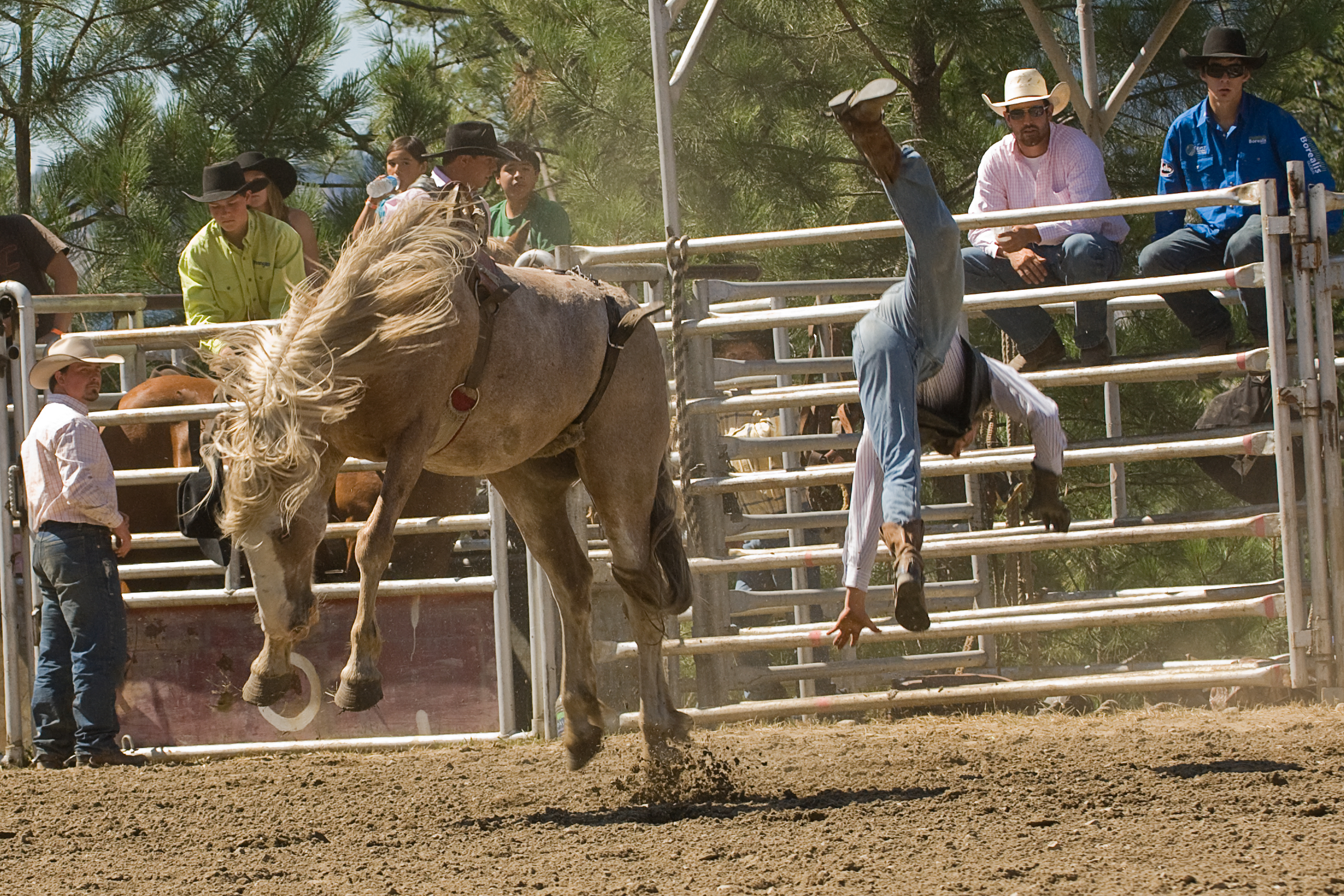
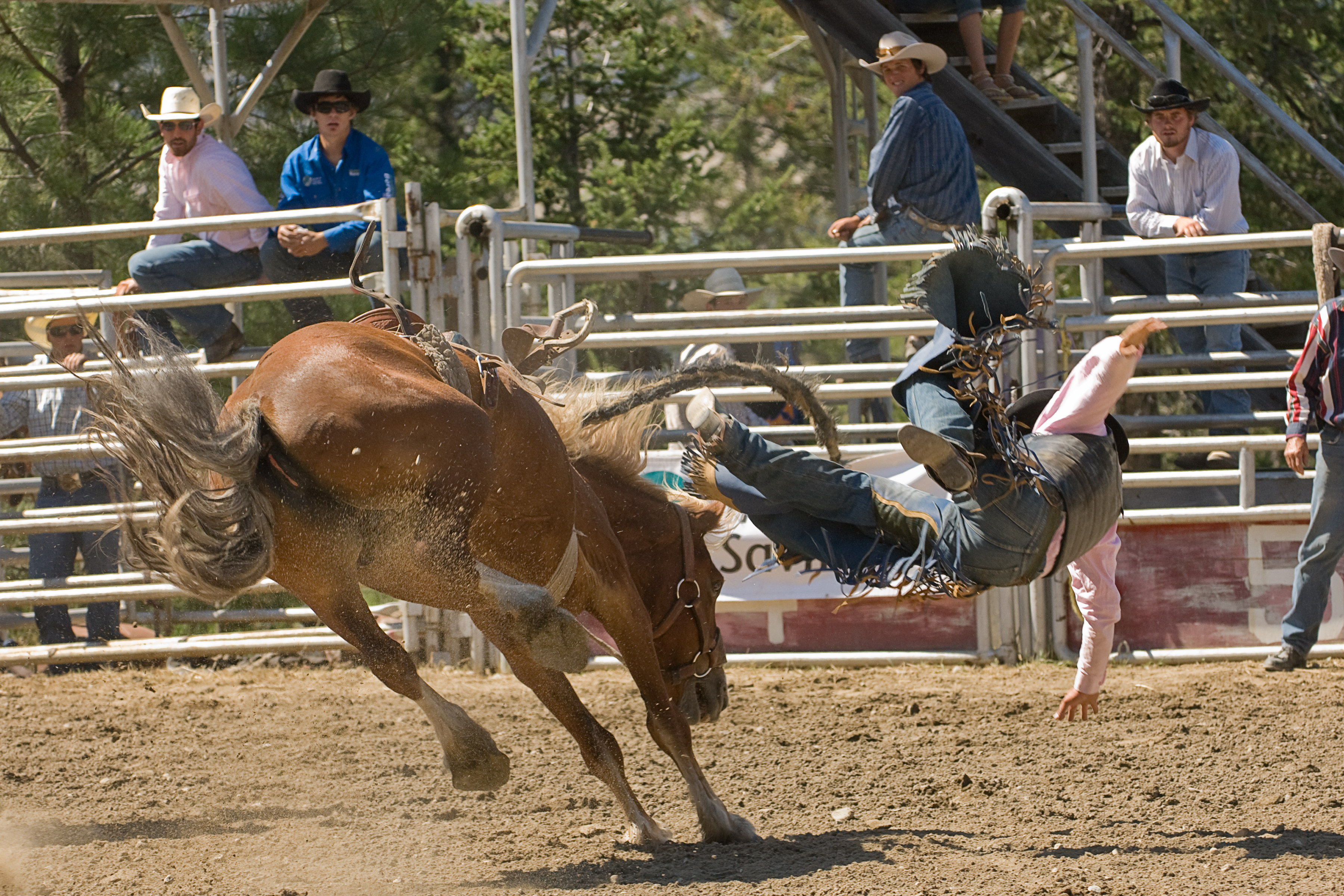
The 17th Annual Pritchard Rodeo was the first I have attended just for the sole purpose of photographing the fast-paced, explosive action, and I thought about the words of professional rodeo photographer Rick Madsen as I walked down the dusty road to the arena, “Each event in a rodeo involves more than one player. It is the interaction between man and animal, or in many cases man and beast, which makes the technical and creative aspects of rodeo photography so exciting and rewarding.”

I was late and the saddle bronc riding had started, but that gave me the opportunity to watch the photographers and I easily figured out who were the first-timers, the dedicated amateurs, and the experienced rodeo photographers. Anytime I am faced with a new photographic adventure I look to those with experience, and don’t mind asking questions if given the chance. I also realized there was time between riders so I would have time to check my metering and get myself in the best position for the action.

It was hot under the midday sun and a bright blue sky with riders starting from a location that was under deep shade, which was fine for them, but I knew that no camera sensor could handle that much contrast; and I knew I would have to make exposures before the participants reached the sunny area, wait, change settings, then start making exposures again when they were in the bright light. I missed the first, and then nailed the rest when I figured out the timing. I quickly learned how important it was to listen to the announcer, not only because he was expressive and fun to listen to, but also because he gave all sorts of important information a photographer could use about the horse and rider.

I am experienced at photographing sporting events, so other than the time it took me to know where to stand for each event, I was ready. My camera was mounted with a 70-210mm lens and I selected shutter priority mode, with 1/500th second shutter speed. The bright day let me get away with ISO200. I also selected the continuous shooting mode so I could get bursts of up to eight frames a second if I wanted.

I photographed from several locations then moved to one end of the arena where five photographers were working. There was a husband and wife team who said they were “just enthusiasts” that liked to photograph rodeos in their spare time. One fellow said photographing rodeos was a hobby, and he had just returned from photographing one in Arizona. I also met a vacationing photographer from France, and while travelling through Kamloops she had heard about the Pritchard rodeo and decided to spend an extra day to photograph the rodeo before continuing south to the Okanagan. We talked about photography and her trip, and, of course, I reminded her about the wonderful BC wineries she would be soon be driving by.

All those people were great to meet and added another dimension to an already great day of photography. Along with them, I met Bernie Hudyma (http://www.berniehudyma.com), an experienced and well-known photographer whose images regularly appear in magazines. In my opinion it doesn’t get much better than that when one is trying to learn about photographing a subject. He gave me tips on where to shoot, and once reminded me I had to take care as a massive bull charged the fence where I was and I quickly pulled back. (Just how heavy are those animals?) Nevertheless, it was a fun day of shooting and I ended up with lots of great photographs.

For those photographers that want to try something new and exciting, I recommend finding a local rodeo. Photographing those explosive moments, as Madsen puts it, “the interaction between man and animal… makes the technical and creative aspects of rodeo photography so exciting and rewarding,” which corresponds to how I found the experience – very exhilarating and satisfying.

http://www.enmanscamera.com