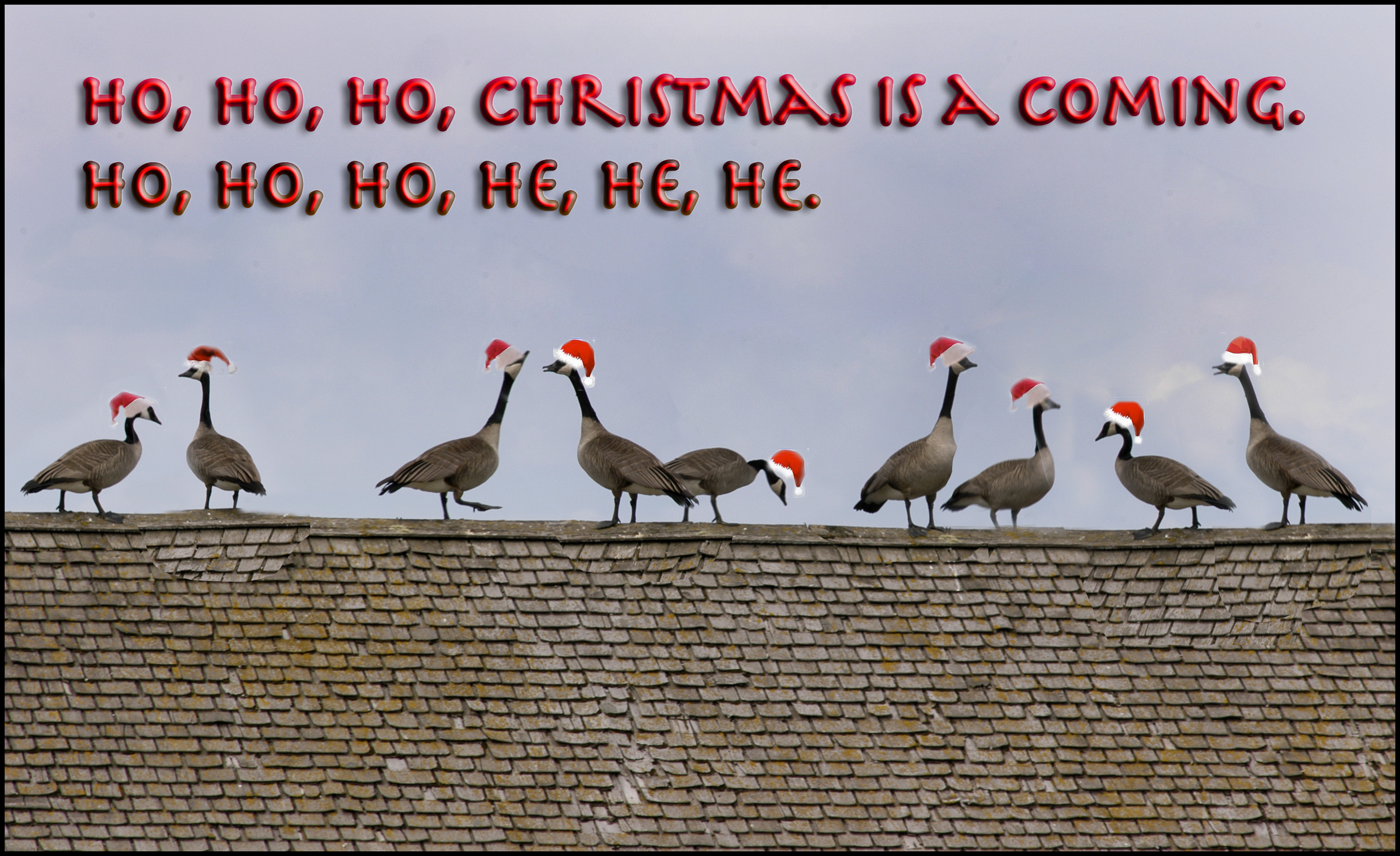
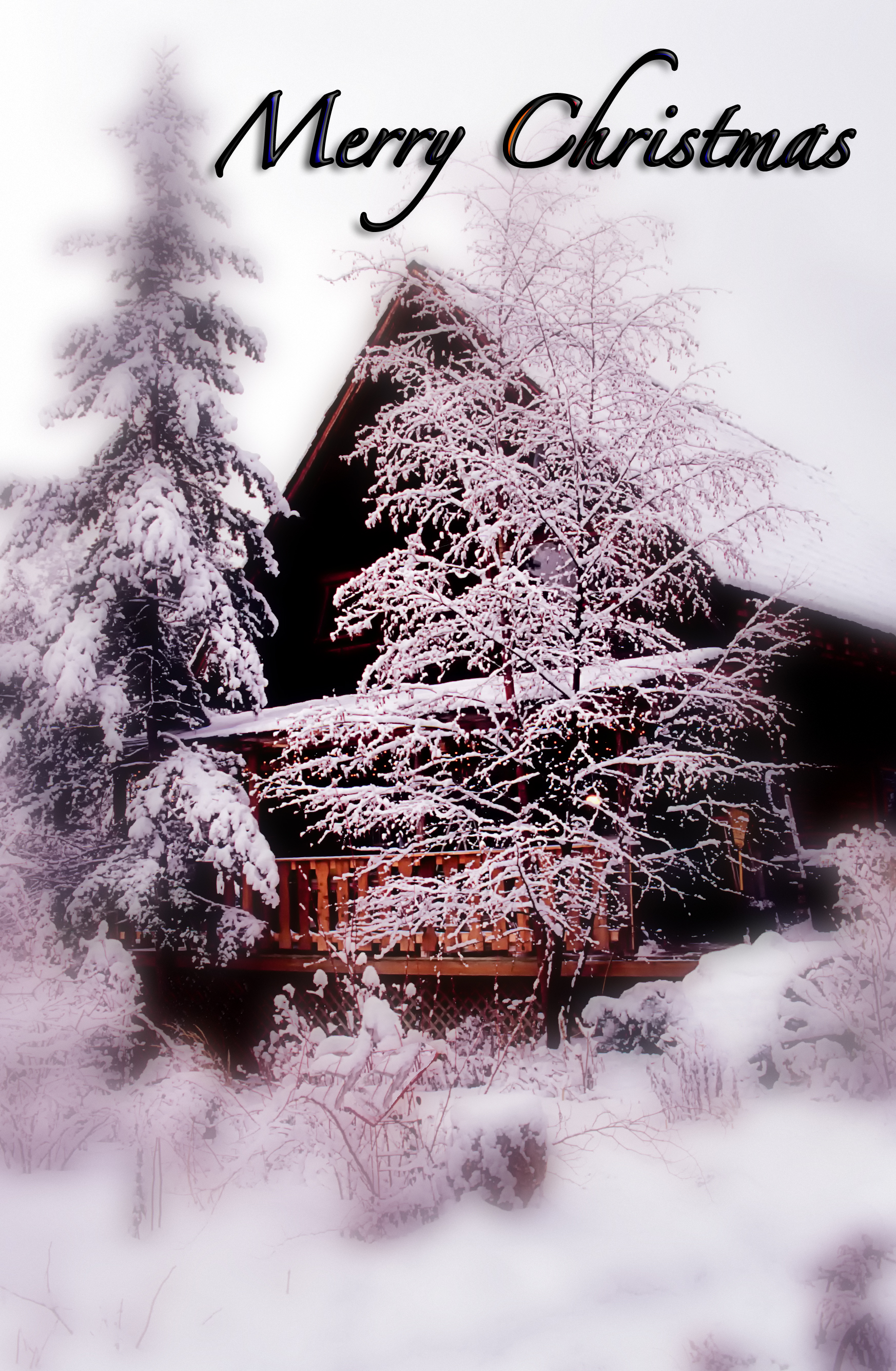


Hey, it’s Christmas Card Time

Television and local stores have begun advertising Christmas again. That was fast. Weren’t those same advertisers just pushing camping and barbecue stuff on us? Don’t get me wrong.  I like Christmas and all the festive celebration that comes with it, but it always sneaks up on me just the same.

This is a great time for photographers that want an excuse to give friends and relatives photographs. I always give photographs this time of year. Sure that could mean framed prints and I have some in mind as gifts, but what I am writing about is Christmas cards.

For those satisfied with mass produced generic Christmas cards, there are stacks and stacks being offered at stores, but for photographers, as I just wrote, it’s a perfect excuse to give people photographs. And personally, I want people to see and enjoy my photography. Even if it’s only as a 5X7 card, that’s better than having my pictures left languishing in some hard-drive.

When my wife and I go to some location with the intention of photography we always return with our memory cards loaded. That’s not much different from any other photographer. Then we return home, delete a bunch, work on some and print one or two, and then store everything in folders on backup hard-drives. For many that’s where it stops. Not for us.

I have written before that my wife and I always make a new monthly calendar. Alternating months. I get December this year. I also make cards for all occasions, like birthday’s, Valentine’s, Mother’s day, etc., from those photography trips.

Right now we are going through our many image files from this year’s photographs selecting those we want for Christmas cards. I prefer a vertical format, but sometimes a horizontal picture also works and I choose that also.

I print up lots of different images and place all sorts of greetings on them. It is rare that we give the same picture to more than one person. And not all the cards say Merry Christmas. To me, it doesn’t matter. Happy Holidays, Seasons greetings, Have fun, A good New Year, and anything else I think fits a particular picture. Sometimes I use bits of songs or quotes I have found instead of the words, Merry Christmas.

What matters is the picture and even that might be a manipulation of the original. What is important to me is that those I give a card to get something unique. And I will say that, unlike a framed print, I really don’t care what they do with the card I sent. I really hope people like what I give them, of course. However, if it gets thrown out with the gift-wrap after the holidays it doesn’t matter either, they got to see a photograph taken by my wife, Linda, or myself, and that’s what’s important.

So, to all the photographer’s out there I’ll say make your own cards this year. I print our cards on a sheet of 8×10 photo paper, fold it so we can write inside, and then cut it to fit inside an envelope. However, it’s easy to make a card gluing a photo to card stock or construction paper, or get a print made and write something festive on the back.  This weekend I’m booked to photograph two young female friends and their horses, and I know they will use their photographs for their Christmas greetings.

My point is, stop hiding all those great photographs. Just showing some picture on your iphone isn’t enough. Print it, make a card, put it in an envelope, and send it to friends and relative this year.  And if you realize on Christmas day that you’ve missed someone (or everyone) you can send your Christmas photo card electronically and instantly.

 I appreciate your comments and be sure to click “like”

My website is at www.enmanscamera.com
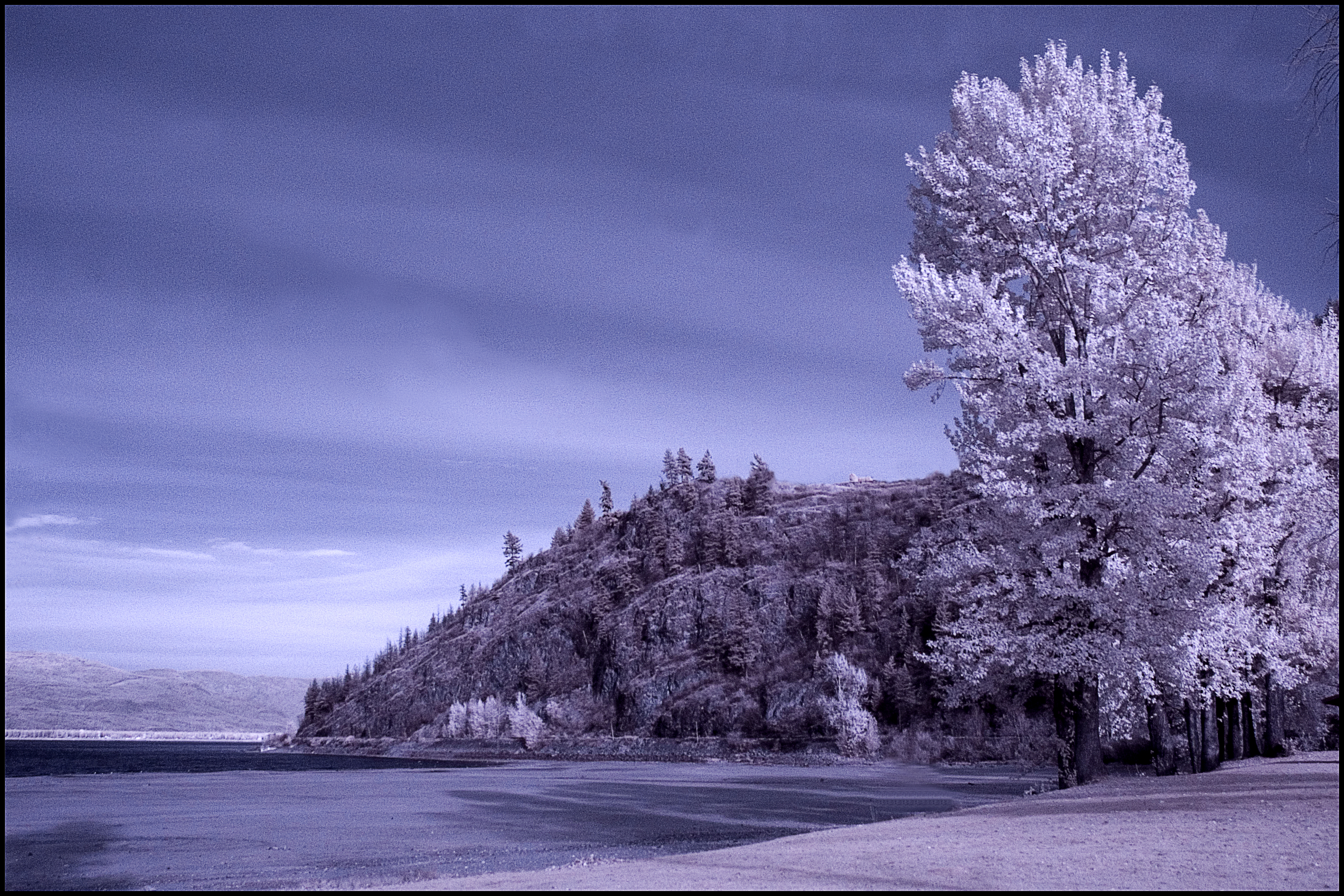
The Dog Days of Summer are Perfect for Infrared Photography


For several days I have been listening to fellow photographers complain about the hot, bright days here in the interior of British Columbia. When they stop by my shop I welcome them with the question “ What have you been out photographing?”  But mostly I have been hearing “Naw, I haven’t been doing anything. It’s too hot, muggy, and the light is crappy anyway. I can’t wait till September.”  Well, I must agree that my personal photography also stagnated during these dog days of summer.  I prefer summer’s end, fall colours and I suppose, the cooler weather.

I had already spent a day doing stuff inside so when my wife mentioned that she wouldn’t mind a quick trip to the grocery store, so I grabbed a DSLR I had converted for infrared and we headed out. The closest town to our place is the small lakeside community of Chase, British Columbia. I like to drive the backroads when I go there and I thought the lake and bright sky would be perfect for a camera that only sees infrared light, plus I knew it would be nice and cool by the lake.

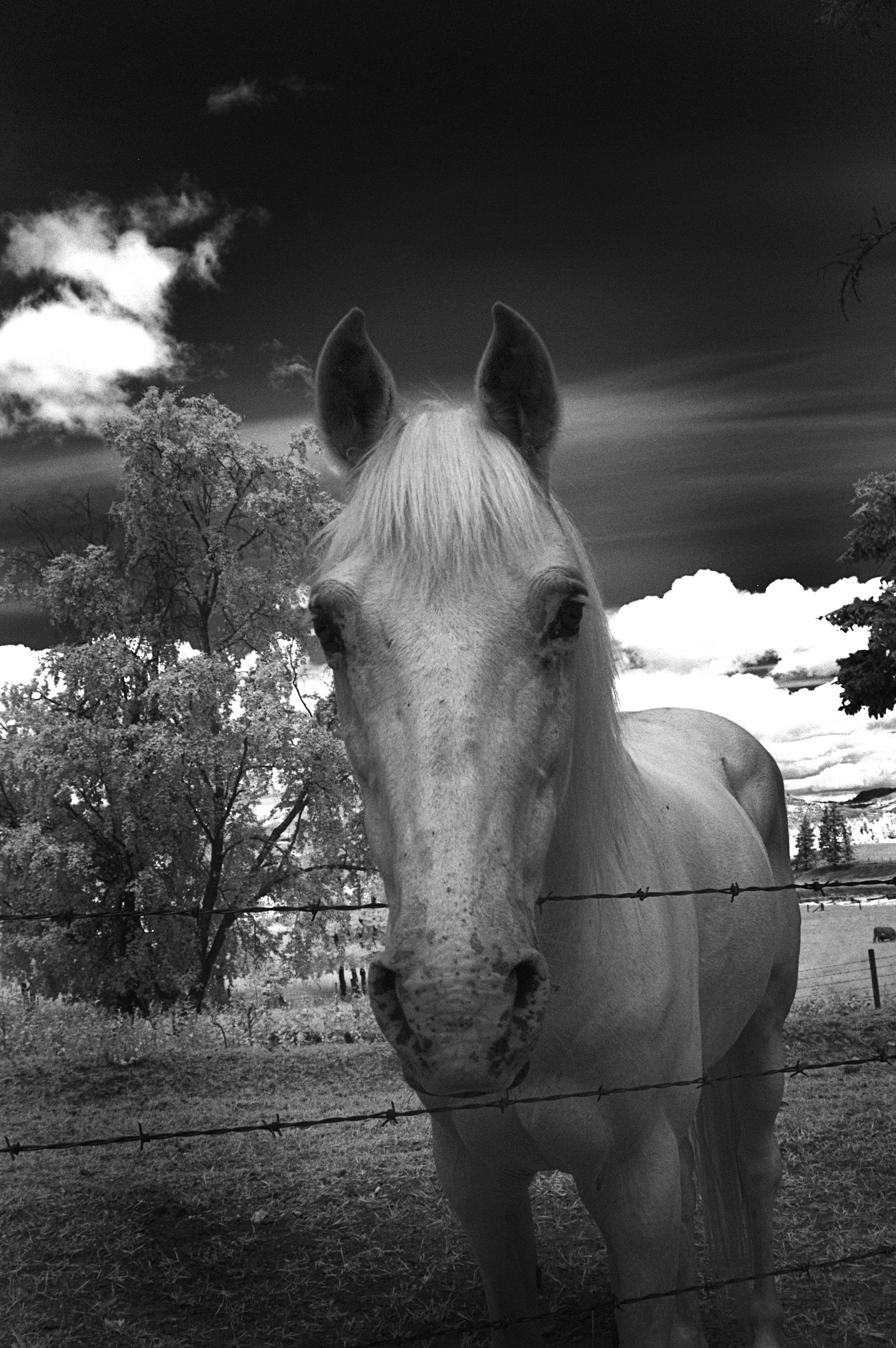
I have a camera that has been modified to only see infrared light and in my experience those harsh bright summer days are perfect for infrared image making. Infrared (IR) light is light that has longer wavelengths on the red edge of the spectrum and is invisible to human eyes.

Here is some trivia: In 1800 William Hershel described the relationship between heat and light and let the world know about his discovery of the existence of infrared light in the electromagnetic spectrum.

The sensors for digital cameras are sensitive to more than just the visible light spectrum. This causes problems with colour balance, so camera manufacturers place a filter in front of the sensor that blocks the infrared part of the spectrum that only allows visible light, and not infrared, to pass through.

The modification is accomplished by removing that filter, and then installing one instead that blocks visible light, allowing mostly infrared light to reach the camera’s sensor.

The camera still functions normally, with full auto focus and auto exposure, except that it’s now able to record the infrared wavelengths that are just beyond what the human eye is capable of seeing.  When infrared photographs are produced as black and white the photographs show trees with glowing white leaves and black skies opening up new visual opportunities for photographing the world around us.

Many think of infrared photography as the stuff of military night reconnaissance, or, as frequently portrayed in movies, as aerial thermal imaging that finds the bad guys. With thermal imaging one sees the heat the subject is producing, however, infrared as photographers use it, with our modified cameras is about capturing the light or radiation that is reflected off a subject and doesn’t involve thermal imaging at all.

I  wander around, and photograph pretty much anything, choosing different angles to see how the light would react. Some subjects don’t work very well with infrared, so I just experiment, take lots of pictures and hope for the best. Everything appears normal through the camera’s viewfinder and because so much light reaches the sensor on a sunny day one can use high shutter speeds and so it is easy to hand hold while exposing a picture.

I like infrared photography and have made prints from infrared film since the beginning of my career in photography, when infrared film had to be loaded and unloaded in complete darkness, and because dark red filters had to be used on the lens subjects were very hard to see through the viewfinder. When digital cameras were introduced all this changed.

For those interested, there is lots of information to be found on the internet. IR photography opens up a new visual dimension for the photographer willing to dust off that old DSLR and get it converted to an infrared camera.

Visit my website   at www.enmanscamera.com

Photographers that have pets have something special.

In my opinion photographers that have pets have something special. I’m not just writing about the companionship, or the devotion one receives.  That relationship is special and important, however, what I am referring to is that pets are perfect models for our portrait photography.

Photographers point their cameras at just about everything in their lives. Spouses and children patiently put up with constantly having their picture being taken, but eventually even they need to go on about their lives without being constantly photographed, and when that happens, if you are like me, you go looking for the family pet.

Got a new camera or lens? Want to try out that studio lighting technique? Or just bored and want someone ever ready and able to pose for a photograph? Call the dog, or coax the cat. I can’t even begin to count the pictures I have taken of the horses, dogs, cats, parakeets, hamsters, chickens, fish, and frogs I have taken in my life.

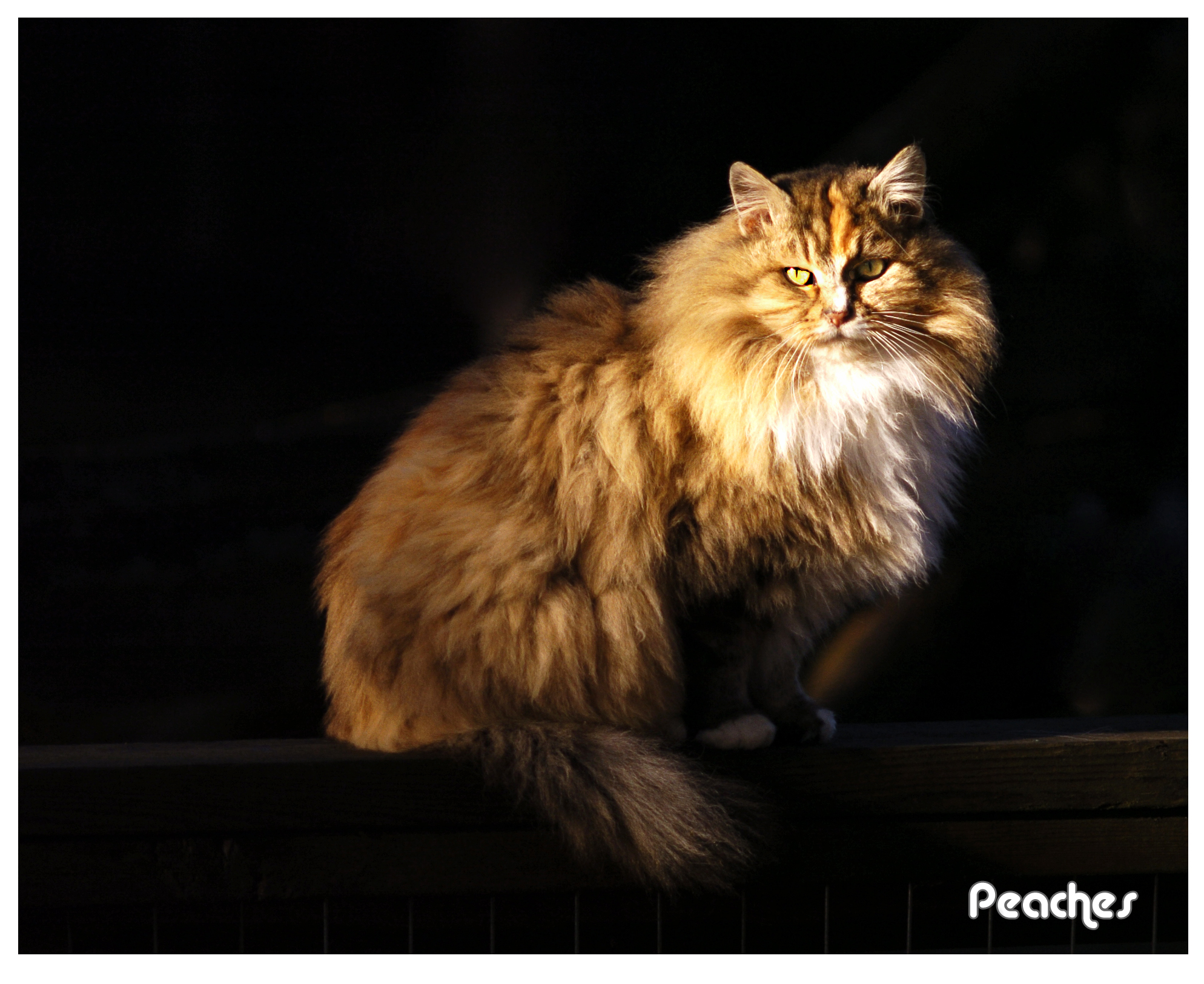
Those pets never complained when the pictures didn’t work out and even waited for another blast of the flash without blinking.  I admit the goldfish aren’t very good posers, and Chuck, the rooster that guards the hens, doesn’t seem too interested in standing still for his portrait, but Peaches, the cat, seems more than ok with posing for long periods of time.

Peaches became a resident years ago in the barn, as cats do from time to time. I have no idea her origin, or how old she is, but after a bad run-in with either a wandering coyote or the neighbor’s dog and the follow up convalescence in our home, she somehow moved from the barn to sleeping on my wife’s lap.

The name Peaches came from when I was feeding three strays one winter. My wife asked me what their names were, but, heck, I just didn’t want them starving in the cold weather and hadn’t bonded enough to exchange names. I explained, “ the black one is named Furry, the spotted one is Furry, and the yellow one is called Furry”.  Linda named them Furry, Trixie, and Peaches, respectively. So after Furry got old and died, and Trixie was adopted by a neighbor down the road, Peaches came inside for first aid, a warm place to live, and has become a constant object of my photography.

I will admit that cats are great posers. They will sit without moving for long periods of time, giving photographers lots of time to test out lenses, learn flash techniques, and get creative with a camera. Peaches ignores me most of the time, except when she wants food. So I can take all the pictures I want pretty much any time without any interference. She just sits and waits.

I have never been one of those picture takers that take cute or silly pictures of the animals with which I share my home. I like portraits, so my pet photographs are usually planned and not much different than a formal portraiture of a person. Actually, that cat is a lot easier than most people because she just sits motionless staring at some spot in space for long periods of time. Other than sleeping and eating, Peaches the cat doesn’t seem to think much else matters, thus she is the perfect poser.

“One day Alice came to a fork in the road and saw a Cheshire cat in a tree. Which road do I take? she asked. Where do you want to go? was his response. I don’t know, Alice answered. Then, said the cat, it doesn’t matter.”  That quote from “Alice in Wonderland” by Lewis Carroll reminds me of my cat, Peaches.

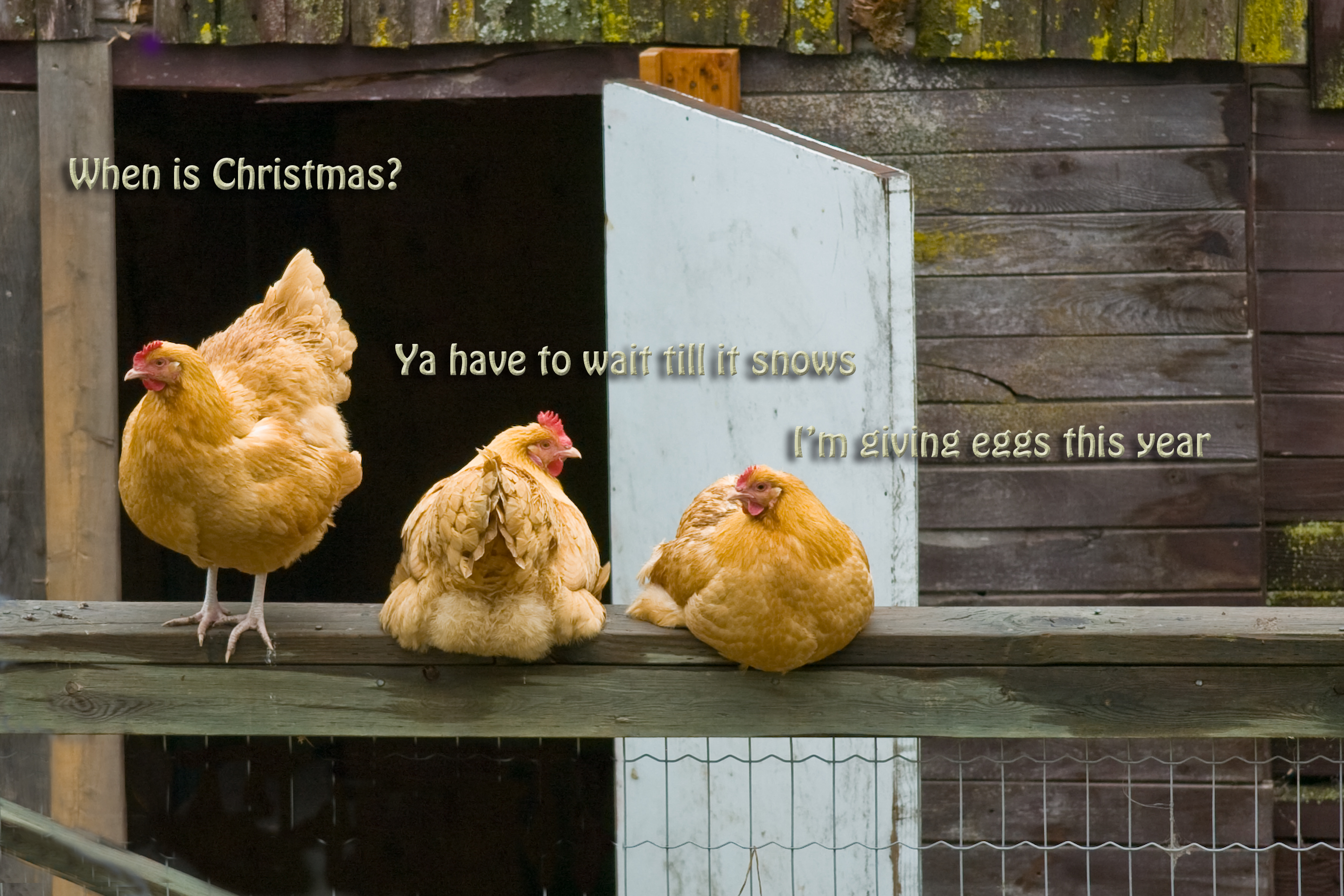
I am not suggesting that photographers should rush out and adopt a cat or any other pet only because they need a model, but if one already inhabits the home then put them to work as an artist’s model. And if any of the pictures are good, then add some words like Merry Christmas or Happy Birthday in PhotoShop and make some cards for your friends and relatives.

Don’t forget to press the “Follow button” . and I am also at www.enmanscamera.com

Photographers – Don’t just add light, modify the light.

For some time I’ve been advising photographers to use a flash when they take pictures of people, whether indoors or out. Yes, I understand that those with a few extra dollars in their pocket can purchase expensive cameras that can capture images in low light using a higher ISO, but using additional light is much more flattering.

While sitting by the window in a coffee shop last week a friend casually snapped a picture of me using an ISO of 9000. I was impressed at the clarity and colour. Hmm… maybe a bit too clear and colourful for my old face.  Nevertheless, my comment was, “Nice picture, too bad you didn’t have a reflector”, which brings me to my topic this week – light modifiers.

Readers know what harsh sunlight looks like on our subject’s face in a photo, or winced at the loss of detail caused by the direct light of a camera-mounted flash.  A flattering photograph isn’t just capturing or adding light, but modifying its path to the subject. That might be as simple as bouncing the flash off the ceiling, or a wall. The pop-up flash might work at parties, but mounting a flash on the camera gives more power, control and pleasing results.

When outdoors without a flash a popular and easy to use light modifier is a reflector. Place the subject out of the direct sun and direct the sun in a controlled way back to the subject using a reflector. Reflectors come in all sizes, shapes, colours and surfaces. Silver is a cool, gold has a warm cast, and white is neutral. I prefer the compact folding reflectors that fit in my camera bag. Reflectors are great outdoors, and are perfect with a bounce flash for that multi-use basement studio.

More and more photographers are using wireless flash. A small hotshoe flash mounted on a stand can be aimed at the ceiling, a wall, or a reflector, for much nicer light than if pointed directly at the subject.  But the wall, ceiling, and reflector only give a broad indirect light. Yes, it is better than a bare flash, but not very controllable.

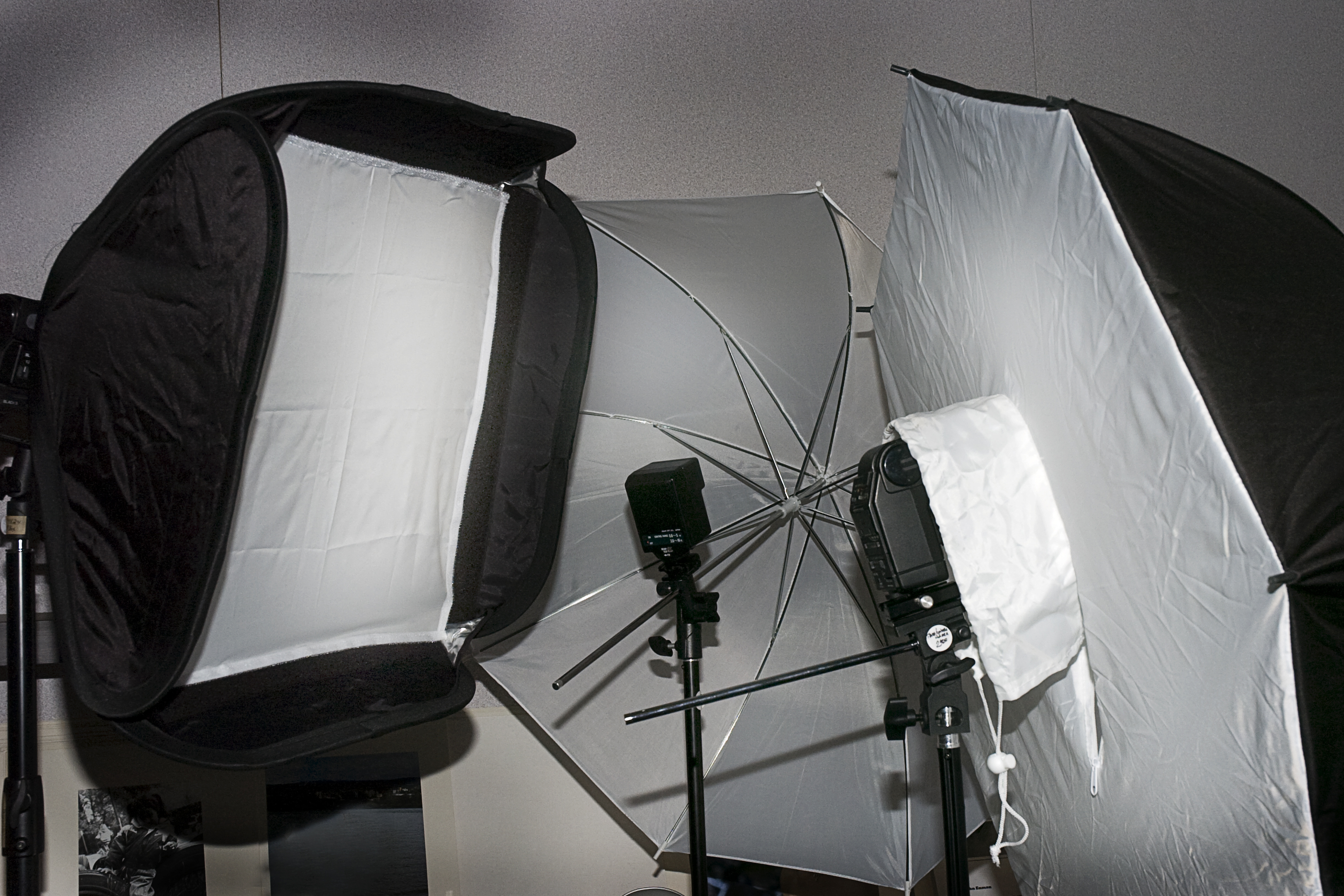
Enter umbrellas, softboxes, beauty dishes, and all sorts of contraptions that modify and control the light.  I like bouncing and reflecting light in some conditions, and these give photographers more control as they reshape, restyle, alter, modify, direct, and soften the light from our little flashes.

Umbrellas come in several types. Choose a shoot through or reflective, large or small. The reflective umbrellas are available with different surfaces – silver, gold, white – each has its own way of changing the light. For example, I like the soft broad light reflective umbrellas give when photographing several people or families.

Many portraitists seem to prefer softboxes. Whereas umbrellas give more control than a flat reflector, a softbox directs and controls light much better than an umbrella. Softboxes also come in many sizes and shapes depending on use – rectangle, square, octagon, etc.  When viewers see that soft shadowed “Rembrandt style” lighting in a portrait, they can safely assume the photographer used a softbox.

For photographers that want more luminosity than umbrellas and softboxes there is the beauty dish. A beauty dish provides a glowing kind of light, very directional, easy to control, and when used with diffuser it has an attractive smooth light.  There are, of course, many modifications to each of those I have mentioned. Again, it depends on how a photographer wants to apply light to a subject.

My set up isn’t always the same. For example, the flash above and behind me might be either in a softbox or a reflector umbrella, the sidelight could be a small shoot-through umbrella or bounced off a reflector, and backlight directed at the background with only a small dome diffuser covering it.  That’s one quick, effortless setup that I can easily carry in two small bags – one bag for light stands and light modifiers and one for the flash units and my camera. The point is that the light I use is more controllable and attractive than a pop up flash, the sun, or relying on a high ISO.

www.enmanscamera.com

 Select the follow button at page top. Thanks


Planning a Photography Excursion to the tulip festival.


Now that the February blahs are over, and March has come and gone bringing warmer days (regular readers know how I feel about March, “Ides of March. 15 March 2012”), I am thinking about planning a spring photography excursion.  I am hoping the weather will be cooperative as I don’t enjoy photography in the rain, and don’t want to get my camera equipment wet.  I think I should include some protective rain gear in the event of bad weather.

I would like to go on spring excursion heading west and south and that should give me the best opportunity for photography that will not include snow or cold temperatures.  I want to go somewhere along the coast I think, as spring comes earlier along the west coast and I should have my choice of flowers, landscapes, or any possible wildlife.  A friend phoned last night from Vancouver saying there was green grass, and flowers, and the temperature was 12 degrees, and expected to get warmer.

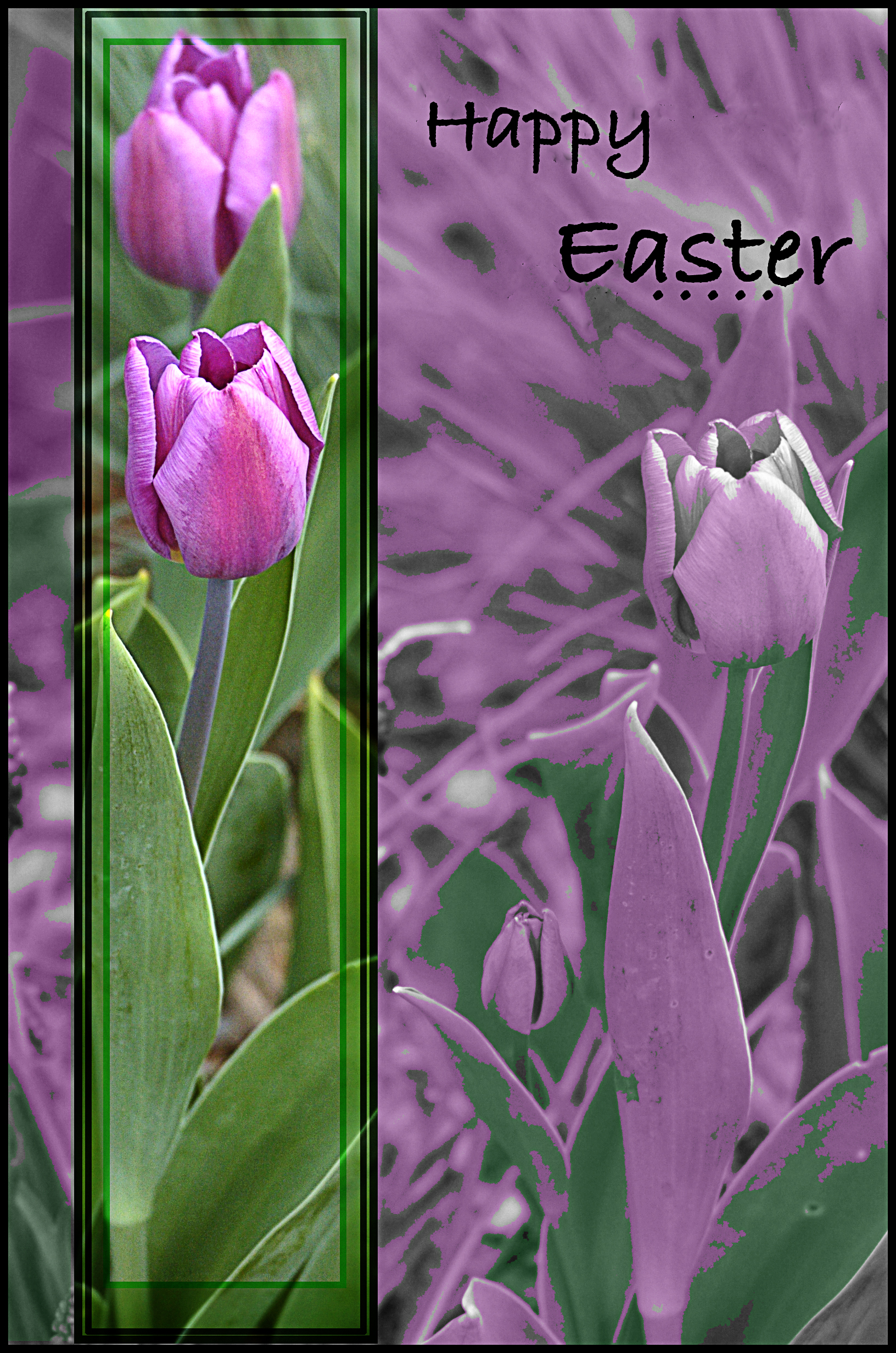
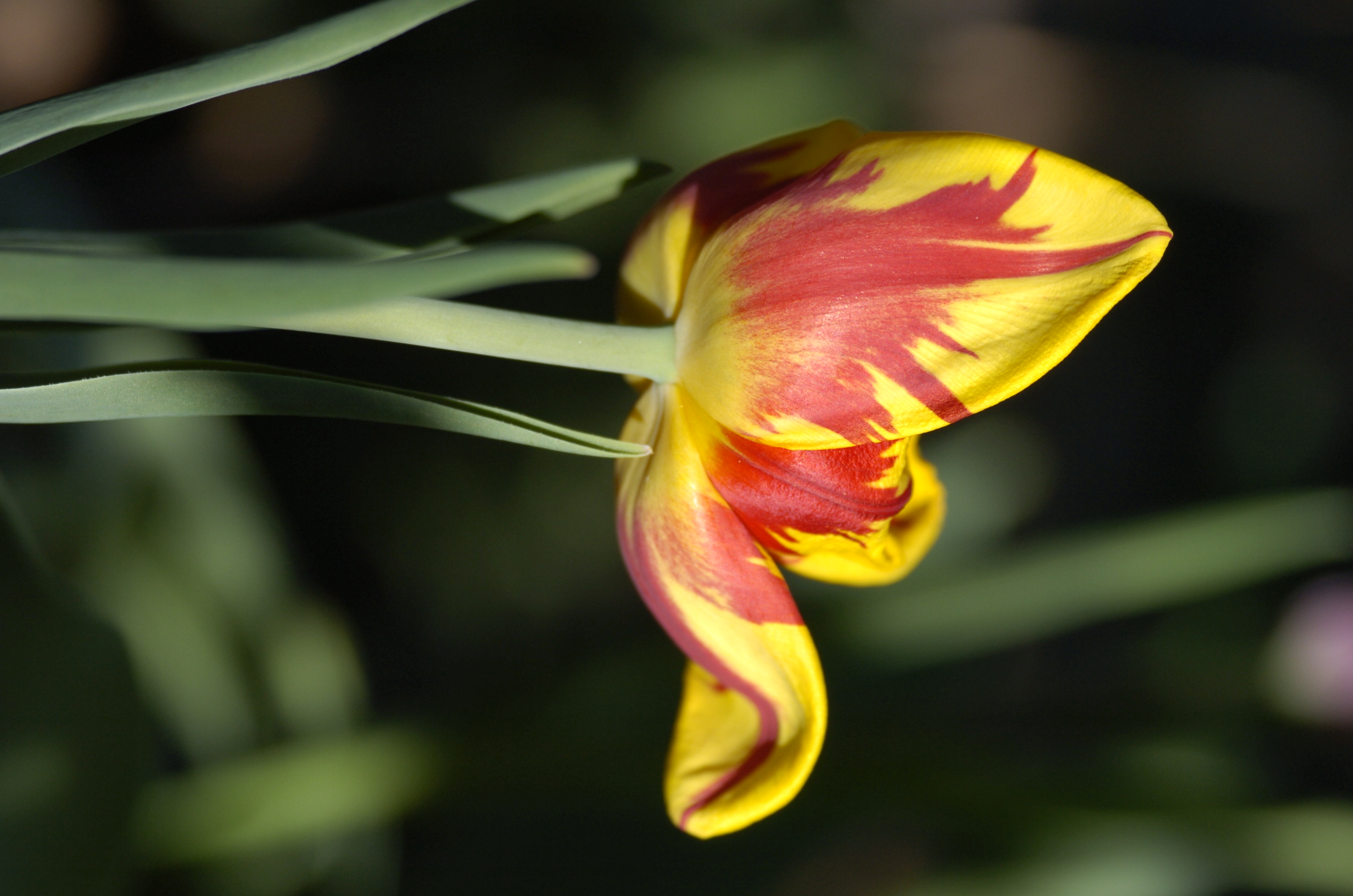
I just received an email reminding me of the spectacular blooming events along Washington State’s northern coast.  I could attend the 29th Annual Skagit Valley Tulip Festival from the 1st to 30th of April.  I know I could link up with other photographers going there from BC, or I could just head to LaConner or some other town on the coast of Washington, find a place to sleep, and join the festivities.  I am not so much a flower person, but like so many other subjects I photograph, I think multicolored fields of tulips would be an interesting photographic challenge. Choices ranging from extreme close-ups to landscapes would be just plain fun.

I don’t tent or RV so I will start browsing the internet for reasonable lodging. I have found fun places to stay in the past by checking out lodging websites, however, I have also ended up by chance in neat places just by going where I want to be and looking around.

If this brings up the question, “Have you ever had bad luck finding a place without advance reservations?”  Oh, yes!  I remember pulling our tiny Suzuki Sidekick off the highway at a roadside rest stop late at night because every hotel and motel was full.  My wife, Linda, and I tried unsuccessfully to spend the night sleeping in that cramped car. Morning came early (4am) and because nothing in the nearby small town was open we drove off tired and hungry. We finally ended up gobbling donuts and coffee hours later at a Tim Horton’s, then later collapsed on a sandy beach beside a lake and slept much of the day away.  Oh well, we will never forget that excursion!

I like to plan and organize such events to include preparing the vehicle, so when the time comes I will ensure the car is tuned up, and the winter tires are changed.  I like lists because I always forget stuff, and so I’ll begin making several brightly colored checklists of the items I will bring, and then I will start looking forward to the photography excursion, and have fun just thinking about the pictures I want to take.

That brings up the best part of planning.  What camera equipment do I bring?  I could bring every lens and camera I have, but that’s just silly as I wouldn’t have any room for a change of clothes.  Too much of the time I over pack my camera gear and end up stashing equipment in the car because it isn’t being used, so I will make an effort to minimize this year.

I don’t like to venture very far with only one camera, so I always carry a backup camera.  Cameras can malfunction and I don’t want to take the chance of reaching my distant destination and not being able to do the photography I went there to do.

Next on the list are the lenses I think I’ll need.  If I attend the tulip festival I’ll need a macro lens for close-up photography and a wide-angle lens for those colourful, flowered landscapes. There will be other opportunities and I’ll bring my 70-200mm and for wide low light opportunities will include a 24-70mm f2.8.  And very important, I will pack lots of memory cards.  By now the camera pack is getting full. That’s three lenses, two camera bodies, and I haven’t yet included my infrared camera that I think I’ll also bring. Oops, there is also my wife’s camera gear. Add her camera, macro lens, and favorite zoom lens, a 70-300mm.

Of course we will take our tripods, that’s a given.  Ahh, the decisions we must make. I just think it is so much fun.  The planning and anticipation of any photographic excursion is as much fun as the actual trip.  Whether I make it to the Washington coast or have to pull back my plans and stay closer to home, I will soon be venturing out camera in hand.

www.enmanscamera.com


Digital Camera Terminology for photographers

A customer walked into my shop last week complaining.  She said, “ My camera isn’t working.  I think there is something wrong with the chip.”  I thought at first that the camera’s main computer wasn’t working and then I realized she was talking about her camera’s memory card, or the small picture storage hard-drive we insert in the camera.  Digital technology  confronts photographers with new terminology. I have written about terminology (or jargon)  in the past, but for those new to this the following may help to understand just what some of the words mean.

Digital Images:  The digital image is a grid of dots or picture elements (pixels). Each pixel is assigned tonal values (black, white, shades of gray, and color), the bits are then interpreted, read by the computer, and produced as an analog version for display or printing. 

Pixel: Picture Element: Digital photographs are comprised of thousands, or millions of them; they are the building blocks of a digital photo (see above).

Sensors: When a picture is taken, the sensor is struck by light coming through the camera’s lens. Each of the tiny pixels that make up the sensor converts this light into electrons. The number of electrons, usually described as the pixel’s accumulated charge, is measured and then converted to a digital value.   There are two most popular types:  CCD: Charge Coupled Device; and CMOS: Complementary Metal-Oxide Semiconductor.

White Balance:  Is a function on the digital camera. It refers to the relative intensity of colors in your image. Without correction, a picture taken at sunset can seem too yellow or orange and a picture taken under fluorescent lights might seem too green. Some cameras come with built-in automatic white balance correction.

DPIDots Per Inch is a measurement of the resolution of a digital photo or digital device. When printing, the higher the number the greater the print quality.

Image Resolution:  Is the number of pixels in a digital photo and that affects the image quality.                                                                         

LCD: Liquid Crystal Display: A low-power monitor often used on a digital camera to display settings or the photo itself.                                                                                                             

Histogram: A graphic representation available on the LCD, of the range of tones from dark to light in a photo.                                                                                                                            

ISO: International Standards Organization is a rating describing the sensitivity of the cameras sensor to light. Generally, as ISO speed climbs, image quality drops.                                                                                                         

JPEG:  A standard for compressing image data developed by the Joint Photographic Experts Group. It is referred to as a lossy format, which means some quality is lost in achieving JPEG’s high compression rates. Usually, if a high-quality, low-compression JPEG setting is chosen on a digital camera, the loss of quality is not detectable to the eye.                                                

RAW:  Is the image format data as it comes directly off the sensor, with no in-camera processing.                       

Megabyte (MB):  A measurement of data storage equal to 1024 kilobytes (KB).                                                         

Mega Pixel:  Equal to one million pixels.                                                                                                         

Noise:  Pixels in your digital image that were misinterpreted, usually at the higher ISO values. It appears as random groups of red, green or blue pixels.

Shutter Lag:  The time between pressing the shutter and actually capturing the image.  This is due to the camera having to calculate the exposure, set the white balance, and focus the lens. It is usually a problem with small point and shoot cameras.

www.enmanscamera.com


Photographing competitive events

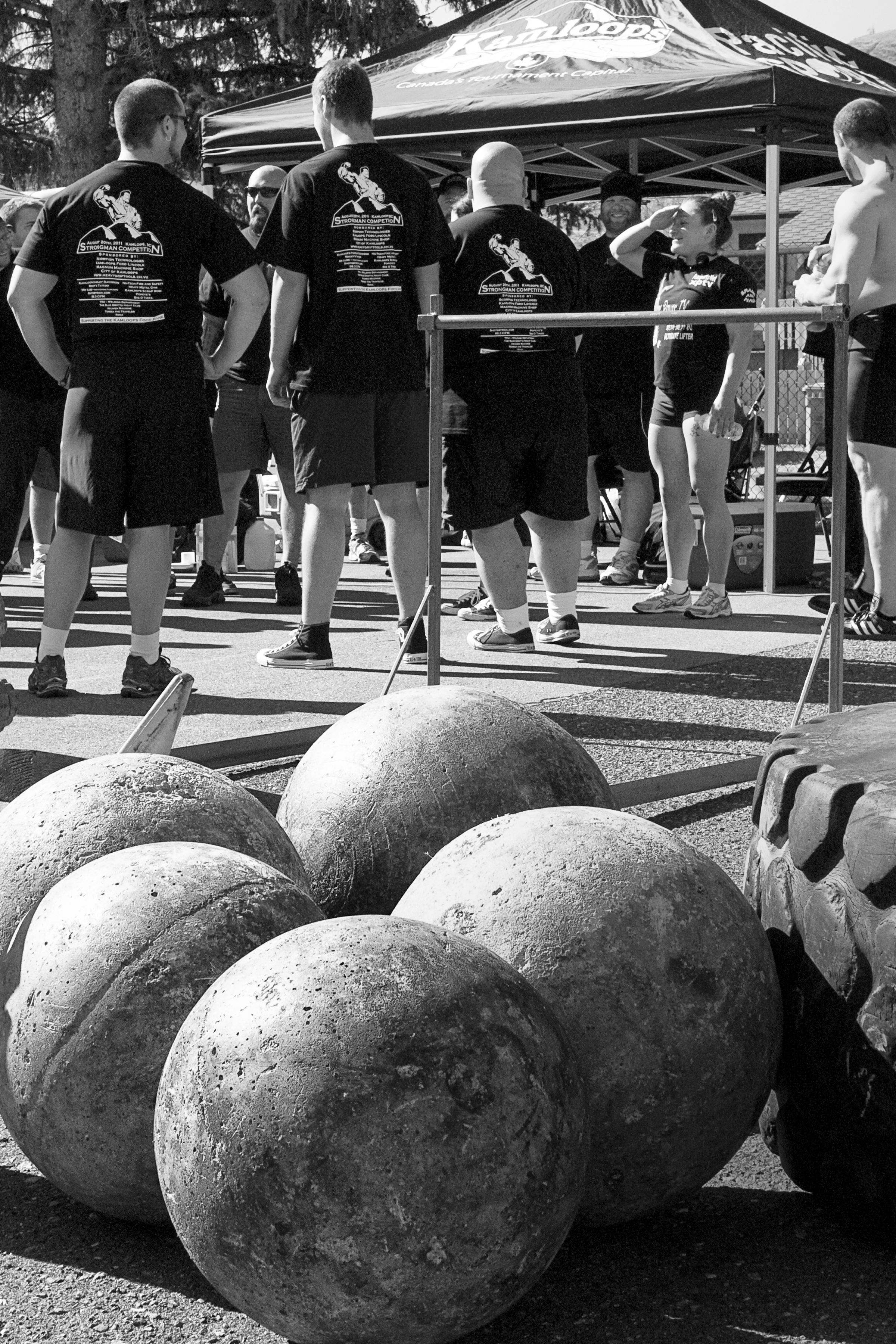
On August 20th I was one of the photographers hired to produce images from this year’s BC 2011 Strongest Man Competition held at McDonald Park in Kamloops.

The day was hot and sunny with a clear blue sky, conditions that made it uncomfortable for the weight lifters and difficult for the photographers. For the athletes I think the heat made the competition more challenging, and for me the sharp contrast between subject and background on such a bright day meant camera metering changed constantly. Selecting Auto program modes would have drastically reduced the number of keepers under those quickly changing conditions, and as it was I constantly altering my settings depending on whether the contestants were facing the sun or not. Sun and shadows on moving subjects can be a problem and photographers have to pay attention, otherwise they will end up with both over-exposed and under-exposed images of their subjects depending on the action. My technical advice in this case would be to select the Manual mode, staying away from Auto Program modes, and keep checking the camera’s histogram, and to be prepared to use a flash when needed. The Manual mode allows one to meter for what is important, for example, a participants face in shadow (or in the bright light just seconds later). Then the histogram can be quickly checked to make sure that the exposure is what the photographer wants.

I know organizers for these types of sporting events always give photographers wide latitude and leave what is to be photographed almost entirely up to the photographers. For newcomers this might bring an immediate response of relief with thoughts that all they need to do is wander around happily snapping candids as they please, however, that is far from the truth. Organizers usually don’t put into words what they want, and trust that their photographers know what to photograph and will deliver usable images, but some random candid photographs that do not tell a story are not what they want, otherwise a photographer wouldn’t be included in their budget.

I am sure that the images of most value to clients will be the ones that aren’t just a document of a guy lifting some heavy weight, and I try to find camera angles that tell a bit of a story, and, hopefully, can stand alone if needed in some future advertisement. My opinion is that photographers need to work hard on this project, to think about their subjects, and be creative as they search for the decisive moment when everything comes together.

In this kind of work it is more than wandering the park with a camera, and creating a photograph that is strong enough to stand on it’s own goes beyond just being a picture filled with nice colors, as it needs to provide the viewers with information that they can make into a story. I think a good photograph is one that makes us have a connection with, or to think about, the subject.

An event photographer’s first goal is to successfully document everything important that happens. The second is to compile enough images to be a narrative of the occasion, then third and lastly, and maybe most importantly, to create photographs that by themselves tell individual stories of those that attended or are the main focus of the function.

I was there the entire day and enjoyed photographing that competition and liked the opportunities to make many excellent photographs of the many participants that I am sure everyone involved will appreciate and be able to use. I came home tired and a little rosy from too much sun, but overall it was a most enjoyable way to spend a Saturday, and by the time the day was over my memory card was just about full.

http://www.enmanscamera.com