Photographing the Washington Palouse

White tower  Dunes 2 Dunes 1  Farm truck Truck  Palouse falls 3 Palouse falls 1  Palouse falls 2

Here’s the situation.  It is 3:00 am and the motel was buzzing with photographers packing camera bags and tripods in vehicles. Even in my tired fog caused by the long, eight-hour drive the day before, and a late evening talking with photographer Andrew Wozniaka till midnight.  I identified at least three other groups from the one I was with heading off for the Steptoe Butte overlook to wait for sunrise to photograph the patterns on the picturesque dunes of the Palouse.

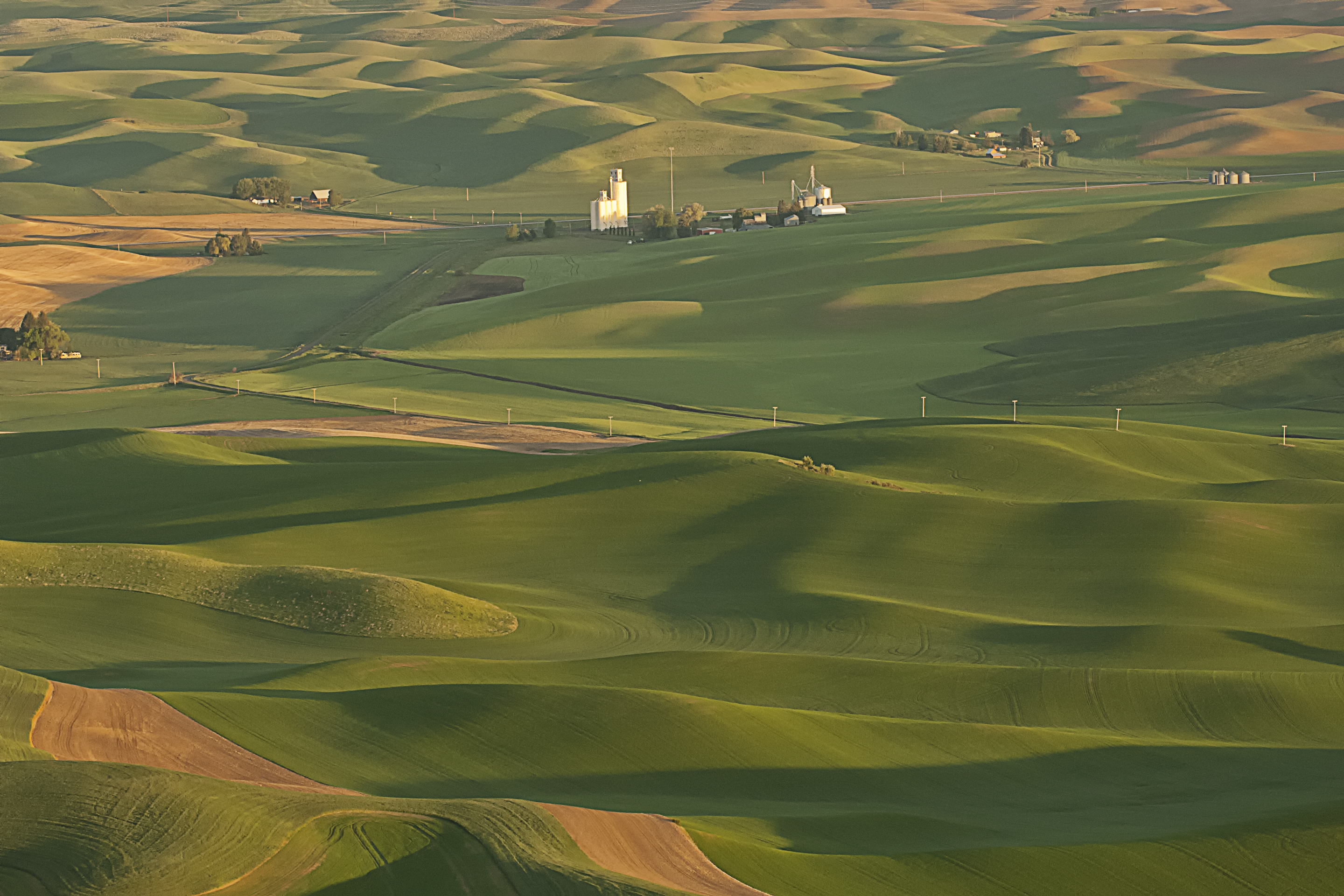
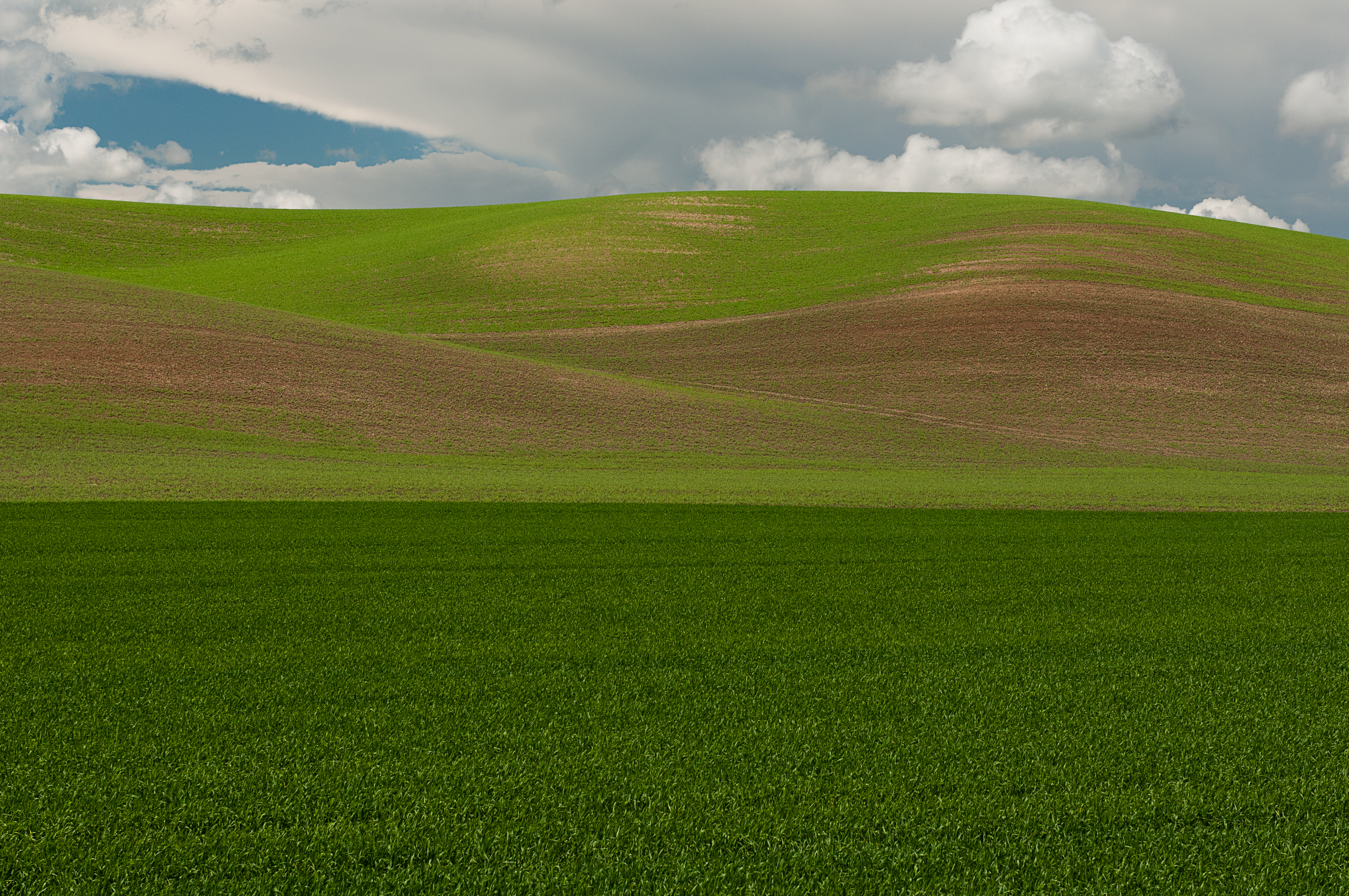
Located south of Spokane, Washington, the Palouse (pe-looss) region of northwestern United States encompasses parts of southeastern Washington, north central Idaho and extends south into northeastern Oregon.  The peculiar and picturesque dunes, which characterize the Palouse prairie formed during the ice age by soil blown in from the glacial outwash plains to the west and south, the Palouse hills are now mostly actively farmed random humps and hollows.

I had joined four others for an Aaron Reed photography workshop, “The Palouse – Exposure Northwest”.  One could just visit the Palouse and wander around without an organized group, but having a leader that knows the area extremely well, if nothing else, will save time wandering from site to site.

Our excursion began early in the morning with a drive to Steptoe butte. Other photographers that had traveled there from all over North America joined us and some even came there from other parts of the world, although I am sure I was the only Canadian on that morning.

There were toe-to-toe tripods waiting for the sun to work its way across the manicured rolling dunes of the Palouse. As the sun rose a colourful landscape was illuminated, shutters were released, and the excitement began. It took me a while to really look into the landscape and isolate patterns. I am used to photographing landscapes that include mountains, trees, lakes and rivers from my part of the world, and it took me a while to watch and see just the patterns of the undulating landscape.

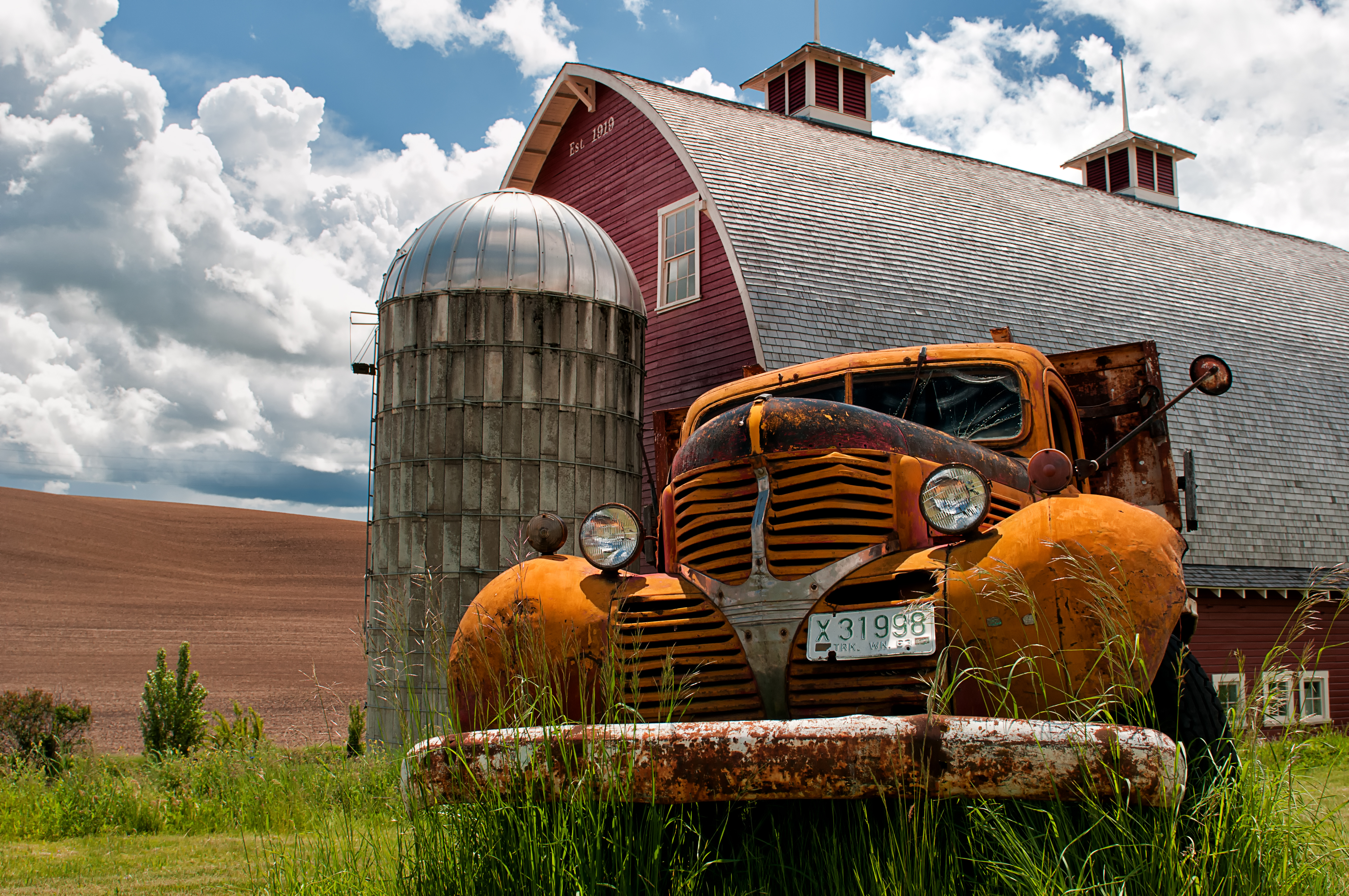
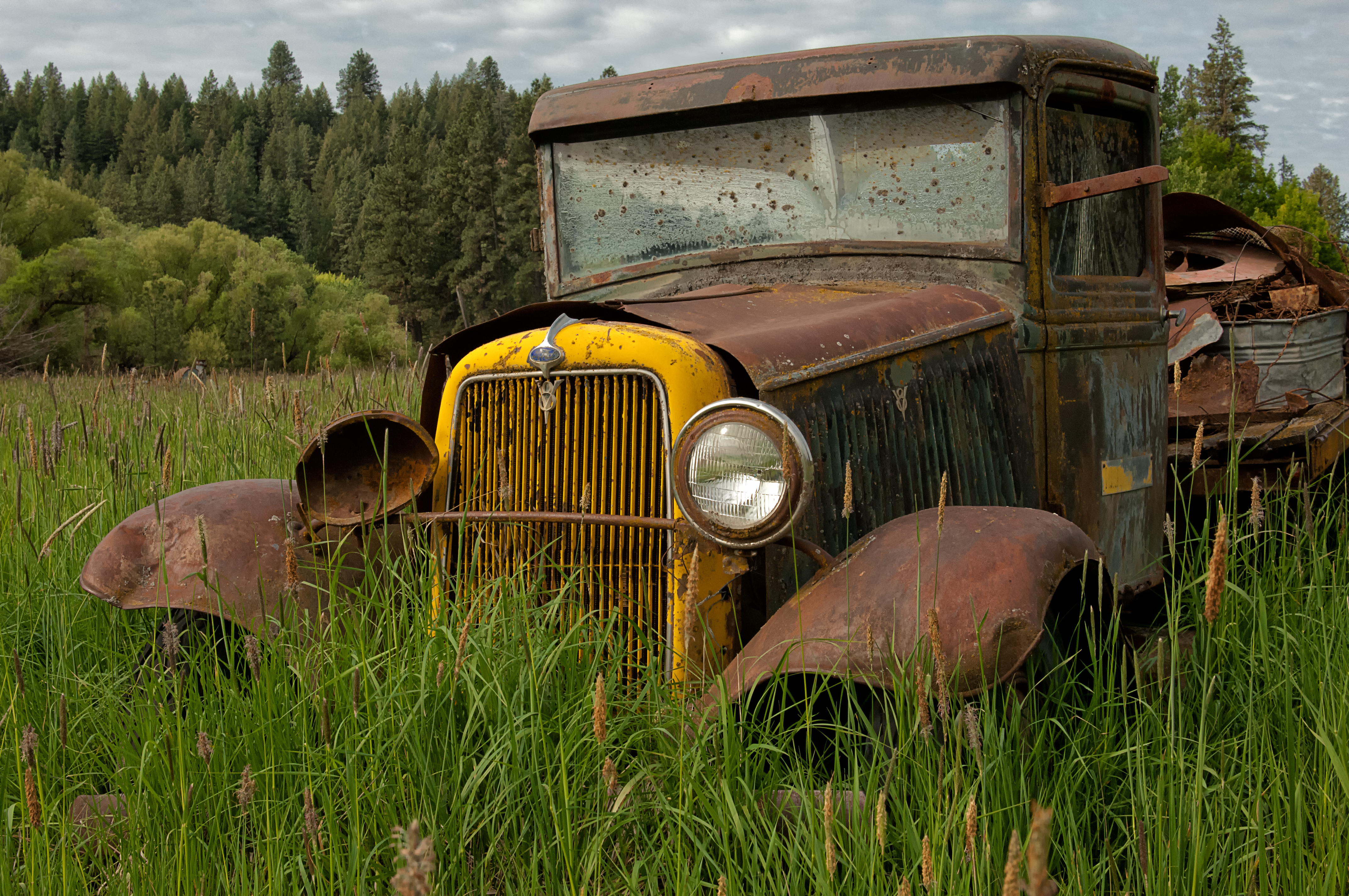
The interesting light only lasted for about an hour, then the patterns caused by the sun’s low horizontal light were gone and it was time to look for other subjects. Reed had picked out other places to go and until late in the afternoon we spent our time photographing deserted buildings and derelict cars and trucks.

While we stopped I saw a tractor plowing the miles of fields. I liked the dust clouds surrounding it so I ran out in the field and made several exposures. When the farmer finally drove to our location he stopped (covering us all with a thick coat of dust in the process) and got out to say hello.  We had been photographing a particularly distinctive old clapboard building and I asked him how old it was. His comment was, “Well, the house I live in was built in 1901 and my aunt lived in this house long before that”.

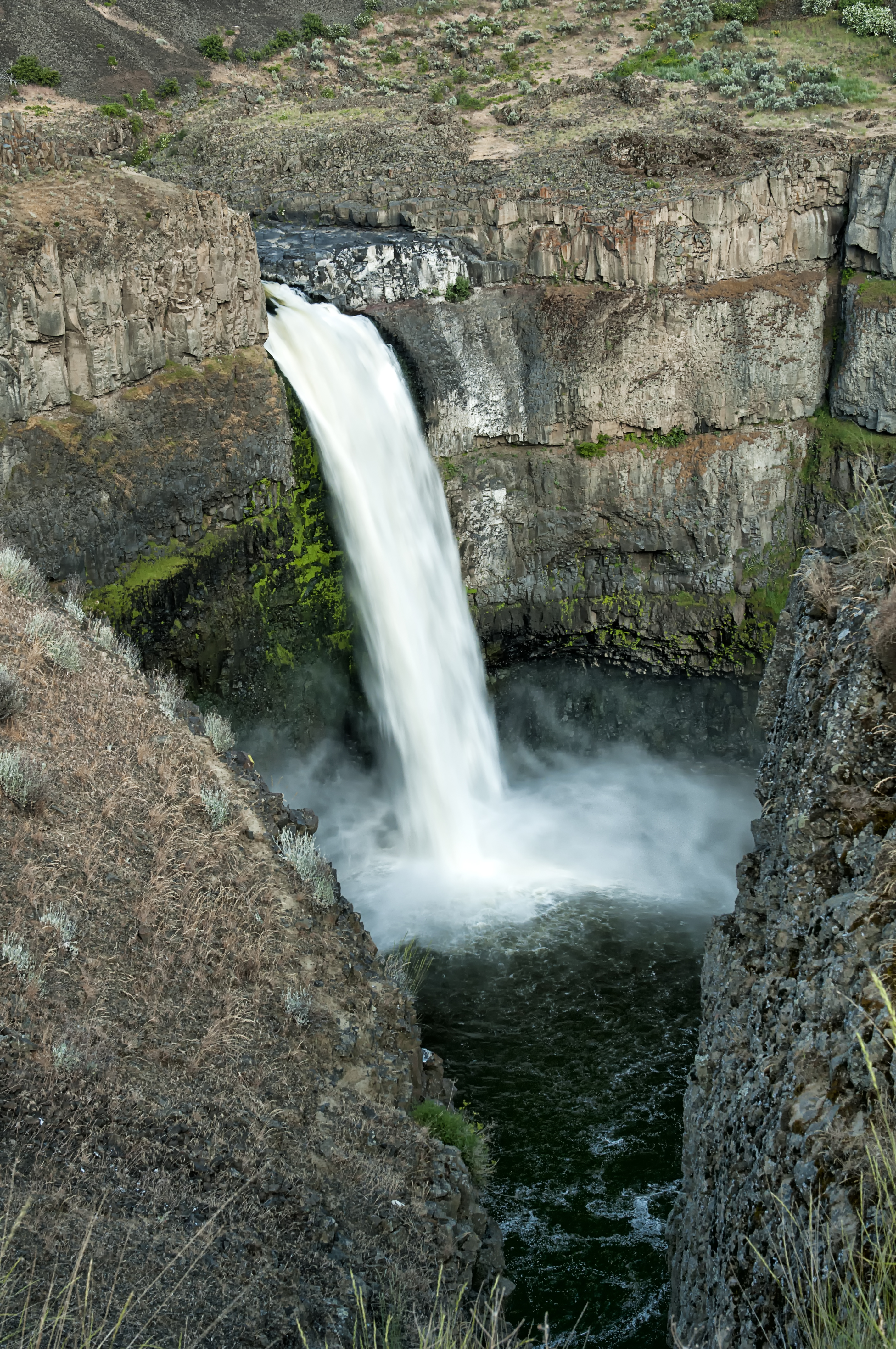
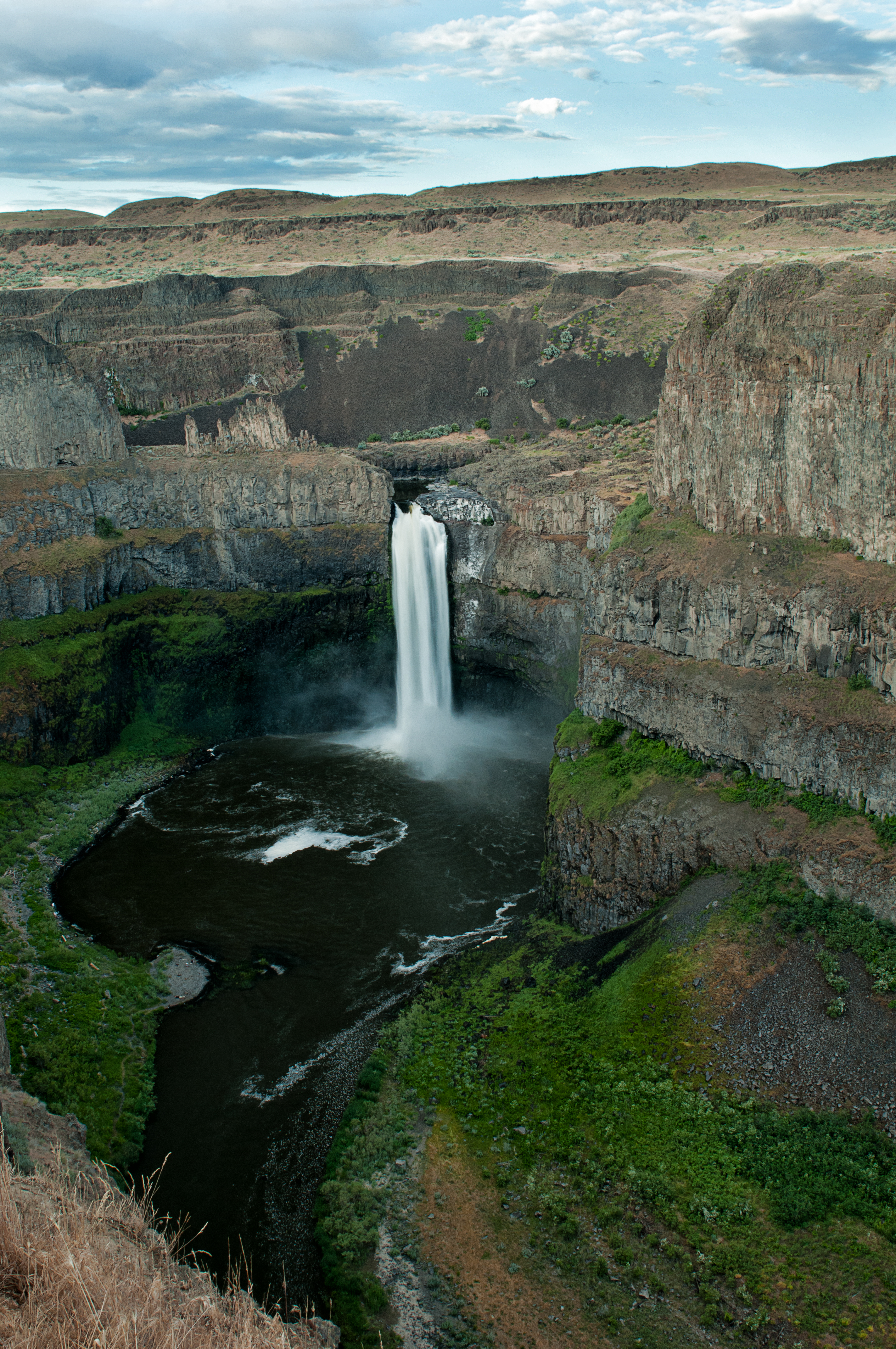
Our final destination of the first day was Palouse Falls State Park and the spectacular Palouse falls with its 186 feet (57 meter) drop.  The scenic and impressive falls can’t be seen until you are nearly on top of it. The broad, broken plateau of black basalt that stretches out to the horizon falls away and there they are: the thundering waters of Palouse Falls pounding down into a circular bowl carved out of the cinder-black rock.

We wandered along the precarious edge making pictures till the sun dropped below the horizon around 9PM. Actually the best time to make images of the falls was just as the sun went down because the contrast between the bottom and the top was pretty drastic.

The itinerary of sun up to sun down photography was repeated on the second day. I will say the long days were tiring, but I’d do it again. Well, after a good long rest.

Spending time getting tips on landscape photography from a photographer of Aaron Reed’s caliber was great as was the camaraderie of the others I met on those two days.  And the opportunity to photograph the Palouse was an exceptional experience.

I always appreciate any comments. Thanks, John

My website is at www.enmanscamera.com

A Good Day of Roadside Photography

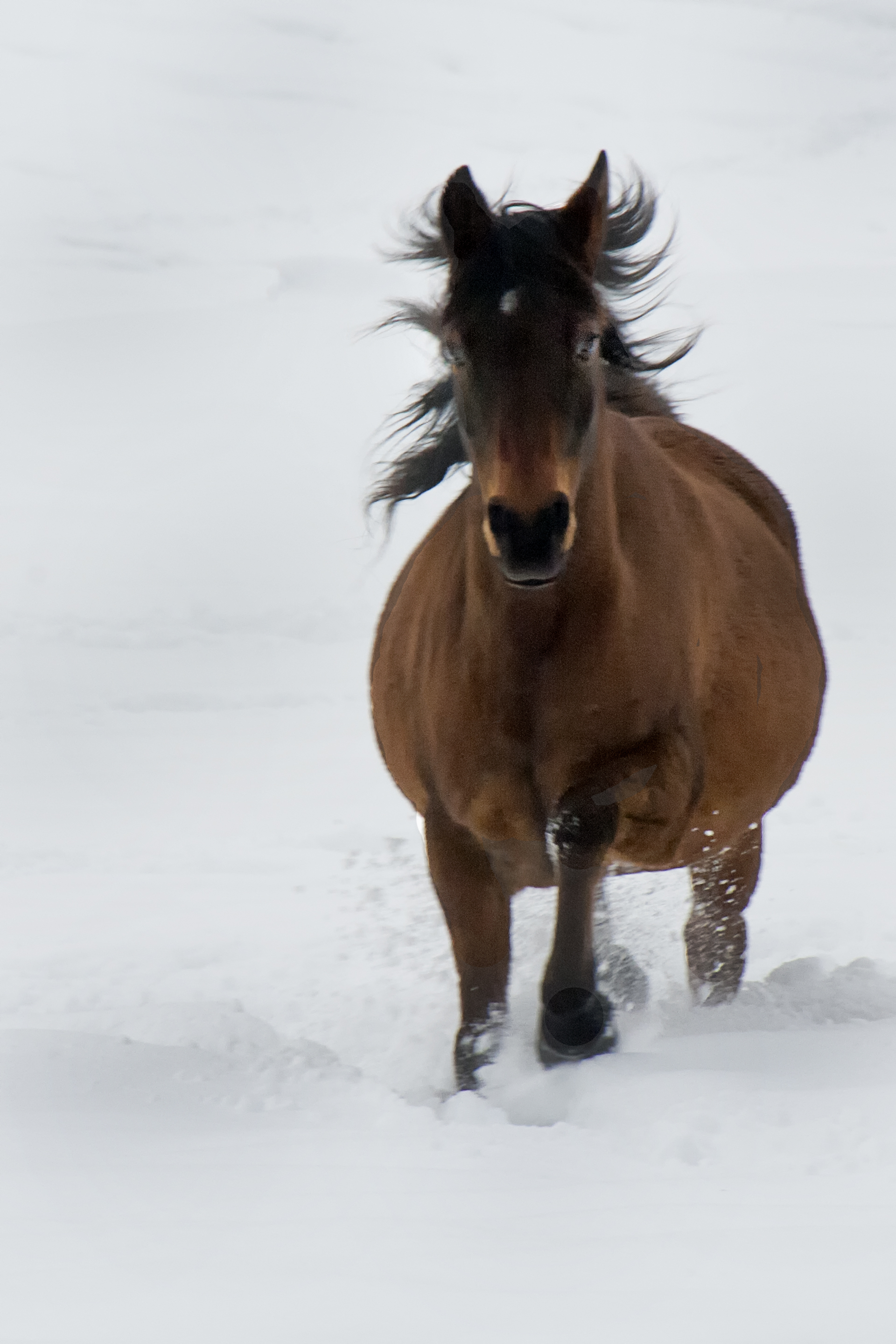
River view copy   REd pier copy Horse running copy

I recently talked to a long time photographer that said the landscape photography in early advertisements by the American Automobile Association was what got him into photography. That organization was once the best place to get maps for road trips in North America. They sent their employees out, with cameras and mapping instruments, across the continent finding the best and most scenic routes. I remember seeing pictures of their big, four-door cargo vehicles with people poised on platforms on top of the vehicle with large tripod mounted 8×10 cameras on some obscure dirt road in the middle of North America. It all looked very exciting.

We both remembered pictures of Ansel Adams standing on a platform on top of a vehicle very much like those used by the American Automobile Association with his large camera making wonderful photographs that scenic photographers still admire.  I actually sold my jaunty, little, two-seater MG that was so easy to get around the streets of Los Angeles, and bought a bright yellow International Scout 4×4. Underpowered, poor turning capability, uncomfortable on long trips with back seats that were only accessed by climbing over a metal barrier behind the front seats, it was perfect in my young mind and meant that I, like Ansel Adams and the folks from the AAA, could gleefully travel the back roads in a cool looking vehicle with my camera capturing the natural world on film.

Years have passed, and technology has changed, and so have I.  There are still lots of back roads to explore and photograph, but the days of climbing on my car roof are long gone.  The American Automobile Association no longer explores the country, and today I check maps on line or my cell phone. I don’t need a large 8×10 view camera like Ansel Adams used with the accompanying long hours working in a chemical darkroom to make good enlargements, and certainly don’t want to drive around in that uncomfortable, gas guzzling International anymore.

I thought about that conversation and the many scenic photographs I have made while driving along the South Thompson River towards Kamloops, British Columbia as I pulled off the road to meet up with fellow photographer Peter Evans. Evans and I were hoping the sun on the gray, overcast day would poke through the clouds enough for us to make some worthwhile pictures. We had headed out on the snow-covered roads without a plan. Not the best way to success, but both of us just wanted to get out.  We drove along the highway photographing horses, snow covered trees, and Evans even jumped out trying for some photos of distant deer bounding through a meadow. There were lots of opportunities in spite of the flat light, but our main problem was getting my car far enough off the snow lined highway so as not to be clipped by large passing transport trucks.

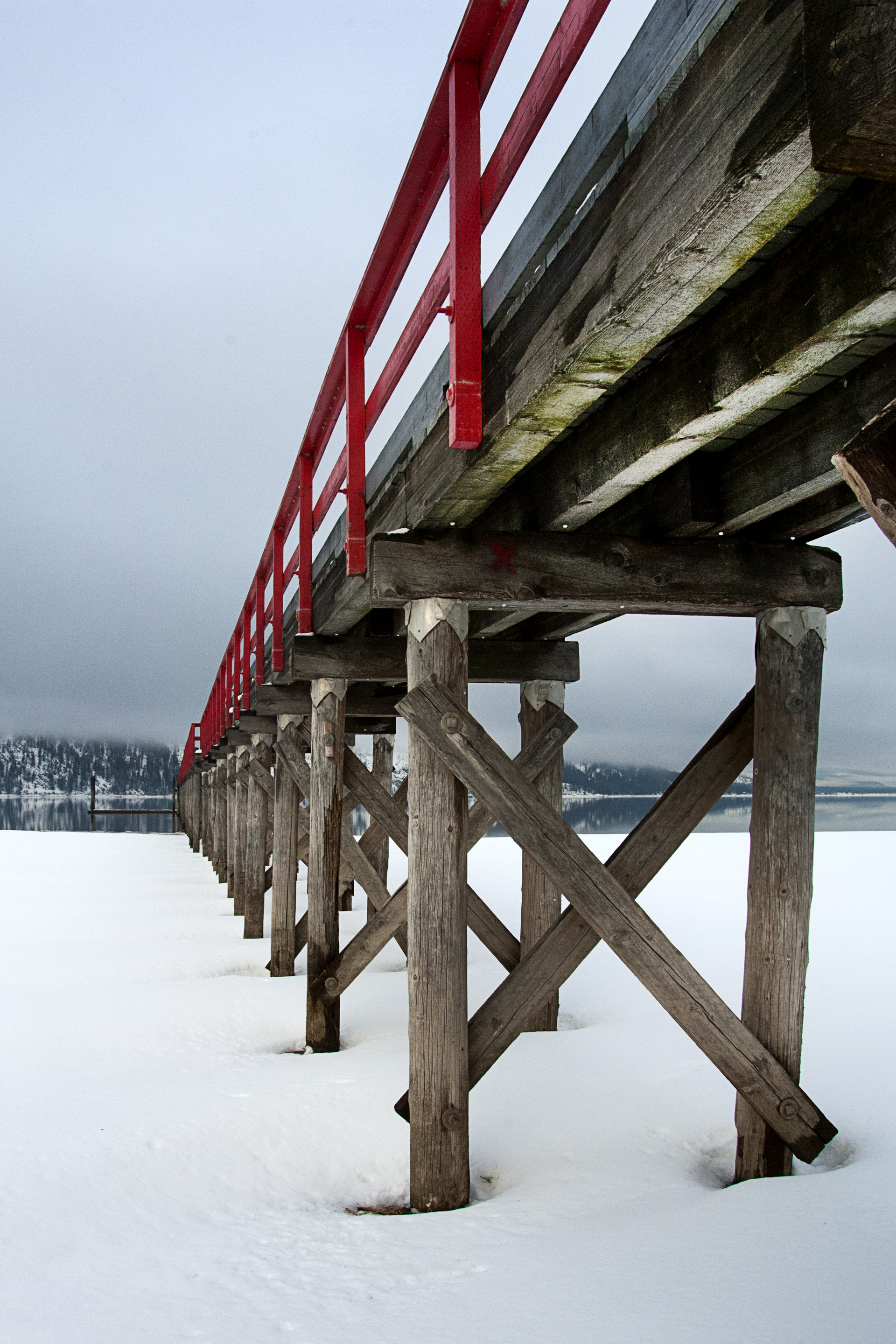
We stopped and wandered along the Shuswap Lake in the small town of Chase , and photographed the pier, reflections in the water, and trees along the white icy shore.  When the sun finally peaked though and we dashed back to the car, our goal to catch the sun along the river near a bridge that crosses the Thompson River a few miles from where we were. Chasing the sun seems to be part of roadside photography sometimes.

By the time we reached the Pritchard river crossing the sun was creating diagonal shafts of light that slowly illuminated some features in the landscape, and then in minutes moved leaving them absent of light.

We parked and rushed on to the bridge, yelling at each other, “look, look, look”. Then in spite of cars crossing the narrow bridge, we stood by the railings and shot away. The river scene was exciting, and I constantly altered my meter trying to keep the exposure under the fast moving light. Then in about ten minutes the sun moved into the clouds and dropped behind distant hills and the sky, hills, and river were back to unexciting flat light. However, we were like two happy young kids as returned to the car talking about our luck with the light.

That’s what I call a good day of roadside photography. Pictures of running horses, reflections on the lake, cool shots of the Chase pier, all capped with luminous pictures of the river and I didn’t even need a platform mounted on a gas guzzling vehicle, a big heavy camera, or back roads.

I appreciate your comments. thanks

My website is at www.enmanscamera.com
Planning a Photography Excursion to the tulip festival.


Now that the February blahs are over, and March has come and gone bringing warmer days (regular readers know how I feel about March, “Ides of March. 15 March 2012”), I am thinking about planning a spring photography excursion.  I am hoping the weather will be cooperative as I don’t enjoy photography in the rain, and don’t want to get my camera equipment wet.  I think I should include some protective rain gear in the event of bad weather.

I would like to go on spring excursion heading west and south and that should give me the best opportunity for photography that will not include snow or cold temperatures.  I want to go somewhere along the coast I think, as spring comes earlier along the west coast and I should have my choice of flowers, landscapes, or any possible wildlife.  A friend phoned last night from Vancouver saying there was green grass, and flowers, and the temperature was 12 degrees, and expected to get warmer.

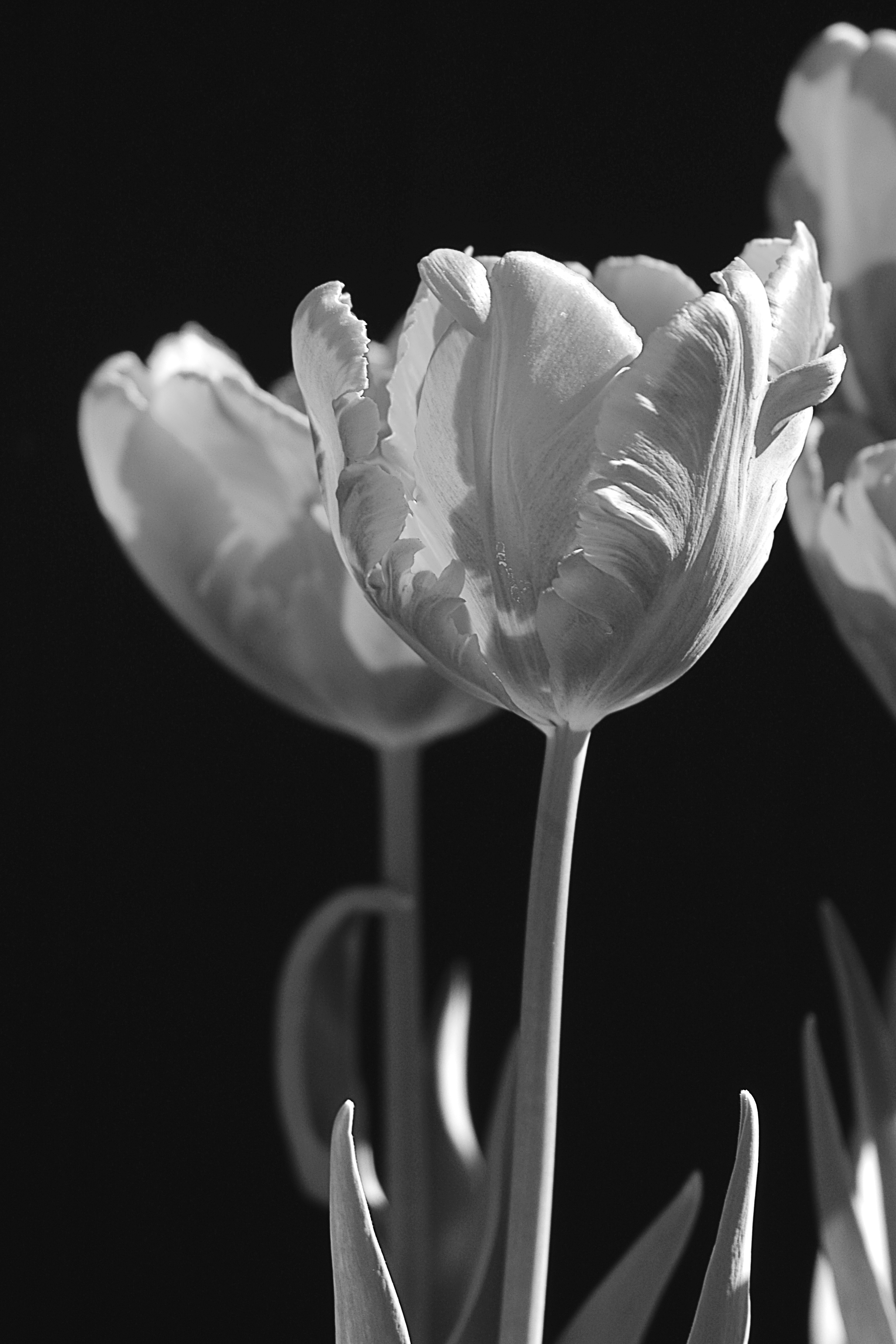
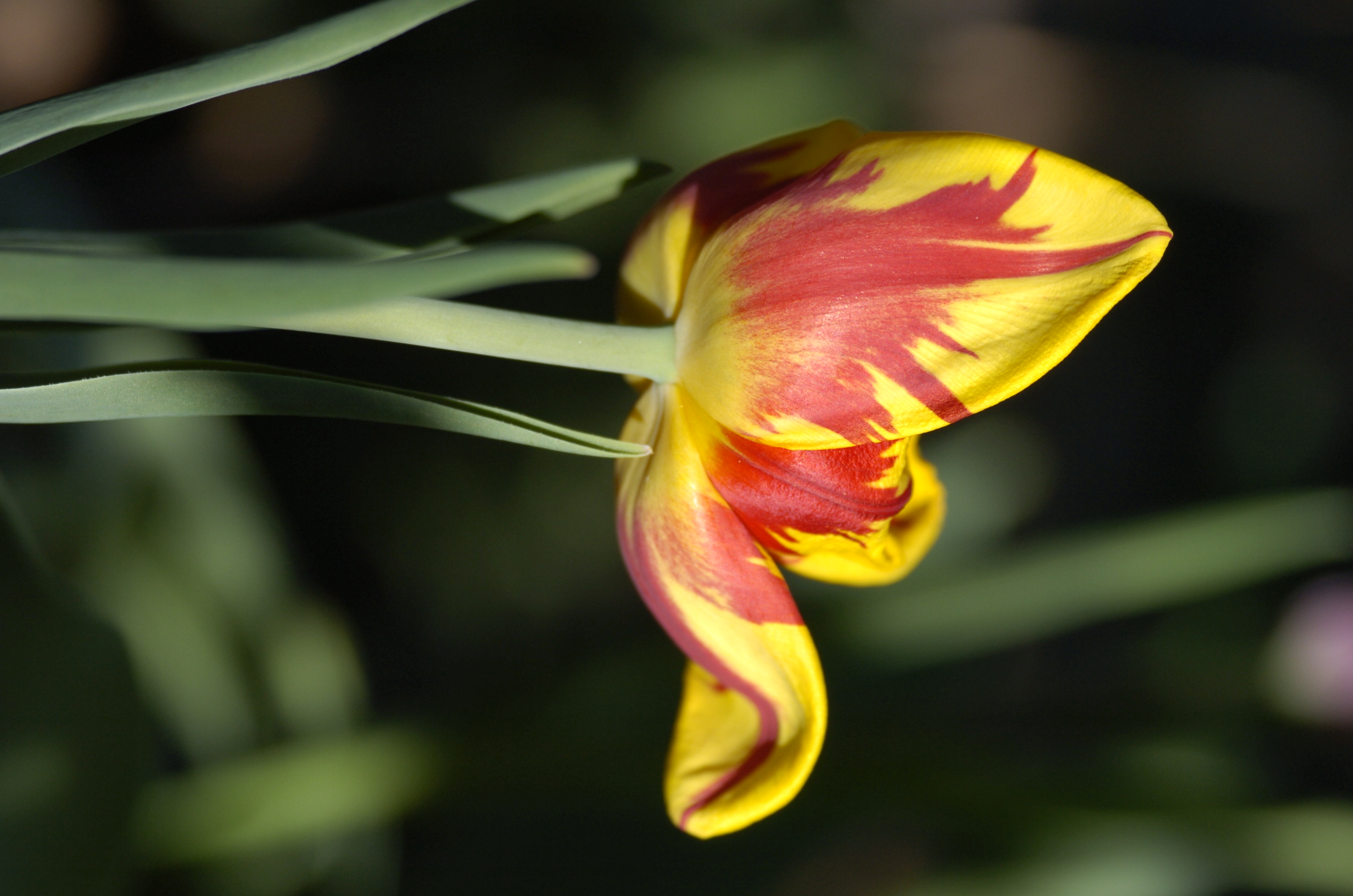
I just received an email reminding me of the spectacular blooming events along Washington State’s northern coast.  I could attend the 29th Annual Skagit Valley Tulip Festival from the 1st to 30th of April.  I know I could link up with other photographers going there from BC, or I could just head to LaConner or some other town on the coast of Washington, find a place to sleep, and join the festivities.  I am not so much a flower person, but like so many other subjects I photograph, I think multicolored fields of tulips would be an interesting photographic challenge. Choices ranging from extreme close-ups to landscapes would be just plain fun.

I don’t tent or RV so I will start browsing the internet for reasonable lodging. I have found fun places to stay in the past by checking out lodging websites, however, I have also ended up by chance in neat places just by going where I want to be and looking around.

If this brings up the question, “Have you ever had bad luck finding a place without advance reservations?”  Oh, yes!  I remember pulling our tiny Suzuki Sidekick off the highway at a roadside rest stop late at night because every hotel and motel was full.  My wife, Linda, and I tried unsuccessfully to spend the night sleeping in that cramped car. Morning came early (4am) and because nothing in the nearby small town was open we drove off tired and hungry. We finally ended up gobbling donuts and coffee hours later at a Tim Horton’s, then later collapsed on a sandy beach beside a lake and slept much of the day away.  Oh well, we will never forget that excursion!

I like to plan and organize such events to include preparing the vehicle, so when the time comes I will ensure the car is tuned up, and the winter tires are changed.  I like lists because I always forget stuff, and so I’ll begin making several brightly colored checklists of the items I will bring, and then I will start looking forward to the photography excursion, and have fun just thinking about the pictures I want to take.

That brings up the best part of planning.  What camera equipment do I bring?  I could bring every lens and camera I have, but that’s just silly as I wouldn’t have any room for a change of clothes.  Too much of the time I over pack my camera gear and end up stashing equipment in the car because it isn’t being used, so I will make an effort to minimize this year.

I don’t like to venture very far with only one camera, so I always carry a backup camera.  Cameras can malfunction and I don’t want to take the chance of reaching my distant destination and not being able to do the photography I went there to do.

Next on the list are the lenses I think I’ll need.  If I attend the tulip festival I’ll need a macro lens for close-up photography and a wide-angle lens for those colourful, flowered landscapes. There will be other opportunities and I’ll bring my 70-200mm and for wide low light opportunities will include a 24-70mm f2.8.  And very important, I will pack lots of memory cards.  By now the camera pack is getting full. That’s three lenses, two camera bodies, and I haven’t yet included my infrared camera that I think I’ll also bring. Oops, there is also my wife’s camera gear. Add her camera, macro lens, and favorite zoom lens, a 70-300mm.

Of course we will take our tripods, that’s a given.  Ahh, the decisions we must make. I just think it is so much fun.  The planning and anticipation of any photographic excursion is as much fun as the actual trip.  Whether I make it to the Washington coast or have to pull back my plans and stay closer to home, I will soon be venturing out camera in hand.

www.enmanscamera.com


Photography in Peace River Country

                                                                                               My wife and I were called away by unfortunate circumstances on a rush trip. The kind where one just points the car, accelerates to 120kpms, selects cruise, and settles in for a long, non-stop drive; in our case, 11 hours from Pritchard to Grimshaw.

In spite of the long hard hours of driving, for a photographer the changing scenery was nothing short of great. We were heading for the northern community of Grimshaw, Alberta. Although I prefer the changing mountains and exotic coast of British Columbia, Alberta is just great. To my eye Alberta seems wide, flat, and pretty much endless without many “bumps” in it’s vast landscape. I remember hearing a joke that “ya can watch your dog run away for a day”. However, my wife informed me that due to the curvature of the earth that we can actually only view 18 miles to the edge of the horizon, so I’ll change that to watching the dog run away for 18 miles.  As I was driving along, watching the western sun slowly going down, it seemed to be in much the same way as I saw it many times while sitting on a sandy pacific ocean beach, I realized that old joke could sometimes be true.

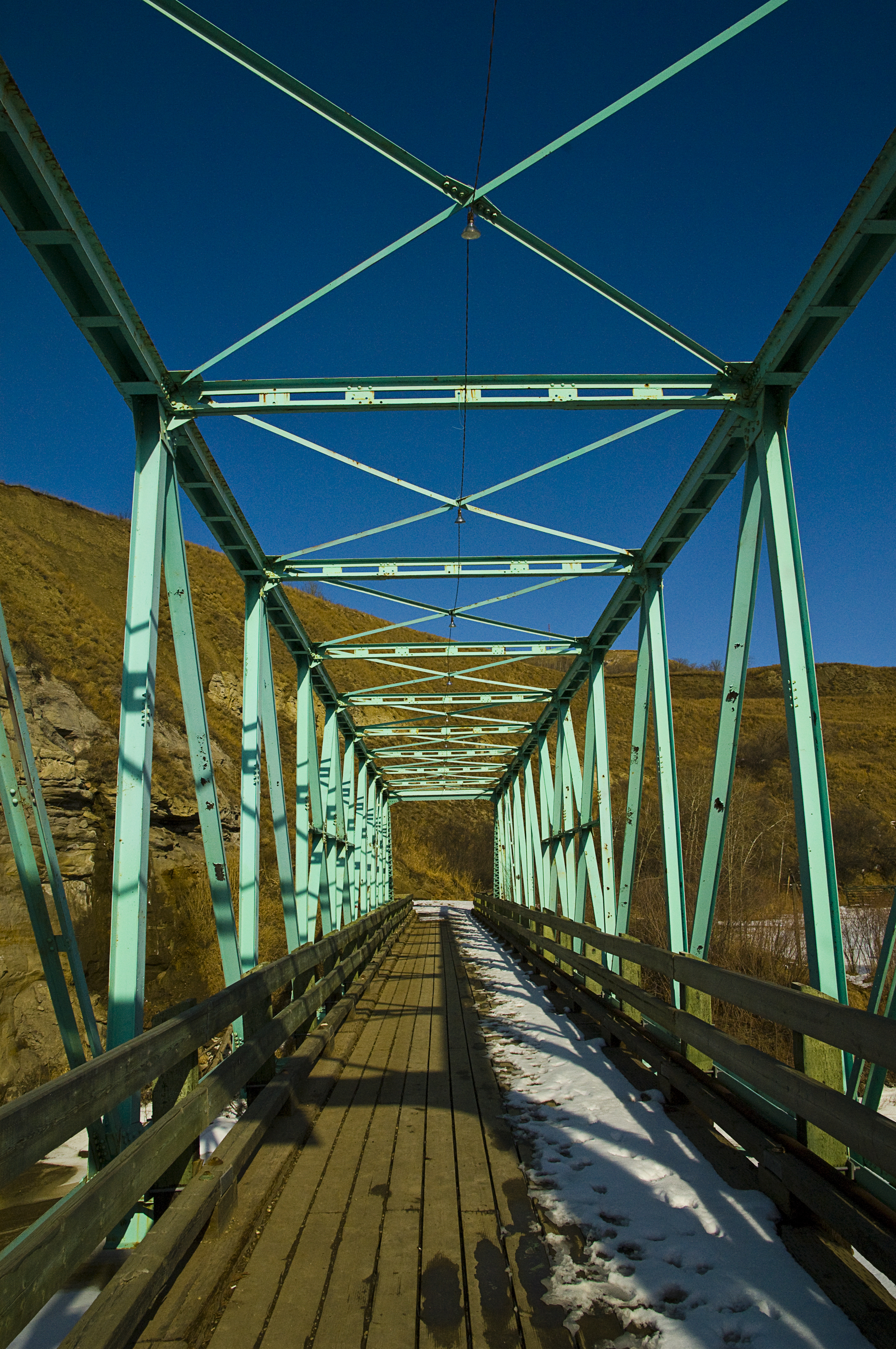
Peace River, which is the major community before Grimshaw, is different. The flat plains suddenly drops and the road leads into a lush, large river valley with lots of bridges. This was the place that would be a perfect to resume my project of photographing bridges.

After all the family welcomes, and catching up with relatives, people had to get away from the food and drink for a while. Some went skeet shooting, some to visit friends, there was last minute shopping, or in my case a cruise around Peace River. Fortunately my niece’s boyfriend, Logan, volunteered to drive me everywhere and anywhere I wanted to go. He had lived in the region all his life and he said “I’ll take you to some cool bridges”, so we bundled into his big pickup.  Those that are familiar with Albertans know that they don’t like the price of gas but won’t give up owning a big four-wheel drive pickup, which is standard operating procedure.

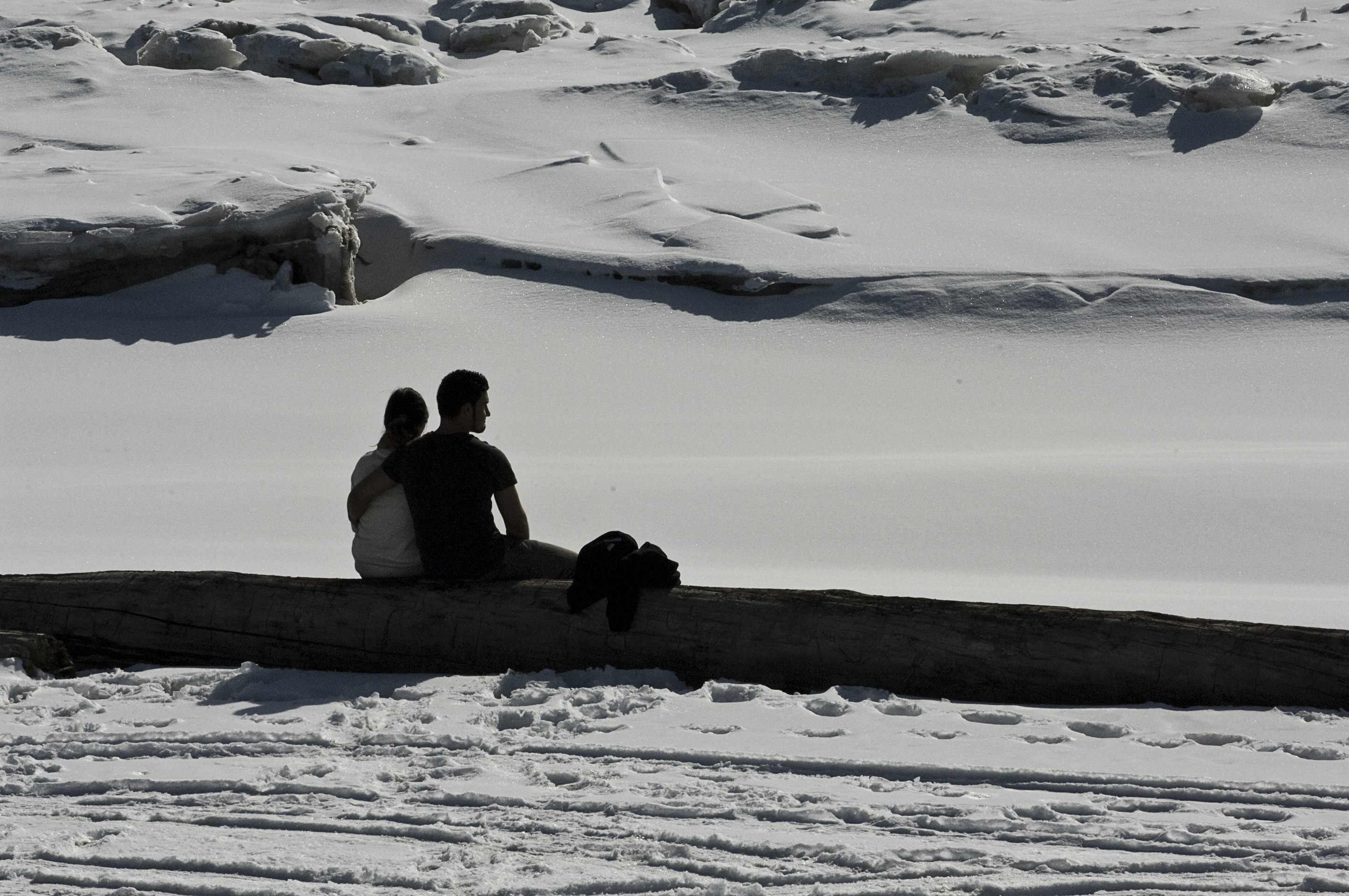
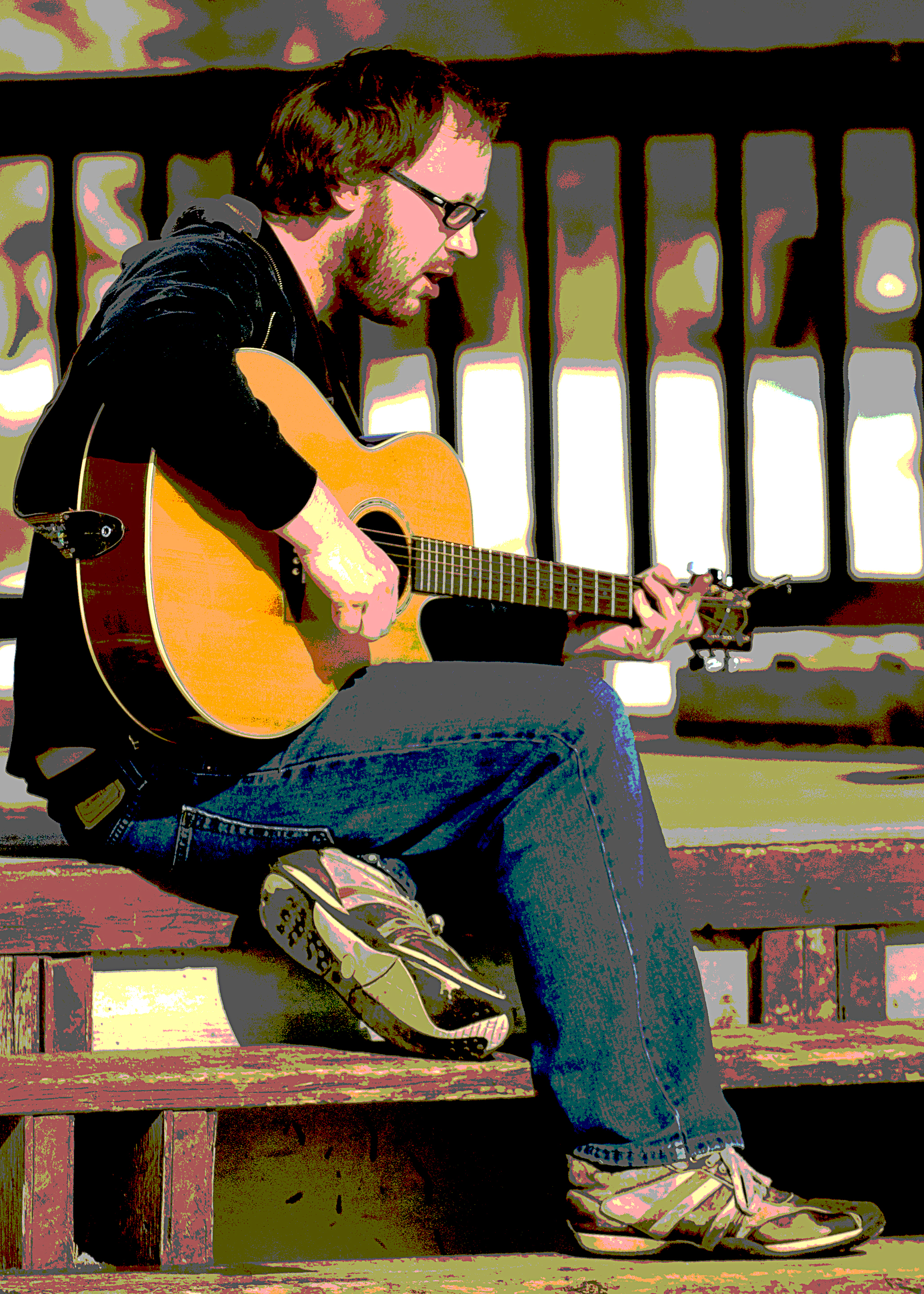
Photographers and non-photographers seem to deal with their worlds differently. Logan was sure all we would do is stop at some viewpoint and I would hang a little camera out the window and snap a picture, however, I loaded my 30lb camera bag containing two DSLR bodies, five lenses and two flashes into his truck. Then when we stopped I got out and told him to leave me, do the chores he had mentioned he needed to do and come back in an hour. “What? You want to be left?”  Yes, photographers and non-photographers do deal with the world differently.  I am a wanderer that has a hard time concentrating on one subject. Sure there was the bridge and I photographed that with both my 16-85mm and 18-200mm, but there was the ice on the river, some old buildings, a boy and girl sitting on a log, a guy sitting in a gazebo playing his guitar, more large chunks of ice, and lots of other stuff that beckoned to me. About 30 minutes after I was dropped off I got a call, and I told them they could find me at a snow-covered park about a mile away.  I was having fun.

Reminding me we were out to photograph the bridges of Peace River, Logan hustled me back to his truck as we headed off, and I thought about how fortunate I was to have such a patient guide. And he had his own stories about every bridge we visited. At this writing I am sure, even with his help I would need several more days to photograph all the bridges. And to do it properly, I would need to take into account that some look better with early morning fog, some with late afternoon light, some in the winter and many deserve the summer.

The next morning I sat my laptop on my in-law’s kitchen table and showed the people the images I had worked on the previous night.  I expect there is a lot more to photograph in Peace River than just bridges but that’s what I focused on this time. Next time who knows? I am easily distracted.

I will say this for those photographers that are looking for a unique experience, northern Alberta certainly has its own distinct charm, and if hospitality is important then this definitely is an area, as one old photographer friend puts it, to put on your “bucket list”.  The 11-hour drive was painful, and next time I think I’ll stop more and overnight at some scenic location. I talked to a family friend that said there’s been an increase in the wolf population in recent years and on my next trip I hope to convince him to help me find some to photograph.  I am easily distracted.

Contact me at www.enmanscamera.com

Looking into the Landscape

Landscape photographer Elliot Porter once said, “Sometimes you can tell a large story with a tiny subject”.

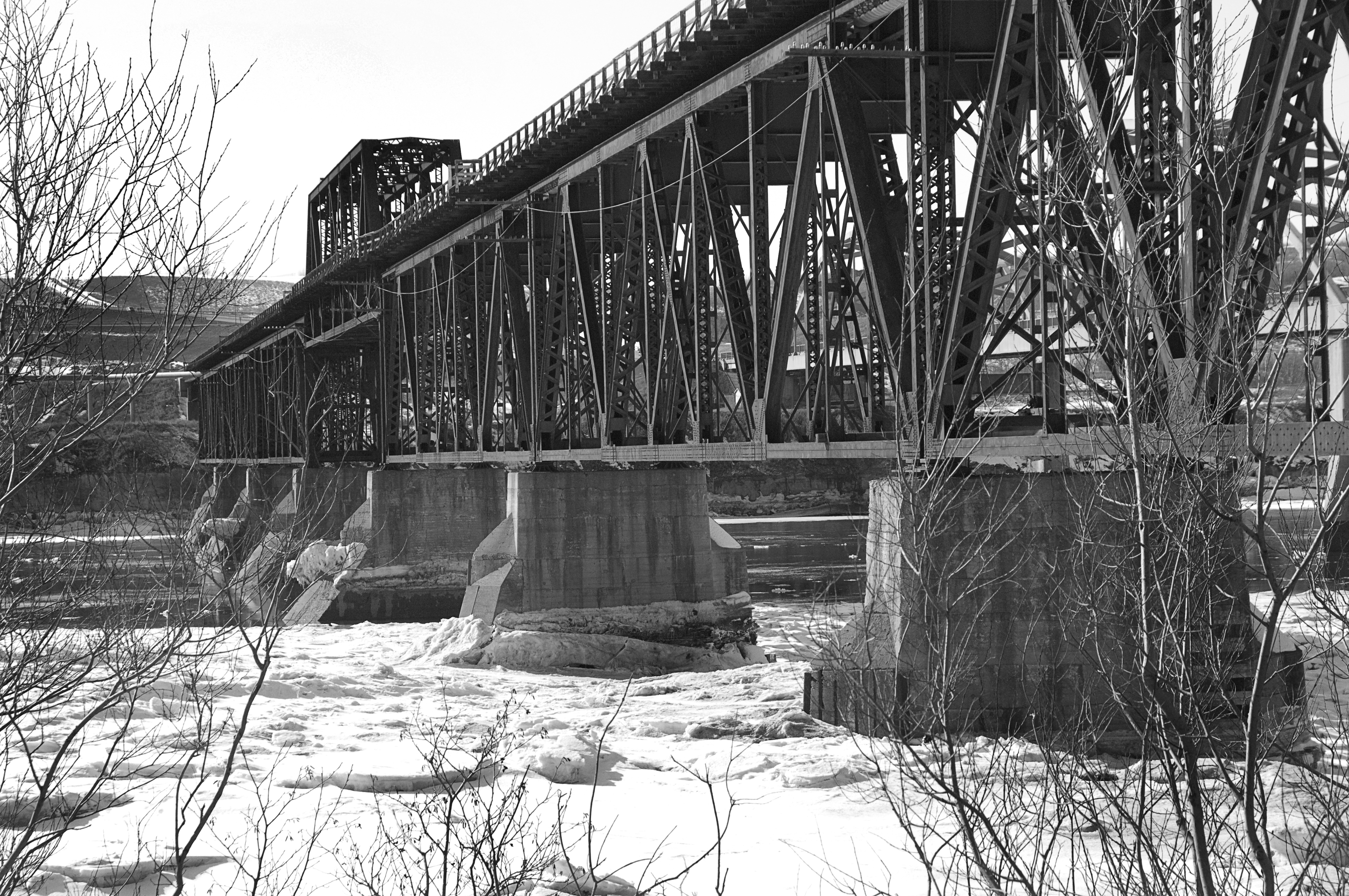
On the weekend I bundled up against the damp, windy cold and headed down to the frozen shore along the South Thompson River not far from my home. My intention was to photograph the Pritchard Bridge that spanned the river and I had hoped to see large chunks of ice jammed against the pillars.

I like photographing architecture, and any kind of structure, whether it is buildings, fences, and yes, bridges, is just plain fun for me. I look for how the light plays on stone, wood, metal, glass, and any other building material and how it creates shadows and features, like ice, that interact with the structure. However, to my disappointment, the large chunks of ice I had noticed a few days earlier were gone. The strong wind that constantly blew along the river valley must have cleared all the ice from around the bridge pillars.

I wandered along under the bridge looking for interesting angles. I had mounted my camera with a 16-85mm lens thinking that its wide view would give me an interesting perspective.  My intention was to photograph the bridge in a fashion that would look good when converted to black and white. I looked for shadows and highlights that would create enough contrast to give depth and dimensionality to black and white images. Much of the time I see black and white images that have been changed to monotone without regard to the tonality of the subject. All I see are flat tones of black and white with no relationship to the actual colour quality of the full colour original. There are several programs that convert image files to black and white while keeping that tonality, PhotoShop among them, but my preference because of the control and finality is Silver Efex Pro from www.niksoftware.com.

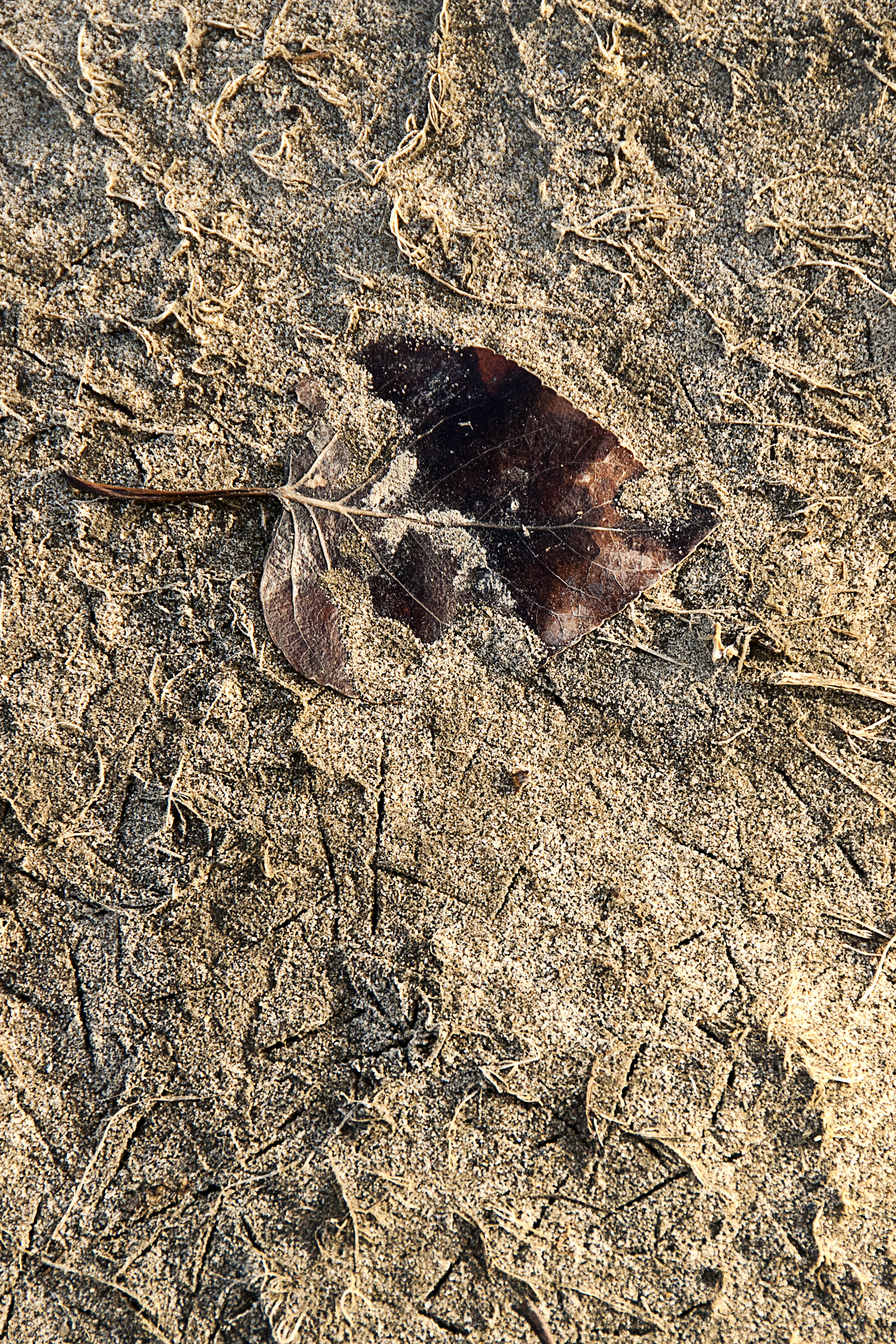
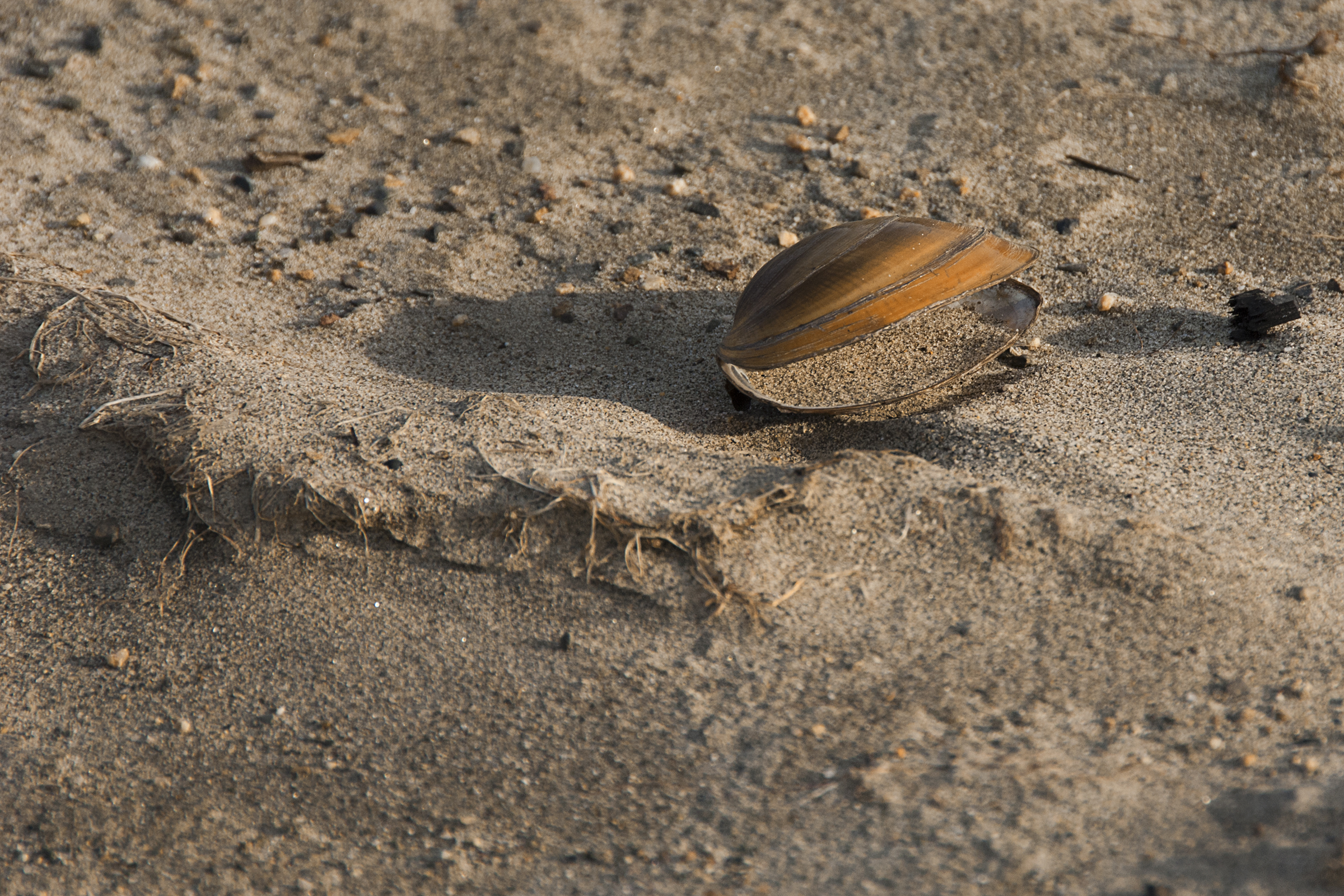
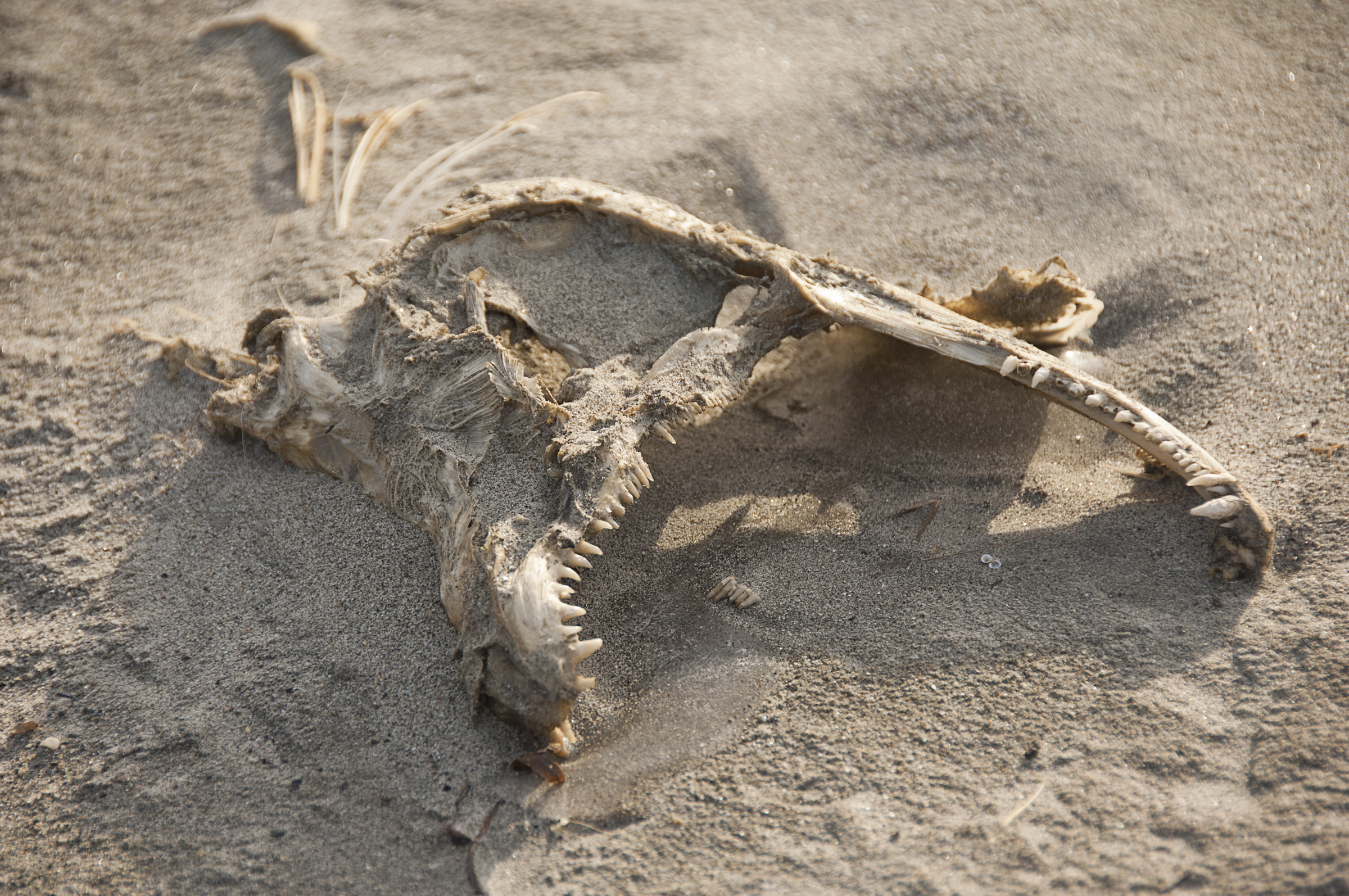
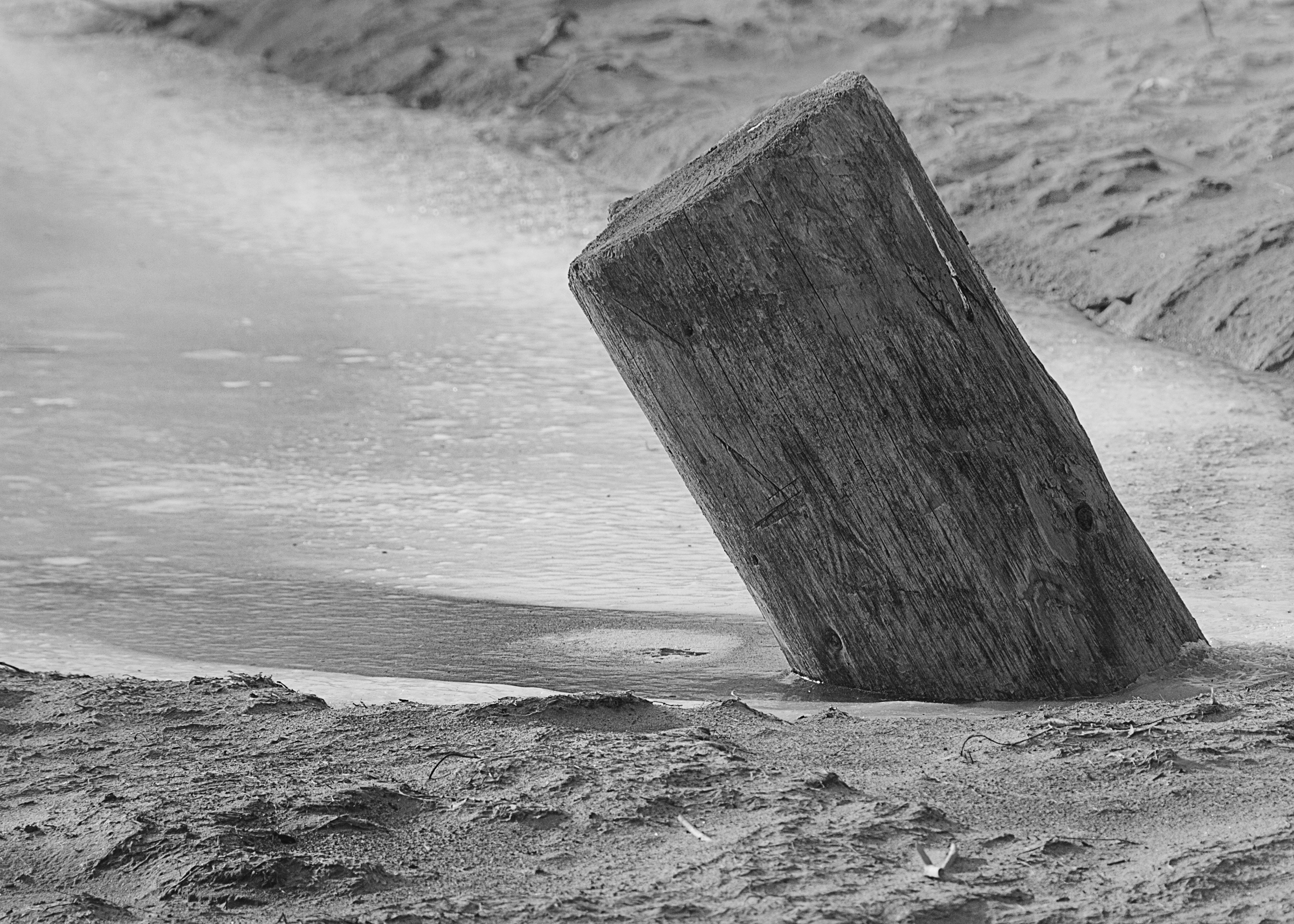
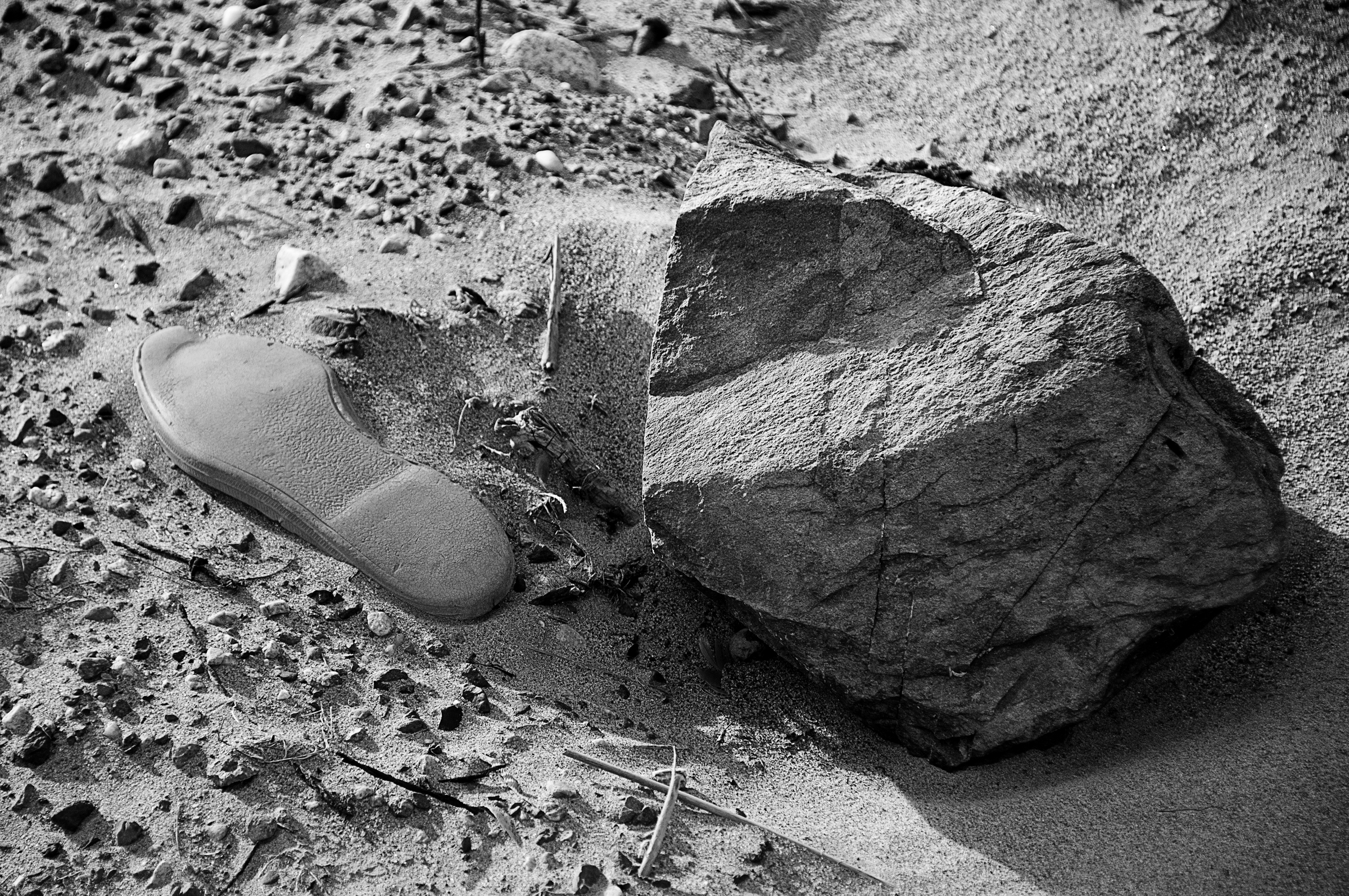
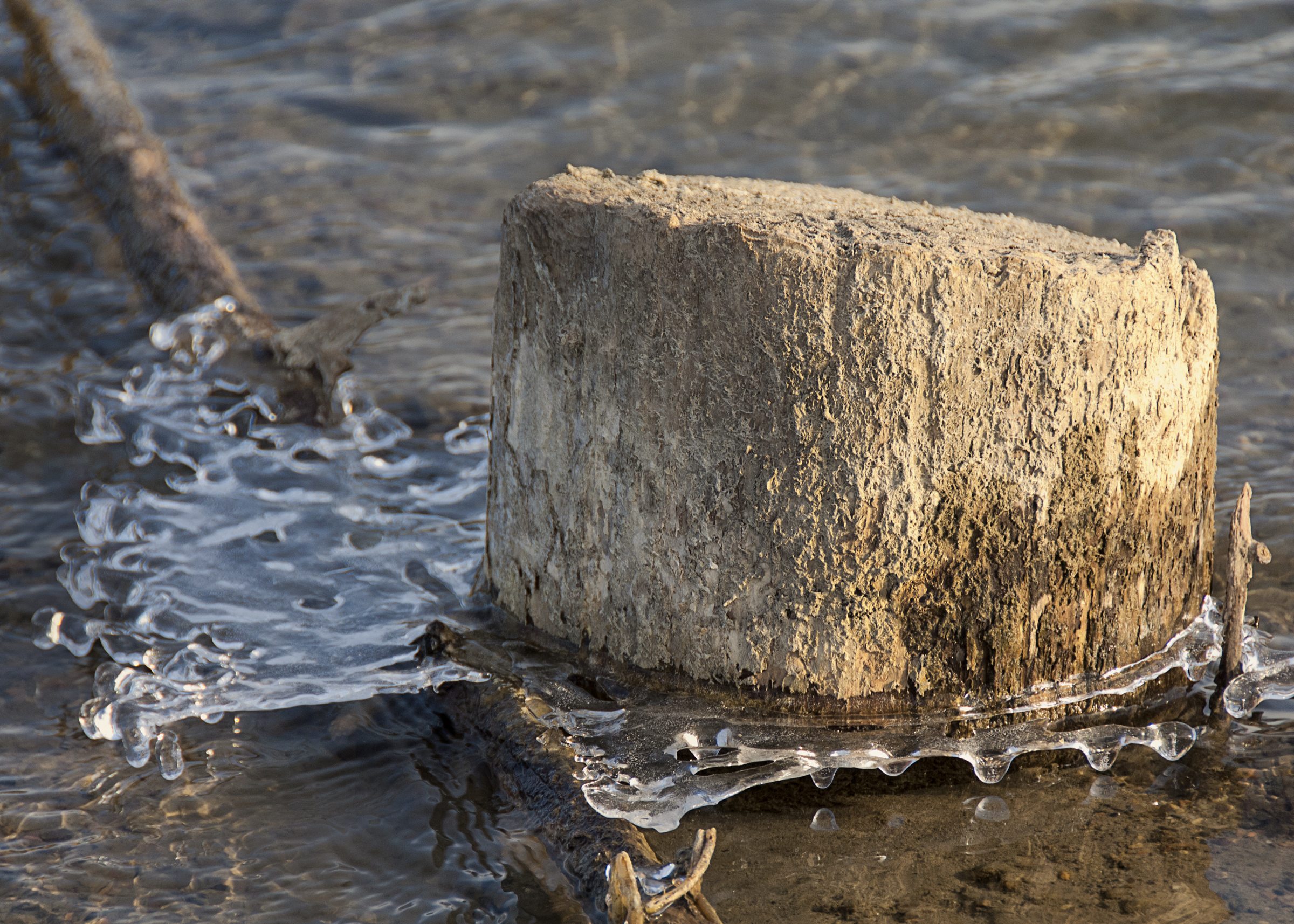
I walked along the shore and crossed under the bridge looking for creative opportunities and trying to find interesting perspectives of the bridge.  Eventually, however, what caught my eye were features protruding from the sand like posts and branches, and I began looking down and along the shore instead of up and that’s when I really started to take pictures that were working for me. There were shells, small bits of water worn wood, a half-buried rusty oil drum, fish skeletons and much more, like an overturned shoe in the sand. I changed lenses to an 18-200mm to have more focal length and a narrower view for ground level shots of posts and other revealed objects sticking up from the sand.

The light was perfect and its low angle created intriguing shadows that added definition to each of the subjects I selected as I walked along the sandy beach. Each small object, in Eliot Porter’s words, had its own “story” and I tried to show something in each that was more than just a snap shot of an object on the beach.

Often we forget that there is more in the landscape than majestic peaks and expanses of fields. I began by ignoring the “tiny subjects” thinking only the bridge would be worth photographing. If this was a garden, then I would immediately contemplate close-up photography and grab my macro lens, but it took me a while to realise how much more there was to photograph on that frozen river beach.  Soon, I will be walking through the sand with my camera again, this time keeping my eye on the ground, and I will be dressed even warmer.

www.enmanscamera.com
Considering a 4×5 View Camera?

Photographers are always looking for the perfect camera, even in these days of high megapixel, large sensor, programmable cameras.  The selection for many has become more than just a choice between manufacturer loyalties, as it extends to technical demands, and practicality when approaching a particular subject.

There is no doubt in my mind that some of the finest landscape and scenic photographs have been produced, and continue to be made, with the type of camera that is a design that has been with us for over a hundred years, the “view” camera.  The great nature photographers Elliot Porter, Ansel Adams, Imogene Cunningham, and Brett Weston used them, and many publications still prefer the quality of 4×5 inch, or larger, sheet film (some readers may never have even seen film).

A local photographer, Peter, stopped by the other day to talk about a 4X5 Burke and James view camera he had purchased. Photographers can easily obtain moderately priced, used, 4×5 inch format film camera by manufacturers like Burke and James, Graphic, Sinar, Linhof, Calumet and many more, that, depending on the use, are similar in application to DSLR (digital single lens reflex) cameras in that there is an extensive array of lenses available, but unlike DSLR’s there is not a limiting lens mount.  One must merely find a lens board that has a hole in it the size of the lens you want to use and voila, the camera is ready to go.

For those unaware of just what a view camera is I’ll describe it as an accordion looking contraption, consisting of a flexible light-tight bellows with a focusing screen and film holder on one end, and a lens board and lens on the other. This assembly is usually mounted on a rail or platform and uses a rack and pinion system to move the bellows back and forth for focusing.  The main advantage of view cameras is the technical control that one can get because both the front and back have the means available that allows for up, down, and lateral movement. At one time some cameras like his were called “press” cameras because they were the camera of preference for news photographers (seen regularly in old movies), so depending on what the source is the camera might be called a press, field, or large format view camera.

I know that may be confusing to those that have only used DSLR type cameras, but volumes have been written about using view cameras and if you are interested information is readily available and I suggest starting with http://www.viewcamera.com.

Simply put:  Consider being able to move a digital camera sensor and lens at different angles. Light certainly doesn’t go around corners, but with a view camera one can change perspective, control distortion, and sharpen an area of focus just by aligning film, lens and subject.

For example, walk up close to a tall building, aim the camera upwards, and release the shutter.  The resulting image will show the building having a wider bottom and narrower top. With a view camera one can adjust the film plane and lens plane positions parallel with the building’s wall, and of course this would be easy to accomplish because between the film and the lens there is a bellows that bends easily. This time the resulting image would not be wide at the bottom and narrow at the top, but whatever, the photographer set it to.

It is this control, and not so much the large negative, that draws serious photographers to view camera technology. However, the large 4×5 inch negative does produce impressive results. Although one would traditionally need a photography darkroom with enlarger, chemicals and trays for processing and printing, many modern photographers now use scanners.  The film still must be processed, but once done just scan that beautiful, large sheet of film into a computer and then proceed as usual into PhotoShop for image enhancing and printing.

Peter plans on taking his 4×5 on some hikes in and around the British Columbia interior. That’s a neat thing about these foldable cameras; they collapse nicely into a portable box. With a lightweight tripod, a few sheet film holders, and a camera that is easily stuffed into a small backpack, he’ll be on his way.  The hills are covered with snow, but if the light is good I know he’ll have a great time there and I look forward to seeing his resulting pictures.

www.enmanscamera.com