Talking about cameras

I am still a bit surprised when people inform me they have decided to keep using film cameras in this day and age of high-quality digital camera image output, and that is just what I was told by a couple last week.  Of course, my response was that they should use whatever makes them comfortable. 

 I find that many photographers using film want to offer a rationale for using film and make statements like “this camera has always taken very good pictures”. I suppose that’s a rational statement, however, but the difference between digital and film is like driving an old 1970 Ford sedan and the newest Ford hybrid model across Canada.  There is a lot more performance, comfort and options available for the operator of the newer model so that the experience can be more pleasurable and certainly more efficient.

 This couple were so emphatic about how great their old film cameras produced pictures that I assumed they do their own darkroom work, but they take their film into a lab that processes it, then scans it to a computer, then with predetermined settings the computer makes the desired print sizes. Hmm, not much photographer input there and most of the process seems to be digital technology. Oh well, at least they are taking pictures.

 I do believe that digital camera users become better photographers faster because of the instant reinforcement of their camera’s LCD, then again because it is so easy and quick to check images on a computer display.  Last Thursday my shop was filled with people discussing equipment. I have to mention that just before I talked to the film camera couple, I had been discussing digital cameras, but the question was “ What’s the best digital SLR camera, what do you like?”  Well, I like them all.  I haven’t had the chance to try every new camera out, but from my reading I think Nikon, Canon, and Pentax all have excellent products.

 My advice was they should first decide what they had available to spend, and then decide on how they like to shoot: sports, landscapes, family and so on. Of course any camera will do everything, but some are better for sports and some won’t hold up to the elements if packed on your horse or bounced around getting cold on the back of a snowmobile. My suggestion was before they choose to do some research before they buy.

 But film? Well if one is into “retro” or likes to experiment with technology from the past picking up an old film camera and the equipment for processing and printing doesn’t cost much and might be lots of fun.  However, for those like me that are dedicated to producing quality photography I would, of course choose a DSLR (digital single lens reflex) camera.

 
www.enmanscamera.com


Photographers Resolutions (or goals) for a New Year

For me New Year’s resolutions aren’t so much resolutions for the next year, made on January 1st, but things I’ve been thinking about for some time. These could be more accurately called photography goals for 2012.  Here are some of my goals as well as my thoughts for each for this year.  There are not very many goals, but too many doesn’t seem to work for me.

1.     Plan a trip or photographer’s vacation this year.  I want my time to be about photography, not one of those trips where I bring along a camera and hope for a snap shot or two, but a real photographer’s excursion that makes me use the equipment, knowledge, and talent I have. 

2.     I want to make the effort to learn new techniques by taking a class, or at least buying some books or CDs written by accomplished photographic writers. Educating oneself is always fun.

3.     I will continue my ongoing quest to organize my old prints and slides.  I want to place as many as possible on archival CDs. There are many ways to copy photographs and slides. For prints I use my camera, a tripod, and a level, to make a digital photograph.  For slides a scanner works best. My scanner, although capable of producing high-resolution scans only produces one film image at a time and is slow.  There are scanners that will do multiple slides and several formats at a time and the price for them is under $1000. Maybe this is my year for a new purchase.

4.     Like many long time photographers, I have old film camera equipment whose time of service has long past. The pictures they produced were great, but modern camera technology has progressed far beyond those old film cameras, and individuals like me, who have embraced the high quality digital world, will never return to film.  Fortunately, there are high school classes that are still are using chemical darkrooms and black and white film that has students looking for inexpensive old manual cameras and that is a much better place than gathering dust in my basement.

5.     I am planning to do a systematic photographic inventory of our household goods.  I have to admit I am as lax as anyone when it came to a photographic home inventory. Then I was faced a couple of summers ago with a forest fire approaching my door and needed to do it in a hurry.  I have that quick and haphazard photo-inventory, but now it’s time to do it right. It’s not very hard if one does it one room at a time, and I think worth the effort.

6.     For me, my store is a great place to interact with others interested in photography, and I have a few chairs available, and it is just fun to just talk about photography. My advice for those that don’t have my convenience, is make the time to get together with other photographers with no other goal then to talk about or do photography, and if you already have been occasionally participating in a club how about searching out photographers specifically interested in the kind of subjects you like to photograph, for example, collaborate with like minded enthusiasts in a macro, scenic or birding group and start planning an outing or just get together for refreshments and talk at some local spot.

7.  I could add a lens and make it one of my goals for this year, but because of my shop camera equipment just happens; and because I prefer to purchase used equipment, I am always on the look out for bargains that fit the kind of photography I do. So my goal this year is to sell something that I am not using and buy something (at a good price) that I will use. 

I am sure readers easily can make their own photography resolutions (or goals) for the year we have just begun. What could they be? I can only imagine.

www.enmanscamera.com

Retirement and Photography

Within the last few months I have been meeting recent retirees who have taken up photography as a way to fill anticipated free time and add an interesting challenge to their future.

I talked to a recently retired fellow last week about an expensive new lens he had purchased as a retirement present for himself. I was as excited as he is about his new lens and thought that it was a neat way to start his retirement. When I mentioned he will have lots of time to do photography, he made me laugh at his reply, “yes, as soon as it gets warmer”, but I know a bit of cold weather isn’t going to stop him. Anytime I get something new, I can’t wait to start using it. So, even though he complained about the cold, he’ll be out this week with his new telephoto lens putting it to use no matter the temperature. I know he wants to photograph birds, but I suggested he take a drive to a nearby area photograph the Bighorn sheep just for practice. 

Baby boomers are starting to retire and many are seriously taking up photography. I heard one fellow say, “I figure with the time I have I should enjoy every day.”  He had just retired and had spent well over $20K on a camera and lenses to set himself up for wildlife photography.  For those that gasp at that level of expenditure, be aware that his recreational investment won’t be taxed every year, won’t need expensive maintenance, and will give him years of enjoyment at no real additional cost, except perhaps expenses to drive to some exciting location.

Another retired friend just downsized to a small apartment, although an avid hunter all his life, he has given up packing a rifle, and instead packs a camera with a long lens attached. He explained to me that he really likes to hunt, but the fun ended and the work started when he shot something, however now it continues after the shutter is released and I expect he enjoys the compliments others given him when he displays a great photograph. He can hunt and photograph wildlife anytime and anywhere. His story of how he snuck up on an elk herd near Jasper by quietly wading a glacier fed river, and crawling through the underbrush, for many super images of majestic elk was superb. I can imagine him wet to his waist, covered with mud and pine needles, but happy and excited with the pictures he captured. Now that’s hunting.

Modern camera technology has freed photographers from equipment and production challenges of the past.  A photographer no longer is weighed down with heavy, metal-bodied SLR (single lens reflex) cameras, and lenses. Gone is the challenge of selecting the correct film for lighting conditions, and the need to worry about storage of film for long trips. Like me, those photographers with tired, old eyes now own cameras that quickly focus by themselves with focus assist indicators for fine detail. The days of returning home from vacation with film, and waiting for days to have it processed, or worrying about how to pay for the processing are happily long gone. Photographers immediately know if they got the shot right and can delete the errors.  We have passed the “click-and-pray” days.

Want to send a picture to the grandkids? It’s laughably easy.  I remember a three-month trip across Canada that I took in the 1970s. I would shoot slides, put them in mailers, and have them sent to my home address. My house-sitting friends would then get together and have slide shows wondering where I was when the picture was made. Today I could post my pictures for friends and family with commentary on a social network, or an image-sharing site like Flickr, from my motel room or while relaxing at Starbucks.

Photography is a tailor made pastime for retirement. It is supposed to be a great time of life and what better way to capture new memories, to be creative, to remain active, and to keep that brain stimulated by working with a camera.

www.enmanscamera.com.

Using the wrong photographic tool

Using the wrong tool usually leads to unacceptable results in one way or another, for example, when a butter knife is substituted for a screwdriver. That was what came to mind when a local artist group asked me if I could save any of the photographs taken of a member’s winning painting. They required a good 8×10 print and a JPG that could be inserted into their on-line newsletter.

The painting was initially photographed straight on, but that resulted in a bright white reflection in the middle from the flash that obscured the painting. The photographer then tried several shots from the side to reduce the glare, but produced unusable foreshortened pictures, by that I mean the closest frame edge was large and distorted and the far frame edge was small.

The photographer tried several shots, always with unacceptable results. That is what I mean by using the wrong tool. A camera with an on-camera flash will produce glare on reflective surfaces and angled shots don’t make for a good documentation of flat artwork because things close to the camera lens appear larger and those farther away become smaller.

The right tool would have been a camera attached to an off camera flash (or better yet, flashes) set away from the painting at a 45 degree angle. Personally, I would have diffused the flash in some way, either by placing some translucent material in front of it or bouncing the light off a large white card or wall. In any case, the light needs to softly and broadly, not sharply, expose the painting surface. The beauty of digital technology is how quickly one can review the image and retake the photo if needed. I also recommend taking several shots at different apertures. For that, the right tool is a camera that one is able set to manual exposure.

When photographing oil paintings or other uneven reflective surfaces I prefer working with slightly under exposed image files. That way I can bring the detail up using PhotoShop without loosing the highlights.

If the next question is “What kind of camera?” my answer will be that it depends on what is the desired outcome. If it is a printed enlargement of the painting, or for reproduction in a book, or the like, the image file needs to be large and for that one must use at least a DSLR (digital single lens reflex), but for a small newspaper or website image a digicam will do just fine.

If there isn’t access to an off-camera flash wait until the painting can be placed in “flat” daylight. Today, as I write, I see out my window that it’s cloudy and overcast. Today would be a good day to have photographed that painting. Place the painting on any support that will allow tilting right, left, up, and down. Then as exposures are made and checked for reflection the painting can be moved around until there is no reflection.

Within PhotoShop there is the means to realign the diagonals of a painting photographed from it’s side, not perfectly, but good enough for the small website picture. The 8×10 enlargement took a bit more effort for fear of distorting the painting’s subject matter. Again, that’s not perfect either as the outside frame looks a bit wonky, but the painting looks proper. The best outcome would have been to use the right tool and make a good photograph at the beginning.

http://www.enmanscamera.com

Connecting with other photographers


Connecting with other photographers, especially those with skill and experience, is a very satisfying and worthwhile experience. Some months ago, while reading my favorite online forum, http://www.Canadian-Digital.com, I came across a request from Jeff, a Manitoba photographer, who mentioned that he would be visiting relatives in Kelowna and inquired if any local members could point him in the direction of good scenic locations in the area. I posted that I couldn’t really help him with Kelowna, but if he was interested I would gladly spend a day introducing him to Wells Gray Park, and added a link to the park’s website.

He sent an enthusiastic return email and we made plans to spend a day wandering my favourite roadside locations in Wells Gray Provincial Park. Photographers that haven’t been able to visit the fourth largest park in British Columbia are missing a visual treat.

Wells Gray is a spectacular, almost pure, wilderness area that is easily accessible by car. Although the website advertises it as a world-class destination for canoeing, kayaking, hiking, and camping, photographers can enjoy a photo-packed day trip wandering along the pleasantly-winding, park road and will return home with memory cards filled with quality wilderness images.

I anticipated that photographer Jeff, my new friend from Manitoba, had no idea what to expect other than the picture postcard images from the website, and I was pleased when he remarked that he would like to look for more creative opportunities than those most would make from the dedicated tourist lookouts.

The experience of meeting a stranger, and then spending the day driving, talking, and site seeing might be uncomfortable for some, but for photographers, I think they only need photography in common to have an enjoyable time. At any time, if the other person’s opinion causes unease, just change the subject to cameras, lenses, or any other thing photographic.

In order to get to Wells Gray early, Jeff had to get up before the sun for a two-hour drive from Kelowna to Kamloops to meet me at my shop at 6am. (I wasn’t being mean! It was his choice.) We bought coffee and departed for Clearwater, an hour and a half drive away, because we had decided to be in the park taking pictures for 8am. From Clearwater we then roamed into the park with our cameras at the ready.

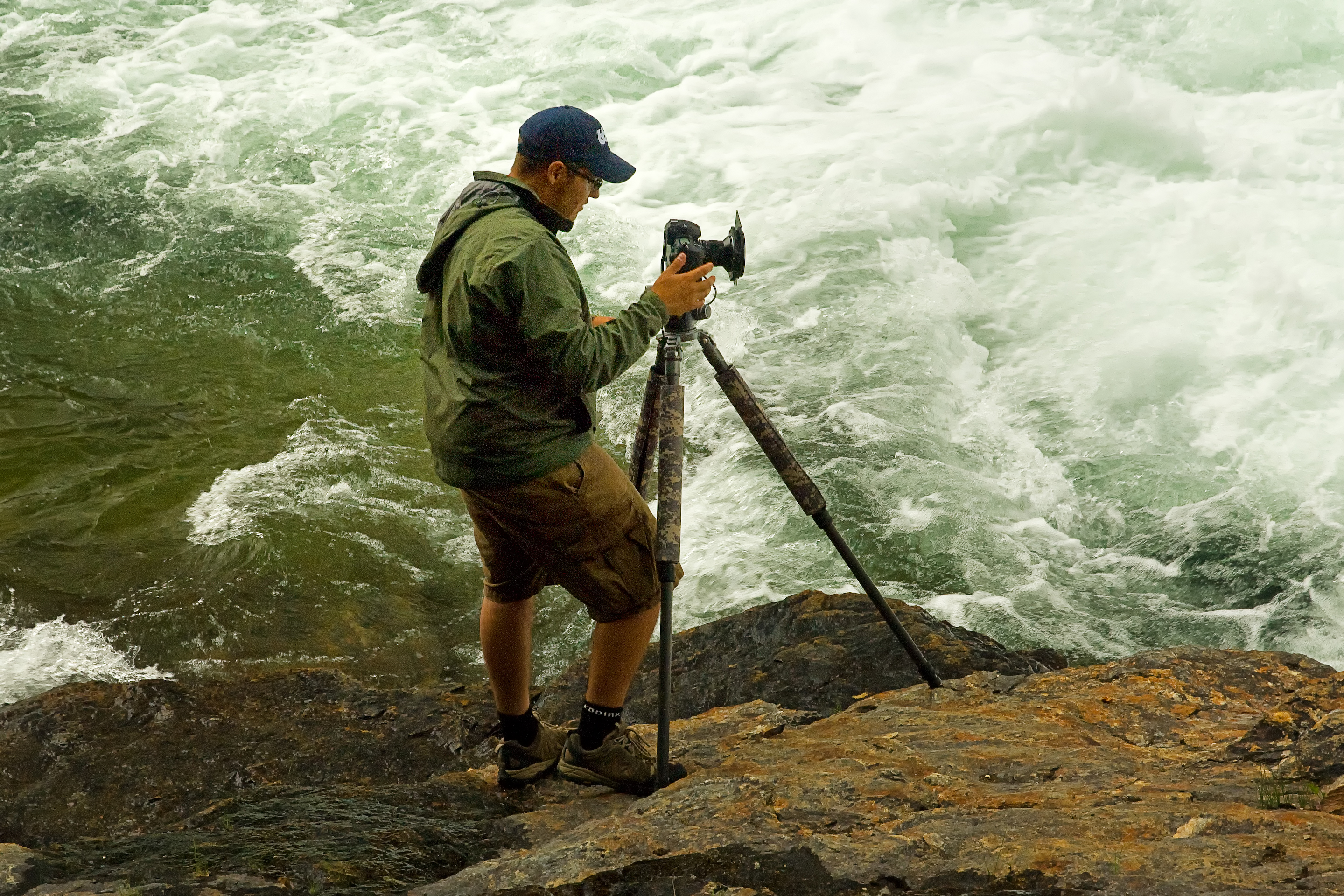
When I put my camera gear on the backseat of his car I had to move his tripod, and remarked that I liked the ball head he had attached to it. He said, “I always use a tripod”, and I thought to myself, “I think I’m going to like this guy.” There’s nothing like a tripod to let one know they are with a serious landscape photographer.

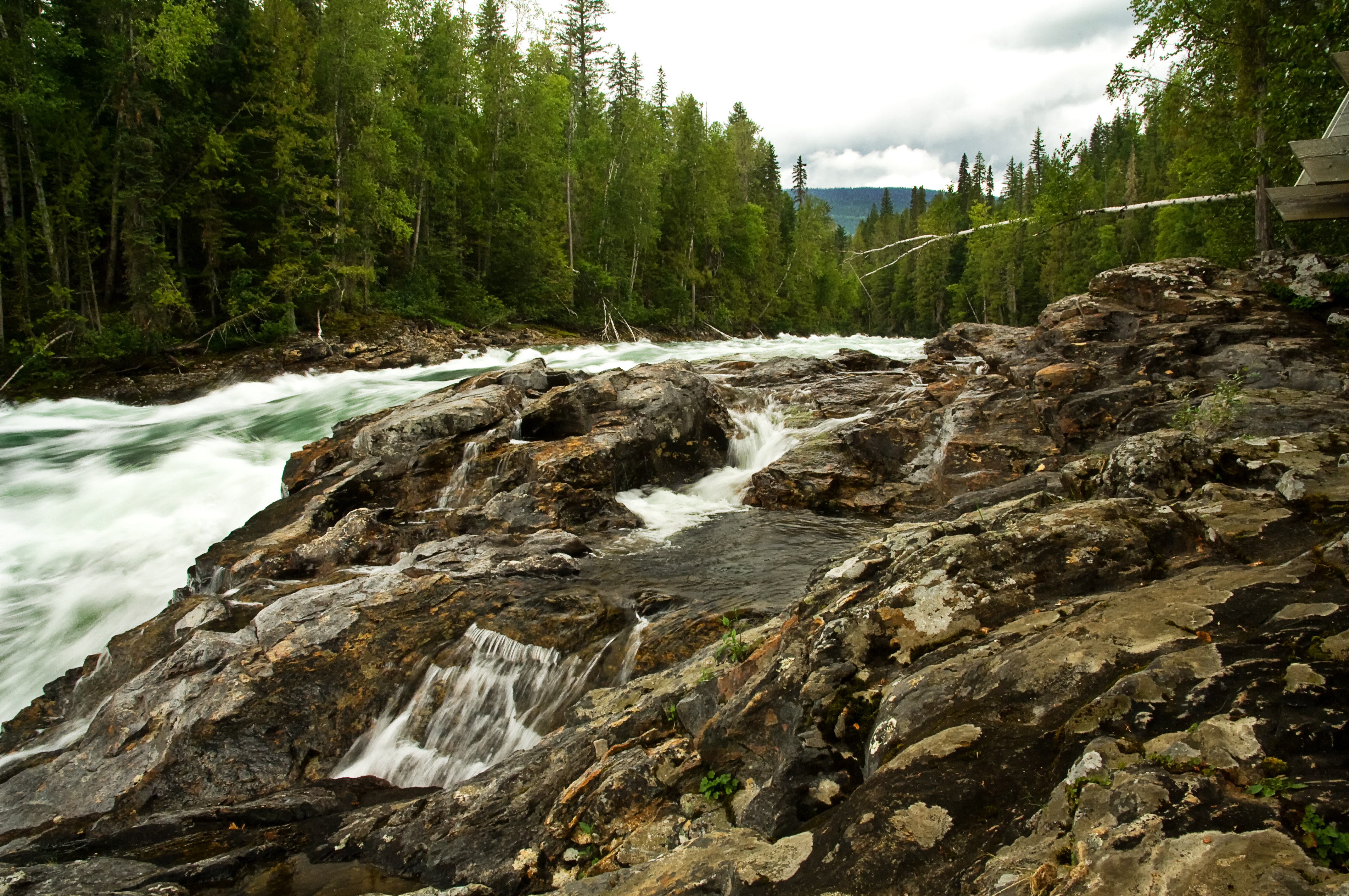
Wells Gray is a great park for roadside photographers with many places to stop, to photograph the spectacular waterfalls, old homesteads and the river’s many geological features tucked only a short walk away, and that is just what we did. Unfortunately, the wildlife was timid and we only briefly saw one black bear.

The comfortably cool day was excellent for photography with a slight overcast and high moving clouds. Jeff changed lenses and filters regularly as he worked the new environment, but for me Wells Gray has been a regular location for years and I was content to stay with my well-used, 24-120mm lens as I photographed the familiar landscape.

The internet is a wonderful way of bringing people together and I know I would really appreciate photographers extending hospitality to me when I travel to some far off place. In the event of any concern, checking up on other forum members is easy. I reviewed Jeff’s online posts (as he had mine), and when he wrote he was visiting BC I was sure he’d be fun to know and to stand beside as we made pictures. One doesn’t always have to participate as a host, but I am sure suggesting locations for photography would be appreciated. For local photographers who have never made the expedition to Wells Gray, it is well worthwhile.

Contact me at http://www.enmanscamera.com

Photographing a Rodeo

There is something about a rodeo that changes the visible culture, or, at least, what seems to be the normal dress code for many folks. Baseball caps are traded for cowboy hats, beige slacks and cargo pants are changed to blue jeans, and footwear for a day out with the family changes from running shoes or toeless sandals to cowboy boots. It could be that a sporting event like a rodeo is more a celebration of a lifestyle than others that are attended by fans donning a team jersey and cheering for their favourite team.

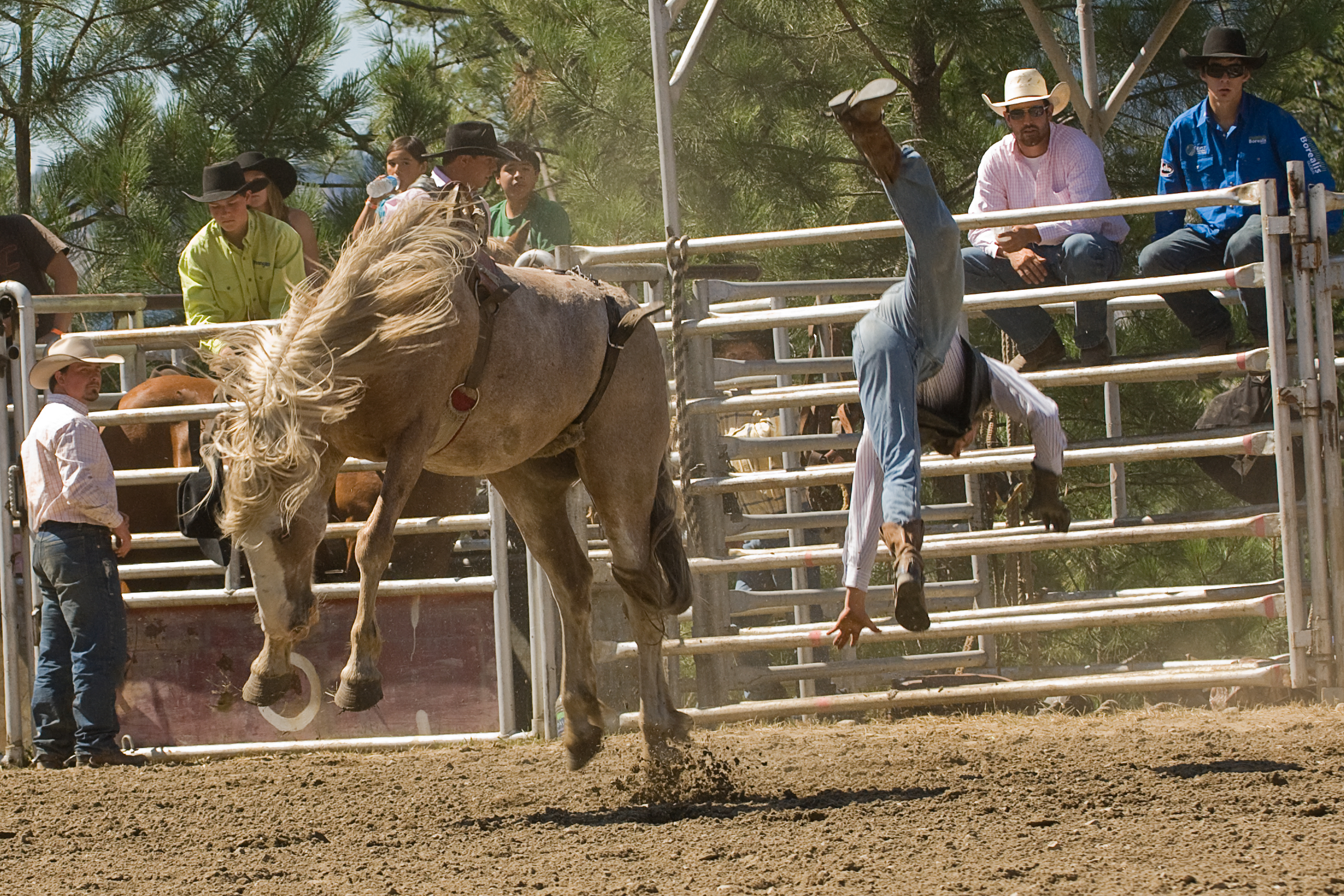
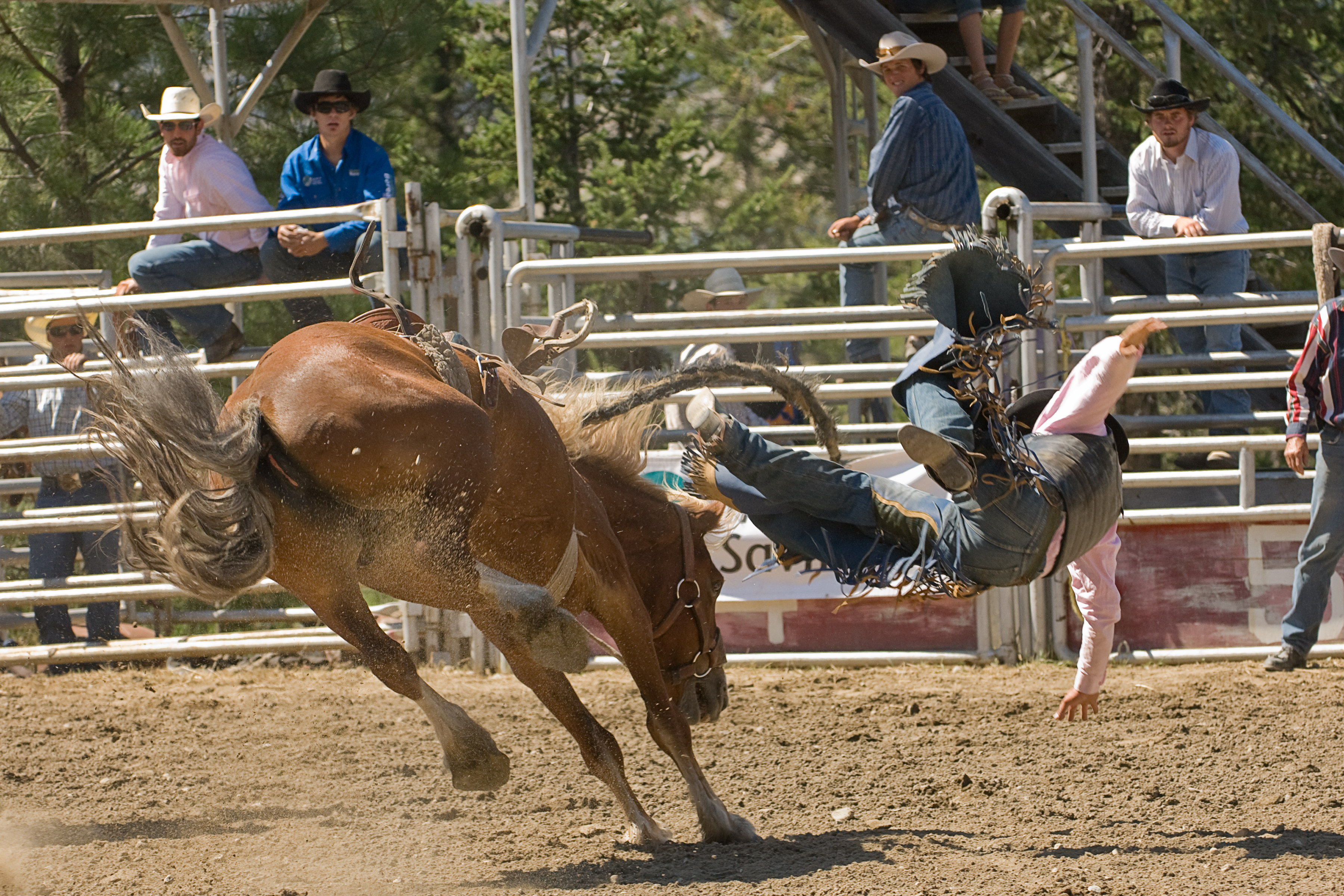
The 17th Annual Pritchard Rodeo was the first I have attended just for the sole purpose of photographing the fast-paced, explosive action, and I thought about the words of professional rodeo photographer Rick Madsen as I walked down the dusty road to the arena, “Each event in a rodeo involves more than one player. It is the interaction between man and animal, or in many cases man and beast, which makes the technical and creative aspects of rodeo photography so exciting and rewarding.”

I was late and the saddle bronc riding had started, but that gave me the opportunity to watch the photographers and I easily figured out who were the first-timers, the dedicated amateurs, and the experienced rodeo photographers. Anytime I am faced with a new photographic adventure I look to those with experience, and don’t mind asking questions if given the chance. I also realized there was time between riders so I would have time to check my metering and get myself in the best position for the action.

It was hot under the midday sun and a bright blue sky with riders starting from a location that was under deep shade, which was fine for them, but I knew that no camera sensor could handle that much contrast; and I knew I would have to make exposures before the participants reached the sunny area, wait, change settings, then start making exposures again when they were in the bright light. I missed the first, and then nailed the rest when I figured out the timing. I quickly learned how important it was to listen to the announcer, not only because he was expressive and fun to listen to, but also because he gave all sorts of important information a photographer could use about the horse and rider.

I am experienced at photographing sporting events, so other than the time it took me to know where to stand for each event, I was ready. My camera was mounted with a 70-210mm lens and I selected shutter priority mode, with 1/500th second shutter speed. The bright day let me get away with ISO200. I also selected the continuous shooting mode so I could get bursts of up to eight frames a second if I wanted.

I photographed from several locations then moved to one end of the arena where five photographers were working. There was a husband and wife team who said they were “just enthusiasts” that liked to photograph rodeos in their spare time. One fellow said photographing rodeos was a hobby, and he had just returned from photographing one in Arizona. I also met a vacationing photographer from France, and while travelling through Kamloops she had heard about the Pritchard rodeo and decided to spend an extra day to photograph the rodeo before continuing south to the Okanagan. We talked about photography and her trip, and, of course, I reminded her about the wonderful BC wineries she would be soon be driving by.

All those people were great to meet and added another dimension to an already great day of photography. Along with them, I met Bernie Hudyma (http://www.berniehudyma.com), an experienced and well-known photographer whose images regularly appear in magazines. In my opinion it doesn’t get much better than that when one is trying to learn about photographing a subject. He gave me tips on where to shoot, and once reminded me I had to take care as a massive bull charged the fence where I was and I quickly pulled back. (Just how heavy are those animals?) Nevertheless, it was a fun day of shooting and I ended up with lots of great photographs.

For those photographers that want to try something new and exciting, I recommend finding a local rodeo. Photographing those explosive moments, as Madsen puts it, “the interaction between man and animal… makes the technical and creative aspects of rodeo photography so exciting and rewarding,” which corresponds to how I found the experience – very exhilarating and satisfying.

http://www.enmanscamera.com