Enman’s Camera     

Gosh, sometimes I have a hard time with the realization that I opened my little shop to sell used cameras over 21 years ago. The time has sure zoomed by.

I had just left the University College of the Cariboo (Now called Thompson Rivers University) and was looking for something interesting to do during the week when I wasn’t making photographs for clients.

In those days wedding and family photographers worked pretty much only on weekends.

After photographing a wedding or family my time was mostly taken up packaging and mailing the rolls of film I had exposed to a custom lab. Then I’d wait about a week for the finished prints, and after putting them in an album I would again wait, this time for the wedding couple to return from their Honeymoon.

I had spent almost 20 years at UCC employed as a public relations photographer and as a part-time photography instructor. After leaving I plunged head first into the business of wedding photography.

I enjoyed photographing people, and I liked the money, but the frantic business of weddings almost every weekend during the year was tiring and could certainly be frustrating at times.

I regularly attended the Vancouver Camera Sale and had made friends with many of the sellers. So when a fellow named Brian Wilson approached me with a proposition to become one of several used camera shops he was setting up around the province I was easily persuaded.

Each of the shops would be part of the “Mr. Camera” group that would exchange and sell used photography equipment. Wilson wanted to start with three shops, one in Penticton another on Vancouver Island and “Enman’s Mr. Camera” in Kamloops.

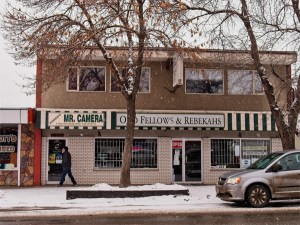
To make a long complicated story short. After a few years Brian Wilson decided he could do better as a custom print maker. Andrew, the owner of the shop on Vancouver Island, quit to sell Real Estate and Enman’s Mr. Camera became Enman’s Camera. (Although I never bothered changing the sign)

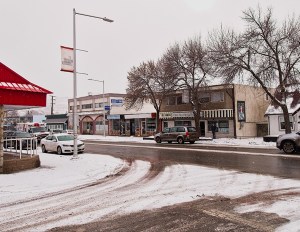
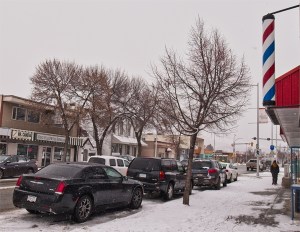
The building I rented a storefront in changed owners over the years, but I stayed.

My shop is unique. There are always photographers hanging out and the layout changes depending what I have for sale and I sell anything photographic.

I have never been much of a salesman. I try to keep the prices low with the thought, “What would I be willing to pay” and price everything with that in mind.

I’ll never get rich with that philosophy, but I do have fun. And at this point in my short life that’s my most important goal.

I live and breathe photography. I sell photography equipment, teach classes in photography, how to use flash, studio lighting and when not doing all that I wander with my camera and write my articles on photography.

I decided to retire from being a paid photographer some years ago. Photographing weddings, families and accepting commercial work and working 6 days a week at my shop came to a happy end. I changed Enman’s Camera hours to only Thursday, Friday and Saturday afternoons.

Now I get to just enjoy pointing my camera.

That shop is packed with twenty years of photography stuff and it’s always fun to go on a hunt to see if I have what someone is looking for. The years seem to have zoomed by, but I am still having a great time making pictures and selling anything for photography.
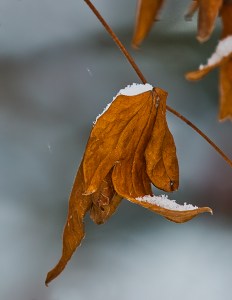
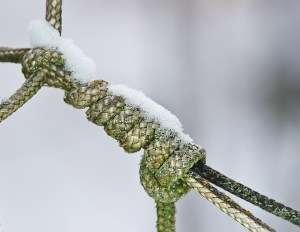


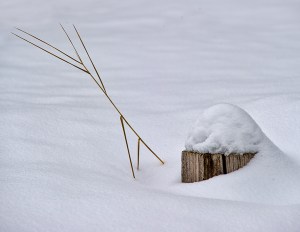
Photographing my winter garden.   

I hadn’t photographed my garden yet this winter. So when my yard got a good dump of snow this past week I decided it was time to grab my camera and see what there was of interest in the five-inch deep snow.

I have three Nikon macro lenses. Yes, I know readers are immediately thinking, “Why the heck does anyone need three lenses that all do the same thing?”

Well, I have a 60mm macro that is short, light weight and easy to use on a sunny day. But when the snow is deep it means getting knees, elbows, and even my face wet trying to get close enough.

I have a 70-180mm. It is very versatile because unlike other zoom lenses, it’s a true macro at all focal lengths. Sometimes it’s the perfect lens to take on a short trip when I expect a variety of subjects.

However, my favourite is an old 200mm manual focus macro lens from the 1970s that I have been using for about 30 years. It’s great as a 200mm telephoto and also as a close-up focusing macro lens.

It’s always fun to set all three on the table and try each out as I decide which will be the one to use.

Actually the 60mm and the 70-180 lenses get used more for portraits than close-up photos. Both are very sharp and the 70-180mm is light to carry around for outdoor portraiture, while the 60mm is a great lens when in limited space.

I mounted the 200mm on my camera, attached my ring flash to the lens and headed out into the afternoon light.

It was cold enough that the snow still clung to the plants and the sunny sky had clouded over so I didn’t have to struggle with the contrast between reflective snow and deep shadows. My timing was perfect.

It was trying to snow. I hoped for more, but all I got was scattered flakes.

I never know what to photograph as I wander around and around intrigued by everything. I had to keep reminding myself to pay attention to the background. A busy background runs the simplicity I prefer when shooting close-up.

I want my subjects to be “graphic” and to stand out with nothing interfering. The ring light flash helps.

I under expose the ambient light a bit so the flash becomes the most important light on my subject. A ring light is on the same axis as my lens and very directional. Someone that has never used one might think it would be overpowering. But placing a light close to my lens and being aware of its output power at different distances is more flattering for close subjects than a TTL flash sitting on top of the camera.

I could have used a couple flashes mounted on stands for even more creativity, but the deep snow would have been a struggle to move the stands through so I decided on the versatility of the ring flash so I could easily change camera position. (Winter work coveralls are also helpful when lying in the snow)

I like the garden in the winter. It forces creativity. Even a dull, lifeless subject becomes interesting in the snow.

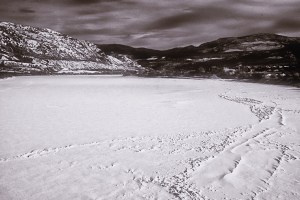
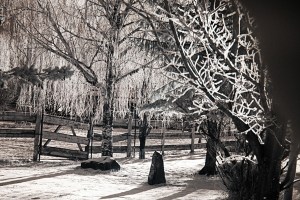
Infrared in the winter


My friend and photography partner, Jo McAvany, has been asking me to loan her my infrared converted camera for a while now.

Jo texted me when she went out to use it this morning.

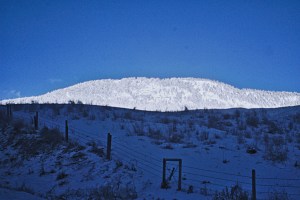
She had hoped for a blue sky after the recent snowfall, but the sun was only peaking out slightly when she drove off along the frozen back road up into the low hills above her home at 8AM.

Infrared and the snow always give a creative photographer a lot to play with. I would have wished for a bit more sun so the infrared effect would have been stronger, but she got some neat images in spite of the overcast cloudy morning.

I was glad it was her wandering along the roadside on the -12c degree morning instead of me. I thought about how many times, in all sorts of weather I have photographed the roads around my home in the past 40 years and how it’s about time for someone else to take that up. Doing it with infrared is perfect.

I looked back over some of the articles I wrote about infrared and saw this entry,

“I grabbed my old IR modified Nikon D100, mounted a 24-70mm lens on it and set off along the winding roads that make up the wooded and hilly location I live in.”

“That old 6MP camera has served me well, I purchased it new when digital cameras were finally making images with enough quality to compete with film. I photographed weddings, scenics and everything else that I once shot with film. Then when Nikon began offering better sensors with more megapixels I sat it aside calling it my “car-trunk” camera because I just left it in the car all the time.”

“I had always shot black and white infrared film, but it was such a hassle. Loading and unloading the camera in the dark and even waiting till late in the evening to process it in metal tanks because I worried there might be some stray light creeping into my home photo lab.”

When I read about infrared conversions for digital cameras I sent that old Nikon away and about a month later for a few hundred bucks I had an infrared camera.

Jo has never shot with film. She began her photographic journey after digital took over. Now she gets to move into a different kind of light by using my IR camera.

There is not much difference between one digital and the next. Sure the sensors keep getting better and one can choose a full frame over a cropped frame, but if printing a large photograph isn’t part of the process its pretty hard to tell one camera from the next.

The images Jo got are a fun change from the colourful pictures or sharp black and white photographs she is used to. Infrared is always a crowd pleaser.

Using an infrared camera is the best way to step away from what other photographers are doing.

I have written about infrared photography many times before, so I’ll just end this by repeating myself, “Shooting infrared is always an exploration, a discovery and moves a photographer far from the usual.”


Photography on an overcast day

I have been trying to get outside to wander in the snow the past week with my camera, but everything kept getting in the way. So when Jo told me she had to take her daughter to a doctor appointment I asked her to drop me off at my favourite wandering place, Chase Creek Falls.

I figured that would give me at least an hour to take some photos and I was hoping to be alone in that snowy canyon on the cold, overcast Monday morning.

I like storms and I like the mood one can get in a photograph on an overcast day.

Jo dropped me off along the road and I walked down along the well-worn path through the snow. I picked a good day. From the looks of all the trodden snow, Sunday must have been pretty active.

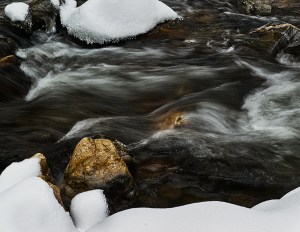
Stopping along the creek to take a long exposure of a rock glowing golden in the cold water I thought about why I like digital cameras and all the photographic creativity that goes along with modern technology.

I continually meet people that assume someone my age would still be using film. Gosh, I could fill page writing about why I don’t bother photographing anything with a film camera. At that moment as I mounted my camera on my tripod to photograph that glowing gold rock I thought about how hard it used to be to make pictures on overcast days and was glad for the modern equipment I have.

I mounted my 24-70mm lens on my camera and selected an ISO of 1600. Then set my shutterspeed to eight seconds, chose an aperture of f/11 and with the camera’s self-timer activated, I pushed the shutter release.

I refocused on a couple different rocks in the creek besides the golden centre of interest to make sure my depth of field would cover everything in my viewfinder. Then I released the shutter a few time and moved on down the stream.

Sunny days are such a struggle for a photographer wanting to photograph a waterfall.

Sure one can get a pretty, bright landscape, but I like to have contrast in the water when I use a long exposure, so overcast is great. And on this day I wanted to capture the cold winter mood and if I really needed to highlight a particular feature like a rock or log or foliage I’d just do that in later in post.

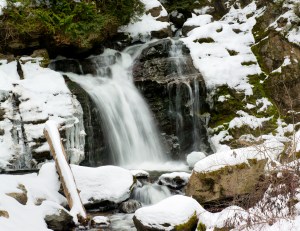
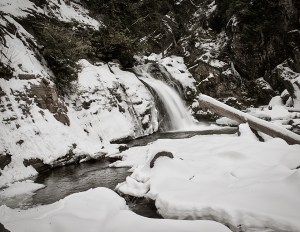
The Chase Falls is always a perfect subject. All I had to do was poke around in the snow with my tripod to make sure there weren’t any spaces between the rocks or soft spots in the ice as I moved around photographing the falls from different locations, eventually I sat on a bare rock to listen for a while and look at the monochromatic January landscape.

I am fortunate not to have to drive and hike hours to enjoy such a photogenic location. Now I am waiting for more snow so I can collect winter photographs in the garden that hides my home from the road. Today there is a light covering of snow, but it’s been so warm that the snow isn’t clinging to the plants.

Ah, but its January and there’s a few more months of snow to come and more winter photography.
Photography at that year’s end party.


I’ll be having some friends over to my house to bring in the New Year with me and I want to make sure I get some fun photographs that I can give them to remember the end of 2018.

With that in mind I decided to repost this article I wrote back in 2013 about photographing parties.

I can hardly believe how fast this year has gone by, wasn’t everyone just complaining about the unforgiving summer heat? Now, here we are bundled up in the -6c cold and snow with snow tires mounted on our cars. Gosh, there is even an advertisement on television about what wine to bring to upcoming New Years Eve parties.

Don’t get me wrong I like this time of year and everything that goes with it, but I am not ready for winter’s snow yet, and neither is all the stuff in my yard that will get covered if I don’t get off my-lazy-whatever and pick them up.

Even though it seems early, the year’s end is here and that means photographic opportunities as we join family, friends, and co-workers at all the festive events.

Photographer friends are going to dive in, digital cameras in hand, happily filling memory cards with candid photos.  Picture taking has become so easy and so much fun as photographers rush over to take a picture, look at the LCD, and quickly slide back to show others those tiny images.

Photography for many has become more about the process of picture taking than it is about creating art, or even documenting the party; it seems its more about standing in front of people, taking lots of quick snapshots, than it is about making memorable photographs.

Most images made in this fashion never become more than space-taking files stored on computers or phones that after quickly being looked at, laughed at, or just smiled at, are tucked away with good intentions to be used in some fashion in the future. But after that initial viewing they loose their value because there are too many, and very few are good enough to give to others anyway.

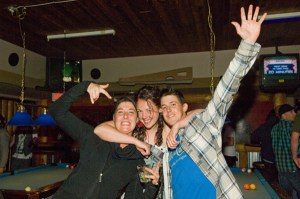
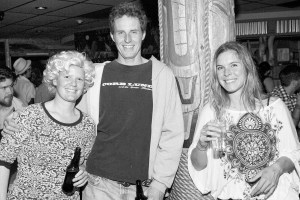
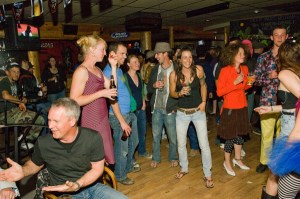
How should readers approach photography at the next party?  I do think we should continue to make candid photographs of people having fun, but, perhaps, one might also think about making pictures that tell a story, capture an exciting moment, and importantly, flatter the subjects.

Most people don’t mind seeing a picture of themselves being silly or having fun, but they don’t like pictures that make them look stupid or unattractive.

My approach is to take a moment to look at the room in which I intend to make photographs, make a couple of test shots with longer shutter speeds (my favourite is 1/60th of a second), to include some ambient light when making exposures using a flash mounted on-camera (bounce flash of course) so as not to end up with brightly lit faces surrounded by a black environment.

When taking group shots with two or three people, get them to position themselves so they are squeezed together with a tight composition, and include only a little background or foreground. Don’t shoot fast, steady the camera, and select a shutter speed that includes the ambient light.

Fortunately most modern DSLRs easily allow ISO sensitivity that is 1600, and some go a lot higher.

Shutter speeds of 1/60th of a second, or less, don’t always work for children playing in the snow during the day because moving subjects will be blurry, but, with limited indoor lighting moving subjects will only be exposed properly when the flash goes off.

Lighting everything with complicated studio equipment would be great. However, the occasion would become more about the photography than about the fun and festivities.  I use an on-camera flash and make adjustments as I go. I want to join in on the fun, not act like a photojournalist.

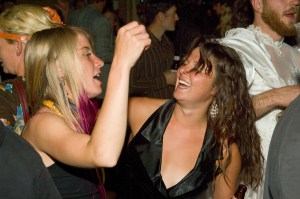
Family and friends don’t mind having their pictures taken as long as its enjoyable and I want pictures that show them having a good time. So, along with those quick candids I make posed portraits with smiling faces, and if I select some prints to give away later I want people to like the pictures and honestly thank me.

The Canadian Pacific Railroad Holiday train 


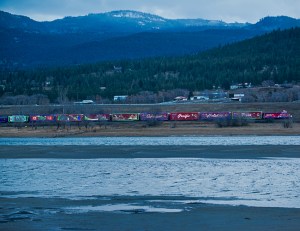
Every year the CPR holiday train chugs its colourful way across Canada from east to      west. The train makes stops at cities along the route where there are crowds of people waiting.

Those of us in rural Canada might miss assembly with all the festivities in the city, but we get to watch and, in my case, photograph that brightly lighted Christmas train as it winds its way through the wooded Canadian countryside.

As I drove from my home down to the river valley to again photograph the Holiday train I passed people waiting in their cars parked in the area between the little Pritchard store and the train tracks just off the highway.

I have tried that location in the past, but it’s so close to the train that the only shots are on an angle. And to make it worse this time, a long freight train was waiting in the perfect position to block the view of the train after only a couple minutes.

My favourite place to photograph the train is from across the river. I drove past my neighbours, crossed the bridge and stopped along the river and walked out on the wide beach to set my tripod up.

I like the long wide view across the Thompson River that even using my 70-200mm lens lets me photograph the whole train at 70mm or just a few cars at 200mm.

That beach location allows me to capture that locomotive and it’s bright boxcars in a scenic view.

The train usually passes through Pritchard when there still is enough light to see the train. I saw a few pictures that were taken after it stopped in Kamloops 30 minutes later, and they only showed neon lights with an empty black background.

I chose an ISO of 800 when I first got there and took a few test shots. I walked around to choose a nice flat place where I didn’t have to stand in the mud. Gosh, mid December and no ice.

I will say that, although I had a better location than those on the other side of the river, I envied the fact that those waiting at the Pritchard store had hills that blocked the unpleasant, cold wind that blew at me across the flat wide river.

I joined by my friends and their children out on the beach. Jo had her stocking hat pulled down over her face and was crouching with her camera trying to get out of the wind.

I covered my ears and set up my tripod as I watched her 3 and 4 year olds running around on the muddy beach, oblivious to the cold, as they excitedly waiting for the train.

They had been to town earlier in the day to meet Santa and now running on the beach and seeing the brightly lite Holiday train was like the icing on the cake.

By the time the train came I had to push my ISO up to 1600. I was using my tripod, but with the all movement I decided the higher ISO would let me keep my shutter at a safer speed.

I think this will be the last photos of Christmas lights for this year. As always, it’s been fun. There isn’t any snow yet, but the snow will come soon I am sure, and I’ll be out again with my camera to make some pictures of that white playground.

I can hardly wait for the snow. But for now I’ll wish a very Merry Christmas and a Happy Holiday to all of you.


Photographing the lights of Christmas  

I like Christmas. I like the gaudy colours, the music, and especially the lights.

Regular readers might remember that last December I wrote that as a child my parents used to bundle my brothers and I into the family car and drive up along the high avenues around Salt Lake City so we could look down on all the decorative lights in the valley.

We even got hot chocolate from my dad’s beat up old thermos that my mother would pour for us when we finally stopped on a hill high over the city to view the lights. Although these days my drink of choice is usually wine or beer, when Christmas rolls around I have a yearning for hot chocolate, and I’ll shamelessly admit to being a Christmas light junky.

Last year I also wrote that for years I had business in Kelowna, British Columbia. And during December I always made sure I brought my camera so I could go out at night and then again at morning’s first light to photograph the Christmas lights along the city streets and waterfront.

I no longer have work to do in that lakeside city, but on the weekend of December 8th I packed my camera into my car and headed south to what I suppose will become my overnight Christmas light photography sojourn for years to come.

I left early enough, wait…that’s not right. “We left” is more the accurate.

Last week when visiting my friends Jo and Shaun I mentioned that I was planning on spending Saturday night and Sunday morning photographing Christmas lights.

I had barely returned home when I received a text from Jo telling me that she had talked her husband into letting her go and could I get her a hotel room because she would be joining me if I didn’t mind. So “We” left early enough to stop for some quick shopping, check in to our hotel and walk down the street to the eatery I had spent my evening at last year before going out to photograph the lights.

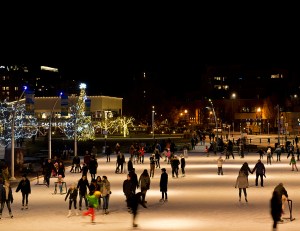
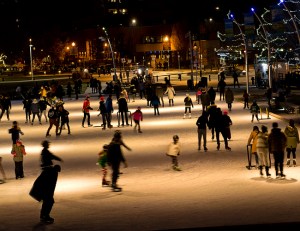
Last year I was disappointed that the weather was to warm and they wouldn’t be opening the outdoor skating rink until after I was gone. However, this time the days were colder and it was packed with people.

I don’t like choosing auto modes on my camera unless there is a good reason. Shutter Priority for a fast moving event like a rodeo, or Aperture Priority for subjects field like flowers that require controlling depth of field.

On dark nights with moving subjects I prefer the Manual mode. I can be in complete control of how I want my subject to look by changing the ISO, the Shutter and the aperture depending what I want. That way I can balance the light so the final image doesn’t look unnatural.

With the Skaters I wanted to see some movement. I knew there would be people stopping, moving slow, and of course passing very fast. All I had to do is work with those three controls to create the photograph I wanted.

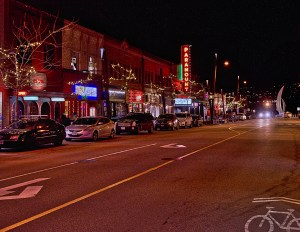
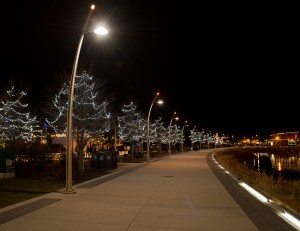
We spent the night photographing the streets, decorated boats moored along the lake, the lakefront walkway, lighted trees, buildings and just about anything in front of our cameras.

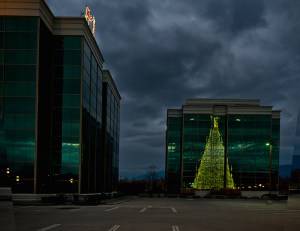
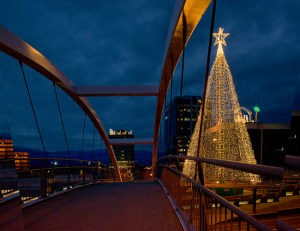
We were up before dawn waiting on a highway overpass for there to be just enough daylight to give buildings some definition. We were there to photograph Kelowna’s 120 foot tall Tree of Hope.

For 20 years, the Tree of Hope made up of about 25,000 LED bulbs has been a symbol of inspiration, giving, and hope to the community.

I like to photograph that light bulb tree. Most photos I see of it either shows no background because it is photographed after dark or too much background because it is photographed after the sun has come up.

I want to barely see beginning blue of the sky. To see buildings with the tree reflecting in their windows and I want the light to vivid and colourful. So we stood in the dark and waited for the early morning sun. This time we lucked out with a cloudy sky.

All we had was about 30 minutes of shooting before the sun came up. Then it was back to our hotel to eat breakfast, warm up, pack our gear and head home.

Repeating my words from last December, “Night photography (well actually, early morning photography) gives a city such a nice mood that isn’t really manifest during the day. I like the mystery and, of course, this time of year the frosting on the cake is the wonderful Christmas lights.”

Photographing a November garden   


For years I have made sure to wander my garden with my camera in every season.

I know most photographers are only interested in the bloom of spring or glorious colours or fall, but to me it’s as much how the yearly changes shape the plants as it is the colourful presentation of spring and fall.

I like to walk around the garden that hides my home from the country road that borders my property. Spring, summer, fall or winter. I enjoy it.

It was on a late afternoon just after 4PM. I walked out on my porch to listen to the coyotes serenading the neighbourhood. Or maybe they were complaining loudly that the wet cold weather was making it hard to find food that normally scurries in the meadows.

Friends have commented that it must be nice to live away from the noise of the hustling city. However, at that moment it wasn’t only the coyotes that were disturbing my supposedly quiet rural life. Three roosters, fourteen chickens and five ducks were all making sure I knew they were as important as the coyotes in their forest home.

As I lazily kicked some fir tree branches out of my path I thought about how the cold plants looked interesting and decided to get my camera.

I mounted my 200mm macro on my camera and attached the ring flash and walked along the little pond to take some pictures. After about five not-so-sharp captures I chastised myself for being lazy and returned to my house to grab a tripod.

A photographer I met that worked for a couple magazines once asked me, “What is the difference between using a tripod and not using a tripod?   “The shot with the tripod is the one the editor chooses for the cover.”   I am not sure if that’s always true, but I am sure using a tripod (and a flash) when photographing plants and gardens give me more keepers.

The ring-flash creates a smooth direct light that is very different from the flash mounted top of the camera. There is a sparkle to the subjects.

I always use a flash for plants.

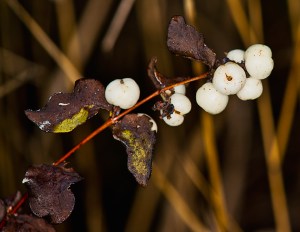
I begin by metering the ambient light as if I were about to photograph the flower without a flash. Then I stop the aperture down to under expose the picture. In the low, bright November light I wanted to darken everything but my subject.

Sure one could open the aperture to reduce the depth-of-field and soften the background. But the closer the lens is to the subject when doing a macro or close-up photograph the less the field of focus in front of and behind the subject will be anyway.

I want as much sharpness as I can get around the flower. So instead of relying on the aperture to separate my subject from a busy background, I reduce the ambient light.

My ring-flash is set to manual so all I need to do is experiment with flash distance. I move forward and back to give the plant the light I want.

The ring-flash has a diffuser and I use a 200mm macro lens. The magnification is the same as with a 50mm or 105mm macro. I just get to be further away and that distance is more effective for the ring-flash.

There isn’t much more relaxing photography than garden photography because the subjects usually cooperate.

December has just overtaken me and I have no doubt that festive Canadian month will bring a totally different garden to photograph.


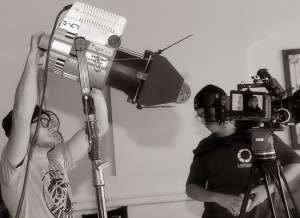
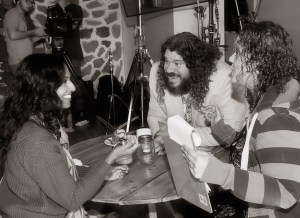
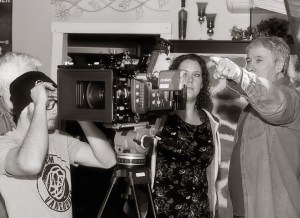
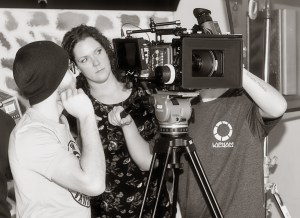
Photographing behind the scenes for a movie.

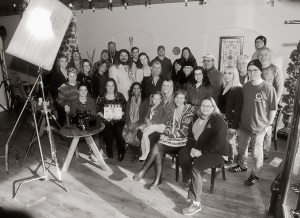
This past week I was again asked by writer and director, Cjay Boisclair if I would be the “stills photographer” for another movie she was directing.

Ms. Boisclair was this year’s winner of the WIDC (Women in the Director’s chair) “short award”. That award allowed her to hire a cast and crew for her latest movie called, “Stood Up”.

When I wrote about my experience as a movie stills photographer last June I said that I drew on my background in Public Relations photography. PR photography is physically active, with never a chance to sit and where one must to constantly be looking for animated subjects to be successful.
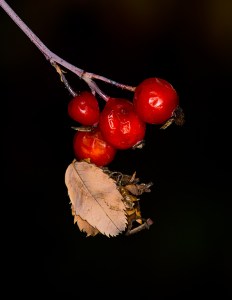
So at 7:30AM I was lurking at the edge of the action voyeuristically capturing behind the scenes activity, and documenting the interaction and hard work of the people in that were making that movie happen.

I like tight shots that force the viewer to get involved with the subjects. I also like my subjects to be well lighted. I see no use in wide shots that have dimly lit people in the distance.

The beauty of my full-frame, large mega-pixel, camera is I can shoot wide and decide how the action and subjects are cropped in post-production with out any loss in detail or image noise in my final photograph.

I stay with a 24-70mm lens because I don’t get the edge and corner distortion of wider-angle lenses.

Modern TTL flashes offer the opportunity not only to bounce the light in any direction, and also allow one to increase or decrease flash power depending on the environment and proximity of the subjects.

When I give beginning wedding photographer’s advice on photographing receptions in large low lighting rooms, I always tell them to slow down their shutterspeed to increase the ambient light. Those “deer-in-the-headlight” type photos that are painfully common in beginner’s photos are so easy to correct by just moving the shutter dial to 1/125th or even slower.

Its that technique I used when photographing the behind scenes action. Indoors I would shoot wide with a slow shutter and outside I use the high-speed sync feature to increase the shutterspeed as needed to balance the flash in the daylight.

As with the last time I photographed for the movie’s director, I am after those classic images I have seen in the old newsreels of the Director in action. Pointing, talking to the actors, or working with the cameramen.

Photographing on a movie set is certainly entertaining experience. I have always thought that movie people were a special breed, and again this time, my first hand experience with the actors and the crew as they creatively worked, more than proved that to me.

Kelowna’s October waterfront  


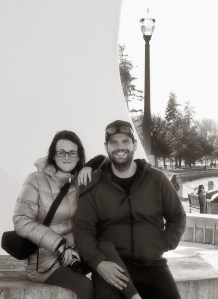
My friends Shaun and Jo McAvany decided to join me on a on a two-day trip to Kelowna.

Their anniversary had just passed and they had spent their honeymoon 9 years ago in Kelowna so I guess the trip was appropriate for them.

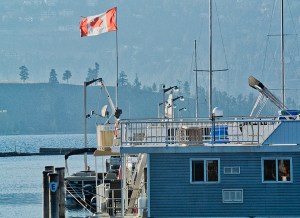
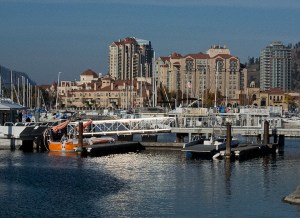
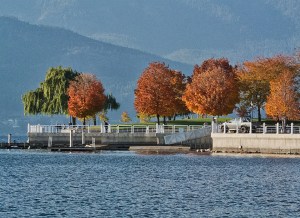
For me it was a chance to spend some time in a bigger city with it’s fancy eateries and, of course, to wander Kelowna’s waterfront with my camera before winter’s snow and ice covered everything.

They dropped off their kids at their grandma and grandpa’s place, found a friend to take care of the menagerie of dogs, cats, rabbits and what ever other animal they have rescued the weekend and jumped into my car to join me for the scenic two hour drive.

Although the Kelowna lake waterfront doesn’t have exactly the same feeling as Vancouver’s seaside, it’s pretty close. And the last days of summer are a perfect time to photograph the colour and mood of the freshwater foliage that mixes with city structures dedicated to tourism.

For this photographic trip both Jo and I carried our little Nikon mirrorless cameras. The Nikon 1 series doesn’t have a very big sensor, but if one isn’t going to be printing 11X14 or 16X20 enlargements, it’s the perfect interchangeable lens travel camera.

The weekend was sunny and it was light jacket weather. In the morning we shopped at 2nd hand stores, then ate lunch at a restaurant called Memphis Blues. (One of my favourite dinning establishments in that city) then spent the rest of the afternoon taking pictures along the waterfront.

One might say that my goal is to experience a different aspect of photography each week. I’ll admit I try very hard. Last week I was at a wondrous wilderness park with few people and this week at one of British Columbia’s premier vacation cities with lots of people.

I am not sure if it’s those changing opportunities that called me to photography, but the range available to those that answered the call of photography is certainly a grand side effect.

Doing photography with another person is fulfilling. One might be at the same location, and even with the exact same camera, but how each person chooses to creatively photograph that location, in my experience, is always very different.

Well that photography adventure is over, I have looked at Jo’s photographs and she has looked at mine. Yes we were at the same place, but our view was very different.