Event Photography

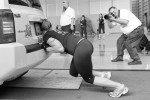
A couple of weekends ago I assisted photographers Rick Tolhurst and Ty Korte photographing the Femsport Challenge held at the Tournament Capital Center in Kamloops.  This event was advertised as the Women’s All Strength & Fitness Challenge and after interviewing several area photographers the organizers selected ShotsbyRick Photography to officially document the event.

Tolhurst approached me to be backup for him and Korte in case of unforeseen problems, and also asked me to setup a photo studio for team portraits. When he asked for assistance I thought that lots of unseasoned local photographers had likely applied for the job.  With modern technology many amateur photographers believe all they need is a new DSLR to match the pros, however they aren’t experienced enough to realize that if this competition was important enough for the organizers to go through a section process for a photographer then it also demanded more than an expensive DSLR and a willingness to try something new.

 In my opinion an event photographer’s first goal is to successfully document everything that happens. The second is to compile enough images to be a narrative of the occasion, and then third, and maybe most important, to create photographs that tells individual stories about those that attended, or are the main focus of the function.

 I felt that Tolhurst and Korte, and the occasional news photographer, were more than enough photographers on the floor of the event. There were lots of friends, family, and well-wishers, all trying to snap pictures of their favorite athlete and if I was on the floor I would be one more person to block their view.  I moved in when I saw angles that weren’t covered, or to get some pictures I could use for this column, and I also wanted some shots of the two photographers that I could give to them. I saw myself as a back up in case of problems, but mostly I was there for team photos.

 All three of us were prepared with wide aperture lenses in case of limited lighting. As it was the Tournament Centre had excellent ambient lighting from high skylights and I expect most shooters only used wide aperture when wanting to blur out the background.

 Tolhurst carried two cameras, both set at 400 ISO, one mounted with an 80-200 and the other a 28-70mm. Korte worked with only one camera sporting a 70-200 lens. I think his camera is easily capable of producing image files at ISO 800 without any background noise, and I think that’s what he used. For my excursions onto the floor I used a 24-70 and 400 ISO.

 Experienced photographers consider a balance of ISO, shutterspeed, and aperture. Photographers need to know just how high an ISO their cameras will operate at without image noise, and yet still produce reasonably-sized, quality enlargements.   To do that requires some experimenting beforehand. I know my camera produces sharp, clean, noise-free images that are easily enlarged to 16×20 (or larger) if I stay around ISO 400. That even gives me comfort room for cropping if I need.

 When I arrived I immediately started checking for the highest shutterspeed and smallest aperture combination. A wide, background-smoothing aperture is great for portraits, but I wanted enough depth of field to allow for quick moving athletes to be shown. The higher the shutterspeed the better one’s chances are to stop action and I knew both Tolhurst and Korte wanted fast shutter speeds and Korte even mentioned, as he walked to the floor, that he would like to use 1/500th second.  All that aside, I also wanted enough ambient light to illuminate the background in some shots, so when I felt my subject was at peak action or stopped for a moment, I actually reduced my shutter speed to 1/160th of a second.

 The Femsport Challenge was packed with excitement; lots of action and the location had great ambience with bright even lighting. All of which made for great opportunities to capture excellent photographs of the many participants.  Overall it was an enjoyable way to spend a Saturday and by the time the day was over we had loaded over eight thousand images into Tolhurst’s laptop.

Recommendations for photographing a christening

This week I replied online to a plea from a photographer wanting information about how to photograph a Christening. He had been persuaded to fill in for another photographer, and, although a good landscape and architectural photographer, and aside from pictures of family and friends, he was walking into new territory.

I have photographed christenings before, and, other than the unproductive time sitting and waiting during services, the event is actually pretty enjoyable. To that worried photographer I commented how I would photograph everything and included a suggestion not to make things complicated and to have fun.

I advised that he should to be as versatile as he could be, and I suggested he leave his fixed focal length (prime) lenses home. Today there is lots of interest in using non-zoom lenses like 50mm, 35mm or 85mm. But in the limited space of a family packed room or child’s bedroom I prefer a short zoom like 24-70mm or even something wider like my 16-85mm that allows me lots of versatility without the hassle of carrying and continually changing lenses.

I am not concerned about a wide aperture because I want family members to be in focus so lots of depth of field is important. I always use a flash, and with small children keep the diffuser cap on and aim toward the ceiling so the light bounces around filling the space, and I shoot like I am at a sporting event, quickly making exposure after exposure in hopes of catching that fleeting smile on the infant’s face. Nevertheless, I’m always patient; I don’t want parents to get frustrated as they try to entice the perfect expression from their child and advise them its ok to do something else and we’ll try again later. I learned years ago that when photographing children one needs to just wait until they are ready.

Modern photographers suggest a second flash held by an assistant off axis for more flattering light. I surely agree if there are two of you. If I can I will use a second flash, but in tight spaces, or a room filled with people, finding a place for a stand-mounted second flash becomes a problem and in situations where family is important, I would never presume to clear the room so I can be an artist. In my opinion it’s all about making each place and time work.

The photographer also questioned about the church and restrictions. In a Catholic ceremony like he was about to participate in I suggest finding the priest before things begin, introduce himself, tell him he is working for the family and ask what the rules are.

I have been working in the same town for years and am familiar with most clergy, however, even when they recognize me I still ask them if there is anything they would rather I refrain from doing, and after I am done I always, always take the time to thank them. I want their trust and to be remembered as the kind of photographer they like at their church service.

During the baptism I am continually moving around. I use a flash and choose shutterspeeds like 1/125 or 1/160 of a second so I can incorporate ambient light. I want the priest in the picture as much I can, and position myself so both he and the parents are visible. Fortunately, it’s possible to lighten those in the background during post-production.

Photography inside a church is much the same as any indoor location. Light the subject, try getting as much as possible in focus, watch the subject(s), make them look as good as possible in the photograph, be patient, capture as much of the action as possible, and have fun.

Anyone can take a picture

“Anyone can take a picture.” That complaint was made by a young photographer worrying that his photographs would not stand out in against those taken by so many other picture takers in this popular, expanding medium. His goal is to produce images that are visual statements of how he feels and are more than just of document of something.

The medium of photography has become very accessible for everyone. The days when a photographer had to be an engineer and chemist are long gone. With modern technology, today’s supercharged camera, machine-gun-like shutters, and seemingly speed of light focusing, many photographers get away without any knowledge whatsoever of photography. At one time photographers actually had to understand the combinations of shutter and aperture for a properly exposed image, and worried about camera shake and film choice. Photographers would carry more than one camera because they wanted the resulting photographs to be in both color and black and white.

The photographer holding his old 1980’s film camera that says, “all this digital isn’t real photography” must remember that a few short years ago photography needed large glass plates, hazardous chemicals, bulky cameras and wagons to carry everything.

I am not sure that the photographers of the late 1800’s or early 1900’s were interested in photography as a creative medium as much as they were interested in a way to document reality, whether it was convincing some person to sit as still as possible for long time periods or setting up unwieldy photographic equipment on a cold mountain top to photograph the view. I expect many photographers that loved the advancements of the 1970’s and 1980’s would never have tried photography if it had remained like that.

There are those that are intent on complaining that with the end of film comes the end of photography. Personally, I don’t think film is going away any time soon. (Film is just one part of photography.) The big box outlets may not carry it much longer, but there are lots of specialty items artists use that are only available in specialty stores, and I think the return of film at camera shops is a good thing, as, at least, the chances of getting the correct advice from the person behind the counter will be more likely.

Yes, anyone can take a picture nowadays. That’s a good thing and not something to complain about. There are lots of nice photographs being taken and most of them fall into the category of documentary or snapshot photography. People just want visual memories and today’s cameras are perfect for that.

I look forward to seeing photographs made by that young photographer and others like him. My advice was to use all the exciting technological advancements (because photography has always been about technology) he can get as he strives to make his photographs more than just a picture. He will work hard producing images that will be technically perfect visual statements about what he feels or wants to say. There are many photographers, myself included, who are interested in the resulting photos no matter how the image is produced as long as the final photograph has something to say, shows control over the technology used, and is visually exciting!

His critical comment “anyone can take a picture” shouldn’t make him worry about competition; and he should look forward to the future of this exciting medium.

The Photographic idea

Ansel Adams, in the Forward to his popular selling 1950’s book “The Print”, said, “Photography, in the final analysis, can be reduced to a few simple principles. But, unlike most arts, it seems complex at the initial approach. The seeming complexity can never be resolved unless a fundamental understanding of both technique and application is sought and exercised from the start. Photography is more than a medium for factual communication of ideas. It is a creative art. Therefore emphasis on technique is justified only so far as it will simplify and clarify the statement of the photographer’s concept.”

I have read and flipped through “The Print” many times since I got into photography. I think that it was almost required reading for photographers once upon a time, especially for those dedicated to spending hours of time in dimly-lit darkrooms peering at paper prints as they slowly materialized in smelly, liquid-filled trays.

There was a series of books by Adams from a period when photography was about striving for the perfect negative and a good final print, but those concepts are all but forgotten in this age of hi-tech, computerized image making. Those days are long gone, we don’t worry about a perfect negative any more, because even if the image file produced in-camera isn’t perfect, most images, especially RAW files are easily colour balanced, cropped, and sharpened. Contrast can be decreased or increased and the final picture doesn’t show any sign of resizing or noise reduction. And increasingly, the trend for many photographers has become to not make prints at all.

I find that Adams’ Forward in “The Print” is as worthwhile now as it was in 1950. Even with the changes of how an image is managed and finally used (whether print or electronic) the thought process and technique are important. Adams wrote about the technique of taking the picture, then the method used to develop the negative, and then finally the printing procedure. He might as well have been talking about transferring image data from a DSLR to computer, optimizing the RAW files in PhotoShop, and outputting to a personal printer for the final print. I thought about that as he continues, “We may draw an analogy with music: The composer entertains a musical idea. He sets it down in conventional musical notation. When he performs it, he may, although respecting the score, inject personal expressive interpretations on the basic patterns of the notes. So it is in expressive photography: The concept of the photograph precedes the operation of the camera. Exposure and development of the negative (RAW image file)(my remarks in parentheses) follow technical patterns selected to achieve the qualities desired in the final print, and the print itself is somewhat of an interpretation, a performance of the photographic idea.” I have always liked that final sentence of his “…the print itself is somewhat of an interpretation, a performance of the photographic idea.” Those words always remind me, as Adams put it, that, “Photography is more than a medium for factual communication of ideas.”

Modern photographers appear to be obsessing with each new offering manufacturers place on the table, and the obsession with technology may often look to be what photography is really about, and I do admit that it is fun, but photographers may need to be reminded that, “The concept of the photograph precedes the operation of the camera.” And that is why this mostly outdated book is still on my bookshelf, and why I regularly open it up. After all the prattle about what the newest camera, or lens, is capable of, I like to be brought back to what, in the end, photography is about for me personally, and as the great man said, “…grasp the full significance of visualization and planned execution in creative photography.”