Photography on a snowy day

After days of overcast weather, British Columbia’s February skies dropped lots and lots of snow of light, fluffy, wet snow. Who would have guessed?  Certainly not the celebrities that read the news to us.  Nevertheless, there were several inches of fresh snow in the morning that wasn’t there the day before and the white landscape was a grand opportunity for photography. The foggy, white, crystallized, hoarfrost-decorated vegetation I wrote about two weeks ago was gone and replaced with soft billowy snow.  Everything was white, and with the increase in temperature I didn’t even need to wear gloves. It’s hard to turn the dials on my camera with padded fingers, and not fogging up my LCD was nice also.

 I wrote about the previous week’s damp, bothersome cold, however, this day it was comfortable wandering through the snow covered woods and fields. I was quickly reminded that I had to be careful not to get covered with that snow while I trudged through that landscape, I didn’t even get past our garden path before both my camera and I was covered with snow. However, I had a hat, and my camera was easily wiped off with the old dishrag I stuck in my pocket. As always, I also had a lens hood and clear filter on the lens.  A lens hood is good under any condition. Not only will a lens hood shade the front lens element from image softening cross light, and protect the lens from front impact, it shelters the lens from snow. And a filter can always be removed after bumping a lens into a snow-covered branch.

 Unlike my last cold day session when I used a flash and saw no need for a tripod, this time I opted to use a tripod. In my excitement I tried some handheld photographs, but the close, low-lit macro images weren’t very sharp. I expect photographers with image stabilizing lenses might have been more successful, but the combination of a long, manual-focusing lens, and my not so sharp eyesight left much to be desired. So I lugged along my tripod. I’m not complaining, as I like using a tripod and those that know me have surely heard me say, “If you don’t like using a tripod, it’s because you have never used a good one.”

 I was in no hurry and didn’t know what to expect, so I took two lenses with me. I hoped for some good landscape shots and stuck a 20mm in my pocket and mounted my 200mm macro on the camera. As it was I quickly exchanged lenses and took pictures of our house, the view down the street and photographed the somewhat bushy wooded area across the road from my place. 

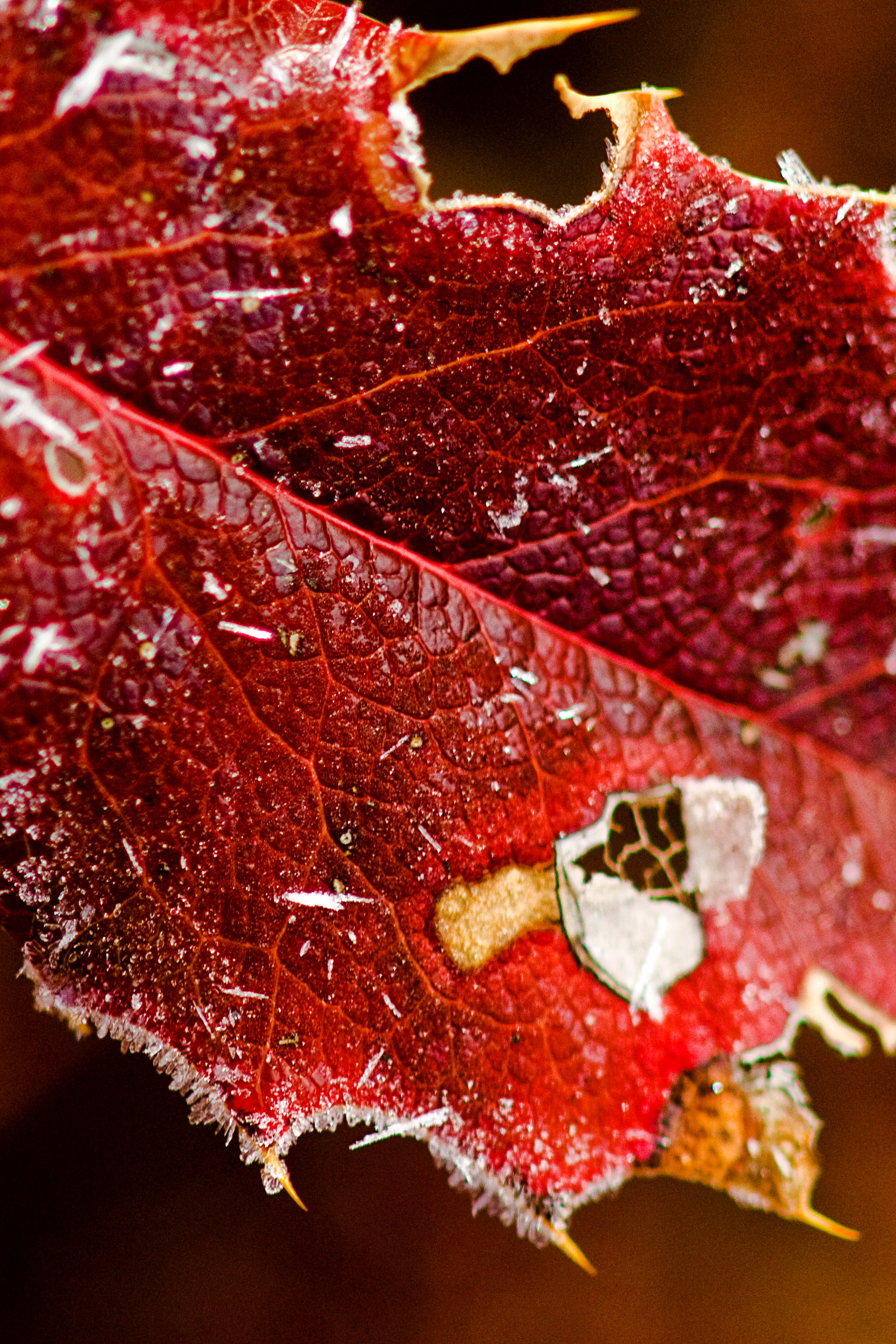
 Although I initially began with landscapes, it was the intimate snow covered vegetation that demanded my photographer’s attention and having a telephoto lens designed for very close photography helped with that. Put a wide angle lens on a camera and we tend to miss what is happening up close, but a telephoto narrows our view and the 200mmm macro kept me looking closer and closer as I isolated parts of plants or drops of water on a wire fence.

 I wandered around for quite a while and took lots of pictures as the light changed. But, when I got back and loaded the image files into my computer I quickly realized those I liked best were from my wife’s garden, but I had enjoyed the long walk in the deep snow anyway. It’s always fun taking pictures even if all you do is delete them in the end.

 I know that snowy overcast days, or cold foggy mornings, like we have had recently put many photographers off going out and taking pictures, and they wait for the sun thinking there can’t possibly be anything worth photographing in flat light. Obviously, I don’t agree.

My wife reminded me about a lecture we once attended given by internationally renowned Canadian photographer Sherman Hines. Hines said, “ I don’t force myself on the environment, I let it manipulate me. There’s no confrontation with nature because I give in to it. I let myself be seduced completely.”

 www.enmanscamera.com

 I am embarrassed to write that I did not fill my obligation with regards to a previous Versatile Blogger nomination. I do have lots of excuses, but I hope readers accept my apology.

 I have again been nominated and will begin with thanks for the nomination by  compellingphotography.wordpress.com

 I understand that I now should make 10 nominations, so here are bloggers I have began to read and enjoy –  the following are my nominations:

RL Photography                                    rebeccaplotnick.wordpress.com

Pilot-Light                                             photoammon.wordpress.com

Shutter bug                                            travellingartist.wordpress.com

Clumsily Kathy                             clumsilykathy.wordpress.com

I Go My Way                                 igomy.wordpress.com/about/         

Indian Wedding Photographer       indianweddingphotographylosangeles.blogspot.com/  

Claire Atkinson                             clairejatkinson.wordpress.com

Mike Moruzi                                  insearchofstyle.wordpress.com/

Tim Cash                                       oregonfilmmaker.wordpress.com

Sheila                                             shecall.wordpress.com/


I also read that being nominated I must say seven things about myself……..Hmmm….Ok:

 1. I have been an active photographer since the 1970’s.

2. I taught college photography credit courses for about 20 years.

3. Writing isn’t so much a struggle – the struggle is choosing and placing the words in a   coherent fashion.

4. I am one of those that having learned photography using film – will never ever return to using it.

5. I earn my living photographing people. However, in spite of being very good making pictures of people, given the choice, I would photograph plants and buildings.

6. I have a small shop that on most Thursdays is filled with other photographers drinking coffee and talking photography. I don’t get much done on Thursdays.

7. My wife says I pay rent on my small shop so I can have a place to talk to other photographers.


Photography on a Frosty Morning

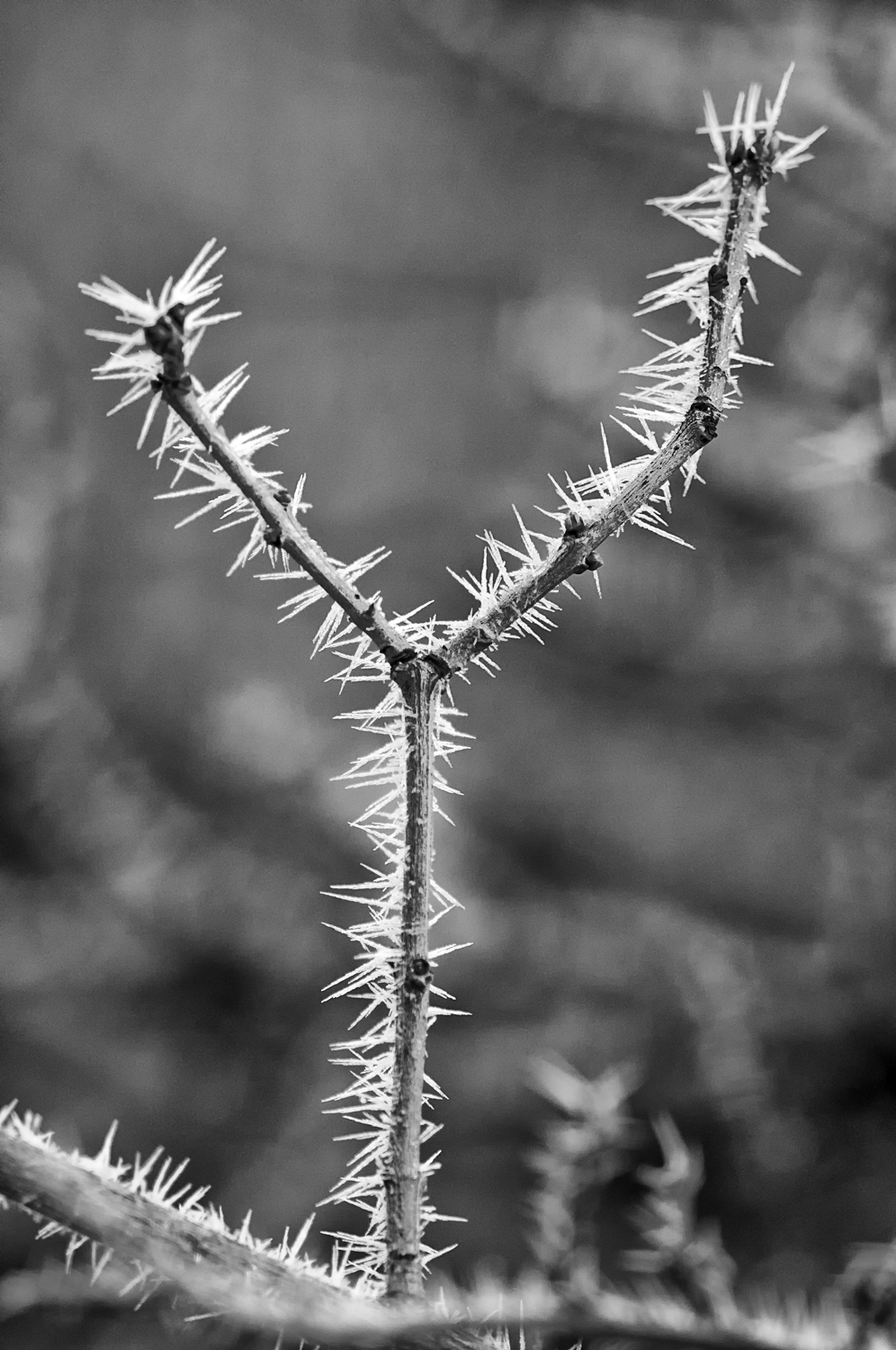
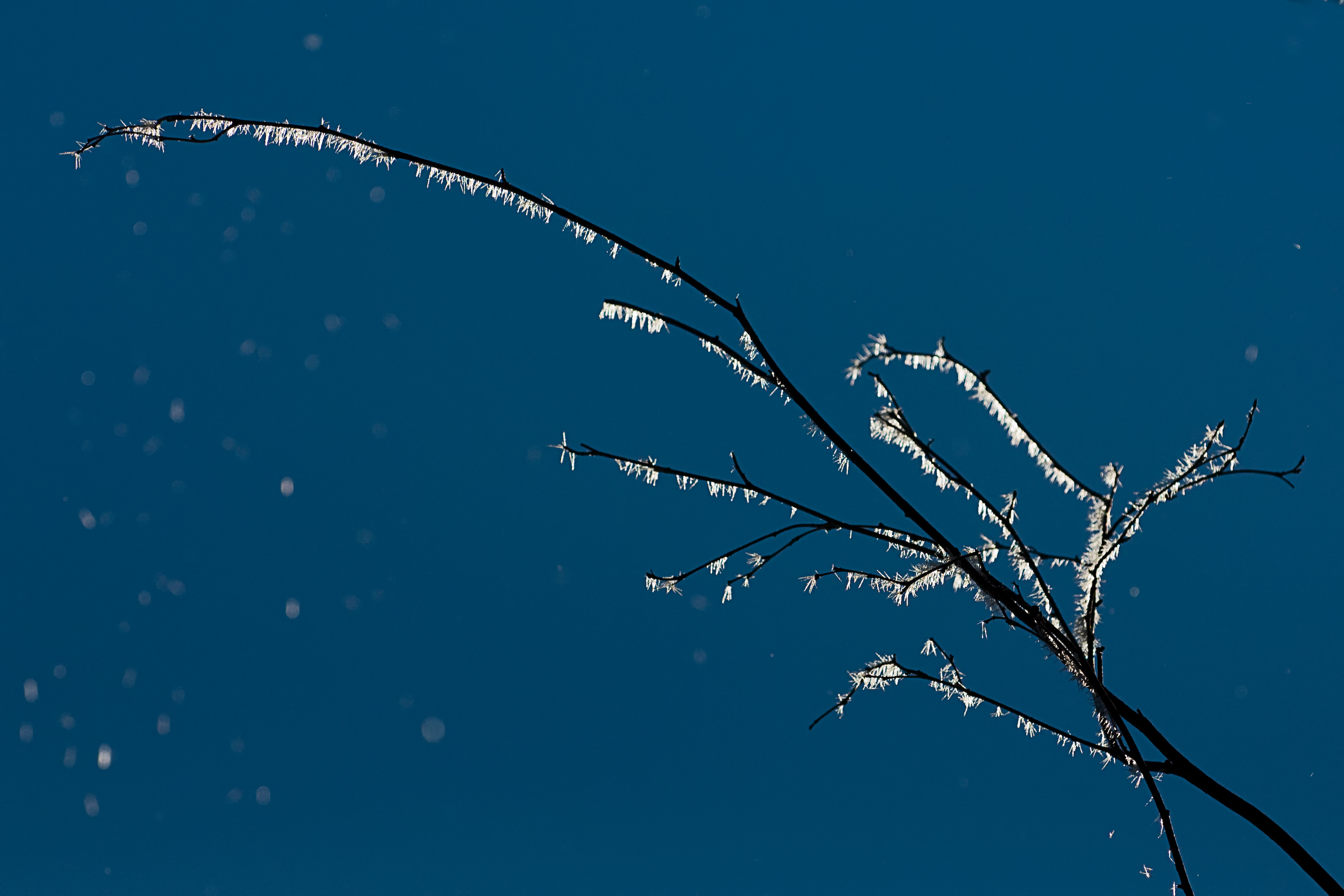
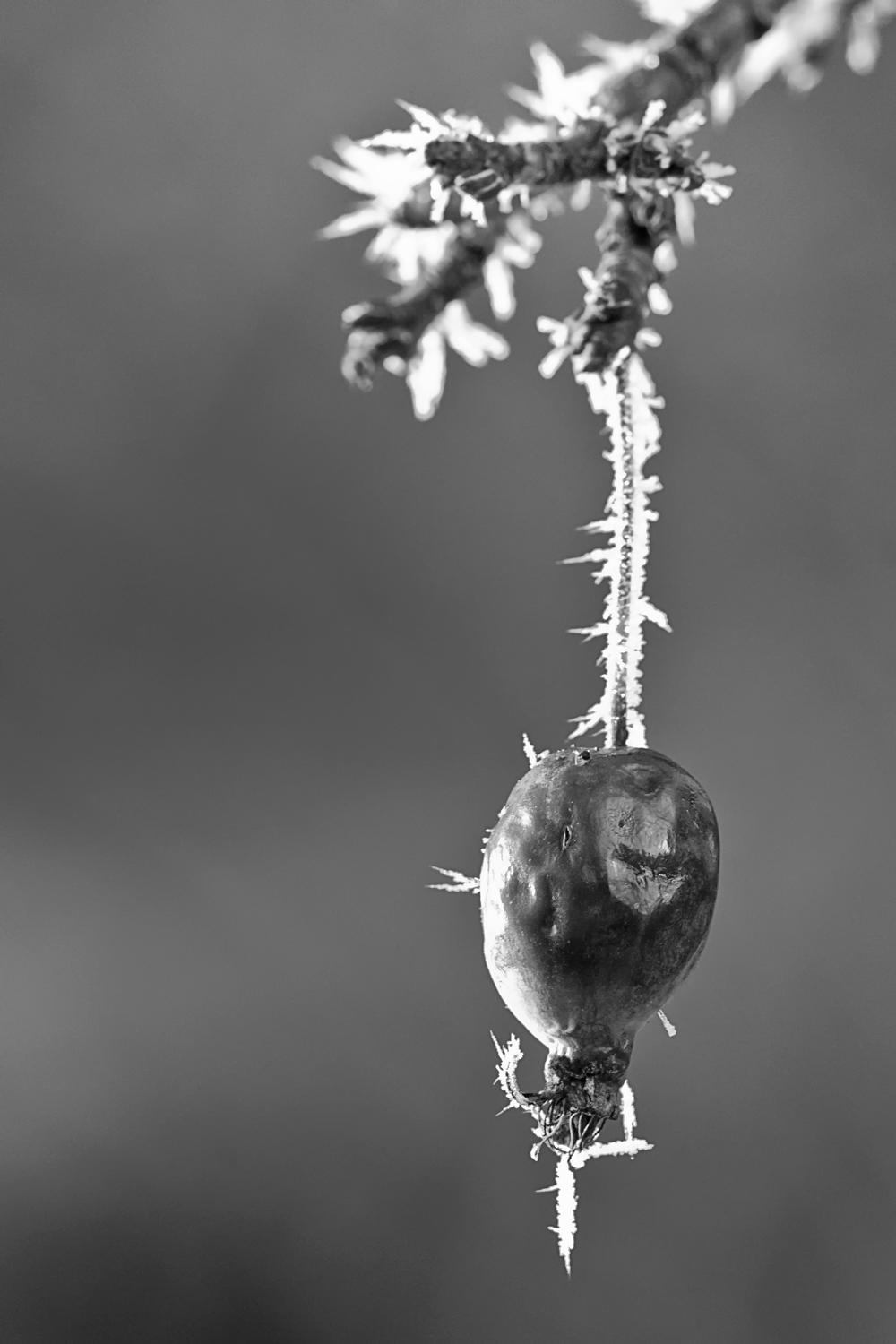
 Daybreak was foggy within a white, crystallized wonderland of hoarfrost-decorated trees and vegetation.  That scene is what I have been waking up to every day this past week. The damp cold has been bothersome, but what photographer could pass up such a creative opportunity to wander through frosty woods and fields trying out different lenses and locations. I like the search and the discovery.

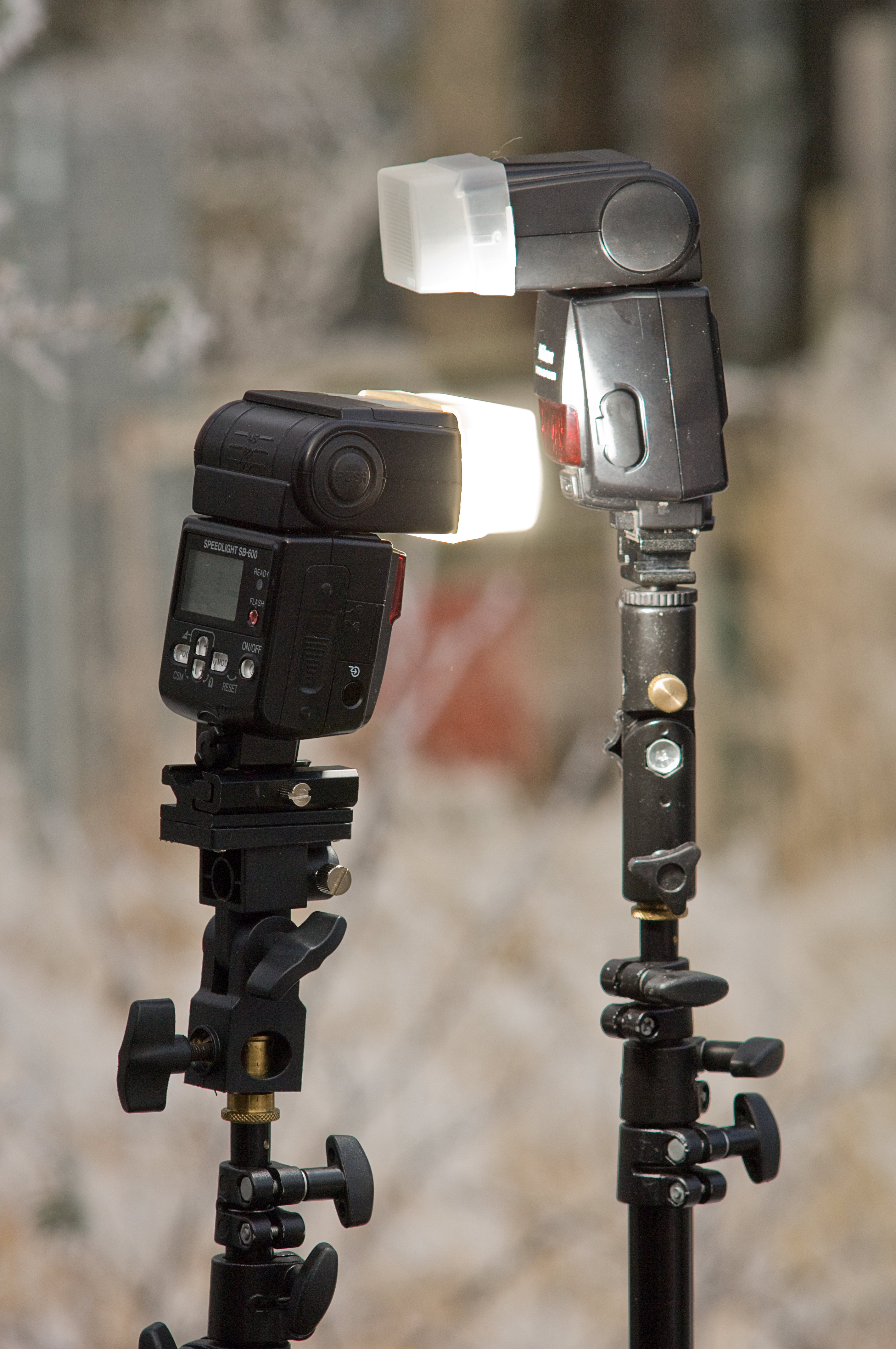
This morning I talked my wife, Linda, into venturing out into the cold to photograph the hoarfrost in her garden. For that we each mounted macro lenses on our cameras and I included a flash mounted on a light stand for both of us. There was a time when we would have been burdened with wires running from the flash to camera, but those days have passed now that wireless flash technology has become the standard.

The morning was overcast and foggy, so the addition of flash was a must in the dim light.  I have a ring flash that I like to use when I photograph plants, but the white crystalline hoarfrost would have been easily over exposed with the direct light from a flash mounted around my lens and I wanted to preserve as much of the delicate details as possible. All we had to do was position our flashes for the best light angle.

Our cameras allowed us to sync the shutterspeed above 1/250th of a second. Many modern cameras have a feature in their menus called “Hi-Sync” or something close to it and I recommend readers check their manuals on how to select and use a high flash synchronizing speed so they won’t be limited to 1/250th of a second shutterspeed.

Handholding at 1/500th of a second (or greater) reduces camera shake and with the addition of flash it is easy to stop any plant movement. Whenever I use a flash outside I like to reduce the ambient light by a stop or two so that if I didn’t use a flash the scene and subject would have been under exposed, consequently, I add the flash to illuminate the main subject, and those elements that the flash doesn’t affect are under exposed, and that flash is off camera sending light from the side or the rear, not limiting us to the on camera flash directly in front of the subject, or forcing us to position ourselves dependent on the sun.

We had a lazy morning and got out late, so although we both prefer to use tripods for close-up photography, we needed to working fast as the temperature rose. We could hear and see the crystals falling with the morning breeze. I suppose if we had a warm outside couch and been bundled up, just sitting on the porch would have been nice. Nevertheless, we got right into photographing our frosty subjects only stopping when we had to reposition our flash.

I approach and light a plant the same way I would a person. I begin by checking the exposure with my camera meter. I always use manual mode so in today’s foggy low light and because I was using hi-sync I could keep my shutterspeed at 1/650th and sometimes higher. Next I chose the best angle of view for my subject, and as always pay attention to what’s in the background. Lastly, I move the light around making exposures until I am satisfied with the highlights and shadows on my subject just as I would if I were doing portraiture of an individual.

I like foggy, frosty mornings and the last few days have been a great time to wander around with my camera. Soon everything is going to change. The frosty vegetation will be replaced with green buds and the cold, foggy, overcast days will be filled with sunny days and blue sky. Yes, I am looking forward to that, but for now winter is a creative challenge and I wouldn’t change it.

www.enmanscamera.com

And thanks to 96arley (www.shootabout.com) for the nomination.


Talking about cameras

I am still a bit surprised when people inform me they have decided to keep using film cameras in this day and age of high-quality digital camera image output, and that is just what I was told by a couple last week.  Of course, my response was that they should use whatever makes them comfortable. 

 I find that many photographers using film want to offer a rationale for using film and make statements like “this camera has always taken very good pictures”. I suppose that’s a rational statement, however, but the difference between digital and film is like driving an old 1970 Ford sedan and the newest Ford hybrid model across Canada.  There is a lot more performance, comfort and options available for the operator of the newer model so that the experience can be more pleasurable and certainly more efficient.

 This couple were so emphatic about how great their old film cameras produced pictures that I assumed they do their own darkroom work, but they take their film into a lab that processes it, then scans it to a computer, then with predetermined settings the computer makes the desired print sizes. Hmm, not much photographer input there and most of the process seems to be digital technology. Oh well, at least they are taking pictures.

 I do believe that digital camera users become better photographers faster because of the instant reinforcement of their camera’s LCD, then again because it is so easy and quick to check images on a computer display.  Last Thursday my shop was filled with people discussing equipment. I have to mention that just before I talked to the film camera couple, I had been discussing digital cameras, but the question was “ What’s the best digital SLR camera, what do you like?”  Well, I like them all.  I haven’t had the chance to try every new camera out, but from my reading I think Nikon, Canon, and Pentax all have excellent products.

 My advice was they should first decide what they had available to spend, and then decide on how they like to shoot: sports, landscapes, family and so on. Of course any camera will do everything, but some are better for sports and some won’t hold up to the elements if packed on your horse or bounced around getting cold on the back of a snowmobile. My suggestion was before they choose to do some research before they buy.

 But film? Well if one is into “retro” or likes to experiment with technology from the past picking up an old film camera and the equipment for processing and printing doesn’t cost much and might be lots of fun.  However, for those like me that are dedicated to producing quality photography I would, of course choose a DSLR (digital single lens reflex) camera.

 
www.enmanscamera.com


Class was about Demystifying the digital camera.

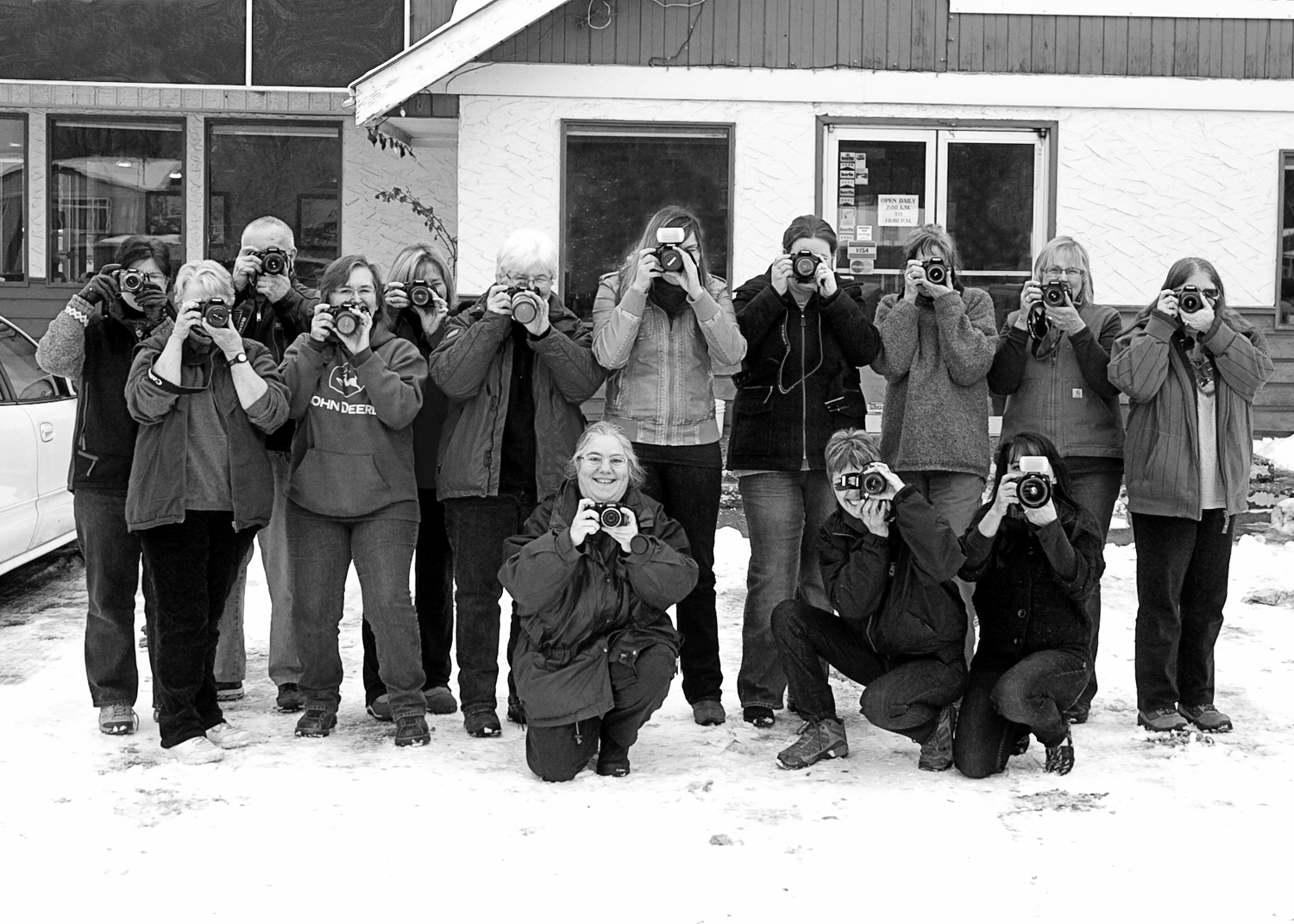
 The scenic hour-long drive from Kamloops to Barriere always has me wanting to pull off the road and take pictures, but for the two previous Sunday mornings stopping would have made me late for the two-session class I was leading and 18 enthusiastic photographers who would have been left wondering.  I remembered being told, “Once photography enters your bloodstream, it is like a disease”, and I am sure they would have patiently smiled if I loaded my morning’s images into the projector and said, “I couldn’t help my self”, after all they had “photography in their bloodstream” too.

The class wasn’t so much about photography as it was about “demystifying” the digital camera. My goal for the two-day session was to help participants become comfortable and familiar with their cameras. I wanted them not to be afraid to push all the buttons, scroll through menus and change default settings as they explored each function.

We discussed controlling exposure, understanding the histogram, and manual metering.  Then we talked about the relationship between the aperture and the shutter to better understand depth of field. For those interested in scenic photography I included a section on photographic composition, and finally there was time set aside to consider selecting lenses, tripods and presenting information about other accessories that enhance the photographic experience.

I know that some felt overwhelmed as we examined the myriad of features available on their modern cameras. As camera technology advances and more options are added new users will certainly feel intimidated, but as they use their cameras and become more familiar with the possibilities they realize the added options give more and more control over picture making.

Interactive lecture classes like this one are more demanding than the usual photography classes that assume participants already know how their camera functions. In my opinion that assumption often has participants going home without understanding camera basics, and although they can read their notes on panorama, portraiture and scenic photography most revert to using the camera in it’s point and shoot Program modes. What a waste!

I always enjoy these types of sessions where eager learners ask lots of questions and are demanding of information that will help them to pursue their particular interest in photography and I get to really delve into the mechanics of this amazing pastime. To me there is more than just aiming the camera at some subject, and, depending on technology, to magically transform that passive action into a photograph.  And that was what I wanted the two sessions to be about.

In this study group I was fortunate enough to have active photographers Jill Hayward and Shelly Lampreau sitting in. They were not only were responsible for organizing and advertising the two-day class, but jumped to help when I wasn’t able to get to someone right away.  It’s people like Hayward and Lampreau that make an interactive workshop all the more valuable to learners and I extend my appreciation to them.

The class was filled with serious people that really wanted to learn about photography. I had a great time and I thank everyone for inviting me, and there is a plan to get together again in the spring and do a day of scenic photography in Wells Gray Park.

During the class there was an announcement that Barriere photographers will shortly be starting their own photography club.  Those interested can now connect with others on the Barriere photography club’s Facebook page.

www.enmanscamera.com

This photographer’s thoughts on Composition

Much of the time the photographers I meet and talk to really have only one interest in photography and that is to discuss equipment.  Nowadays, especially, they are very excited about the newest products.  Photographers should be building a selection of equipment that will allow them to do photography the way they like and that works effectively for the subject they want to photograph.

As much as I do like talking about cameras, lenses, and other assorted equipment, what I really like to talk about is photographs.  So, last week, when a photographer stopped by with some nice enlargements, I was pleased to say the least.  We talked about how successful her photographs were at capturing the viewer’s attention, where the photos were taken, her objectives for each, the colors, and why she cropped them the way she had.  They were good photographs and looking at good photos sometimes lets you know a bit about the person who took them.  We started talking about photographic composition; not so much of the photos we were looking at, but just a general discussion.  So today I thought I’d put some thoughts down that people could think about when composing a photograph.

A person painting or drawing can truly compose an image; they have total freedom to place, arrange and alter the appearance of visual elements.  Photographers are limited by the actual physical appearance of the subject being photographed and depend on using camera position, point of view or the perspective created by different focal lengths of their lenses.  With photography we try to produce exciting, well balanced images, depending on the subject and how we want to communicate with those elements in the photograph.

What is your photograph about?  Instead of shooting right away, stop to decide which part of the scene you really want to show. Let the content determine the size and importance of the objects.   Try what I call the apple technique:  You are driving along and see an inspiring scene. Don’t just point your camera out the car window!

1. Stop the car.

2. Get out.

3. Leave the camera in your bag.

4. Get an apple and eat it as you are looking at that inspiring scene.   Think about what you like about it. Make some choices. What would you like to say to the viewer?

5. Then get your camera and make the picture.

As you are making your basic choices and deciding on what visual elements are important think about what the famous War photographer Robert Capra, known for the intensity and immediacy of his images, said, “If your pictures aren’t good enough, you aren’t close enough.”  Getting closer eliminates distracting objects and simplifies the contents of a picture. It reduces busy backgrounds and focuses attention to the main subject or center of interest.

Another consideration is whether to photograph horizontal or vertical.  I listened to a discussion by successful magazine photographer, Scott Bourne.  He asked the question, “When do you take the horizontal?”  His answer was, “After you take the vertical.”

A final thought is to think about important visual elements and how best to arrange them in your photograph. The Rule of Thirds – Draw imaginary lines dividing the picture area into thirds horizontally, than vertically. Important subject areas should fall on the intersections of the lines.  For example, a photograph of an old barn in a field; move your viewfinder around to see how it would look placed in the upper right intersection the each other after that. If you take the time to decide and compose, your photographs will be much more successful.

www.enmanscamera.com

my fan page

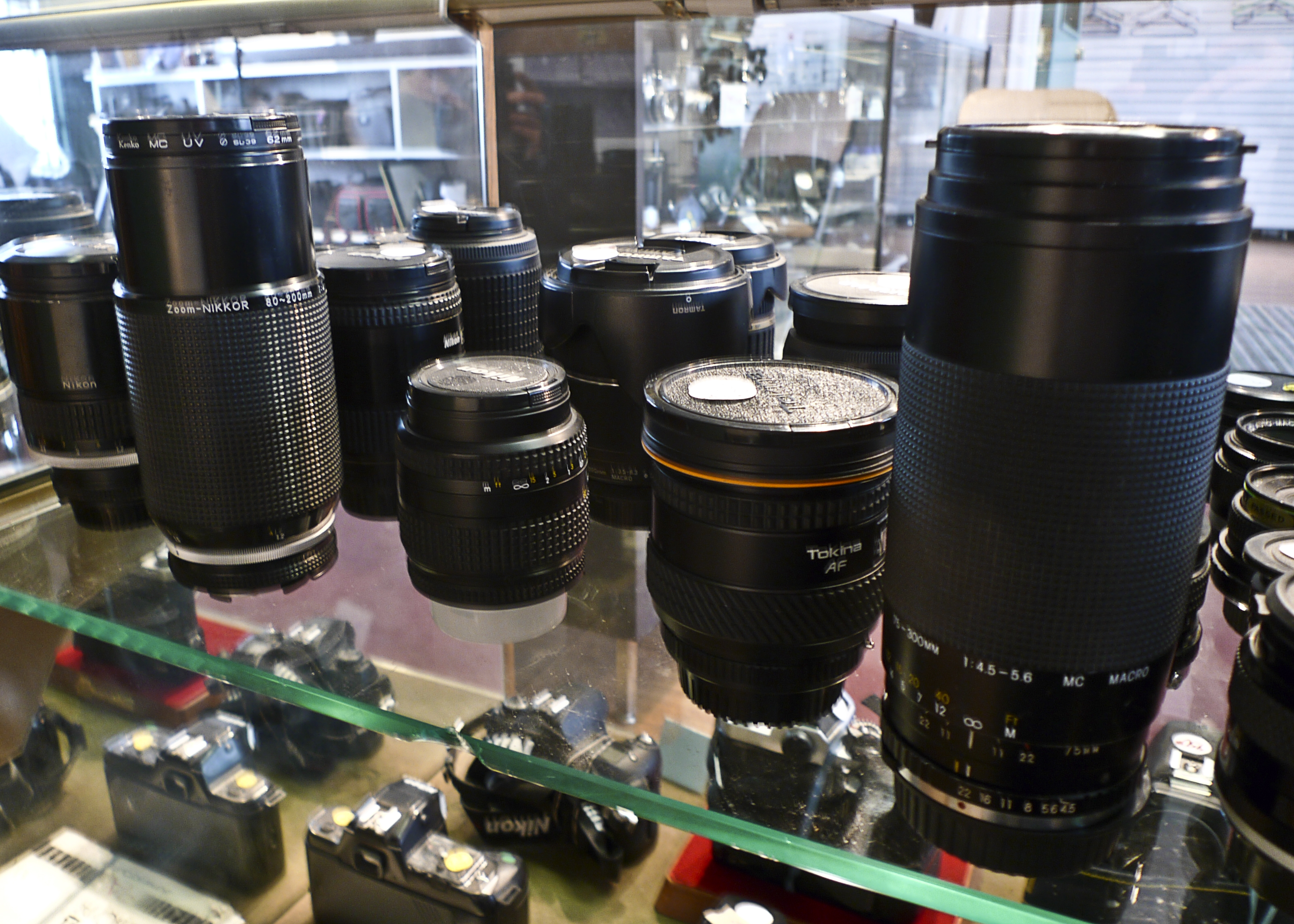
Do I Need Another Lens?

In my experience, any image can be altered (sometimes dramatically) when one changes lenses.  A subject can be isolated and the perspective in front of, and behind, the subject flattened with a telephoto lens; while landscapes in many cases look better with a wide-angle lens as the field of focus increases and the view around the subject widens.

I select my lenses depending on what I want to photograph and say about the subject. Because control over my image is important to me I question two items.  What am I photographing? And what result do I want?

For close up photography, one will be more successful with a macro lens that is designed to move in close to a subject than a mid range zoom that only focuses ‘sort of’ close, but is really designed for distance work.  For those wide expanse landscapes in the interior of British Columbia one may want a lens with wide-angle capabilities. For example, I might select my 18-70mm or 16-85mm as I search for a focal length that helps me include important features.

Last week I discussed lenses with a photographer who wants to get serious about photographing the abundance of wildlife here in the interior of British Columbia.  I suggested starting with a 70-300mm and then a longer telephoto in the future. Those lenses have a narrow angle of view, but plenty of magnification for wildlife photography.  Most of the 70-300mm lenses available today are lightweight and easily hand held. One can dig into their piggy bank and purchase some of the super telephotos like a 500 or 600mm, but until then moderately priced lenses like the 70-300mm should do.

There are interesting lenses like the 18-200mm that are just great. These multifocal length lenses are lightweight, and excellent for vacations or just walking around.   However, for serious enthusiasts there are wide aperture lenses with maximum apertures like f/2.8 that allow much more light in than lenses with f/3.5 or f/4 that are most common. These large aperture lenses give the user lots of light gathering capability and the ability to use higher shutter speeds for reducing camera shake, and help stop fast moving subjects.

To explain that, there is an optimum amount of light that reaches the camera’s sensor for a correct exposure. When the aperture is closed down it lets in less light and one must slow the shutter speed.  With large aperture lenses the shutter opening can be increased and let in a lot more light, therefore one has the ability to increase the shutter speed and still get a proper exposure.

All this also affects “depth of field”.  Depth of field is best defined as that area around the main subject, in front of and behind, that is acceptably sharp.  Photographers like to blur non-essential elements in the background by reducing the depth of field, and do that by increasing the size of the lens aperture.  In addition, letting in more light makes shooting in low light conditions less difficult.

So we get back to my earlier question:  Do I need another lens?  Even though I like the wide range focal length lenses like the 18-200mm for everyday use there are lots of other choices that will better help me visually say what I want when I make a picture.  A brief summary might be as follows; a macro for close-ups, a wide angle for landscapes, a telephoto for wildlife and, of course, some lenses with wide aperture for low light and for more control of depth of field.

Each year manufacturers introduce more lenses with different technology, which improves imaging capabilities, and naturally, increases the price.  Now you understand why one of the favourite sayings in photography is “it’s all about the glass” as I’ve explained to readers in this short discussion.  So, go ahead, check out the many offerings and ask yourself “Do I need another lens?”.

www.enmanscamera.com


Considering a 4×5 View Camera?

Photographers are always looking for the perfect camera, even in these days of high megapixel, large sensor, programmable cameras.  The selection for many has become more than just a choice between manufacturer loyalties, as it extends to technical demands, and practicality when approaching a particular subject.

There is no doubt in my mind that some of the finest landscape and scenic photographs have been produced, and continue to be made, with the type of camera that is a design that has been with us for over a hundred years, the “view” camera.  The great nature photographers Elliot Porter, Ansel Adams, Imogene Cunningham, and Brett Weston used them, and many publications still prefer the quality of 4×5 inch, or larger, sheet film (some readers may never have even seen film).

A local photographer, Peter, stopped by the other day to talk about a 4X5 Burke and James view camera he had purchased. Photographers can easily obtain moderately priced, used, 4×5 inch format film camera by manufacturers like Burke and James, Graphic, Sinar, Linhof, Calumet and many more, that, depending on the use, are similar in application to DSLR (digital single lens reflex) cameras in that there is an extensive array of lenses available, but unlike DSLR’s there is not a limiting lens mount.  One must merely find a lens board that has a hole in it the size of the lens you want to use and voila, the camera is ready to go.

For those unaware of just what a view camera is I’ll describe it as an accordion looking contraption, consisting of a flexible light-tight bellows with a focusing screen and film holder on one end, and a lens board and lens on the other. This assembly is usually mounted on a rail or platform and uses a rack and pinion system to move the bellows back and forth for focusing.  The main advantage of view cameras is the technical control that one can get because both the front and back have the means available that allows for up, down, and lateral movement. At one time some cameras like his were called “press” cameras because they were the camera of preference for news photographers (seen regularly in old movies), so depending on what the source is the camera might be called a press, field, or large format view camera.

I know that may be confusing to those that have only used DSLR type cameras, but volumes have been written about using view cameras and if you are interested information is readily available and I suggest starting with http://www.viewcamera.com.

Simply put:  Consider being able to move a digital camera sensor and lens at different angles. Light certainly doesn’t go around corners, but with a view camera one can change perspective, control distortion, and sharpen an area of focus just by aligning film, lens and subject.

For example, walk up close to a tall building, aim the camera upwards, and release the shutter.  The resulting image will show the building having a wider bottom and narrower top. With a view camera one can adjust the film plane and lens plane positions parallel with the building’s wall, and of course this would be easy to accomplish because between the film and the lens there is a bellows that bends easily. This time the resulting image would not be wide at the bottom and narrow at the top, but whatever, the photographer set it to.

It is this control, and not so much the large negative, that draws serious photographers to view camera technology. However, the large 4×5 inch negative does produce impressive results. Although one would traditionally need a photography darkroom with enlarger, chemicals and trays for processing and printing, many modern photographers now use scanners.  The film still must be processed, but once done just scan that beautiful, large sheet of film into a computer and then proceed as usual into PhotoShop for image enhancing and printing.

Peter plans on taking his 4×5 on some hikes in and around the British Columbia interior. That’s a neat thing about these foldable cameras; they collapse nicely into a portable box. With a lightweight tripod, a few sheet film holders, and a camera that is easily stuffed into a small backpack, he’ll be on his way.  The hills are covered with snow, but if the light is good I know he’ll have a great time there and I look forward to seeing his resulting pictures.

www.enmanscamera.com


This photographer isn’t sure about an advertisement television.

Currently, there is an advertisement being shown on television with the goal of convincing new camera owners to purchase more another lens for their new DSLR camera.   The ad begins with a picture of little girl in a playground.  Viewers see the child in the foreground with lots of stuff behind her. Then as viewers are told to purchase a better lens the picture changes to a sharp portrait of the child with a soft out-of-focus background. The subject much remains the same, but, because the clutter in the background is diminished, now the portrait is more pleasing.

Viewers are given the impression that there is a special type of lens made specifically for portrait photography and to buy it if we want good portraits. I agree that buying the best quality lenses will give photographers the highest quality image, however, the difference between the two pictures viewers are shown doesn’t really have anything to do with good quality lenses.  Any photographer can easily create the effect of a blurry background by using the same lens (or any lens) by choosing a wider aperture to reduce the depth of field.

Depth of field is defined as the area around the main subject, in front of, and behind, that is in acceptably sharp focus. The smaller the aperture the greater the field of focus is, and the larger the aperture the less the field of focus, thus by focusing on the subject and reducing the field of focus, much of the area in front of, and behind, the subject looses sharpness.

In my opinion learning to use a camera effectively is more important than falling for the hype put forward in ads like that. All photographers should learn about depth of field, composition, and metering. They should have an understanding of perspective, and why at times subjects in the foreground seem uncomfortably larger than those standing only a few feet behind. Fast action is easily controlled by increasing the shutterspeed, and if the elements in the picture aren’t bright enough, by increasing the camera’s ISO.  Sharpening the landscape on a bright sunny day only takes the additions of a lens hood to reduce lens flare; and, as always, in my opinion, the best scenics are those where the photographer uses a good sturdy tripod.

I advise saving some money and purchasing a book on portraiture, or, at least basic photography instead, and there are lots of online forums where photographers show, discuss, and exchange advice on their pictures. Or, readers could take a class.

The voice in the advertisement advises that photographers can change from a good shot to an amazing shot if a better lens was purchased. I regularly talk to photographers that believe the only way to make better pictures is to buy a new camera, and I expect because of that advertisement they will go out and purchase new lenses in the misguided belief that they will suddenly become better at photography.

What I actually like about the ad, in spite of the not so truthful claim that a good portrait is only accomplished when one buys another lens, is that it gets photographers thinking about adding to their collection of lenses. All camera manufacturers (just like auto manufacturers) have various levels of quality and one type of lens isn’t necessarily the best for all subjects.  As long as I have been involved with photography the catch phrase “it’s all in the glass” has been around. And I regularly tell those new to photography that they should be changing lenses before changing cameras. Nevertheless, I also tell them that they should know what they expect from a lens before purchasing it; and after researching it to match their expectations with what they can afford to acquire.  There isn’t necessarily any lens that might be called a portrait lens and the selection of which lens to use is really up to the photographer.  I think an in depth discussion of lenses is best left to another time.

www.enmanscamera.com

How far we have come since photographer Margaret Bourke-White

The other night I was rummaging through my collection of old photo magazines and I came across the 1964 issue of “US Camera”. As I casually thumbed through it amused by the ads on equipment and how-to tutorials on printmaking I came across a very interesting story by the famous photographer Margaret Bourke-White about her beginnings as a photographer in the 1920’s. 

The short story was an excerpt from her book “Portrait of Myself”. Specifically, I enjoyed the part about her trials and successes photographing the Otis Steel Mill in Cleveland. She talked about how hard it was to capture the interior of the mill that to the eye was more than illuminated by the molten metal, but was extremely underexposed and unrecognizable on her film. In those days film and photographic paper had little latitude and the film emulsions were very slow, probably 50 ISO at most. She further talked about how excited she was when she was able to borrow a “fast” f/3.5 lens. And even then her exposures were inconsistent, sometimes over exposed, sometimes under exposed. Her success finally came first by using big magnesium flares for illumination, then with new photographic print technology for that time that contained very heavy deposits of silver therefore giving it a “long gray scale”. Her amazing photographs in 1928 were probably the first pictures of those kind ever made.

All this got me thinking about how far we have come since those days of heavy view cameras accompanied by large, unwieldy tripods, Sheet film was barely light sensitive and had to be carried in special holders, and lenses normally had their widest apertures at f/6 and were thought to be wide opening if they had apertures of f/3.5. The lighting equipment was extremely dangerous, inconsistent and consisted of either magnesium flairs or flash powder.  And after all that a photographer needed to have extra processing skills when using crude printmaking equipment that more than likely was a combination of home made enlargers and shelves of chemistry to mix different developers.

Today depending on how large a print we want to make we can either select a camera with a large sensor or upsize our image in programs like PhotoShop and Genuine Fractals. Tripods have become lightweight, durable and strong. We select the best tripod head for the camera and lens combination we are using and install that.  Many of the super telephoto lenses have apertures of f/6, but lenses at 200mm or shorter with apertures of f/2.8 are common. And remember using that 200mm on a digital camera may give a crop that is effectively 300mm.  Lighting equipment has  become amazing and we have just as much choice with electronic flash as we have with digital cameras, maybe more. I am amazed at the process Bourke-White had to go through to get a clear, well-exposed image in those steel mills. 

As I read that article I thought about how far we have come since those days and how easily it would be to photograph those scenes with today’s equipment.

We could first select a camera that allowed a high ISO and a lens with an f/2.8 aperture. Wait, many of us have f/2 and f/1.4 lenses, so they would allow even more light gain.  Heavy cameras and tripods are no longer an issue. Together the average DSLR (digital single lens reflex) camera with a “heavy” f/2 lens and tripod probably weighs less than four pounds. Lastly there is lighting that is now easier with light meters and digital cameras. Some photographers may use powerful studio equipment while others could make do with several small flashes positioned around an interior using slaves to fire them off.

This is a very exciting time for photographers. Photography has become so accessible and the advancements in technology can free beginners from the tedious mathematics, expensive film testing, and dark chemical filled rooms. Yes, I think this is a very exciting time for photographers.

 Margaret Bourke-White spent close to 30 years as a staff photographer for Life magazine and had her photography published in numerous books and magazines. If interested check her out, there have been several books written about her and much about her is easily accessed on the internet.

http://www.enmanscamera.com 


Photographers Resolutions (or goals) for a New Year

For me New Year’s resolutions aren’t so much resolutions for the next year, made on January 1st, but things I’ve been thinking about for some time. These could be more accurately called photography goals for 2012.  Here are some of my goals as well as my thoughts for each for this year.  There are not very many goals, but too many doesn’t seem to work for me.

1.     Plan a trip or photographer’s vacation this year.  I want my time to be about photography, not one of those trips where I bring along a camera and hope for a snap shot or two, but a real photographer’s excursion that makes me use the equipment, knowledge, and talent I have. 

2.     I want to make the effort to learn new techniques by taking a class, or at least buying some books or CDs written by accomplished photographic writers. Educating oneself is always fun.

3.     I will continue my ongoing quest to organize my old prints and slides.  I want to place as many as possible on archival CDs. There are many ways to copy photographs and slides. For prints I use my camera, a tripod, and a level, to make a digital photograph.  For slides a scanner works best. My scanner, although capable of producing high-resolution scans only produces one film image at a time and is slow.  There are scanners that will do multiple slides and several formats at a time and the price for them is under $1000. Maybe this is my year for a new purchase.

4.     Like many long time photographers, I have old film camera equipment whose time of service has long past. The pictures they produced were great, but modern camera technology has progressed far beyond those old film cameras, and individuals like me, who have embraced the high quality digital world, will never return to film.  Fortunately, there are high school classes that are still are using chemical darkrooms and black and white film that has students looking for inexpensive old manual cameras and that is a much better place than gathering dust in my basement.

5.     I am planning to do a systematic photographic inventory of our household goods.  I have to admit I am as lax as anyone when it came to a photographic home inventory. Then I was faced a couple of summers ago with a forest fire approaching my door and needed to do it in a hurry.  I have that quick and haphazard photo-inventory, but now it’s time to do it right. It’s not very hard if one does it one room at a time, and I think worth the effort.

6.     For me, my store is a great place to interact with others interested in photography, and I have a few chairs available, and it is just fun to just talk about photography. My advice for those that don’t have my convenience, is make the time to get together with other photographers with no other goal then to talk about or do photography, and if you already have been occasionally participating in a club how about searching out photographers specifically interested in the kind of subjects you like to photograph, for example, collaborate with like minded enthusiasts in a macro, scenic or birding group and start planning an outing or just get together for refreshments and talk at some local spot.

7.  I could add a lens and make it one of my goals for this year, but because of my shop camera equipment just happens; and because I prefer to purchase used equipment, I am always on the look out for bargains that fit the kind of photography I do. So my goal this year is to sell something that I am not using and buy something (at a good price) that I will use. 

I am sure readers easily can make their own photography resolutions (or goals) for the year we have just begun. What could they be? I can only imagine.

www.enmanscamera.com